Migrant tales
Menu
  • #MakeRacismHistory “In Your Eyes”
  • About Migrant Tales
  • It’s all about Human Rights
  • Literary
  • Migrant Tales Media Monitoring
  • NoHateFinland.org
  • Tales from Europe
Menu

Tag: police

Watch out for the Finnish police “pizza squad!”

Posted on October 13, 2015 by Migrant Tales

Two policewomen who are looking for tax evaders have their eyes set on pizzerias, which are, surprise, surprise, mostly owned by migrants. If this isn’t an example of ethnic profiling then what is? 

But where do you complain?

Thanks to this post on Facebook by the policewomen, the whole suggestion that cheap pizza automatically means tax evasion has become a sad joke on social media, especially for the pizzeria owners who work 12-16 hours a day.

Not only is this a clear example of how ignorant the police service is of migrant entrepreneur but once again shows the ugly side of ethnic profiling.

Imagine the police service asks customers to report to them if they can buy pizza for less than 6 euros!

I wonder if these policewoman have ever gone to the market and asked why frozen pizza costs less than two euros? What about multinational companies like McDonalds that find tax loopholes to stash their money in offshore accounts?

Näyttökuva 2015-10-13 kello 11.27.18

If Lidl sells pizza at 1.39 euros are they evading taxes? Thank you Ossi Mäntyniemi for the heads-up.

Why not write about these companies? Or why not ask what law gives the police the right to determine at what price should pizzas be sold in Finland, according to Taloussanomat.

“It’s not the first time this has happened,” a pizzeria owner, who spoke on condition of anonymity, told Migrant Tales. “The police like health authorities too often target restaurants owned by foreigners.”

Now here’s the million-euro question: To whom are you going to complain if you believe that your restaurant has been ethnically profiled?

Continue reading “Watch out for the Finnish police “pizza squad!””

Defining white Finnish privilege #23: Greater police powers to monitor migrants and minorities

Posted on August 4, 2015 by Migrant Tales

Finnish white privilege, like any majority culture’s privilege, not only permeates in our institutions but marks the pace of how those with no privilege are treated in this society. Granting the police greater monitoring powers [1] to carry out arbitrary checks on migrants, and subsequently on non-white Finns, is a case in point in white Finnish privilege. 

Writes YLE in English:

New legislative changes came into force in May allowing police and border guard officials to perform immigration checks as part of their everyday duties, without any prior suspicion of crime. The wider powers will allow officers to conduct thorough inspections of business premises as part of their work.

The goal of the legal reform is to clarify the jurisdiction of police and border guards. Previously police were only able to investigate business premises for possible immigration offences if they suspected a crime had been committed.

The Council of Europe, and other anti-racism activists in Finland and abroad, have expressed concern about ethnic profiling by the police.

Continue reading “Defining white Finnish privilege #23: Greater police powers to monitor migrants and minorities”

Muslim woman wasn’t admitted to the Finnish police training school because she would refuse to take off her headscarf

Posted on April 3, 2014 by Migrant Tales

A Muslim woman, 38, was not admitted to the police training school because she would not take off her headscarf during working hours, reports YLE in English. The woman was so disappointed with the rejection that she even contemplated leaving Finland.

 Näyttökuva 2014-4-3 kello 20.29.48

Read full story here.

“In the [police] interviewer’s opinion it was not possible to negotiate, and I didn’t get in to the school,” said the Muslim woman. “I have always wanted to join the police and now I’ve been forced to give up on my dream. The scarf is my identity and religion; I cannot give it up during working hours.”

Conservative Christian Democrat Interior Minister Päivi Räsänen, who mixes too often religion with matters of the state, added salt to injury by claiming that the police should “represent official power, not certain religious convictions.”

Räsänen doesn’t believe that the restriction to wear a headscarf has anything to do with religion and our cultural norms.

In neighboring Sweden matters are done differently.

“Scarves, turbans and Jewish kippahs are allowed because the Swedish police want people from different backgrounds to become police,” said Carolina Ekéus of the Swedish police. “In addition, allowing headscarves was seen as an equality measure.”

The point by Ekéus is key: Do people who come from different religions and cultural backgrounds in Finland have equal rights? Is this another example of how we speak of two-way integration but it’s actually ethnocentric one-way adaption?

The headscarf case shows clearly that Finland’s police still believes that it doesn’t have to change and adjust to our ever-growing ethnic and cultural diversity.

Migrant Tales reported recently about a Sikh busman’s struggle right to wear a turban at work and there was a even a case where a Muslim woman was fired on the first day of work for wearing a headscarf.

Finland’s Constitution and non-discrimination act state clearly that a person cannot be discriminated because of his or her background. Such laws have little meaning if a public employer like the police interpret the law to suit themselves.

Moreover, it shows a total disregard for the fact that Finland is today a culturally diverse country. It is a visible thumbs down by the police to this fact.


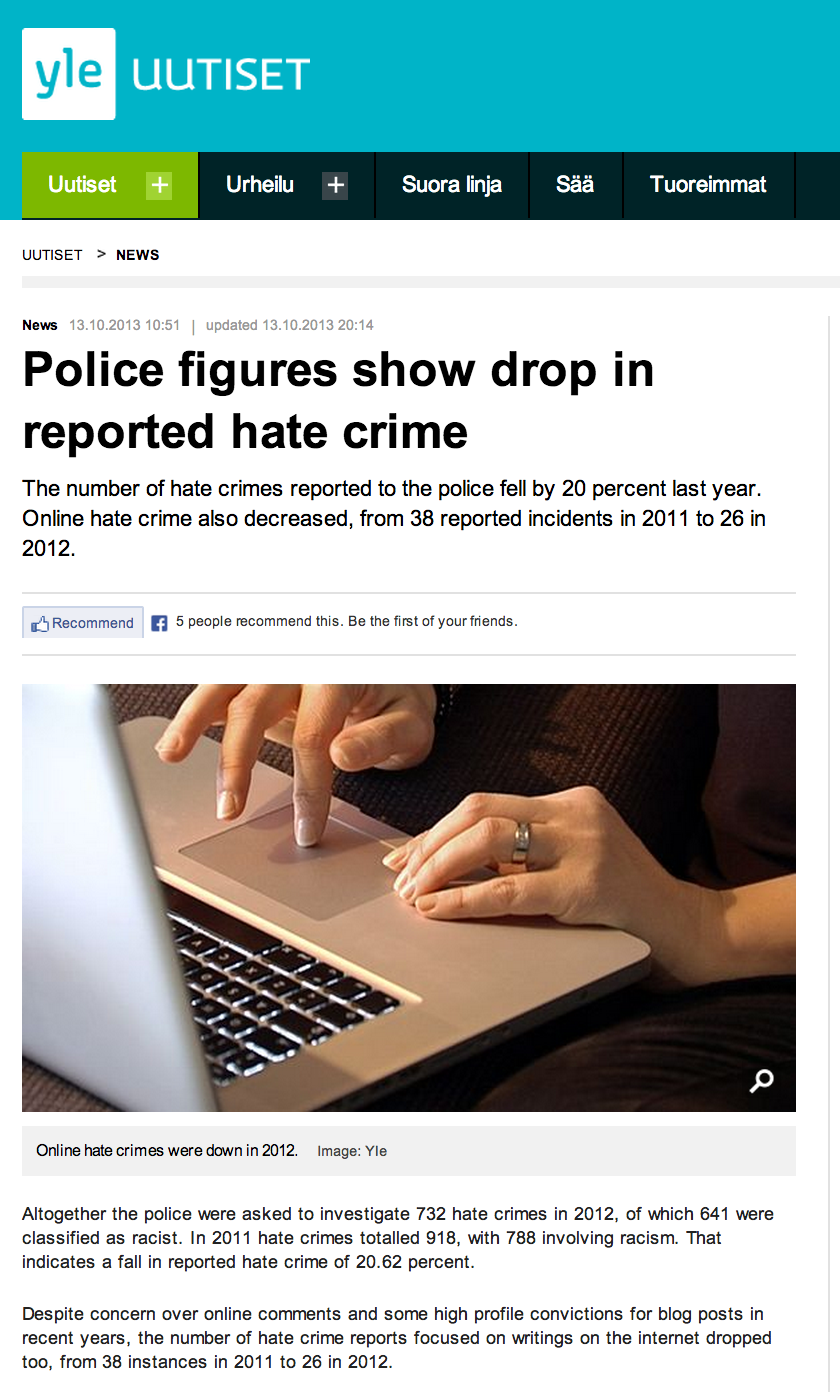
Suspected hate crimes in Finland fall by 20.6% in 2012

Posted on October 13, 2013 by Migrant Tales

Suspected hate crimes in 2012 totaled 732, which is a 20.6% fall from 918 cases in the previous year, according to YLE in English. Of the total hate crimes reported to the police last year, 641 cases were classified as racist. 

Kuvankaappaus 2013-10-13 kello 21.15.38

Read full story here.

According to YLE in English, the most common offense investigated by the police was “inciting ethnic hatred.” 

The majority of the suspects were white Finns, but there were three cases where the suspect belonged to a minority. 

While it is welcome news that hate crimes are on the retreat in Finland, how credible are these figures? Should we accept them at face value or treat them with tweezers? 

Last month, Tarja Mankkinen, internal security secretariat head, said that many racist crimes in Finland go unreported.

As long as Finland gives political space to intolerance in any shape or form, which encourages hate crimes to happen, these types of statistics should be taken with a grain of salt. At the best, the police should encourage immigrants and visible minorities to report hate crimes.

As Migrant Tales has written previously, reporting racist harassment to the police is easier said than done.

Kuvankaappaus 2013-11-7 kello 8.53.04
 The first line reads “racist crimes” (rasistiset rikokset) and the second one “other hate crimes” (muut viharikokset). This table has two discrepancies with earlier figures published by the Police College of Finland. In 2008 the corresponding figure was 859 and in 2011 918. Source: Police College of Finland.

Like in other parts of Europe, a Race Council Cymru study of Wales revealed how racism goes  “underreported,” according to a story published by the BBC,

Factors like language barriers, fear of reprisals and lack of trust in the police are some reasons why racist crimes continue to be underreported in Wales.

The same factors must play a role in Finland as well.

Internal security secretariat head: Many racist crimes go unreported in Finland

Posted on September 1, 2013 by Migrant Tales

Some migrants may not report a racist crime in Finland because of mistrust of the police, poor Finnish-language skills and ignorance of one’s rights, according to Tarja Mankkinen, director of the ministry of the interior’s internal security secretariat. 

The Police College of Finland reported 918 suspected hate crimes in 2011, which is a 7% rise from 860 in the previous year.

For obvious reasons, Perussuomalaiset (PS) chairman Timo Soini is the only politician who has used these statistics to show that hate crime and intolerance aren’t a problem in Finland.

Kuvankaappaus 2013-9-1 kello 13.54.56

Read full story (in Finnish) here.

Without providing any sources to back her claim and that YLE doesn’t cite any migrant or visible minority in the story, Mankkinen states that relations between the police and migrant community are ”very good” when compared with other countries. She is, however,”pretty certain” that many racist crimes go unreported.

How can relations between the migrant community and the police be “very good” if the majority of racist crimes go unreported?

Some reasons why some migrants are inhibited from reporting racist crimes to the police is language, difficulty in filling out forms, and ignorance of one’s rights never mind knowing what a hate crime is.

So what’s the problem? Is it that the migrant community and police have little contact or is their mistrust on both sides?

We have a lot of reason to doubt that matters are ok on the tolerance front.

An internal investigation  revealed last month that judges of the Helsinki Court of Appeal use racist and sexist language and constant denials that the police do not ethnically profile anyone shed light on a much bigger problem that we’re not addressing.

It is a good matter that little by little such issues are brought to light. There are good examples of cooperation in cities like Joensuu, where the police, anti-racist organizations, municipalities and migrants work together, according to YLE.

We need more proactive solutions to move forward rather than the usual denials by officials.

Council of Europe concerned about ethnic profiling by police in Finland

Posted on July 9, 2013 by Migrant Tales

Is it a surprise that the Council of Europe’s anti-racism body expressed concern in a report that Finnish police ask people’s ID based on ethnic appearance? No need to get an official answer to find out because ethnic profiling doesn’t happen in Finland. Why not ask immigrants and visible minorities instead if you went a candid answer?

The Council of Europe anti-racism body, the European Commission against Racism and Intolerance (ECRI), published its fourth report Tuesday where it expressed concern over ethnic profiling by the police in Finland, reports YLE in English.

The ECRI report said that the police in Finland have the right to question foreign-looking people in places where they are believed to be causing problems.

Kuvankaappaus 2013-7-9 kello 15.42.05

“There is one [regulation] which increases the risk of racial profiling by the police, so this is the police singling out people based simply on the basis of their visible appearance,” Council of Europe communications officer Andrew Cutting told Yle. “Another issue [the report] raises is that foreigners can be detained whilst their identity can be ascertained in certain situations, and that this too is discriminatory.”

Ethnic profiling is part of the the wider problem of institutional racism in this country.

The fact that the police and Christian Democrat interior minister, Päivi Räsänen, deny any wrongdoing concerning ethnic profiling is highly revealing in itself. Such denials suggest that the contrary does take place and that it is a much wider problem than the authorities want to admit.

The police and the interior minister are, however, adamant: No ethnic profiling goes on in Finland by the police.

But is this the case?

The Ombudsman for Minorities has been in negotiations with the police to have in force this year new anti-ethnic profiling guidelines.

Rainer Hiltunen, the Minority Ombudsman’s head of office, told Migrant Tales last year that he receives calls from foreigners who say they have been repeatedly questioned in the street by police. Some of those stopped are naturalized Finns and visible minorities.

Even if the police and Räsänen claim that foreign-looking people aren’t stopped by the police,  Migrant Tales  understands that the problem is far more common than officials want to admit.

It is, however, a good matter that European organizations like the ECRI are looking into the matter.

Read full ECRI report here.


Finnish police to have new anti-ethnic profiling guidelines in force in 2013

Posted on December 18, 2012 by Migrant Tales

Rainer Hiltunen, Ombudsman for Minorities head of office, told Migrant Tales that talks have taken place with the Finnish police to draft new guidelines and more effective monitoring to ensure that ethnic profiling doesn’t happen. The new guidelines are expected to be in force in 2013. 

Kuva 106

The Ombudsman for Minorities office expressed concern in spring about higher-than-average complaints from foreigners that they were being indiscriminately stopped by the police for spot checks.

Interior Minister Päivi Räsänen confirmed in April that the Finnish police doesn’t ethnically profile anyone.

Foreigners are sometimes stopped in Finland by the police when looking for undocumented immigrants, according to Räsänen.

“One of the problems [concerning ethnic profiling] is that when the police stop a person, they sometimes forget to tell them clearly why they have been stopped,” he said. “Better monitoring of the police in this respect is crucial to discourage ethnic profiling from happening.”

The Ombudsman for Minorities official saw England as a good example for the Finnish police to follow.

“The Stephen Lawrence case is a good case in point that shows how institutional racism can undermine the effectiveness of the Metropolitan Police of London,” he said.


Finnish police accused of ethnic profiling

Posted on April 11, 2012 by Migrant Tales

By Enrique Tessieri

A day after the police released a Somali who was under police custody for about seven months, the Ombudsman for Minorities expressed concern about ethnic profiling by the police, according to YLE. 

Rainer Hiltunen, the Minority Ombudsman’s head of office, said that he receives calls from foreigners who say they have been repeatedly questioned in the street by police. Some of those stopped are naturalized Finns and visible minorities.

The police deny any wrongdoing.

“If a person is stopped, they’re told why,” said Helsinki police inspector Jari Taponen, who denied hearing of any cases where people were not told why they were questioned by the police.

Helena Eronen, Perussuomalaiset (PS) MP James Hirvisaari’s new aide, suggested in a column today that a good way to help the police to distinguish immigrants from Finns would be to oblige people to wear sleeve badges.

This kind of “satire” coming especially from a Hirvisaari aide is in pretty bad taste.

Hirvisaari was fined for hate speech in December.

I remember being stopped a long time ago by the Finnish police on the freeway from Porvoo to Helsinki. We were three “foreign-looking” men inside a Skoda driving home when Czechoslovakian President Vaclav Pavel visited Finland in 1991.

One of the questions that surprised me by the policeman when we were pulled over was if I was a Finnish citizen. I refused to answer the policeman’s question because I thought it had nothing to do with whatever I was being stopped.

After a semi-long tug-of-war with the policeman, I told him that I was a Finnish citizen. He then told me that I had been pulled over because one of my headlamps was out.

If that was the reason why he stopped me, what did that have to do with me being a Finnish citizen or not?

A new view of our diversity as a society is needed by the Finnish police

Posted on February 25, 2012 by Migrant Tales

By Enrique Tessieri

The violence we have witnessed recently against immigrants in cities like Oulu and Espoo Leppävaara put into question the claim that hate crimes fell by 15%  in 2010, according to the Police College of Finland. Apart from raising worrisome questions about the present direction of our society it looks at the role of the police in answering this threat.

Reporting a hate crime to the authorities can be easier said than done, according to a Migrant Tales blog entry.  The low hate-crime figure in 2010 could reveal a worrisome reality:  Mistrust of the police by some immigrants.

It is nothing new that Finland’s society is becoming more culturally and ethnically diverse. The rise of some parties like the anti-immigration Perussuomalaiset (PS), and the ongoing heated debate on some anti-immigration forums, reveal that some Finns, and even immigrants, are either in denial or ignorant about such an ever-growing group.

This reality can be seen in our police force, where you’ll find dear little representation of that ever-growing “Other” Finland.

Migrant Tales got in touch with the police and asked how many non-white police there were in Finland. According to the present law, the police are not required to reveal the ethnic identity of its employees. While steps are being taken to diversify Finland’s police force and change the law in order to recruit more non-white Finns to the force, it is still unclear when this will happen, according to the police.

While I am certain that there are many service-community minded policemen and policewomen in Finland, there appears to be at present a lack of political will to do so.

The apparent lack of will to change matters on this front could explain why the immigrant community has mixed feeling about the police.  Some claim that the police do a fine job while others express mistrust and accuse them of racial profiling.

One good way to undermine mistrust and bolster credibility of the police force is by diversifying it and ensuring immigrants and visible minorities in the process that they are equally protected, not persecuted.  Being colorblind, or arguing that ethnicity has no bearing on a crime, does more harm to the integrity of the police force and its assurances that it serves each member of the community equally.

Changing Finland’s police force to represent “Other” Finns and immigrants may be easier said than done.  As with the rest of society, many still find it difficult to accept immigrants and Finns who are visible minorities as equals. The recent warning by the police about hate speech and racism on the Internet reinforce the latter perception and should concern us all.


  • Previous
  • 1
  • 2
Read more about documentary film
Read more

Recent Posts

  • Lahti is the latest city to prohibit the niqab and burka
  • Finland’s tabloids Iltalehti and Ilta-Sanomat are the pits
  • Riikka Purra’s Dr Jekyll and Mr Hyde mask
  • Double standards
  • Perussuomalaiset: Uusi logo, sama vanha juttu

Recent Comments

  1. Absolutely Socking: Racist Finnish Facebook group against human rights gets flooded with socks on Musta Barbaari’s mother and sister charged by the police in “ethnic profiling” case
  2. Ilkka Nuotio on Pekka Myrskylä: “Tilastot kertovat toista kuin poliittinen keskustelu”
  3. Genrih Soinkara on The war in Ukraine and the Russian-Finnish border crisis are showing Finland’s ugly side
  4. Ahti Tolvanen on Comment by Ahti Tolvanen on the Helsinki +50 conference
  5. Angel Barrientos on Angel Barrientos is one of the kind beacons of Finland’s Chilean community

Archives

  • June 2026
  • May 2026
  • April 2026
  • March 2026
  • February 2026
  • January 2026
  • December 2025
  • November 2025
  • October 2025
  • September 2025
  • August 2025
  • July 2025
  • June 2025
  • May 2025
  • April 2025
  • March 2025
  • February 2025
  • January 2025
  • December 2024
  • November 2024
  • October 2024
  • September 2024
  • August 2024
  • July 2024
  • June 2024
  • May 2024
  • April 2024
  • March 2024
  • February 2024
  • January 2024
  • December 2023
  • November 2023
  • October 2023
  • September 2023
  • August 2023
  • July 2023
  • June 2023
  • May 2023
  • April 2023
  • March 2023
  • February 2023
  • January 2023
  • December 2022
  • November 2022
  • October 2022
  • September 2022
  • August 2022
  • July 2022
  • June 2022
  • May 2022
  • April 2022
  • March 2022
  • February 2022
  • January 2022
  • December 2021
  • November 2021
  • October 2021
  • September 2021
  • August 2021
  • July 2021
  • June 2021
  • May 2021
  • April 2021
  • March 2021
  • February 2021
  • January 2021
  • December 2020
  • November 2020
  • October 2020
  • September 2020
  • August 2020
  • July 2020
  • June 2020
  • May 2020
  • April 2020
  • March 2020
  • February 2020
  • January 2020
  • December 2019
  • November 2019
  • October 2019
  • September 2019
  • August 2019
  • July 2019
  • June 2019
  • May 2019
  • April 2019
  • March 2019
  • February 2019
  • January 2019
  • December 2018
  • November 2018
  • October 2018
  • September 2018
  • August 2018
  • July 2018
  • June 2018
  • May 2018
  • April 2018
  • March 2018
  • February 2018
  • January 2018
  • December 2017
  • November 2017
  • October 2017
  • September 2017
  • August 2017
  • July 2017
  • June 2017
  • May 2017
  • April 2017
  • March 2017
  • February 2017
  • January 2017
  • December 2016
  • November 2016
  • October 2016
  • September 2016
  • August 2016
  • July 2016
  • June 2016
  • May 2016
  • April 2016
  • March 2016
  • February 2016
  • January 2016
  • December 2015
  • November 2015
  • October 2015
  • September 2015
  • August 2015
  • July 2015
  • June 2015
  • May 2015
  • April 2015
  • March 2015
  • February 2015
  • January 2015
  • December 2014
  • November 2014
  • October 2014
  • September 2014
  • August 2014
  • July 2014
  • June 2014
  • May 2014
  • April 2014
  • March 2014
  • February 2014
  • January 2014
  • December 2013
  • November 2013
  • October 2013
  • September 2013
  • August 2013
  • July 2013
  • June 2013
  • May 2013
  • April 2013
  • March 2013
  • February 2013
  • January 2013
  • December 2012
  • November 2012
  • October 2012
  • September 2012
  • August 2012
  • July 2012
  • June 2012
  • May 2012
  • April 2012
  • March 2012
  • February 2012
  • January 2012
  • December 2011
  • November 2011
  • October 2011
  • September 2011
  • August 2011
  • July 2011
  • June 2011
  • May 2011
  • April 2011
  • March 2011
  • February 2011
  • January 2011
  • December 2010
  • November 2010
  • October 2010
  • September 2010
  • August 2010
  • July 2010
  • June 2010
  • May 2010
  • April 2010
  • March 2010
  • February 2010
  • January 2010
  • December 2009
  • November 2009
  • October 2009
  • September 2009
  • August 2009
  • July 2009
  • December 2008
  • November 2008
  • October 2008
  • September 2008
  • August 2008
  • July 2008
  • June 2008
  • May 2008
  • April 2008
  • March 2008
  • February 2008
  • January 2008
  • November 2007
  • October 2007
  • September 2007
  • August 2007
  • July 2007
  • June 2007
  • May 2007

Categories

  • ?? Gia L?c
  • ????? ?????? ????? ???????? ?? ??????
  • ???????
  • @HerraAhmed
  • @mondepasrond
  • @nohatefinland
  • @oula_silver
  • @Varathas
  • A Pakistani family
  • äärioikeisto
  • Abbas Bahmanpour
  • Abdi Muhis
  • Abdirahim Hussein Mohamed
  • Abdirahim Husu Hussein
  • Abdirisak Mahamed
  • About Migrant Tales
  • activism
  • Adam Al-Sawad
  • Adel Abidin
  • Afrofinland
  • Ahmed IJ
  • Ahti Tolvanen
  • Aino Pennanen
  • Aisha Maniar
  • Alan Ali
  • Alan Anstead
  • Alejandro Díaz Ortiz
  • Alekey Bulavsev
  • Aleksander Hemon
  • Aleksanterinliitto
  • Aleksanterinliitto ry
  • Aleksanterinliitto ry:n hallitus
  • Alex Alex
  • Alex Mckie
  • Alexander Nix
  • Alexandra Ayse Albayrak
  • Alexis Neuberg
  • Ali Asaad Hasan Alzuhairi
  • Ali Hossein Mir Ali
  • Ali Rashid
  • Ali Sagal Abdikarim
  • Alina Tsui
  • Aline Müller
  • All categories
  • Aman Heidari
  • Amiirah Salleh-Hoddin & Jana Turk
  • Amin A. Alem
  • Amir Zuhairi
  • Amkelwa Mbekeni
  • Ana María Gutiérrez Sorainen
  • Anachoma
  • Anders Adlecreutz
  • Angeliina Koskinen
  • Anna De Mutiis
  • Anna María Gutiérrez Sorainen
  • Anna-Kaisa Kuusisto ja Jaakko Tuominen
  • Annastiina Kallius
  • Anneli Juise Friman Lindeman
  • Announcement
  • Anonymous
  • Antero Leitzinger
  • anti-black racism
  • Anti-Hate Crime Organisation Finland
  • Anudari Boldbaatar
  • Arshiya Nasser
  • Aspergers Syndrome
  • Asylum Corner
  • Asylum seeker 406
  • Athena Griffin and Joe Feagin
  • Autism
  • Avaaz.org
  • Awale Olad
  • Ayan Said Mohamed
  • AYY
  • Barachiel
  • Bashy Quraishy
  • Beatrice Kabutakapua
  • Beri Jamal
  • Beri Jamal and Enrique Tessieri
  • Bertolt Brecht
  • Boiata
  • Boodi Kabbani
  • Bruno Gronow
  • Carmen Pekkarinen
  • Çelen Oben and Sheila Riikonen
  • Chiara Costa-Virtanen
  • Chiara Costa-Virtanen
  • Chiara Sorbello
  • Christian Thibault
  • Christopher Wylie
  • Clara Dublanc
  • Dana
  • Daniel Malpica
  • Danilo Canguçu
  • David Papineau
  • David Schneider
  • Dexter He
  • Don Flynn
  • Dr Masoud Kamali
  • Dr. Faith Mkwesha
  • Dr. Theodoros Fouskas
  • Edna Chun
  • Eeva Kilpi
  • Emanuela Susheela
  • En castellano
  • ENAR
  • Enrique
  • Enrique Tessieri
  • Enrique Tessieri & Raghad Mchawh
  • Enrique Tessieri & Yahya Rouissi
  • Enrique Tessieri and Muhammed Shire
  • Enrique Tessieri and Sira Moksi
  • Enrique Tessieri and Tom Vandenbosch
  • Enrique Tessieri and Wael Che
  • Enrique Tessieri and Yahya Rouissi
  • Enrique Tessieri and Zimema Mhone
  • Epäluottamusmies
  • EU
  • Europe
  • European Islamophobia Report
  • European Islamophobia Report 2019,
  • European Union
  • Eve Kyntäjä
  • Ezequiel Caldeiro
  • Facebook
  • Fadumo Dayib
  • Faisa Kahiye
  • Farhad Manjoo
  • Fasismi
  • Finland
  • Fizza Qureshi
  • Flyktingar och asyl
  • Foreign Student
  • Fozia Mir-Ali
  • Frances Webber
  • Frida Selim
  • Gareth Rice
  • Ghyslain Vedeaux
  • Global Art Point
  • Great Replacement
  • Habiba Ali
  • Hami Bahadori
  • Hami Bahdori
  • Hamid
  • Hamid Alsaameere
  • Hamid Bahdori
  • Handshake
  • Harmit Athwal
  • Hassan Abdi Ali
  • Hassan Muhumud
  • Heikki Huttunen
  • Heikki Wilenius
  • Helsingin Sanomat
  • Henning van der Hoeven
  • Henrika Mälmsröm
  • Hser Hser
  • Hser Hser ja Mustafa Isman
  • Husein Muhammed
  • Hussain Kazemian
  • Hussain Kazmenian
  • Ibrahim Khan
  • Ida
  • Ignacio Pérez Pérez
  • Iise Ali Hassan
  • Ilari Kaila & Tuomas Kaila
  • Imam Ka
  • inside-an-airport
  • Institute of Race Relations
  • Iraqi asylum seeker
  • IRR European News Team
  • IRR News Team
  • Islamic Society of Norhern FInland
  • Islamic Society of Northern Finland
  • Islamophobia
  • Jacobinmag.com
  • Jallow Momodou
  • Jan Holmberg
  • Jane Elliott
  • Jani Mäkelä
  • Jari Luoto
  • Jari Taponen
  • Jegor Nazarov
  • Jenni Stammeier
  • Jenny Bourne
  • Jessie Daniels
  • Joe Davidow
  • Johannes Koski
  • John D. Foster
  • John Grayson
  • John Marriott
  • Jon Burnett
  • Jorma Härkönen
  • Jos Schuurmans
  • José León Toro Mejías
  • Josue Tumayine
  • Jouni Karnasaari
  • Juan Camilo
  • Jukka Eräkare
  • Julian Abagond
  • Julie Pascoet
  • Jussi Halla-aho
  • Jussi Hallla-aho
  • Jussi Jalonen
  • JusticeDemon
  • Kadar Gelle
  • Kaksoiskansalaisuus
  • Kansainvälinen Mikkeli
  • Kansainvälinen Mikkeli ry
  • Katherine Tonkiss
  • Kati Lepistö
  • Kati van der Hoeven-Lepistö
  • Katie Bell
  • Kättely
  • Kerstin Ögård
  • Keshia Fredua-Mensah & Jamie Schearer
  • Khadidiatou Sylla
  • Khadra Abdirazak Sugulle
  • Kiihotus kansanryhmää vastaan
  • Kirsi Crowley
  • Koko Hubara
  • Kristiina Toivikko
  • Kubra Amini
  • KuRI
  • La Colectiva
  • La incitación al odio
  • Laura Huhtasaari
  • Lauri Finér
  • Leif Hagert
  • Léo Custódio
  • Leo Honka
  • Leontios Christodoulou
  • Lessie Branch
  • Lex Gaudius
  • Leyes de Finlandia
  • Liikkukaa!
  • Linda Hyökki
  • Liz Fekete
  • M. Blanc
  • Maarit Snellman
  • Mahad Sheikh Musse
  • Maija Vilkkumaa
  • Malmin Kebab Pizzeria Port Arthur
  • Marcell Lorincz
  • Mari Aaltola
  • María Paz López
  • Maria Rittis Ikola
  • Maria Tjader
  • Marja-Liisa Tolvanen
  • Mark
  • Markku Heikkinen
  • Marshall Niles
  • Martin Al-Laji
  • Maryan Siyad
  • Matt Carr
  • Mauricio Farah Gebara
  • Media Monitoring Group of Finland
  • Micah J. Christian
  • Michael McEachrane
  • Michele Levoy
  • Michelle Kaila
  • Migrant Tales
  • Migrant Tales Literary
  • Migrantes News
  • Migrants' Rights Network
  • MigriLeaks
  • Mikko Kapanen
  • Miriam Attias and Camila Haavisto
  • Mohamed Adan
  • Mohammad Javid
  • Mohammad M.
  • Monikulttuurisuus
  • Monisha Bhatia and Victoria Canning
  • Mor Ndiaye
  • Muh'ed
  • Muhamed Abdimajed Murshid
  • Muhammed Shire
  • Muhammed Shire and Enrique Tessieri
  • Muhis Azizi
  • Musimenta Dansila
  • Muslimiviha
  • Musulmanes
  • Namir al-Azzawi
  • Natsismi
  • Neurodiversity
  • New Women Connectors
  • Nils Muižnieks
  • No Labels No Walls
  • Noel Dandes
  • Nuor Dawood
  • Omar Khan
  • Otavanmedia
  • Oula Silvennoinen
  • Paco Diop
  • Pakistani family
  • Pentti Stranius
  • Perussuomalaiset
  • perustuslaki
  • Petra Laiti
  • Petri Cederlöf
  • Pia Grochowski
  • Podcast-lukija Bea Bergholm
  • Pohjois – Suomen Islamilainen Yhdyskunta
  • Pohjois Suomen Islamilainen Yhyskunta
  • Polina Kopylova
  • Race Files
  • racism
  • Racism Review
  • Raghad Mchawh
  • Ranska
  • Rashid H. and Migrant Tales
  • Rasismi
  • Raul Perez
  • Rebecka Holm
  • Reem Abu-Hayyeh
  • Refugees
  • Reija Härkönen
  • Remiel
  • Reza Nasri
  • Richard Gresswell
  • Riikka Purra
  • Risto Laakkonen
  • Rita Chahda
  • Ritva Kondi
  • Robito Ibrahim
  • Roble Bashir
  • Rockhaya Sylla
  • Rodolfo Walsh
  • Roger Casale
  • Rostam Atai
  • Roxana Crisólogo Correa
  • Ruth Grove-White
  • Ruth Waweru-Folabit
  • S-worldview
  • Sadio Ali Nuur
  • Sami Rusanen
  • Sandhu Bhamra
  • Sara de Jong
  • Sarah Crowther
  • Sari Alhariri
  • Sarkawt Khalil
  • Sasu
  • Scot Nakagawa
  • Shabana Ahmadzai
  • Shada Islam
  • Sharon Chang blogs
  • Shenita Ann McLean
  • Shirlene Green Newball
  • Sini Savolainen
  • Sira Moksi
  • Sonia K.
  • Sonia Maria Koo
  • Steverp
  • Stop Deportations
  • Suldaan Said Ahmed
  • Suomen mediaseurantakollektiivi
  • Suomen Muslimifoorumi ry
  • Suomen viharikosvastainen yhdistys
  • Suomen viharikosvastainen yhdistys ry
  • Suomi
  • Supermen
  • Susannah
  • Suva
  • Syrjintä
  • Talous
  • Tapio Tuomala
  • Taw Reh
  • Teivo Teivainen
  • The Daily Show
  • The Heino
  • The Supermen
  • Thomas Elfgren
  • Thulfiqar Abdulkarim
  • Tim McGettigan
  • Tino Singh
  • Tito Moustafa Sliem
  • Tobias Hübinette and L. Janelle Dance
  • Transport
  • Trica Danielle Keaton
  • Trilce Garcia
  • Trish Pääkkönen
  • Trish Pääkkönen and Enrique Tessieri
  • Tuulia Reponen
  • Uncategorized
  • UNITED
  • University of Eastern Finland
  • Uyi Osazee
  • Väkivalta
  • Vapaa Liikkuvuus
  • Venla-Sofia Saariaho
  • Vieraskynä
  • W. Che
  • W. Che an Enrique Tessieri
  • Wael Ch.
  • Wan Wei
  • Women for Refugee Women
  • Xaan Kaafi Maxamed Xalane
  • Xassan Kaafi Maxamed Xalane
  • Xassan-Kaafi Mohamed Halane & Enrique Tessieri
  • Yahya Rouissi
  • Yasmin Yusuf
  • Yassen Ghaleb
  • Yle Puhe
  • Yuliet Tresa
  • Yve Shepherd
  • Zahra Khavari
  • Zaker
  • Zalina Ametova
  • Zamzam Ahmed Ali
  • Zeinab Amini ja Soheila Khavari
  • Zimema Mahone and Enrique Tessieri
  • Zimema Mhone
  • Zoila Forss Crespo Moreyra
  • ZT
  • Zulma Sierra
  • Zuzeeko Tegha Abeng
© 2026 Migrant tales | Powered by Minimalist Blog WordPress Theme