Migrant tales
Menu
  • #MakeRacismHistory “In Your Eyes”
  • About Migrant Tales
  • It’s all about Human Rights
  • Literary
  • Migrant Tales Media Monitoring
  • NoHateFinland.org
  • Tales from Europe
Menu

Tag: family reunification

FIS: Somali family reunifications plummeted to just over 500 in 2012

Posted on February 15, 2013 by Migrant Tales

The number of Somali family reunification applications in 2012 plummeted to just over 500 application compared with 1,900 in the previous year and 3,900 in 2010, reports Helsingin Sanomat, citing the Finnish Immigration Service (FIS).

Kuvankaappaus 2013-2-15 kello 20.51.23 

There were a total of 8,600 applications in 2012. The highest number were from were from citizens of the Russian Federation, followed by Thai and Somalis, according to Helsingin Sanomat.

The sharp drop in applications by Somalis is due to tightened laws. Application fees have soared as well.

A Somali resident in Finland, who spoke on the condition of anonymity, told Migrant Tales that matters started to get especially difficult from 2012.

“In 2011 there were still some who could bring their families,” the Somali said, “but in 2012 almost every application was turned down by the authorities.”

FIS reported earlier that at the end of 2011 there were a total of 6,100 family reunification application by Somalis. According to the Refugee Advice Center, only 329 family reunifications took place on average annually between 1999 and 2010.

Apart from the suffering of living separated from your loved ones indefinitely, what’s supposed to happen if separation is the price you must pay if you want to stay in Finland?  

It’s natural that immigrant and refugees want to bring their families to their new homeland.

Finns that moved to the United States in the nineteenth century did the same. First came the relatives and later on the neighbors and friends.

The social tragedy of the family reunification problem of Somalis in Finland

Posted on January 27, 2013 by Migrant Tales

The Finnish Immigration Service states in a report (see page 4) that at the end of 2011 there were a total of 6,100 family reunification applications by Somalis living in the country. Even so, only 329 family reunifications took place on average annually between 1999 and 2010, according to the Refugee Advice Center.

No matter how one looks at the figures, there are very few family reunifications taking place in Finland among refugees.

Migrant Tales has reported on previous blog entries about the challenges that Somalis face if they want to be reunited with their families.

The Somalis are not a small community. They are the fourth-biggest foreign group (7,421) living in Finland in 2011 after the Estonians, Russians and Swedes, according to the Population Register Center. There were a total of 14,045 people who speak Somali as their mother tongue.

In many respects, the situation of the Somali community resembles the discrimination (without the obvious Jim Crow laws) that black people faced before the end of Civil Rights Movement in the United States in 1968. Prejudice, racism and outright hostility are some of the threats that some Somalis face in this country on a daily basis.

Contrary to USAmerican blacks, the Somalis come from a Muslim country that has been at civil war since the early 1990s.

The family reunification issue facing the Somali community is a ticking social time bomb that aims to undermine, not strengthen, its roots with this country.

Look at the plight of the Somali community in the following manner: You flee to Finland as a refugee, are granted asylum but the high price you’ll have to pay is living without your family indefinitely.

Even if a fifteen year old is considered an adult in Somalia, in Europe he or she is still a minor. What kind of country offers asylum to a minor but refuses him the right to live with his immediate family?

What happens if you live separated for ten years from your loved ones? How does that change you as a person and what scars does it leave on your family and children?

Kuvankaappaus 2013-1-27 kello 0.11.07

An article on Kouvolan Sanomat reports about the Somali family reunification problem and how some are getting organized to ask authorities to speed-up applications. The high amount of rejections has raised questions by the Somali community that tightened family reunification laws have been passed to hinder more Somalis moving to Finland, reports the Kouvola-based daily.

While the authorities will not admit it, the long application queues are intentional and offer only a short-term answer to an ever-growing social problem and tragedy, which is going to get worse.

Even if the authorities want to ensure that a person living in Finland can support his family, its wishful thinking that some refugee groups can make enough money to support their families any time soon.

Finnish Lutheran Church says family reunification from Africa is costly and dangerous

Posted on September 23, 2012 by Migrant Tales

Archbishop Kari Mäkinen said that family reunification of Africans with their families in Finland is not only costly but dangerous, reports YLE. Since Finland does not have an embassy in war-ravaged Somalia, Somalis are required to apply for residence permits in neighboring Ethiopia or Kenya. 

The Finnish Immigration Service has a backlog of about 10,000 family reunification applications. Most of them are from Somalia.

Family reunification is a normal part of immigration. Finns who emigrated to the North America from the 1860s not only encouraged their relatives to follow them but their neighbors and friends as well.

Migrant Tales has written about the expensive ordeal that Somalis have to endure when applying for a residence permit in Ethiopia or Kenya.

The first blog entry, The long and costly ordeal of family reunification from Somalia to Finland, revealed that a two-and-a-half year wait in the Ethiopian capital, Addis Ababa, can cost a family of  six between $9,000 and $12,000.

The second blog entry,  Feeding Somalis and poor immigrants to the loan sharks of Finland, showed how some immigrants in Finland have to turn to loan sharks in order to help their relatives finance their residence applications from the Finnish embassy in Nairobi, Kenya.

If the aim of Finnish immigration officials is to make family reunification as difficult as possible for some immigrants, then they are doing an effective job. It explains why the whole process takes so long, is expensive and even dangerous.


Feeding Somalis and poor immigrants to the loan sharks of Finland

Posted on September 19, 2012 by Migrant Tales

Migrant Tales wrote in May about the high cost, hassle and red tape some Somalis face to bring their relatives to Finland. Since it appears that the aim of the immigration authorities and politicians is to make family reunification as expensive and difficult as possible, some immigrants are being fed to the loan sharks as a result. 

Migrant Tales wrote that a two-and-half year wait in the Ethiopian capital to bring your family to Finland can cost between $9,000 and $12,000.  That’s a lot of money taking into account that annual income in Somalia is about $600, according to the CIA Factbook.

“I don’t have any work so I was forced to turn to these loan [shark] companies,” said a Somali, whose wife and brother are applying to come to Finland from the Finnish Embassy in Nairobi, Kenya. “I went to my bank but they wouldn’t give me a loan because I don’t have a job.”

The young man hasn’t seen his wife for three years. Many immigrants in Finland have lived separated from their children for years.

In order to bring his wife and brother to Finland, the Somali was forced to take three costly loans that amounted to 1,000 euros.  As a result, the man will end up paying 294.63 euros on the loans as interest and expenses! Payback time is two months for a total of 1,294.63 euros.

One of the bills of the three loans. Expenses amount to a hefty 75.47 euros! 

Taking into account Interior Minister Päivi Räsänen makes over 12,000 euros a month, it’s clear that a well-paid minister or politicians would care little about the plight of Somalis and other poor immigrants in Finland struggling to bring their loved ones to the country.

If there is a tragedy to be told in Finland about immigrants, family reunification is certainly one of them!


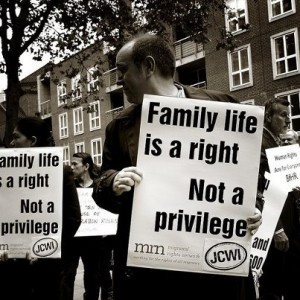
Migrants’ Rights Network: The battle on family migration will be a long one, but we can win

Posted on July 16, 2012 by Migrant Tales

By Ruth Grove-White

Every now and again there are changes to the immigration rules which even writers for the Daily Mail voice their objections to. The new rules on family migration to the UK, which came into force on Monday, represent a major assault on family life for Brits and migrants alike. Campaigners now need to work on bringing political opposition to the rules out from behind closed doors.

Monday’s changes to the family migration rules are significant: the UK now ranks among the toughest of Western democracies on family reunification policies.

Among other changes, the government has introduced a new income requirement of £18,600 per year for people who wish to bring a foreign partner to live with them in the UK. This means an estimated 47% of the UK working population would not qualify to bring their overseas spouse or partner here in the future.

The Home Office estimates up to 18,500 people every year will be prevented from coming to join family members here as a result. This may be helpful in inching the government towards lower net migration levels, but will be devastating for the families who are kept apart as a result.

Although the family migration changes have been politically controversial, much opposition has been confined to back rooms in Whitehall rather than aired in public. Press reports earlier this year hinted at internal battles between Lib Dems and Conservatives on family migration, with children and families minister Sarah Teather rumoured to be particularly resistant to tough rule changes.

Although these issues were officially resolved, behind closed doors there is reportedly still opposition among some Lib Dem MPs to the new rules.

Labour has also found itself in a tangled position over the family migration changes. Despite vocal opposition to the family rules among key players such as front bencher Kate Green MP and home affairs committee chair Keith Vaz MP, the Labour front bench has not yet expressed a clear position against these rules.

Still in the midst of a policy review, there has seemingly been reluctance to wade into a debate that could result in Labour once again being painted as soft on immigration. But never say never. What is certain is that the fight for family rights will continue and it has the scope to build political support.

Now that the family migration rules have come into force there will be growing evidence about their negative impacts, with particular problems anticipated for young couples, Asian families, and in parts of the UK with low average incomes.

Families who are affected can help to overturn these rules in the future by writing to their MPs, joining campaigns and building solidarity with others who are affected.

If the evidence can be amassed, Monday’s changes potentially offer up a future political opportunity: to speak out on an immigration issue that will affect thousands of Brits as well as migrants in the UK. And as the next general election draws nearer we hope to see quiet support develop into concerted political leadership, that points the UK in a different direction on family migration.

This article first appeared on the Left Foot Forward website on 11th July 2012.

Read original story here.

This piece was reprinted by Migrant Tales with permission.


The long and costly ordeal of family reunification from Somalia to Finland

Posted on May 16, 2012 by Migrant Tales

Ever wondered about the hassle and red tape a Somali resident of Finland must face to bring his family here? Apart from the long two-and-a-half year wait on average, the whole process is especially costly for a person from Somalia, where annual income totals about $600 (471 euros), according to the CIA Factbook.  

There are three ways to be reunited with your loved one in Finland if you live in Somalia: either apply for political asylum in Finland or turn to the Finnish Embassy in Ethiopia or Kenya.

The fastest of the three routes is applying directly for asylum.

Finnish immigration authorities have around 10,000 family reunification applications on file, mostly from Somalis. While the Finnish Immigration Service blames a lack of personnel for the backlog, some believe that this is done on purpose to reduce the number of Somalis seeking to move to Finland.

Family reunification can be a long and costly ordeal if you are a Somali. Administration fees alone charged at the Finnish Embassy in Addis Ababa amount to 415 euros per adult, according to the Finnish interior minsitry. For minors they are a bit cheaper (180 euros).

According to a Somali resident of Finland, the cost of traveling from Mogadishu to Addis Ababa by car is $100 and you’ll need $30 for food. The journey to the Ethiopian capital takes about seven days from Mogadishu.

“Some who apply at the Finnish Embassy in Addis Ababa may wait in the capital for those two-and-half years to get the green light to move to Finland,” the Somali said. “Waiting is expensive. Rent in Addis Ababa for a family of seven can cost about $100/month, or between $300 and $400 if all living expenses are included.”

A two-and-and-half year wait can cost  a family $9,000-$12,000 if you plan to wait it out in the Ethiopian capital.

If you are a minor in Finland and want to bring your parents and four brothers and sisters to live with you here, administration costs alone for your family would amount to a hefty 1,550 euros. To the sum we’d have to include interpretation fees, which amount to about 20 euros/person (450 Ethiopian birrs).

If, by a stroke of luck, the family gets the green light to be reunited with a family member in Finland, they will have to get a travel document issued by the United Nations that costs 120 euros/person, or a total of 720 euros for a family of six in Ethiopia.

Even if Interior Minister Päivi Räsänen said last year that one of the aims of the government is to tighten family reunification rules still further, this isn’t necessary because of cost and the long wait.

Probably one of the problems with the ongoing debate about family reunifications in Finland is that it makes us forget about the tragedy and suffering of people who made it here but  who still live separated from their loved ones.


A family reunification interview request to appear at the Finnish Embassy in Addis Ababa, Ethiopia. This invitation kicks off a long and expensive process for Somali families. 


Family reunification in the UK: ‘Keeping families apart’ – MRN briefing on family migration policy

Posted on April 22, 2012 by Migrant Tales

Ruth Grove-White

The MRN (Migrants’ Rights Network) campaign on family migration releases a new briefing paper showing that a higher income threshold for family migration could shut out 50% of the UK working population from bringing a spouse or partner here – with ethnic minorities, women and children particularly hit.

Since last summer’s public consultation we have been waiting for the government to announce its final decision on changes to toughen up family migration policy – during which MRN has been producing regular analysis of the proposals which you can access here, here and here.

But a waiting game provides opportunities – until the announcement is made there is still time to have an impact on the final policy announcement. It is likely that, in the coming weeks, the home secretary will make an announcement about her decision on the reforms to family migration. Over the coming weeks, in the run-up to her announcement, MRN will be stepping up our campaigning through a series of meetings and campaign work on the issue of family migration.

We are taking this work forward by releasing today’s briefing paper on the proposed income threshold. This change would prevent up to 50% of the UK working population from bringing foreign family members here as a result of a new, higher income threshold requirement.  If you are interested in organising a public meeting on this issue in your local area, taking part in joint advocacy work or would like to speak out about how you might be affected by this change in policy to the UK, please get in touch.

There are plenty of other issues raised by the family migration proposals, which will also be the focus of MRN activity in coming weeks. Key measures proposed by the government last year included increasing family insecurity by preventing foreign spouses and partners who are in the UK from applying for settlement for an additional 3 years, increasing the bar for language testing at the point of applying for settlement, and introducing tough enforcement measures aimed at tackling ‘sham’ and forced marriages, including a new pre-entry ‘attachment requirement’ and wider in-country enforcement activity.

Many of the proposals put forward by the government, if introduced, could interfere with the right to a family life of many people in the UK. In analysis of the proposals last summer the Brussels-based Migration Policy Group (MPG) reviewed the impacts of new family reunion requirements in the small number of EU states (in particular Denmark and the Netherlands) where similar restrictions to those planned in the UK. An MPG policy briefing on new family reunion tests and requirements in relation to migrant integration concluded:

“These policies have a disproportionate impact on the most vulnerable groups: the elderly, young adults, the less educated, … and to some extent, women. … Making family life harder or even impossible can negatively impact on the well-being and future integration of the entire family”.

A MIPEX analysis of the UK government’s plans exposes the fact that key policy proposals, if enacted, would put the UK among the toughest of European countries on family migration.

So there is plenty of evidence, from policy groups to community organisations, which shows that tough changes to family migration rules in the UK could have the effect of alienating both British citizens and recent arrivals in the UK who have family overseas. Now we need to marshall it into arguments which make the case for a better deal for families in the UK.

Please keep an eye on the website for more info and analysis in the coming weeks – we hope you will get involved.

Finland & Cultural Diversity 2011

Posted on December 29, 2011 by Migrant Tales

By Enrique Tessieri

In many respects 2011 was a watershed year for Finland and Europe concerning the rise of anti-immigration parties and xenophobia. The biggest news to hit Finland this year was without a doubt the April 17 election, which saw the anti-immigration Perussuomalaiset (PS) party win 39 seats compared with only 5 in 2007. On July 22 Anders Breivik gunned down most of his 77 victims in Norway. 

If you are an immigrant or a visible minority in Finland,  2011 will go down as one the worst years in a very long time. Certainly anti-immigration parties in Europe have gained strength by the ever-worsening economic situation, the euro crisis and financial bailouts of countries like Greece, Ireland and Portugal.

Below is a quarter-by-quarter account of what made news on the immigration front in Finland during 2011:

First quarter 

The year kicked off in January with news of the death of Eveline Fadayel, an Egyptian grandmother who was granted a  residence permit after a lengthy process with immigration officials. The late woman’s legal battle to remain in Finland with her naturalized Finnish son triggered lots of concern and public debate over her plight as well as on immigration policy.

Her case highlights problems with our immigration policy and family reunification. A similar example are minors who have been granted refugee status by this country but who are forced to live separated from their parents. The government has announced plans to tighten family reunification rules further.

With the PS looking better in the polls as the historic April election neared, the party published its election manifesto in February. What is odd about the PS’ manifesto is that it does not differ radically from the government’s immigration policy, which suggests that most political parties in Finland take a tough line on immigration policy.

PS chairman, Timo Soini, told a group of German journalists in April before the election that he supported the government’s immigration policy.

With the anti-immigration atmosphere thickening in Finland, concern over the rights of minorities like the Swedish speakers in Finland was expressed by Sweden’s Integration Minister Erik Ullenhage. Then foreign minister, Alexander Stubb, said the debating atmosphere on immigrants and refugees in this country had become “oppressive.”

Second quarter

The election on April 17 dominated national and even international attention for quite a while. Newly elected PS MPs like Teuvo Hakkarainen became instant household names and the darlings of the tabloids with their racist and derogatory statements about blacks, refugees and immigrants. Racism, holocaust denial and off-the-cuff remarks by PS MPs and others would put Soini under the media spotlight throughout the year.

While Soini tried to calm Europe after the election by stating that the PS wasn’t an extremist party and that “Europe could sleep safely,” the news of the PS’ election victory did not go down well with some. Writer Sofi Oksanen was quoted as saying on Rome-based daily La Reppublica that the PS has its roots in Hitler’s Germany.

Emboldened by the election result, the Finnish media started to report more closely hate crimes. One of these that was reported by a tabloid about the speaker of parliament, Ben Zyskowicz, who was almost attacked by an unidentified person after he was called a Jew.

PS MP Jussi Halla-aho, who leads the far-right Suomen Sisu anti-immigration wing of Soini’s party, was elected to chair the administration committee, which among other things oversees immigration policy.

Despite the election victory fanfare of the PS, a group of 1,000 immigrants and Finns demonstrated in front of parliament against the PS.  The demonstration was organized by My Finland is International on Facebook. It was a historic event since the last time that immigrants and Finns demonstrated together in such large numbers was in October 1982.

The PS decided to sit it out in the opposition instead of forming part of government due to differences over EU policy. Even if the PS are now in the opposition, it does not mean that the other parties can’t feel its shadow. This became clear when the government appointed Christian Democrat Päivi Räsänen to head the interior ministry in charge of immigration policy.

The PS has approved and expressed satisfaction with Räsänen’s appointment. The Christian Democrat’s provocative views on homosexuality caused a large exodus of people to abandon the Lutheran Church.

Third quarter

The holiday month of July in Finland was rudely awoken when news of  Breivik’s mass-killing crusade to save Europe from “Islamization” and “cultural Marxists” became known to the world.  While Breivik had quoted Halla-aho in his manifesto, far-right parties and Islamophobic websites like the Gates of Vienna and anti-immigration politicians distanced themselves from the mass killer.

Others like PS MP James Hirvissari blamed the mass killings in Norway on the “100% rapes” committed by foreigners in Norway.

Europe and especially the Nordic region was never the same after 22/7. The ever-growing support that anti-immigration party’s thought that would never end hit a wall. For some Finnish parties like the Social Democrats, it was a wake up call to the threat that the far right and populist parties pose on society.

The tragic evens in Norway had as well an  impact on elections in Norway and Denmark.  Even the far-right Sweden Democrats had taken a hit in the opinion polls. One explanation why we haven’t seen a big fall in support for the PS in Finland is because it has profiled itself for now as an anti-EU party as one opposed to immigration and Islam.

There was more news that we read about in the third quarter like the  Romany minority evictions in Helsinki, former President Martti Ahtisaari asking Finns to invite immigrants for coffee, and news of hate crimes and racism emerging in Eastern Finnish towns like  Iisalmi and Lieksa.

Like in the beginning of the year, another poll showed that parents in Southern Finland want to limit at their school the number of children with immigrant backgrounds.

The Police College of Finland reported in October that hate crimes had fallen in 2010 by 15% compared with the previous year. Some, like Migrant Tales, treated this news with skepticism.

Finns learned in the end of July of Ulla Pyysalo, PS MP Juho Eerola’s aide, who posted a racist joke  on Facebook about Green Party MP Jani Toivola, who is black and gay.  She would gain more notoriety in early November when hackers uncovered her name on a neo-Nazi association membership list. MP Eerola, who has written positively about Benito Mussolini’s economic policies, does not believe belonging to a neo-Nazi association is grounds for dismissal.

Researcher Vesa Puuronen claimed  at the end of July that there are “tens of thousands” of far-right supporters in Finland. Secret police Supo does not consider the far right to be a threat in Finland  but is keeping a close eye on such groups.

My Finland is International organized in the end of July a demonstration in show of support for Breivik’s victims and against a culture of silence with respect to hate crimes and racism.

The PS change their English name to “The Finns.”

Fourth quarter

As in the previous three quarters of the year, there was no shortage of news on the immigration and hate-speech and crime front.  Migrant Tales has criticized on a number of occasions the Finnish media, politicians and public officials for their lack of leadership concerning the growth of racism and parties like the PS.

Helsingin Sanomat editor,  Riikka Venäläinen, offered in early November a humble mea culpa.  She said: “…our job is to give background information, analysis and develop the story from a certain angle.When that is done  on a tight schedule, it’s pretty certain that we are guilty of very short-sighted conclusions. I accept the criticism that has to do with reporting on immigration issues.”

Former Helsingin Sanomat Janne Virkkunen was not as apologetic. He expressed concern over the anti-immigration atmosphere in Finland and partly blamed its rise on the PS.

If the media turned a partial blind eye on PS candidates for their membership in extremist associations like Suomen Sisu,  the silence of too many politicians and the PS’ lame stance on racism and neo-Nazi groups is equally worrying. One of the biggest anti-immigration extremists of the PS and Suomen Sisu member, MP Hirvisaari, got fined in mid-December for hate speech.

All eyes are now on PS chairman Soini, who has said publicly that any member who got “convicted for racism” would be kicked out of the party. Soini said that he will make a decision on Hirvisaari after an appeal has been heard by the Supreme Court.

PS MP Pentti Oinonen refused to attend the president’s independence day reception on December 6 because he thought homosexuals dancing together at the reception were an insult to veterans. A local party boss of the PS claimed the homosexuality led to pedophilia.

In order to show the government’s get-tough stance against immigrants, refugees and in the process steal some of the political thunder of the PS, Minister of Interior Räsänen reinforced plans to tighten family reunification rules.

One of the bright spots in December has been President Tarja Halonen, who has been outspoken against discrimination and exclusion.  In early December she said   on a popular talk show that racism will not do away with injustice. She said that journalists, politicians, the clergy and teachers must break the cycle of hate speech.

Halonen commented as well on a poll by Helsingin Sanomat, which showed that two thirds of Finns felt there is much or a fair amount of racism in Finland. The poll revealed that PS supporters were twice as likely to recognize racism in themselves than others surveyed.  “People who recognise racism in themselves have ended up voting for the True Finns,” said Halonen. The comment angered a lot of PS supporters including Soini.

The credibility of such surveys, which highlight a serious social problem in Finland, have been questioned by researchers like Migration Institute director Ismo Söderling.

With a pretty dismal year ending, what kind of  new year do we expect in 2012 concerning immigration and our ever-growing cultural diversity as a society?

At the present pace it’s evident that there will be no shortages of news next year!
  • Previous
  • 1
  • 2
  • 3
  • 4
Read more about documentary film
Read more

Recent Posts

  • Lahti is the latest city to prohibit the niqab and burka
  • Finland’s tabloids Iltalehti and Ilta-Sanomat are the pits
  • Riikka Purra’s Dr Jekyll and Mr Hyde mask
  • Double standards
  • Perussuomalaiset: Uusi logo, sama vanha juttu

Recent Comments

  1. Absolutely Socking: Racist Finnish Facebook group against human rights gets flooded with socks on Musta Barbaari’s mother and sister charged by the police in “ethnic profiling” case
  2. Ilkka Nuotio on Pekka Myrskylä: “Tilastot kertovat toista kuin poliittinen keskustelu”
  3. Genrih Soinkara on The war in Ukraine and the Russian-Finnish border crisis are showing Finland’s ugly side
  4. Ahti Tolvanen on Comment by Ahti Tolvanen on the Helsinki +50 conference
  5. Angel Barrientos on Angel Barrientos is one of the kind beacons of Finland’s Chilean community

Archives

  • June 2026
  • May 2026
  • April 2026
  • March 2026
  • February 2026
  • January 2026
  • December 2025
  • November 2025
  • October 2025
  • September 2025
  • August 2025
  • July 2025
  • June 2025
  • May 2025
  • April 2025
  • March 2025
  • February 2025
  • January 2025
  • December 2024
  • November 2024
  • October 2024
  • September 2024
  • August 2024
  • July 2024
  • June 2024
  • May 2024
  • April 2024
  • March 2024
  • February 2024
  • January 2024
  • December 2023
  • November 2023
  • October 2023
  • September 2023
  • August 2023
  • July 2023
  • June 2023
  • May 2023
  • April 2023
  • March 2023
  • February 2023
  • January 2023
  • December 2022
  • November 2022
  • October 2022
  • September 2022
  • August 2022
  • July 2022
  • June 2022
  • May 2022
  • April 2022
  • March 2022
  • February 2022
  • January 2022
  • December 2021
  • November 2021
  • October 2021
  • September 2021
  • August 2021
  • July 2021
  • June 2021
  • May 2021
  • April 2021
  • March 2021
  • February 2021
  • January 2021
  • December 2020
  • November 2020
  • October 2020
  • September 2020
  • August 2020
  • July 2020
  • June 2020
  • May 2020
  • April 2020
  • March 2020
  • February 2020
  • January 2020
  • December 2019
  • November 2019
  • October 2019
  • September 2019
  • August 2019
  • July 2019
  • June 2019
  • May 2019
  • April 2019
  • March 2019
  • February 2019
  • January 2019
  • December 2018
  • November 2018
  • October 2018
  • September 2018
  • August 2018
  • July 2018
  • June 2018
  • May 2018
  • April 2018
  • March 2018
  • February 2018
  • January 2018
  • December 2017
  • November 2017
  • October 2017
  • September 2017
  • August 2017
  • July 2017
  • June 2017
  • May 2017
  • April 2017
  • March 2017
  • February 2017
  • January 2017
  • December 2016
  • November 2016
  • October 2016
  • September 2016
  • August 2016
  • July 2016
  • June 2016
  • May 2016
  • April 2016
  • March 2016
  • February 2016
  • January 2016
  • December 2015
  • November 2015
  • October 2015
  • September 2015
  • August 2015
  • July 2015
  • June 2015
  • May 2015
  • April 2015
  • March 2015
  • February 2015
  • January 2015
  • December 2014
  • November 2014
  • October 2014
  • September 2014
  • August 2014
  • July 2014
  • June 2014
  • May 2014
  • April 2014
  • March 2014
  • February 2014
  • January 2014
  • December 2013
  • November 2013
  • October 2013
  • September 2013
  • August 2013
  • July 2013
  • June 2013
  • May 2013
  • April 2013
  • March 2013
  • February 2013
  • January 2013
  • December 2012
  • November 2012
  • October 2012
  • September 2012
  • August 2012
  • July 2012
  • June 2012
  • May 2012
  • April 2012
  • March 2012
  • February 2012
  • January 2012
  • December 2011
  • November 2011
  • October 2011
  • September 2011
  • August 2011
  • July 2011
  • June 2011
  • May 2011
  • April 2011
  • March 2011
  • February 2011
  • January 2011
  • December 2010
  • November 2010
  • October 2010
  • September 2010
  • August 2010
  • July 2010
  • June 2010
  • May 2010
  • April 2010
  • March 2010
  • February 2010
  • January 2010
  • December 2009
  • November 2009
  • October 2009
  • September 2009
  • August 2009
  • July 2009
  • December 2008
  • November 2008
  • October 2008
  • September 2008
  • August 2008
  • July 2008
  • June 2008
  • May 2008
  • April 2008
  • March 2008
  • February 2008
  • January 2008
  • November 2007
  • October 2007
  • September 2007
  • August 2007
  • July 2007
  • June 2007
  • May 2007

Categories

  • ?? Gia L?c
  • ????? ?????? ????? ???????? ?? ??????
  • ???????
  • @HerraAhmed
  • @mondepasrond
  • @nohatefinland
  • @oula_silver
  • @Varathas
  • A Pakistani family
  • äärioikeisto
  • Abbas Bahmanpour
  • Abdi Muhis
  • Abdirahim Hussein Mohamed
  • Abdirahim Husu Hussein
  • Abdirisak Mahamed
  • About Migrant Tales
  • activism
  • Adam Al-Sawad
  • Adel Abidin
  • Afrofinland
  • Ahmed IJ
  • Ahti Tolvanen
  • Aino Pennanen
  • Aisha Maniar
  • Alan Ali
  • Alan Anstead
  • Alejandro Díaz Ortiz
  • Alekey Bulavsev
  • Aleksander Hemon
  • Aleksanterinliitto
  • Aleksanterinliitto ry
  • Aleksanterinliitto ry:n hallitus
  • Alex Alex
  • Alex Mckie
  • Alexander Nix
  • Alexandra Ayse Albayrak
  • Alexis Neuberg
  • Ali Asaad Hasan Alzuhairi
  • Ali Hossein Mir Ali
  • Ali Rashid
  • Ali Sagal Abdikarim
  • Alina Tsui
  • Aline Müller
  • All categories
  • Aman Heidari
  • Amiirah Salleh-Hoddin & Jana Turk
  • Amin A. Alem
  • Amir Zuhairi
  • Amkelwa Mbekeni
  • Ana María Gutiérrez Sorainen
  • Anachoma
  • Anders Adlecreutz
  • Angeliina Koskinen
  • Anna De Mutiis
  • Anna María Gutiérrez Sorainen
  • Anna-Kaisa Kuusisto ja Jaakko Tuominen
  • Annastiina Kallius
  • Anneli Juise Friman Lindeman
  • Announcement
  • Anonymous
  • Antero Leitzinger
  • anti-black racism
  • Anti-Hate Crime Organisation Finland
  • Anudari Boldbaatar
  • Arshiya Nasser
  • Aspergers Syndrome
  • Asylum Corner
  • Asylum seeker 406
  • Athena Griffin and Joe Feagin
  • Autism
  • Avaaz.org
  • Awale Olad
  • Ayan Said Mohamed
  • AYY
  • Barachiel
  • Bashy Quraishy
  • Beatrice Kabutakapua
  • Beri Jamal
  • Beri Jamal and Enrique Tessieri
  • Bertolt Brecht
  • Boiata
  • Boodi Kabbani
  • Bruno Gronow
  • Carmen Pekkarinen
  • Çelen Oben and Sheila Riikonen
  • Chiara Costa-Virtanen
  • Chiara Costa-Virtanen
  • Chiara Sorbello
  • Christian Thibault
  • Christopher Wylie
  • Clara Dublanc
  • Dana
  • Daniel Malpica
  • Danilo Canguçu
  • David Papineau
  • David Schneider
  • Dexter He
  • Don Flynn
  • Dr Masoud Kamali
  • Dr. Faith Mkwesha
  • Dr. Theodoros Fouskas
  • Edna Chun
  • Eeva Kilpi
  • Emanuela Susheela
  • En castellano
  • ENAR
  • Enrique
  • Enrique Tessieri
  • Enrique Tessieri & Raghad Mchawh
  • Enrique Tessieri & Yahya Rouissi
  • Enrique Tessieri and Muhammed Shire
  • Enrique Tessieri and Sira Moksi
  • Enrique Tessieri and Tom Vandenbosch
  • Enrique Tessieri and Wael Che
  • Enrique Tessieri and Yahya Rouissi
  • Enrique Tessieri and Zimema Mhone
  • Epäluottamusmies
  • EU
  • Europe
  • European Islamophobia Report
  • European Islamophobia Report 2019,
  • European Union
  • Eve Kyntäjä
  • Ezequiel Caldeiro
  • Facebook
  • Fadumo Dayib
  • Faisa Kahiye
  • Farhad Manjoo
  • Fasismi
  • Finland
  • Fizza Qureshi
  • Flyktingar och asyl
  • Foreign Student
  • Fozia Mir-Ali
  • Frances Webber
  • Frida Selim
  • Gareth Rice
  • Ghyslain Vedeaux
  • Global Art Point
  • Great Replacement
  • Habiba Ali
  • Hami Bahadori
  • Hami Bahdori
  • Hamid
  • Hamid Alsaameere
  • Hamid Bahdori
  • Handshake
  • Harmit Athwal
  • Hassan Abdi Ali
  • Hassan Muhumud
  • Heikki Huttunen
  • Heikki Wilenius
  • Helsingin Sanomat
  • Henning van der Hoeven
  • Henrika Mälmsröm
  • Hser Hser
  • Hser Hser ja Mustafa Isman
  • Husein Muhammed
  • Hussain Kazemian
  • Hussain Kazmenian
  • Ibrahim Khan
  • Ida
  • Ignacio Pérez Pérez
  • Iise Ali Hassan
  • Ilari Kaila & Tuomas Kaila
  • Imam Ka
  • inside-an-airport
  • Institute of Race Relations
  • Iraqi asylum seeker
  • IRR European News Team
  • IRR News Team
  • Islamic Society of Norhern FInland
  • Islamic Society of Northern Finland
  • Islamophobia
  • Jacobinmag.com
  • Jallow Momodou
  • Jan Holmberg
  • Jane Elliott
  • Jani Mäkelä
  • Jari Luoto
  • Jari Taponen
  • Jegor Nazarov
  • Jenni Stammeier
  • Jenny Bourne
  • Jessie Daniels
  • Joe Davidow
  • Johannes Koski
  • John D. Foster
  • John Grayson
  • John Marriott
  • Jon Burnett
  • Jorma Härkönen
  • Jos Schuurmans
  • José León Toro Mejías
  • Josue Tumayine
  • Jouni Karnasaari
  • Juan Camilo
  • Jukka Eräkare
  • Julian Abagond
  • Julie Pascoet
  • Jussi Halla-aho
  • Jussi Hallla-aho
  • Jussi Jalonen
  • JusticeDemon
  • Kadar Gelle
  • Kaksoiskansalaisuus
  • Kansainvälinen Mikkeli
  • Kansainvälinen Mikkeli ry
  • Katherine Tonkiss
  • Kati Lepistö
  • Kati van der Hoeven-Lepistö
  • Katie Bell
  • Kättely
  • Kerstin Ögård
  • Keshia Fredua-Mensah & Jamie Schearer
  • Khadidiatou Sylla
  • Khadra Abdirazak Sugulle
  • Kiihotus kansanryhmää vastaan
  • Kirsi Crowley
  • Koko Hubara
  • Kristiina Toivikko
  • Kubra Amini
  • KuRI
  • La Colectiva
  • La incitación al odio
  • Laura Huhtasaari
  • Lauri Finér
  • Leif Hagert
  • Léo Custódio
  • Leo Honka
  • Leontios Christodoulou
  • Lessie Branch
  • Lex Gaudius
  • Leyes de Finlandia
  • Liikkukaa!
  • Linda Hyökki
  • Liz Fekete
  • M. Blanc
  • Maarit Snellman
  • Mahad Sheikh Musse
  • Maija Vilkkumaa
  • Malmin Kebab Pizzeria Port Arthur
  • Marcell Lorincz
  • Mari Aaltola
  • María Paz López
  • Maria Rittis Ikola
  • Maria Tjader
  • Marja-Liisa Tolvanen
  • Mark
  • Markku Heikkinen
  • Marshall Niles
  • Martin Al-Laji
  • Maryan Siyad
  • Matt Carr
  • Mauricio Farah Gebara
  • Media Monitoring Group of Finland
  • Micah J. Christian
  • Michael McEachrane
  • Michele Levoy
  • Michelle Kaila
  • Migrant Tales
  • Migrant Tales Literary
  • Migrantes News
  • Migrants' Rights Network
  • MigriLeaks
  • Mikko Kapanen
  • Miriam Attias and Camila Haavisto
  • Mohamed Adan
  • Mohammad Javid
  • Mohammad M.
  • Monikulttuurisuus
  • Monisha Bhatia and Victoria Canning
  • Mor Ndiaye
  • Muh'ed
  • Muhamed Abdimajed Murshid
  • Muhammed Shire
  • Muhammed Shire and Enrique Tessieri
  • Muhis Azizi
  • Musimenta Dansila
  • Muslimiviha
  • Musulmanes
  • Namir al-Azzawi
  • Natsismi
  • Neurodiversity
  • New Women Connectors
  • Nils Muižnieks
  • No Labels No Walls
  • Noel Dandes
  • Nuor Dawood
  • Omar Khan
  • Otavanmedia
  • Oula Silvennoinen
  • Paco Diop
  • Pakistani family
  • Pentti Stranius
  • Perussuomalaiset
  • perustuslaki
  • Petra Laiti
  • Petri Cederlöf
  • Pia Grochowski
  • Podcast-lukija Bea Bergholm
  • Pohjois – Suomen Islamilainen Yhdyskunta
  • Pohjois Suomen Islamilainen Yhyskunta
  • Polina Kopylova
  • Race Files
  • racism
  • Racism Review
  • Raghad Mchawh
  • Ranska
  • Rashid H. and Migrant Tales
  • Rasismi
  • Raul Perez
  • Rebecka Holm
  • Reem Abu-Hayyeh
  • Refugees
  • Reija Härkönen
  • Remiel
  • Reza Nasri
  • Richard Gresswell
  • Riikka Purra
  • Risto Laakkonen
  • Rita Chahda
  • Ritva Kondi
  • Robito Ibrahim
  • Roble Bashir
  • Rockhaya Sylla
  • Rodolfo Walsh
  • Roger Casale
  • Rostam Atai
  • Roxana Crisólogo Correa
  • Ruth Grove-White
  • Ruth Waweru-Folabit
  • S-worldview
  • Sadio Ali Nuur
  • Sami Rusanen
  • Sandhu Bhamra
  • Sara de Jong
  • Sarah Crowther
  • Sari Alhariri
  • Sarkawt Khalil
  • Sasu
  • Scot Nakagawa
  • Shabana Ahmadzai
  • Shada Islam
  • Sharon Chang blogs
  • Shenita Ann McLean
  • Shirlene Green Newball
  • Sini Savolainen
  • Sira Moksi
  • Sonia K.
  • Sonia Maria Koo
  • Steverp
  • Stop Deportations
  • Suldaan Said Ahmed
  • Suomen mediaseurantakollektiivi
  • Suomen Muslimifoorumi ry
  • Suomen viharikosvastainen yhdistys
  • Suomen viharikosvastainen yhdistys ry
  • Suomi
  • Supermen
  • Susannah
  • Suva
  • Syrjintä
  • Talous
  • Tapio Tuomala
  • Taw Reh
  • Teivo Teivainen
  • The Daily Show
  • The Heino
  • The Supermen
  • Thomas Elfgren
  • Thulfiqar Abdulkarim
  • Tim McGettigan
  • Tino Singh
  • Tito Moustafa Sliem
  • Tobias Hübinette and L. Janelle Dance
  • Transport
  • Trica Danielle Keaton
  • Trilce Garcia
  • Trish Pääkkönen
  • Trish Pääkkönen and Enrique Tessieri
  • Tuulia Reponen
  • Uncategorized
  • UNITED
  • University of Eastern Finland
  • Uyi Osazee
  • Väkivalta
  • Vapaa Liikkuvuus
  • Venla-Sofia Saariaho
  • Vieraskynä
  • W. Che
  • W. Che an Enrique Tessieri
  • Wael Ch.
  • Wan Wei
  • Women for Refugee Women
  • Xaan Kaafi Maxamed Xalane
  • Xassan Kaafi Maxamed Xalane
  • Xassan-Kaafi Mohamed Halane & Enrique Tessieri
  • Yahya Rouissi
  • Yasmin Yusuf
  • Yassen Ghaleb
  • Yle Puhe
  • Yuliet Tresa
  • Yve Shepherd
  • Zahra Khavari
  • Zaker
  • Zalina Ametova
  • Zamzam Ahmed Ali
  • Zeinab Amini ja Soheila Khavari
  • Zimema Mahone and Enrique Tessieri
  • Zimema Mhone
  • Zoila Forss Crespo Moreyra
  • ZT
  • Zulma Sierra
  • Zuzeeko Tegha Abeng
© 2026 Migrant tales | Powered by Minimalist Blog WordPress Theme