We are a small group called the Media Monitoring Group of Finland, represented by people from different minority backgrounds. Today we published our first report in English and Finnish.
Has media coverage of “youth gangs” and the security guards scandal been fair?
In our opinion, coverage has been problematic. Please read the report and see our findings.
Tabloid Ilta-Sanomat, which has had a murky history for publishing and attacking Somalis and other migrants in the 1990s, publishes a story about two Romany women who shoplift 2,600 euros of merchandise.
Certainly, shoplifting is a crime, but what about when a tabloid publishes a story that reinforces stereotypes about a certain group? Considering that Ilta-Sanomat was responsible in the 1990s for fueling Finnish racism against groups like the Somalis, isn’t that “a crime” also?
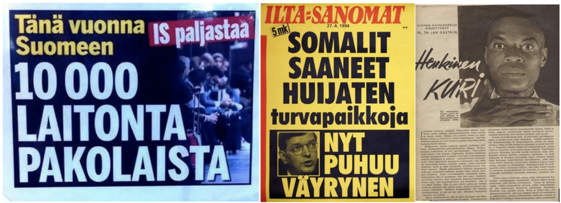
In the Finnish media, tabloids like Ilta-Sanomat have published racist stories. From left to right: This year, Finland will receive 10,000 illegal refugees (sic!); The Somalis coned the authorities to give them asylum; (right) Suomen Kuvalehti wrote in 1940 that the Finnish soldier did not run away, but an African tribe in the Indian Ocean does.
Apart from pointing out that the two women had hidden the merchandise in their Romany dresses, one of the suspects had yelled and acted aggressively against the security guard.
What would have happened if the shoplifters had been white Finns? If it were news, the tabloid would probably lead with the following headline: “A white Finns shoplifts.”
Who would be interested in reading such a story?
In our opinion, the story about the Romany women shoplifters has no other role than exposing the reporter’s prejudices and racist stereotypes of Romany women.
Sexual assault, especially suspected cases, is heatedly used by anti-immigration parties like the Perussuomalaiset (PS)* and public services like the police to demonstrate how some foreigners are. The police admitted today to a mistake in tabulating suspected sexual assault cases during 2020.
The mistake originates from a foreigner suspected of sexually assaulting his wife 141 times. Since the person was reported as 141 individual suspects, the amount for 2020 is therefore too high.
The police and Statistics Finland have confirmed the mistake.
The correct percentage of all suspected sexual assaults last year was 27.2%, not 38.5%.
Another interesting finding of the sexual assault statistics is that Northern Europeans, not Western Asians (Middle Easterners, Persians, and other nationalities), committed most suspected sexual assaults.
Why didn’t the media make a bigger deal about this fact?
Northern Europeans had the most sexual assault cases (58.9%), as many as 80% of alleged sexual assault against children.
Another important legal point that media coverage forgot to mention is that a person is innocent before proven guilty by a court of law. The number of convicted cases for sexual assault is only a fraction of the suspected ones. In 2019, 12.9% of all suspected cases were handed convictions.
How would we tell the events that led to the death of an eighteen-year-old Somali Finn youth last Sunday at the Kannelmäki railway station?
According to one account, supposedly the victim’s witness that experienced the whole horrific event, which has shocked many, especially Somalis and other black people.
According to one account, the victim and his friend walked down the stairs when they encountered the two suspects. The witness says that they weren’t acquaintances.
The victim was an eighteen-year old Somali Finn. Why was his life cut so short?
Something was said to the two that walked down the stairs. The witness didn’t answer back, but the suspect did. The stabbing happened so rapidly that the witness though the victim was joking when he said he was stabbed.
The blood gave away the gravity of the situation and the witness called 112.
The witness believed that the two young men were drunk. Even so, being drunk or having a criminal record does not absolve you from committing a hate crime.
Was it a hate crime? Do the suspects belong to a hate group like the Skinheads? These are some of the questions debated on social media forums right after the death of the victim.
Apart from investigating the crime like seeking the testimony of other witnesses, the police have also at their disposal CCTV cameras.
One of the questions that some Somalis and other black people are asking is if what happened was a hate crime, or that the attack and death of the Somali Finn youth were due to his ethnic background.
While such questions need to be thoroughly investigated by the police, some white Finns may not consider them to be necessary even if the opposite is true of some visible minorities and migrants. Why? Because many of them face racist harassment and microaggressions daily.
Many feel that they live in a racist society and have the psychological, some even physical wounds, to prove it. Too many believe that the police and society aren’t serious about tackling a social ill like racism.
Disagree?
What about if the crime at Kannelmäki were committed by two blacks and the victim was a white Finn? We have seen a lot of social media lynch mobs during the years, especially when sexual assault cases come to public light, as was the case recently in Oulu.
If one remembers what happened in Oulu, the police, the media, and politicians – all-white – were fueling the fires of suspicion and labeling the whole Muslim community in the process.
Since we strive to live in a society that solves problems, one matter that the police should show now is leadership by contacting the Somali community and hold a meeting to calm down fears. Present at such a meeting should be representatives of Victim Support (Riku), the police hate crime unit, sociologists, NGOs, and others.
The usual answer, “this was not a hate crime” with no further explanation will not do. It is not enough and will only increase suspicion of the police’s credibility in resolving such crimes.
One Somali Finn put it in the following words: “Is the police going to sweep the issue of racism under the rug? Are they going to conclude that the suspects had mental issues? Were they [the suspects] under the influence of alcohol or drugs? Are they hardened criminals? Or did they grow up in broken homes?”
Distrust of the police shows that such a public service still has a way to go before winning the trust of Finland’s culturally diverse communities.
The death of the Somali youth could be a good place to start.
Dr. Abdul Mannan, the imam and the president of the Oulu-based Islamic Society of Northern Finland, is adamant about one matter: Those who are guilty of sexual assault should pay for their crimes. He said that the suspects, which number 16 men, have also brought shame to their community.
“These types of crimes [committed by the suspects] are unacceptable in all religions,” he said. “We strongly condemn what they did because of their gravity and the friction they cause with the rest of society. The whole community is suffering because of their crime.”
Dr. Abdul Mannan.
Dr. Mannan, who has lived 26 years in Finland, said he knows well the country’s Islamic community, which is the second biggest religion in the country with more than 100,000 members after the Finnish Evangelical Lutheran Church. Muslims account for 2.8% of the total population.
Being a Muslim in today’s Finland and Europe is sometimes challenging. Since September 2017, the mosque in Oulu was vandalized eight times.
The sexual assault cases in Oulu are a good example of how whole groups are easily labelled.
“The media and journalists carry a lot of responsibility on how others see us [in a negative or positive light],” he said. “Journalists must understand that they play an important role in society. What they say has a big impact.”
This police statement above is about an attack against a Muslim 10-year-old who was attacked by her classmates. Nowhere in the statement does it state that the girl is Muslim or that the attackers were white Finnish children. Probably because the victim and suspects are children, the police believe it is a good idea to hide their religious and ethnic backgrounds.
Our family suffered a terrible crime on February 23 in Vantaa when three youths approached my husband from Pakistan at night and asked for a cigarette. My husband is a kind and loving person. If you ask him for a cigarette, he’ll give you two. But there was a problem: The three youths that asked for cigarettes looked like minors.
My husband asked for identification papers. One of them responded that he was 19.
On turning around, and after taking a few steps, my husband was violently attacked with a knife, ax, and a pointed object. Without going into detail, it took four hours to remove my husband’s stitches from over 20 wounds. He also has a double skull fracture and has been on the operating table a number of times.
My husband wants to do everything possible so that nobody will fall victim to such a vile crime. He and I are convinced that what happened was a hate crime. We are Muslims and Pakistanis, visible minorities in Finland. Why would anyone go to such an extent to cause such bodily harm if ethnic background did not play a role?
Finnish deputy chief of police of Helsinki, Ilkka Koskimäki, is the latest representative of the police service whose statements have left people scratching their heads. He’s quoted as saying in the Daily Telegraph: “This phenomenon [sexual harassment] is new in Finnish sexual crime history. We have never before had this kind of sexual harassment happening at New Year’s Eve.”
Really? Finnish women have never before been harassed sexually by Finnish men?
If Koskimäki is in the dark about the long and ugly history of sexual harassment of women in Finland, he should go out and interview some of the victims. And there are many of them.
Sexual harassment became illegal in 2014 but it doesn’t mean, like Koskimäki claims, that it is a “new” phenomenon even if the law is. What he said is misleading and serves to label all asylum seekers in a negative manner in Finland.
Koskimäki isn’t the only police service representative that has left people awed. Earilier this month we read about East Uusimaa Detective Chief Inspector Markku Tuominen’s advicethat Finns should leave rapidly if a foreigner wants to make contact with them.
That’s not all. There’s been some statements by National Police Commissioner Seppo Kolehmainen and Justice Minister Jari Lindström who are in favor of street patrol gangs while Interior Minister Petteri Orpohas said that they are not necessary because they fuel insecurity.