Denmark is a good example of how radical-right parties like the Danish People’s Party (DPP) grow and eventually die off. In the 2022 election, the DPP saw its support plummet to an all-time low of 2.63%, losing 11 MPs to end up with a total of 5 MPs. In the 2015 election, the DPP had their best election result ever, winning 37 seats.
It should not come as any surprise that the radical right Perussuomalaiset (PS)* are close ideological allies of the DPP. It should not also come as a surprise that the catastrophic election result of the DPP last year sent shivers up the PS’ spine.
From left to right, three Nordic Region parties have captured the racist imagination of their voters: The Danish People’s Party, Sweden Democrats, and Perussuomalaiset.
The spectacular fall from the political grace of the DPP to the rapid rise of the Sweden Democrats and PS in the last decade rings a similar bell: rapid growth with the help of a hostile anti-immigration campaign message is easy but does not mean that voters will continue to support such parties forever.
Support for the Danish People’s Party plunged by 87.4% from 2015 to the 2022 general election. Source: Statistics Denmark
Even if anti-immigration parties may grow rapidly, Denmark proved that the most effective way of destroying them is by adopting the same radical policies as these parties. The key is to become more radical because voters will not vote for “light” xenophobic versions of a radical right party.
It’s clear that the Moderate Party in Sweden and the National Coalition Party of Finland are taking a big risk in cooperating with the Sweden Democrats and PS. For one, such support could enable their radical-right partners to eat them up unless they react.
In 2020, foreigners made nationally 11,465 euros less annually than Finns.
While negotiations in process on forming a new government in Finland, it’s clear from the talks led by National Coalition Party (NCP) Prime Minister-designate Petteri Orpo that labor discrimination ranks low on their list of priorities.
The negotiators have the misguided expectation that non-EU migrants: will come here in droves and work for peanuts.
And migrants do work for much less than Finns. In 2020, the average taxable income nationally was 38,111 euros for Finns and 26,646 euros for migrants, an 11,465 euro difference,, according to a report by Pasi Saukkonen. For Helsinki and Greater Helsinki, the corresponding figures are 46,701 and 28,279, respectively.
Issues facing the labor market:
Foreigners in Finland made in 2020 nationally 11,465 euros less annually than Finns.
Discrimination in the labor market has been cited by a number of studies. Having a foreign-sounding name could be an obstacle to landing a job interview.
Finnish labor markets are highly racialized and segregated.
Having a university degree is in many cases not enough to get a better-paying job.
Discrimination in the housing market is another problem facing migrants and minorities.
The situation will get worse for migrants and minorities with the new government, which has a radical-right party that is openly xenophobic agenda supported by the National Coalition Party and Christian Democrats.
Migrant Tales insight: “Immigration Services” is an art exhibition that will debut in Reykjavík, Iceland, and aims to bring to light the suffering and challenges of Iraqi asylum seekers who came to Finland in 2015. It is encouraging that artists like Adel Abidin continue to show the injustices faced by Iraqi asylum seekers.
In the logic of the far-right Perussuomalaiset (PS)* party, the new youth leader of the party is genetically suspect with one of his parents being from the Philippines. Certainly, his name, Lauri Laitinen, has helped, but it proves a point: cultural and ethnic diversity does not pave the way for greater understanding.
While my point is not to mock Laitinen’s background, it does raise some questions about hypocrisy. Ethnic background does not ensure a greater “understanding” of diversity but can have the opposite effect.
Disagree? Look at the Tory government in the UK and the hardline immigration policies of Suella Braverman.
Considering that the PS is a party that believes in ethnonationalism, so does Laitinen. It’s odd, that Helsingin Sanomat did not mention anything about this far-right conspiracy theory.
Laitinen defended in aHelsingin Sanomat letter to the editor why linguistic and ethnic homogeneity is a good matter. Laitinen likes to talk about “harmful” migration as a motive for why he got into politics.
It is interesting that Helsingin Sanomat gives so much space to the new youth leader of the PS and forgets to mention his problematic views about migrants, which are clearly against our laws.
The far-right Perussuomalaiset (PS) party has gained significant traction by capitalizing on anti-immigrant sentiment, particularly targeting vulnerable groups such as Muslims.
In addition to their hostility towards migrants and minorities, many PS supporters and politicians hold admiration for autocratic leaders like Donald Trump and view Viktor Orbán’s Hungary as an ideal country to emulate.
However, it would be overly simplistic to solely attribute Finland’s racism and animosity to the PS. Other parties such as the National Coalition Party, Christian Democrats, Center Party, and even the Social Democrats also face challenges regarding racism.
For migrants contemplating joining a political party, the common concern revolves around identifying the one with the least amount of racism.
When examining the PS, it becomes evident that all of them have built their political careers on propagating racism and fostering animosity towards migrants and minorities.
One example of this is MP Sebastian Tynkkynen, whose notoriety stems from promoting false information, engaging in hate speech, and receiving three ethnic agitation convictions.
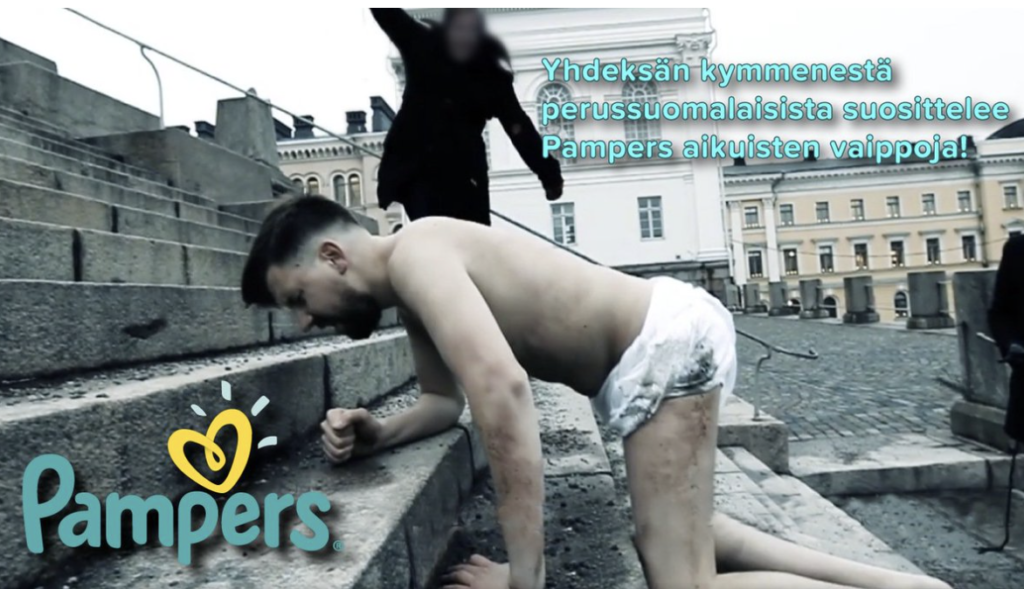
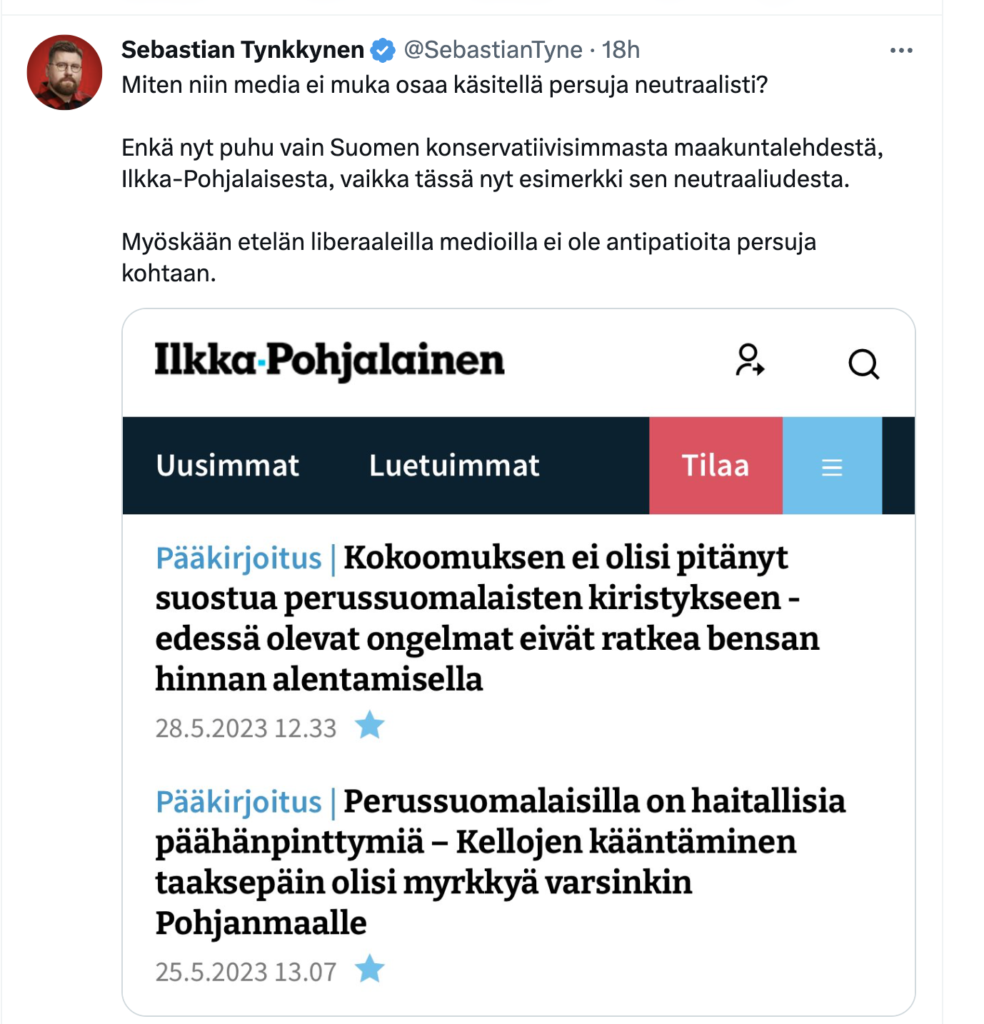
(Left) Sebastian Tynkkynen trying to make a point by wearing diapers. He voices his displeasure at an editorial that criticizes his party and asks why the media is unable to remain impartial. Answer: Why should a newspaper stay impartial in an editorial? Tynkkynen’s post shows his ignorance of the media.
A recent row erupted earlier this month in government talks when Tynkkynen asked his followers which YLE content is unnecessary.
if Tynkkynen had his way, like many other PS politicians, they’d tell the media what they can write.
Sounds like a party with a “Hungarian” heart, right?
I am currently not very motivated to help a government that includes the Finns Party to succeed, but for the sake of the Swedish People’s Party (SPP) and the country, I am writing this post anyway.
I believe that SPP should demand tomorrow that the government program must include that all changes regarding immigration be postponed until the government has created a completely new immigration program based on a positive future vision for the next 20-30 years. We must do it anyway because the current situation has been anything but good. Current laws and methods have been built in many small steps in a very amateurish manner without experience and knowledge over the past 30-40 years. And in the same amateurish way, they have also been cut and changed without a comprehensive concept.
As a result, we lack workforce and have managed to become the most racist country in Europe according to a 2018 survey comparing 12 EU states, including Sweden and Denmark. Unfortunately, the Marin government has not changed much about it either; last year we were reminded and warned by the EU Commission because we had not implemented changes.
But it should not be external pressure that motivates us; as mentioned, it should be a positive future vision regarding immigration that leads us. A vision of a cohesive country that can attract the best workforce from everywhere in the world and that provides security for immigrants and ethnic minorities and their families who are already. There has to be an end to demotivating and frustrating those who constitute our only growing population segment. We need to be a country that contributes its part to alleviate the distress in the world. A country that draw energy, inspiration, and innovation from all its population parts, and where everyone has the right to be happy, find suitable work, and feel part of society. A country that respects international agreements and where everyone can contribute to the welfare.
I do not believe that there is a great risk that, against my will, I am helping the Finns Party to participate in a successful government; one can hardly expect them to accept good advice.
The opinions expressed herein do not necessarily reflect the views of Migrant Tales.
If migration policy is based on lies, suspicion and racism, it is doomed to fail.
The attacks and hostility against the migrant and minority community in Finland intensified. The Perussuomalaiset (PS)* party has assured its supporters that there will be a significant tightening of immigration policies. This comes after reaching an agreement with the Swedish People’s Party (SPP) on such policies.
The PS and SPP were at loggerheads over the new government’s immigration policy. While the head of the PS, Riikka Purra, gave an ultimatum that it would pull out of the talks if the Swedish People’s Party did not accept the proposal on immigration policy.
Despite the dramatic nature of the events that unfolded on Saturday, resembling a second-rate soap opera, the PS ate its words and went through some points that the SPP had made.
Helsingin Sanomat, Finland’s leading daily, reported: “The SPP made changes that the tightening of immigration policy must be carried out within the limits of the constitution [and] the right of asylum seekers not to be deported will be respected.”
Yes, you read right. The SPP is asking that any tightening of immigration policy must respect the constitution and deportation bans will also be respected.
According to media reports, Finland is on the verge of forming its most right-wing and anti-immigration government, which is proposing a requirement for migrants seeking Finnish citizenship to earn an annual income of 40,000 euros.
CORRECTION: The media, which reported earlier that the new government plans to place a 40,000-euro annual salary threshold to qualify for citizenship, is wrong.
The National Coalition Party (NCP), Christian Democrats, and possibly the Swedish People’s Party today will give the nod to stricter immigration policies that would force residents to earn an average salary of 40,000 euros per year.
However, it is worth noting that foreigners in Finland typically earn about 20% less than Finns, as indicated by statistical data. If this new government implements such a minimum income threshold, it would effectively exclude many foreigners in Finland from obtaining citizenship.
What do you do when you make citizenship more difficult? For one, parties such as the Perussuomalaiset,* NCP, Christian Democrats, and very likely the Swedish People’s Party are apprehensive about granting citizenship to foreigners because it would grant voting rights to these people and voters against such parties.
Many parties in Finland are misguided believing there is a mad rush to move to Finland.
Implementing these stricter regulations will only make Finland even less appealing to foreign labor. It will exacerbate the existing problem of sourcing foreign labor.
Watching the ongoing government negotiations to give birth to Finland’s most right-wing and anti-immigration government can raise one’s blood pressure. The sticky issue National Coalition Party (Kokoomus) prime minister-designate, Petteri Orpo, hopes to resolve the sticky issue of migration and environmental policy.
In the face of a chronic labor shortage due to Finland’s graying population, the Perussuomalaiset (PS)* have made an ultimatum to Orpo: We will not form part of any government that does not tighten migration policy significantly.
One of the sticking points in the negotiations is how much a non-EU citizen makes in order to work in Finland. In the beginning, the PS stated a 3,000 euro minimum but is ready to lower it to 2,500 euros.
“The problem concerning [foreign] labor is that there is too little of it,” said Oksala, “so we should not place obstacles but contrarily place conditions that will bring labor migrants [to Finland]. We are in dire need of [more] labor.”
Technology Industries of Finland chairperson, Jaakko Eskola, who did not participate in the A-studio talk show, believes that Finland needs during a 28-year period 50,000 labor migrants annually, or 1.4 million people.
Kokoomus julkaisi heinäkuussa 2021 eduskuntaryhmänsä valmisteleman maahanmuutto- ja kotouttamisohjelman, jossa se ehdotti maahanmuuttajien ja kantasuomalaisten sosiaaliturvan eriyttämistä. Julkisen äläkän vuoksi termiksi vaihdettiin ”Suomessa pysyvästi asuva Suomen kansalainen”, mutta ohjelman rasistisuus ei siitä tietysti miksikään muuttunut. Kotouttamisohjelma sisälsi esimerkiksi rasistisen ajatuksen ”meistä kantasuomalaisista” ja niistä muista, jotka eivät ansaitse samaa sosiaaliturvaa, jos eivät löydä työpaikkaa.
”Työn ja toimeentulon tulisi olla sellaista, että ihminen voi osoittaa elättävänsä itsensä ja perheensä ilman yhteiskunnan tarjoamia sosiaalietuuksia”. Sosiaaliturvaa ei siis pidä olla – jos sitä on, niin perustuslain mukaan Suomen asukkaat ovat sen saannissa tasa-arvoisia. Kokoomus yrittää keplotella sillä, että edellisellä vaalikaudella perustuslakivaliokunta ”ei täysin sulkenut pois tähän liittyvää mahdollisuutta, mikäli asialle esitettäisiin hyväksyttävä peruste”.
Kokoomuslaisten käymä keskustelu maahanmuutosta tai siihen yhdistetyistä asioista on lähes identtistä perussuomalaisten kanssa: ”Ruotsin tietä” eli suurta maahanmuuttajamäärää pidetään kauhistuttavana ja hyvänä esimerkkinä siitä, mitä Suomen ei pidä tehdä. Nuorisorikollisuus ja katujengit nähdään maahanmuuttajien syyksi ja pakolaisten huono työllistyminen johtuu siitä, että he eivät ole halunneet oppia suomen kieltä. Perussuomalaisten Jussi Halla-aho kommentoi nyreänä, että kokoomus on tullut heidän tontilleen ja kopioinut heidän maahanmuutto-ohjelmansa.
Hyvin tavallista on kokoomuslaisten joukossa myös ajattelu, että maahanmuuttajat, kuten myös suomalaiset työttömät, ovat laiskoja ja eivät siksi työllisty tai opi suomea. Kenenkään en ole nähnyt pohtivan sitä, kuinka suomen kielen oppii, jos suomalainen ei sitä pakolaiselle puhu ja jos vaaditaan täydellistä kielitaitoa, ennen kuin pääsee mihinkään työhön.
Puoluetta ei voi pestä rasismista puhtaaksi sillä, että kokoomuslainen joskus sanoo: ”Kyllä minä hyväksyn maahanmuuton, meillehän tarvitaan lähihoitajia” tai ”Kyllä tänne ovat tervetulleita kaikki ne, jotka ovat valmiita töitä tekemään”. Itse asiassa nuo molemmat tokaisut ovat rasistisia, koska ne sisältävät rasistien yleisesti rummuttamat ajatukset, että maahan muualta muuttaneet kelpaavat vain alempien palkkaluokkien töihin ja suurin osa yrittää vain päästä tänne laiskottelemaan sosiaaliturvan varaan.
Kävin läpi kokoomuksen nykyisen eduskuntaryhmän julkaisemia kommentteja maahanmuutosta. Tulos oli pysäyttävä.
Ohessa rasistisia aivoituksia julkaisseet kansanedustajat aakkosjärjestyksessä:
Markku Eestilä hehkutti 27.10.2019 Uuden Suomen haastattelussa Viktor Orbanin politiikkaa Unkarissa. Kaikki on Eestilän mielestä kunnossa, vaikka oikeusvaltiosta ei enää voida puhua, sananvapautta on heikennetty, maahanmuuttajia kohdellaan kaltoin ja demokratia on vaihtunut diktatuuriksi. Tärkeintä Eestilän mielestä on, että talous on kasvanut. https://www.savonsanomat.fi/paikalliset/2781415