I am standing with my soul pearls
Dissecting Finnish racism and bigotry
“Racism is like a Cadillac, they bring out a new model every year.”
Malcolm X (1925-65)
The quote by one of the most powerful voices to emerge from the U.S. Civil Rights Movements, reveals how racism survived in the 1960s to see another day. Even though the quote by Malcolm X was made about a half a century ago, it still sheds light on how racism survives another day to oppress, exploit and disenfranchise.
When speaking of racism in a country like Finland, the first question we should address is where did it come from. The over 1.2 million Finns that emigrated from this land between 1860 and 1999 offer one answer as does Germany, our former historical big brother.
Like many European countries, Germany had colonies in Africa and elsewhere. Like any world colonial power, it too had to establish a racist system that gave it the moral right to pillage, exploit and commit genocide.
European racism was so rampant in the nineteenth century that it had lost touch with reality and created a pseudoscience called eugenics, whose sole purpose was to justify the extermination of so-called undesirable non-white ethnic groups. Any group that was deemed undesirable was one that threatened white or colonial privilege.
What kind of colonial masters were the Germans? They were just as ruthless as the British, French, Spaniards, Italians, Dutch, Belgians, white U.S. Americans, Japanese and others.
Between 1904 and 1908, Germans systematically massacred ancestors of the Herero and Nama people for daring to rebel against their colonial ruler. The first concentration camps were not built by the Nazis in World War 2 but in Namibia by the Germans.
European colonialism was directly responsible for the mass extermination of non-white groups in Tasmania, Latin America and other regions like the former Belgian Congo, where an estimated half of the 20 million inhabitants died to satisfy King Leopold II’s greed. Not only did colonialism bring hardships like mass slavery, it turned against its master in World War I and II by causing the death of some 100 million people.
While there are many examples of how racism found its way to far-flung Finland, it survives amongst us today for the same reasons as it did in the past.
Any sensible person agrees that racism is horrible and none of us would endorse it openly. We do support such a social ill, however, through our silence, denials and prejudice.
Migrant Tales is living proof of how little we have done in this country to challenge intolerance. It’s sad but true: intolerance will become a bigger problem in Finland as our society become more culturally diverse. The rise of the anti-immigration Perussuomalaiset (PS) party is one example that reinforces the latter.
Since racism is a pernicious force, we need leadership to challenge it. We don’t need to mobilize hundreds of thousands of people, only a few are enough to leave a lasting impression.
Leadership can be shown on a public tram by Helsinki Deputy Mayor Pekka Sauri, and by others like Rebecka Holm, an adolescent who decided to do something about racist harassment, and Ricky Ghansha, who forced a “super racist” to apologize publicly for his behavior.
Our struggle against intolerance doesn’t even have to be so public. We can do a lot at the workplace just by reacting to a racist, homophobic or sexist comment. The message must be clear: We won’t tolerate intolerance.
Tim Soutphommasane, who wrote an interesting opinion piece on Australian racism, says the following: “It’s [political correctness] nonsense because the worst form of censorship comes from the opposite direction. Nothing shuts down debate more than the idea that any allegation of racism must involve a moral charge against each and every Australian [or Finn in our case]. That it must mean we are saying there’s something fundamentally rotten about the Australian character.”
Soutphommasane explains why it’s difficult to debate a social ill like racism in Australia and even in Finland since we’re at a loss on how to confront the issue. A strange logic takes place when we play down racism and allow self-censorship to muffle our arguments.
He asks: “Do we go to the trouble of making such fine distinctions between hooligan behavior and hooligans? Or between criminal behavior and criminals? Why must we take such extraordinary care to avoid offending those who engage in racist behaviour? This is a grotesque form of self-censorship, if ever there was one.”
Not only must we understanding where and how a phenomenon like racism has lodged itself in our society, we must rally leadership and resolve to confront it with its real name.
If we succeed at this, we’d have made significant progress in stopping new Cadillac models from entering the market every year.
When Timo Soini and the PS cross the political point of no return
When do you know when Timo Soini and the Perussuomalaiset (PS) have crossed the line and passed a political point of no return? The 50,000-euro ad on the front page of Helsingin Sanomat, Finland’s largest-circulation daily, blasting the government’s euro bailout policy is one of many examples. While more voters are turning their backs to the PS, the party has burned as well important bridges with other political groups in this country.
Timo Soini and the PS have got a lot of people pissed off in Finland. One of these is Paavo Pyykkönen.
Just like the party’s rhetoric and criticism of the EU, euro, gay marriage, immigrants and Muslims, the biggest threat to the PS doesn’t come from abroad or from outside the party but from within. The PS comprises of such a rambunctious group of people that anything can happen. It is a wild card that bases its future political exploits on chance, never on concrete workable policies.
An opinion poll published by YLE last week revealed that the PS is “hemorrhaging support” to the opposition Center Party, which has taken a less openly hostile position in the opposition than Soini’s party. Yle in English quotes Jari Pajunen, head researcher at Taloustutkimus, as saying that the Center Party has managed to attract low-income workers into its ranks.
Voters appear to be getting tired with the PS’ anti-EU message, which sounds like a broken record playing over and over again the same rhetoric without any solutions.
“There must be some significance [that the PS’ anti-EU message is wearing thin], because here at home the discussion is on rather concrete issues that touch everyone. EU matters are always a bit more abstract,” Pajunen said.
While Soini is raising the stakes on next year’s EU parliamentary elections to help the PS score a similar parliamentary election victory in 2015 as in 2011, it’s doubtful that this will happen. If anything, the PS appears to be heading south in the polls and in the eyes of the voters.
Migrant Tales has never doubted that the PS is a pernicious political force whose rhetoric and actions polarize people living in this country. If the PS had its way, immigrants and visible minorities would be relegated to fourth- and fifth-class status in this country.
In the minds of too many PS politicians, there would be one set of laws for white Finns and another one for non-white “not-real” Finns.
Even if the PS tries to portray itself as a party close to “the masses,” it’s nothing more than a conservative party in the same ideological league as the right-wing populist Tea Party of the United States.
Racism Review: Sweden – No Longer the Exception to Western Racist Rule
Authored by Tobias Hübinette and L. Janelle Dance
Since May 20, 2013, mass vandalism, material damage and outbursts of rioting in the poor and non-white suburbs of Greater Stockholm have dominated Swedish and international news media. This civil unrest was sparked when, on May 12, the police shot and killed a 69-year-old man from Husby, one of the marginalized suburban communities of metropolitan Stockholm. The shooting is still under investigation. The burning of cars, other types of arsons, and attacks on the police erupted in Husby on the evening of May 19th and quickly spread to many other similar suburbs of Greater Stockholm such as Fittja, Tensta, Flemingsberg, Hjulsta, Jakobsberg, Hagsätra, Rågsved, Skärholmen and Skogås. As we write this post, after six nights of uninterrupted suburban unrest, the vandalism and the violence have also spread to other Swedish cities like Gothenburg, Örebro and Linköping. Although the US and UK embassy warnings to keep out from such districts are clearly exaggerated—the scale of the unrest cannot be compared to similar previous waves of riots in for example the US, the UK or France—a feeling of a serious social crisis is gaining ground in the political debate as leading government officials and the Prime Minister Fredrik Reinfeldt urge a stop to the material damage.
This is not the first time that Sweden is experiencing a series of riots; the last time was between 2008-09. However, it is arguably the first time when voices from the suburbs are entering the public debate as a new nascent social movement. At the helm of this movement, which has gained the spotlight in recent years, are teens and young adults who are also usually born and raised in Sweden (the so-called second generation). More than ever before, these youth are denouncing police harassment, the declining social welfare services in the suburbs and the dramatically increasing disparities between rich and poor—a development which is heavily racialized as the proportion of poor white Swedes is below 5% while the proportion of poor Swedes of color hovers around 35-45%. Representatives from this movement have, for example, alerted the media to the use of racial slurs among the police who patrol the suburbs, and above all they have been able to express an unprecedented analysis of a New Sweden, which is becoming heavily polarized along racial lines.
For decades Sweden has proudly viewed itself as the most progressive country in the world, as “the conscience of the world”. Furthermore, Sweden’s antiracist image and radical anti-discrimination, migration and integration legislation are well known all over the world. However, recently Sweden has also become the OECD country showing the highest difference in unemployment between foreign-born and native-born Swedes, while its big- and mid-size cities are characterized by one of the most extreme ethno-racial residential segregation patterns in the Western world. Thus, it is not in the context of the old Sweden of exceptionalism but in the wake of the New Sweden of exclusion that we must understand the frustration, the desperation and the rage that can be found particularly among young people in the suburbs. This second generation has grown up in Sweden but due to stigmatized postal addresses and “non-Swedish” appearances they are not accepted within the majority society at large, without taking into account these worrying statistical correlations.
There are also other political groups that are exploiting the current suburban unrest. A fact overlooked by the media is that these other groups do not live in the suburbs yet exacerbate the unrest. While ignoring these instigators, the media focuses on spectacular videos and photos of burning buildings and cars and policemen fighting with youngsters. Firstly, there are indications that white Swedish leftist activists have encouraged and participated in the riots, something that also happened in 2008-09. Their sole political agenda is to sustain and encourage even more social antagonism at the expense of an even stronger stigmatization of the poor and non-white suburbs among the white majority population. Furthermore, Swedish extreme right-wing activists are also active in the events by portraying themselves as “ordinary Swedes” who want to help the police as “citizen guards”, a popular yet loaded discourse that the media all too often buy into. Saturday night for example, around 200 Nazi activists more or less invaded Tumba in Southern Botkyrka in the southern part of Greater Stockholm, and started to hunt down and beat up any youngster who was deemed to be a “rioter”.
However for ordinary white Swedes reading and watching the news it is highly probable that all the inhabitants in the suburbs are associated with violence and rioting. In the end, the Sweden Democrats (a former Nazi party which has transformed itself into a populist anti-immigration party and which, according to opinion polls, is the fourth or the third largest party in Sweden) will maybe become the biggest political winner due to the suburban unrest. Now, the Sweden Democrats will most probably gain even more support among the voters. Of course, representatives from the party have already made use of the events by calling for stronger police interventions and the introduction of temporary state of emergency measures in certain urban districts.
Once “exceptional” Sweden is no longer the exception to the general Western rule of blaming the racialized victim. On the contrary, white Swedes are remarkably unexceptional as they behave like racist and conservative white Americans. Ordinary white Swedes, who claim to embrace antiracism, equality and social democracy, look at the riots in Stockholm and blame marginalized youths for the institutional discrimination, political marginalization, and structural racism that have become common place in the former “conscience of the world”.
Tobias Hübinette is an Associate Professor and researcher at the Multicultural Centre in Botkyrka, Sweden. L. Janelle Dance is an Associate Professor of Sociology and Ethnic Studies at the University of Nebraska and a visiting scholar at the Center for Middle Eastern Studies at Lund University in Sweden. Dance is currently living in Sweden.
Read original blog entry here.
This piece was reprinted by Migrant Tales with permission.
Ricky Ghansah and the “super racist:” All’s well that ends well
Following the way some social and print media tried to substantiate whether Ricky Ghansah forced a “super racist” to apologize on a bus, reveals how some took the whole incident personally. Racism is a serious social ill and to have a shameful racist apologize to a young black man on a bus maybe too much for some to endure.
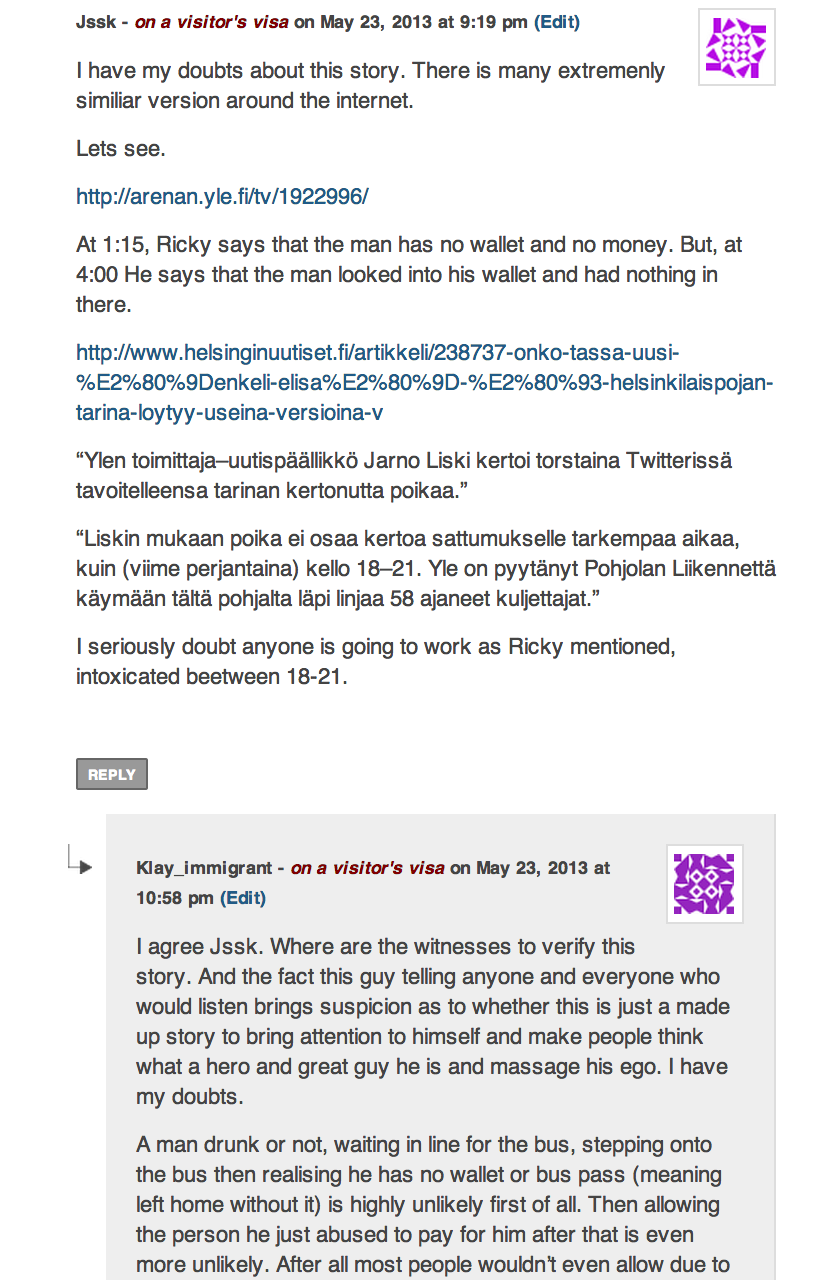
Comments by JSSK and Klay Immigrant on Migrant Tales reveal the suspicion that Ghansah’s account raised in Finland. Klay Immigrant and Jssk accused Ghansah of making up the story.
Writes Klay Immigrant: “I agree Jssk. Where are the witnesses to verify this story. And the fact this guy telling anyone and everyone who would listen brings suspicion as to whether this is just a made up story to bring attention to himself and make people think what a hero and great guy he is and massage his ego. I have my doubts.”
In a story on Helsingin Sanomat, Finland’s largest circulation daily, confirmed Ghansah’s account, which he published on Facebook.
About two weeks ago, a man who entered the same bus as Ghansah in Helsinki harassed him in a racist manner. The man forgot his wallet at home and had no money to pay the bus fare. Ghansah bought the man the bus ticket. In gratitude, the man apologized for his rude behavior.
Ghansa asked if the man could apologize a little louder so the whole bus could hear him. He did and the bus passengers clapped their hands in approval.
We must go to the source if we want to challenge intolerance in Finland
Even if the Continuation War (1941-44) and our military alliance with Nazi Germany ended 69 years ago, much of the ethnic ideology that sprung from that period is still alive and kicking. If we are serious about confronting intolerance in our society, we must challenge its many sacrosanct sources.
When I think of Finland’s short-lived and disastrous alliance with Nazi Germany, I see images of Finnish Marshall Carl Mannerheim speaking cordially with Adolf Hitler and SS head Heinrich Himmler. All of this is happening while millions of Jews, other minorities and innocent civilians are being murdered on both sides of the frontline.
One murky chapter of Finnish history that hasn’t been answered is our alliance with Nazi Germany during the Continuation War.
Even if Berlin fell in 1945 after Hitler took his life, his racist views continue to live on in countries like Finland and promoted today by anti-immigration politicians from parties such as the Perussuomalaiset (PS).
In a clear rebuttal to Abdirahim Hussein’s blog entry about the riots in the northern Stockholm neighborhood of Husby, Kai Haavisto of the PS affirms that a New Finn isn’t a Finn. Haavisto has made outrageous claims in the past like solving the refugee problem to Finland with rice exports to Africa and that certain refugee groups should be chemically castrated before being allowed to live in Finland.
While Haavisto’s writings “are his own views,” the PS politician is a good example of how racists in this country see a social construct like the Finn. They see Finnishness as an exclusive club where you not only have to be white, but live hundreds of years in this country.
He writes on Uusi Suomi: “A Finnish citizen with immigrant background isn’t a Finn, his genetic background is foreign. You can never turn such a person into Finns no matter how you look at it. A foreigner is always a foreigner [irrespective if he becomes a naturalized Finn].”
Then Haavisto writes further down the blog entry why he’s a Finn and Hussein isn’t. He claims that his family has lived in Finland for about 400 years.
Nazi Germany and the SS used similar schemes like Haavisto to define aryan ancestry (sic!). As everyone knows, the term aryan was a racist social construct devised by the Nazi regime to exclude, deport and murder other ethnicities and religious groups in Germany.
It should be pointed out that not only were the Nazis racist, but all of Europe. The Nazis, however, used their racist diatribe as a political and geopolitical weapon to wage war and murder systematically six million Jews and other minorities like the Roma and gays.
With the passage of the Nuremberg laws of 1935 under Nazi Germany, a Jew was a person who had at least three Jewish grandparents who had been enrolled with a Jewish congregation. The Nazi regime had a very clear classification system to define who was Jewish. Haavisto and many others speak in the same race-and-blood terms.
It should be pointed out that it’s not the aim of a new Finn to become white. On the contrary, Finnish identity is and always has been diverse. The mere fact that over 1.2 million people emigrated from this land between 1860 and 1999 is ample proof of the latter.
A non-white Finn has the same right as a white Finn to be accepted and be treated as an equal member of this society.
Migrant Tales Literary: Black shirt

I need a few balck shirts now
I only have one and my mom’s gone
I need a few more i need to change
Who r u mom – where are you?
I need to comb my hair but i can’t
Come on mom do it for me, i need you
After seven years you opened ur wings
So sorry i only have broken songs to offer
My tears come and go, i can’t hide them
What have you done? Dont leave, don’t go, please: NO!
I want talk to you, i really need to
Who taught you to leave? I disagree, but to whom?
I love your heart, i love your words
I need to hug you, I miss your calls.
Especially now, i’m a mourner but still don’t get it – why?
I can’t accept it, you are the best part of me
Oh i need your help, where are you, mom?
Who can buy me a balck shirt now, tell me who?
U rise higher, higher and highest
But i’m here below with a hunter
Now my colour turns to a repulsive yellow
But you’re colourless, oh mom: HELLO!
I’m not dizzy but in deep shock
No/one is here, no/one can make this work
I need your smile… don’t go too far
Come touch my fingers you’re my star
My self feels alone, my blood runs away
you are my essence,i need to join you
I need u need u, i need to join you.
Suomalaisuuden liitto: Seeing Finland through blue eyes
Suomalaisuuden liittto, an association taken over by the Perussuomalaiset (PS) party to lobby against Finland’s ever-growing cultural diversity, condemns in a statement death threats to leading figures of the Finnish Swedish-speaking community.
While it is a good matter that the association’s chairman Sampo Terho condemns such death threats, it is quite another matter if we should take his words seriously. Should Suomalaisuuden liitto take instead a bold look at itself in the mirror and ask if it is somehow responsible for stoking the flames of intolerance against our Swedish-speaking community?
Together with Vapaa kielivalinta and the youth associations of the PS and National Coalition Party, Suomalaisuuden liitto has launched a campaign to demote Finland’s second official language to elective status at schools.
What kind of an association is Suomalaisuuden liitto? How many non-white Finns does it have on its board? None. The association sees Finland exclusively through blue eyes.
One of the pet issues that the PS like to attack is affirmative action. Why? Because they are colorblind. Source: The Sociological Cinema via Annie Hayford.
This is not the first time that death threats have been sent in Finland. Feminists, researchers and even Migrant Tales have been intimidated in such a questionable manner. There is a pattern, however: Those that promote or research cultural diversity are likely to get death threats in this country.
It’s clear by the PS’ and Suomalaisuuden liitto’s track record that they’re not too happy about Finland’s every-growing cultural diversity, which they see as a threat. This is one reason why we should treat Terho’s words with tweezers.
Check out how one PS MP played down the death threats while another one, former police chief inspector Tom Packalen, thought it was a bad idea to publish it as news on the country’s largest daily, Helsingin Sanomat, even if one of the daily’s managing editors was threatened.
Here again we see an old stunt by the PS: condemn racism but give it simultaneously a pat on the back.
Attaching little importance to intolerance speaks volumes as well.
Should we be worried by the exclusive white nationalism promoted by PS-run associations like Suomalaisuuden liitto? Certainly, but time has a magic effect and is ruthless with those who like to remain anchored in its stuffy corridors.
Those that don’t want to accept the fact that Finland never was, is, or will be just a “white” society, will eventually turn into museums where future generations can see with astonishment how some Finns thought about diversity a long, long time ago.
Migrant Tales turns six years today
Migrant Tales celebrates its sixth year as a blog today. Our blog has grown from a humble voice to one that gets noticed in Finland and abroad.
Our aim is a simple: Migrant Tales is a blog community that debates some of the salient issues facing immigrants and minorities in Finland and elsewhere. It aims to be a voice for those whose views and situation are understood poorly and heard faintly by the media, politicians and public.
Our blog’s existence hinges on challenging intolerance in all shapes and forms in this country and elsewhere.
As long as intolerance is a problem, Migrant Tales will be there.
Ombudsman for Minorities responds to Migrant Tales’ queries concerning phone operators and insurance companies
Migrant Tales spoke recently to the office of the Ombudsman for Minorities about two cases by Finland’s mobile phone operators and insurance companies. We asked as well if using the term students with immigrant backgrounds, or maahanmuuttajataustainen, at elementary and middle schools was discriminatory.
The term maahanmuuttajataustainen appears to be so common in some Mikkeli schools that they refer to such students with the acronym “MMT.”
If you feel that you are discriminated because of your ethnic and/or national background, the Ombudsman for Minorities is a good place to inquire about such matters from Monday to Friday from 10-noon at 071 878 8666.
In an email dated May 13 to Ombudsperson for Minorties Eva Biaudet and Rainer Hiltunen, ombudsman head of office, I pointed out the three above-mentioned cases.
The Ombudsman for Minorities gave the following responses in a telephone interview:
Mobile phone operators can in principle ask for a deposit if the person doesn’t have a credit history in Finland. This rule should not only apply to immigrants but to everyone who lives in Finland irrespective of the person’s nationality.
One of the solutions that the Ombudsman for Minorities gave was for the potential customer to ask the phone operator if it was possible to provide a credit history from the person’s last country of residence.
On the second mater concerning residence and language requirements by insurance companies, the Ombudsman for Minorities said that such cases are still ongoing. The cases and sources supplied by Migrant Tales would be given to the department in charge of negotiating these matters with with insurance companies.
The final matter, whether it was discriminatory for elementary and middle schools to openly call third-culture children ”students with immigrant backdgrounds” was discriminatory, the Ombudsman for Minorities asked what better word could be used in place of maahanmuuttajataustainen.
At some learning institutions the term ”immigrant” or ”person with immigrant background” has been dropped and replaced by “mulitucltural student.” Even if this isn’t the best term, it’s much better than immigrant or person with immigrant background.
It’s clear that the terms used to label immigrants, their children and visible minorities can fuel discrimination and promote inequality. By labelling a person who was born in this country or who has lived most of his or her life in Finland a person with immigrant background is making the following affirmation: Your not equal to me because I’m a native and you’re a foreigner.