Abdulah, whose life as a Somali Finn has appeared in previous stories on Migrant Tales, was especially troubled by a news story published this month about the sharp rise in deportations of convicted and undocumented immigrants. According to YLE, the number of deportations from Finland have risen sharply after the Sello Mall killings of December 31, 2009.
Last year alone, the Finnish Immigration Service (FIS) deported over 270 people. That’s about 50 more, or a 22% rise, from 220 deportation in 2011.
The Sello Mall killings, which took place at a crowded mall in the Espoo suburb of Leppävaara, was carried out by Ibrahim Shkupolli, who murdered five people before taking his life. Read full story here.
FIS denies that there is a connection between the rise in deportations and the killings that took place at Leppävaara about four years ago.
For Abdulah, who has applied since 1999 five times without luck for Finnish citizenship, the news about the rise in deportations was a source of concern for a number of reasons. Apart from reinforcing his view that Finland has become an ever-intolerant and xenophobic country to live in, it apparently worsened his chances of getting citizenship.
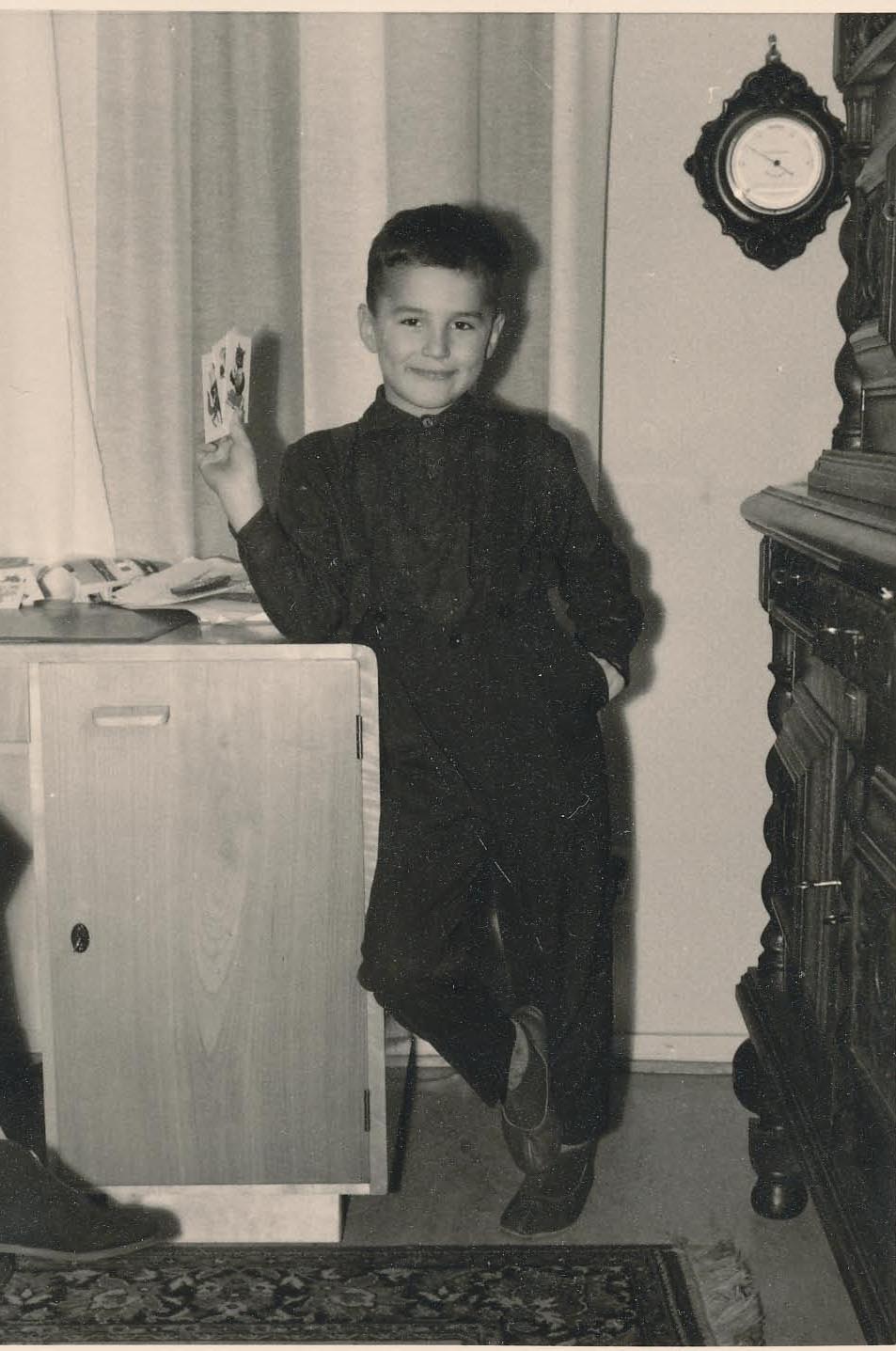
“I moved to this country when I was seven years old and have lived here for over twenty years,” he said. “Finland is my home country. I speak Finnish better than the language of my parents.”
Abdulah, who says Finland became a more racist country especially after the Perussuomalaiset (PS) party won the 2011 elections, claims that his human rights are being violated because he’s denied citizenship. He’s gets the following standard explanation every time his citizenship application is turned down: “Your behavior [in this country] hasn’t been above reproach.”*
The Somali Finn, who is presently unemployed, said that applying for citizenship is expensive costing 450 euros.
“Is my destiny in Finland to live as a permanent outsider?” asked Abdulah.
“That’s a lot of money for me,” he continued. “I saved up the money for a whole year. I ate cheap food like macaroni, spaghetti, tuna fish flakes, ground meat that was on sale and two slices of bread before going to bed. Your body suffers because it doesn’t get enough protein.”
Breakfast was never a problem for Abdulah since you can buy porridge at the market for less than a euro.
Abdulah said that in a six-year period he was sentenced five times by a court. Four times for fighting in public and once for attempted robbery.
He claims that he was sentenced unjustly.
“Back then, I was young, naive and lacked a father figure since my dad died just before 1999,” he said. “I should have just stayed at home and not hang out with the wrong people. I should have understood that Finland is a very racist country and that the system, the police and the courts are stacked against you.”
Abdulah said that in one case where he took part in a fight, a group of skinheads attacked him and his friends. The police came and he was arrested even if it the skinheads started the fight.
“Once I was accused of being in another fight,” he continued. “The white Finn claimed that we started it but the police believed his word against ours even if he didn’t have any witnesses. The police treated me with disrespect. Once they locked me up at a police station and addressed me all the time with the n-word.”
Abdulah admits that one can make mistakes when you’re young. But he’s today a changed man.
“Back when I was young, I looked for acceptance,” he said. “I couldn’t find it in society, which was hostile to me, or among my family.”
“As I mentioned, I lost my father and lacked a father figure as well,” he continued. “If I could, I would challenge those cases against me. I was sentenced unjustly. Sometimes I didn’t have access to a lawyer. Being black and a Somali in this society meant that you were already guilty before the trial began.”
Another part of Abdulah’s dilemma in Finland hinges on what so many children of immigrants experience, living in between two cultures. For those who have experienced it, it’s like living in a land between Nowhere and Somewhere for some.
“Being from a culture that you used to identity with and from another one that doesn’t accept you really mixes up your sense of who you are and it’s depressing,” he said. “Not being able to get citizenship only reinforces that feeling of estrangement.”
Racialization, or ethnicization, is a sociological concept that ascribes racial or ethnic identities to a relationship. In simple terms it is the way that a dominant group ascribes an identity on minorities in order to dominate them. In Finland this is so common that our nationality is mentioned on our drivers license even if we’re Finnish citizens.
On the third line of my drivers license after name and surname, there’s my date of birth and place of birth. In my case it’s ARG, or Argentina.
I was born in Argentina but grew up in California and lived in cities like London and Helsinki when I was a minor. Why aren’t these reflected on my drivers license?
This practice smells of Helena Eronen’s suggestion that immigrants should start wearing sleeve badges and what the Nazis did when they obliged Jews to sew the Star of David on their clothing.
The question is why do we have to have this information on our drivers license?
Does the information give the police who stop you more information about your background? Does it encourage ethnic profiling and make the difference whether you’ll get off with a warning or a ticket?
Why is it anyone’s business to know where I’m from? What about if I show my drivers license to a shop keeper as ID? Why should he or she know where I was born?
The Finnish state and its employees like the police, who are paid to serve us, appear to be obsessed by race and blood as well as ethnicity. Since this information appears to be crucial to them, why not include sexual preference? Why not classify Finns according to the region they were born or which ethnic group they belong to?
Instead of encouraging inclusiveness, these types of practices are one of many ways that the Finnish state continues to remind you that you aren’t an equal member of this society.
My son asked me Friday an interesting question that revealed what is wrong concerning the present debate on immigration and immigrants in Finland. He asked me to show how does immigration fuel economic growth. His question, which is a valid one, reveals some of the perceptions that some have about immigration.
Due to the attention that anti-immigration politicians have received in the media, coupled by the silence and lack of leadership from the majority of politicians, many actually believe that the majority of foreigners in this country are refugees, Muslims, from Africa and here only to live off welfare.
Some, like MPs of the Perussuomalaiset (PS) party, play on our worst prejudices and fears by claiming that Muslims are invading Finland and Europe in Trojan horses. It’s only a question of time when ghettos will be set alight by ethnic strife, according to them.
Tabloids like Ilta-Sanomat continue to spread racism in Finland. This billboard of 1992 claimed that Somalis “tricked” authorities to pay phone bills costing hundreds of thousands of Finnish marks. In that period, you could buy a row house in Helsinki for 500,000 marks. Billboard source: Institute of Migration
Facts reveal a very different picture, however. Finland has today fewer refugees than in the 1920s, when some 35,000 refugees from Russia lived in our country. In 2012, a mere 3,219 refugees applied for asylum but only 1,601 were accepted versus 43,900 in Sweden, according to the Finnish Immigration Service.
Moreover, 9.1% of all people who were born abroad and are residents of Finland are from Africa (25,895). The majority, or 64% (182,696), are from a European country.
A news story by Helsingin Sanomat on Friday showed how lopsided the present debate on immigration and immigrants is in Finland. The story revealed that our country accepted 149 Syrian refugees last year compared with 14,600 in Sweden.
There is nothing wrong with immigration from Africa as there is nothing wrong with immigration from Latin America, Asia, North America or from other European countries. What is wrong and unacceptable, however, is how such a distorted picture of immigration continues to be maintained.
This proves, in my opinion, that the media has been led more by its prejudices than its journalistic standards, politicians by their opportunism than leadership, and the general public by their apathy on the topic. The most shameful matter is that few are doing anything to bust such myths.
It’s possible to understand this situation from a historic perspective since Finland did everything possible up to 1995, when we became an EU member, to hinder as much as possible immigration and foreign investment to this country.
This suspicion of the outside world can be explained in part by our difficult relations with the former Soviet Union. Even so, it can’t suffice as the whole answer. How can a nation that lost over 1.2 million of its countrymen to emigration during 1860-1999 house such suspicious attitudes towards immigrants?
Going back to the question that my son asked Friday, I told him that it’s highly doubtful that his father, grandfather, great grandfather and great great grandfather, who were all immigrants, ever discussed how negative or harmful immigration is to society. On the contrary. Immigration is a positive phenomenon that brings new blood, new ideas and new strength to a country.
“The fact is simple,” I continued, “the whole idea of migrating from one country to another is opportunity and the search for a better life. This is the case irrespective if you migrate for political or economic reasons.”
Recent calls by the head of the Government Institute for Economic Research (VATT), Juhanna Vartiainen, and the Confederation of Finnish Industries (EK), that Finland needs more labor immigrants, has been met with skepticism by SAK, the central organization of Finnish trade unions.
According to SAK, immigration isn’t a solution to labor shortages because it would lead to two labor markets, according to YLE in English.
Any sensible person understands that the aim of immigration shouldn’t be to drive down salaries and rollback important gains and rights achieved for employees by our labor market. If Finland’s immigrant population grows in the future, as it will, it should be the job of the labor unions and authorities to ensure that the rights of every employee, including immigrants, aren’t compromised by abusive employers.
A recent article published by Forbes magazine, offers us sobering advice on what to avoid in Finland and Europe on the immigration front.
“Attempting to fence off the country is no answer to anything. It would be difficult for a generally free society with extensive borders to close out the rest of the world. Worse, to be effective such controls as ID cards, citizenship checks, workplace raids, employer sanctions, and more would undermine domestic liberties.”
One important step that we must take in order to debate fairly and in a proactive manner about our ever-growing cultural diversity, is bust those terrible and destructive myths that distort the debate on immigration and immigrants.
Maintaining alive such myths is damaging to our country economically, politically and socially. We will end up paying a hefty price if we don’t in the form of lower living standards and loss of competitiveness.
After following on a daily basis news about cultural diversity in Finland and elsewhere, the stories that Migrant Tales aims to cover in 2014 are those stories that the mainstream media doesn’t consider news.
One reason why the mainstream media still writes about cultural diversity from it’s perspective is because those writing the stories are mainly white. It’s especially difficult for some who are white to grasp how destructive a social ill like racism is if it doesn’t affect them directly.
While this may be the case, it doesn’t imply that you cannot learn. Learning, which enables you to understand the dynamics of intolerance, will help you to write better stories about migrants and visible minorities. The way to do this is to hear the opinions of migrants and minorities.
In the United States, the U.S. abolitionist movement of the nineteenth century wasn’t only led by blacks like Frederick Douglass and Harriet Tubman, but by white U.S. Americans such as William Lloyd Garrison, John Brown, Garrett Smith and others.
I had an interesting chat before the New Year with Mikko Kapanen, a Migrant Tales associate editor. He made an excellent suggestion on how more immigrants, especially those with poor Finnish or Swedish language skills, should be heard more by the government and public officials.
Kapanen said that usually the best-adapted migrants, who speak fluent Finnish or Swedish, are the ones that are heard by public officials. Even so, we should be listening more closely to those that aren’t as fluent in the two official languages of this country.
Another matter that gives us a distorted view of the plight of immigrants is that most of those that head anti-racism associations are white. I’m certain that many do their work diligently. Even so, more representatives of the migrant and visible minority community are necessary in leadership positions.
Another odd matter that I’d like to point out is how people are labelled by the majority. How come people like Nasima Razimar, Ali Jahangiri, Arman Alizad, Fatbardhe Hetemaj and others who have grown up in this country are not only portrayed, but allow themselves to be labelled “persons with immigrant background?”
Shouldn’t these people, who are public figures, be promoting our ever-growing culturally diverse society and that there are many types of Finns with different backgrounds? By permitting the white media and society to label you as something “foreign,” which is fine in some cases but suggests that you aren’t equal because you aren’t white enough, is to place obstacles and hinder the process of acceptance of tens of thousands of Finns who don’t have white Finnish backgrounds.
I was recently interviewed in December by a reporter from YLE. He wanted to do a short interview about what Finland’s independence meant for me as a foreigner. I told the reporter that I’m not an immigrant but a Finn.
I’m a Finn because that is one of the identities I have. I am a Finn legally because my mother is a Finn and because I am a citizen of this country, I said.
For most of my life in this country, I have allowed people to label me as a half-Finn or as a foreigner from Argentina or the United States.
We, who are multicultural Finns, or Finns with culturally diverse backgrounds, are a rapidly growing minority numbering in the tends of thousands. Our power lies in understanding that we are Finns, not half-Finns or so-called people with immigrant backgrounds. We’re real people and just as Finnish as anyone else.
At schools some of us, who have lived all of our lives in this country, are unfairly labelled and treated as “children with immigrant backgrounds.” Such a label, which denies children of different ethnic backgrounds the right to be treated as Finns on their cultural terms or due to their ethnic backgrounds, is unfair because it promotes social inequality.
These are some of the topics Migrant Tales would like to write on this year.
The Migrant Tales team wants to take the opportunity to thank all of our readers and supporters.
This beautiful drawing was by Luis Blanchard in Argentina.
We look forward to another good year in our struggle to promote in Finland a culturally diverse society that is united by mutual acceptance, respect and equal opportunities.
Perussuomalaiset (PS) Euro MP Sampo Terho, who is also the chairman of Association of Finnish Culture and Identity (Suomalaisuuden liitto), claims in a recent blog entry that his association has been the target of vicious attacks by the media, which have accused it of being narrow-minded, hate-mongering, one-sided association that spreads hatred of minorities.
Surisingly, Terho claims that such criticism of his association is synonymous with hate speech.
If we are serious and critically honest with ourselves, it’s Suomalaisuuden liitto that has spearheaded a vicious campaign against Finland’s second official language, Swedish, and done everything possible to hinder the rightful acceptance and respect of our cultural diversity.
What kind of an association is Suomalaisuuden liitto? How many non-white Finns does it have on its board? Does it ever speak of cultural diversity without seeing it as a threat to this country?
Associations like Suomalaisuuden liitto bear a striking resemblance to Don Quixote. Just like the Spanish literary hero of the early seventeenth century who attacked windmills, associations like Suomalaisuuden liitto can deny our cultural diversity for as long as they wish by not recognizing or demonizing it as something “them” and “foreign.” They can do this but not forever.
A warning to Suomalaisuuden liitto: If you don’t care to grasp that we are, and have always been, a culturally diverse society, it is you that will be relegated to the dustbin of history.
In order to understand the dynamics of intolerance in Finland and elsewhere, speaking just of racism is one matter. Cultural diversity is the real issue, which is the well from which intolerance springs.
This year’s Finland & Cultural Diversity 2013 report by Migrant Tales reveals something that we’ve known all along but had difficulty challenging: Accepting others who are different from us as equals.
This is unfortunate considering that we have all the legal means to do so. Our Constitution guarantees cultural diversity and sees discrimination as a crime.
One of the reasons why intolerance isn’t still taken seriously in Finland is because of the factors that have led to our lack of cultural diversity. It’s very difficult, although not impossible, for the media, politicians and public to grasp the adverse nature of intolerance if you’re white.
A good indication that we are stuck in the same spot we were a long time ago is how some Finns see the “other,” which are rarely accepted and labelled as Finns but a variety of odd names from “people with immigrant backgrounds” to “mamu,” a Finnish name for Uncle Tom.
Apart from not being accepted as Finns, even if they were born and grew up in this country, nobody tells you or gives you a hint on how many generations you’ll have to live here in order to be accepted as a Finn.
We don’t need to search for an answer to the latter question. The Romany minority, which has lived in Finland for about 500 years, offers us a disturbing answer on acceptance.
All of the labels used to classify our cultural diversity and different groups in Finland don’t promote social equality but reinforce social inequality. The only term that comes close to promoting social equality is New Finn.
One of the first and foremost steps that we must do in order to change the “us” and “them” mentality in Finland is throw most of the ethnic labels, which are placed by the majority on the minority, into the dustbin.
According to Finland & Cultural Diversity 2013 report, this year’s overall grade* for promoting and defending cultural diversity in this country was between +5 and -6 in 2013 versus +5 in the previous year. Five of the eight members of the Migrant Tales editorial board had mixed feeling about the final grade: three gave the country a 7, while two gave it a 5 and 4. An average score on cultural diversity is a modest result.
Read Finland & Cultural Diversity 2013 report here.
* The grade given to Finland shows how the majority of Migrant Tales’ editorial board sees how well the country is promoting and defending cultural diversity. Grading scale: 10 (excellent), 9-8 (very good), 7-6 (average), 5-4 (below average), and 3 (fail).
Compared with the previous two years, 2013 will be remembered as business as usual on the intolerance front. A positive sign, however, is the reaction of some of the Finnish media to racism. Even so, the media in this country continues to give some racists inflated respectability and importance by spreading their prejudice.
The reaction of the media to intolerance in Finland not only reveals that there is racism in this society, but a lot of it since it is being exposed more boldly than before.
Hats go off in November to Lieksan Lehtieditor-in-chief Marja Mölsä, who published a story of a city councilman of the Perussuomalaiset (PS) party who said he doesn’t want his group to meet in the same room where Somalis hold their meetings. What the councilman said is disgraceful and unacceptable, but saying it as if it were the most normal thing in a room full of other people is what is so surprising and revealing.
While it still is apparently “normal” to make racist comments with impunity with colleagues and friends, we need to stand up, like Mölsä did, and expose the ogre like Dracula to deadly sunlight. This is exactly what happened in many parts of the United States after the Civil Rights Movement. Racist behavior changed from normal to shameful.
Even if there are encouraging signs that the Finnish media is reporting more discrimination and racism cases, a good example of how things should be done was when BBC’s Stephen Sackur of HARDtalk pinned PS chairman Timo Soini on racism in his party. One reason why the Finnish media has treated the PS with understanding is because it is white and because racism doesn’t affect its journalists and most of its readers.
BBC teaches the Finnish media how to challenge Soini on racism. Are Finnish journalists accustomed to making hard questions? If it isn’t common, it should be. See interview here.
One very interesting case that we have been watching with keen interest is that of Sikh bus driver Sukhdarshan Singh, who is still struggling with his employer to have the right to wear a turban at work. This case is a watershed in this country since it addresses the heart of the issue of intolerance and how to move forward: accepting cultural diversity and people who are different from the majority.
Finland’s overall grade* for promoting and defending cultural diversity was between +5 and -6 in 2013 versus +5 in the previous year. Five of the eight members of the Migrant Tales editorial board had mixed feeling about the final grade: three gave the country a 7, while two gave it a 5 and 4. An average score on cultural diversity is a modest result.
* The grade given to Finland shows how the majority of Migrant Tales’ editorial board sees how well the country is promoting and defending cultural diversity. Grading scale: 10 (excellent), 9-8 (very good), 7-6 (average), 5-4 (below average), and 3 (fail).
First quarter (January-March)
Umayya Abu Hanna’s opinion piece published in the end of December on Helsingin Sanomat, Finland’s largest daily, which was expanded by Mikko Koponen on Migrant Tales, evidently touched a raw nerve. Like many well-written pieces about intolerance in our society, the story behind the story of Abu Hanna’s opinion piece was the reaction to it.
Apart from tabloid Ilta-Sanomat editor Ulla Appelsin, who took the story personally and tried to show how ungrateful Palestinian-born Abu Hanna was for all that she had got in Finland, others like Anu Uhtio, chairwoman of The Adoptive Families in Finland association, tried to play down her personal view of how racism had affected her life and that of her adopted daughter. Throughout the year, Migrant Tales has published a number of stories that have been widely. All of them have been on the topic of racism.
By far the most popular posting by Migrant Tales everis “Are you a victim of racism in Finland?” It was published in June 2007 and has attracted over 1,500 comments and over 24,600 visits.
Taking into account how the Finnish media fell for the racist discourse of some PS and other mainstream party politicians before the April 2011 elections, it is a positive matter that dissenting voices are emerging thanks to women like Abu Hanna, Maryan Abdulkarim and Fadumo Dayib.
Despite such positive signs and voices, the atmosphere in Finland is still negative especially towards some immigrant groups never mind cultural diversity in general. A clear sign that matters are moving in the wrong direction was when Kansalinen Vastarinta, a neo-Nazi group, barged in a book presentation far-right extremism in the end of January in the central Finnish city of Jyväskylä.
Researchers of the University of Eastern Finland who study racism and multiculturalism voiced concern over threats they have received. Read full story here.
Another distressing news story that was published in February came from researchers at the University of Eastern Finland, who had received death threats and hate mail. Antero Puhakala of the Negotiation Organization for Public Sector Professionals was quoted as saying on YLE in English:
“Our researchers into racism and multiculturalism have been subjected to threats. Anonymous threatening letters have been posted to their homes and researchers have faced abuse on Facebook. Complaints regarding the activities of researchers and teachers have been filed with the vice-chancellor or to a higher authority.”
Certainly we shouldn’t be intimidated by such threats because that is exactly what such people, anonymously, want you to do. Even if such threats are disturbing, they should embolden us to be more outspoken on a social ill like racism. Moreover, can you ever “debate” with such people who are so disrespectful of your right to express yourself? Can we and should we debate why group x should have less rights in our society? Shouldn’t we be debating the opposite, or equal rights for all members of our society?
Migrant Tales reported in March about a black train cleaner working for the state-owned railways company, VR, who was violently attacked by two men in the northern Finnish city of Kajaani.
Another story that was reported from the city of Vaasa was about city councilman Risto Helin, who got off with a warning from the PS for giving a Hitler clock as a present to a neo-Nazi club in that city. Helin wasn’t sacked from the party.
Second quarter (April-June)
While some of the members of Migrant Tales‘ editorial board felt that PS MP James Hirvisaari’s expulsion from the party in October was the biggest news on the cultural diversity front (see third quarter below), two important events that should be mentioned are Ali and Husu’s radio show on YLE that kicked off in January, and a landmark turban case.
Sikh bus driver, Gill Sukhdarshan Singh, has challenged his employer, Veolia Transport Vantaa, which still prohibits him from using a turban at work despite two recommendations by the the Southern Finland Regional State Administrative Agency (Avi), which saw the ban as discriminatory.
According to Sukhdashan Singh, the employer didn’t tell him directly whether he would be allowed to use the turban at work or not from the end of September, the deadline imposed by Avi to resolve the dispute. The Sikh busman announced in December that he will take the matter with the AKT transport union to court in February.
As many other cases in this country, this one in particular is important since a positive decision would promote cultural diversity at the work place.
The adverse atmosphere for some immigrants in Finland was not only evident at the PS’ annual conference in Joensuu this June, but at the home of Abdirahim “Husu” Husssein, a Center Party politician who hosts the Ali and Husu talk show.
“This is the third time it’s happened [attacked my home] and there seems to be a pattern,” he told Migrant Tales. “Somebody wrote ‘Binladen was here’ on our door, the second time there was a drawing on my children’s bedroom window of a bomb that blew up and now this.”
The European Commission and other anti-racist groups are watching Finland. Concern for hate mail and death threats to Swedish-language journalists and public figures in this country was voiced by European Commission Vice President Neelie Kroes, who cited Migrant Talesas a source.
Kroes wrote that death threats are unacceptable in any democratic society. “But in this case, there is also a particular threat to freedom of speech [in Finland], and to our cultural and linguistic diversity,” she wrote.
As a sign of recognition for the work that we do at Migrant Tales, we participated in April in a German Broadcasting Company program on hate speech. Our stories have been cited and picked up by Sveriges Radio, YLE’s Suora linja, UNHCR in Greece, Time Magazine and many thers. The BBC and TV4 of Russia have gotten in touch with Migrant Tales as well.
As our popularity as a forum has grown from our humble beginnings, which they still are, so have the attacks by those who want to silence and discredit us. The stronger such Islamophobic, anti-Semitic, anti-Roma and anti-cultural diversity groups become, the stronger Migrant Tales becomes. We don’t receive any financial support from anyone and are true to our main goal: Aiming to be a voice for those whose views and situation are understood poorly and heard faintly by the media, politicians and public.
Why does Migrant Tales exist? Because Finland is our home and because we want our children and grandchildren to grow up in a country where intolerance is the exception, not the rule.
We have never hidden our criticism of anti-immigration parties in Europe and Finland. And we don’t plan to budge on this important issue since giving in to their intolerance would be the same like digging our own graves and accepting that we are second- and third-class citizens.
A good video published on International Migrants Day (December 18) stated what we’ve been saying all along: “When the rights of others are denied, the rights of citizens are at risk.”
Apart from some stateless persons having a difficult time opening a bank account in Finland, never mind getting access to online banking, EU citizens are discriminated as well when trying to get a mobile phone line or life insurance. For example, Nordea requires immigrants to have five years residency in a Nordic country and speak fluently Finnish or Swedish in order to be eligible for life insurance.
The Ombudsman for Minorities responded to Migrant Tales about such issues and how it planned to resolve them. If an immigrant or visible minority believes that he or she is being treated unfairly by the authorities or a company, it’s important that he or she gets in touch with the Ombudsman for Minorities.
The only way that intolerance can be challenged in a country like Finland is tireless work exposing the social ill and, importantly, finding proactive solutions.
Never losing an opportunity to take a swipe at immigrants and visible minorities in this country, PS MP Vesa-Matti Saarakkala commented in June about the riots in Husby, Sweden. He suggested that immigrants with “behavior disorders” should be interned for a half a year at a camp to learn how to behave in our society.
Apart from the media labeling the rioters as “immigrants,” reveals a lot about the present state of social exclusion in Sweden and how some in that country see second-generation Swedes as “foreigners.” Social exclusion was one of the factors that sparked the riots in Sweden, according to Racism Review.
The European Network Against Racism (ENAR) said in a statement that it condemned the violence used by rioters but blamed the ongoing institutional violence of successive Swedish governments, which have chosen not to address the deep-rooted causes of exclusion plaguing Swedish society today.
While some MPs like Arto Satonen of the National Coalition Party gave some suggestions on how to avoid the same types of riots in Finland, Abdirahim Hussein said that the same could happen in this country in 10-15 years if we commit the same mistakes.
Migrant Tales agrees with Hussein. Not enough is being done to promote social inclusion. We are sowing the seeds of our social problems today.
A good piece of news published in the second quarter was about the record number of immigrants who had become Finnish citizens in 2012, rising by 4,530 to 9,090, according to Statistics Finland. Ricky Ghansah showed us as well how kindness can go a long way to humble a racist on a bus.
Third quarter (July-September)
By far the three most important stories that had an impact on immigrants and cultural diversity in Finland during the third quarter were the plight of a group of Thai berry pickers, a promise by Magneettimedia, a publication that advertises Kärkkäinen department store products, would stop publishing anti-Semitic writings by the likes of David Duke, and Council of Europe concern over ethnic profiling by the Finnish police.
Other news that had a negative impact on cultural diversity were the elections in Norway in September that gave the right-wing populist anti-immigration Progress Party (FrP) the opportunity to form part of the country’s new minority government with the Conservative Party (Høyre). What happened in Norway could well be the scenario in Finland after the 2015 parliamentary elections.
While matters will not change radically in Norway due to the FrP, the worst that can happen is tightening of immigration policy and a negative political stalemate on how to move forward on the cultural diversity front. The FrP in Norway, like the PS in Finland today, are sending a negative message to their countrymen about immigrants and visible minorities by denying such groups equal acceptance and respect.
FrP, which will be in government for the first time after it was founded in 1973, had as a temporary member mass killer Anders Breivik.
In the Nordic region, FrP is in the same anti-immigration league as the Danish People’s Party, Sweden Democrats and PS. All of these parties are united in the following manner: They are anti-EU, anti-immigration and especially anti-Islam. All use the same rhetoric to hide their loathing for immigrants and cultural diversity in order to appear more mainstream. FrP head Siv Jensen, for example, said in an interview with The Local was that she was against Norwegian immigration policy, not immigrants. As any critical observer can appreciate, such a claim by Jensen is a red herring.
An article by Helsingin Sanomat in September showed that Thai berry pickers, who pay for their plane tickets, insurance and lodging while in Finland, make a mere 2,40 euros an hour. Facing losses and a poor berry harvest, some fifty berry pickers decided to fight for their rights and demand better working condition and security from their employer, Ber-Ex.
It is unclear how the whole matter was resolved and if any improvements will be made offer greater job security to foreign berry pickers. Poor working rights is mainly a result of poor legislation and lack of regulation by the authorities and unions. This has been an ongoing problem in Finland for decades.
Juha Kärkkäinen, the owner of the department stores that carry his surname, announced in early August that he will stop publishing anti-Semitic opinion pieces on Magneettimedia, reported Helsingin Sanomat.
Numerous anti-Semitic articles have been published in previous issues of Magneettimedia. These include:
The Jews Who Control the Media
Who Owns the Media in 2012?
A Great Video Shows What a Cheat Albert Einstein Really Was!
Zionist Terrorism in Norway
CNN, Goldman Sachs and Zionist Control
How to Break Down and Dominate the Zionists
The last two writings were written by former Ku Klux Klan wizard, Duke.
The Simon Wiesenthal Center – Europe expressed concern in a letter to President Sauli Niinistö about the columns that appeared in the publication. Magneettimedia editor and owner Kärkkäinen was fined in October by a Finnish court 45,000 euros for publishing the anti-Semitic writings.
Read full story (in Finnish) here. What is surprising that these anti-Semitic writings can be still read online.
While Kärkkäinen may blame “international Jewish conspiracy” for his company’s financial woes, the anti-Semitic writings are a clear example of how Finland’s intolerance for cultural diversity has grown together with anti-immigration and anti-Islam sentiment.
In the face of repeated denials by the Finnish police and Interior Minister Päivi Räsänen, the Council of Europe’s anti-racism body, European Commission against Racism and Intolerance (ECRI), expressed as well concern in a report that Finnish police ask people’s ID based on ethnic appearance.
The fact that the police and Christian Democrat interior minister deny any wrongdoing concerning ethnic profiling in Finland is highly revealing in itself. Such denials suggest that the contrary takes place and that it is a much wider problem than the authorities want to admit.
The police and the interior minister are, however, adamant: No ethnic profiling goes on in Finland by the police. In the face of such denials, however, the Ombudsman for Minorities has been in negotiations with the police to have in force this year new anti-ethnic profiling guidelines.
Finland’s Muslim community suffered a new act of hostility by PS MP Teuvo Hakkarainen, who claimed in a blog entry in August that the West is being flooded by millions of Muslims and that there are extremists in Turku ready to declare a holy war against Finland.
Hakkarainen is one of many PS politicians who has built his political career by spreading racism. Apart from using the n-word before, he recommended over two years ago that homosexuals, lesbians and Somalis should be relocated to the Åland Islands.
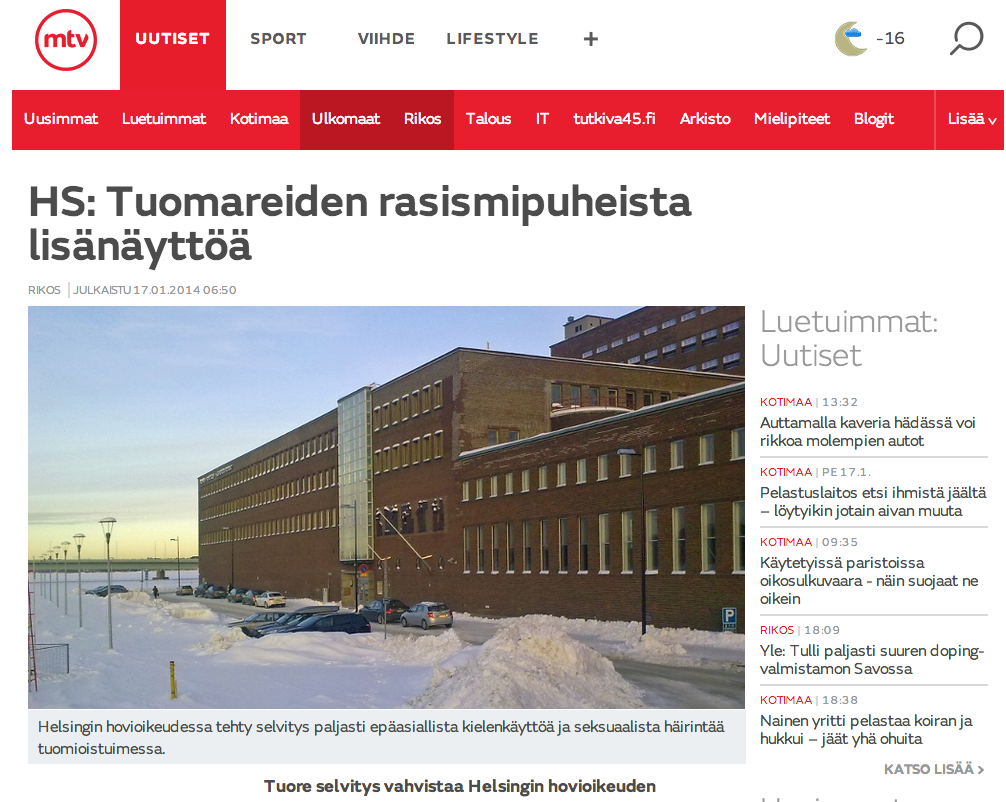
One of the reasons why intolerance has shown itself with such strength in Finland is because there is wide acceptance of this type of anti-social behavior, which manifests itself as institutional racism as well. An internal report, which was obtained and published by MTV3in August, revealed that the Helsinki Court of Appeal judges used derogatory labels for black (n-word), Russians, Jews and gays as well as sexually harassed women at parties.
Despite what the report revealed about the judges, no new stories were published about what steps the ministry of justice took to tackle this type of behavior at the Helsinki Court of Appeal.
There are many ways to skin a racist cat. Just like how Ghansah humbled a racist with his kindness, Abde Hussein wrote on his Facebook wall on September 26 his encounter with a racist on the Helsinki metro. The racist, who accused Hussein of living off unemployment and welfare, was the one who was out of work and living off state handouts. His story on his Facebook wall attracted 10,200 likes, 423 comments and 1,643 shares.
Fourth quarter (October-December)
In the face of former PS MP James Hirvisaari’s ever-erratic behavior in the summer, tweeting in July that a journalist “masturbated wildly” during a telephone interview, Migrant Tales asked back then when he’d be sacked from the party.
About two months later in early October that is exactly what happened: Hirvisaari got expelled from the PS after inviting far-right activist Seppo Lehto to parliament, where he took a picture of him making a Nazi salute. This was the last straw for PS chairman Soini, who was quoted as saying on MTV3 that Hirvisaari would be sacked from the party.
While this was the least that Soini could do, the PS leader attempted to use Hirvisaari as a scapegoat for the PS’ racism issues. Even if Hirvisaari is now the lone member of the far-right Muutos 2011 party in parliament, business is back to normal at the PS.
The picture of Lehto was taken and distributed on social media by Hirvisaari.
Around mid-November, however, another racism scandal broke out in the city of Lieksa, which has been in the national spotlight for some time due to the problems it has had with Somali immigrants.
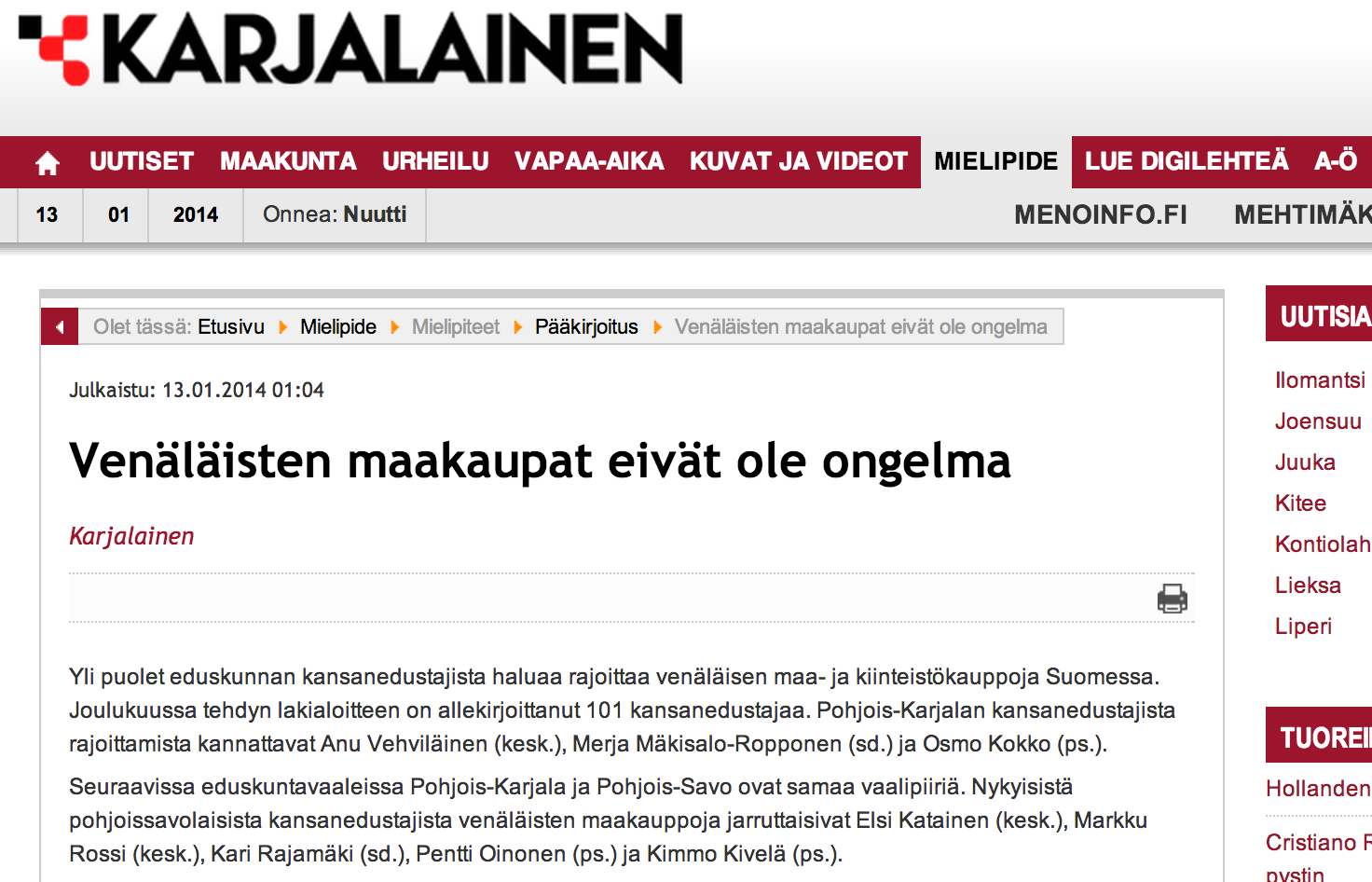
Esko Saastamoinen, the PS councilperson from Lieksa, brought the city back into the national news when he asked for a ”Somali-free” meeting room for his group. As a result of what Saastamoinen said, the PS councilperson was sacked as the party’s city council leader but wasn’t required to resign from the party. He was allowed to keep his post as the city’s board first vice president as well, according to Karjalainen, a Joensuu-based daily.
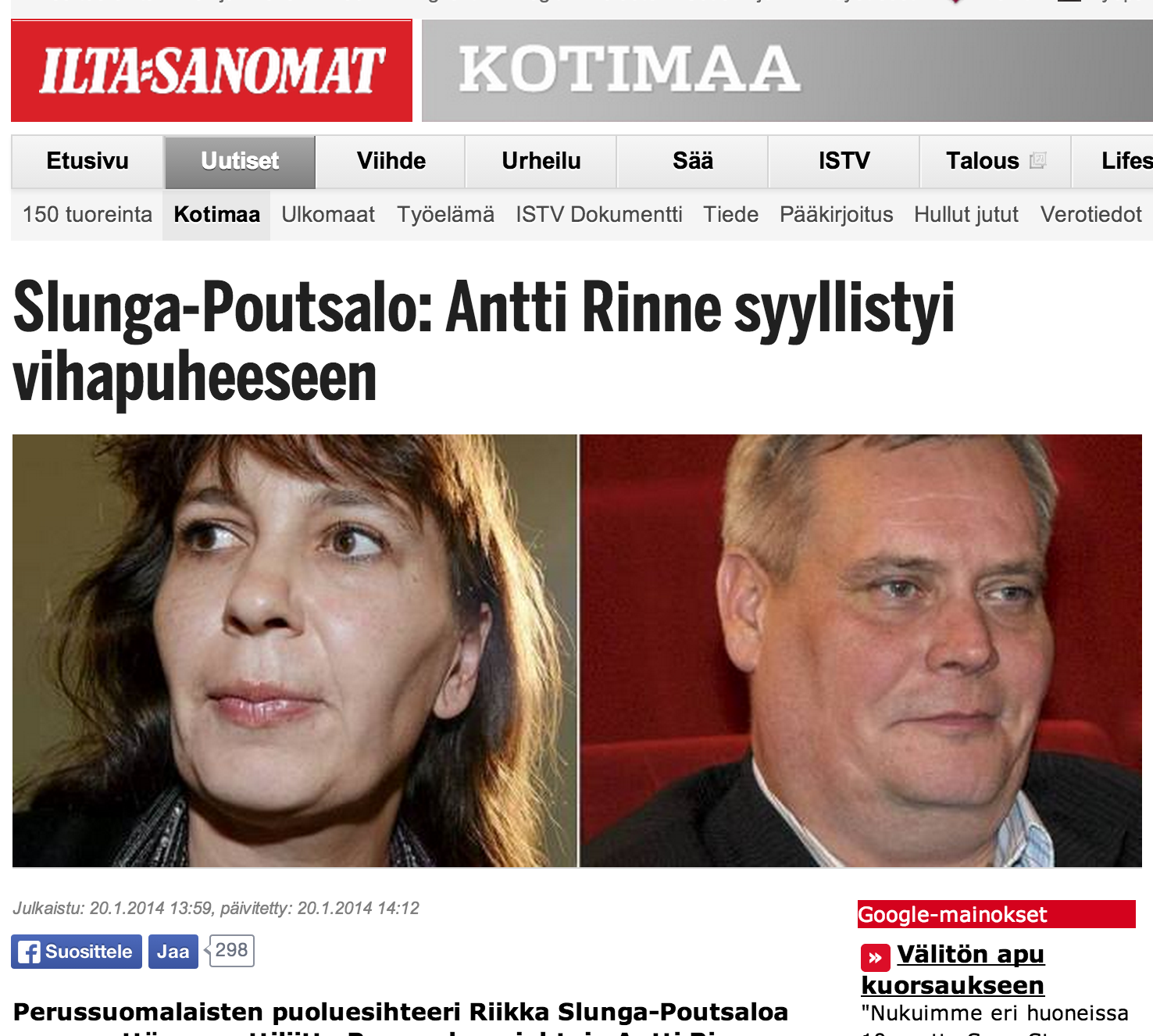
If the Lieksa affair didn’t bring more notoriety to the PS on the racism front, one of its MPs, Olli Immonen, announced a month later in December that he had given parliament a written question that Finland should start registering people according to their ethnic background. Certainly the question we should ask Immonen is why he wants to classify people by ethnic origin in the first place and if there is any use for such a register. What is most surprising about the whole affair is Soini’s silence.
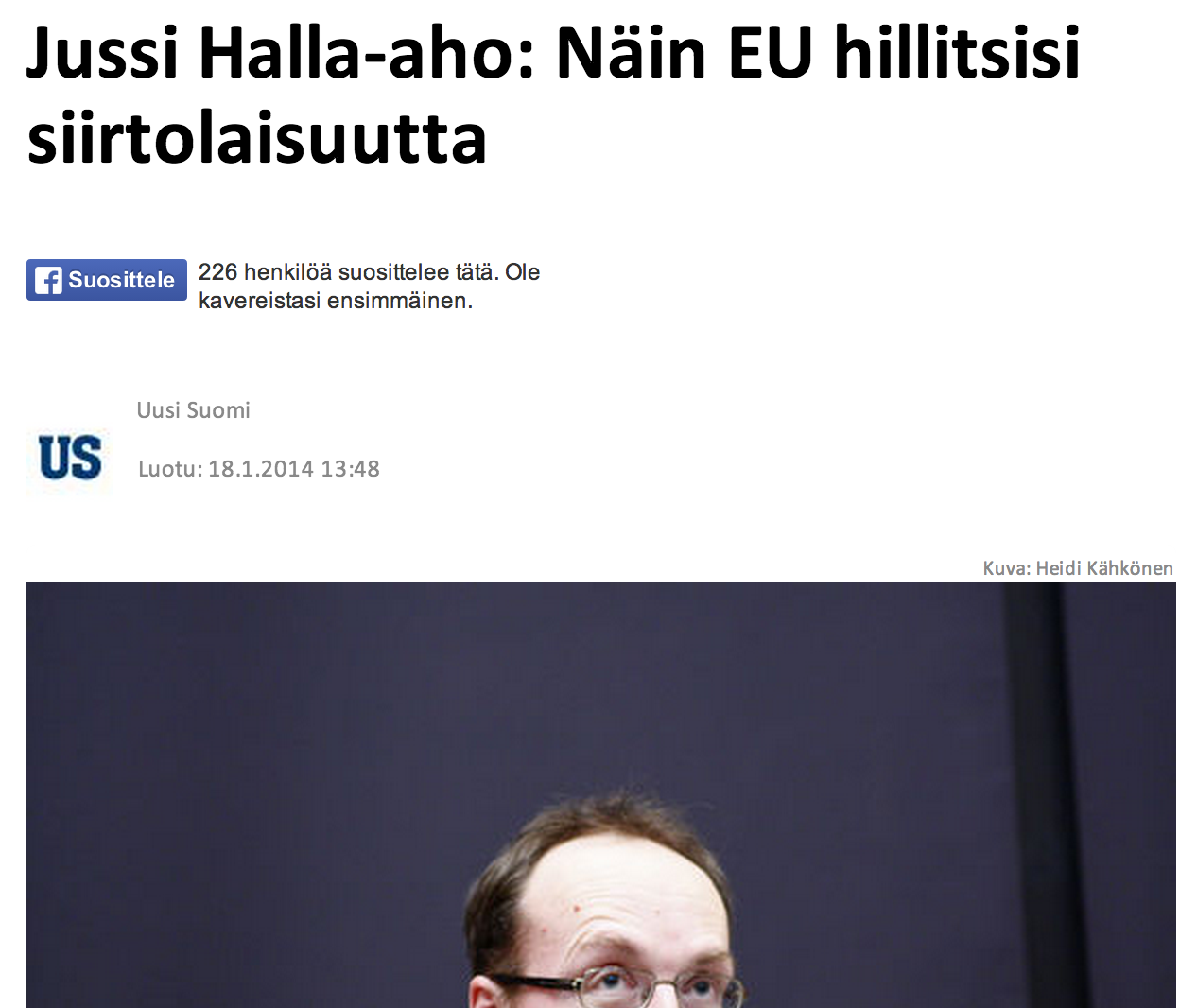
Other news that hit the fan in the last quarter of the year was PS MP Jussi Halla-aho’s appointment as deputy member of the Finnish delegation of the Council of Europe. The controversial nomination of Halla-aho, who was sentenced for ethnic agitation and breaching the sanctity of religion, prompted the parliamentary leaders of seven parties to express regret in a joint statement for the appointment.
Apart from stiff campaigning by Halla-aho and Saarakkala to stop Finland from accepting Syrian refugees, the PS has succeeded in limiting the number of municipalities in accepting even quota refugees. Our country has pledged to accept 500 refugees from Syria, while our neighbor, Sweden, has already granted 16,000 residence permits to refugees from the war-ravaged country.
Suspected hate crimes in 2012 totaled 732, which is a 20.6% fall from 918 cases in the previous year, according to YLE in English. Of the total hate crimes reported to the police last year, 641 cases were classified as racist. Despite the sharp fall from 2012, there weren’t any officials celebrating how hate hate crime have fallen sharply in this country.
Tarja Mankkinen, internal security secretariat head, admitted in November that many racist crimes in Finland go unreported. Thus the lower number of hate crimes reported to the police could reveal mistrust and ignorance that immigrants and visible minorities have of the police and their rights.
Migrant Tales has written in the past how difficult it is to report a a hate crime to the police.
One of the strangest stories that revealed that racism is alive and kicking in Europe was media interest in a white Roma girl in Greece. The case shed light on the plight of immigrants and visible minorities in Europe, because it showed how much we pay attention to skin color and ethnicity. The Finnish police exposed another stereotype in summer that had been relentlessly used by politicians and the media to justify intolerance against the Roma. The police concluded that the Roma that come to beg in Finland aren’t victims of human trafficking or linked to organized crime.
A very good documentary on Silminnäkijä (Eyewitness) by Sam Kinglsey revealed how much ethnic background makes a difference in Finland when trying to look for a job, get housing or enter a night club.
While these types of investigative reporting are important and necessary, their findings aren’t surprising. What is odd, however, is that rarely Finland’s 10,000-strong Romany minority community is asked about discrimination in this country. It’s as if we’re asking the same question over and over again about intolerance hoping not to get the answer we expect and know. Most importantly, we don’t have to challenge this problem in earnest.
Even if there are more voices than before in Finland that are standing up against intolerance, like a march in December where 150-200 people gathered in Helsinki to protest against racism, far-right and neo-Nazi extremists that attacked an anti-racist demonstration in Stockholm, more of these are needed.
News published by the media this year reveals that 2013 was worse than 2012.
Taking into account that an anti-immigration party like the Perussuomalaiset must win the next Euro MP and parliamentary elections in 2014 and 2015, respectively, and that mainstream parties are vying for the same voters, suggests that matters will get worse for immigrants and visible minorities before they improve.
Gill Sukhdashan Singh, the Sikh bus driver that has been denied the right to wear a turban at work by his employer, told Migrant Tales that transport workers union AKT will take Veolia bus company to court concerning the matter.
Helsingin Sanomat, Finland’s largest daily, has been following the story closely. Read full story here.
The decision to take Veolia to court was made after the Southern Finland Regional State Administrative Agency (Avi) stated that the ban by Veolia to wear a turban ban was discriminatory.
The bus company has not changed its position concerning the turban ban despite two recommendations by Avi.
“I’ve been in touch with a lawyer from AKT, which will take this case to court as discrimination at the workplace,” Sukhdashan Singh said. “I’ll be on holiday in January and the case will begin in February.”
The case is one of the most important this year in Finland concerning cultural diversity.
The problems that the Sikh busman faces at work is a good example of how far Finland lags behind other European countries concerning cultural diversity. Sikh bus drivers in England won such rights over forty years ago in 1969.