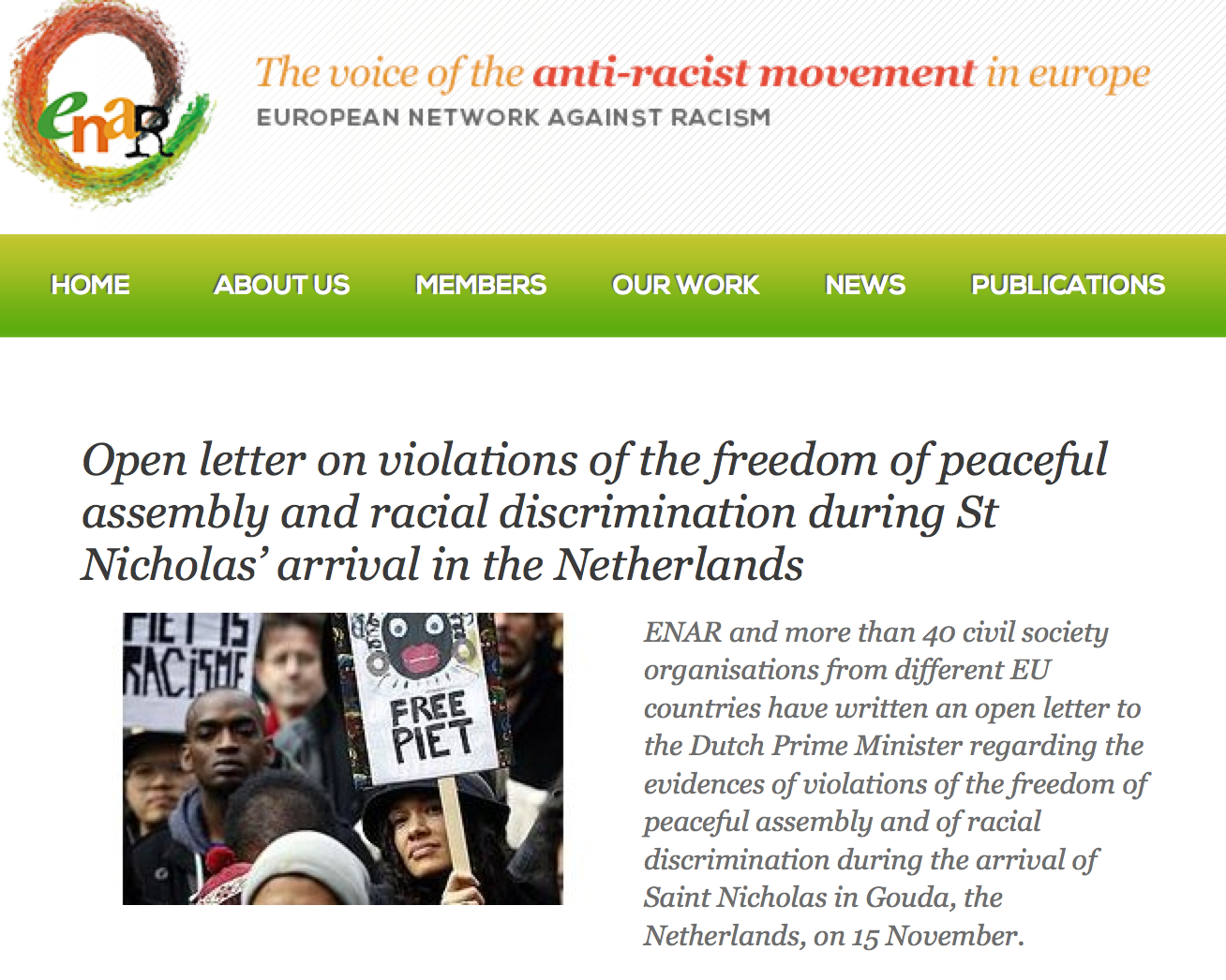
1. An independent investigation into the mayor’s decision is conducted in due time.2. An independent investigation into the law-enforcement behaviors is conducted in due time.3. All fines of peaceful protesters are dropped.4. Future decisions on assemblies are taken with due consideration of the freedom of peaceful assembly and the principle of non-discrimination.5. Police internal procedures include clear prohibition of racial profiling and police officers receive diversity training.6. A debate on blackfacing in the Saint-Nicholas celebrations is held in the National Parliament.7. Authorities take steps to forbid blackfacing in the Saint-Nicholas celebrations.
Hate crimes in 2013 are up by 13.9% in Finland but who cares?
Suspected hate crimes in 2013 rose by 13.9% to 833 cases compared with 732 in the previous year, according to the Police College of Finland. While one suspected hate crime is too many, how should we interpret these figures? What do they reflect? Do they reveal that there are high or low hate crime levels in Finland?
Do they show the migrant and minority communities’ mistrust of the police since the majority of hate crimes go unreported?
If this is the case, what do these figures reveal to us about intolerance in Finland?
Or maybe we should ask some hard questions of the police like if they actively encourage people to report hate crimes?
In 2013, total hate crimes rose to 833 from 732 in 2012. The first line reads “racist crimes” (rasistiset rikokset) and the second one “other hate crimes” (muut viharikokset). This table has two discrepancies with earlier figures published by the Police College of Finland. In 2008 the corresponding figure was 859 and in 2011 919. Source: Police College of Finland.
Meanwhile, a YLE in English reports that the police doesn’t consider diversity a priority in the face of budget cuts.
“We have a serious lack of police officers, there are so few of us. Lack of money could be a great cause of this, which also leads to a lack of diversity in my opinion. Our priority is not to gain in diversity, but to gain in numbers in general,” stated one of the protesting officers in November against budget cuts.
As Finland’s cultural and ethnic diversity increases, how many migrants and minorities will have to live in Finland for the police to understand that diversity is crucial?
When they understand this and when there are more minorities on the police force, possibly then we’ll probably start to make some sense of these hate crime statistics.
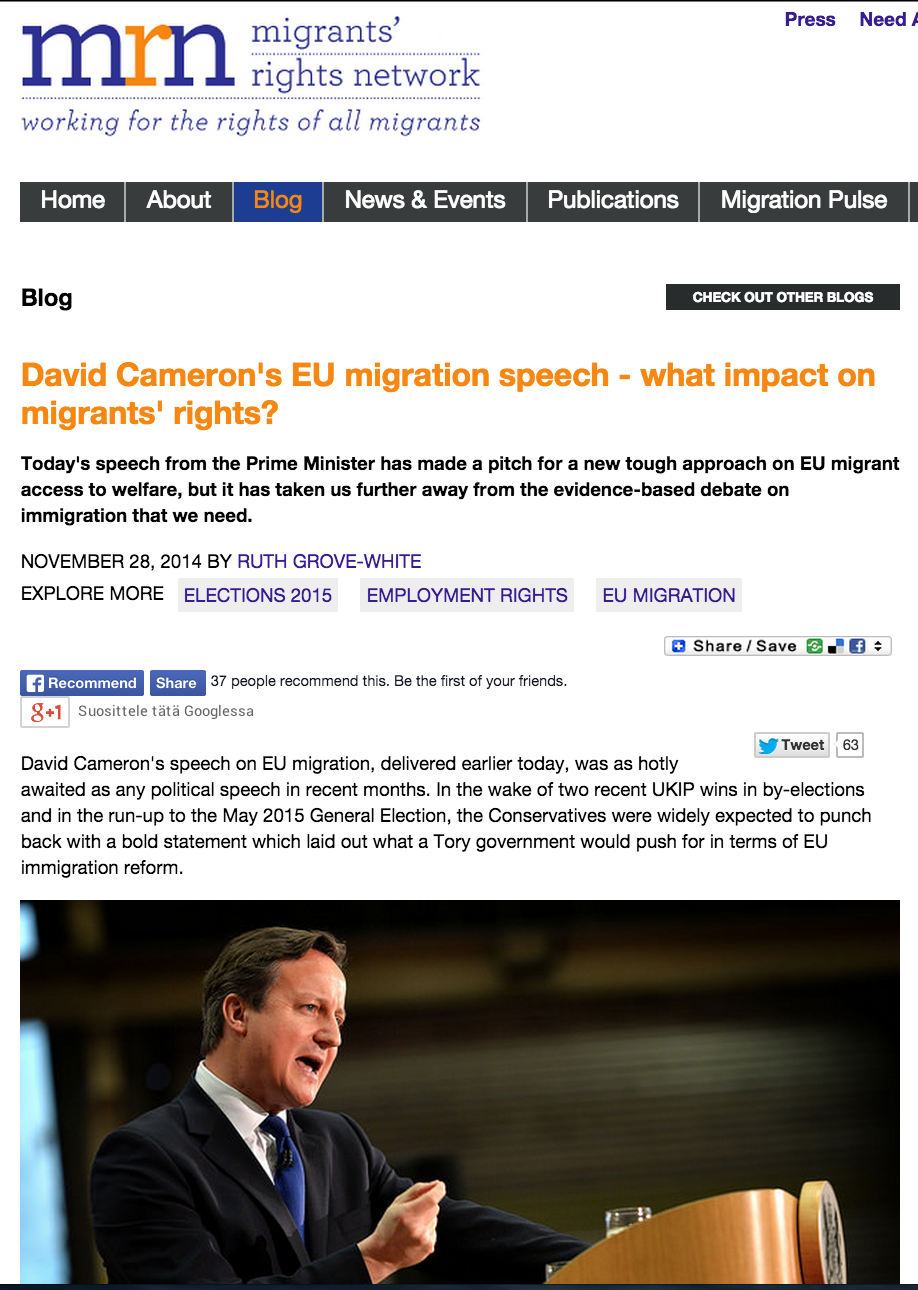
Migrants’ Rights Network: David Cameron’s EU migration speech – what impact on migrants’ rights?
Ruth Grove-White*
Today’s (28.11) speech from the Prime Minister has made a pitch for a new tough approach on EU migrant access to welfare, but it has taken us further away from the evidence-based debate on immigration that we need.
Read full story here.
David Cameron’s speech on EU migration, delivered earlier Friday, was as hotly awaited as any political speech in recent months. In the wake of two recent UKIP wins in by-elections and in the run-up to the May 2015 General Election, the Conservatives were widely expected to punch back with a bold statement which laid out what a Tory government would push for in terms of EU immigration reform.
In the event the speech was a clever piece of political positioning. The PM rejected the temptation to introduce the more lurid proposals hoped for by some Conservative Euro-sceptic backbenchers, such as emergency brakes on EU migration and caps on numbers. Instead he chose a relatively measured tone which aimed his pitch to the public straight down into the centre-ground, and was at pains to reject an overtly anti-immigration stance. This was a call for the continuation of EU free movement but with ‘tough approach to welfare’ – in other words, a UK within which EU migrants can still come here, but have their eligibility for state support significantly scaled-back.
As such Cameron has received plaudits for having apparently made a legitimate attempt to address concerns firmly planted in the public mind about EU migration and access to welfare. Elements of his pitch have been openly supported by organisations ranging from Labour, the Lib Dems and a number of thinktanks. But there has seemed to be little enthusiasm for defending the principle of welfare entitlement for EU migrant workers on the grounds of basic fairness…
For our part, MRN has a number of objections to the content of Cameron’s speech – here are three of them:
1. It does nothing to move us towards a more evidence-based and fair immigration debate
Yes, the tone of this speech was measured, but its implications were not. By putting EU migrant access to benefits at the heart of his speech Cameron has given credence to one of the biggest myths about EU migration – that there is a significant take-up of welfare benefits by this group of workers.
All the statistics show otherwise. We know that less than 10% of all EU migrants claim any kind of welfare, which includes in-work benefits for those working in low-wage jobs. EU migrants contribute £20 billion more in taxes than they take out in any kind of welfare or social security. According to Open Europe, as of February 2014, only 2.5% of total unemployment benefits claimants were EU migrants. Government data for 2013 suggests that only 6.4% of workers claiming tax credits in the UK are from the EU. And just four per cent of new social housing lettings in England in 2012-13 were to people from the European Union – almost all went to people who have been here for five years or longer. The evidence all points in the same direction, but the message sent out to the public today has been the opposite.
The truth is that we have to put this down as yet another missed opportunity to reframe the public conversation about EU migration and advance proposals which could allay fears and point to a more positive engagement with the issue. We needed to hear more about how, if some EU migration creates pressures in certain areas or on certain services, they could be tackled. How could local public service providers or authorities better support local integration? Why are so many EU migrants stuck in low-paid work that British people don’t want to do? Cameron made a brief and welcome acknowledgement that more resources would be needed in these areas, but otherwise allowed his proposals to centre on the more hyped area of welfare support.
2. These policies would create a cohort of workers on poverty wages
A centrepiece of this speech was the proposal to cut in-work benefits, with the claim that this will deter EU migrant workers from coming to the UK in the future. Maybe some will be put off coming, but there are real grounds for concern that a ‘crackdown’ on EU migrant benefits will also create a new cohort of vulnerable workers in the UK. These workers will be able to come and do the lowest-paid jobs in sectors with very little regulation, whilst paying their taxes but with no safety net of welfare support whatsoever.
Many EU migrants are coming here do low-paid but vital jobs like looking after our sick and elderly in care homes. Cutting protections for those in low-wage work would tip them into vulnerability, forcing them to live on incomes between 30% and 60% less than their British counterparts. There would be no complaint from exploitative employers who would find they now have an EU migrant workforce which is desperate to work long hours and accept all manner of ill-treatment if it will help them to make a liveable wage. Instead of accepting this proposal, we should be demanding that the Government introduce wages for all workers at the bottom end of the labour market which are adequate to live on, rather than requiring a top-up from the welfare system in order to make them decent.
3. This speech will do little to solve the public’s disquiet about immigration.
It seems unlikely that Cameron’s speech will do anything to ease public concerns about immigration. We know that there is no magic bullet on this issue, particularly because of its embeddedness in wider issues relating to the economy, education, housing and welfare. But today is a reminder that immigration is, as ever, vulnerable to being held hostage to politics. Short-term promises and pledges – such as today’s suggestion that EU migration can be substantially reduced as a result of these reforms – will in the end do little to build confidence if there is no real delivery. And we think it unlikely that today’s proposals would substantially reduce EU migration for the simple reason that EU migrants do not come to the UK to claim benefits.
Instead, we expect that the main outcome of this speech will be to build the pressure around today’s whipping boy – EU migrants – while continuing to deflect attention from the wide range of policies which are embedding social injustice and inequality across our society. It might be that for the time being Mr Cameron has won a point or two, but with real problems stacking up now and into the foreseeable future around the position of vulnerable migrants, we see no reason for anyone else to celebrate it.
Read original story here.
This piece was reprinted by Migrant Tales with permission.
*Ruth Grove-White is MRN’s Policy Director, responsible for developing the network’s responses to Government policy and legislation, leading on MRN parliamentary work and supporting the Director in representing the organization.
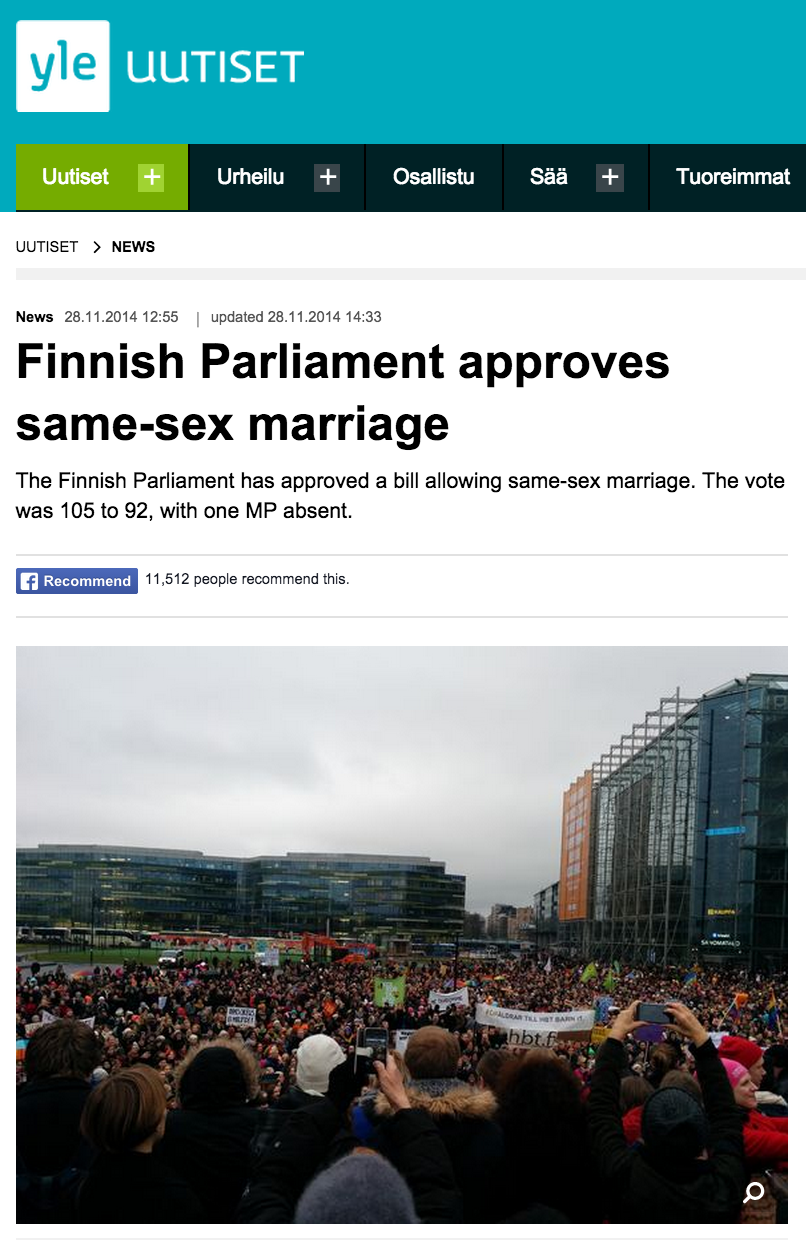
Same-sex marriage bill approved by Finnish parliament
Parliament has approved 105-92 a bill that will pave the way for same-sex marriage, according to YLE in English. The vote in favor of same-sex marriage is the first-ever citizens’ initiative that has been approved by the Eduskunta, or parliament.
The vote was a big setback for Timo Soini and the Perussuomalasiet (PS)* party, which had spent a lot of political capital against the bill.
Other losers were Päivi Räsänen and the Christian Democrats.
The biggest winners were parties like the Greens, Social Democrats, Left Alliance and Swedish People’s Party, which voted in majority for same-sex marriage.
Migrant Tales believes that the passage of the bill will be a big boost for gay rights but for our ever-growing culturally and ethnically diverse society.
Read full story here.
With the passage of the bill, Finland finally joins the other Nordic nations that have approved same sex marriage.
Writes YLE in English: ”The reform will force wide-ranging changes in other legislation, which will take well over a year to finalize. The law will therefore not take effect until 2016 at the earliest.”
Gays and lesbians have been allowed to have registered partnerships since 2002.
* The Finnish name for the Finns Party is the Perussuomalaiset (PS). The names adopted by the PS, like True Finns or Finns Party, promote in our opinion nativist nationalism and xenophobia. We therefore prefer to use the Finnish name of the party on our postings.
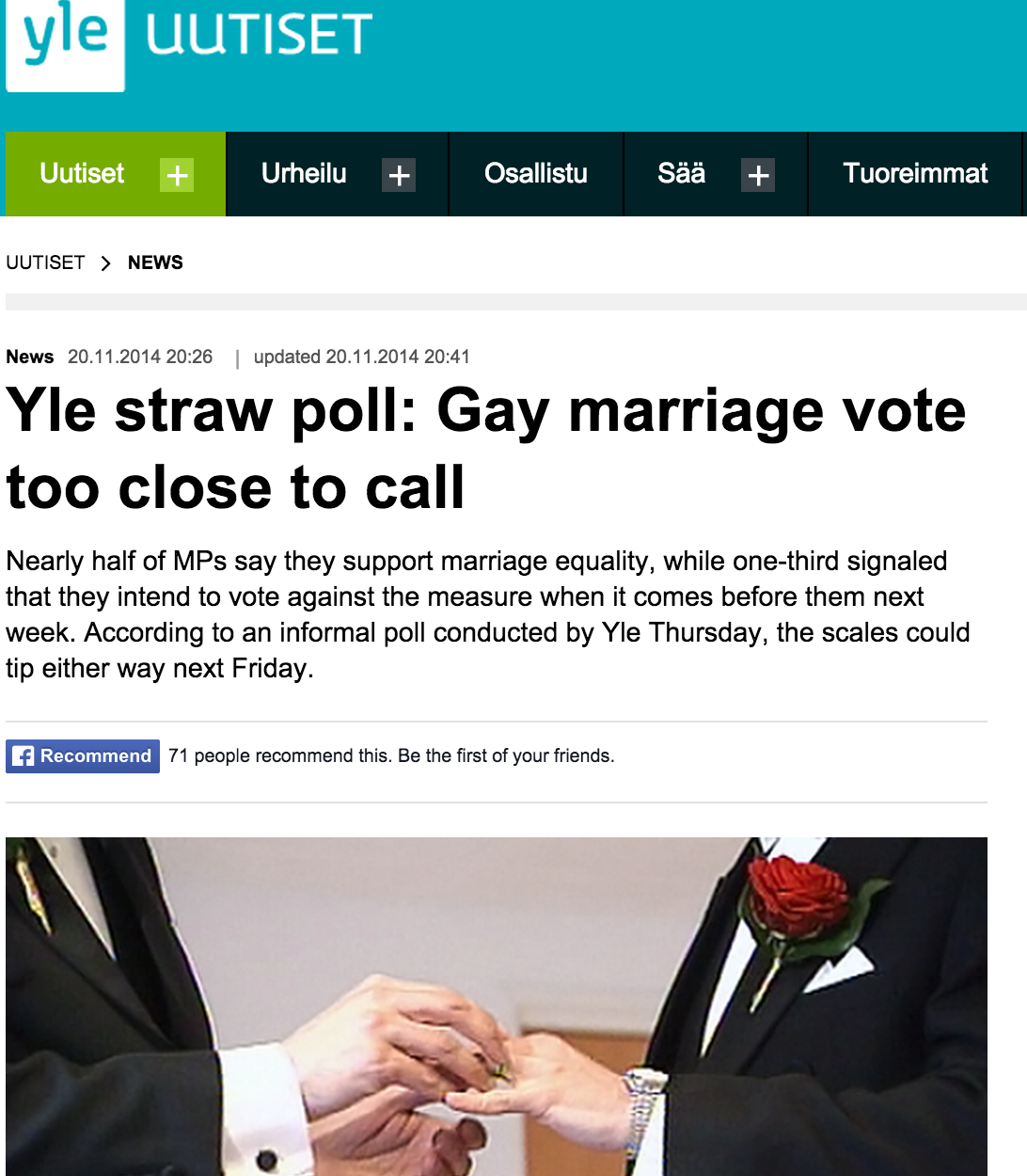
Same-sex marriage bill vote Friday will be a cliff hanger
Finland will vote Friday on the long-overdue bill that would make marriage legal between same-sex couples. A lot rides on tomorrow’s vote. In many respects, the outcome of Friday’s vote shows Finland to be at an important crossroads.
Some analysts see the passage of the same-sex marriage bill not only as a victory for gays but for all minorities in Finland.
At present, the social construct of the so-called white, heterosexual Finn is being seriously challenged by tomorrow’s vote as well as by our ever-growing cultural diversity.
According to political observers, the vote is still too close to call.
Read full story here.
The debate on same-sex marriage has divided Finland. Even so, Evangelical Church of Finland Archbishop Kari Mäkinen said this week he supports granting homosexual couples the right to marriage.
It’s highly probable that the historic vote Friday would not be a cliff hanger if it weren’t for the Perussuomalaiset (PS),* which are betting much of their political capital against the bill.
In 2011 the PS won their historic parliamentary election victory by gaining 39 seats in parliament from 5 previously. Their election victory was based on hostility and mistrust of the EU, immigrants, refugees, cultural diversity and homosexuals.
Friday’s vote will reveal a lot of things. One is whether we are a closed or open-minded society.
The closed society, supported by the PS, is outright hostile to minorities and keeps such groups excluded by building fences of mistrust with the help of myths.
The open-minded society is the new face of Finland in this century that cannot be stopped. That face and landscape comprises of minorities with equal rights.
* The Finnish name for the Finns Party is the Perussuomalaiset (PS). The names adopted by the PS, like True Finns or Finns Party, promote in our opinion nativist nationalism and xenophobia. We therefore prefer to use the Finnish name of the party on our postings.
Finland: A nation of emigrants
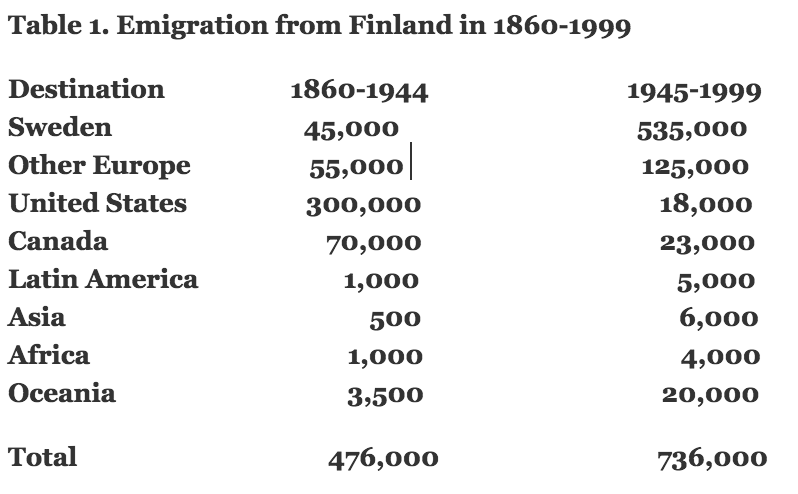
While some heads of state like Barack Obama speak of the United States as a nation of immigrants, Finland has historically been a nation of emigrants. How does being a nation of emigrants differ from being a nation of immigrants? There is a big difference and reveals in part why some Finns are so hostile to immigration.
Finland is a good example of a country made up of emigrants. During 1860-1999, over 1.2 million emigrated, with the majority moving to Sweden (580,000) and North America (411,000).
If all of these emigrants would have stayed put in Finland, our population would be today about 7 million instead of 5.470 million.
Emigration has had a big demographic never mind social impact on Finland.
Source: Jouni Korkiasaari and Ismo Söderling: Finnish emigration and immigration after World War II. Migration Institute 2003. Source: http://www.migrationinstitute.fi/articles/011_Korkiasaari_Soderling.pdf
Since we are a nation of emigrants, it explains in part why some of our politicians and society don’t see immigration as a positive matter.
Being a land of emigration has distorted our view of things. Instead of seeing the world as an opportunity, it’s seen by too many as a threat. This is understandable considering our difficult history with the former Soviet Union. Even so, wars and conflicts end and we must learn to move on, even if the Ukraine crisis has reinforced our worst prejudices.
Finland is slowly learning to become a nation of immigrants. When we’ll be able to call ourselves a nation of immigrants, that’s when our perceptions of foreigners and newcomers will change, hopefully for the better.
This will take time. But we’re already on that road no matter how some resist this fact tooth and nail and throw everything they have against our ever-growing culturally and ethnically diverse nation.
Julian Abagond: nation of immigrants
Migrant Tales insight: Finland is a nation of emigrants, not of immigrants. Even so, the same structures that have kept intact the structures and systemic exploitation of minorities, slavery and Jim Crow are still alive and kicking despite the fact that we try to convince ourselves that the United States is a nation of immigrants.
___________________
Julian Abagond
The phrase “nation of immigrants” (1883) is often applied to the United States, especially by its scholars, journalists, presidents and schoolteachers.
Last week, President Obama put it like this (on November 20th 2014):
“My fellow Americans, we are and always will be a nation of immigrants. We were strangers once, too. And whether our forebearers were strangers who crossed the Atlantic, or the Pacific or the Rio Grande, we are here only because this country welcomed them in and taught them that to be an American is about something more than what we look like or what our last names are, or how we worship.”
His words do not apply to about 40% of the nation:
- Not to Native Americans who were wiped out or driven west.
- Nor to Black Americans who were brought in chains.
- Nor to Chinese Americans who were killed or driven out of the western US in the late 1800s.
- Nor to Mexican Americans deported in the 1930s.
- Nor to the people whose lands the US took over: Native Americans,Northern Mexicans, Alaska Natives, Native Hawaiians, Puerto Ricans, Guamanians, Palauans, Eastern Samoans, Northern Mariana Islanders or Virgin Islanders.
- Nor, given the perpetual foreigner stereotype, to Asian Americans.
- Nor to most British or Dutch Americans, who were not immigrants (people who move to a foreign country) but colonists (people who create an offshoot of their mother country). Calling them “immigrants” would mean they joined Native American societies. They were conquerors and invaders, not “immigrants”.
In English the word “immigrant” only goes back to 1792. The phrase “nation of immigrants” does not appear in print till 1883, not in the New York Times till 1923. It was still a surprising idea at Harvard University in 1945, even for historian Oscar Handlin, who grew up in New York City as the son of Russian Jewish immigrants. It did not take off till the 1960s, when President Kennedy wrote a book for the Jewish Anti-Defamation League called “A Nation of Immigrants” (1964).
So when Obama says, as he did in 2010, 2013 and 2014:
“We’ve always defined ourselves as a nation of immigrants.”
He is reading history backwards. It is an idea that did not catch on till the Third Enlargement of Whiteness, which took in southern and eastern Europeans.
Obama on Independence Day, 2012:
“We say it so often, we sometimes forget what it means – we are a nation of immigrants. Unless you are one of the first Americans, a Native American, we are all descended from folks who came from someplace else – whether they arrived on the Mayflower or on a slave ship, whether they came through Ellis Island or crossed the Rio Grande.”
The “nation of immigrants” thing colour-blinds US history as if it were not much affected by racism – genocide, slavery, settler colonialism, imperialism, etc – as if Italian and Jamaican immigrants are pretty much the same, or English colonists and African slaves, as if US institutions protect everyone’s rights regardless of race and the Bootstrap Myth is true.
Thanks to Kyle for suggesting this post.
See also:
- The three pillars of American white supremacy
- The Third Enlargement of American Whiteness
- white racial frame
- genocide
- The Cherokee Trail of Tears
- Kingdom of Hawaii
Read original posting here.
This piece was reprinted by Migrant Tales with permission.
Migrants’ Rights Network: “How to talk about immigration?”
It is clear that, given the current febrile state of the public mood, a lot of damage can be done by talking about immigration in ways that are insensitive to many people’s anxieties. Times are exceptionally hard for so many people – wage earners in particular are feeling the squeeze of an economy which has blocked off any rise in their living standards for most of a decade. Commonsense, that age-old foe of critical thinking, tells citizens that immigration must have something to do with this unhappy state of affairs. If there is good evidence which shows that this is not the case then we have to find the best way to get this across to the people who would benefit from knowing the true facts.
Read full story here.
The British Future manual provides a good checklist, based on three years of public opinion research, for the obvious things that should not be done in communicating about migration: Don’t make out that people are stupid because they are showing resistance to the idea that migrants pay more in taxes than they receive in services. Take seriously the concerns they have that changes brought about by migration might be happening too quickly. Think about the reasons why new arrivals might not be welcome in communities which feel that the public services which are so important to their lives are already under too great a stress.
British Future also puts forward a compelling argument for the view that the majority of the population occupies a ‘persuadable middle ground’ position in immigration which would shift in the direction of moderately pro-immigration arguments, providing these were put well by people they trust.
It seems almost rude to stir up disagreements with a set of ideas and proposals which have the best intentions, but a few red flags need to be posted about British Future’s policy conclusions, which merit further discussion.
Theorists of this sort of thing tell us that there are broadly two ways of doing politics in liberal democratic societies. One of these is the technocratic approach favoured by expert elites. It tells us that modern society is tremendously complex and capable of generating problems and tensions at any point across its extended field of operation. Each has the potential to be dealt with in isolation from the others, with the need to fight foreign wars having no necessary relation to heath care policies or the cost of housing.
In this way of looking at things immigration policy throws up a set of issues that ought to be isolated from the ability of politicians to deal with the budget deficit, improve the standard of primary school education, or provide adequate pensions for the retired. Government needs to draw on the expertise of policy wizards who know how to fix things under each of these individual headings and let them get on with the job.
Against this there is the populist tide in democratic politics which resists the idea that the problems of contemporary life are fragmented and separate. It answers the charge that we should leave it to the experts to get the system to work again with the accusation that the apparently separate problems are actually subsets of the one big problem which is breaking the back of the whole of society. The experts have failed and it is now down to ordinary citizens to work out what needs to be done to come up with solutions – and these will inevitably be far reaching and radical.
The British Future approach strongly skews the direction of the discussion towards technocratic responses. Following a detailed analysis of public opinion research, the book concludes by putting forward an immigration management package which it proposes is plausible according to the requirements of the ‘persuadable majority’, and that would generate a set of ‘realistic targets’ that a majority would be prepared to back. How to talk about immigration ends by pitching a deal that would allow universities to recruit international students, employers to bring in skilled workers, and shepherd all newcomers to a safe haven as integrated residents of British society.
It sounds so elegantly simple as to make you wonder why no one has come up with it before. But hang on a minute – that is exactly what the all the parties in government have thought they were doing at virtually every moment for close on the past two decades. New Labour promised to be ‘as tough as old boots’ on unwanted asylum seekers and labour migrants who failed to produce value for the UK economy. They offered a ‘realistic’ package of ultra-surveillance that would have enhanced the power of state agencies to enforce the immigration rules through biometric identity cards and total overview of migrant movements through society.
The quid pro quo for this assurance that everyone moving into the country was subject to thoroughgoing control was acceptance of migration at the higher levels needed to maintain growth amongst the economic sectors producing employment growth – primarily the small and medium sized business hungry for a workforce with the sort of soft skills to be found most readily amongst migrants.
The coalition government subsequently promoted its own version of realistic targets – in broad terms similar to the set New Labour had been running when they were evicted from office but with the added oomph of a promise to reduce net migration to the tens of thousands. Ironically, whilst this might have had a higher approval rating amongst public opinion as to what people really wanted, the conjunction of a whole range of factors running from the obligations that ensued from the EU Treaties, the persistence of high levels of demand for migrants amongst British employers, and the chronic ineptitude of a Home Office which exemplifies everything we know about that dead end, sclerotic structure which is the Westminster state today, was always certain to confound and destroy all the hopes for the ‘no ifs, no buts’ solution the coalition was aiming for.
The danger for British Future in this context is the risk of association with the claims of technocratic currents in mainstream politics that an unreformed, over-centralised, elitist bureaucratic state is capable of delivering the goods. The guiding framework for the paper is the issues that would be acceptable to the public and the political elite at this moment in time, and some of the most difficult but salient human rights issues relating to migration – for example the impacts of immigration enforcement, the position of undocumented migrants, the need for reform of the detention estate, the shape of future asylum policy and so on – are not tackled.
So if the door is slammed shut against the prospect of progress through this style of political management, what about its more unashamedly populist and democratic alternative? What would advocacy of immigration policies look like if it was bold enough to share the widely held view that mainstream politics does have to carry a large share of the blame for the mess that so many people are in today?
We have the examples of the public conversation in Scotland to know that framing the issue of migration according to the needs of 5 million people has brought a very different shape to the politics of that country. Last week’s news of Obama’s executive order offering temporary legal status to approximately five million undocumented immigrants is another good example of how politicans can push for a real change beyond the established middle ground.
There are good grounds for believing that the task of winning the debate on immigration will require a great deal more than finessing the language aimed at the mainstream majority. The populist moods sweeping liberal democracies all over the world require conviction and a robust determination to take on and defeat a resurgent right wing which is working to rally opinion around the pole of traditional authority and the Thatcherite values of middle England. The language and advocacy we most need is that which is most capable of taking this on and beating it, and finding our way to that approach ought to be our highest authority.
Read original posting here.
This piece was reprinted by Migrant Tales with permission.
*Don Flynn, the MRN Director, leads the organisation’s strategic development and coordinates MRN’s policy and project work. He is a regular and sought-after speaker at conferences, seminars and lectures on behalf of MRN.
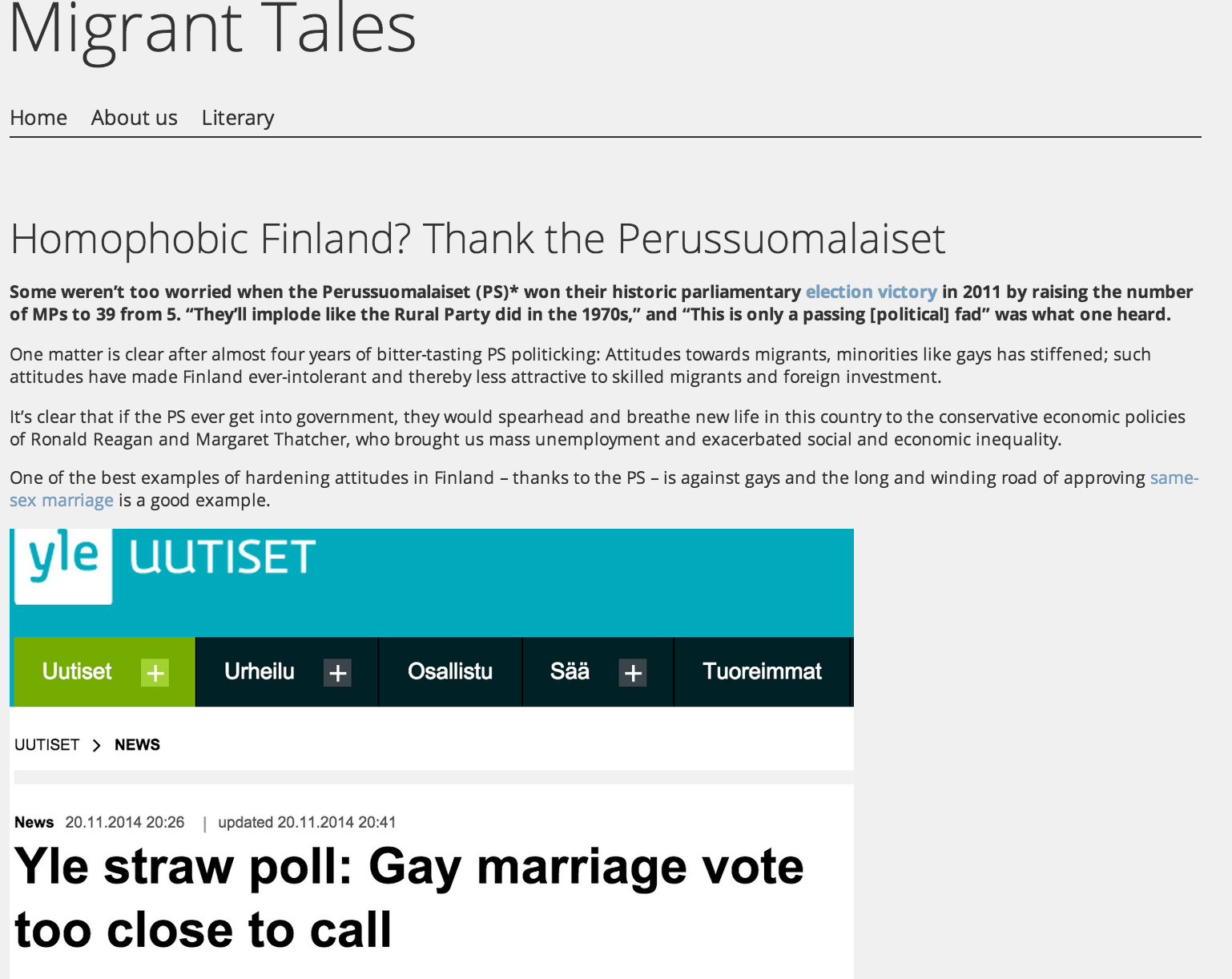
Homophobic Finland? Thank the Perussuomalaiset
Some weren’t too worried when the Perussuomalaiset (PS)* won their historic parliamentary election victory in 2011 by raising the number of MPs to 39 from 5. “They’ll implode like the Rural Party did in the 1970s,” and “This is only a passing [political] fad” was what one heard.
One matter is clear after almost four years of bitter-tasting PS politicking: Attitudes towards migrants, minorities like gays has stiffened; such attitudes have made Finland ever-intolerant and thereby less attractive to skilled migrants and foreign investment.
It’s clear that if the PS ever get into government, they would spearhead and breathe new life in this country to the conservative economic policies of Ronald Reagan and Margaret Thatcher, who brought us mass unemployment and exacerbated social and economic inequality.
One of the best examples of hardening attitudes in Finland – thanks to the PS – is against gays and the long and winding road of approving same-sex marriage is a good example.
One of the most outspoken voices against same-sex marriage is the Perussuomalaiset party. Read full story here.
It’s clear that if the PS wouldn’t have won in 2011, same-sex marriage would have already been legal in this country.
Taking into account that recent polls show the Center Party to be the clear favorite to win the next parliamentary elections in April and the party’s voting record, Friday’s parliamentary vote for or against same-sex marriage will be the last for a very long time.
The PS has tried to pull many fast ones on the public. One of these was a recent claim that migration costs Finland near-2 billion euros. While such claims were conjured by the PS for obvious reasons, has anyone asked how much the populist party has cost Finland in the way of lost skilled migrants, jobs, opportunities and investment?
Finland has a problem: It’s population is aging and we need skilled migrants to fill the gap as well as new jobs. Why would any person in his right mind move to a country that is suspicious of migrants and foreign investment?
One problem with racism and ethnocentrism is that it distorts reality.
* The Finnish name for the Finns Party is the Perussuomalaiset (PS). The names adopted by the PS, like True Finns or Finns Party, promote in our opinion nativist nationalism and xenophobia. We therefore prefer to use the Finnish name of the party on our postings.
Systemic disenfranchisement of migrants and minorities in Europe
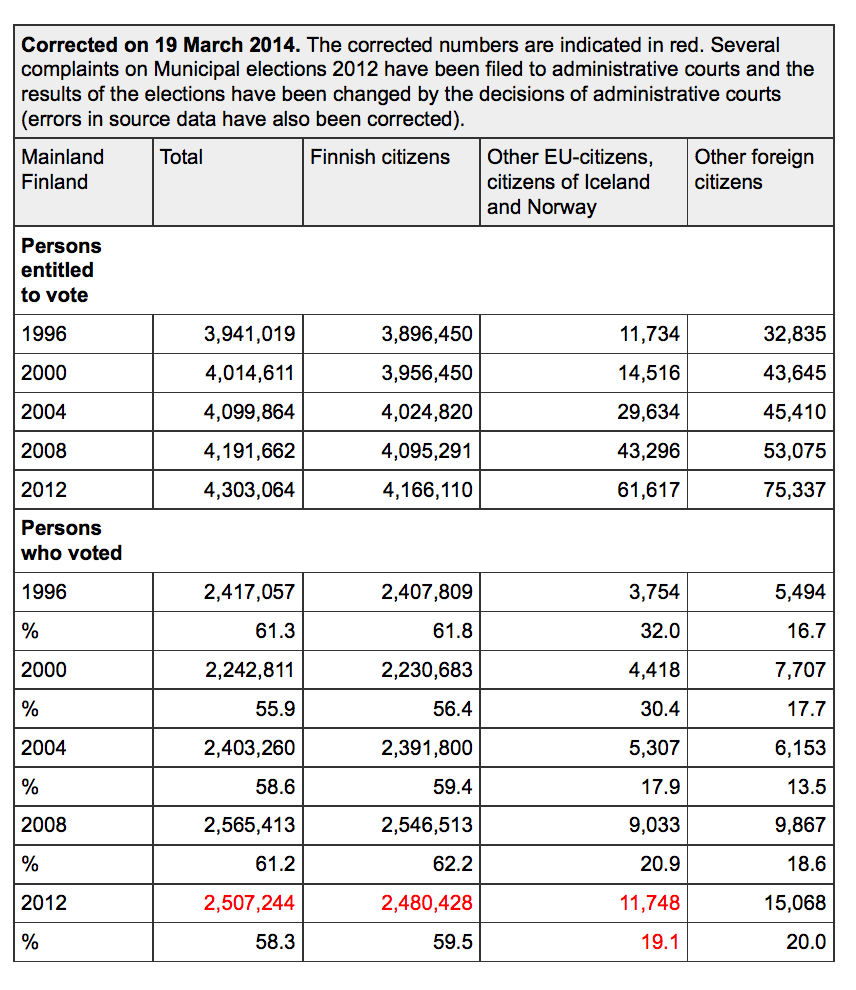
One important question that doesn’t appear to bother too many politicians is why migrant voter turnout in Europe is so low. In the 2012 municipal elections of Finland, 20% of eligible migrants voted compared with 18.6% in 2008. This is a far cry from 59.5% and 62.2% of Finnish citizens that voted in such elections, respectively.
As we saw in the EU elections of May, the far right made important gains especially in countries like France, United Kingdom, Denmark Austria, Sweden and Greece. The low voter turnout coupled with the disenfranchisement of migrants from the political system and society in general has benefited the far right.
According to an opinion piece on euobserver by Thomas Huddleston, the low levels of voter participation and naturalization of Europe’s ever-growing immigrant population have become “the major disenfranchisement cause of our time.”
Table 1: Persons entitled to vote and those who voted by nationality in municipal elections during 1996-2012.
Source: Statistics Finland.
Some of the key issues that Huddleston points out are the following:
- There are 51 million migrants aged 15-74 in the EU, or 14% of the adult population;
- 32 million migrants are first- and 18 million are second-generation migrants;
- Two thirds of the first first-generation are not citizens of their country of residence;
- A large number of young second generation adults are not citizens in around half of the EU member states;
- Among non-EU citizens, 10 million live in EU countries (Germany, Italy, France, Greece and Austria) denying them even the right to vote in local elections;
- Far right parties in countries like Austria, Belgium, Denmark, France and the UK are benefiting the most from this democratic deficit.
It’s clear why the far right and anti-immigration groups do not want to give migrants greater voting rights since such a move would undermine their power. But if we want to make the EU more inclusive, it’s clear that we are going to have to make an about-turn in voting rights to migrants.
Writes Huddleston:
Research finds that the electoral power of the far-right is the most important factor explaining the restrictiveness of European countries’ citizenship policies, which then has major effects on immigrants’ naturalization rates, even for high-educated and developed-world immigrants.
For those who still believe that parties like the Perussuomalaiset (PS), which has far right roots, haven’t poisoned the air for migrants and polarized society should think twice. A good example is the ongoing debate on same-sex marriage in Finland. If the PS wouldn’t have won the 2011 elections and become the third-largest party in parliament, same-sex marriage would most likely have been approved a long time ago.
* The Finnish name for the Finns Party is the Perussuomalaiset (PS). The names adopted by the PS, like True Finns or Finns Party, promote in our opinion nativist nationalism and xenophobia. We therefore prefer to use the Finnish name of the party on our postings.