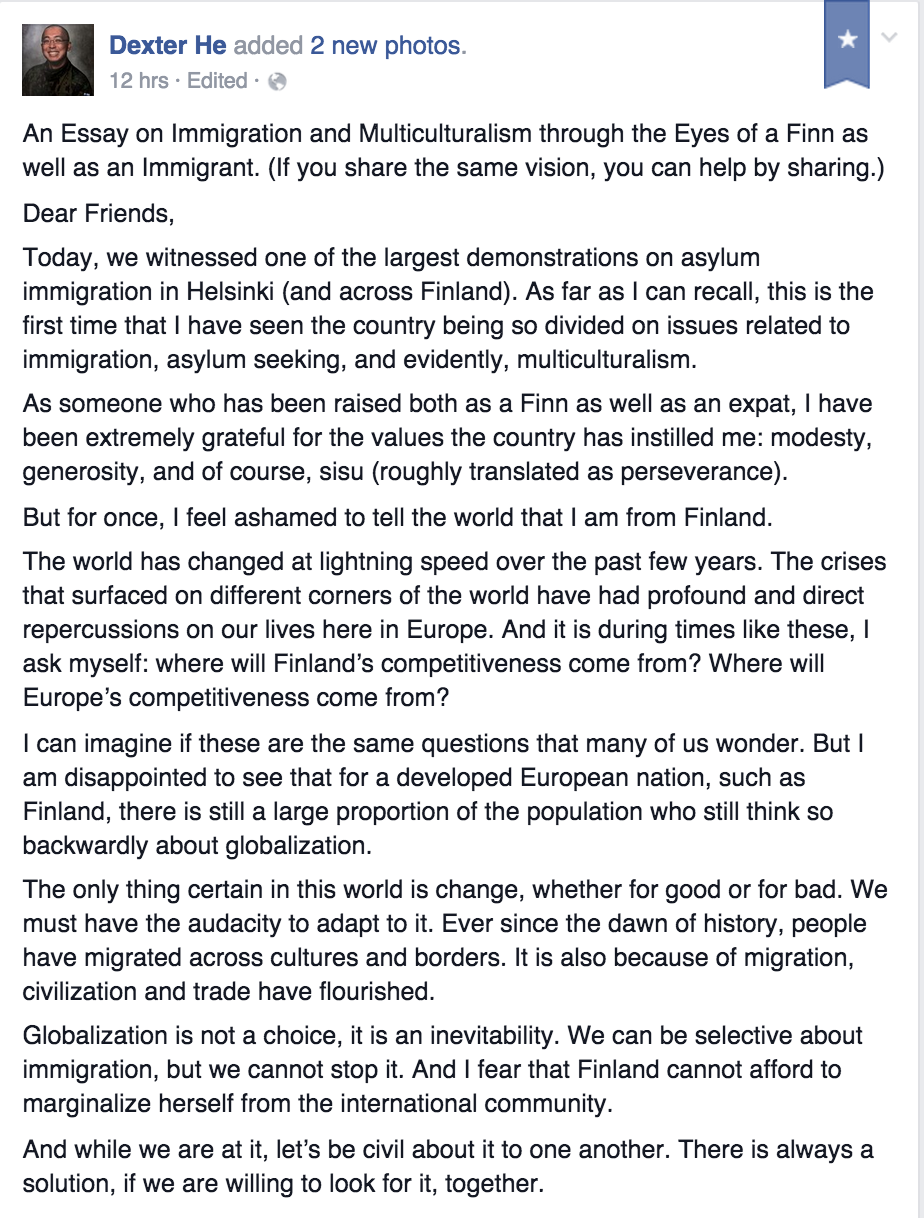
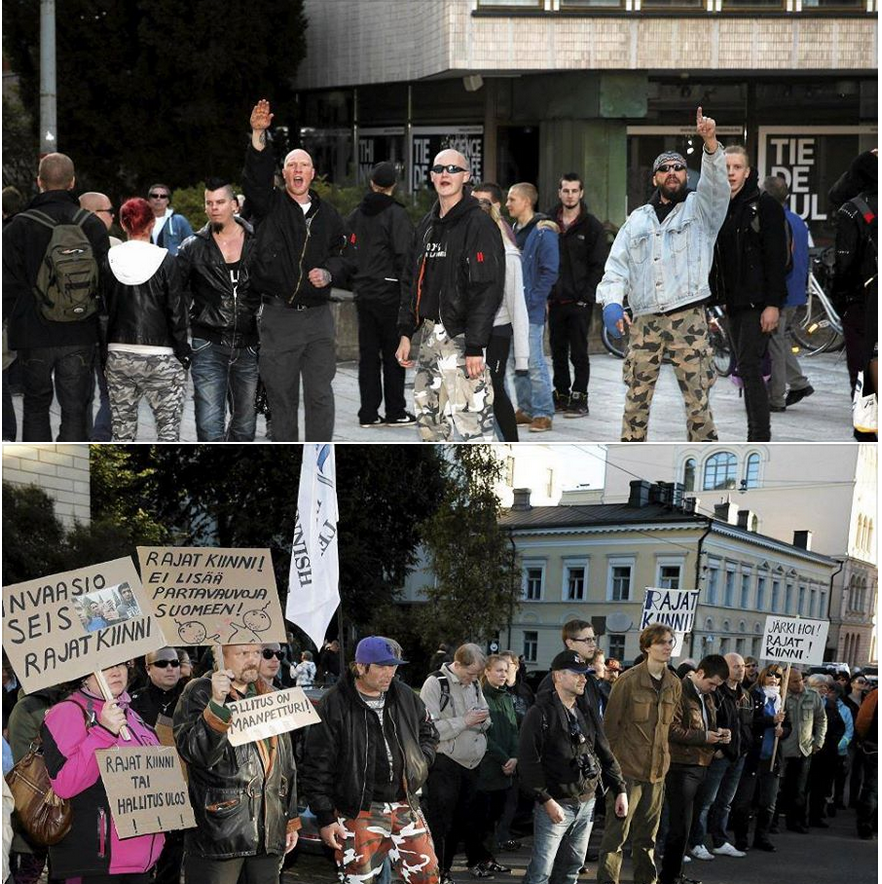
One of the questions Migrant Tales asked after we saw support for the Perussuomalaiset (PS)* plummet in YLE’s latest poll is that the result is bad news for migrants and minorities in Finland because the populist party will step up its anti-immigration rhetoric and measures.
We got a taste of the latter Friday, when Social and Welfare Minister Hanna Mäntylä, who is well known for her anti-immigration views, announced that those that come as asylum seekers and get a residence permit from March 1, 2016 will see their social welfare drop significantly.
Mäntylä believes that by lowering social welfare assistance to refugees will discourage others from coming to Finland. Mäntylä’s message is clear: People aren’t fleeing war in the Middle East they are only coming here to live off our social welfare.
Sakari Tiimonen, writes in his latest blog entry about the planned cuts by Mäntylä: “I don’t know if the question is [her] ignorance of the constitution and the social welfare system or just panicking about the loss and hoping not to lose any more [PS party] support, but this sure looks like harassment.”
The latest poll published by YLEshows that support for the populist anti-immigration Perussuomalaiset (PS)* party has plummeted, diving in one month by 4.3 percentage points to 10.7% and since the April parliamentary elections by as much as 7 percentage points.
It is the biggest fall ever seen in such a short time in the polls by a party.
The exceptionally poor result of the PS boosted the Green League to fourth place in the poll with 12.7%.
The biggest surprise is the Social Democratic Party, which saw its support rise by 3.9 percentage points to 18.3%.
While all government parties saw their support fall, none of them suffered such a sharp drop as the PS.
The Center Party continues to be the biggest party in Finland with 21.7% (-1.2%) with the National Coalition Party seeing its support fall by 0.9 percentage points to 18.0%.
One more time I’m going to show one of the low points of the A2 Pakolais-ilta debate on refugees. Yes, right, it’s the porridge scene where the host Wali Hashi offers porridge to a Syrian family. Not funny but it reveals a lot about the media’s attitude.
If we are what we eat we do have to be careful when speaking about food. If you don’t like your host’s food it means you don’t like your host. Your host is what he eats.
The way that the Finnish media took the complaint of poor food by some asylum seekers is highly revealing. It shows, in my opinion, knee-jerk ethnocentrism.
If some asylum seekers are dissatisfied with the food don’t we have the know-how and resources to solve the problem? Why make such a fuss over it?
Why shove the issue in in their faces?
If the media gets offended at some asylum seekers because they don’t like the food it shows that we still have a lot to learn about cultural diversity.
Everyone should not forget as well that you are what you eat.
Migrant Tales’ 2015 Hall of Poor and Sloppy Journalism will be updated separately. To see other examples of opinionated journalism in Finland about cultural diversity, please go to this link.
What was wrong with this television debate? Even if one of the hosts on the program was Wali Hashi, it was white Finns’ perceptions and opinions about asylum seekers coming to Finland and how they should integrate to our society. The term “integration” was mentioned a lot of times but it was code for assimilation, or one-way integration. Every form of prejudice Finland has about asylum seekers and migrants, like they are criminals, rapists, social welfare bums and other labels, were pushed around freely during the one-sided debate. Forcing a refugee family to eat porridge and speaking of these people, who are also medics and university graduates, as helpless children who have to learn that zucchini is kesäkurpitsa in Finnish is beyond me. The program did little to dispel the xenophobic climate in Finland but instead reinforced it by not challenging it. On top of this you had one National Coalition Party MP, Susanna Koski, and a pastor, Marjanna Toivianen, who still don’t know that the correct Finnish term for integration is kotoutuminen, not kotiutuminen, which means “coming home.” In 1998 Finland had to invent a new term for integration because none existed before that. That term is kotoutuminen.
If YLE cannot do a descent TV debate on our ever-growing culturally diverse society it should not do one at all.
En sanoo mitään A2 Pakolais-illan ohjelmasta, koska se oli pettymys minulle. Mielestäni siinä vahvistettiin enemmän kun haastettiin suomalaisten ennakkoluuloja pakolaisiin ja maahanmuuttajiin.
Yksi asia joka pisti silmään oli ettei ohjelman vieraat, kuten kokoomuslainen kansanedustaja Susanna Koski sekä pappi Marjaana Toiviainen, tienneet ero sanasta kotoutumisesta ja kotiutumisesta.
Kotoutuminen on aika uusi sanaa suomen kielessä ja se tarkoitta prosessi jolloin maahanmuuttajia sopeutuu meidän yhteiskuntaan. Kotiutuminen on aivan eri asia eikä sillä pitäisi olla mitä tekemiseen ihmisten sopeutuminen Suomeen.
Toinen vieras joka ei tiennyt mitä on kotoutuminen ja kotiutuminen oli pappi Marjaana Toiviainen.
As the Perussuomalaiset (PS)* starts to implode with third vice president Sebastian Tynkkynen demands that the populist anti-immigration party exits government, its self-destruction will not be caused by outside factors but from within.
One guiding star of the PS is not only its inexperience but outright ignorance that shows us the ugly face of its racism.
Teuvo Hakkarainen, a PS lawmaker, said something incredible over the weekend as did Social and Health Minister Hanna Mäntylä of the same party. One said it outright while the other one said it indirectly.
Hakkarainen was quoted as saying in Oulu-based Kalevathat international agreements and the Constitution hinder the PS from realizing its policies.
Mäntylä, who has a fixed obsession against asylum seekers, proposed again that asylum seekers should be treated unequally before the law and should not have equal access to the law and social welfare.
Yes, you read right: Hakkarainen states that we should change the constitution and shelve international agreements to we can socially exclude and treat migrants as third-class citizens in Finland.
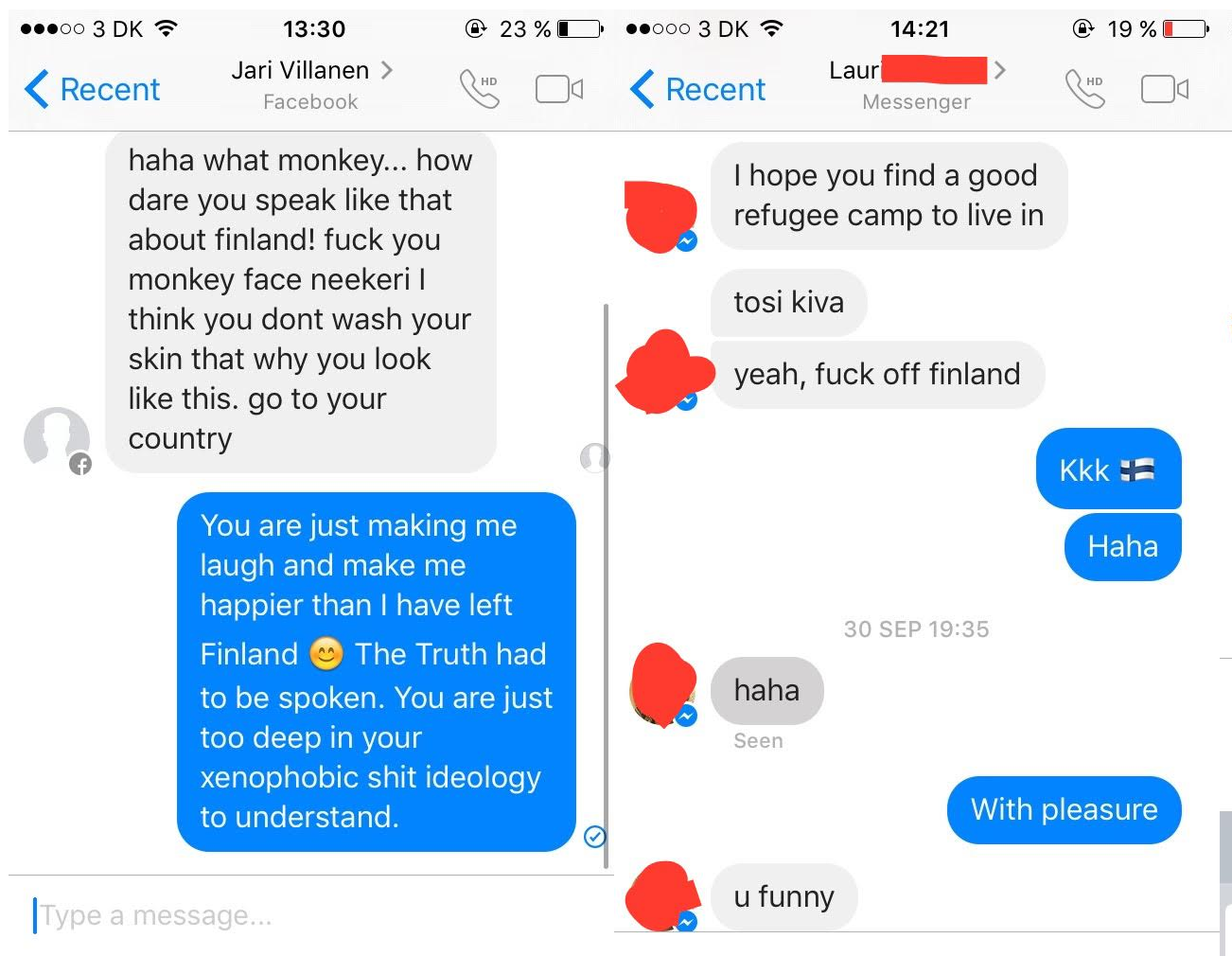
Migrant Tales insight: One of the worst things that one can do is to be intimidated by violence and threats. Such threats have become, unfortunately, a too often occurrence in Finland. Here is a rebuttal by M. Blanc. I raise my hate to him for having the courage and strength to write despite the flack he’s got.
Read M. Blanc’s first opinion piece here.
___________________
M. Blanc*
I wrote an piece about my experiences and stated the reasons why I have decided to leave Finland and how foreigners are treated by great number of Finns. I kept close track of how people reacted to what I wrote on Facebook and all of a sudden hundreds of foreigners were encouraged and agreed with my points and thanking me for speaking out. Of course there were those who started saying that I am the problem and I am lying to manipulate others. Some guy even compared me with Hitler!
I got a lot of messages from people that had been through the same things as I and they thanked me for sharing my experience. Last week, however, I started to get a lot of bullying and hate messages and they are still following me even though I have left Finland for good…
Now I realized why hardly any foreigner is speaking out in public because they are afraid and get so much pressure! I have received a lot of scary messages from Finns including one with a life threatening statement. I deleted all the messages from the people harassing me and soon will delete my account but I have a few screenshots in case I take legal action below.
I just don’t know what has happened to some people… Sometimes I feel life is worthless and there is no more reason to live when people are so ugly to each other like now… At least I wish I had never existed in this world for these people…
Standing together with four other Nordic prime ministers, Juha Sipilä states that Finland isn’t a racist country, according to YLE in English. I’m a bit baffled by Sipilä’s statement. What does Finland “not being a racist country” actually mean?
Is he saying that racism doesn’t exist? Does his claim mean that it’s under control? Does it mean that we have racism and the prime minister is ashamed by it?
Or is it denial that such a social ill is one of the biggest challenges we have as our society becomes ever-culturally diverse?
We don’t know because the statement doesn’t give us too many clues.
Sipilä also claimed at the press conference that all of the Nordic countries “are international, open and tolerant.”
Taking into account recent election results in Denmark and Finland, one could debate the prime minister’s claim.
The only prime minister at the press conference that could be considered “international, open and tolerant” is Stefan Lofven of Sweden. Norway, Denmark and Finland all have populist and anti-cultural diversity parties that could be described as “xenophobic, closed and intolerant.”
Who are they? The Perussuomalaiset (PS)* of Finland, the Danish People’s Party and the Progress Party of Norway.
All three of these parties base their political support on anti-cultural diversity sentiment, excluding and victimizing migrants and minorities and encouraging that they be kept on short leashes.
Why have we seen in recent years the rise of populist parties in the Nordic region that are xenophobic and hostile to cultural diversity if we “are open, international and tolerant?”
Supremacy on elokuva, joka perustuu tositapahtumiin. Se kertoo äärioikeisto väkivallasta. Päähenkilö Garrett Tully on väkivaltarikollinen, joka vankilassa radikalisoituu uusnatsiyhteisön aktiiviseksi jäseneksi. Arjalainen Veljeskunta on hänelle yhteisö, jossa hän palvelee suurempaa tarkoitusta. Sen parissa hän on jotain. Sitä ennen hän oli vain oman kokemuksena mukaan piece of shit.
15 vuotta vankilassa ei tehnyt yhteiskuntakelpoiseksi. Päin vastoin. Yksi päivä vapaudessa vei takaisin vankilaan odottamaan kuolemantuomion täytäntöönpanoa. Äärioikeistolainen ideologia vei koko nuoren miehen menessään.
Hän eli ja hengitti vihasta. Hänen toisen käden sormiinsa oli tatuoitu kirjaimet H-A-T-E. Kasvoihin ja rintaan oli tatuoitu hakaristejä sekä muita natsisymboleja. Ideologinen harha omasta ylemmyydestä on vahva ja aivan yhtä ristiriitainen kuin sen päätään nostanut suomalainen versio.
Tullyn taustasta elokuvassa ei kerrota. Sen sijaan se raottaa rasismin verhoa puistattavan todentuntuisesti. Rasismi kohdistuu tuntemattomiin ihmisiin täysin odottamatta voimalla, josta toisinaan aina joku maksaa hengellään vain siksi, että joku kokee olevansa ylempäni ja arvokkaampi ihonvärin, uskonnon, sukupuolen tai jonkun muun vuoksi.
Elokuvassa kidnapatun mustan perheen isä jo vanhus, puhuu Tullylle tämän pitäessä pistoolin piippua vanhuksen otsalla. Puhe avaa rasistien sielunmaisemaa tavalla, joka salpaa hengen.
En anele henkeni edestä.
En anele henkeni edestä.
Mitä nyt.
Ihonvärini?
Jos on kyse siitä
tappamisemme ei pelasta sinua.
Entä jos se on jotain sisimmässäsi?
Sisälläsi on tuska,
jota vastaan ponnistelet.
Jos niin on,
ehkä käymme samaa taistelua.
Olemme samassa veneessä.
Tully: Menetin kaiken, enkä palaa sinne.
Et ole menettänyt kaikkea.
Et ole menettänyt kaikkea.
Sinua pelottaa.
Kyllä, sinua pelottaa.
Sinua pelottaa valinta,
joka sinua odottaa.
Sinä voit valita niin,
että lasket aseesi juuri nyt.
Kävelemme täältä ulos.
Voit tehdä sen valinnan.
Tully: Tämä on minun valintani (paljastaen natsitatuointinsa)
Ja sinä pysyt vitun nekruna.
Niin. Neekerinä. Nekruna.
Aina on kyse siitä laiskasta, oppimattomasta
nekrusta, joka vie muilta kaiken.
Siitä nekrusta.
Aina hän syyttää olosuhteita ja käyttää
niitä tekosyynä saadakseen sen,
minkä hän luulee ansainneensa.
Se nekru ei mieti tulevaisuutta,
huomista eikä tätä päivää.
Hän miettii sitä, että hän saisi juonitella,
kähmiä …. se nekru.
Se nekru. Tässä huoneessa on vain
yksi nekru.
Tässä talossa. Se nekru olet sinä.
Se nekru olet sinä.
Se nekru olet sinä, Tully.
Se nekru olet sinä.
Tilanne laukeaa. Tämä elokuva on rasismin pitkä oppimäärä.