It looks like Donald Trump is heading for an upset victory over Hillary Clinton in the US presidential elections, according to the New York Times.
A friend in California asked me a few weeks ago what would happen if Trump was elected US president. I told him that the demise of the United States as a world power would speed up. We are living in difficult times.
When will Trump build his infamous wall with Mexico? What about banning Muslims from the US? How many women will he grab by the genitals? How much racism and bigotry will he unleash in Europe on top of the racism and bigotry that we’ve seen already?
A saying filled us with hope when Argentina was ruled by tinpot dictators in the 1960s and 1970s: No evil lasts a hundred years, or no hay mal que dure cien años.
A new report finds that nearly half of all newspaper immigration stories since 2006 relied on statements or arguments made by the journalist, rather than reporting the views of external sources such as policy-makers, NGOs, community organizations or academics.
This practice is an apparent breach of the NUJ’s code of conduct that requires journalists to ‘distinguish between fact and opinion’. It ialso appears to ignore the Editors Code of Practice devised by the press regulator Ipso. This says that, in relation to accuracy, ‘The Press, while free to editorialize and campaign, must distinguish clearly between comment, conjecture and fact’.
Key findings of the Migration Observatory report include:
A sharp increase in newspaper migration coverage over the course of the Conservative-led coalition government from 2010
A significant decline in discussion of the legal status of migrants and an increase in the focus on the scale of migration from 2009 onwards.
A rise in the relative importance of discussion relating to ‘limiting’ or ‘controlling’ migration since 2010
A sharp increase in the frequency of discussion of migrants from the EU/Europe which spiked in 2014 when migrants from Romania and Bulgaria achieved full access to the UK labor market
A tendency for journalists themselves to play the role of framing problems in the migration debate, rather than simply reporting on analysis by politicians or think-tanks, for example
A tendency to hold politicians responsible for problems relating to EU migration, while migrants themselves are more likely to be held responsible for problems relating to illegal migration.
In light of the assessment published by the Finnish Immigration Service (Migri) in May, where it claims that countries like Iraq, Afghanistan, and Somalia are “safe” to return asylum seekers we strongly challenge such a claim. I challenge Migri’s assessment because it is political and has little to do with reality.
Migrant Tales has documented at least three cases of people who returned to Iraq and Afghanistan after Migri’s assessment.
Of the three Iraqi asylum seekers that returned to their home country, one ended up in a hospital after being shot six times and two others died in bomb explosions.
One naturalized Finn originally from Afghanistan was shot dead in September in the capital Kabul shortly after he was wed.
All of these four people returned to “safe” Iraq and Afghanistan and got killed or ended up in the hospital shot.
What about Somalia, a country that has been absorbed in a civil war since 1991?
Is it a “safe” country as Migri alleges?
This Kenyan woman tells about her ordeal when she was kidnapped for two years in Somalia. Source: Amisom.
European Country of Origin Information Network (ecoi.net), the Austrian Red Cross information system, is one of many sources that warn about the security situation in Somalia. Apart from problems with Al-Shabaab, there is also bloodshed between different clans.
MP Teuvo Hakkarainen, who is facing ethnic agitation charges, and the Perussuomalaiset (PS)* party are deplorable examples of how low our society has stooped in the dubious racism and bigotry league.
The PS isn’t just any party but a member of Prime Minister Juha Sipilä’s government comprised of the Center Party and National Coalition Party (NCP).
The silence of the PS in the face of Hakkarainen’s racist and bigoted statements in the PS’ Suomen Uutiset publication not only speak volumes about how racism is encouraged and spread in Finland at the highest levels of government and parliament.
We will translate most of Hakkarainen’s comments in Suomen Uutiset so that politicians and institutions around Europe can get a glimpse of the social illness inflicting Finland today.
According to Suomen Uutiset and Teuvo Hakkarainen, racism and bigotry are fine as long as it’s done by white Finns. Funding for the publication comes from tax-payers. Read full interview (in Finnish) here.
The asylum refugee center in Saarijärvi, a central Finnish town of 10,000 inhabitants that Hakkarainen represents, will close at the end of April.
One of the matters that surprised me a lot when I visited my grandparents in Finland when I lived in Southern California was how he related to black people. The way my grandfather saw black people over forty years ago was so negative and shocking to me that I still remember his reaction.
It must have been in 1968 because my sister and I showed him a picture of starving black children in Biafra, an eastern state of Nigeria that declared independence and plunged the country into a bloody civil war. His reaction was so strong that we made fun of his reaction and taped a picture of a starving black child by his bed, which he immediately took away.
I don’t remember exactly the picture that I showed my grandfather of starving Biafran children, but it was something like the picture above. Source:Modern Ghana.
The way my grandfather related to blacks in the 1960s reveals a lot about how some Finns continue to see diversity as a threat that must be contained at all costs by denying it oxygen and living space.
Perussuomlaiset (PS)* MP Teuvo Hakkarainen, who has made numerous racist and bigoted statements against Muslims, Somalis and gays, finally got charged for ethnic agitation by the state deputy prosecutor. Hakkarainen isn’t the only PS politician being charged for ethnic agitation. On that shameful list are Mertsu Merivireta, Terhi Kieumunki and Olli Sademies.
The deputy state prosecutor was considering charging Hakkarainen with ethnic agitation shortly after he was elected in 2011 after he appeared in a Helsingin Sanomatinterview, where he stated that “the country’s borders were awash with “n-words” and went on to mock an Islamic call to prayer.
“Bring it on if I get sentenced [for hate speech]. I’ll take care of this in my own way,” he was quoted as saying. “Of course [one should follow the law]. But this [possible sentence for hate speech] is like a speeding ticket. Everything is today seen as hate speech.”
The video below shows the MP’s first day in parliament in 2011. It is a good example of the politician’s acting skills.
Hakkarainen denies any wrongdoing and claims, after insulting near-constantly Muslims, migrants, and minorities such as gays that “everyone is innocent before proven guilty.”
Ironically, if the PS MP would have followed that advice, he wouldn’t be in legal hot water now.
Ethnic agitation charges against Hakkarainen and other PS politicians isn’t a light matter. The PS is a government party and rules Finland together with the Center Party and National Coalition Party.
While it is a good matter that the state reacts and takes action against hate speech, one matter that surprises us is that it took so long?
This is the comment by Hakkarainen that got him in trouble when he wrote on his Facebook wall in mid-July after the Nice killings:
“We’ve got to stop pussyfooting. Muslims out of this country! Not all Muslims are terrorists but all terrorists are Muslims. We shouldn’t accept Muslims from the Middle East and Africa to our country.”
The Finnish Immigration Service (Migri) announced in May that countries like Iraq, Afghanistan, and Somalia are “safe” to return refugees who get their asylum applications rejected. Migrant Tales documented two deaths and one shooting of Iraqi asylum seekers that returned recently to Iraq.
When asked about such cases, Migri tweets the following: “Good morning Marianne. Without confirmation we cannot comment on the fate of those [asylum seekers] that have been refused to stay [in Finland].”
We would like to introduce Reza Hasani, a naturalized Finn originally from Afghanistan, who got shot and killed on September 19, or seven days after he got married in the capital Kabul.
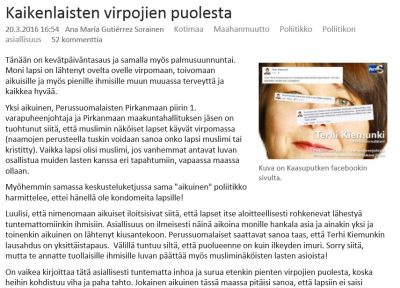
Terhi Kiemunki, jonka vastaan on nostettu syytteet kiihottamisesta kansanryhmää vastaan nousi viikonloppuna Tampereen perussuomalaisten johtoon yksimielisesti.
Kiemunki työskentelee yhä yhden perussuomalaisen kansanedustajan avustajana. Mitä se kertoo Suomen eduskunnasta? Mitä sanovat Jan Vapaavuoren puoluekaverit hallituksesta ja Keskustalaiset ministerit ja kansanedustajat? Hallituspuolueet tekevät niin mielellään yhteistyötä Terhi Kiemungin kaltaisten suomalaisten kanssa.
Toive toisenlaisesta Suomesta kuin Kiemungin Suomi elää vahvasti monissa suomalaisissa. Media voisi puhua perussuomalaisista oikeilla termeillä: äärioikeistoystäväälisenä- ja jopa rasismimyönteisenä puolueena.
Kirjoitus on ilmestynyt Uuden Suomen Puheenvuoron palveluksessa. Samassa paikassa, jossa ilmestyi kuvassa oleva kirjoitus Terhi Kiemungin pääsiäisnoitien kommenteista.
In May and much to the surprise of many, especially asylum seekers and concernedcitizens, the Finnish Immigration Service (Migri) announced that countries like Iraq, Afghanistan, and Somalia were safe to return asylum seekers.
Migrant Tales reported in September about Mohammed Khulbus Idnan’s return to “safe” Iraq after waiting for a year for his residence permit without luck. He returned to Baghdad to be at his mother’s side since she was going to die. He returned and was lucky: He got shot six times and survived.
Two other persons weren’t as lucky as Khulbus Idnan when they returned in summer to “safe” Iraq. Both of them were killed by bombs.
Hussein Ali Shawi Al-Frajas was twenty-nine years old when a bomb planted in his car detonated and ripped him in half from the waist down. We have pictures that show him inside the car that we won’t publish because they are so shocking.
Al-Frajas had been in Baghdad only three days before he was killed.
He left Finland after Migri had turned down his asylum application. He was a father of two.
Hussein Ali Shawi Al-Frajas died in summer three days after his return to Baghdad from Oulu, Finland.
The second young man to die in summer is Ahmed Kadhim Ali Alsultani, who returned back to Baghdad because he missed his two children and wife. He had come to Finland in September and waited for months without luck for a decision from Migri.