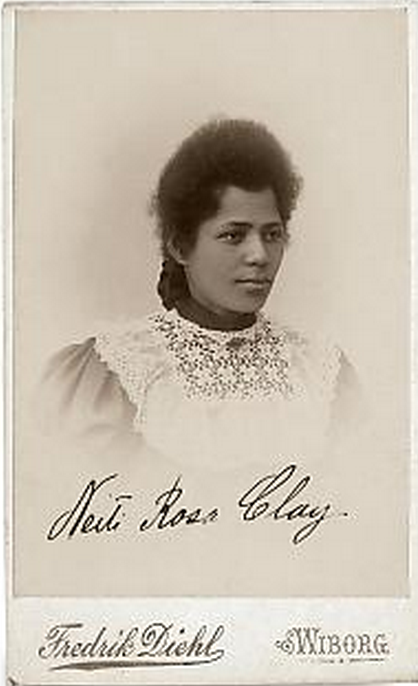
Una pregunta simple: ¿Por qué no hay una calle que se llame Rosa Emilia Clay en Finlandia? Clay era la primera africana que recibió la ciudadanía finlandesa en el año 1899. No existe una calle que lleva el nombre de Rosa Emilia Clay en Tampere, donde vivió un tiempo antes de emigrar a los Estados Unidos en 1904, ni tampoco en el pueblo de Mustinlahti, donde fue maestra de primaria en 1898.
Es tiempo ya que pongan una calle con el nombre de Rosa Emilia Clay.
I asked on Saturday the young Iraqi asylum seeker in detention cell 406 to show with pictures his world which is now a barred window that exposes some buildings and the rainy, overcast day. He messaged that he is “just nervous and stressed about the next week what will happen.”
The asylum seeker will find out next week whether it is deportation back to Iraq. He’s a Christian, and he claims that his father was killed in Iraq because he converted to Christianity.
It is not only punishment for an innocent person to be detained in a cell like the young asylum seeker in Lappeenranta, but hard on those that are in contact with him.
I can only imagine what he is going through as time ticks and nears him to his fate.
I too was once locked up in a detention cell in Argentina during the dirty war (1976-83) for forgetting my ID. There was also a barred window at the place I was detained without glass that exposed the overcast day, too. I remember hoping to turn into a bird inside that cell so I could fly to freedom but I couldn’t.
Asylum seeker in detention cell 406 wrote that he too hopes to be free but cannot think straight because he is too stressed and empty.
Här är en enkel fråga : Varför finns det inte någon gata i Finland som fått namnet Rosa Emilia Clay, den första afrikanska naturaliserade finnen 1899? Det finns ingen gata i Tammerfors som fått namnet efter henne. Rosa Emilia Clay bosatte sig i Tammerfors en kort tid före hon immigrerade till Förenta staterna 1904, även på Mustinlahti där hon var en förskolelärare fanns ingen gata som har fått namnet efter henne.
Borde vi inte sträva efter att få en gata i Finland namngiven efter Rosa Emilia Clay?
Tässä yksinkertainen kysymys: Miksei Suomessa ole yhtään katua nimeltä Rosa Emilia Clayn kunniaksi? Clay oli ensimmäinen afrikkalainen, joka sai suomen kansalaisuuden vuonna 1899. Rosa Emilia Clayn katu ei löydy Tampereelta, jossa hän oleskeli vähän aika ennen kun muutti pysyvästi vuonna 1904 Yhdysvaltoihin eikä Mustinlahdessa, jossa hän oli kansakoulunopettajana.
Eikö olisi korkea aika että Suomessa olisi katu nimeltä Rosa Emilia Clay?
Here’s a straightforward question: Why isn’t there in Finland any street named after Rosa Emilia Clay, the first African naturalized Finn in 1899? There is no street in Tampere that carries her name, where she resided shortly after migrating to the United States in 1904, and in Mustinlahti, where she was an elementary school teacher in 1898.
Shouldn’t we strive to get a street in Finland named after Rosa Emilia Clay?
Just like the Finnish Immigration Service (Migri) proclaims violent countries like Afghanistan, Iraq, and Somalia to be “safe” for such nationals but not for Finns, they don’t have any problems about deporting you back to such countries if you are a Christian. If what Iraqi asylum seeker in detention cell 406 in Joutseno* states is correct, his life is in danger if deported as a Christian back to his former home country.
The document below, provided by the asylum seeker is an interview with a grand mufti, an authority that interprets and spells out Islamic law. Grand Mufti Mahdi Ben Ahmed Al-Sumldei states quite clearly in the document that any Muslim that changes religion should suffer death.
“The death of such a person is based on an order by the prophet Muhammed: a person who changes his religion must die,” the document states citing a book.
The asylum seeker in detention cell 406 alleges that his father was killed in Iraq in 2010 for being a Christian.
“They warned that if my father converted to Christianity he and his family would be killed,” the asylum seeker said. “We escaped to Syria [after he was killed] and didn’t want to return [to Iraq] because we feared for our lives.”
“I didn’t mention this in the first interview with Migri because fear hit me,” he added. “I was afraid to tell anyone this fact about my family. I fear for my life in Iraq.”
* The asylum seeker who was locked up in this cell thought he was in Lappeenranta but in fact he was at the Joutseno immigration removal center located 20km away.
We published last week a story about Iraqi asylum seeker in detention cell 406 in Lappeenranta, Finland. He was detained on October 23 in the eastern Finnish city of Mikkeli by the police and sent to Lappeenranta.
The Iraqi asylum seeker launched a new case for asylum while in detention, but it was rejected. His lawyer said that if the appeal doesn’t go through his deportation could happen as early as next week.
Here is an excerpt from our messaging this evening:
The picture on the left was taken last week by the asylum seeker from his detention cell last week. The picture on the right is of the same detention cell but taken tonight.
If anyone wants to send messages of hope to Asylum Seeker in Detention Cell 406, they can do so by emailing to [email protected]
I am Fadi,* a Palestinian refugee born in Lebanon at Ain Alhliwa refugee camp. The camp itself is a big prison, just like Gaza.
I couldn’t stand living at Ail Alhilwa where fights, shootings, and bombings happened almost every day. This went on despite the fact that the Lebanese army surrounds the camp, and which they turned into a prison,
We were all suffering. All my family, especially the children. It was never safe. I came to Finland seeking peace for my family and me. After waiting for almost two years, our psychological condition is terrible; we are suffering, my wife cannot stand waiting anymore. For this reason, I hope that the ministry would have mercy on us.
We are holders of Palestinian – Lebanese refugee travel documents.
Ein al-Hilweh is the largest Palestinian refugee camp in Lebanon. It had a population of over 70,000 Palestinian refugees but swelled to nearly 120,000,[1] as a result of the influx of refugees from Syria since 2011. The camp is located west of the village Miye ou Miye and the Mieh Mieh refugee camp, southeast of the port city of Sidon and north of Darb Es Sim.
In 2016 Lebanese authorities began constructing a concrete wall with watchtowers around the camp. The wall has faced some criticism, being called “racist”.
Migrant Tales published in 2015 a Hall of Poor and Sloppy Journalism that aimed at highlighting the too frequent shoddy reporting by the national media of our ever-growing non-white community of Finland. A story published by Iltalehti on October 27 is not only an example of shoddy journalism but one that is racist as well.
One of the oldest stereotypes about the Roma minority in Finland is that they are thieves and cannot be trusted.
The Iltalehti story reinforces such a stereotype with a story about a 30-year-old woman, who shoplifts food from a market and hides it under her skirt. While the story doesn’t use the term “Roma” once, they use code to identify the ethnic group: “hides produce under her skirt.”
One of the ways that white Finnish privilege exposes itself is through the media. The story by Iltalehti of the suspected Roma shoplifter is an example of how stereotypes of specific ethnic groups are maintained.