


The 5 November US presidential election will be remembered as the alarm that signifies the end of USAmerica and when all of its contradictions caught up with it and destroyed it. Nothing good can come out of a second Trump term except for more global and national chaos.
The US poet Allan Ginsberg (1926-1997) put it in the following words in his book The Fall of America: “In a thousand years, if there is history, America’ll will be remembered as a Nasty little country full of Pricks…”
Only the system is to blame for the downfall of the United States, a history of the unfree. The United States’ predicament has come to fruition thanks to runaway capitalism and the lack of guardrails.
Power blinds, but also destroys.
Whenever a country believes it is invinsible, that is when ita downfall spiral begins.
Right behind the United States is Europe.
Our downfall tells us that we’ll be treated the same way as we treat others from developed countries – with contempt.
Tapasin Mara-Liisa Tolvasen Thunder Bayssä Kanadassa vuonna 2006. Thunder Bay (Tunterpei) on kaupunki, jossa on paljon suomalaistaustaisia. Marja-Liisa oli niin ystävällinen, että hän antoi minulle sanakirjan, jossa on joitakin Fingliska-sanoja.
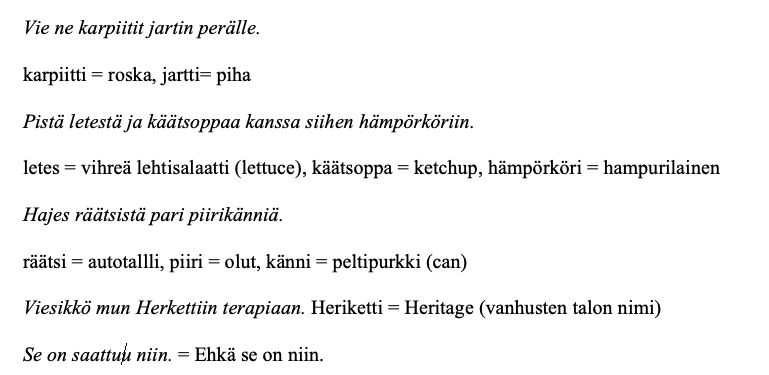
Sanoja
Saulstemarie tai Suustemarie = Sault St. Marie Supperi = Sudbury Tunterpei = Thunder Bay Vankkuuveri = Vancouver Vinnipekki = Winnipeg Rutto = Trudeau (ent. pääministeri)
mauri = pormestari (mayor) lojiari = lakimies (lawyer) nörsä = sairaanhoitaja mainari = kaivosmies kuvermentti = valtio laisi = lupa (licence) ajolaisi = ajokortti roki =avolavapikup tai kuoma-auto pootti = vene kämppä = kesämökki haussi = talo kaara = auto haiskoulu = high school maali = ostokeskus (mall) haali = seurojentalo (hall) hospitaali = sairaala
Continue reading “Opitaan Fingliska Mara-Liisa Tolvasen kanssa”
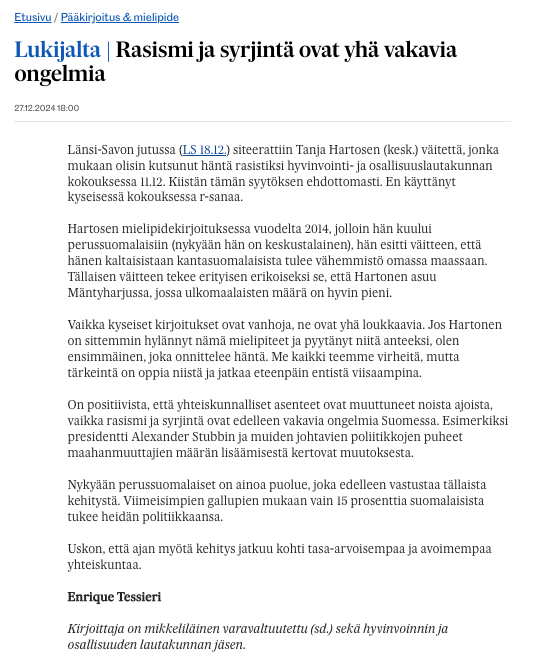
Thanks to National Coalition Party (NCP) MP and chairperson of the constitutional committee, Heikki Vestman, Finland regressed to the days of the cold war, when human rights was seen as a negative matter because it jeopardized our relationship with the former Soviet Union.
Vestman, who has been accused of throwing the rule of law and human rights under the bus and allowing politics to taint the credibility of the constitutional committee, accuses Juha Lavapuro, who will begin his term as a member of the European Court of Human Rights, of undermining the rule of law because he criticized the pushback law passed in July.
Even if the law was passed in the summer, Syrian asylum seekers who crossed the Finnish-Russian border in November claim that Finnish border guards started to pushback asylum seekers in December 2023.
The Finnish Border Guards have not confirmed or denied such a claim because they do not comment on such claims.
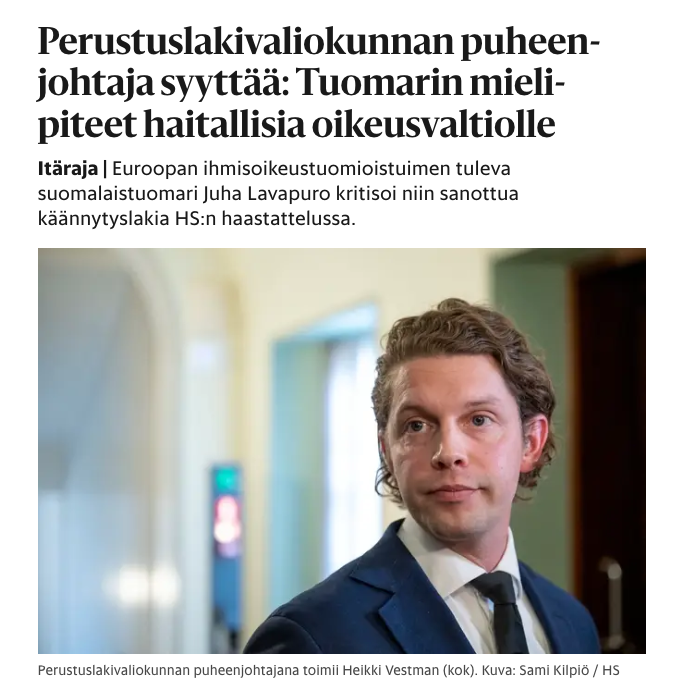
Read the full story (in Finnish) here.
Lavapuro criticized Monday the constitutional committee and the pushback law in Helsingin Sanomat: “If you consult independent experts and make fun of their legal views by invoking national security, it is fair to say that the constitutional committee has stepped out of its constitutional role and into the political arena,” he was quoted as saying.
Vestman struck back at Lavapuro in a Helsingin Sanomat interview: “In general, I consider as harmful to the rule of law any speech that disputes the decision of a competent institution on the existing legal situation and the obligation to comply with it – whether it is made by a politician, judge, professor or ordinary citizen,” Vestman wrote on X.
Apart from his role in the constitutional committee and making possible the passage of the pushback law, Vestman has spoken lowly about asylum seekers.
Migrant Tales wrote about Vestman in 2021: “When I heard your speech [in parliament] and rationale Wednesday (20 October), I wondered how a young, apparently intelligent person could house such opinionated and unsubstantiated claims about migrants. If you are honest, would you want to [live and] grow up in a country where this type of discourse is ongoing by politicians seeking power and attention?
Read some history and check out how the Finns were labeled in Sweden during the 1960s and 1970s.
Does the phrase “en finne igen” [a Finn again*] ring a bell?”
Apart from throwing human rights and the rule of law under the bus, Vestman also does it with asylum seekers.
*In the 1970s, any crime that was reported in the media was assumed to be done y a Finn. They say when reading about a crime, it was “a Finn again.”
| Enrique Tessieri <[email protected]> | May 1, 2017, 4:29 PM |  | |
| to [email protected] | |||
President Jimmy Carter, you don’t know me but I’d like to thank you from the bottom of my heart for giving me hope during one of my darkest hours when I was in Argentina during the dirty war (1976-83).
At the time when you mentioned that human rights would form a part of US foreign policy, I was arrested in Buenos Aires and thrown in a prison cell for forgetting my ID at home. There was no habeas corpus, no due process and everything appeared to be left to chance as I stared out through the barred opening into the overcast day from the cold cell.
I remember that day so clearly and didn’t feel forsaken because you had spoken about human rights. I was a young man back then and started to study more in detail the thirty sections of the UN Declaration of Human Rights.
I write this email to you, Mr. President, because I read that President Donald Trump has asked Argentine President Mauricio Macri to rescind a decision to give you the Order of San Martin, Argentina’s most prestigious medal.
I am ashamed and saddened by the actions of Argentina’s president.
Even so, I want you to know that your foreign policy of human rights during your mandate as US president will never be forgotten by me. It gave me hope during one of the darkest moments of my life, when I was physically detained in a cell on a Saturday afternoon.
I recovered from that incident but haven’t ever forgotten it. I work today as a techer and anti-racism activist during my spare time.
I’m eternally thankful to you.
Enrique Tessieri
THE REVIEW WAS UPDATED
Writer and director Ahti Tolvanen, who is a member of the Migrant Tales board, has written a play that reflects hard and uncertain times for Finland. When Ahti came to Finland in the 1970s, it was a very different country. For one, its foreign policy, which some criticized as Finlandization, attempted to coexist with its giant eastern neighbor.
But matters have chaned from those cold war years. Some Finnish politicians regularly beat their chests at Russia and believe that NATO will save the day if Finland is ever invaded by Russia.
“Before, Finland’s foreign policy wa dicttd by the Soviet Union and now we are prostrate towards the United States,” said Tolvanen. “Finland seems to be adrift and nobody can see where it is heading.”
The play offers a different narrative and take on things. Geopolitics, politics, immigration policy and other factors come to light and offer the viewer a chance to reflect where the country is heading.
Helsinki Noir, which has showed in Helsinki and London, has received some rave reviews:
“Satirizing ultra-conservative politicians…raising public awareness, and empowering the disempowered” – Yuko Kurahashi, a vising reviewer and professor of drama, Kent State University.
“A wonderful show” said Laura Killeen, director of Rosemary Branch, London

See the full play here.
The cast was made up by Ahti Tolvanen, Eric Riekko, Elia Ronin, Marita ämsä, Maia Kosonen and Peter Joy.
When Finns talk about expats, they usually mean those that are Finnish citizens and, most importantly, speak the Finnish or Swedish language. Apart from speaking on of Finland’s two official languages, your ethnic background plays a role as well.
When you generalize, you risk walking on thin ice. I’ll take that risk, however, to make a point. If you grew up in countries like the united States, Canada, Australia or any other with a large white English-speaking population, your acceptance in Finland may be easier than if you were black, Native American, and Latino.
Being white doesn’t mean tat you’ll be automatically accepted. Many Russians, who are white struggle for acceptance in this country due to the historical wounds that have not yet healed. Let’s make on matter clear: When I speak of Finns I’m talking about some Finns, not all Finns.
Certainly there are matters that officially define where you’re from. This can be a passport, but what if you feel a close bond to this country, don’t speak any of the two languages and aren’t a Finnish citizen?
In my opinion, the line that separates Finns from “us” versus “them” should be obliterated. If there is one factor that is throwing sand in the gears of building a vibrant culturally diverse society in this century, it’s our narrow definition of who is and who isn’t a Finn.
Look at it this way. Over 1.2 million people emigrated between 1860 and 1999. The fact that so many built their lives abroad suggests that Finnish national culture, language, and identity have changed dramatically. Those Finns that have lived abroad for some generations are decades ahead of us in Finland since they represent the future Finn.
Who are the future Finns? They are those who have multicultural and multiethnic backgrounds but still see Finland a a part of their heritage.
New century, new Finn
The meteoric rise of an anti-EU, anti-immigration and especially anti-Islam part in the 2011 parliamentary elections, is one sin that matter have changed radically in Finland.
The number of MPs of the Finns Party won two years ago soared to 39 from just 5 in 2007. While Finland’s ever-growing culturally diversity played a role in the Finns Party victory, other factors like the euro crisis and massive bailout of countries like Greece Ireland and Portugal helped.
The knee-jerk reaction and te rise of a populist party to our ever-growing culture diversity and EU skepticism shouldn’t surprise us. Even if hundreds of thousands of Finns had emigrated from the country in the last two centuries, Finland immigrant population has been tiny, peaking to 29,685 in 1928 but steadily declining to 5,483 in 1970. EU membership in 1995 changed matters dramatically and today our foreign population total 195,511.
When I had the opportunity to visit the Finnish community of Thunder Bay in Canada in 2006, I learned that Finnish identity was not only restless but constantly changing: It could be Canadian, Finnish Canadian, Finnish or a multitude of other identities.
Even if some of the members of the Finnish community of Thunder Bay ad grown accustomed to speaking Finngligh, what I witnessed was not a distancing from the Finnish spoke n in Finland but the birth of a new branch of our language.
Inclusion and acceptance
Despite my Finnish multicultural background, which I’m proud of, it is still used by some to remind me that I’m not fully “us.” This, fortunately, happens less than before.
Continue reading “Suomen Silta* (6/2013): Finns of all backgrounds, unite!”Instead of seeing a reversal in Islamophobia in the European Union, we see the opposite. The European Islamophobia Report 2023 states “how anti-Muslim racism manifests through systemic discrimination, political rhetoric, media narratives, and societal attitudes, exacerbated by geopolitical events such as the Gaza conflict.”
One of the key findings of the report are the denial, recognition and solution to the rise of Islamophobia.
In Finland, the new government of Prime Miister Petteri Orpo with the Perussuomalaiset (PS)* has normalized racism in general and anti-Muslim racism in particular. I wrote: “…because of
the 180-degree turn in immigration policy. The government’s policies and assurances
have failed to reduce the climate of hostility towards migrants and minorities, which
is likely to continue to grow.”
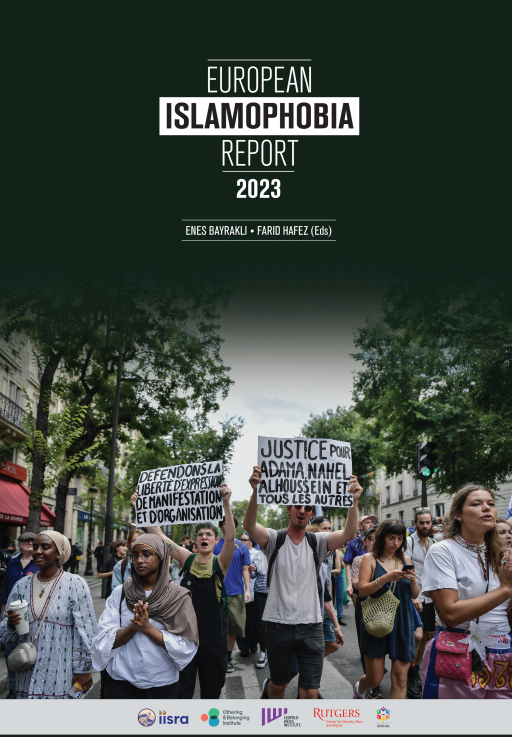
Read the full report here.
The Finland chapter is on pages 259-284.
White fragility is a defensive action, whereby white people react violently and defensively whenever racism is brought up. The aim of such hostility is to make the person bringing up the topic so attacked that he or she will not dare bring up the subject ever again.
Finance Minister Riikka Purra and Jussi Halla-aho of the Perussuomalaiset (PS)*, an anti-immigration party, often write and speak in a demeaning manner about migrants and minorities. Do their postings ever get old? They don’t. They are always there ready to release their toxicity.
THE POSTING WAS UPDATED
White fragility is a kneejerk reaction to instill fear and shut the mouths of racialized people. As an antiracist activit, one must be strong and not be intimidated by such hostility. Even if the concept of white fragility was coined by Robin Diangelo to expose racism in the US, it applies to Finland as well.

In a 2008 poting, Finance Minister and head of the PS Riikka Purra wrote with the pseudonym “riikka,” wrote: “If you gave me a weapon, [youth with migrant background] corpses would appear on a commuter train, you see.” Source: European Islamophobic Report 2023.
Engaging in conversations about racism may trigger a range of defensive reactions, feelings, and behaviors, such as hostile anger, fear, and silence. Finland is no different.
UPDATE: After I had mentioned to councilperson Tanja Hartonen that her past writings revealed how she voted to give money to the Crisis Center as opposed to multicultural association Mimosa, she exploded and started yelling at me stating a number of times what I wrote about her was “outrageous.” She said at the time she could have pressed charges for defamation.
Was her reaction appropriate and becoming of a member of a city council committee?
She was so riled up that I couldn’t utter a word, never mind falsely accusing me of of calling her a racist.
Note: I did not mention her problematic blog post on Uusi Suomi, she did, and it would have been a travesty if she could press charges successfully for writing such trash that was taken down by the moderators.
Below, is a post by Tanja Hartonen, today a Mikkeli Center Party councilperson who was originally a member of the Social Democratic Party and then became a member of the PS.
Below is a blog post that Hartonen wrote in 2014 that resurfaced by her in December at a Mikkeli city committee meeting. Hartonen’s posting back then was so toxic that it was taken down by the Uusi Suomi moderators.
Even if she attempted to playdown the posting by stating it was written a long time ago and that she was planning back then to charge me with defamation, does such a post ever get old?
At the time of her posting, Hartonen was eyeing the 2015 general election and certainly wanted more fuel for her campaign by spreading anti-immigration rhetoric. At the time I was also worried for four Muslim teenagers who moved at the time to Mäntyharju as quota refugees.
Below is the original 2014 posting by Hartonen that was picked up by Migrant Tales.

Writes Hartonen: “Soon Finland won’t look like Finland anymore, or Finns at this rate. At this rate, we’ll become a minority in our own country. Cultural enrichment (what a term!) is in some people’s opinion a good thing? Oh in order to make Finns more sociable? What’s wrong with our culture anyway? If somebody doesn’t speak or kiss you, that’s how things are.“
Read Hartonen’s blog post translation here.