In my opinion In Finland, the far-right can be understood as an underlying connection of ideological alignment shared between political parties, political groups within parties, individuals. Ideological outlooks that are characterized by extreme nationalist, anti-immigrant, and too often racist views.
These groups typically promote the preservation of a perceived “pure” or “authentic” white Finnish identity, which they see as threatened by a loss of “traditional” social values, immigration, multiculturalism, and specified scapegoated communities – with Muslim, African and Roma communities being the primary (though not the only ones, the list goes far longer and includes every group or community that isn’t perceived Finnish) targets. A strong belief in the “Great Replacement Theory” and climate change denial, as well as a rejection of liberal democratic principles, free media, diversity, and policies that promote inclusion, human rights, and equality frameworks.
The far-right is far from a unified, homogeneous movement confined to a single, well-defined party. Instead, its influence often spreads across various parties, including those that present themselves as centrist, national (center-right or right-wing), and even occasionally “liberal” to some extent. Within these parties, a wide spectrum of views exists, ranging from liberal to highly conservative. As a result, tolerance levels—and attitudes toward racism—vary significantly across this ideological scale, reflecting the diversity of opinions within these political groups.
When key triggers such as xenophobia, Islamophobia, the questioning of human rights (under the guise of “security”), migration, and the right to seek asylum are activated—often in response to specific events or contexts—they are typically deployed to target minorities. It is still surprising to some when populist rhetoric and calls for restrictive or exclusionary laws, aimed at one or more racialized minorities, emerge from members of mainstream political parties. These parties often align with far-right, explicitly nationalist factions. Given the shared ideological foundations of nationalism, aversion to foreigners, racial intolerance, and beliefs in racial superiority, their cooperation and partnership are unsurprising.
The term “BURANA,” an inside joke in Finland akin to a “one-size-fits-all” solution, is a fitting metaphor for the far-right’s scapegoating tactic. This rhetorical “duct tape” is used to channel public frustration toward specific minority groups. During times of perceived economic hardship, far-right movements attempt to garner support by positioning themselves as the defenders of “the originals,” while portraying racialized minorities as outsiders and threats. This oversimplified narrative is used to blame these communities for everything from rising prices, cuts in healthcare, and higher taxes—even bad weather, the only aspect of climate change they are willing to acknowledge. Conveniently, this tactic distracts from the far-right’s own political and economic failures, deflecting attention to external scapegoats.
*Ibuprofen, or Burana, is a nonsteroidal anti-inflammatory drug that is used to relieve pain, fever, and inflammation.
Finland, a bright yesterday, so vivid one feels he can still touch it: a society striving for better living standards, equitable opportunities, and ideals of fundamental human rights, a happy nation where almost all its inhabitants did not feel a sharp gap between the rich and the poor, a country that did not leave the poor (low-income or vulnerable people) to fend for themselves… or behind.
While promising a better tomorrow, the future echoes a growing economic divide, which will come with social tension, mental anguish, and an era of unrest, to be the next generation’s inheritance. An inheritance of an incohesive society, deteriorating public welfare systems, decline of social safety nets particularly for low-income people, seniors, and retirees, racism and fears instead of inheriting a world of endless possibilities. The promised magic wand turned out to be a grim scissors.
The drivers, while ignoring perhaps one of the most troubling aspects of this regressive trajectory, insist on (shifting from a society that celebrates openness and liberal values to one that is increasingly closed-off and xenophobic, eroding the fundamental human rights and disregarding the basic principles of human dignity), and is on its way to ‘no-‘ where they succeeded to tarnish to some extent the Finnish reputation on the global stage, the legacy of tolerance and progress that was built over years and years. It is being overshadowed by the very few, our happy four members in government have managed to do.
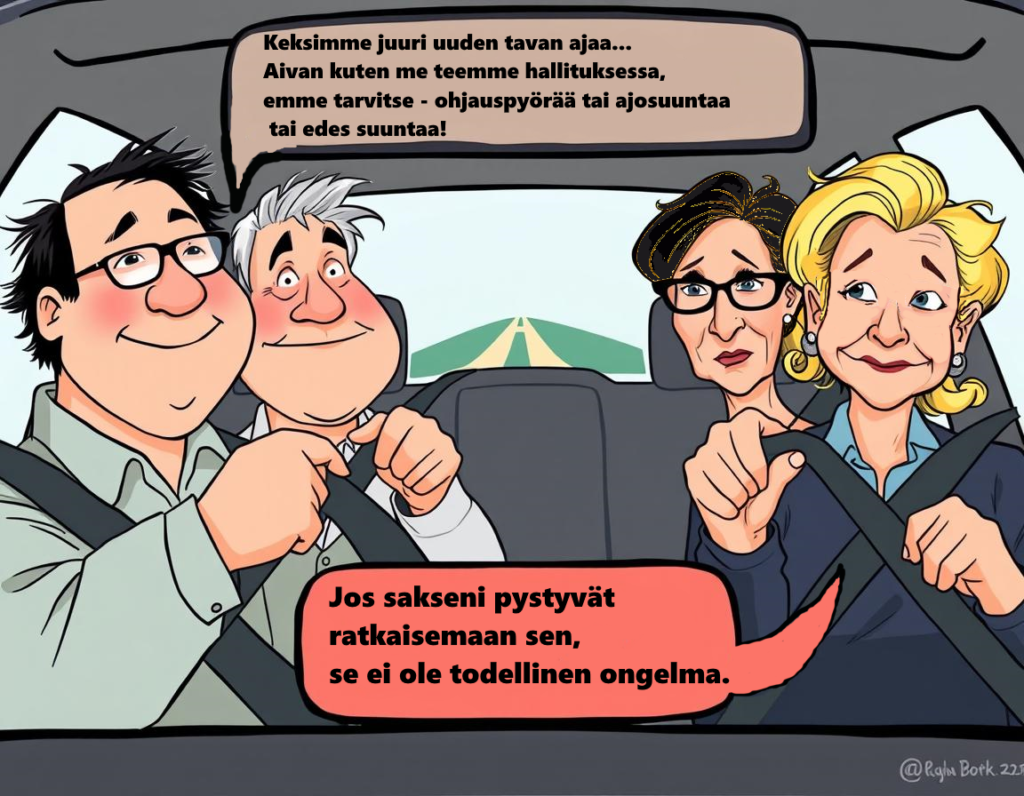
For there was nothing more fruitful for the political “leaders” but to blame it all on the “strangers” to their ideals, ideals that fit in few words, “whites, but not any, and with blue eyes but not from elsewhere.” No landmark was more celebrated on their way than how swift and effective it is, to approve and pass a law that pushes back those who are not welcome or desired. As the ‘car’ is effectively unreliable there were more than just frequent stops to fuel more hate and share some racism to “touch base” and distract the curious followers questioning the destination.
Ai generated image by the author. “We just invented a new way to drive…Just like we do in government, we don’t need a steering wheel, driving direction, or even direction. If y scissors can find a solution, it should not be seen as a real problem.”
If immigrants and their contribution to society, the economy, and professional labor are the issues, one should think if the ones that are accepted or needed would not accept a better offer, with lighter workloads and better pay elsewhere, from very close nations that for them people are valued, nations that have become favored for among others like Finnish professionals to move and work in.
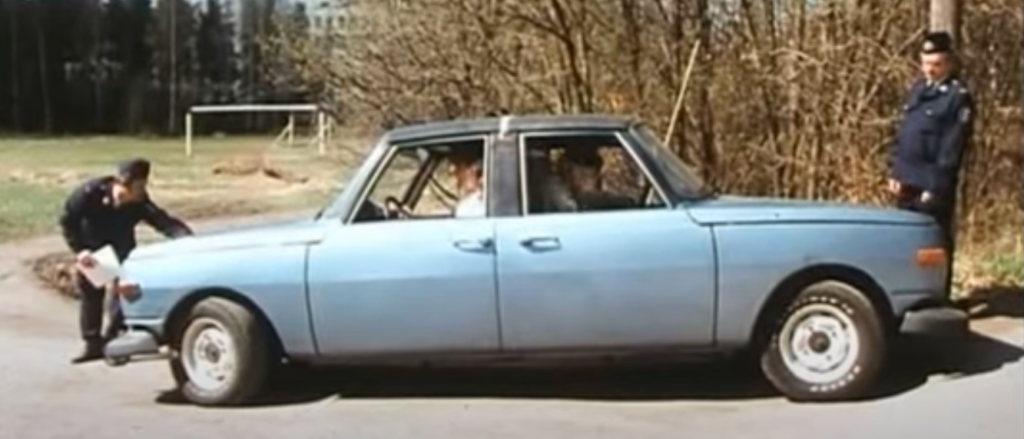
Two-headed car from the famous Uuno Turhapuro movie, ”Uuno Espanjassa”
From ‘Kaksipäinen auto’ from Uuno Espanjassa that brought laughter and joy to ‘kaksipäinen hallitusohjelma‘ of our ‘Leaders’ which does not in any way bring more than gloom. The peculiar car in many ways portray the contradictions, open but very closed, liberal but very conservative, “Zero tolerance” but very racist and government program to combat racism but the program they came up with!
The government’s celebration of their way out of many racist scandals ‘Me Puhumme Teoin’ (Action, not only words) campaign reminded me of a saying I heard:
“Not every bump in a belly is a ‘blessed’ baby, more often than not, it’s just gas.“
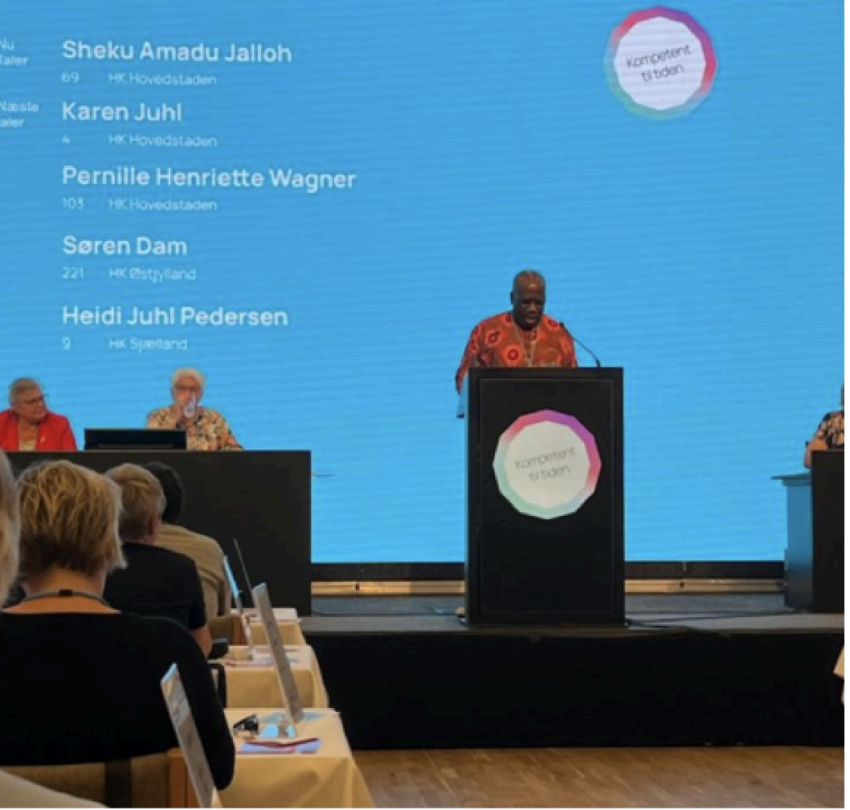
In November 1990, Sheku Amadu Jalloh arrived in Denmark from Sierra Leone as a stowaway, escaping the political turmoil of his homeland. Over three decades later, the stowaway, Jalloh who has studied journalism at the University of Liberia with a three-month training program in the USA, is a Danish citizen and a dedicated employee at the Royal Library. Jalloh is also a celebrated activist committed to combating racism and discrimination.
Making a speech on 21 March during the UN International Day for the Elimination of Racial Discrimination.
A Journey from Sierra Leone to Denmark
Jalloh left Sierra Leone due to the political instability and civil war that plagued the West African country for 11 years and sought a better life in Denmark. Since then, 30 years have passed and he has deeply integrated into Danish society. He recently celebrated 30 years working at the Royal Library.
At a trade union congress.
Leadership in the Fight Against Racism
“A Denmark in which justice and equality are not just ideals, but realities for all of its inhabitants,”
As chairman of SOS Racism Denmark and board member of the Afro-Danish Collective, Jalloh advocates against racism and discrimination. These organizations aim to create a society where everyone has equal opportunities, regardless of their background. Jalloh states that their mission is to prevent the spread of racism and discrimination. Despite Denmark ranking fourth in Europe as a racist country, according to Information in November 2023, Jalloh notes that this view is not representative of all political parties. Some parties offer support to immigrants and people of foreign descent.
Making speech on workers day on May 1st (Left picture) – From a meeting with Rosa Lund (right front photo sitting), an MP of the Red-Green Alliance political party. An anti-discrimination action plan was discussed at the meeting. (right picture)
A broader alliance for equality
In addition to participating in the Afro-Danish Collective and SOS Racism, Jalloh is a strong advocate of Mellemfolkeligt Samvirke, a coalition organizing activities and protests to encourage communication with legislators and lobbying for anti-discrimination laws. In the face of the government’s erratic refugee quotas, which were lowered from 500 to 50 and are currently 200, Jalloh and his associates are unwavering in their demands for greater acceptance rates. They stress that, in light of other countries’ efforts, even the former quota of 500 is insufficient.
Celebrating the UN International Day for the Elimination of Racial Discrimination.
The Role of Trade Unions
A major component of Jalloh’s approach is mobilizing trade unions for the cause. He anticipates using the combined might of organized labor to present a unified front against racism and discrimination. “My goal is to involve more trade unions in the anti-discrimination battle and every year on March 21, we celebrate the UN International Day for the Elimination of Racial Discrimination Day together with five to six trade unions participating in the events,” he said.
A vision for the future
Jalloh and his fellow activists were instrumental in the adoption and enactment of the anti-discrimination action plan in Copenhagen in 2023. Seeing that their efforts have proven fruitful, he has now resolved to attain similar outcomes with an equivalent national legislation.
Addressing delegates at the HK Stat Trade Union congress.
Despite the many challenges, Jalloh remains unfazed and his vision is clear: “A Denmark in which justice and equality are not just ideals, but realities for all of its inhabitants,” he continued. “One thing we have to work very hard on is coming together to fight racism and discrimination.”
Jalloh’s story is one of zeal, perseverance, and unflinching dedication. From his beginnings in Sierra Leone to his current position as an activist in Denmark, he shows the impact that one person can have in the battle for a more equitable, inclusive society. Through his work, he continues to inspire and motivate others, demonstrating that the route to equality, while arduous, is “undoubtedly worth every step”.
How to make a zero-tolerance winter recipe for boiled rocks in a pot, spreading fear and throwing the elderly, disabled, and low-income people into the woods.
Get fresh carefully planted governmental hate seeds and a handful of conspiracy-based theories.
Add to them as many social media posts and photos encouraging discrimination based on racial, ethnic, and religious background.
RWell grounded in your portfolio, a deep-rooted pinch of racial superiority to attract as many voters as possible.
Once it is ready, it doesn’t take long to cook, do not worry if you get far-right terrorism and racist crimes – it’s only collateral damage.
The recipe and prize for ‘Her Blue Eyes’ is a stench strong enough to cover up unfulfilled yellow promises of the Perussuomalaiset.*
Enough to cover up the unfulfilled yellow promises of Blonde Edward Scissorhands’ parody and the incompetence (didn’t do, can’t be blamed) of Mr. Blue, Blue Blue (code name 00 Zero tolerance).
If this recipe is done properly, it can affect your appetite to ask for more. For example, you can blame the victims, not directly of course, but by using them all in the same pot to promote ethnic profiling, body searches, and more (the thing with the badger symbolism-doctrine or way of being).
A naïve person’s question: Would Timo Vornanen be stopped, searched, or even suspected?
Would the 15-year-old suspect of the second Oulu stabbing at te Valkea shopping center be suspected?
Would Juhani Sebastian Lämsä , who was involved in the activities of the banned Nordic Resistance Movement, stab a 12-year-old child with a foreign background in almost the same place.
Dr. Faith Mkwesha is a Zimbabwean who did her doctorate in South Africa and now lives in Finland. She has worked in higher education in Africa for many years. She is currently a lecturer and researcher at the University of Helsinki, the Swedish School of Social Sciences, and the Centre of Ethnic Relations and Nationalism (CEREN). She founded the Ubuntu Nordic Academy (UNA), where she offers Ubuntu-centered courses and expert workshops for institutions, businesses, and politics on health and well-being.
“I registered UNA after being encouraged by a friend who liked the meaning and practices of Ubuntu/Unhu African philosophy when he heard me give lectures on Ubuntu centered relations and partnerships. He even went on to buy some books on Ubuntu to show me that what I teach is more meaningful than some of these books. You know i was not thinking of making this a business that contributes in society here in Finland. You know Ubuntu teaches us to be kind even to strangers, give them food because we say a visitor does not empty the granary, and to respect each other. Ubuntu is very relevant in any society, i even teach about Ubuntu in university. This inspired me to start SahWira Africa International NGO an organization grounded in Ubuntu to advocate for women and children´s rights. “ – Dr. Faith Mkwesha
In a Western society, embracing the concept of Ubuntu has tremendous potential to foster unity, acceptance, and prosperity. Rooted in African philosophy, Ubuntu emphasizes the interconnectedness of humanity and the idea that our well-being is intertwined with the well-being of others. By embracing this principle, Western societies can move toward a more communal and inclusive mindset, breaking down barriers and fostering a sense of shared responsibility. In a world often characterized by individualism, Ubuntu promotes empathy, cooperation, and mutual support – essential elements for addressing societal challenges. This philosophy can pave the way for a more compassionate and understanding society where diverse perspectives are not only tolerated but celebrated. Ultimately, the integration of Ubuntu into Western cultures can help build a more harmonious and prosperous community where the collective success of all is prioritized over individual achievement.
Among other very important things, Dr. Faith Mkwesha in her lecture below, “Ubuntu Centered Diversity,” highlights the profound importance of the deeply rooted Sankofa bird which is a rich tapestry of Akan culture. Sankofa embodies a profound philosophy that transcends time, encourages a reflective journey, and reminds us that understanding our roots is essential to personal and collective growth. This timeless wisdom resonates and echoes throughout the African diaspora, serving as a powerful beacon of cultural identity.
Amid the rise of far-right ideologies, Ubuntu is emerging as a powerful tool for healing and building a stronger society. Ubuntu serves as a counterforce to divisive narratives by championing interconnectedness and shared humanity. It encourages dialogue over discord and promotes understanding in the face of ideological polarization. The philosophy’s emphasis on collective well-being by dismantling the exclusivity often associated with far-right politics, it paves the way for a more inclusive and harmonious society. Ubuntu challenges the us-versus-them mentality and offers a way to heal societal fractures and build a resilient foundation rooted in empathy, cooperation, and shared prosperity. In times of political polarization, embracing Ubuntu becomes not only a cultural imperative but a pragmatic strategy for forging a more united and resilient future.
I invite you to embark on a transformative intellectual journey by watching a riveting lecture by Dr. Faith Mkwesha, which delves into Ubuntu Centered Diversity. The video, accessible via Ubuntu Nordic Academy’s YouTube channel, showcases Dr. Faith Mkwesha’s expertise and promises to provide valuable insights that could reshape our understanding of our society and how much Ubuntu is needed.
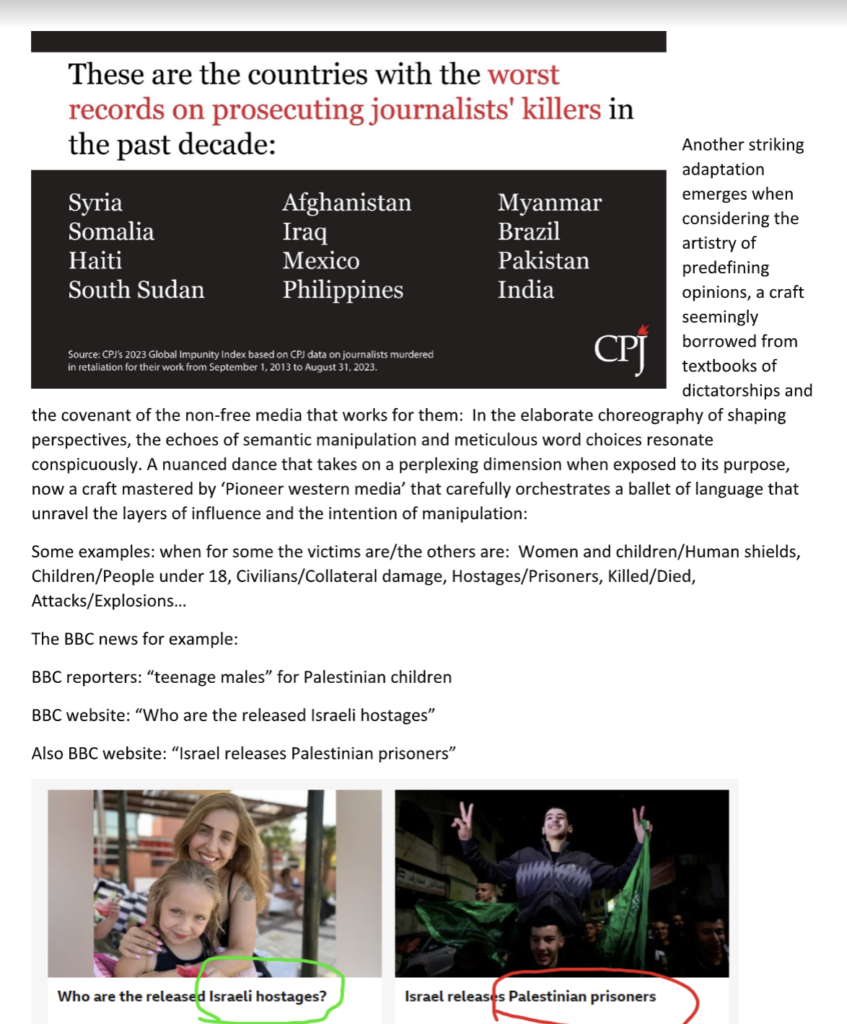
Media, high pillar of civilization, pride of the developed world, crown jewel of any democracy, far (rightly) from being biased, “fair”, “free” and “ethical”… The title is addressing you.
You can cut all the flowers, but you cannot keep spring from coming.
Pablo Neruda
As we navigate daily “a” distorted gallery, the glaring contrast between the spotlight cast on some and the shadows shrouding others becomes an uncomfortable tableau. The dichotomy echoes the oppressive silence enforced by the Western media that “beautify and nose-powder”, confining information and strangely by selectively applying censorship. In this unsettling narrative, objectivity is the art of selective disclosure that taints a casualty and information. As we traverse (ironically) the landscape of double standards, let’s pick some of the information and look it up from the mainstream.
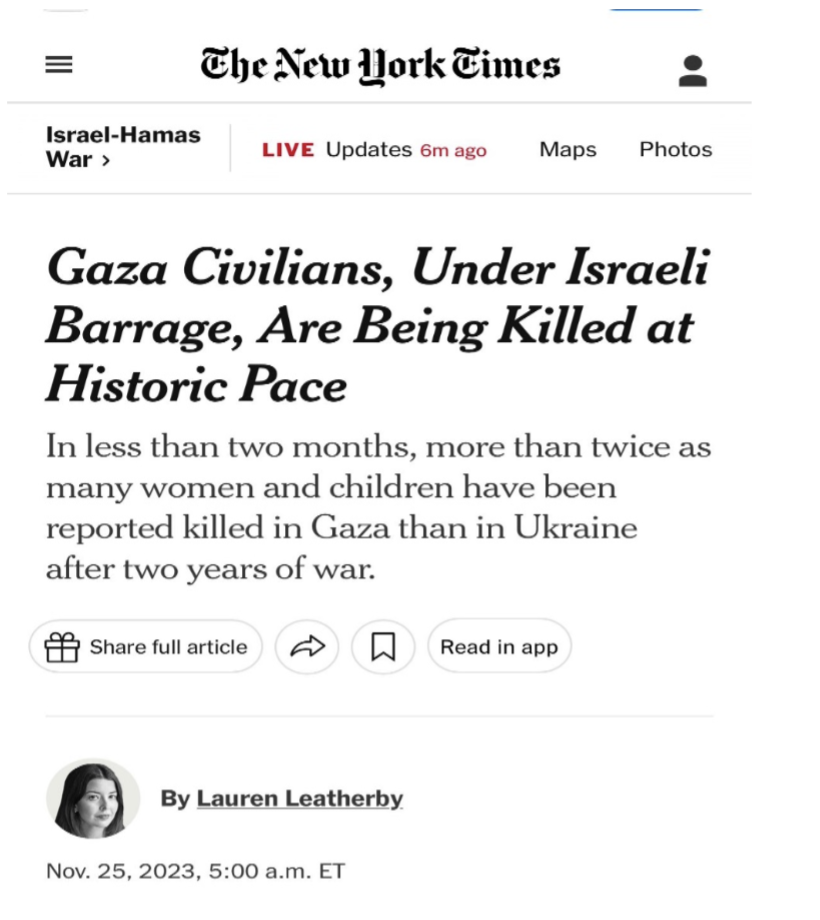
While it only took 49 days of genocide and 8,000 children killed to get an article like the one below from the New York Times, and a change of heart in some other outlets, the media in Europe is a far cry from the noble Western values for human rights, at least the same way it glowed when it was about Ukraine. It’s worth reminding that Germany, for example, charged Russia with war crimes for ONE indiscriminate missile attack that killed 22 people. Israel has done this approximately 1,000 times.
The full article of the New York Times here: https://www.nytimes.com/2023/11/25/world/middleeast/israel-gaza-death-toll.html
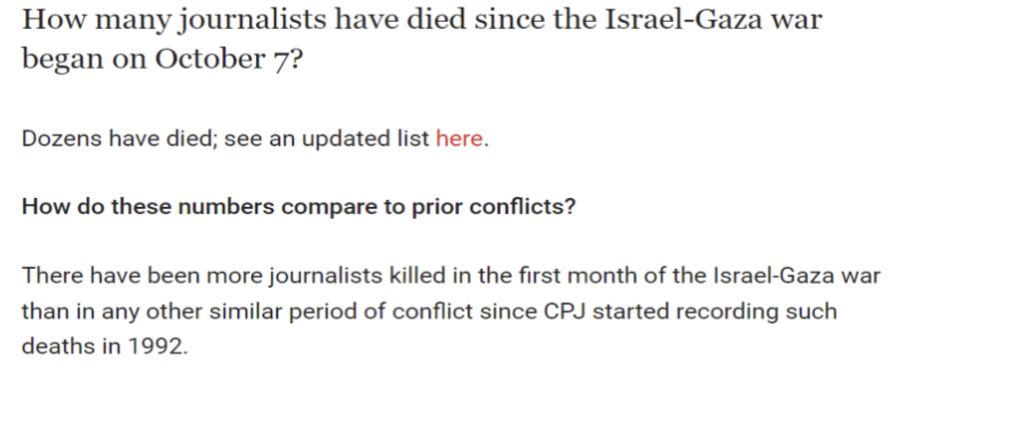
There are a few many things that don’t comply with the proclaimed Western values when it comes to this matter: Journalists from there aren’t that much valued, supported, or protected by their “colleagues” in Europe. The number of journalists that have been killed (67) is practically a record that has never been recorded before, and the silence about it is no less significant.
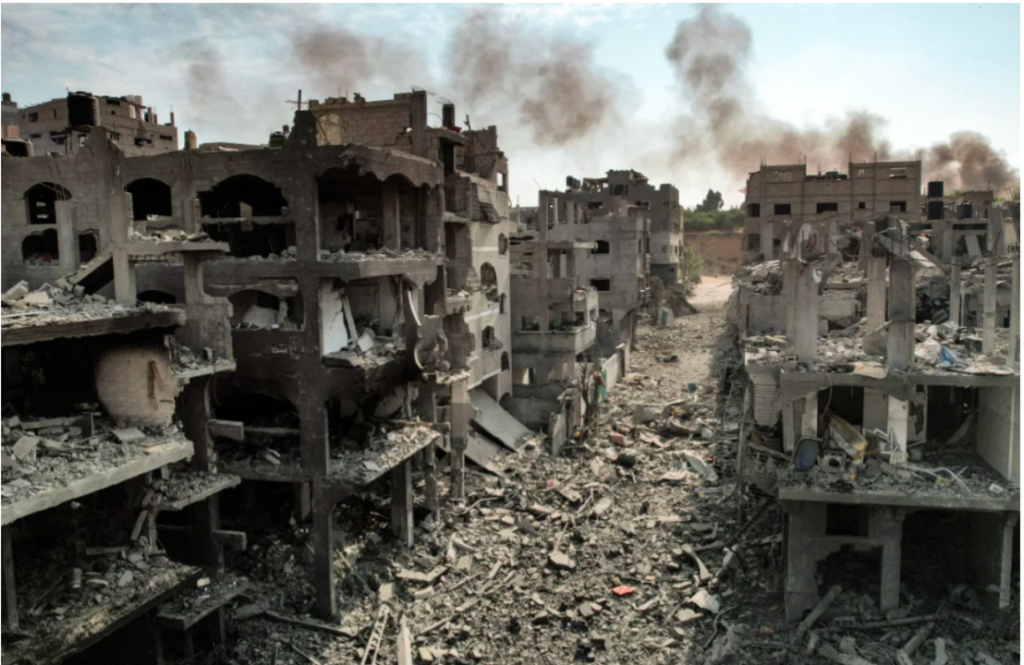
The quantity of explosives that have been dropped on Gaza has exceeded 12.000 tons, equivalent to the size of the nuclear bomb dropped on Hiroshima. Bear in mind that Gaza (45km²) is one-third the size of Nagasaki. More than 2.2 million Palestinians live in Gaza, an area about 40km long and 10km wide at its widest point!
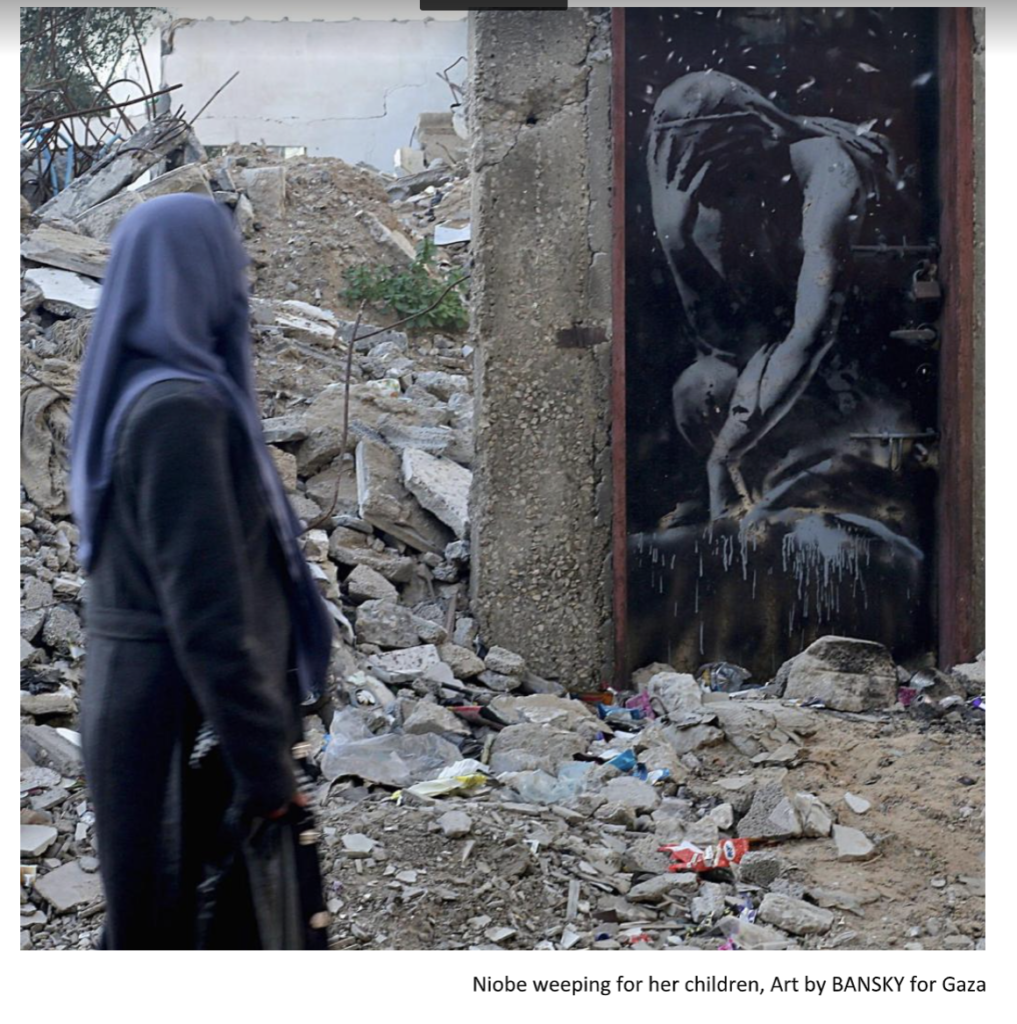
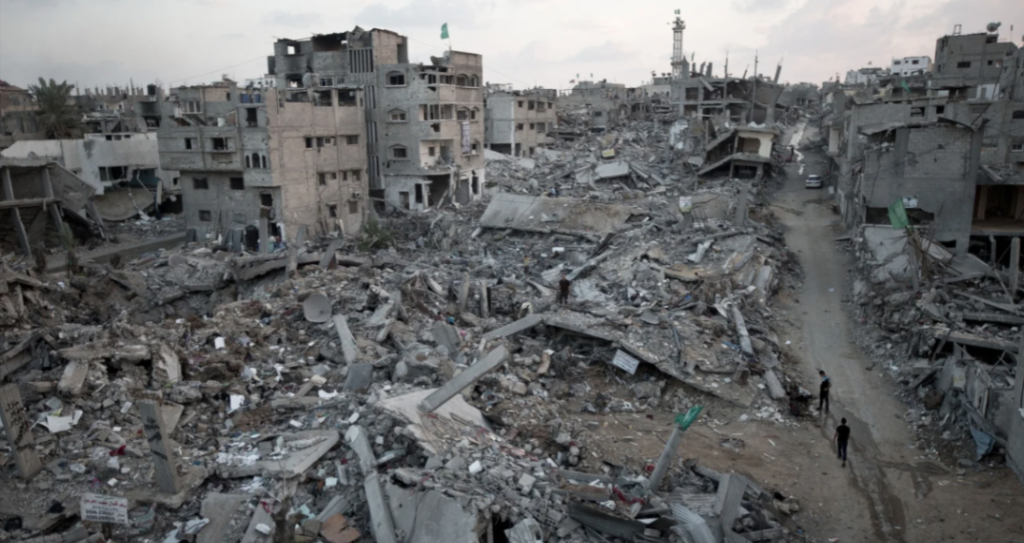
The destruction of Gaza. Open Source.
The foreign minister of Israel who in the UN had all the audacity to say out loud “from now on there is no place for balanced positions” is not somehow questioned by any of the media in EU as if those words are okay, acceptable and encouraged. Which is the case adopted by the Media, the free world’s most prestigious tool and moral judge took a side and enabled the following:
Israeli politician Moshe Feiglin on channel 14 (Israeli tv), went even farther: “Do not leave a stone upon stone in Gaza. Gaza needs to turn to Dresden. Complete incineration. Annihilate Gaza now.!”
Daniel Hagari, IDF spokesman said on October 10th in Ha’aretz newspaper: “We are dropping hundreds of tons of bombs on Gaza. The focus is on destruction, not accuracy”
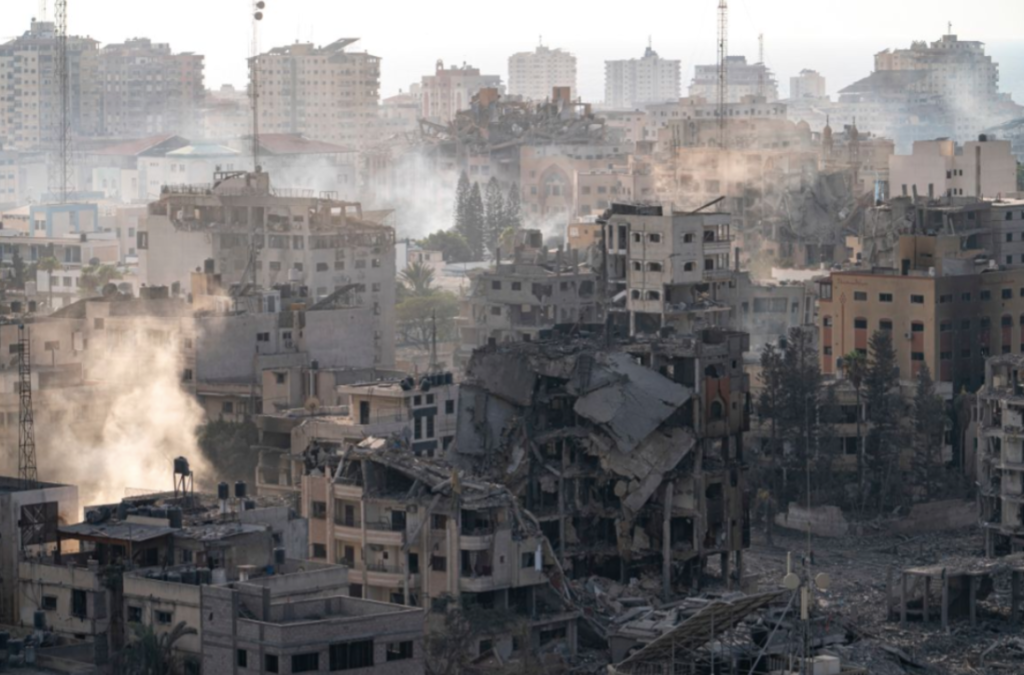
On the ground that is what is happening:
Destruction and not accuracy in Gaza. Open Source.
The dire humanitarian situation is indescribable:
53 UNRWA have been killed by the bombing in Gaza since October 7th.
15 hospitals out of 35 have shut their doors due to lack of fuel and medical supplies.
More than 18.967 injured people are currently in hospitals. The majority of injured suffers from fourth-degree burns. And there is no space left for more injured.
Cases of smallpox, scabies and diarrhea have been on the rise due to poor sanitary conditions and use of water from unsafe sources.
More than 1.5 million people have been internally displaced since 13th of October. They are distributed between families, UN schools, hospitals, churches and mosques. UN described this as “the fastest humanitarian crisis resulting in the largest displacement crisis”.
42% of the residential units were destroyed. More than 46.758 residential units are inhabitable. And more than 190.000 damaged housing units.
50.000 women are pregnant and are struggling to access minimum of health care.
7326 people were killed including 3038 children, 1726 women and 2562 men (over 70% of the victims are women, children and elderly), over 1700 are still under the rubbles including 940 children (27.10.2023).
825 entire family was massacred (all family member killed) 27.10.2023
Statistics from various sources such as UNRWA, UN, and the Palestinian Health Ministry
As the death toll mounts in Gaza, Biden says “I have no notion if Palestinians are telling the truth about how many people are killed”
Constant bombing while being streamed live on one of the most densely populated areas in the entire world. Open Source.
Joe Biden’s position and side can be simply explained by the fact that the U.S. has used its veto power a total of 46 times to block UN Security Council resolutions that were critical of Israel. At least 34 times the US used its veto power on the matter of Palestine and Palestinians, to strike down resolutions about the situation in Palestine to protect Israel from facing censure or accountability for its violations of international law. The majority of these resolutions were drafted to provide a framework for peace in the decades-long Israel-Palestine conflict, including asking Israel to adhere to international laws, calling for self-determination for Palestine statehood, or condemning Israel for the displacement of Palestinians or settlement building in occupied Palestinian territories. A total of 46 times U.S. vetoed resolutions against Israel is all that is there to know on why Joe Biden does look the other way and deny even the suffering of Palestinians even in their death count or the way the media “should” look at it!
U.S. secretary of state, Toni Blinkin, asked the Qatari prime minister less than two weeks ago to tone down Al Jazeera’s rhetoric about the “war in Gaza”. Noting that Al Jazeera is the only news channel that reports live from Gaza, in Gaza not in a form of recorded “video tapes”, in the response of reporters and journalists say that they were shocked for the request of censorship and that they reported on both the strikes of rockets targeting Israel by Hamas and the damage and the stories, and the bombardment and air strikes on Gaza by Israel, that they show from the ground and on the spot what is happening.
A response to this “defiance” of censorship was shortly delivered:
On Channel 13 ‘journalist’ admits/alleged (depends on interpretation of course!) that Israel purposefully and premeditatedly murdered the family of Al Jazeera Gaza bureau chief Wael Dahdouh: “Generally we know the target. For example, today there was a target: the family of an Al Jazeera reporter. In general, we know.”
The target murder comes a day after Tony Blinkin demanded Qatar suppress Al Jazeera’s coverage on Gaza. It wouldn’t be small to add that his family was in the United Nations-recognized Nuseirat refugee camp in central Gaza, which was called a “safe area” by Israeli forces.
Mr. Dahdouh, 53, is well-known journalist who has covered armed conflicts in the area, was helping broadcast live images of the war in Gaza when he received the devastating news. His wife, his son (was in his final year of high school), daughter (7 years old) and grandson (18 months old).
At least 31 journalists were killed by Israel carpet-bombing on Gaza since it launched its military offensive on October 7th (up to October 27th 2023).
Isn’t this at the very least concerning when there is this tendency to deny and censor the events of a genocide happening right now?
“We didn’t know that there were concentration camps, we didn’t know they were killing the Jews”
Isn’t this what the Germans said and so many more at the time?
Isn’t history repeating itself with such a persistent irony?
“No news coverage, denial, censorship, banning manifestations and restrictions…” 2023: What about now? You didn’t know or you don’t want to?”
While this time the biggest game changer in the world view to the matter was social media which gave an easy access to information and live feed and media that never make it to the news rooms of national TVs, the biggest chocking concern that cannot be denied is this huge censorship and tunnel view filter in the media, with textbook characteristics that align with oppressive regimes that have engaged in extensive censorship and propaganda to maintain their power and control over information. Some historical regimes with similarities include:
Nazi Germany (1933-1945): The Nazi regime under Adolf Hitler tightly controlled the narrative, suppressed dissenting voices, and promoted a singular view of Aryan supremacy and the Nazi agenda. They used propaganda extensively to manipulate public perception and dehumanize those they considered enemies, particularly Jews.
Stalinist Soviet Union (1924-1953): Under Joseph Stalin’s leadership, the Soviet Union had a strict state-controlled media that only disseminated the official narrative. Questioning the state’s agenda or presenting alternative viewpoints could lead to severe consequences, often including imprisonment or execution.
North Korea (since 1948): The Democratic People’s Republic of Korea (North Korea) is notorious for its extreme control over information. The regime tightly manages the narrative, and any dissent or questioning of the state’s ideology is considered a grave offense, often leading to imprisonment or death.
Maoist China (1949-1976): During the rule of Mao Zedong, the Chinese Communist Party maintained a stranglehold on media and promoted a single narrative in line with Communist ideology. Alternative views were suppressed, and questioning the state’s agenda was dangerous.
Cultural Revolution in China (1966-1976): The Cultural Revolution was a particularly oppressive period within Maoist China. It saw widespread censorship, propaganda, and a cult of personality built around Mao. Dissent was brutally suppressed, and those who questioned the regime were persecuted.
These regimes share common traits of authoritarianism, media control, censorship, and suppression of dissent, leading to a singular, state-approved narrative. The consequences for questioning or presenting alternative views often included severe punishment, creating an environment where loyalty to the state was paramount. The regime here is the one side story and unconditional support and the state in question here is Israel, and the committed to the one view and one narrative are EU, UK and the US.
“Adagio per sortem, annales se iterum replicabant.”
Before ascension, from under the rubbles, Palestinian children with a bitter smile:
“In articulo mortis. Morituri te salutant (At the moment of death. Those who are about to die salute you).”
From the high seat of human rights and standards Europe replies:
“Mors ultima ratio (Death is the final accounting).”
Then EU continues in a chant-like rhythm and soft of cold brittle voice:
“Sanguis liberorum tuorum et populi tui dolor sit sacrificium pro peccatis meis factis”
(‘Let the blood of your children and the suffering of your people be the sacrifice for the sins of my doing’)
Comes Lady Justice the virtuous UN and whispers:
“Sanguis tuus in ara sancta, purus et absque dolo, sit sacrificium et redemption mea”
(‘May your guileless blood on the holy altar be my sacrifice and my redemption’)
And the freedom bearer and liberty server USA:
“If we do everything right, if we do it with absolute certainty, there’s still a 30% chance we’re going to get it wrong.”
(Joe Biden, speaking to members of the House Democratic caucus who were gathered in Williamsburg, Va., for their annual retreat.)
By Everyday, In Everyday, On Everyday
The title of my poem means “Slowly through fate, the annals repeated themselves.” This conveys the idea of a slow and ironic repetition of historical events influenced by the fate as we make it.
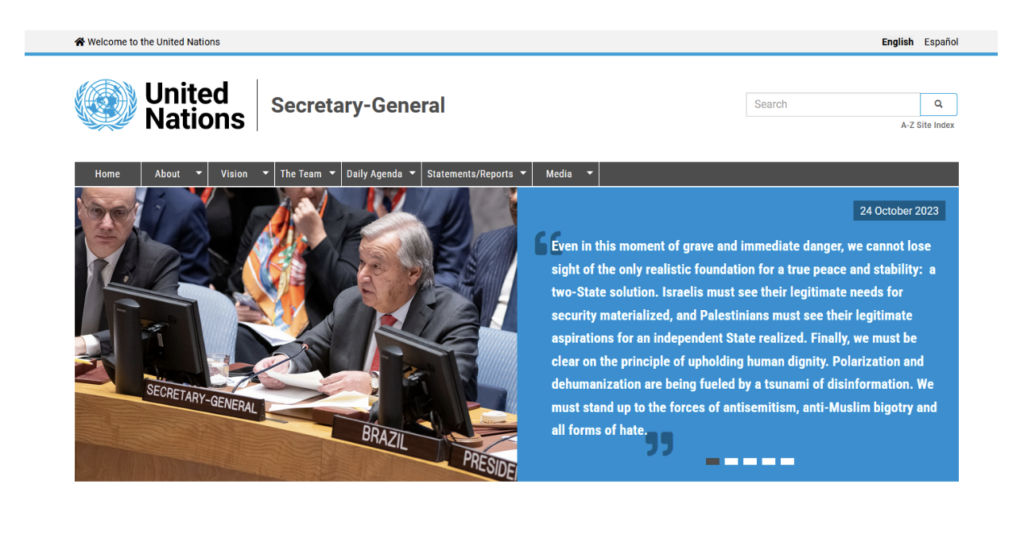
Secretary-General António Guterres’ remarks (24.10) to the Security Council on the Middle East.:
“It is important to also recognize the attacks by Hamas did not happen in a vacuum.
The Palestinian people have been subjected to 56 years of suffocating occupation.
They have seen their land steadily devoured by settlements and plagued by violence; their economy stifled; their people displaced and their homes demolished. Their hopes for a political solution to their plight have been vanishing.
At One People ASBL, our most cherished quote is: “Anti-racism is a team sport.”
Celebrating Black History Month is a diverse and inclusive event that highlights and promotes the rich culture and history of the Afro community. It caters to people of all backgrounds, including children, youths, entrepreneurs, and employees. The event includes a wide range of activities such as concerts, discussions, topics such as the role of technology like AI in combating discrimination, explorations of Afro-feminism and Pan-Africanism, and screenings of media and films that delve into the experiences and contributions of the Black community.
Migrant Tales had the opportunity to talk to One People ASBL Madeline Yougye, One People chairperon.
“I was born in Cameroon, moved to France at the age of 3, and have been living in Luxembourg for nearly a decade,” she said. “I was immediately drawn to the cultural diversity of Luxembourg, with 70% of the capital’s residents hailing from different parts of the world, such as Africa, Asia, and Europe.
Yougye said that upon moving to Luxembourg, she noticed the disparities in the treatment of expatriates. “This realization inspired me to become involved in the local community, particularly after the death of George Floyd,” she said. “In collaboration with like-minded individuals, I founded One People dedicated to fighting racism and promoting equality of opportunity.”
Black History Month is celebrated during the month of October and organized by One People ASBL of Luxembourg and aims to forster fosters a sense of belonging and unity among all communities while promoting a deeper understanding of the challenges and achievements of the Black community.
One People ASBL Chairperson Madeleine Yougye.
Yahya Rouissi: Can you tell us a little about your organization?
Madeline Yougye: One People is a not-for-profit association created in Luxembourg in 2021 that works to strengthen citizen and intercultural anti-racism, for real equal opportunities while respecting everyone’s fundamental rights.
Our aim is to raise awareness of the exclusion suffered by people who are discriminated against because they belong to an ethnic group.”
YR: Are there any role models or experiences that have shaped your activism and work?
MY: My father used to wait for Mohammed Alie’s fights all night long with jet lag, I didn’t understand why, it was only afterward that I became interested in this personality and understood his commitment.
My first real job was as an event organizer for the AIDS association in Paris. I had the opportunity to go to the French West Indies when I was 25, and it was the first time for me to see a book with a Black person on the cover. I realized that after a more or less successful schooling, after having read Molière, Zola and Orwell, I had never read an Afro-descendant writer. So I bought this book and several others: “Peau noir masque blanc” by Frantz Fanon. It was this book that helped me answer many of the questions I was asking myself at the time, and awakened my awareness of the profound nature of systemic racism and the biases it could introduce into my own vision of the world and the way others looked at me because of my skin. Then I start reading all books i could find written by people of color, like Cheik Anta Diop, Aimé Cesaire, Tony Morrison… “
YR: What are the key objectives of your association to fight against racism?
Recent discussions by the Finnish government have raised concerns among human rights groups about the possibility of copying Denmark to carry out random spot checks on people in certain neighborhoods.
If such a measure were ever implemented, it could lead to France’s controversial Article 24 which restricts videoing the police with the intention of “threatening [their] physical or psychological integrity.”
Even if such changes in the law in Finland now seem far-fetched in a country where the police have a good reputation, it is essential to examine what is happening in other European countries where far-right governments have gained power. Some of these include Switzerland, where the Swiss People’s Party is the biggest party, the ruling Brothers of Italy and Lega Nord of Italy, Fidesz of Hungary, the United Right of Poland, Sweden Democrats, and the Perussuomalaiset (PS)* of Finland.
Also, in non-EU countries like Serbia (United Serbia) and North Macedonia (VMRO-DPMNE), there are far-right parties that target migrants and refugees.
Considering that the EU is a region that abides by the European Convention of Human Rights, it is concerning that such parties above target ethnic groups and minorities and want to weaken the civil rights of such people.
One consistent pattern seen in countries where far-right ideologies have gained power is the control and manipulation of narratives to instill fear, racist conspiracy theories, and the perception of dangerous threats by migrants to the native population.
At the core of these ideologies lie xenophobia and ethnic superiority. The far-right presents itself as the savior and protector of the native population, framing every outsider—immigrant, Roma, or anyone deemed different—as an ongoing threat and suspect.
Ethnic Profiling and Suspicion
A common tactic employed by far-right governments is ethnic profiling and the disproportionate targeting of ethnic, religious, and other minority groups by law enforcement agencies. This type of profiling often masquerades as “legitimate” when the police suspect someone of drug possession or gang affiliation.
“Legalized” ethnic profiling is used to justify the increased scrutiny and surveillance of certain communities and ethnic groups even if crime does not have a specific skin color or ethnicity. But when law enforcement focuses its attention on one particular ethnic group, they are more likely to uncover crime, not because of inherent criminality but due to increased scrutiny. It can lead to a vicious cycle, where arrests and convictions are used to justify further restrictions and targeting, perpetuating the belief that these communities are inherently dangerous.
Minister of Interior Mari Rantanen
In an interview with Joona Aaltonen of Helsingin Sanomat, Minister of Interior Mari Rantanen acknowledged concerns about the country’s “growing” youth and gang crime problem. She cited a statement by Jonne Rinne, the chairman of the Association of Police Organizations, who estimated that 95% of street gang members in Finland are of foreign origin on the basis of their names and ethnic backgrounds. Rinne did not care to elaborate if these youths were born in Finland, were Finnish citizens or had a Finnish parent.
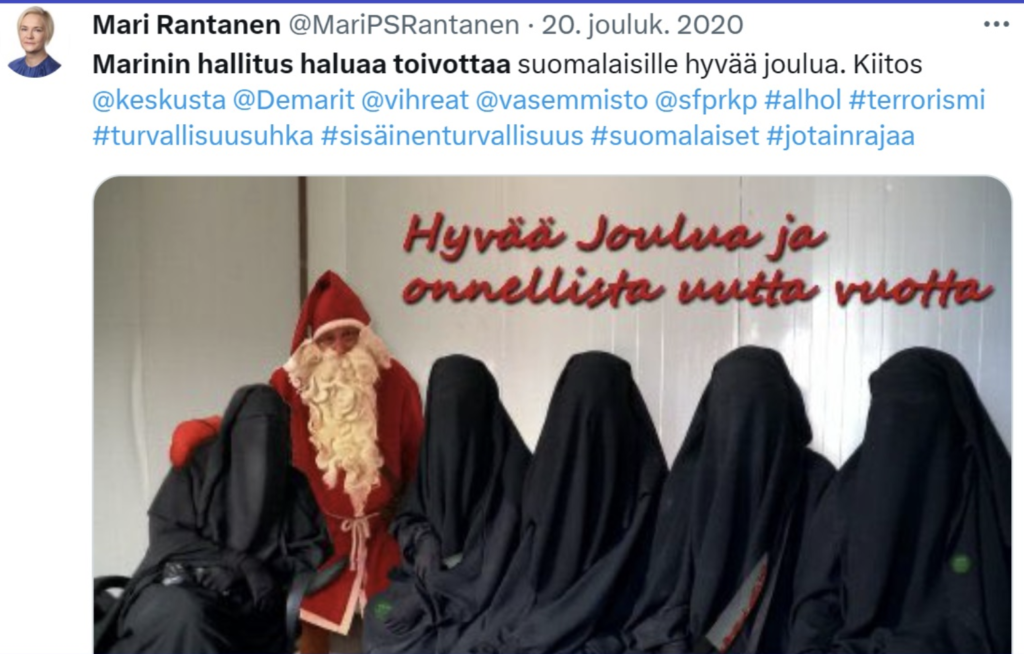
Before Rantanen was minister, she would send Islamophobic messages to then Prime Minister Sanna Marin. “Marin’s government wishes Finns a Merry Christmas,” she wrote. Source: X (formerly Twitter).