
Migrant tales
Menu
  • #MakeRacismHistory “In Your Eyes”
  • About Migrant Tales
  • It’s all about Human Rights
  • Literary
  • Migrant Tales Media Monitoring
  • NoHateFinland.org
  • Tales from Europe
Menu

Category: Julian Abagond

Julian Abagond: nation of immigrants

Posted on November 25, 2014 by Migrant Tales

Migrant Tales insight: Finland is a nation of emigrants, not of immigrants. Even so, the same structures that have kept intact the structures and systemic exploitation of minorities, slavery and Jim Crow are still alive and kicking despite the fact that we try to convince ourselves that the United States is a nation of immigrants. 

___________________

Julian Abagond

The phrase “nation of immigrants” (1883) is often applied to the United States, especially by its scholars, journalists, presidents and schoolteachers.

Näyttökuva 2014-11-25 kello 21.14.36

Last week, President Obama put it like this (on November 20th 2014):

“My fellow Americans, we are and always will be a nation of immigrants. We were strangers once, too. And whether our forebearers were strangers who crossed the Atlantic, or the Pacific or the Rio Grande, we are here only because this country welcomed them in and taught them that to be an American is about something more than what we look like or what our last names are, or how we worship.”

His words do not apply to about 40% of the nation:

  • Not to Native Americans who were wiped out or driven west.
  • Nor to Black Americans who were brought in chains.
  • Nor to Chinese Americans who were killed or driven out of the western US in the late 1800s.
  • Nor to Mexican Americans deported in the 1930s.
  • Nor to the people whose lands the US took over: Native Americans,Northern Mexicans, Alaska Natives, Native Hawaiians, Puerto Ricans, Guamanians, Palauans, Eastern Samoans, Northern Mariana Islanders or Virgin Islanders.
  • Nor, given the perpetual foreigner stereotype, to Asian Americans.
  • Nor to most British or Dutch Americans, who were not immigrants (people who move to a foreign country) but colonists (people who create an offshoot of their mother country). Calling them “immigrants” would mean they joined Native American societies. They were conquerors and invaders, not “immigrants”.

In English the word “immigrant” only goes back to 1792. The phrase “nation of immigrants” does not appear in print till 1883, not in the New York Times till 1923. It was still a surprising idea at Harvard University in 1945, even for historian Oscar Handlin, who grew up in New York City as the son of Russian Jewish immigrants. It did not take off till the 1960s, when President Kennedy wrote a book for the Jewish Anti-Defamation League called “A Nation of Immigrants” (1964).

Näyttökuva 2014-11-25 kello 21.12.53

So when Obama says, as he did in 2010, 2013 and 2014:

“We’ve always defined ourselves as a nation of immigrants.”

He is reading history backwards. It is an idea that did not catch on till the Third Enlargement of Whiteness, which took in southern and eastern Europeans.

Obama on Independence Day, 2012:

“We say it so often, we sometimes forget what it means – we are a nation of immigrants. Unless you are one of the first Americans, a Native American, we are all descended from folks who came from someplace else – whether they arrived on the Mayflower or on a slave ship, whether they came through Ellis Island or crossed the Rio Grande.”

The “nation of immigrants” thing colour-blinds US history as if it were not much affected by racism – genocide, slavery, settler colonialism, imperialism, etc – as if Italian and Jamaican immigrants are pretty much the same, or English colonists and African slaves, as if US institutions protect everyone’s rights regardless of race and the Bootstrap Myth is true.

Thanks to Kyle for suggesting this post.

See also:

  • The three pillars of American white supremacy
  • The Third Enlargement of American Whiteness
  • white racial frame
    • colour-blind racism: the four frames
    • Bootstrap Myth
    • perpetual foreigner stereotype
  • genocide
  • The Cherokee Trail of Tears
  • Kingdom of Hawaii

Read original posting here.

This piece was reprinted by Migrant Tales with permission.


Julian Abagond: Was Hitler evil?

Posted on August 19, 2013 by Migrant Tales

MT comment: Was Hitler and the Nazis an aberration or a product of European racism and colonialism?  Was the devastation that Hitler sowed the same beast that Europeans had imposed on others in Africa, the Americas,  Asia and Australia? By blaming Hitler and the Nazis for what they did, are we denying the problem of our own intolerance? Was Hitler German and/or white? 

_______________

By Julian Abagond

Kuvankaappaus 2013-8-19 kello 7.42.45

Was Hitler evil?

Most White Americans will say yes: he killed 6 million Jews in the Holocaust!

But to avoid any double standard we should apply the same moral reasoning White Americans apply to their own history:

  1. Everyone does it. Tribalism goes back to at least the invention of the spear. History is full of mass killing of civilians: Rwanda, Congo, Darfur, Srebrenica, Hiroshima, Hanoi, Gaza, Dresden, Nanking, Tamerlane, Alexander the Great,  Mongols, Assyrians, Iroquois, the killing of Armenians, Kurds, American Indians, Australian Aboriginals, Tasmanians, Namibians and on and on. If Hitler killed more people than some others, it was because he had better technology.
  2. Technology made him do it. Anyone with Hitler’s technology would have done the same thing.
  3. Europeans kill each other all the time. What’s the big deal?
  4. Jews are racist too. They have forced Palestinians off their land, apply separate laws to them and regularly massacre Palestinian civilians.
  5. Americans are no better. They have forced American Indians off their land, applied separate laws to them and regularly massacred American Indian civilians.
  6. Hitler is not uniquely evil. See above.
  7. Hitler’s intentions were good. He saw the Holocaust as doing the world a favour.
  8. It was the times! The West back then was nakedly racist. Racism had the backing of science. The book Hitler called his Bible was bought by over a million Americans: “The Passing of the Great Race” (1916) by Madison Grant, a rich New Yorker. The word genocide was not invented till 1943 and not properly defined till after the war – by the winners to condemn Hitler! We should not judge the past by current morals.
  9. We should be grateful. Germans invented the printing press, car, jet plane, rocket, etc. They gave us much of the modern medicine that allows most people to live past 40. Albert Schweitzer and other Germans have helped people in Africa. Condemning Hitler without pointing out all the good Germans have done is unbalanced and hypocritical.
  10. Get over it! It took place a long time ago. My family did not take part in it. No one you know was affected by it. Why make such a big deal about it? The past is dead and gone. There are more important issues.
  11. It is racist to talk about racism. Talking about anti-Semitism keeps it alive. Condemning Hitler is divisive.
  12. You can dismiss what Americans say about Hitler: they were his enemies; many of their journalists and historians are Jewish; their schools teach patriotic lies.

Every single one of these arguments, with the names changed, have been used on this blog to downplay American racism, slavery and genocide.

W.E.B. Du Bois:

there was no Nazi atrocity – concentration camps, wholesale maiming and murder, defilement of women or ghastly blasphemy of childhood – which the Christian civilization of Europe had not long been practicing against colored folk in all parts of the world in the name of and for the defense of a Superior Race born to rule the world.

Read original story here.

This piece was reprinted by Migrant Tales with permission.


Julian Abagond: What did race have to do with the George Zimmerman case?

Posted on July 16, 2013 by Migrant Tales

By Julian Abagond

Kuvankaappaus 2013-7-16 kello 9.22.39

What did race have to do with the George Zimmerman case in America?George Zimmerman, a half-white, half-Latino man who gets a bloody nose and a few scratches on his head, shoots dead Trayvon Martin, an unarmed, 17-year-old black boy, calls it self-defence and is found “not guilty” of both murder and manslaughter by a nearly all-white court. How could that possibly be racist? I mean, it is not like Zimmerman used the N-word. It was a fair trial! Besides, the president is black!

Here are some ways:

  1. Black life was assumed not to matter much. In effect, a bloody nose and a few scratches on the head of a man who is half-white mattered more than the life of a 17-year-old black boy. It was not just Zimmerman who thought that, so did the police, who did not think the killing was a big deal. So did the prosecution, who pretty much just went through the motions – they did not even properly prepare their witnesses.
  2. The Black Brute stereotype – the idea that black men rape and kill for no reason, that they have “violent tendencies”, “criminal propensities”, as if huge numbers of them are savage psychopaths or something. It is why white women clutch their purses, why whites cross the street – because, apparently, black men only tug at purses gently, cannot cross the street and never go after those who show fear. This stereotype ran throughout the case:
    • Zimmerman racially profiled Martin. As a neighbourhood watchman, Zimmerman only reported black males as “suspicious”. Martin was one of them, even though it was only seven at night and he was minding his own business walking back from 7-Eleven. It was not like Martin was breaking into a house or a car or beating up someone.
    • The police assumed Martin was the bad guy. Instead of giving Zimmerman a drug test and holding him for 48 hours while they sorted out what took place, the police let him go to work the next day! They believed his story just on his say-so – in part because it fit the Black Brute stereotype perfectly: some black guy jumped out at him in the dark and tried to kill him. For no reason. Because, apparently, black men are like mad dogs.
    • The prosecution lawyers never seriously questioned the main hole in Zimmerman’s story: Why in the world would Trayvon Martin want to kill George Zimmerman? Martin did not know Zimmerman. Zimmerman says he did not threaten him. Martin had no record of violence or insanity. The Black Brute stereotype is the spit holding this story together.
    • The defence lawyers painted Martin as a dangerous thug, based not on a police record or record of violence, but on how he looked! How was that possible?
    • The jury was packed with white women. We do not know what their thinking was. Maybe they were not racist at all. But the defence certainly assumed they were, playing on their purse-clutching fears of black men!

Read original story here.

This piece was reprinted by Migrant Tales with permission.


Julian Abagond: How to tell if a white person is a recovering racist

Posted on July 6, 2013 by Migrant Tales

By Julian Abagond

drug_addict

In America there are only racists and recovering racists. It is like alcoholism. There is no point at which you are rid of it completely – racist thinking is too much a part of American culture. No one completely escapes it, not even people of colour.

Signs that a White American is a recovering racist (the signs for a person of colour are different):

  1. Admits to racism, both in one’s self and in American society. Like with alcoholism, the first step to recovery is to break out of denial.
    • That means not getting upset at being called the r-word.
    • That means giving up the “Anything But Racism” kneejerk reaction.
    • That means not downplaying or excusing white racist words and acts, either now or in history.
    • That means not blaming the victims of racism for inequality.
    • That means calling out racism.
  2. Takes what people of colour say seriously. Assumes that they are just as capable as white people in making observations and coming to conclusions, that they are just as intelligent, that they can think for themselves and know what is in their own best interest. Recovering racists do not necessarily always agree with people of colour – they think for themselves too! – but neither do they assume that people of colour are children who imagine stuff, whine, need to be talked down to – or saved. Recovering racists do not assume that whites always know best, that they are the moral centre.
  3. Sees both whites and people of colour as equally imperfectly human: Sees the good and bad in both, puts themselves in the shoes of others. Just as racists demonize and look down on people of colour, noticing all their faults while dismissing their successes, so they also idealize whites, playing up the good things about them while giving a huge pass to the the bad they do. Both demonization and idealization are racist and unrealistic.
  4. Assumes that the lives, feelings and concerns people of colour are important, just as important as those of white people.
    • That means that white people should not always get their way.
    • That means seeing Asian, Black, Latino, Native and Muslim Americans as Real Americans.
    • That means taking the anger of people of colour seriously rather than trying to police their tone.
    • That means not seeing people of colour as a “drain on society” or a “waste” of (white) taxpayer money.
    • That means pushing for policies to make society more equal – you know, as if everyone’s life mattered, not just those of rich, white men.
  5. Accepts people as they are, not as they “should” be, not “in spite of” what makes them different. They see colour, but they also see that different is just different, not “less than”.
  6. Respects people of colour. Does not tell then what to feel or think or act high-handed. Does not tell them to “Get over it.” Does not put them down for their race, does not call them racial slurs or tell racist jokes. Does not ” href=”http://abagond.wordpress.com/2009/04/08/derailing-for-dummies/”>derail their talk of racism.                           

Read original story here.

This piece was reprinted by Migrant Tales with permission.
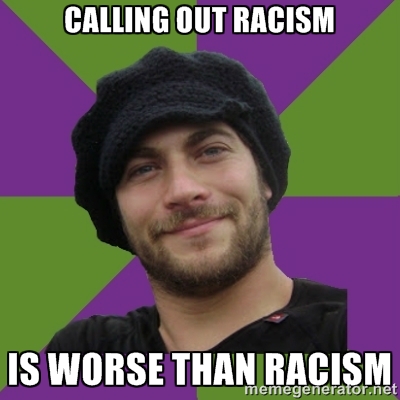
Julian Abagond: Calling out racism

Posted on June 18, 2013 by Migrant Tales

By Julian Abagond

31560844

Calling out racism is where you point out that something is racist. It might not seem like a big deal, but it is an important part of fighting racism. It can even stop genocide, as crazy as that sounds.

Genocide: Genocides unfold in eight stages. Stopping it at any one stage, stops the genocide from going forward. The second to last stage before the mass killings is this:

Polarization: The first people killed in any genocide are not the pariahs themselves but those in the mainstream who speak up for them. The voices in the middle are silenced through threats, arrests or even killings. Now the message of hate goes unchallenged.

What applies to genocide applies to racism more generally. Racism grows and feeds off a culture of silence. The point of calling out racism is to break down that silence. It does not matter if you persuade anyone, it does not matter if you “win the argument”. It is very unlikely you will. What matters is that you were heard and planted that seed in people’s minds of, “Hey, maybe this is not right.”

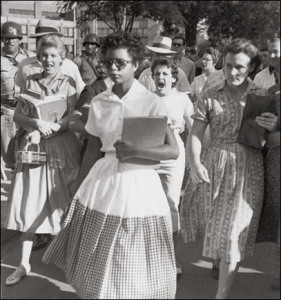
Elizabeth Eckford was one of the first nine black students to go to Little Rock Central High School in the American South. That school was a racist hell for her – because the 90% who were not giving her hell would not stand up to the 10% who were. She could not even enter the school till the president of the nation grew a pair and stood up to the governor of the state.

1957-09-04

The American civil rights movement succeeded when people stopped being cowed by fear of standing up to racists.

White people calling out racism: One of the best thing white people can do at the personal level to fight racism is to call it out when they see it. If not to the racist person’s face, then to family and friends. If not to family and friends, then at least inside their own head. Anything is better than nothing.

In America calling out racism matters more when it comes from whites. That is because of the Rules of Racial Standing – that thing where white people think others whites are way more objective and neutral about racism than blacks. The Tim Wise Effect.

Black people calling out racism: White Americans discount what blacks say, it is part of their cultural conditioning, but they still hear it. They hear what they say and, just as important, what they do not say. If something racist goes down and blacks say nothing, whites will assume that it is “okay” or “not so bad”. Especially since many whites assume blacks are “oversensitive”.

That is part of why I post on, say, Quvenzhané Wallis, but not Don Imus or the racist outcry over the Cheerios ad – because those two were roundly condemned even by white people.

Warning: Calling out racism does require judgement and sometimes courage. This post is not about that.

Read original story here.

 This piece was reprinted by Migrant Tales with permission.
Julian Abagond: style guide – Eurocentric words

Posted on April 26, 2013 by Migrant Tales

By Julian Abagond

46252958887

Eurocentricisms are words that centre Western experience, that make white people seem “normal” and everyone else strange, exotic or screwed up. Such words get in the way of clear thinking.

In general, avoid:

  1. Dichotomous thinking: words that split the world in two, especially into a good half and a bad half. The world is a coat of many colours with no centre, no Chosen People.
  2. Prejudiced thinking: words that see people of an out-group as all the same or screwed up.
  3. Exoticization: words that would not be applied to white people under the same circumstances.
  4. Loaded words: words that assume the West is best.
  5. The centre with no name: use ”Western”, “white”, “Christian”, “European”, “American”, etc, instead of assuming them.

Some examples:

backward – a loaded word that makes the West the measure of all.

canoe – use “boat” unless you are talking about particular kinds of boats.

chief – use “king”, “ruler”, “leader” or the person’s title. Avoid “chief” since it is rarely applied to whites. Even Vikings did not have “chiefs”.

contribution – use “invention”, “advance”, etc. Western inventions are just inventions, never “contributions” to China or elsewhere.

developed – puts Western industrialized society at the top of human development. Say “Westernized” or “industrialized” or at least “rich”.

elders – use their title. No one calls American senators “elders”.

everyone – use “white people”, “Americans”, etc.

exotic –  Everyone is exotic and no one is exotic.

ghetto – applied to parts of Black American culture not yet accepted by whites.

hut – use “house” unless you are talking about styles of housing.

Indian – sees the thousands of native cultures of the Americas as being pretty much the same. Say what you mean: “Navajo”, “Iroquois”, etc.

medicine man – use “doctor” where possible. The trouble is that “doctor” has been Eurocentricized to mean someone with a degree in Western medicine.

Middle East – use “Muslim world” or “Arab world” instead, depending what you mean. “Middle East” is a Eurocentric term (East of where? In the Middle of what?) from American and British foreign policy. It is not a cultural region.

minority – on a world scale everyone is a minority. Even in America, whites are already a minority in places like California and metropolitan New York.

moccasin – use “shoe” unless you are talking about particular styles of shoes.

no accent – everyone speaks with an accent.

slurs – avoid unless your aim is to be a racist jerk.

stereotypes – mostly projections of white insecurity. If whites are individuals, so is everyone else.

sub-Saharan Africa – racist geography that tries to sound “objective”.

terrorist – One man’s terrorist is another man’s freedom fighter is another man’s nutcase. Thomas Jefferson and Winston Churchill were both “terrorists”.

tribal lands – use “country”.

tribe – use “nation” or “ethnic group”, which is what their white counterparts are called.

universal – use “Western”.

village – use “town”, the term almost always used for white settlements of the same size.

warrior – use “soldier” or at least “fighter”. No one calls George Washington a “warrior”.

world – use “Western world”.

Read original story here.

 This piece was reprinted by Migrant Tales with permission.

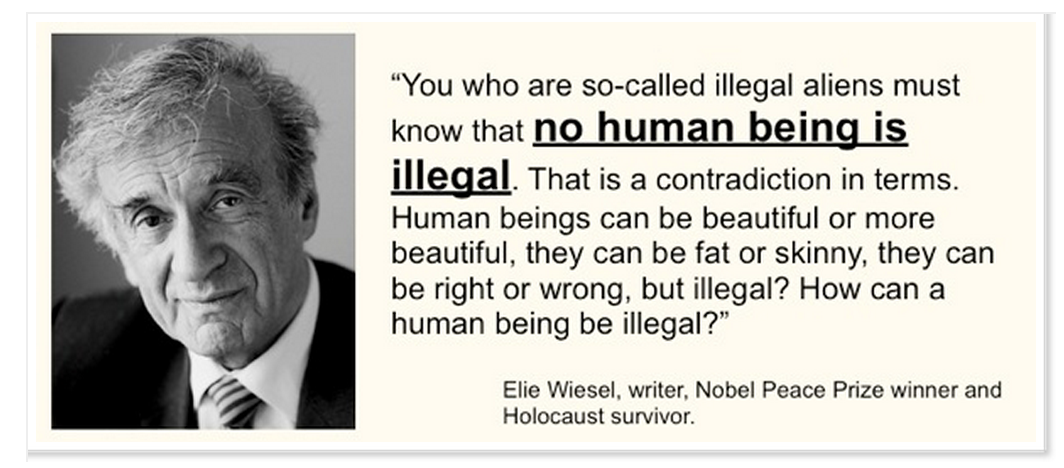
Julian Abagond: The term “illegal immigrant”

Posted on April 14, 2013 by Migrant Tales

By Julian Abagond

The term “illegal immigrant” (1930s- ) means an undocumented immigrant, one without papers to stay in the country. The older term was ”illegal alien”, common in English in the 1970s and 1980s, rare in American news stories since 2003.

An illegal immigrant can mean someone who:

  1. crossed the border illegally,
  2. overstayed a student or tourist visa,
  3. was brought to the country as a child,
  4. is waiting for a green card,

Etc.

It was first applied to Jews in Palestine in the 1930s. In America it first appeared in the Republican platform in 1986, in the Democratic one in 1996.

Since the 1980s there has been a push to get rid of it: actions are illegal, not people. Huffington Post got rid of it in 2008. The Miami Herald and MSNBC no longer use it. Then, on April 2nd 2013, the Associated Press (AP) stylebook got rid of it, saying in part:

illegal immigration Entering or residing in a country in violation of civil or criminal law. Except in direct quotes essential to the story, use illegal only to refer to an action, not a person: illegal immigration, but not illegal immigrant. Acceptable variations include living in or entering a country illegally or without legal permission.

That is huge: most American news reporters and editors follow the AP stylebook. The Los Angeles Times and the New York Times, two of the country’s biggest newspapers, are now thinking of getting rid of the term.

Why get rid of it:

  1. It makes racism respectable. It dehumanizes not just the 11 million people in America who are without papers, who are mostly people of colour (3 million are black), but 52 million Latinos, whom many assume to be undocumented even though most are American citizens. It has become a slur: Just before Marcelo Lucero was killed in a hate crime on Long Island he was called a “fucking illegal”. Yet, as Touré points out, no one calls Martha Stewart an “illegal business woman” – even though she was found guilty of insider trading in a court of law.
  2. It frames the debate on immigration: It pins the blame on immigrants, not those who employ them and often take advantage of them, whom no one ever seems to call “illegal employers”. Nor does it blame the American government’s immigration policy, which is at least 11 million cases behind in meeting the country’s labour needs. It makes it seem like the answer is to punish immigrants – even though some are undocumented through no fault of their own. It makes police raids on Latino neighbourhoods seem reasonable – as well as racial profiling (Arizona SB 1070). It makes it easy for Republicans to kill reasonable reform by calling it “amnesty for illegals”, as they did in 2006. And, worst of all, it makes it seem like undocumented immigrants should have no rights at all.

Linguist John McWhorter of Columbia University says in ten years “undocumented immigrant” will seem just as dismissive as “illegal immigrant”.

Linguist George Lakoff of UC Berkeley says that in debating and making laws framing is huge: words matter.

Kuvankaappaus 2013-4-14 kello 15.06.28


Read original story here.

 This piece was reprinted by Migrant Tales with permission.


Julian Abagond: Spielberg’s Lincoln

Posted on November 27, 2012 by Migrant Tales

By Julian Abagond

“Lincoln” (2012) is a Steven Spielberg film about the passing of the Thirteenth Amendment, the one that freed the slaves. It stars Daniel Day-Lewis as Abraham Lincoln, Sally Field as his wife and Tommy Lee Jones as Radical Republican Congressman Thaddeus Stevens. Gloria Reuben plays Elizabeth Keckley, Mrs Lincoln’s dressmaker and friend.

The film is based in part on the book “Team of Rivals” (2006) by Doris Kearns Goodwin.

Executive summary: “The Help” as costume drama – though Daniel Day-Lewis is amazing as Lincoln.

Best line: When Gloria Reuben says to Lincoln:

White people don’t want us here – any of them. Do you?

Like the “The Help”, Participant Media lists this as one of its films about social action. And like “The Help” it rewrites history as a story about a well-meaning white person, who is not one bit racist, helping blacks by fighting against n-word-using white racists – while blacks largely take a back seat.

While “The Help” had fleshed-out black characters, this film has none. Gloria Reuben comes the closest – she is listed 17th in the credits. In this film about freeing slaves not a single slave appears.

On the other hand it does show black soldiers in the opening scene – so the Helpless Darkies in this one are not quite so helpless.

Although the film takes great pains to make Daniel Day-Lewis look like Lincoln, talk like Lincoln and walk like Lincoln, it whitewashes Lincoln.

In real life Lincoln used the n-word. Spielberg’s Lincoln does not – even though others in the film do.

In real life Lincoln said stuff like this:

… there is a physical difference between the white and black races which I believe will for ever forbid the two races living together on terms of social and political equality.

Spielberg’s Lincoln never says stuff like that. He is for equal rights! This is no longer history, but fantasy. Lincoln was against giving blacks the vote till the last week of his life, and even then it would only be for veterans and the “very intelligent” – Jim Crow stuff.

In real life Lincoln was for ethnic cleansing. He wanted to send blacks away after the war – till Frederick Douglass (not in the film) talked him out of it.

Douglass 11 years after Lincoln’s death said:

President Lincoln was a white man, and shared the prejudices common to his countrymen towards the coloured race.

Racism is not a matter of some misguided whites, like in a Hollywood film. Most whites are not Basically Good, as this film would have you suppose. Most are racist, morally compromised. Lincoln was no different.

What sets Lincoln apart was that he fought against his own racism, against his fallen nature, and did right in spite of it. Instead of giving into it and calling it right. That is the story that went untold. It would be far truer, far more interesting and far more helpful as a model for social action. Instead we get yet another feel-good White Saviour fantasy flick.

Read original story here.

 This piece was reprinted by Migrant Tales with permission.
Check out this blog entry on Spielberg’s Lincoln movie posted by Racism Review.

Julian Abagond: Why I write about racism

Posted on September 27, 2012 by Migrant Tales

By Julian Abagond

I write about racism in America because it affects my life and the lives of those I care about. Because it has shaped how I experience and see the world and myself, so by understanding racism I understand myself and the world better. It has little to do with trying to make whites look bad or making some kind of appeal to them.

My mother brought me up to be colour-blind. She meant well but she was a kumbayah anti-racist. That sent me into a strange land without a map. And so I have had to learn the hard way what was on that map, piece by piece.

Some say, “You see racism in everything. You see what you expect.” Wrong: I was so unprepared I have been surprised over and over again at how deeply white racism ran.

At first I was surprised when they called me names. Then I was surprised at how different the black and white parts of New York were. Then I was surprised at the police, who were not merely bad but evil to the bone. Then I went across the country and was surprised at how the Sioux Indians were even worse off, at how they had many of the very same issues as blacks – even though they lived hundreds of miles away and came from a completely different history.

And on and on.

Then I started this blog and I was surprised yet again. Not that whites are racist – I already knew that – but how deep and twisted their racism ran. It was not merely a matter of them not knowing any better, of living in nice, lily-white suburbs and believing everything they saw on television. No, it was way worse than that – even among Otherwise Intelligent White People. And so I was surprised yet again.

Dr Beverly Tatum says there is a five-stage cycle to growing up black in America:

  1. pre-encounter – you know you are black (by age five) but it is no big deal.
  2. encounter – you experience racism in an unmistakable way, repeatedly.
  3. immersion/emersion – you learn everything you can about being black because it helps you to understand your experience.
  4. internalization – what you learned becomes part of your identity, who you are, which helps to undo the internalized racism you have unknowingly learned. You become less angry, more hopeful.
  5. internalization-commitment – now you can move beyond race.

Most blacks reach the last stage at about age 25 to 30 and then go back to the first stage to go round again at a higher level of understanding.

So for me New York provided the first encounter stage, this blog (and some other events in my life) the second. In the earlier posts on this blog you can see me still in my second pre-encounter stage, in utter innocence of what was about to hit.

So now I am in the immersion stage for the second time in my life and consumed once again with the subject.

Read original story here.

 This piece was reprinted by Migrant Tales with permission.

Julian Abagond: “Stereotypes have some truth to them”

Posted on August 14, 2012 by Migrant Tales

By Julian Abagond

“Stereotypes have some truth to them” has some truth to it but not in the way people think. That truth is not about the stereotyped but the stereotyper.

First, stereotypes are kept alive by confirmation bias: We notice the few examples that fit the stereotype and overlook the ton of examples that do not. This has been proved by studies.

For example, here are two stereotypes that I used to think had some truth to them:

  1. Black women are harder to get along with than white women.
  2. Asians are more serious about their studies than whites or blacks.

So when I argue with my wife, it “proves” the first one true – even though I have never been with a white woman!

Or when I go to the library and see Asians there I think, “See how studious they are!” – even though there are way more blacks and whites there doing their homework!

That is confirmation bias. Stereotypes are not based in fact but instead make you blind to the facts.

Second, stereotypes can be made up out of thin air.

For example, black people are supposed to love watermelon way more than anyone. But when I looked  it up on the Internet  it was Asians who ate the most watermelon by far of anyone in America. Blacks do eat more watermelon than whites but the difference is so slight – like a slice more a year – that no one would notice it.

Or: Some white people say that there are all these black rapists on the loose going after white women. They said the government numbers proved it! But when I looked at the numbers for myself I found out that they had imagined the whole thing!

Or: When I read about the Mammy stereotype I found out it was made up by white people in the early 1800s to defend slavery! Made up.

Third, whites know so little about black people they must be talking about themselves.

Whites keep themselves apart from blacks. So much so that they seem to get most of what they know about blacks from television. But television  is put together by other whites who, if anything, know even less about blacks since they can afford to keep themselves even more apart. The blinder leading the blind.

In effect black people become a canvas on which white people paint their fears and self-serving lies. So stereotypes often become this strange mirror of white people:

  • Whites got rich off of black slave labour. So blacks are pictured as not wanting to work hard, as being a drain on society.
  • White men raped black slave women in such huge numbers that Black Americans are now 15% white. So black men are pictured as dangerous rapists.
  • White men use to kill blacks without fear of the law. So black men are seen as violent and dangerous without fear of the law.
  • Whites repeatedly broke their treaties with American Indians, so now “Indian giver” means someone who takes back what he promised.

Read original story here.

 This piece was reprinted by Migrant Tales with permission.


  • 1
  • 2
  • Next
Read more about documentary film
Read more

Recent Posts

  • Finland’s tabloids Iltalehti and Ilta-Sanomat are the pits
  • Riikka Purra’s Dr Jekyll and Mr Hyde mask
  • Double standards
  • Perussuomalaiset: Uusi logo, sama vanha juttu
  • Taco Trump

Recent Comments

  1. Absolutely Socking: Racist Finnish Facebook group against human rights gets flooded with socks on Musta Barbaari’s mother and sister charged by the police in “ethnic profiling” case
  2. Ilkka Nuotio on Pekka Myrskylä: “Tilastot kertovat toista kuin poliittinen keskustelu”
  3. Genrih Soinkara on The war in Ukraine and the Russian-Finnish border crisis are showing Finland’s ugly side
  4. Ahti Tolvanen on Comment by Ahti Tolvanen on the Helsinki +50 conference
  5. Angel Barrientos on Angel Barrientos is one of the kind beacons of Finland’s Chilean community

Archives

  • June 2026
  • May 2026
  • April 2026
  • March 2026
  • February 2026
  • January 2026
  • December 2025
  • November 2025
  • October 2025
  • September 2025
  • August 2025
  • July 2025
  • June 2025
  • May 2025
  • April 2025
  • March 2025
  • February 2025
  • January 2025
  • December 2024
  • November 2024
  • October 2024
  • September 2024
  • August 2024
  • July 2024
  • June 2024
  • May 2024
  • April 2024
  • March 2024
  • February 2024
  • January 2024
  • December 2023
  • November 2023
  • October 2023
  • September 2023
  • August 2023
  • July 2023
  • June 2023
  • May 2023
  • April 2023
  • March 2023
  • February 2023
  • January 2023
  • December 2022
  • November 2022
  • October 2022
  • September 2022
  • August 2022
  • July 2022
  • June 2022
  • May 2022
  • April 2022
  • March 2022
  • February 2022
  • January 2022
  • December 2021
  • November 2021
  • October 2021
  • September 2021
  • August 2021
  • July 2021
  • June 2021
  • May 2021
  • April 2021
  • March 2021
  • February 2021
  • January 2021
  • December 2020
  • November 2020
  • October 2020
  • September 2020
  • August 2020
  • July 2020
  • June 2020
  • May 2020
  • April 2020
  • March 2020
  • February 2020
  • January 2020
  • December 2019
  • November 2019
  • October 2019
  • September 2019
  • August 2019
  • July 2019
  • June 2019
  • May 2019
  • April 2019
  • March 2019
  • February 2019
  • January 2019
  • December 2018
  • November 2018
  • October 2018
  • September 2018
  • August 2018
  • July 2018
  • June 2018
  • May 2018
  • April 2018
  • March 2018
  • February 2018
  • January 2018
  • December 2017
  • November 2017
  • October 2017
  • September 2017
  • August 2017
  • July 2017
  • June 2017
  • May 2017
  • April 2017
  • March 2017
  • February 2017
  • January 2017
  • December 2016
  • November 2016
  • October 2016
  • September 2016
  • August 2016
  • July 2016
  • June 2016
  • May 2016
  • April 2016
  • March 2016
  • February 2016
  • January 2016
  • December 2015
  • November 2015
  • October 2015
  • September 2015
  • August 2015
  • July 2015
  • June 2015
  • May 2015
  • April 2015
  • March 2015
  • February 2015
  • January 2015
  • December 2014
  • November 2014
  • October 2014
  • September 2014
  • August 2014
  • July 2014
  • June 2014
  • May 2014
  • April 2014
  • March 2014
  • February 2014
  • January 2014
  • December 2013
  • November 2013
  • October 2013
  • September 2013
  • August 2013
  • July 2013
  • June 2013
  • May 2013
  • April 2013
  • March 2013
  • February 2013
  • January 2013
  • December 2012
  • November 2012
  • October 2012
  • September 2012
  • August 2012
  • July 2012
  • June 2012
  • May 2012
  • April 2012
  • March 2012
  • February 2012
  • January 2012
  • December 2011
  • November 2011
  • October 2011
  • September 2011
  • August 2011
  • July 2011
  • June 2011
  • May 2011
  • April 2011
  • March 2011
  • February 2011
  • January 2011
  • December 2010
  • November 2010
  • October 2010
  • September 2010
  • August 2010
  • July 2010
  • June 2010
  • May 2010
  • April 2010
  • March 2010
  • February 2010
  • January 2010
  • December 2009
  • November 2009
  • October 2009
  • September 2009
  • August 2009
  • July 2009
  • December 2008
  • November 2008
  • October 2008
  • September 2008
  • August 2008
  • July 2008
  • June 2008
  • May 2008
  • April 2008
  • March 2008
  • February 2008
  • January 2008
  • November 2007
  • October 2007
  • September 2007
  • August 2007
  • July 2007
  • June 2007
  • May 2007

Categories

  • ?? Gia L?c
  • ????? ?????? ????? ???????? ?? ??????
  • ???????
  • @HerraAhmed
  • @mondepasrond
  • @nohatefinland
  • @oula_silver
  • @Varathas
  • A Pakistani family
  • äärioikeisto
  • Abbas Bahmanpour
  • Abdi Muhis
  • Abdirahim Hussein Mohamed
  • Abdirahim Husu Hussein
  • Abdirisak Mahamed
  • About Migrant Tales
  • activism
  • Adam Al-Sawad
  • Adel Abidin
  • Afrofinland
  • Ahmed IJ
  • Ahti Tolvanen
  • Aino Pennanen
  • Aisha Maniar
  • Alan Ali
  • Alan Anstead
  • Alejandro Díaz Ortiz
  • Alekey Bulavsev
  • Aleksander Hemon
  • Aleksanterinliitto
  • Aleksanterinliitto ry
  • Aleksanterinliitto ry:n hallitus
  • Alex Alex
  • Alex Mckie
  • Alexander Nix
  • Alexandra Ayse Albayrak
  • Alexis Neuberg
  • Ali Asaad Hasan Alzuhairi
  • Ali Hossein Mir Ali
  • Ali Rashid
  • Ali Sagal Abdikarim
  • Alina Tsui
  • Aline Müller
  • All categories
  • Aman Heidari
  • Amiirah Salleh-Hoddin & Jana Turk
  • Amin A. Alem
  • Amir Zuhairi
  • Amkelwa Mbekeni
  • Ana María Gutiérrez Sorainen
  • Anachoma
  • Anders Adlecreutz
  • Angeliina Koskinen
  • Anna De Mutiis
  • Anna María Gutiérrez Sorainen
  • Anna-Kaisa Kuusisto ja Jaakko Tuominen
  • Annastiina Kallius
  • Anneli Juise Friman Lindeman
  • Announcement
  • Anonymous
  • Antero Leitzinger
  • anti-black racism
  • Anti-Hate Crime Organisation Finland
  • Anudari Boldbaatar
  • Arshiya Nasser
  • Aspergers Syndrome
  • Asylum Corner
  • Asylum seeker 406
  • Athena Griffin and Joe Feagin
  • Autism
  • Avaaz.org
  • Awale Olad
  • Ayan Said Mohamed
  • AYY
  • Barachiel
  • Bashy Quraishy
  • Beatrice Kabutakapua
  • Beri Jamal
  • Beri Jamal and Enrique Tessieri
  • Bertolt Brecht
  • Boiata
  • Boodi Kabbani
  • Bruno Gronow
  • Carmen Pekkarinen
  • Çelen Oben and Sheila Riikonen
  • Chiara Costa-Virtanen
  • Chiara Costa-Virtanen
  • Chiara Sorbello
  • Christian Thibault
  • Christopher Wylie
  • Clara Dublanc
  • Dana
  • Daniel Malpica
  • Danilo Canguçu
  • David Papineau
  • David Schneider
  • Dexter He
  • Don Flynn
  • Dr Masoud Kamali
  • Dr. Faith Mkwesha
  • Dr. Theodoros Fouskas
  • Edna Chun
  • Eeva Kilpi
  • Emanuela Susheela
  • En castellano
  • ENAR
  • Enrique
  • Enrique Tessieri
  • Enrique Tessieri & Raghad Mchawh
  • Enrique Tessieri & Yahya Rouissi
  • Enrique Tessieri and Muhammed Shire
  • Enrique Tessieri and Sira Moksi
  • Enrique Tessieri and Tom Vandenbosch
  • Enrique Tessieri and Wael Che
  • Enrique Tessieri and Yahya Rouissi
  • Enrique Tessieri and Zimema Mhone
  • Epäluottamusmies
  • EU
  • Europe
  • European Islamophobia Report
  • European Islamophobia Report 2019,
  • European Union
  • Eve Kyntäjä
  • Ezequiel Caldeiro
  • Facebook
  • Fadumo Dayib
  • Faisa Kahiye
  • Farhad Manjoo
  • Fasismi
  • Finland
  • Fizza Qureshi
  • Flyktingar och asyl
  • Foreign Student
  • Fozia Mir-Ali
  • Frances Webber
  • Frida Selim
  • Gareth Rice
  • Ghyslain Vedeaux
  • Global Art Point
  • Great Replacement
  • Habiba Ali
  • Hami Bahadori
  • Hami Bahdori
  • Hamid
  • Hamid Alsaameere
  • Hamid Bahdori
  • Handshake
  • Harmit Athwal
  • Hassan Abdi Ali
  • Hassan Muhumud
  • Heikki Huttunen
  • Heikki Wilenius
  • Helsingin Sanomat
  • Henning van der Hoeven
  • Henrika Mälmsröm
  • Hser Hser
  • Hser Hser ja Mustafa Isman
  • Husein Muhammed
  • Hussain Kazemian
  • Hussain Kazmenian
  • Ibrahim Khan
  • Ida
  • Ignacio Pérez Pérez
  • Iise Ali Hassan
  • Ilari Kaila & Tuomas Kaila
  • Imam Ka
  • inside-an-airport
  • Institute of Race Relations
  • Iraqi asylum seeker
  • IRR European News Team
  • IRR News Team
  • Islamic Society of Norhern FInland
  • Islamic Society of Northern Finland
  • Islamophobia
  • Jacobinmag.com
  • Jallow Momodou
  • Jan Holmberg
  • Jane Elliott
  • Jani Mäkelä
  • Jari Luoto
  • Jari Taponen
  • Jegor Nazarov
  • Jenni Stammeier
  • Jenny Bourne
  • Jessie Daniels
  • Joe Davidow
  • Johannes Koski
  • John D. Foster
  • John Grayson
  • John Marriott
  • Jon Burnett
  • Jorma Härkönen
  • Jos Schuurmans
  • José León Toro Mejías
  • Josue Tumayine
  • Jouni Karnasaari
  • Juan Camilo
  • Jukka Eräkare
  • Julian Abagond
  • Julie Pascoet
  • Jussi Halla-aho
  • Jussi Hallla-aho
  • Jussi Jalonen
  • JusticeDemon
  • Kadar Gelle
  • Kaksoiskansalaisuus
  • Kansainvälinen Mikkeli
  • Kansainvälinen Mikkeli ry
  • Katherine Tonkiss
  • Kati Lepistö
  • Kati van der Hoeven-Lepistö
  • Katie Bell
  • Kättely
  • Kerstin Ögård
  • Keshia Fredua-Mensah & Jamie Schearer
  • Khadidiatou Sylla
  • Khadra Abdirazak Sugulle
  • Kiihotus kansanryhmää vastaan
  • Kirsi Crowley
  • Koko Hubara
  • Kristiina Toivikko
  • Kubra Amini
  • KuRI
  • La Colectiva
  • La incitación al odio
  • Laura Huhtasaari
  • Lauri Finér
  • Leif Hagert
  • Léo Custódio
  • Leo Honka
  • Leontios Christodoulou
  • Lessie Branch
  • Lex Gaudius
  • Leyes de Finlandia
  • Liikkukaa!
  • Linda Hyökki
  • Liz Fekete
  • M. Blanc
  • Maarit Snellman
  • Mahad Sheikh Musse
  • Maija Vilkkumaa
  • Malmin Kebab Pizzeria Port Arthur
  • Marcell Lorincz
  • Mari Aaltola
  • María Paz López
  • Maria Rittis Ikola
  • Maria Tjader
  • Marja-Liisa Tolvanen
  • Mark
  • Markku Heikkinen
  • Marshall Niles
  • Martin Al-Laji
  • Maryan Siyad
  • Matt Carr
  • Mauricio Farah Gebara
  • Media Monitoring Group of Finland
  • Micah J. Christian
  • Michael McEachrane
  • Michele Levoy
  • Michelle Kaila
  • Migrant Tales
  • Migrant Tales Literary
  • Migrantes News
  • Migrants' Rights Network
  • MigriLeaks
  • Mikko Kapanen
  • Miriam Attias and Camila Haavisto
  • Mohamed Adan
  • Mohammad Javid
  • Mohammad M.
  • Monikulttuurisuus
  • Monisha Bhatia and Victoria Canning
  • Mor Ndiaye
  • Muh'ed
  • Muhamed Abdimajed Murshid
  • Muhammed Shire
  • Muhammed Shire and Enrique Tessieri
  • Muhis Azizi
  • Musimenta Dansila
  • Muslimiviha
  • Musulmanes
  • Namir al-Azzawi
  • Natsismi
  • Neurodiversity
  • New Women Connectors
  • Nils Muižnieks
  • No Labels No Walls
  • Noel Dandes
  • Nuor Dawood
  • Omar Khan
  • Otavanmedia
  • Oula Silvennoinen
  • Paco Diop
  • Pakistani family
  • Pentti Stranius
  • Perussuomalaiset
  • perustuslaki
  • Petra Laiti
  • Petri Cederlöf
  • Pia Grochowski
  • Podcast-lukija Bea Bergholm
  • Pohjois – Suomen Islamilainen Yhdyskunta
  • Pohjois Suomen Islamilainen Yhyskunta
  • Polina Kopylova
  • Race Files
  • racism
  • Racism Review
  • Raghad Mchawh
  • Ranska
  • Rashid H. and Migrant Tales
  • Rasismi
  • Raul Perez
  • Rebecka Holm
  • Reem Abu-Hayyeh
  • Refugees
  • Reija Härkönen
  • Remiel
  • Reza Nasri
  • Richard Gresswell
  • Riikka Purra
  • Risto Laakkonen
  • Rita Chahda
  • Ritva Kondi
  • Robito Ibrahim
  • Roble Bashir
  • Rockhaya Sylla
  • Rodolfo Walsh
  • Roger Casale
  • Rostam Atai
  • Roxana Crisólogo Correa
  • Ruth Grove-White
  • Ruth Waweru-Folabit
  • S-worldview
  • Sadio Ali Nuur
  • Sami Rusanen
  • Sandhu Bhamra
  • Sara de Jong
  • Sarah Crowther
  • Sari Alhariri
  • Sarkawt Khalil
  • Sasu
  • Scot Nakagawa
  • Shabana Ahmadzai
  • Shada Islam
  • Sharon Chang blogs
  • Shenita Ann McLean
  • Shirlene Green Newball
  • Sini Savolainen
  • Sira Moksi
  • Sonia K.
  • Sonia Maria Koo
  • Steverp
  • Stop Deportations
  • Suldaan Said Ahmed
  • Suomen mediaseurantakollektiivi
  • Suomen Muslimifoorumi ry
  • Suomen viharikosvastainen yhdistys
  • Suomen viharikosvastainen yhdistys ry
  • Suomi
  • Supermen
  • Susannah
  • Suva
  • Syrjintä
  • Talous
  • Tapio Tuomala
  • Taw Reh
  • Teivo Teivainen
  • The Daily Show
  • The Heino
  • The Supermen
  • Thomas Elfgren
  • Thulfiqar Abdulkarim
  • Tim McGettigan
  • Tino Singh
  • Tito Moustafa Sliem
  • Tobias Hübinette and L. Janelle Dance
  • Transport
  • Trica Danielle Keaton
  • Trilce Garcia
  • Trish Pääkkönen
  • Trish Pääkkönen and Enrique Tessieri
  • Tuulia Reponen
  • Uncategorized
  • UNITED
  • University of Eastern Finland
  • Uyi Osazee
  • Väkivalta
  • Vapaa Liikkuvuus
  • Venla-Sofia Saariaho
  • Vieraskynä
  • W. Che
  • W. Che an Enrique Tessieri
  • Wael Ch.
  • Wan Wei
  • Women for Refugee Women
  • Xaan Kaafi Maxamed Xalane
  • Xassan Kaafi Maxamed Xalane
  • Xassan-Kaafi Mohamed Halane & Enrique Tessieri
  • Yahya Rouissi
  • Yasmin Yusuf
  • Yassen Ghaleb
  • Yle Puhe
  • Yuliet Tresa
  • Yve Shepherd
  • Zahra Khavari
  • Zaker
  • Zalina Ametova
  • Zamzam Ahmed Ali
  • Zeinab Amini ja Soheila Khavari
  • Zimema Mahone and Enrique Tessieri
  • Zimema Mhone
  • Zoila Forss Crespo Moreyra
  • ZT
  • Zulma Sierra
  • Zuzeeko Tegha Abeng
© 2026 Migrant tales | Powered by Minimalist Blog WordPress Theme