Migrant tales
Menu
  • #MakeRacismHistory “In Your Eyes”
  • About Migrant Tales
  • It’s all about Human Rights
  • Literary
  • Migrant Tales Media Monitoring
  • NoHateFinland.org
  • Tales from Europe
Menu

Category: Finland

The term “harmful immigration” is just as bad a word as using the n-word

Posted on August 13, 2019 by Migrant Tales

THIS STORY WAS UPDATED

Racists, xenophobes and populist opportunists from parties like the Perussuomalaiset (PS)* like to be intentionally mean to Muslim and African asylum seekers by labelling them “harmful” immigration.

Using the term harmful immigration to describe non-EU migrants by especially politicians of the Perussuomalaiset (PS)* party is as bad as using the n-word.

Ville Manner did not understand in a tweet what was wrong with calling certain migrant groups harmful.

When Helsinki councilperson Abdirahim Husu Hussein tweeted that the PS, its voters, and follower are racist, it’s clear that the party got a generous taste of its own medicine.

PS vice-chairperson Riikka Purra is now on a rampage to prove that Europe’s whitest country will look like Mexico City in 2100. In her far-right conspiracy theories about “The Great Replacement,” she wants to keep out Muslims and Africans from coming to Finland.

A paper by Frank Ndukwe about the experiences of Africans in the Helsinki area states: “When immigrants migrate, especially to such a culturally homogenous country, there is often the tendency of fear from the natives in the mainstream and the political circles, about the ‘cultural disruption’ immigrants could bring to the society.”

Whenever the PS uses the term “harmful immigration” when speaking of Africans and Middle Easterners, we can also ask if there is such a thing like harmful native, or Finn?

Who is a harmful native? A vulnerable member of society who is probably unemployed and living on the fringes of society.

Either way, the term is insulting and should not be tolerated.

QUOTE OF THE DAY (Farhad Manjoo): White replacement fear-mongering are racist and misogynistic conspiracy theories

Posted on August 10, 2019 by Migrant Tales

Parties like the Perussuomalaiset (PS) in Finland eagerly talk about how one of Europe’s whitest country’s will be taken over by people of color and become minorities.

Writes Farhad Manjoo: “’The Great Replacement’ is a racist and misogynistic conspiracy theory that holds that white people face existential decline, even extinction, because of rising immigration in the West and falling birthrates among white women (caused, of course, by feminism).'”

Together with PS chairperson Jussi Halla-aho, vice-chairperson Riikka Purra is one of the most eager to spread racist and misogynistic conspiracy theories.

PS MP Jani Mäkelä is infamous for his off the wall comments. Here he tweets: “Replacement theory. Harmful immigration. Yes, I said those words and will say them again.”

Manjoon continues: “The white-extinction theory plays well online. It has found its greatest purchase among a certain type of basement-dwelling incel edgelord, to whom it offers both an explanation for self-pitying personal circumstance and a set of convenient antagonists (roughly, the blame falls on race-betraying, sexually empowered women; immigrants; and the Jews said to control the whole system).”

PS MEP Laura Huhtasaari contradicts herself in two tweets: “Just like that. I don’t consider the Perussuomalaiset racists.” And then tweets again: “The Perussuomalaiset are racists. What of it?”

So what is behind all this nonsense about the Great Replacement and spreading fear about whites becoming a minority? Manjoo puts it well: Racism and misogyny.

* The far-right Perussuomalaiset (PS) party imploded on June 13, 2017, into two factions, the PS and New Alternative, which is now called Blue Reform. In the last parliamentary election, Blue Reform has wiped off the Finnish political map when they saw their numbers in parliament plummet from 18 MPs to none. A direct translation of Perussuomalaiset in English would be something like “basic” or “fundamental Finn.” Official translations of the Finnish name of the party, such as Finns Party or True Finns, promote in our opinion nativist nationalism and racism. We, therefore, at Migrant Tales prefer to use in our postings the Finnish name of the party once and after that the acronym PS.

Meidän Suomen lippu

Posted on October 3, 2016 by Ana María Gutiérrez Sorainen

Tämä vähän alempana oleva kirjoitus ja varsinkin se, että Uuden Suomen henkilökunta päätti nostaa sen pyörimään karuselliin nostatti taas tunteita. Sanon taas, koska tämä ei ole ainut kerta , jolloin joku kirjoituksista herättää muita blogisteja kirjoittelemaan. Minusta nyt kritiikki oli varsin erikoista, koska kyseessä oli kirjoitus Suomen lipun arvosta.

Itse en valitettavasti pääsyt nauttimaan kyseisen kirjoituksen lukemisesta. Kun ehdin Puheenvuoroon, kirjoitus oli poistettu ja tilalle ilmestynyt tässä linkissä oleva ilmoitus, jonka otsikko on erikoinen. Puheenvuoroni ei ole suljettu eikä suljeta yhden toisen kirjoittajan toimesta.

Tässä kirjoituksen Suomen lipun käytöstä:

Kuten yli 15 000 muuta suomalaista, olin minäkin Helsingissä osoittamassa mieltä fasismia, natsismia ja väkivaltaa vastaan.

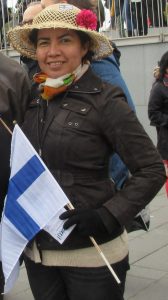
Kuten Puheenvuoron blogissa lupasin, minulla oli kädessä Suomen lippu ja pienempi Nicaraguan lippu. Suomen lippu löytyi myös hatustani.ana1

Mielenosoituksessa seisoin kavereiden kanssa. Meitä opasti Jukka Virlander, jolla oli keskikokoinen Suomen lippu koko ajan kädessä.


Lippuni kiersi välillä eri ihmisten käsissä. Eräs heistä oli pelle, joka pellekavereineen “teki natsitarkastuksia”. Aluksi pelle katsoi minua vähän empien kun ojensin lipun hänelle, mutta kun sanoin tiukasti, että Suomen lippu on meidän kaiken, hän sitten hymyili ja nosti lipun korkeuteen.

mielenosoitus3
Pelle ja lippu.

batman
Viime vuoden puolella Sebastian Tynkkynen vastusti burkhaa mm koska siinä oli vain reikä silmille, mutta Batmanin asu on samanlainen kuin burkhaa. Batman oli mielenosoituksessa luopumassa väkivallasta ja siksi ojensin hänellekin lippuni. <3

tyttolippu
Nuori ja Suomen lippu. Upea! Myös parilla monilla muilla oli lippunsa mukana.


Jokaisen suomalaisen pitäisi nyt nostaa Suomen lippu korkeuteen ja kantaa sen rakkaudella. Valitettavasti moni ei tee niin ja yleisin syy mitä olen kuullut, kun olen kysynyt ihmisiltä on se, että Suomen lippu edustaa natsia ja ääri-isänmaallista ajattelua. Olen sanonut niille ihmisille, että he luovuttavat tärkeää asia kyseenalaiseen tarkoitukseen.

Laki sanoo selkeästä Suomen lipun käytöstä, että se, joka julkisesti turmelee Suomen lipun tai käyttää sitä epäkunnioittavasti taikka luvattomasti ottaa paikaltaan yleisesti nähtäville asetetun Suomen lipun, on tuomittava Suomen lipun häpäisemisestä sakkoon. (21.4.1995)

Lipun turmeleminen on ilmeisesti tulkintakysymys ja siksi voidaan kysyä, että voitaisiinko tulkita niin, että Suomen lipun käyttäminen natsismin, fasismin ja poliittisen väkivallan ajamisessa julkisesti tai ei (esim. painotuissa tuotteissa) voitaisiin tulkita lipun turmelemisena!

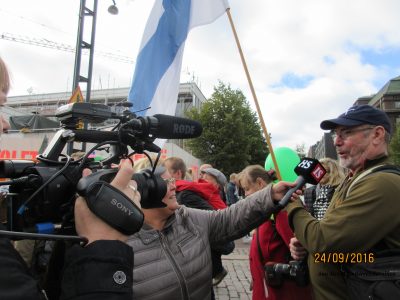
Haluan ajatella, kuten Jukka Virlander sanoi yhdelle toimittajalle Rikotaan hiljaisuutta -mielenosoituksessa, että “Haluan, että saamme lippumme takaisin”.

jukka
Jukka Virlander kertoo kantansa Helsingin Sanomien toimittajalle.


Included – not integrated

Posted on July 19, 2015 by Maarit Snellman

Inclusion is when everyone is along per se.

In Finland we are still struggling with integration issues. We need programmes and policies so that developmentally disabled people can live where other people are living. We need special laws to make sure that they can have the services they need. But those does not matter when money comes to the picture. Because they are not productive in the eyes of decision makers.

There is a long history of segregative practices in Finland. Disabled people we hidden to institutions in the rural areas because that was best for the disabled. Now the times have changed but lot of work has been done and still has to be done before disabled are equals with the rest of us.

There is intolerance against Sami people and Roms. Finnish – Swedes have been hated and disliked for decades. This increased before 2011 Parliament elections when populism came to Finnish politics by Perussuomalaiset. One of my Sami friends was attacked in the university campus because of his activism.

When my parents came here as refugees after evacuation in 1944 from the neck of land Karelia not everyone was happy for that. Karelians are more talkative and outgoing. Many thought Karelian traditions and habits were bizarre.

A couple of moths ago I was told that Finns have done enough for refugees when they took the Karelian people here. People who had lost everything like all of my grandparents. We are also unwelcome and unwanted. Own people. But we Karelians we integrated and we paid taxes. That was the good part I was told. This made me fee like crying.

In this context of intolerance I don’t wonder at all that refugees, paperless, immigrants, other foreigners and black-skinned people meet intolerance, hard attitudes, racism and discrimination.

What comes to religious diversity Finland has been very Lutherian for a long long time. Times are changing and some people have difficulties to face to growing multiculturalism. We have developed a new phobia – Islamofobia. People suffering for it unfortunately are the loudest ones in most public discussion. At the same time Anti-Semitism is rising in Europe

Constitutional Law of Finland and law for equality are clear on equal rights. The new Finnish government says in the government programme that racism will not be tolerated. Still Perussuomalaiset as an openly racist party has been taken to government and the spokesman Soini is the minister of foreign affairs. The rest of the government is looking the other way which is participating to racist acts. I haven heard a single statement concerning increasing hostility made by government members.

Finnish media has a lot to do with the success of Perussuomalaiset and influencing on negative attitudes towards diversity. Media has given PS a lot of media time and helped them to first election victory in 2011. That is the opinion of some political analysts. I just wonder what is in the interests of media to make sure that party hostile towards foreigners and against immigration is doing well.

Law for equal marriage rights should come into the force in 2017 in Finland. But 50 000 people have supported citizen initiative to prevent it from happening. Mostly religious arguments are being used against the fact that sexual orientation is a biological feature. Homophobia is alive and well.

There are also signs of political discrimination. The left parties are the reason for the poor economics. Which is as much BS as that islamist or jihadist is the same as Muslim. Also the poor and unemployed are having a hard time and get blamed for their situation.

Economics is poor but that does not justify racism or xenophobia. We don’t need to make same poor choices and mistakes. We can make some profound changes in economics. We don’t need scapegoats. That wont solve anything. We have been through that road before and cruelty, inhumanity and violence just are not solution. We can do better. But we have to solve the economics and some key social issues it is causing globally.

Inclusion is when everyone is along per se.

What do Jim Crow, Nuremberg Laws and Finland’s Restricting Act of 1939 have in common?

Posted on December 28, 2014 by Migrant Tales

All forms of intolerance have one factor in common: They are violent ways to disenfranchise and control groups through social exclusion. Jim Crow laws in the United States sought to ensure that blacks remain marginalized in the same way as the Nuremberg Laws of Nazi Germany took away all power from the Jews. In Finland, foreigners were controlled by the Restricting Act of 1939 (law 219/1939) and the lack of any laws that ensured them basic human rights. 

While in different historical contexts, all three laws had the same aim: Dominate and control groups perceived to be a threat. Whites in the United States feared that blacks would become their masters. The same argument was used in the Final Solution of the Jews.

Rudolf Hoess, Auschwitz camp commandant 1940-43 and 1944-45, justified the extermination of about 2.5 million Jews [1] with the following twisted logic.

Hoess: “I had my personal orders from [Heinrich] Himmler [to exterminate Jews].”

Question: “Did you ever protest?”

Hoess: “I couldn’t do that. The reasons Himmler gave me I had to accept.”

Question: “In other words, you think it was justified to kill 2.5 million men, women, and children?”

Hoess: “Not justified – but Himmler told me that if the Jews were not exterminated at that time, then the German people would be exterminated for all time by the Jews.”

Certainly myths must be created in order to depict “us” as the good guys and “them” as the bad guys as we exclude other groups. This can be done to justify mass murder or through an oppressive system like Jim Crow, which permitted mass murder through mob violence and the lynching of blacks.

The reason why intolerance continues to dominate our societies these days is because we still believe that certain groups are a threat. The massive number of black and Hispanic USAmericans that are incarcerated reveal a New Jim Crow, while anti-Semitism is on the rise in Europe under many masks like Islamophobia.

All three laws – Jim Crow, Nuremberg Laws and the Restricting Act of 1939 – had the same aim: To take away rights from other groups in order to neutralize and control them. In Finland it was not only done with the 1939 law but with no law that ensured foreigners had no civil rights in this country.

It was only 66 years after independence that Finland enacted its first Aliens Act in 1983.


Näyttökuva 2014-12-28 kello 8.37.46

While the targeted group was different in the Nuremberg Laws and during Jim Crow (Mississippi), both laws are similar because their aim and arguments are the same even if they are in different national and historical contexts.


Just like the Nuremberg Laws prohibited Jews marrying white Germans, Jim Crow prohibited blacks from marrying whites. Schools and public spaces were segregated for Jews in Germany and blacks in the United States, especially in the South.

In Finland too white Finns were discouraged from marrying foreigners. Some white Finnish immigrant women in Sweden married Asian and African men. Those that did usually lost their Finnish citizenship until a new law in 1968 permitted them to regain it.

Even if Finland was the first European country to give women the right to vote, it didn’t trust women with foreigners. Until 1984, only Finnish males could pass Finnish citizenship to their children.

The Restricting Act of 1939 prohibited foreigners from owning real estate and acquiring a majority stake in Finnish companies – limiting this to 20% normally and 40% under special permission. The Act stipulated that foreigners could not own shares in sectors such as forestry, securities trading, transportation, mining, real estate and shipping.

The Restricting Act of 1939, which was passed during the Great Depression, became redundant in 1992.

If the Restricting Act wasn’t enough to ensure that you couldn’t publish newspapers, organize demonstrations, be a chairman of a Finnish association or own land, the lack of any law that protected immigrants in this country meant that the authorities didn’t have to respect your human rights and could imprison and deport you and ask questions later.

Like Jim Crow and the Nuremberg Laws, the Restricting Act had the same aim: to wipe out and keep the foreign population to a minimum. Finland almost succeeded at making the country “foreigner free.” From a high of 29,685 immigrants in 1929, the foreign community had plummeted in the following 41 years to a mere 5,483 in 1970, according to Antero Leitzinger.

If we take into account that a large number of these “foreigners” were native Finns who were naturalized Swedes, the amount of non-Finns living in the country was even smaller.

Is it a coincidence that intolerance and xenophobia raised its rude head in such a forceful way in the 2011 parliamentary elections, when the Perussuomalaiset (PS)* saw its support rise from 5MPs in 2007 to 39MPs?

Should we be surprised why there is still so much suspicion, intolerance and nativist nationalism in Finland? All we have to do is look at our past laws and history to find the answers.

Blinding  our view, however, are those myths about ourselves and excuses that keep us in our national comfort zone.

[1] Leo Goldensohn: Nuremberg Interviews. Vintage Books. New York 2004. p. 296.

* The Finnish name of the Finns Party is the Perussuomalaiset (PS). The English -language names adopted by the PS, like True Finns or Finns Party, promote in our opinion nativist nationalism and xenophobia. We therefore prefer to use the Finnish name of the party on our postings.

Suomen Sisu tests Finland’s tolerance for hate

Posted on November 11, 2013 by Migrant Tales

If you want a good view of the type of Finland a far right association like Suomen Sisu wants to build, check out the invitation to their 15th anniversary celebration at the Santahamina Military Base near Helsinki. The invitation states at the end:  “Santahamina is a military zone where only Finnish citizens have access to [the base].”

Fortunately, Finland’s defense forces have prohibited such an event taking place at the base, according to Monday’s Helsingin Sanomat.

The Santahamina Military Base is the home of the Jaeger Regiment, which played a key role in helping the Whites defeat the Reds in the Civil War of 1918.

The invitation, signed by Perussuomalaiset (PS) MP Olli Immonen, who hasn’t hid before his loathing for Muslims and other minorities like the Roma, is another example of how far-right groups test how much Finns tolerate hate.

Kuvankaappaus 2013-11-11 kello 20.11.09Finland’s Security Intelligence Service (Supo) sees Suomen Sisu as an extremist ogranization.

One of the aims of Suomen Sisu is to keep Finland white. It discourages white ethnic Finns from marrying foreigners, especially blacks.

If you believe that Suomen Sisu is a “nationalist association that promotes Finnish values and self-esteem,” then you believe that the English Defense League fights for human rights. Such claims are red herrings that aim to hide their  hatred for certain minorities.

Suomelaisuuden liitto, which has been overtaken by PS members, has waged a hostile campaign against the the role of  theSwedish language in Finland.

The association is closely related to Suomen Sisu.

Thank you Niko Tamminen for the heads-up.

European Court of Human Rights will not review PS MP Hirvisaari’s conviction for ethnic agitation

Posted on July 10, 2013 by Migrant Tales

The European Court of Human Rights has turned down a request by Perussuomalaiset (PS) MP James Hirvisaari to review a conviction for ethnic agitation in December 2011 by the Kouvola Court of Appeals, which was upheld last year by the Finnish Supreme Court.

There was no doubt that far right PS MP Hirvisaari stood a chance of having his conviction reviewed by the European Court of Human Rights after it was upheld by a Supreme Court decision earlier.

Migrant Tales applauds the decision.

Kuvankaappaus 2013-7-10 kello 9.07.49

Lahti-based daily Etelä-Suomen Sanomat wrote about the European Court of Human Rights’ decision. Hirvisaari has declared war on the daily by boycotting it.

In his usual style, Hirvisaari lashes out against the decision not to review his conviction as ”bowing to Mecca.” On a Facebook thread he slams the president of the Kouvola Court of Appeals, Pertti Nieminen, as the ”Great Satan.”

Hirvisaari, who would never have stood a chance of being elected to parliament without the help of Timo Soini, who commonly plays down racism in the party, has been embroiled in numerous scandals during his two years as MP. Some of these include complaining about skid marks on the toilet bowls of parliament to blaming Anders Breivik’s murderous rampage in Norway on immigration policy.

Some of his most infamous remarks aren’t his homophobic views and plans to control what the Finnish media writes,  but hiring Helena Eronen as his aide.

Eronen, who is a member of the far right anti-immigration Muutos2011 party, resigned in August after she wrote a scandalous blog entry that foreigners could help the police in ethnic profiling by wearing sleeve badges.

The reaction of the Finnish and even international media to her blog entry was a clear sign how far out of touch Eronen’s “sarcasm” was with common decency and respect for immigrants and visible minorities.

The last time ethnic groups like the Jews were required to wear identifying badges was during the Nazi regime in Germany.


Landmark decision in Finland: Sikh busman can wear a turban at work

Posted on June 27, 2013 by Migrant Tales

The Southern Finland Regional State Administrative Agency announced that banning a Sikh busman from using a turban at work was discriminatory, reports YLE in English. The decision is an important watershed and a victory for other minorities living in Finland. 

The busman, Gill Sukhdarshan Singh of Vantaa, was prohibited from using a turban at work and decided in May to challenge the decision.

The agency said that Singh’s employer, Veolia Transport Vantaa, was guilty of indirect discrimination and ordered the firm to report by the end of September how it plans to redress the problem.

Kuvankaappaus 2013-6-27 kello 22.23.39

The decision in favor of Singh should be seen as a watershed since it will propel greater cultural diversity and tolerance at the workplace.

Eva Biaudet, Finland’s ombudsman for minorities, applauded the decision. She said it was a significant step forward in making cultural diversity more acceptable at the workplace.

Sing’s victory over his employer is a good example of how far Finland lags behind other European countries concerning cultural diversity. Sikh bus drivers in England won such rights over forty years ago in 1969.


Aspergers and Ableism Part 1: Introductions

Posted on June 16, 2013 by Barachiel

brain

The following is part of a personal statement I originally wrote to apply for the International Student Exchange Program (ISEP) last year, before I came to study in Finland and eventually settle in the Nordic countries. I plan to discuss the culture and challenges of the Autism/Asperger’s community, and how I believe the issue of the disabled is treated in the Nordics, over the course of the summer here on Migrant Tales. This will be the first part of a series, dealing with social issues related to neurodevelopmental disabilities and eventually introducing the concept of neurodiversity to a Finnish audience.

I am a third-year history student at Virginia Commonwealth University. I am applying for a Benjamin A. Gilman International Scholarship to fund my study-abroad to Germany this fall. I hope that this funding will aid me in my exploration of a culture that is totally apart from my own. I have developed a desire to walk on strange soil, meet with new people, and live in a country with an interesting history to be learned. I believe that the Gilman scholarship will offer me some financial security as I set out to do this—and will not take opportunity for granted should I be accepted.

My future plans, following my graduation in [Finland/Sweden], include starting parallel careers in scriptwriting for films and speechwriting for politics. I feel that my education in history, gained during my time both at VCU and at the two community colleges I attended beforehand, would serve me well in both professions. Historical knowledge could help me create scripts serving as allegories surrounding a person, an event, or an issue. Historical knowledge could also help me navigate cultural attitudes surrounding a particular topic, and engineer an effective political campaign.

I consider myself as coming from a diverse background—not because of a difference in race or nationality, but in mind. I have Asperger’s Syndrome, a high-functioning form of autism which affects how I neurologically register the emotions of myself and others. Several awkward encounters involving my disorder remind me of awkward encounters that happen between people of differing cultural backgrounds all the time. But despite my social mishaps, I have learned how to act around new people and handle myself in new environments; I feel that I could reasonably get along well at an international site.

I have experience interacting with foreign people, namely exchange students who have come to VCU either through ISEP or inter-collegiate partnerships. For the 2010-2011 academic year, I participated in VCU’s “buddy” program and was paired with a British biology student. This year, I have been paired with a German student studying urban planning. I guided them through American culture in several interactive ways, and my efforts were met with great appreciation by both the exchange students and the faculty members running VCU’s international office.

My immediate goal for integrating into my host country is to acquaint myself with its history and culture. I have read travel books, have taken history courses, and have gleaned information from news outlets in the host countries I am considering; by doing this, I aim to know which topics I can discuss with members of the host culture, which topics to avoid, and which topics related to America that might interest them. Another goal is to learn the dominant language(s) of the host country, which I am currently practicing for by taking classes in German at VCU.

I feel that my experience with Asperger’s Syndrome and with the exchange students at VCU has trained me for daily life in an unfamiliar place. My empathy and my patience with others have been made more resolute by my experiences, and I feel more mature for it. Once I am abroad, I plan on gaining the best knowledge from my experience in the most resolute posture possible. I am also going out of my way to learn about where I’m going and not come across as another “ignorant American” wherever I end up. I hope I am given a chance to prove that with the financial help I may receive through the Gilman scholarship.

Announcement: Youth and power are the focus of Helsinki African Film Festival this week

Posted on May 8, 2013 by Mikko Kapanen

Kenyan film Nairobi Half Life is part of Helsinki African Film Festival selection and its director Tosh Gitonga will be speaking today in Caisa starting at 5pm
Kenyan film Nairobi Half Life is part of Helsinki African Film Festival selection and its director Tosh Gitonga will be speaking today in Caisa starting at 5pm (free entrance)

(Announcement)

The annual Helsinki African Film Festival (HAFF) brings a selection of the best of African cinema to Finland for the fourth time this week. The festival has a broad range of films from all over the continent and this time both fact and fiction will be brought together by the overarching theme of Youth and Power.

“We will focus on the lives of young people across the diverse African continent and diaspora”, says the festival director Wanjiku wa Ngugi, and continues “Everyone agrees that young people are the future of Africa, but what are the challenges they face as they claim their place in their societies – whether they are pushing for political change and demanding justice, finding ways to make a living, or deciding how to live and love?”

The festival will take place this week between the 8th and the 12th of May in Helsinki at two cinemas: the Andorra and Kino Engel, as well as at the cultural centre Caisa. The opening film is Nairobi Half Life from Kenya and its director Tosh Gitonga will be speaking about the film and film making on the continent of Africa in general on the today (8.5.) in Caisa starting at 5pm. His views can also be heard on the ask from director event held as a part of the festival opening.

Another particularly notable film this year is Senegalese Tey(Today), which is directed by Alain Gomis and starring Saul Williams. Tey won the Golden Stallion award of FESPACO (Pan-African Film Festival of Ouagadougou) which can be compared to an African Oscar. The festival will also feature other films by Gomis.

The festival is organised by the Helsinki African Film Festival working group in collaboration with development cooperation organisation Shalin ry. The aim of the festival is to provide the Finnish audiences an opportunity to see top quality contemporary African films and act as a counter-balance to the dominant and one-sided news narrative from the African continent which leans on negative stereotypes and simplifications of Africa and Africans.

The full festival programme is available at www.haff.fi

Aside from the film festival, HAFF will be also organising an African street festival in the Helsinki city center, at Kansalaistori (between Sanomatalo and the new Music House) today starting at 13.00.

Welcome to the screenings and events.


  • 1
  • 2
  • Next
Read more about documentary film
Read more

Recent Posts

  • Finland’s tabloids Iltalehti and Ilta-Sanomat are the pits
  • Riikka Purra’s Dr Jekyll and Mr Hyde mask
  • Double standards
  • Perussuomalaiset: Uusi logo, sama vanha juttu
  • Taco Trump

Recent Comments

  1. Absolutely Socking: Racist Finnish Facebook group against human rights gets flooded with socks on Musta Barbaari’s mother and sister charged by the police in “ethnic profiling” case
  2. Ilkka Nuotio on Pekka Myrskylä: “Tilastot kertovat toista kuin poliittinen keskustelu”
  3. Genrih Soinkara on The war in Ukraine and the Russian-Finnish border crisis are showing Finland’s ugly side
  4. Ahti Tolvanen on Comment by Ahti Tolvanen on the Helsinki +50 conference
  5. Angel Barrientos on Angel Barrientos is one of the kind beacons of Finland’s Chilean community

Archives

  • June 2026
  • May 2026
  • April 2026
  • March 2026
  • February 2026
  • January 2026
  • December 2025
  • November 2025
  • October 2025
  • September 2025
  • August 2025
  • July 2025
  • June 2025
  • May 2025
  • April 2025
  • March 2025
  • February 2025
  • January 2025
  • December 2024
  • November 2024
  • October 2024
  • September 2024
  • August 2024
  • July 2024
  • June 2024
  • May 2024
  • April 2024
  • March 2024
  • February 2024
  • January 2024
  • December 2023
  • November 2023
  • October 2023
  • September 2023
  • August 2023
  • July 2023
  • June 2023
  • May 2023
  • April 2023
  • March 2023
  • February 2023
  • January 2023
  • December 2022
  • November 2022
  • October 2022
  • September 2022
  • August 2022
  • July 2022
  • June 2022
  • May 2022
  • April 2022
  • March 2022
  • February 2022
  • January 2022
  • December 2021
  • November 2021
  • October 2021
  • September 2021
  • August 2021
  • July 2021
  • June 2021
  • May 2021
  • April 2021
  • March 2021
  • February 2021
  • January 2021
  • December 2020
  • November 2020
  • October 2020
  • September 2020
  • August 2020
  • July 2020
  • June 2020
  • May 2020
  • April 2020
  • March 2020
  • February 2020
  • January 2020
  • December 2019
  • November 2019
  • October 2019
  • September 2019
  • August 2019
  • July 2019
  • June 2019
  • May 2019
  • April 2019
  • March 2019
  • February 2019
  • January 2019
  • December 2018
  • November 2018
  • October 2018
  • September 2018
  • August 2018
  • July 2018
  • June 2018
  • May 2018
  • April 2018
  • March 2018
  • February 2018
  • January 2018
  • December 2017
  • November 2017
  • October 2017
  • September 2017
  • August 2017
  • July 2017
  • June 2017
  • May 2017
  • April 2017
  • March 2017
  • February 2017
  • January 2017
  • December 2016
  • November 2016
  • October 2016
  • September 2016
  • August 2016
  • July 2016
  • June 2016
  • May 2016
  • April 2016
  • March 2016
  • February 2016
  • January 2016
  • December 2015
  • November 2015
  • October 2015
  • September 2015
  • August 2015
  • July 2015
  • June 2015
  • May 2015
  • April 2015
  • March 2015
  • February 2015
  • January 2015
  • December 2014
  • November 2014
  • October 2014
  • September 2014
  • August 2014
  • July 2014
  • June 2014
  • May 2014
  • April 2014
  • March 2014
  • February 2014
  • January 2014
  • December 2013
  • November 2013
  • October 2013
  • September 2013
  • August 2013
  • July 2013
  • June 2013
  • May 2013
  • April 2013
  • March 2013
  • February 2013
  • January 2013
  • December 2012
  • November 2012
  • October 2012
  • September 2012
  • August 2012
  • July 2012
  • June 2012
  • May 2012
  • April 2012
  • March 2012
  • February 2012
  • January 2012
  • December 2011
  • November 2011
  • October 2011
  • September 2011
  • August 2011
  • July 2011
  • June 2011
  • May 2011
  • April 2011
  • March 2011
  • February 2011
  • January 2011
  • December 2010
  • November 2010
  • October 2010
  • September 2010
  • August 2010
  • July 2010
  • June 2010
  • May 2010
  • April 2010
  • March 2010
  • February 2010
  • January 2010
  • December 2009
  • November 2009
  • October 2009
  • September 2009
  • August 2009
  • July 2009
  • December 2008
  • November 2008
  • October 2008
  • September 2008
  • August 2008
  • July 2008
  • June 2008
  • May 2008
  • April 2008
  • March 2008
  • February 2008
  • January 2008
  • November 2007
  • October 2007
  • September 2007
  • August 2007
  • July 2007
  • June 2007
  • May 2007

Categories

  • ?? Gia L?c
  • ????? ?????? ????? ???????? ?? ??????
  • ???????
  • @HerraAhmed
  • @mondepasrond
  • @nohatefinland
  • @oula_silver
  • @Varathas
  • A Pakistani family
  • äärioikeisto
  • Abbas Bahmanpour
  • Abdi Muhis
  • Abdirahim Hussein Mohamed
  • Abdirahim Husu Hussein
  • Abdirisak Mahamed
  • About Migrant Tales
  • activism
  • Adam Al-Sawad
  • Adel Abidin
  • Afrofinland
  • Ahmed IJ
  • Ahti Tolvanen
  • Aino Pennanen
  • Aisha Maniar
  • Alan Ali
  • Alan Anstead
  • Alejandro Díaz Ortiz
  • Alekey Bulavsev
  • Aleksander Hemon
  • Aleksanterinliitto
  • Aleksanterinliitto ry
  • Aleksanterinliitto ry:n hallitus
  • Alex Alex
  • Alex Mckie
  • Alexander Nix
  • Alexandra Ayse Albayrak
  • Alexis Neuberg
  • Ali Asaad Hasan Alzuhairi
  • Ali Hossein Mir Ali
  • Ali Rashid
  • Ali Sagal Abdikarim
  • Alina Tsui
  • Aline Müller
  • All categories
  • Aman Heidari
  • Amiirah Salleh-Hoddin & Jana Turk
  • Amin A. Alem
  • Amir Zuhairi
  • Amkelwa Mbekeni
  • Ana María Gutiérrez Sorainen
  • Anachoma
  • Anders Adlecreutz
  • Angeliina Koskinen
  • Anna De Mutiis
  • Anna María Gutiérrez Sorainen
  • Anna-Kaisa Kuusisto ja Jaakko Tuominen
  • Annastiina Kallius
  • Anneli Juise Friman Lindeman
  • Announcement
  • Anonymous
  • Antero Leitzinger
  • anti-black racism
  • Anti-Hate Crime Organisation Finland
  • Anudari Boldbaatar
  • Arshiya Nasser
  • Aspergers Syndrome
  • Asylum Corner
  • Asylum seeker 406
  • Athena Griffin and Joe Feagin
  • Autism
  • Avaaz.org
  • Awale Olad
  • Ayan Said Mohamed
  • AYY
  • Barachiel
  • Bashy Quraishy
  • Beatrice Kabutakapua
  • Beri Jamal
  • Beri Jamal and Enrique Tessieri
  • Bertolt Brecht
  • Boiata
  • Boodi Kabbani
  • Bruno Gronow
  • Carmen Pekkarinen
  • Çelen Oben and Sheila Riikonen
  • Chiara Costa-Virtanen
  • Chiara Costa-Virtanen
  • Chiara Sorbello
  • Christian Thibault
  • Christopher Wylie
  • Clara Dublanc
  • Dana
  • Daniel Malpica
  • Danilo Canguçu
  • David Papineau
  • David Schneider
  • Dexter He
  • Don Flynn
  • Dr Masoud Kamali
  • Dr. Faith Mkwesha
  • Dr. Theodoros Fouskas
  • Edna Chun
  • Eeva Kilpi
  • Emanuela Susheela
  • En castellano
  • ENAR
  • Enrique
  • Enrique Tessieri
  • Enrique Tessieri & Raghad Mchawh
  • Enrique Tessieri & Yahya Rouissi
  • Enrique Tessieri and Muhammed Shire
  • Enrique Tessieri and Sira Moksi
  • Enrique Tessieri and Tom Vandenbosch
  • Enrique Tessieri and Wael Che
  • Enrique Tessieri and Yahya Rouissi
  • Enrique Tessieri and Zimema Mhone
  • Epäluottamusmies
  • EU
  • Europe
  • European Islamophobia Report
  • European Islamophobia Report 2019,
  • European Union
  • Eve Kyntäjä
  • Ezequiel Caldeiro
  • Facebook
  • Fadumo Dayib
  • Faisa Kahiye
  • Farhad Manjoo
  • Fasismi
  • Finland
  • Fizza Qureshi
  • Flyktingar och asyl
  • Foreign Student
  • Fozia Mir-Ali
  • Frances Webber
  • Frida Selim
  • Gareth Rice
  • Ghyslain Vedeaux
  • Global Art Point
  • Great Replacement
  • Habiba Ali
  • Hami Bahadori
  • Hami Bahdori
  • Hamid
  • Hamid Alsaameere
  • Hamid Bahdori
  • Handshake
  • Harmit Athwal
  • Hassan Abdi Ali
  • Hassan Muhumud
  • Heikki Huttunen
  • Heikki Wilenius
  • Helsingin Sanomat
  • Henning van der Hoeven
  • Henrika Mälmsröm
  • Hser Hser
  • Hser Hser ja Mustafa Isman
  • Husein Muhammed
  • Hussain Kazemian
  • Hussain Kazmenian
  • Ibrahim Khan
  • Ida
  • Ignacio Pérez Pérez
  • Iise Ali Hassan
  • Ilari Kaila & Tuomas Kaila
  • Imam Ka
  • inside-an-airport
  • Institute of Race Relations
  • Iraqi asylum seeker
  • IRR European News Team
  • IRR News Team
  • Islamic Society of Norhern FInland
  • Islamic Society of Northern Finland
  • Islamophobia
  • Jacobinmag.com
  • Jallow Momodou
  • Jan Holmberg
  • Jane Elliott
  • Jani Mäkelä
  • Jari Luoto
  • Jari Taponen
  • Jegor Nazarov
  • Jenni Stammeier
  • Jenny Bourne
  • Jessie Daniels
  • Joe Davidow
  • Johannes Koski
  • John D. Foster
  • John Grayson
  • John Marriott
  • Jon Burnett
  • Jorma Härkönen
  • Jos Schuurmans
  • José León Toro Mejías
  • Josue Tumayine
  • Jouni Karnasaari
  • Juan Camilo
  • Jukka Eräkare
  • Julian Abagond
  • Julie Pascoet
  • Jussi Halla-aho
  • Jussi Hallla-aho
  • Jussi Jalonen
  • JusticeDemon
  • Kadar Gelle
  • Kaksoiskansalaisuus
  • Kansainvälinen Mikkeli
  • Kansainvälinen Mikkeli ry
  • Katherine Tonkiss
  • Kati Lepistö
  • Kati van der Hoeven-Lepistö
  • Katie Bell
  • Kättely
  • Kerstin Ögård
  • Keshia Fredua-Mensah & Jamie Schearer
  • Khadidiatou Sylla
  • Khadra Abdirazak Sugulle
  • Kiihotus kansanryhmää vastaan
  • Kirsi Crowley
  • Koko Hubara
  • Kristiina Toivikko
  • Kubra Amini
  • KuRI
  • La Colectiva
  • La incitación al odio
  • Laura Huhtasaari
  • Lauri Finér
  • Leif Hagert
  • Léo Custódio
  • Leo Honka
  • Leontios Christodoulou
  • Lessie Branch
  • Lex Gaudius
  • Leyes de Finlandia
  • Liikkukaa!
  • Linda Hyökki
  • Liz Fekete
  • M. Blanc
  • Maarit Snellman
  • Mahad Sheikh Musse
  • Maija Vilkkumaa
  • Malmin Kebab Pizzeria Port Arthur
  • Marcell Lorincz
  • Mari Aaltola
  • María Paz López
  • Maria Rittis Ikola
  • Maria Tjader
  • Marja-Liisa Tolvanen
  • Mark
  • Markku Heikkinen
  • Marshall Niles
  • Martin Al-Laji
  • Maryan Siyad
  • Matt Carr
  • Mauricio Farah Gebara
  • Media Monitoring Group of Finland
  • Micah J. Christian
  • Michael McEachrane
  • Michele Levoy
  • Michelle Kaila
  • Migrant Tales
  • Migrant Tales Literary
  • Migrantes News
  • Migrants' Rights Network
  • MigriLeaks
  • Mikko Kapanen
  • Miriam Attias and Camila Haavisto
  • Mohamed Adan
  • Mohammad Javid
  • Mohammad M.
  • Monikulttuurisuus
  • Monisha Bhatia and Victoria Canning
  • Mor Ndiaye
  • Muh'ed
  • Muhamed Abdimajed Murshid
  • Muhammed Shire
  • Muhammed Shire and Enrique Tessieri
  • Muhis Azizi
  • Musimenta Dansila
  • Muslimiviha
  • Musulmanes
  • Namir al-Azzawi
  • Natsismi
  • Neurodiversity
  • New Women Connectors
  • Nils Muižnieks
  • No Labels No Walls
  • Noel Dandes
  • Nuor Dawood
  • Omar Khan
  • Otavanmedia
  • Oula Silvennoinen
  • Paco Diop
  • Pakistani family
  • Pentti Stranius
  • Perussuomalaiset
  • perustuslaki
  • Petra Laiti
  • Petri Cederlöf
  • Pia Grochowski
  • Podcast-lukija Bea Bergholm
  • Pohjois – Suomen Islamilainen Yhdyskunta
  • Pohjois Suomen Islamilainen Yhyskunta
  • Polina Kopylova
  • Race Files
  • racism
  • Racism Review
  • Raghad Mchawh
  • Ranska
  • Rashid H. and Migrant Tales
  • Rasismi
  • Raul Perez
  • Rebecka Holm
  • Reem Abu-Hayyeh
  • Refugees
  • Reija Härkönen
  • Remiel
  • Reza Nasri
  • Richard Gresswell
  • Riikka Purra
  • Risto Laakkonen
  • Rita Chahda
  • Ritva Kondi
  • Robito Ibrahim
  • Roble Bashir
  • Rockhaya Sylla
  • Rodolfo Walsh
  • Roger Casale
  • Rostam Atai
  • Roxana Crisólogo Correa
  • Ruth Grove-White
  • Ruth Waweru-Folabit
  • S-worldview
  • Sadio Ali Nuur
  • Sami Rusanen
  • Sandhu Bhamra
  • Sara de Jong
  • Sarah Crowther
  • Sari Alhariri
  • Sarkawt Khalil
  • Sasu
  • Scot Nakagawa
  • Shabana Ahmadzai
  • Shada Islam
  • Sharon Chang blogs
  • Shenita Ann McLean
  • Shirlene Green Newball
  • Sini Savolainen
  • Sira Moksi
  • Sonia K.
  • Sonia Maria Koo
  • Steverp
  • Stop Deportations
  • Suldaan Said Ahmed
  • Suomen mediaseurantakollektiivi
  • Suomen Muslimifoorumi ry
  • Suomen viharikosvastainen yhdistys
  • Suomen viharikosvastainen yhdistys ry
  • Suomi
  • Supermen
  • Susannah
  • Suva
  • Syrjintä
  • Talous
  • Tapio Tuomala
  • Taw Reh
  • Teivo Teivainen
  • The Daily Show
  • The Heino
  • The Supermen
  • Thomas Elfgren
  • Thulfiqar Abdulkarim
  • Tim McGettigan
  • Tino Singh
  • Tito Moustafa Sliem
  • Tobias Hübinette and L. Janelle Dance
  • Transport
  • Trica Danielle Keaton
  • Trilce Garcia
  • Trish Pääkkönen
  • Trish Pääkkönen and Enrique Tessieri
  • Tuulia Reponen
  • Uncategorized
  • UNITED
  • University of Eastern Finland
  • Uyi Osazee
  • Väkivalta
  • Vapaa Liikkuvuus
  • Venla-Sofia Saariaho
  • Vieraskynä
  • W. Che
  • W. Che an Enrique Tessieri
  • Wael Ch.
  • Wan Wei
  • Women for Refugee Women
  • Xaan Kaafi Maxamed Xalane
  • Xassan Kaafi Maxamed Xalane
  • Xassan-Kaafi Mohamed Halane & Enrique Tessieri
  • Yahya Rouissi
  • Yasmin Yusuf
  • Yassen Ghaleb
  • Yle Puhe
  • Yuliet Tresa
  • Yve Shepherd
  • Zahra Khavari
  • Zaker
  • Zalina Ametova
  • Zamzam Ahmed Ali
  • Zeinab Amini ja Soheila Khavari
  • Zimema Mahone and Enrique Tessieri
  • Zimema Mhone
  • Zoila Forss Crespo Moreyra
  • ZT
  • Zulma Sierra
  • Zuzeeko Tegha Abeng
© 2026 Migrant tales | Powered by Minimalist Blog WordPress Theme