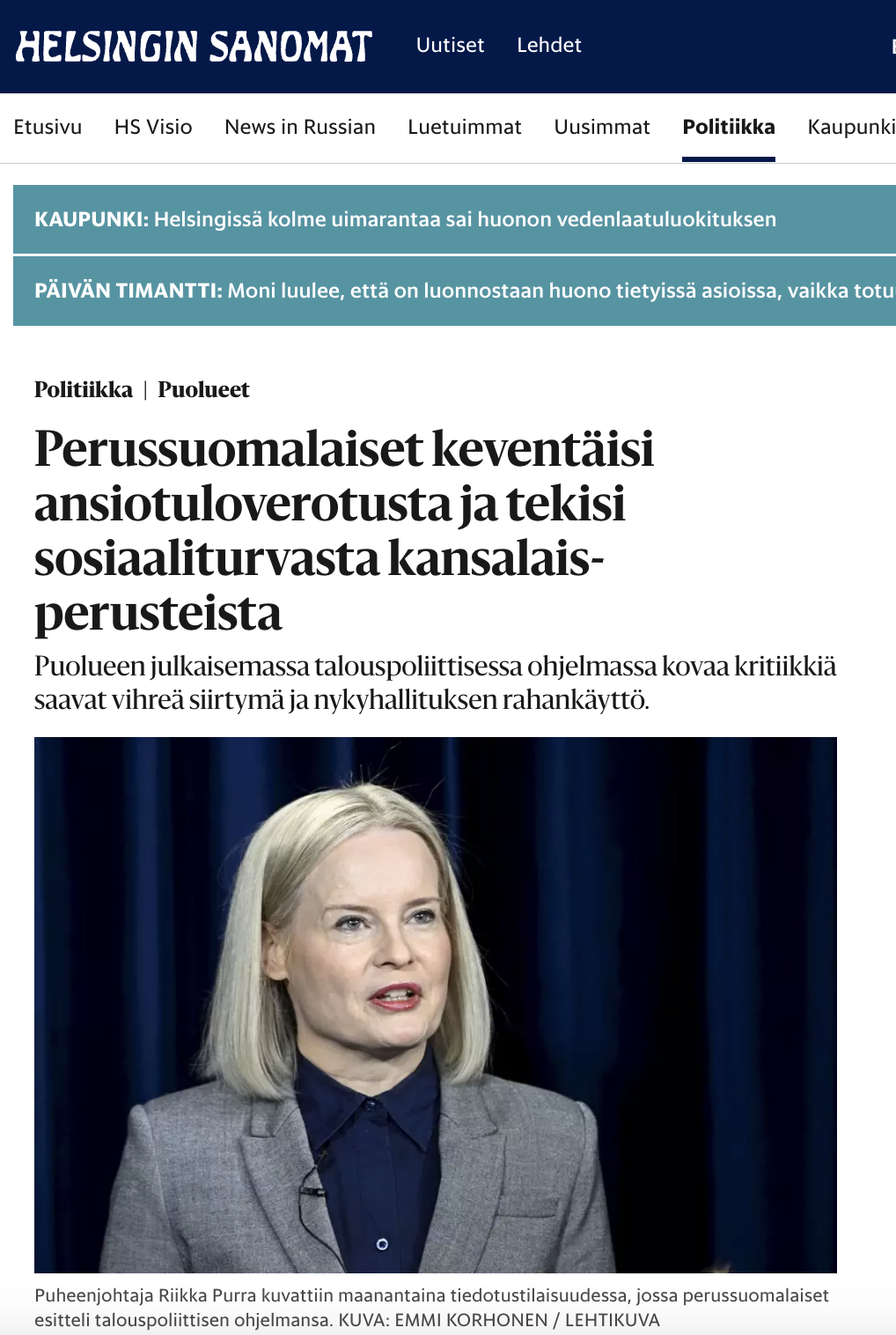
Perussuomalaiset (PS)* party chairperson, Riikka Purra, has actively promoted her racist talking points. Some of these are the far-right great replacement theory and, most recently, her party’s aim to exclude non-Finnish citizens from getting social welfare.
While such a suggestion may appear for now a political stunt to lure voters, Purra’s suggestion is outrageous, to say the least. Did the media see it in the same way?
Nope.
Did any newspaper write an editorial about Purra’s statement?
Nope.
Apart from demonizing foreigners and minorities, her plan has the same ring as the Nurenburg Race Laws, which effectively excluded Jews from German society.
Even if the Nurenburg Race Laws came into force in 1935, Purra’s suggestion could be a modern version of the latter. The idea is the same: label, victimize and exclude whole groups.
Helsingin Sanomat does some fine reporting, but sometimes it falls flat on its face.
The story about Purra’s suggestion to exclude foreigners from receiving social welfare is a good example of deficient or lazy reporting.
Being a minority in Finland is being nearly always suspicious of official intentions.
Perussuomalaiset (PS)* chairperson Riikka Purra reiterated her party’s aim to exclude foreign residents from getting social welfare. According to her, the only ones who qualify for social welfare are Finnish citizens.
The radical-right politician added that such plans would not materialize in the next political term but was a long-range plan.
The fact that she can make such a statement reveals a lot about how racism has entered Finnish politics. Her party’s aim is synonymous with what is happening in Afghanistan today with women’s rights.
This Facebook post was made in 2019. Today, the PS is the second-most popular party in a YLEpoll.
But the icing on the racist cake is the silence coming from parties like the National Coalition Party (Kokoomus) and others concerning Purra’s statement about disenfranchising foreign residents in Finland. After a second try, Kokoomus’ head of communication, Kirsi Holtta, said that the party not believe that social security should be based on nationality.
We read about the tragic death of a woman at Espoo’s Iso Omena shopping center on Saturday. The woman died while being escorted by four Securitas security guards out of the shopping center. The altercation ended with the woman on the floor, handcuffed, and eventually lifeless.
The police announced Sunday that the security guards in the incident are suspected of manslaughter.
The woman’s death followed a police investigation of security guards at Avarn Security, who systematically beat and humiliated its victims.
Both incidents shed light on some uncomfortable but imperative matters: greater scrutiny of security guards by the companies and police, better training, and stricter psychological tests to determine if they qualify for such work.
A good editorial by Helsingin Sanomat today caused us to reflect on crime and punishment. As everyone knows, and with elections on April 4, radical-right parties like the Perussuomalaiset and the National Coalition Party (Kokoomus) are spreading fear about youth gangs and how they are a threat to our society.
After reading 77 stories published by Yle (9 stories), Helsingin Sanomat (19), Iltalehti (6), Ilta-Sanomat (30), and MTV (13) about the Avarn Security scandal, only one story alleges racism as a factor in the working culture of security guards. Another story by Ilta-Sanomat, which wrote about excessive force, only mentioned once a “person of foreign background” was apprehended by security guards.
Meanwhile, according to various media reports, a woman died on Saturday at Espoo’s Iso Omena shopping center. The woman was being escorted out of the shopping center by Securitas security guards. The police suspect that manslaughter is the cause of death.
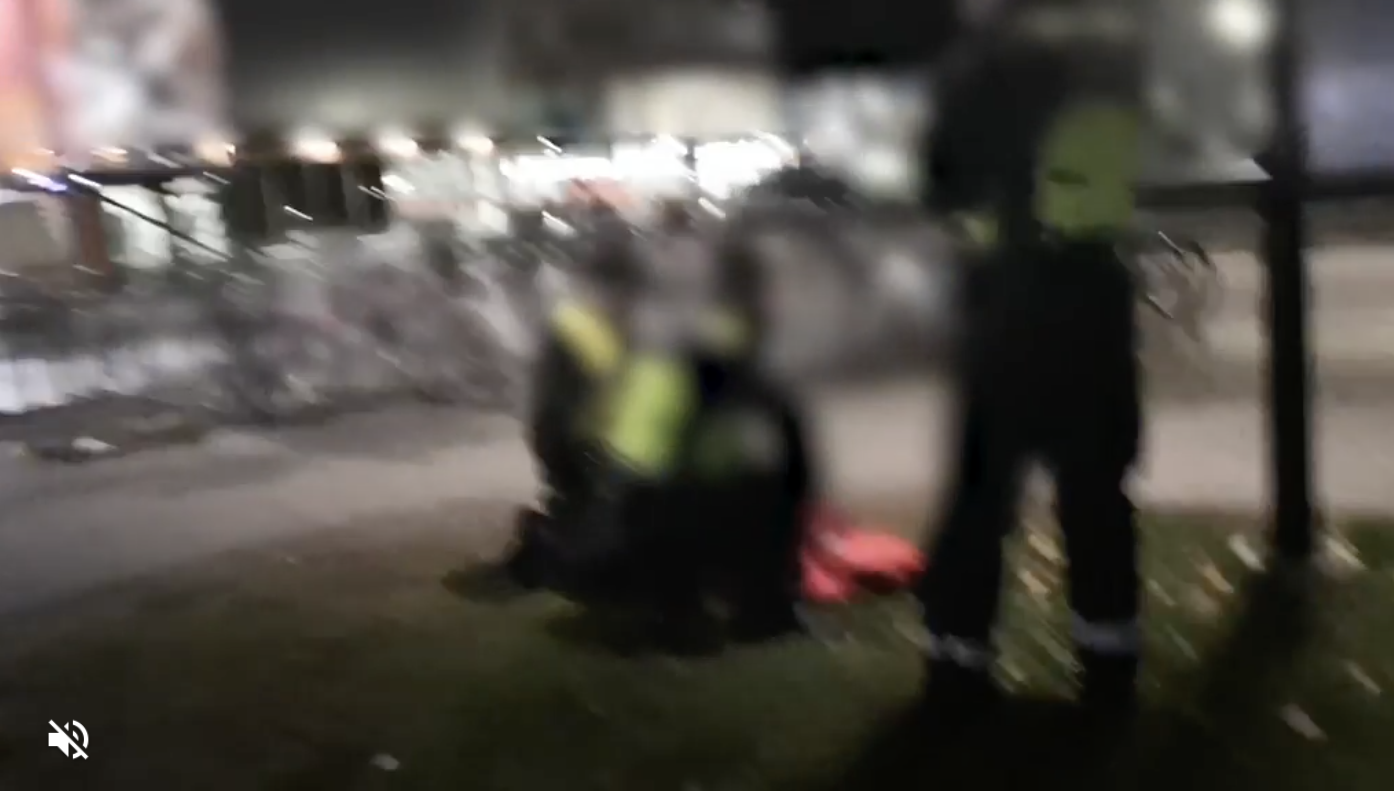
Avarn Security guards holding down a victim. Source: Helsingin Sanomat.
While the youth gang stories hyped by the media have no problem labeling “persons of foreign background” as a source of the “problem,” there is no mention of ethnic profiling as a factor. Surprisingly, non of the 77 stories mention ethnic profiling at all.
Helsingin Sanomat asked in a story what the security guards’ motives were in using excessive violence and humiliating their victims. Another story by the daily alleged that excessive force is used against socially venerable and disadvantaged people.
What do they mean? The homeless? Drunks? Old people? People of color? Other minorities?
The Republicans exposed the clown show in choosing, after six failed attempts, the speaker of the house. It is a mirror image of the Perussuomalaiset (PS)* parliamentary group. All there is personal political greed, simplistic 1+1=2 (non)solutions, and utter incompetence.
Today, Yle published its latest monthly opinion poll, which showed the PS overtaking the Social Democrats to become the second-most popular party after the National Coalition Party (Kokoomus).
Disgraced former National Coalition Party (Kokoomus) MP Wille Rydman announced that he’d join the Perussuomalaiset (PS)*. After announcing Monday that he’d leave Kokoomus, the latest announcement did not come as a surprise considering Rydman’s anti-immigration stance.
But some questions remain. In Kokoomus, he had built a reputation for being the Jussi Halla-aho of the party. Halla-aho was convicted in 2012 for ethnic agitation and breaching the sanctity of religion. The far-right politician is responsible for steering the PS on its radical right path.
The next day he announced that he’d join the PS. A campaign poster for the 2011 parliamentary election, where Rydman claims, among other matters, that Finland should only accept the number of migrants it can adapt. In the ad, Mukhtar Abid, a social worker, states, ” This is why I, a Helsinki Social Democrat, will vote for Kokoomus’ Wille Rydman.” I sent Abib a message to ask him what he thought about the scandal and if Rydman was the right person to back in 2011. He has not responded to my message. Source: Migrant Tales
Will Rydman feel at home with so many Islamophobes? He will no longer be the Halla-aho of his party but will be part of a nasty mass of Islamophobes PS MPs.
Another important question: Does the scandal, which led to him being indefinitely ousted from Kokoomus’ parliamentary group in June, means the end of Rydman’s political career?
A Helsingin Sanomat investigative story exposed in the summer MP Rydman’s sexual harassment of underage girls to whom he sometimes offered alcohol.
“That’s the central issue, people who want to be here need to accept our core values: democracy, equality, human rights and all of that. If they don’t, they can’t stay in Finland.”
During the many years I have written about President Sauli Niinistö, he has always disappointed me. For me, he represents a Finland where time will steamroll over it. If you read many of his comments throughout the years, one matter stands out like a sore thumb: He does not like anti-racism activists, Muslims, and minorities like people of color.
Instead of uniting all the people in this country from diverse cultural and ethnic backgrounds, his populism gets the better of him.
There are many examples, like when he addressed parliament in 2020. Without mentioning radical-right parties like the Perussuomalaiset (PS)*, he warned about the rise of “anti-Semitism and racism.” There is nothing wrong with that, but what was odd was he did not mention a word about Muslims and Islamophobia.
Cartoonist Ville Ranta’s view of President Sauli Niinistö’s two-extremes argument.
Islam is Finland’s second-biggest religion, with 120,000-130,000 followers.
A good example that he does not respect cultural diversity is the following statement he made in 2018, which is the worst of the worst.
He said: “I read in a newspaper about an Iraqi who had lived a long time in Finland, and he said that this [his culture] isn’t any problem. When I leave home for work, go to the store, or anywhere, I behave like a Finn. In this society, [I] follow the rules of the [cultural] game. But when I come home, I have Iraqi culture – truly impressive. And together with acquaintances can practice [my culture] very well, but the starting point is that Finland’s values are respected, democracy, gender equality.”
The surprising matter about the Avarn Security scandal, when (in)security guards used excessive force and humiliated their victims, was that it wasn’t a surprise. Poor selection criteria, lack of proper psychological training, little to no internal and external regulation, and near-blind trust would eventually lead us to the present scandal.
The positive side of the scandal is that the police service and media can make a difference by bringing to light such abuses.
Migrant Tales has written several cases involving the questionable professional treatment of security guards. Remember in June 2020, when two security guards aggressively escorted a black East African nursing student out of a train? One of them held her arm, and the other had her in a chokehold.
What about Moustafa Tito Sliem, who alleges that he was assaulted by five security guards in Helsinki’s Itäkeskus? Another case reported by the Helsinki Times of a black father and his son being treated dehumanizing after returning from a basketball game in Tampere.
Another case in 2020 that received a lot of coverage by the media. Two friends, one black and white youth passed the security guards at the Helsinki Railway metro station who were checking tickets. The security guard didn’t stop the white youth, but the black one was.
Writes Dr. Faith Mkwesha, the mother of the black youth, posted on Facebook:
I asked Dr. Mkwesha what thoughts she had when she heard about the Avarn Security scandal. The same company had detained her child.
“When I saw this thing in the newspapers About Avarn Security, it triggered my trauma due to what happened to my son in Helsinki,” she said. “For me, the pain [of that incident] came back.”
Dr. Mkwesha said that if the conversation she had with Avarn Security had helped the company mitigate the use of excessive force, the current scandal would not have happened. Moreover, my son would have never suffered what he did at the Helsinki metro Railway Station.
Instead of improving their ways, all efforts were made to cover up what happened, according to her.
“The police investigation ended quickly in a hush-hush style by stating that there was no [racism and ethnic profiling] case,” she continued. “And then it was my son’s fault, a seventeen-year-old boy still suffering from traumas due to what happened.”
The scandal that has rocked and come to public light about Avarn Security gets more incriminating by the day, revealing a culture of downplaying and coverup. Avarn Security Managing Director Niclas Sacklén’s initial reaction to Helsingin Sanomat was disbelief.
According to the daily, Sacklén considered the allegations “unbelievable.” Moreover, he initially would not confirm if the company, which has an annual turnover of 100 million euros, terminated the employment of the suspected security guards.
Sacklén has denied in repeated interviews with Helsingin Sanomat that the company as zero tolerance for violence by security guards. Now he admits that the company has failed in this task.
Sacklén’s assurances are nothing more than a coverup. A security company that does not provide security but terrorizes people is highly problematic. The problem reveals a wider problem in Finnish society, which lacks the will to regulate itself. Sacklén should resign from his job.
Avarn Security Managing Director Niclas Sacklén’s said upon seeing the video was “truly terribly,” according to Helsingin Sanomat, which has uncovered several cases of assault like the one above. The video is of another incident that does not involve the suspects held in custody by the police. What is worrying and suggests that the violence by Avarn Security guards is more widespread and a bigger problem than Sacklén admits. Continue reading “Avarn Security Managing Director Niclas Sacklén should step down”
Helsingin Sanomat has closely followed the story about six Avarn Security guards suspected of assault. In the latest stories, the daily reports that four security guards have now been remanded into custody. It also raises three unanswered questions about the scandal.
Mikko Minkkinen, crime commissioner of the Eastern Uusimaa Police Department, said in a statement Wednesday: “In the suspected offenses, the security guards transported the victims they encountered during their work to a more sheltered location near the train stations, after which they assaulted the victims and filmed the acts.”
Helsingin Sanomatraises three important questions about the scandal.
Source: Avast Security
One of the questions is motive. The second is if Avarn Security has done enough to prevent such a thing. Finally, an essential yet obvious question is if security guards are under enough scrutiny. Here is question number four: How many security guards have been sentenced for using excessive force?
Hopefully, this case will not end up like so many involving the police and other public services that abuse their power.