The cartoon was originally posted on May 26, 2012.
Ever since he 2011 parliamentary elections, when the Perussuomalaiset (PS)* party won 39 seats from 5 seats previously, we have never trusted this party even though the Finnish media gave it the benefit of the doubt.
Not only did the Finnish media give the PS the benefit of the doubt, but too many were fascinated by its racism and Timo Soini’s populism.
After three parliamentary elections, it is now clearer than ever before that the PS is not only an Islamophobic and populist party but far-right as well.
Migrant Tales was right to suspect and be critical of this party: The PS is not only a threat to our growing culturally diverse communities but to the whole country. Supporting such a party is like shooting our democracy and values in the head.
* The Perussuomalaiset (PS) party imploded on June 13, 2017, into two factions, the PS and New Alternative, which is now called Blue Reform. In the last parliamentary election, Blue Reform has wiped off the Finnish political map when they saw their numbers in parliament plummet from 18 MPs to none. A direct translation of Perussuomalaiset in English would be something like “basic” or “fundamental Finn.” Official translations of the Finnish name of the party, such as Finns Party or True Finns, promote in our opinion nativist nationalism and racism. We, therefore, at Migrant Tales prefer to use in our postings the Finnish name of the party once and after that the acronym PS.
Only MP Ozan Yanar, Jani Toivola and for about two years Nasima Razmyar, or 1.5% of all 200 MPs during the 2015-2019 term, were the only visible minorities in parliament. In the present 2019-2021 term, matters aren’t much better: Bella Forsgrén and Hussein al-Taee, who is on sick leave, are the only MPs who are visible minorities.
While there are many reasons why former Prime Minister Juha Sipilä’s government was one of the most hostile towards visible migrants, especially Muslim asylum seekers, the Islamophobic Perussuomalaiset (PS)* played a crucial role in the government’s tightening of immigration policy and bolstering Finland’s hostile environment.
A group picture of Finland’s MPs taken in 2017. Can you spot a minority? Source: Eduskunta.
With the last parliamentary election in April, new hope arose when the Social Democrats, Green League, Center Party, Left Alliance, and Swedish People’s Party formed a new government.
Even if there is hope that this government will be less xenophobic than the previous one, all of the ministers in Prime Minister Rinne’s government are white. One positive matter, however, is that 11 of the 19 ministers are women.
Can you spot a minister that isn’t white in Prime Minister Antti Rinne’s government? Source: Yle.
So what do these two pictures tell us?
They clearly state that there is too little if no minority representation in parliament as MPs and in the government as ministers.
Am I hopeful that matters will change for the better during Prime Minister Rinne’s government?
Experience has taught me to see deeds first and then offer an opinion later.
* The Perussuomalaiset (PS) party imploded on June 13, 2017, into two factions, the PS and New Alternative, which is now called Blue Reform. In the last parliamentary election, Blue Reform has wiped off the Finnish political map when they saw their numbers in parliament plummet from 18 MPs to none. A direct translation of Perussuomalaiset in English would be something like “basic” or “fundamental Finn.” Official translations of the Finnish name of the party, such as Finns Party or True Finns, promote in our opinion nativist nationalism and racism. We, therefore, at Migrant Tales prefer to use in our postings the Finnish name of the party once and after that the acronym PS.
After Helsingin Sanomat Monday published a story where oddly termed four progressive US congresswomen of color as “people of migrant origin,” state broadcaster Yle used the same term on Monday for Alexandria Ocasio-Cortez, Rashida Tlaib, Ayanna Pressley, and Ilhan Omar.
Even if Finland’s largest daily corrected the story, the old headline was still found in some tweets from Helsingin Sanomat.
Not only have members of “the Squad” revealed Trump’s racism towards people of color, but they helped expose it here in Finland and how our leading media talks about people who are not white.
Here is a simple definition for the media: If you are a USAmerican or Finnish citizen, you are a USAmrican and Finn. Considering the racism that exists in our societies, it is too much for some to stomach this fact.
This means that representatives Ocasio-Cortez, Tlaib, Pressley, and Omar are USAmericans who call themselves people of color. Disagree? Tell me a single person from the United States who isn’t of migrant origin.
The use of the term by some Finnish journalists shows how far off Finland still is from being an inclusive culturally and ethnically diverse society.
What do you think a congresswoman of the Squad would react if a Finnish journalist would refer to any of them in an interview as “people of migrant background?”
I suspect there would first be a smile and then irritation.
“Is that what you call people of color in Finland,” they may ask.
Monday’s story in Helsingin Sanomat. On the left is the first take and on the right the corrected version.
*White Finnish media story of the day highlights how the national media racializes Finland’s ever-growing culturally and ethnically diverse society by maintaining antiquated, even racist and exclusive views about who has the right to belong and call this country their home.
It is not the first time when Migrant Tales has spotted mistakes by the Finnish media. The latest one involves a story concerning US President Donald Trump’s racist tweets against four minority congresswomen: Alexandria Ocasio-Cortez, Rashida Tlaib, Ayanna Pressley, and Ilhan Omar.
The original story, which referred to the four congresswomen as “people of migrant origin,” revealed how Finland’s largest daily labels and racializes non-white people.
Now you see the term “people of migrant origin” on the right and on the left, it is gone. Source: Helsingin Sanomat.
About seven hours after the story was published, Helsingin Sanomat corrected the story.
Correction by Helsingin Sanomat.
Even if Helsingin Sanomat corrected the headline and the story by taking away the term that referred to the congresswomen as “people of migrant origin,” it is a prime example of how the Finnish media, which is about 99% white, excludes and labels non-white people.
The term “people of migrant origin” or “people of foreign origin” are code or racial buzzwords for a person who is non-white and born outside of the EU. Never or rarely would a white EU citizen or USAmericans be labeled by the media as “person of migrant origin.”
*White Finnish media story of the day highlights how the national media racializes Finland’s ever-growing culturally and ethnically diverse society by maintaining antiquated, even racist and exclusive views about who has the right to belong and call this country their home.
A headline in a Helsingin Sanomat news story about US President Donald Trump’s racist tweets to “the Squad,” four progressive women elected to congress in 2018, highlights how the media racializes non-white people in Finland.
While the story uses the Finnish News Agency (STT) and AFP as sources, the copy editors at Helsingin Sanomat could do a much better job instead of labeling people of color as people of migrant origin.
Helsingin Sanomat calls the four congresswomen, Alexandria Ocasio-Cortez, Rashida Tlaib, Ayanna Pressley, and Ilhan Omar, “people of migrant origin” when, in fact, they should be called people of color or minorities.
In my opinion, people of migrant origin is a convenient term to deny people of color and other minorities the right to be equal members of society. How can one be equal if you are constantly reminded with problematic labels that you are outsiders and eternal migrants?
I wonder how the four US congresswomen would react in an interview if a white Finnish journalist called them “people of migrant origin.”
They would, I suspect, be surprised. It would prompt a swift reaction: Who isn’t a person of migrant origin in the United States, they’d ask.
Even if some ethnonationalist groups in Finland like to romanticize that they were chipping stones right after the Ice Age, every white Finn, every single one, in this country is “a person of migrant origin.”
Helsingin Sanomat calls congresswomen Alexandria Ocasio-Cortez, Rashida Tlaib, Ayanna Pressley, and Ilhan Omar “people of migrant origin.” Give me a break! Read the original story here.
That label used by Finland’s largest newspaper is not only offensive but shows Helsingin Sanomat’s ignorance and prejudice towards people of color. It reveals how racialized the media is when it speaks of non-white people in Finland.
Instead of seeing Finland through racialized lenses, the media should show leadership in promoting inclusion and public spaces to people of color instead of constantly reinforcing their exclusion with labels made up by them.
Does the Finnish language have a translation for the term people of color? If it doesn’t like integration (kotoutuminen) about twenty years ago, it should find one.
In the late-1990s and apart from the term integroituminen, Finland had to invent a new term for integration because there was no appropriate word in the Finnish language.
*White Finnish media story of the day highlights how the national media racializes Finland’s ever-growing culturally and ethnically diverse society by maintaining antiquated, even racist and exclusive views about who has the right to belong and call this country their home.
Finland’s hostile environment against migrants and minorities is relentless, unforgiving, even exceptionally vicious. Matters are in such a dire state in Finland that even the new government fears upsetting racists who hate asylum seekers, especially Muslims, migrants, and minorities.
The best example of the latter is the cases of eleven, yes eleven, Finnish women who are stuck at the al-Hol refugee camp in Syria with their children, which total 33, according to Yle. Other sources state that there are eight women and 25 children.
Apart from giving the cold shoulder to these women, their biggest crime was alegedly joining a terrorist group but abandoning their white Finnish culture for the Muslim faith.
Finland is a country that creates storms in teacups with the hostile environment spoon. Source: Westword.
By not assisting these women and their children, who are Finns, to return to Finland is setting a dangerous precedent: We can bypass the constitution and unilaterally strip a person of his or her citizenship rights, which are supposed to be inalienable.
ted If these women are suspected of committing crimes when they were with Isis, they should be brought before a court of law and tried. Instead of allowing our worst lynch-mob reaction to getting the best of us, maintaining the rule of law is vital: People are innocent before proven guilty.
Apart from the eleven Finnish women in Syria, another case involving eight suspects that were handed prison terms is another example of racist mob bullying in Finland.
Even if one sexual assault is one too many, our reaction should reinforce the rule of law and not a hysteric knee-jerk reaction that labels a whole community. The politicians, media and police should understand this but apparently don’t grasp the consequences of their questionable actions.
The coverage of the Oulu sexual assault cases by the media and police are a case in point.
One of the biggest lessons that these groups should learn is that they have a lot of power and what they say and do have serious consequences on a whole community like Muslims and people of color.
Here is a good example of how these three groups shoot an ant with a bazooka. In my opinion, media coverage of Muslims reveals that the Finnish media is Islamophobic.
Concerning the Oulu sexual assault cases, Migrant Talesreported that from November 27 to February 13, only the state-owned broadcaster Yle published77 stories on the topic. On January 14 alone, Yle published 13 stories about the issue.
When compared with a similar sexual abuse case of minors involving white Finns, there was a different reaction. The story about the pedophile ring accused of sexually abusing 6-15-year-old boys lasted only a week in the news with seven stories published by Yle.
Last but not least, is Center Party MP Mikko Kärnä who shows us another example of how storms are created in teacups with the help and encouragement of the hostile environment. He was quoted as saying in Uusi Suomi that the Center Party should ditch the government if its migration policy is “reckless.”
Kärnä was referring to the government’s plans to accept 13 of the 53 asylum seekers on the Sea Watchwomanned by Carola Rackete.
Apart from showing how the hostile environment works in Finland, what else does it reveal? Deep-seated institutional racism, bigotry, power, privilege, and impunity.
Media studies that look into social ills like Islamophobia and racism in general in Britain offer us a view of how matters could be in Finland. With little scrutiny of institutional racism in the Finnish police, similar studies of the mainstream media still appear light-years away.
A study published by The Muslim Council of Britain revealed that 59% of all coverage of Muslims in the British media “has a negative theme.” Another study by the University of Leeds of The Mail, The Sun, The Guardian, and The Independent, showed that 70% of the stories were hostile to Muslims.
Sexual assault is one common theme found in the Finnish media is about “asylum seekers,” which is code for Muslim.
With respect to the Oulu sexual assault cases in which former and present “asylum seekers” were implicated, Migrant Talesreported that from November 27 to February 13, only the state-owned broadcaster Yle published77 stories on the topic. On January 14 alone, Yle published 13 stories about the topic.
When compared with a similar sexual abuse case of minors involving white Finns, there was a different reaction. The story about the pedophile ring accused of sexually abusing 6-15-year-old boys lasted only a week in the news with 7 stories published by Yle.
Which dailies in Finland would have the most negative coverage of Muslims? Yle? Iltalehti? Ilta-Sanomat? Uusi Suomi? Kaleva? Helsingin Sanomat? Others?
Why don’t we know the answer to that question and what does it reveal about denial?
A documentary about Islamophobia in the UK published by Redfish offers us some answers about how the mainstream media portrays Muslims and migrants in Finland.
Roshan Muhammed Salih is a journalist of UK-based 5 Pillars after he left mainstream journalism.
Salih states:
“The mainstream media is institutionally Islamophobic in my point of view. We have had inquires into the police that are institutionally racist, but we haven’t had the same scrutiny of the media. The Sadiq (?) University says that 94% of British journalists are white. There are three million Muslims in the country and that equates to 5% of the total population, but it is something like 0.3-0.4% are journalists.
So you can see how woefully Muslims are underrepresented in the mainstream media and the Muslim journalists that are in the mainstream media don’t tend to kind of reflect their community. Their answer to underrepresentation is tokenism. It’s not the dressing that is the root issue how do we tell the story of minorities communities, but let’s get some brown or black faces who say exactly the same thing as the white faces.”
As Salih of 5 Pillars pointed out, Muslims account for 5% of
Britain’s population but only 0.3-0.4% are journalists. What would the
corresponding figure be for Finland? Zero?
Finland’s Muslim population is estimated at 100,000 people, accounting for 1.8% of the total population.
With the rise of Islamophobia in Europe, one culprit culprit is the media. In the United Kingdom, 59% of coverage of Muslims had a negative theme, according to The Guardian, which cites The Muslim Council of Britain. If a national media has an appetite for biased news reporting of Muslims, it gives politicians and hate groups a lot of space and power.
Writes The Guardian: “The study [by the Muslim Council of Britain] found the Mail on Sunday had the most negative coverage of Islam, with 78% of its stories featuring Muslims having negative themes – above an already-high industry average of 59%.”
If one did a similar study in Finland, would it show the same results as in Britain? Taking into account the rise of Islamophobia in Finland through parties like the Perussuomalaiset (PS)*, one would think that such a study would be necessary in understanding the rise of far-right populism.
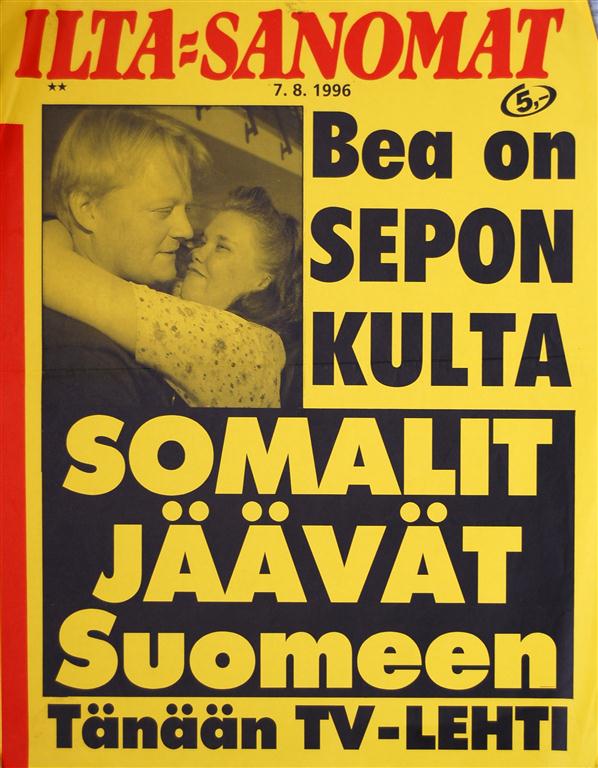
This billboard from 1996 tells its readers of the big news: The Somalis are going to make Finland their home. Some of the most racist examples of Finnish journalism are from tabloids. This does not, however, absolve the mainstream media which has succumbed to the same type of racism in its reporting. Source: Ilta-Sanomat.
Which dailies in Finland would have the most negative coverage of Muslims? Yle? Iltalehti? Ilta-Sanomat? Uusi Suomi? Kaleva? Helsingin Sanomat? Others?
Quality journalism aims to be fair and understands, or should understand, that you do not need to kill an ant with a bazooka.
With respect to the Oulu sexual assault cases in which Muslims were implicated, Migrant Tales reported that from November 27 to February 13, only the state-owned broadcaster Yle published77 stories on the topic. On January 14 alone, Yle published 13 stories about the topic.
When compared with a similar sexual abuse case of minors involving white Finns, there was a different reaction. The story about the pedophile ring accused of sexually abusing 6-15-year-old boys lasted only a week in the news with 7 stories published by Yle.
One of the matters that becomes evident in stories is the code used to talk about Muslims. While the term Muslim isn’t that readily mentioned, stories talk about “asylum seekers” or “people of foreign origin” to mean the former.
* The Perussuomalaiset (PS) party imploded on June 13, 2017, into
two factions, the PS and New Alternative, which is now called Blue
Reform. In the last parliamentary election, Blue Reform has wiped off
the Finnish political map when they saw their numbers in parliament
plummet from 18 MPs to none. A direct translation of Perussuomalaiset in
English would be something like “basic” or “fundamental Finn.” Official
translations of the Finnish name of the party, such as Finns Party or
True Finns, promote in our opinion nativist nationalism and racism. We,
therefore, at Migrant Tales prefer to use in our postings the Finnish
name of the party once and after that the acronym PS.