Migrant tales
Menu
  • #MakeRacismHistory “In Your Eyes”
  • About Migrant Tales
  • It’s all about Human Rights
  • Literary
  • Migrant Tales Media Monitoring
  • NoHateFinland.org
  • Tales from Europe
Menu

Category: ENAR

European Network Against Racism: Denmark is the “happiest” country in the world

Posted on August 31, 2022 by Migrant Tales

The European Network Against Racism (ENAR) is Europe’s biggest anti-racism NGO.

It writes:

“Denmark is said to be the ‘happiest’ country in the world.

It depends on who you ask. With the elections approaching, religious freedom for minorities seems once again to be at the heart of political debates as Denmark considers whether to ban headscarves in schools.

As a reminder of the long history of discriminatory laws against Muslim women in Europe, here is a chronological summary of all the laws banning headscarves in schools in Europe since 2004, when France got the ball rolling.” 


Continue reading “European Network Against Racism: Denmark is the “happiest” country in the world”

Ethnic profiling in the EU is illegal and discriminatory

Posted on December 7, 2016 by Migrant Tales

Please share: 

#EthnicProfiling is unfair & discriminatory. @EU_Justice we need EU standards on #FairPolicing #SingledOut 

When police use ethnicity as a basis for a stop & search it is #discrimination. EU member states must stop #EthnicProfiling #SingledOut 

#EthnicProfiling can damage trust & alienate local communities. EU must develop standards on #FairPolicing @EU_Justice #SingledOut 

39% of Roma surveyed in Greece said they felt that they were stopped by police because of their ethnicity #EthnicProfiling #SingledOut 

Continue reading “Ethnic profiling in the EU is illegal and discriminatory”

Launch of ENAR’s 2014-15 Shadow Report on Afrophobia in the European Union

Posted on March 20, 2016 by Migrant Tales

This fact sheet for Finland based on ENAR’s Shadow Report questionnaire 2014/2015 was answered by Enrique Tessieri from Migrant Tales.

Na?ytto?kuva 2016-3-20 kello 0.13.47

Go to original link here.

European Network Against Racism: Muslims in Europe – Questions and Answers

Posted on February 21, 2015 by Migrant Tales

European Network Against Racism (ENAR)*

As anti-Muslim manifestations increase in Europe, particularly in the aftermath of the Paris and Copenhagen attacks, we clarify some misconceptions and answer some of the most frequent questions about Muslims in Europe.

Näyttökuva 2015-2-21 kello 9.55.11

Visit original posting here.


Q: Who are Muslim Europeans?

Muslims have been present in Europe since the 7th century. Diplomacy and trade exchanges have always existed between the Muslim world and Europe. After World War II, a large immigrant labour force coming primarily from Mediterranean countries with majority Muslim populations were recruited to support rebuilding efforts in Europe. Nowadays, Muslim communities are as diverse as European countries are. Different ethnic and cultural origins, nationalities, political views, social classes mean that there is no such thing as one ‘Muslim community’. While in Europe, Islam is often associated with Arabs, the latter make up only 15% of the world’s Muslim population. Muslims refer to different understandings and lectures of the Islamic literature and to a great variety of theological, juridical and spiritual schools, obedience and traditions. Muslims are spread across the spectrum of potential religious practice: from total non-practice to intensive practice – the level of practice evolving also during a life time. Levels of practice differ also according to the religious practice: whereas estimates consider that only 10% of Muslims are engaging in regular prayers, more than 70% tend to respect fasting during the month of Ramadan.

Q: How many Muslims are there in Europe?

Most EU countries do not collect data disaggregated by religion in censuses, so it is impossible to know exactly how many Muslims live in Europe. However, research based on proxies has estimated that around 19 million Muslims live in Europe, which represents 6% of the total European population. Populist and far-right parties tend to increase this number to support the argument of an “islamisation of Europe”. Recent public opinion surveys have shown that the number of European Muslims is often overestimated. A 2014 survey found that French respondents thought that 31% of their compatriots were Muslim, while actual figures show that only 8% of French residents are Muslims – including non-practising Muslims. UK respondents thought there were 21% Muslims in Britain, when they constitute only 5 % of the British population.

Q: Are all Muslims violent, terrorist extremists?

While there is no single interpretation of Islam, renowned Islamic authorities across the world have repeatedly affirmed that terrorism cannot be justified by the teachings of their religion, which aims to promote justice and peace. Muslim leaders and scholars often speak out against terrorism and seek to counter misinterpreted or twisted teachings based on a theology of violence and death that fringe groups use to justify their violent actions. Most Muslims feel as threatened as anyone else by these violent extremists who say they act in the name of Islam. Muslims have been the target of terrorist attacks too, and are in no way protected because of their religion. To date, worldwide, Muslims suffer the highest death toll due to jihadist terror groups. Some of the victims of the Paris attacks were Muslims.

Q: If all Muslims are not terrorists, are all terrorists Muslims?

A survey conducted by the Center for Research and Globalization found that the terrorists acts perpetrated by Muslim extremists constitute only 2.5% of all terrorist attacks on U.S. soil between 1970 and 2012. In 2013, 152 terrorist attacks occurred in Europe with only one attack being religiously motivated while 84 were motivated by ethno-nationalist or separatist beliefs. The massive media coverage of Muslims extremists’ acts contributes to feeding the myth that all terrorist acts are perpetrated by Muslims. Far-right movements are also a form of extremism present in Europe, which poses a similar threat to society and peaceful coexistence.

Q: Do Muslims agree with the Paris and Copenhagen terror attacks?

Some Muslims have felt offended by some of Charlie Hebdo’s cartoons. But this in no way means that they support the deadly attacks. Most Muslim organisations publically condemned these murders, recalling that words should be countered with words, and that Islam shouldn’t be used as a way to justify terror attacks. Many of these organisations were present on 11th January to peacefully march in Paris and other French and European capitals. A number of European Muslim intellectuals have also insisted on the importance of freedom of expression.

Q: Are European Muslims increasingly anti-Semites?

Anti-Semitism is not new in Europe and is still very much present across European society. Muslims are not immune to anti-Semitism. Some Muslims are influenced by theological discourses rooted in anti-Semitism, far-right ideologues, negationists and those spreading confusion between Israel and Jews in general. However, a recent Pew Research Center study shows that negative opinions on Jews are growing in Europe, reaching 25 % of unfavourable opinion in Germany, where only 6 % of the population is Muslim. In Spain, where less than 3 % of the population is Muslim, close to 50 % of the population hold negative opinions about Jews. In France, research and surveys have showed that an ‘old’ type of far-right anti-Semitism is still dominant and goes hand in hand with other forms of prejudice, including Islamophobia. Affirmations that Muslims are the only source of anti-Semitism in Europe are based on an attempt to pit Jews and Muslims against each other, divide society and spread both Islamophobia and anti-Semitism.

Q: What are the consequences of the Paris attacks on Muslim communities?

Muslims have been publicly called to condemn the attacks, implying that Muslims intrinsically support the perpetrators of the attacks. As a consequence, some Muslims have feared retaliation. The attacks took place in a context of growing Islamophobia in Europe (47% increase in recorded Islamophobic acts in France in 2013 compared to 2012), anti-Muslim marches organised by the far-right Pegida movement, and regular attacks of mosques in Sweden. From 7 January 2015 to 7 February 2015, there were 153 Islamophobic incidents against individuals and places of worship in France, which represents a 70% increase compared to January 2014.

Q: Are young Muslims in Europe becoming more radicalised?

Discrimination and social exclusion are key factors leading young Muslims, among others, to feel excluded and humiliated in Europe and become easy targets for radicalisation. It is necessary to address social segregation and discrimination in employment to include those who no longer believe in the structures that regulate our societies: families, education and employment.

Former and current armed conflicts in the Middle East and beyond have left abandoned populations in chaos in countries that are not able to guaranty a minimum level of security. These conflicts are used in narratives and easily spread by violent extremists to justify terrorist acts. This propaganda is widely spread via social media and mostly appealing to young people’s emotions. Worrying trends show an increase of the number of European young Muslims leaving to join jihadist organisations. However, estimates show that these represent less than 0.1% of the total Muslim youth.

Q: What is Islamophobia? How can it be a form of racism as Islam is not a race?

Islamophobia is a specific form of racism that refers to acts of violence and discrimination, as well as racist speech, fuelled by historical abuses and negative stereotyping and leading to exclusion and dehumanisation of Muslims, and all those perceived as such. Islamophobia can also be the result of structural discrimination. Islamophobia is a form of racism in the sense that it is the result of the social construction of a group as a race and to which specificities and stereotypes are attributed. These characteristics are considered genetic (for instance “Islam is violent, thus Muslims and their kids are violent”). Consequently, even those who choose not to practice Islam but who are perceived as Muslim are subjected to discrimination. Islamophobia has nothing to do with criticism of Islam. Islam, as a religion, as an ideology, is subject to criticism as any other religion or ideology.

Q: Is racial profiling the solution to prevent radicalism?

Data mining and surveillances practices have not yield conclusive results on combating terrorism or radicalisation. These data collection practices can lead to discriminatory practices and prohibited processing of data revealing race, ethnic origin or religion through the use of proxies. Information such as residency status, home address, nationality, place of birth, phone calls to certain countries, time of bank operations or physical appearance (a beard, a veil, etc.) can be used to racially profile individuals. Racial profiling is a form of racial discrimination that is prohibited under international law. It is also ineffective and counter-productive in that it alienates the very communities whose support is necessary for fighting crime and terrorism. Racial profiling is not effective in terms of law enforcement. Policing depends on cooperation from the public to report crime, provide suspect descriptions and give witness testimonies. Research shows that poor police-citizen contacts and bad treatment by law enforcement officers can have a negative impact on public confidence in law enforcement and also result in reduced cooperation with the latter.

*Migrant Tales is a member of the European Network Against Racism.

ENAR: Charlie Hebdo killings in France: Time for mourning, not for scapegoating

Posted on January 8, 2015 by Migrant Tales

As a member of the European Network Against Racism (ENAR), we repost the following statement below in light of the terrible news that we heard from Paris. If you want to read good insight on the tragedy, check out Juan Cole’s Why al-Qaeda attacked satirists in Paris (thank you Gaven Titley for the heads-up).

___________________

Brussels, 7 January 2015 – Following the tragic killings at the office of the newspaper ‘Charlie Hebdo’ in Paris, France, the European Network Against Racism (ENAR) strongly condemns this attack against freedom of expression, a cornerstone of our democracy. Nothing can justify such an attack.

ENAR also warns against backlash and stigmatisation against Muslim communities in France following declarations about the alleged identity of the perpetrators, especially given the current anti-Muslim climate across Europe. Recent examples include arson attacks against mosques in Sweden and France and anti-Islam demonstrations by the Pegida movement in Germany. At this point, no information is available on the perpetrators’ identity and motivations.

ENAR calls for calm, unity and solidarity to defeat hateful and terrorist violence.

For further information, contact:
Georgina Siklossy, Communication and Press Officer
Tel: +32 (0)2 229 35 70 – Mobile: +32 (0)473 49 05 31 – E-mail: [email protected] – Website: www.enar-eu.org

Notes to the editor:
1. The European Network Against Racism (ENAR aisbl) stands up against racism and discrimination and advocates for equality and solidarity for all in Europe. We connect local and national anti-racist NGOs throughout Europe and voice the concerns of ethnic and religious minorities in European and national policy debates.

ENAR*: Open letter to Mark Rutte, Prime Minister of The Netherlands , Ivo Opstelten , Ministry for Security and Justice and Fred Teeven , State Secretary for Security and Justice

Posted on December 5, 2014 by Migrant Tales
 Brussels, 24 November 2014
Dear Prime Minister, Dear Ministers,
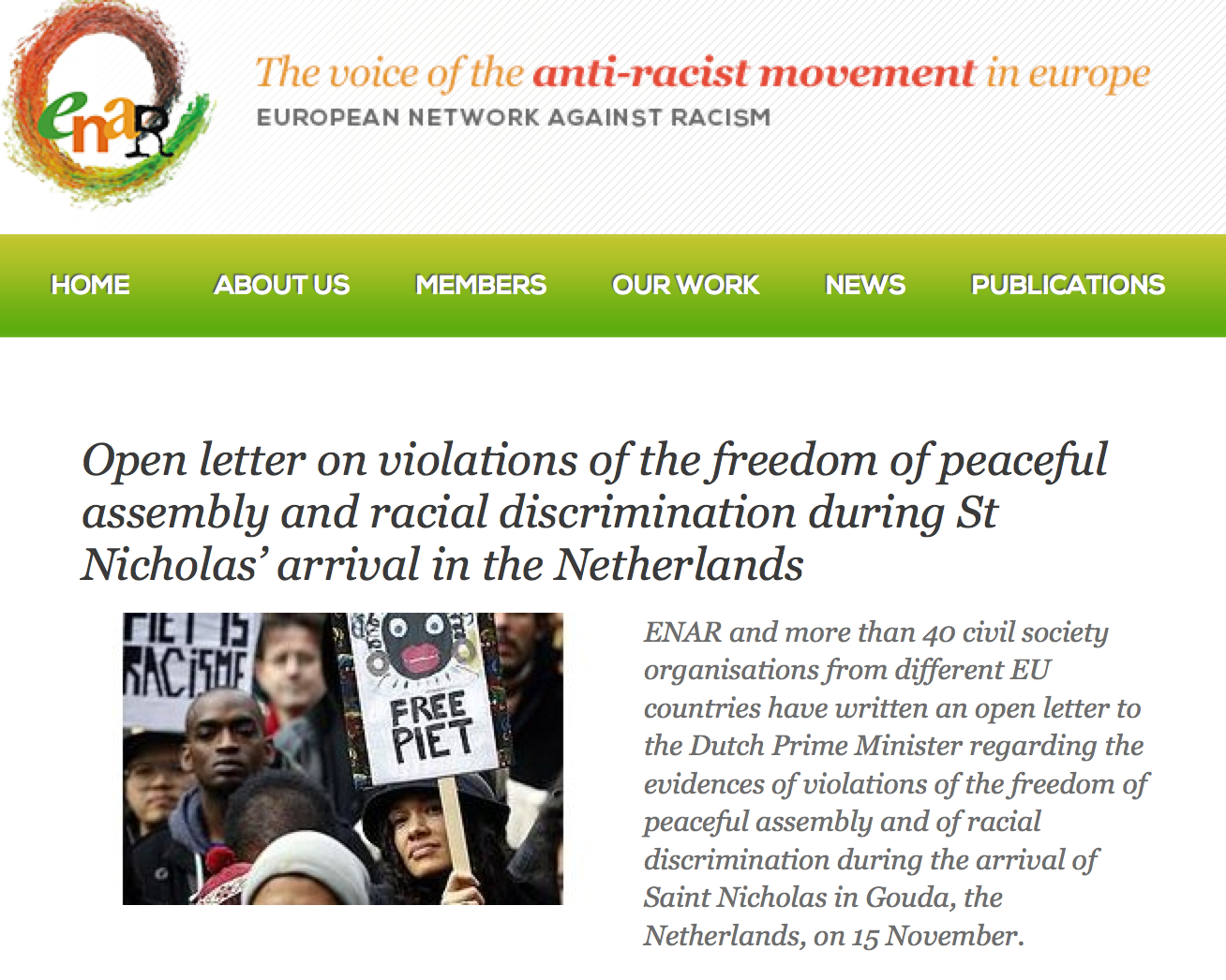
We, the undersigned, are writing to express our concern regarding the conduct of Dutch authorities and law enforcement officials on the day of the ‘arrival’ of Saint Nicholas in Gouda, the Netherlands on 15 November 2014. First hand evidences show clear violations of the freedom of peaceful assembly and reveal patterns of racial discrimination. We urge you to ensure proper independent investigation into the law – enforcement actions, ensure equal treatment of ethnic minorities, and guarantee that future peaceful assemblies will be safeguarded and protected in accordance with international law.
Näyttökuva 2014-12-5 kello 16.11.04
The European Network Against Racism, a network of over 120 NGOs working to counter racism and racial discrimination in the European Union, supports calls to abolish the racist figure of Zwarte Piet. The fully black-faced character is a legacy from The Netherlands’ colonial past and contributes to fuelling stereotypes of People of African Descent and Black Europeans. While we take note of the recent efforts to tone down the figure, we believe that the Dutch authorities have fallen short to suppressing the racist element of the tradition.
The European Network Against Racism, a network of over 120 NGOs working to counter racism and racial discrimination in the European Union, supports calls to abolish the racist figure of Zwarte Piet. The fully black – faced character is a legacy from The Netherlands’ colonial past and contributes to fuelling stereotypes of People of African Descent and Black Europeans. While we take note of the recent efforts to tone down the figure, we believe that the Dutch authorities have fallen short to suppressing the racist element of the tradition.
Blackfacing is one of the broader manifestations of Afrophobia that contributes to the dehumanization of Black people and leads their exclusion. Studies conducted by the Fundamental Rights Agency show that the 7-12 million People of African Descent and Black Europeans in Europe are particularly affected by racist violence, hate speech and discrimination.
The decision by the mayor of Gouda to forbid the anti-Zwarte Piet protest to be held in the centre, near the ‘Markt’, clearly violates international standards with respect to the freedom of peaceful assembly, as recalled in the OSCE guidelines on this fundamental freedom. This right should be enjoyed without discrimination. As a rule protests must be organized within “sight and sound” of their target audience. The alternative locations proposed by the mayor were not suitable for the protesters to actually convey their message to the persons they wanted to target, in this case the audience of the festivity and the media.
Likewise, the mayor restricted the freedom of assembly for not being able to ensure protesters protection against far-right groups and Zwarte Piet supporters. We believe that this purported reason is not valid. Law-enforcement authorities have the positive obligation to facilitate peaceful assemblies and “to protect its participants from any persons or groups that attempt to disrupt or inhibit them in anyway”. OSCE guidelines further read: “potential disorder arising from hostility directed against those participating in a peaceful assembly must not be used to justify the imposition of restrictions on peaceful assembly.”
In addition, police behavior on the day of the protest is a source of concern. Reports of Black people arrested before arriving on the main square, in some case without any sign of being part of the protest, raise suspicion of racial profiling – the prohibited use of racial or ethnic characteristics as a way of singling out people for identity or security checks. One protester was tackled to the ground, kicked and blindfolded, using a modus operandi similar to 2011 arrests of anti-Zwarte Piet protesters. The Dutch Ombudsman recently concluded that the later constituted excessive use of force. The arrest, after the protest, and the detention for over five hours of the rest of the peaceful protesters – about 90 persons in total among which ENAR members and a 13 year-old girl with disabilities – does not comply with standards on arrest during protest. Mass arrest should be avoided and the time of detention should be limited to a minimum. In compliance with the jurisprudence from the European Court of Human Rights, restriction of liberty is only allowed when this is strictly necessary and proportionate to the aim pursued. Arrest and detention were not proportionate means to achieve the goal of giving a fine to the protesters.
The above-described procedure and violations of standards with respect to the expression of opinions, by means of peaceful protest, reveal patterns of racial discrimination and intimidation of the activists and citizens involved in this action. This is unacceptable in a
modern democracy such as The Netherlands.
Therefore we, the undersigned, ask that:
1.  An independent investigation into the mayor’s decision is conducted in due time.
2. An independent investigation into the law-enforcement behaviors is conducted in due time.
3. All fines of peaceful protesters are dropped.
4. Future decisions on assemblies are taken with due consideration of the freedom of peaceful assembly and the principle of non-discrimination.
5. Police internal procedures include clear prohibition of racial profiling and police officers receive diversity training.
6. A debate on blackfacing in the Saint-Nicholas celebrations is held in the National Parliament.
7. Authorities take steps to forbid blackfacing in the Saint-Nicholas celebrations.
We trust that we can start a constructive dialogue in order to address the issues highlighted in this letter, and we remain available to provide any support in this process. We look forward to receiving your reply.
Sincerely yours,
1. The European Network Against Racism
2. New Urban Collective, The Netherlands
3. Initiative Schwarze Menschen in Deutschland, Germany
4. Zwarte Piet Niet, The Netherlands
5. Roet in Het Eten, the Netherlands
6. Nederland wordt beter, The Netherlands
7. Stichting Overlegorgaan Caribische Nederlanders, The Netherlands
8. Africa Centre, Ireland
9. Pan African Movement for Justice, Sweden
10. Centre Against Racism, Sweden
11. INCIDE – Inclusión, Ciudadanía, Diversidad y Educación, Spain
12. JUST West Yorkshire, UK
13. Northamptonshire Rights and Equality Council, UK
14. Radio AFRIKA TV, Austria
15. Northern Ireland Council for Ethnic Minorities, UK
16. Migrant Tales, Finland
17. Foundation for Subjective Values, Hungary
18. Muslim for progressive values, France
19. Institute for African studies, Slovenia
20. Coordination des Associations & Particuliers pour la Liberté de Conscience, France
21. Association Des Juristes Arabo-Musulmans d’Europe, France
22. Lithuanian Centre for Human Rights, Lithuania
23. Plate-forme Migrants et Citoyenneté européenne, France
24. SOS mod Racisme, Denmark
25. Fight Racism Now (FRN), Sweden
26. European Association for the Defense of Human Rights–AEPADO, Romania
27. Operation Black Vote, UK
28. Black Activists Rising Against Cuts (BARAC), UK
29. Movement Against Xenophobia, UK
30. Forum of European Muslim Youth and Student Organisations (FEMYSO)
31. European Association of Lawyers for Democracy and World Human Rights
32. African Empowerment Centre, Denmark
33. Movement X, Belgium
34. Mouvement contre le Racisme, l’Anti-semitisme et la Xénophobie (MRAX), Belgium
35. Conseil représentatif des associations noires (CRAN), France
36. Collectif Stop le Contrôle au Faciès, France
37. Les Indivisibles, France
38. Réseau des Femmes Immigrées et d’Origines Etrangères de Belgique, Belgium
39. Groupe de soutien des femmes africaines (SVAV) du Conseil des communautées africaines (RvdAGE), Belgium
40. International Institute for Scientific Research, The Netherlands
41. Justice 21, Bulgaria
*European Network Against Racism (ENAR)

European Network Against Racism first hate speech report

Posted on May 8, 2014 by Migrant Tales

In March, the European Network Against Racism (ENAR) and European Region of the International Lesbian, Gay, Bisexual, Trans & Intersex Association (ILGA-Europe) launched an Appeal for an election campaign free from discrimination and intolerance, urging European parties to condemn discriminatory or intolerant remarks during the European Parliament election campaign.
An online form was launched, enabling the public to report discriminatory or intolerant incidents during the campaign. This report compiles submissions received so far.

8 May 2014

After 6 weeks of campaigning, we received 17 valid reports of hate speech against minorities.

Reports consisted mostly of incitement to hatred, prejudice or discrimination, either implicitly (6 in 10) or explicitly (4 in 10). Incidents also included attacks on the dignity of minority groups—and notably migrants, asylum-seekers and ethnic minorities. Derogatory or insulting language was also noted in several cases (4 in 10).

A large number of reports (3 in 10) originated from the United Kingdom; however, language self-selection and the collection methodology means this may not be representative of the genuine occurrence of hate speech across the campaign in the EU.

Finally, reports have mostly come from the political margins, with most coming from candidates with no European party affiliation (6 in 10), or from European parties from the radical right (2 in 10).

We will continue monitoring incidences of hate speech in the context of the campaign, and publish further updates, including possible new reactions by political parties.

Read the full report here

  • nohateep2014_-_report.pdf (PDF – 301.3 kb)


Statement: EU elections 2014: the way towards more equality in Europe, 7 demands from ENAR

Posted on March 7, 2014 by Migrant Tales

The next European Parliament to be elected in May 2014 has a crucial role to play when it comes to reducing the entrenched inequalities faced by its citizens and residents. Among these are ethnic minorities and migrants who often face discrimination on multiple grounds: ethnic origin, nationality, social status, income, gender or age. The European Network Against Racism (ENAR) therefore puts forward 7 key demands for more equality in Europe to upcoming Members of the European Parliament. Leading Members of the European Parliament have already endorsed our demands because they are convinced that they will lead to a better and more equal Europe and are also sound, concrete and achievable.

Kuvankaappaus 2014-3-7 kello 19.25.59
Read full statement here.

Starting with the basics, we ask parties to open up their lists and decision making structures to ethnic minorities and migrants. Fighting toxic and xenophobic political discourses and policies as well as structural discrimination starts at home. Political decision makers need to be exemplary to generate constructive emulation within broader society. We need a more diverse European Parliament. As a minimum, the next European Parliament and its political groups should hire professionals from minority communities..

“If you are not counted, you don’t count”: combating discrimination begins with knowing the extent of it. Today, we only have comparable and reliable Europe-wide equality data on the grounds of sex and age. We need more. There are 6 grounds of discrimination covered by the EU treaties and 17 by the Charter of Fundamental Rights – there is thus much room for improvement in collecting and analysing data about discrimination in Europe. Ethnic and religious groups want to count and to use data to ask governments to be accountable for their actions. These 60 million Europeans deserve justice.

Racist violence has multiple effects on individual victims, but also on their families and communities. They are not targeted randomly by perpetrators, but because of who they are. The European Parliament has a crucial role to play in bringing the European Commission and Member States to support victims in seeking redress and avoiding re-victimisation. Equality at work is not just a matter of preventing discrimination from happening. It is also about ensuring the workplace caters for the needs of an increasingly diverse workforce. Accommodating diversity at work will result in developing workers’ potential, employee retention, a safe working environment and a better work-life balance. The adoption of the European framework for national Roma integration strategies demonstrated the EU’s political will to fight discrimination against its largest ethnic minority. Black Europeans, People of African Descent, Muslims and Jews need to benefit from similar strategies which will ensure their social inclusion and protection from discrimination, and therefore contribute to the overall reduction of poverty and exclusion in Europe.

Finally, we call for the continuation of the current Anti-Racism and Diversity Intergroup in the European Parliament. This will ensure MEPs committed to equality have a platform to voice and tackle challenges relating to inequality and discrimination.

Our 7 demands can contribute to a leap forward towards equality in Europe. Time for commitment has come. The future of a diverse and resilient Europe is at stake: we encourage parties and individual candidates to endorse them and mainstream them in their own programmes ahead – and after – the elections.

ENAR condemns racism against blacks in Europe

Posted on August 28, 2013 by Migrant Tales

MT comment:  The statement by the European Network Against Racism (ENAR) was published five days before the fiftieth anniversary of Martin Luther King Jr’s “I have a dream” speech, and the International Day for the Remembrance of the Slave Trade and of its Abolition. Millions of black Europeans are still victims of racism and discrimination in this part of the world. 

____________

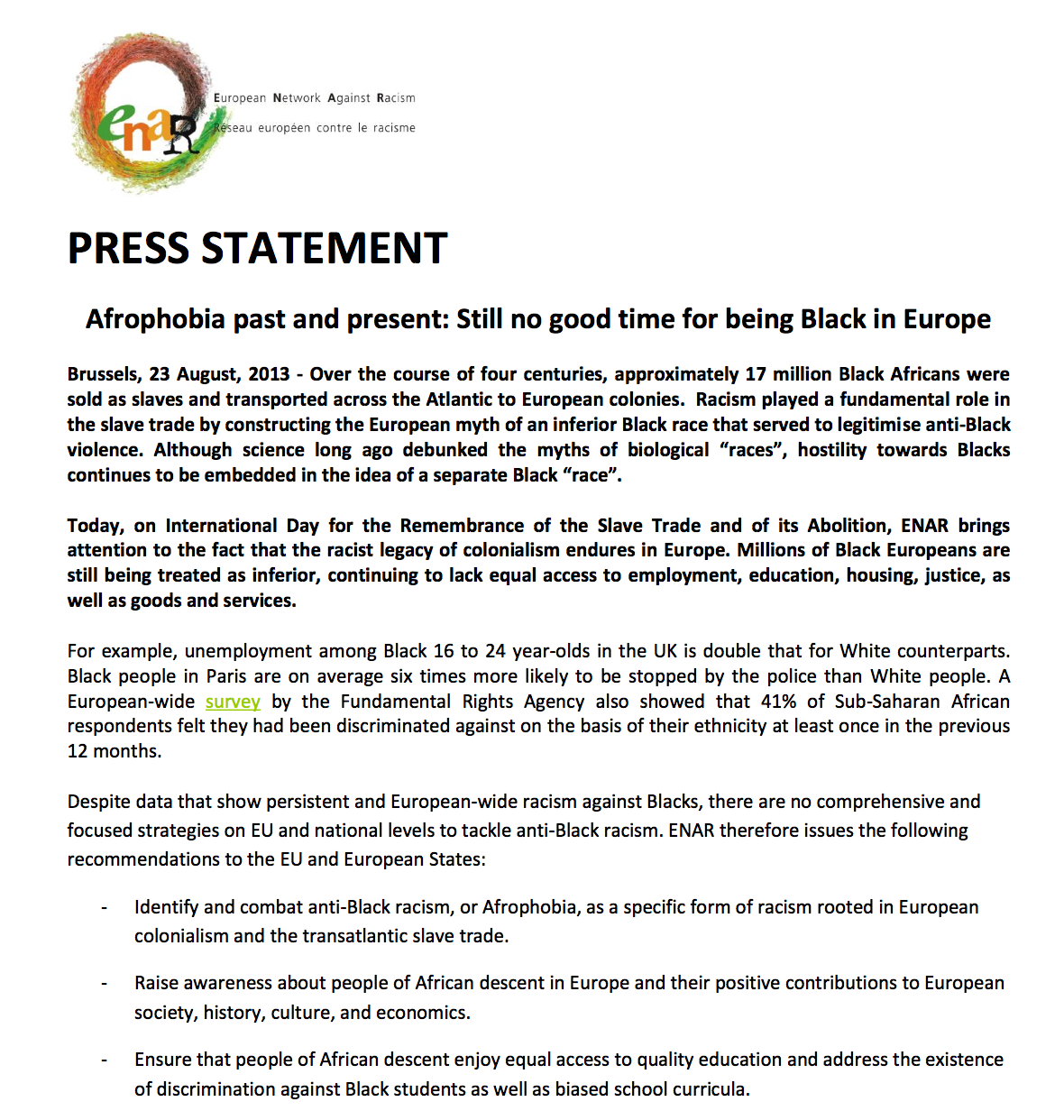
Over the course of four centuries, approximately 17 million Black Africans were sold as slaves and transported across the Atlantic to European colonies. Racism played a fundamental role in the slave trade by constructing the European myth of an inferior Black race that served to legitimise anti-Black violence. Although science long ago debunked the myths of biological “races”, hostility towards Blacks continues to be embedded in the idea of a separate Black “race”.

Kuvankaappaus 2013-8-28 kello 9.12.24


Read full statement here.

23/8/2013- Today, on International Day for the Remembrance of the Slave Trade and of its Abolition, ENAR brings attention to the fact that the racist legacy of colonialism endures in Europe. Millions of Black Europeans are still being treated as inferior, continuing to lack equal access to employment, education, housing, justice, as well as goods and services. For example, unemployment among Black 16 to 24 year-olds in the UK is double that for White counterparts. 

Black people in Paris are on average six times more likely to be stopped by the police than White people.

A European-wide survey by the Fundamental Rights Agency also showed that 41% of Sub-Saharan African respondents felt they had been discriminated against on the basis of their ethnicity at least once in the previous 12 months. Despite data that show persistent and European-wide racism against Blacks, there are no comprehensive and focused strategies on EU and national levels to tackle anti-Black racism. ENAR therefore issues the following recommendations to the EU and European States: 

– Identify and combat anti-Black racism, or Afrophobia, as a specific form of racism rooted in European colonialism and the transatlantic slave trade.
– Raise awareness about people of African descent in Europe and their positive contributions to European society, history, culture, and economics.
– Ensure that people of African descent enjoy equal access to quality education and address the existence of discrimination against Black students as well as biased school curricula.
– Promote equal justice for people of African descent and tackle disparities in police and border stop rates, sentencing, incarceration, and other inequities in justice.
– Collect and publish EU-wide racial discrimination and inclusion data to empirically document and monitor discrimination and exclusion impacting people of African descent.

ENAR Chair Sarah Isal said: “There continues to be a complacent acceptance of Afrophobia in European societies. To end discrimination against Blacks in Europe, political leaders and representatives must publicly recognise anti-Black racism both as a specific form of racism and as a pan-European problem, stemming from a shared heritage of colonial abuses. It is high time that states and civil society acknowledge that hostility towards Blacks is irrational and grounded in the myth of a distinct and inferior Black race”.

ENAR press statement: Anti-Roma statements in France: a race to be the most outrageous?

Posted on July 10, 2013 by Migrant Tales

MT comment: Taking into account the xenophobia gripping Europe these days and how far right, populist and even mainstream parties are vying for the anti-immigration vote, the same is going on in Finland. The victims are the most vulnerable groups  like Romany beggars. A story on YLE in English  reports that the National Coalition Party is planning – once again – to prohibit begging. The anti-immigration Perussuomalaiset (PS) are strongly in favor as are the Christian Democrats. 

What a shameful stance by these parties. Nothing will be resolved not matter how many anti-begging laws you pass except for exacerbating the problem. 

___________

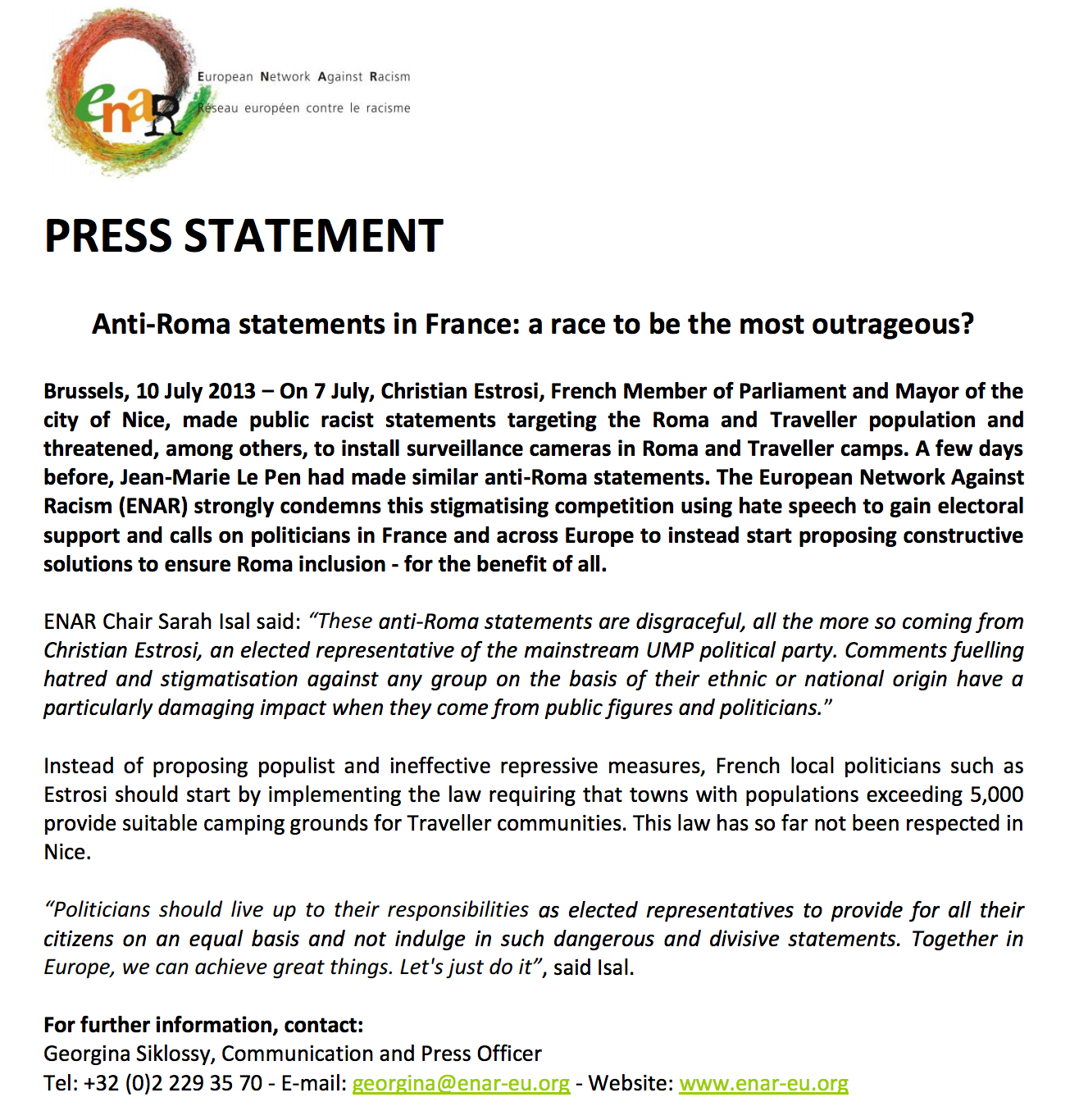
Brussels, 10 July 2013 – On 7 July, Christian Estrosi, French Member of Parliament and Mayor of the city of Nice, made public racist statements targeting the Roma and Traveller population and threatened, among others, to install surveillance cameras in Roma and Traveller camps. A few days before, Jean-Marie Le Pen had made similar anti-Roma statements. The European Network Against
Racism (ENAR) strongly condemns this stigmatising competition using hate speech to gain electoral support and calls on politicians in France and across Europe to instead start proposing constructive solutions to ensure Roma inclusion – for the benefit of all.

Kuvankaappaus 2013-7-10 kello 15.58.28

Read original statement here.

ENAR Chair Sarah Isal said: “These anti-Roma statements are disgraceful, all the more so coming from Christian Estrosi, an elected representative of the mainstream UMP political party. Comments fuelling hatred and stigmatisation against any group on the basis of their ethnic or national origin have a particularly damaging impact when they come from public figures and politicians.”

Instead of proposing populist and ineffective repressive measures, French local politicians such as Estrosi should start by implementing the law requiring that towns with populations exceeding 5,000 provide suitable camping grounds for Traveller communities. This law has so far not been respected in Nice.

“Politicians should live up to their responsibilities as elected representatives to provide for all their citizens on an equal basis and not indulge in such dangerous and divisive statements. Together in  Europe, we can achieve great things. Let’s just do it”, said Isal.

Read ENAR statement here. 

  • 1
  • 2
  • Next
Read more about documentary film
Read more

Recent Posts

  • Finland’s tabloids Iltalehti and Ilta-Sanomat are the pits
  • Riikka Purra’s Dr Jekyll and Mr Hyde mask
  • Double standards
  • Perussuomalaiset: Uusi logo, sama vanha juttu
  • Taco Trump

Recent Comments

  1. Absolutely Socking: Racist Finnish Facebook group against human rights gets flooded with socks on Musta Barbaari’s mother and sister charged by the police in “ethnic profiling” case
  2. Ilkka Nuotio on Pekka Myrskylä: “Tilastot kertovat toista kuin poliittinen keskustelu”
  3. Genrih Soinkara on The war in Ukraine and the Russian-Finnish border crisis are showing Finland’s ugly side
  4. Ahti Tolvanen on Comment by Ahti Tolvanen on the Helsinki +50 conference
  5. Angel Barrientos on Angel Barrientos is one of the kind beacons of Finland’s Chilean community

Archives

  • June 2026
  • May 2026
  • April 2026
  • March 2026
  • February 2026
  • January 2026
  • December 2025
  • November 2025
  • October 2025
  • September 2025
  • August 2025
  • July 2025
  • June 2025
  • May 2025
  • April 2025
  • March 2025
  • February 2025
  • January 2025
  • December 2024
  • November 2024
  • October 2024
  • September 2024
  • August 2024
  • July 2024
  • June 2024
  • May 2024
  • April 2024
  • March 2024
  • February 2024
  • January 2024
  • December 2023
  • November 2023
  • October 2023
  • September 2023
  • August 2023
  • July 2023
  • June 2023
  • May 2023
  • April 2023
  • March 2023
  • February 2023
  • January 2023
  • December 2022
  • November 2022
  • October 2022
  • September 2022
  • August 2022
  • July 2022
  • June 2022
  • May 2022
  • April 2022
  • March 2022
  • February 2022
  • January 2022
  • December 2021
  • November 2021
  • October 2021
  • September 2021
  • August 2021
  • July 2021
  • June 2021
  • May 2021
  • April 2021
  • March 2021
  • February 2021
  • January 2021
  • December 2020
  • November 2020
  • October 2020
  • September 2020
  • August 2020
  • July 2020
  • June 2020
  • May 2020
  • April 2020
  • March 2020
  • February 2020
  • January 2020
  • December 2019
  • November 2019
  • October 2019
  • September 2019
  • August 2019
  • July 2019
  • June 2019
  • May 2019
  • April 2019
  • March 2019
  • February 2019
  • January 2019
  • December 2018
  • November 2018
  • October 2018
  • September 2018
  • August 2018
  • July 2018
  • June 2018
  • May 2018
  • April 2018
  • March 2018
  • February 2018
  • January 2018
  • December 2017
  • November 2017
  • October 2017
  • September 2017
  • August 2017
  • July 2017
  • June 2017
  • May 2017
  • April 2017
  • March 2017
  • February 2017
  • January 2017
  • December 2016
  • November 2016
  • October 2016
  • September 2016
  • August 2016
  • July 2016
  • June 2016
  • May 2016
  • April 2016
  • March 2016
  • February 2016
  • January 2016
  • December 2015
  • November 2015
  • October 2015
  • September 2015
  • August 2015
  • July 2015
  • June 2015
  • May 2015
  • April 2015
  • March 2015
  • February 2015
  • January 2015
  • December 2014
  • November 2014
  • October 2014
  • September 2014
  • August 2014
  • July 2014
  • June 2014
  • May 2014
  • April 2014
  • March 2014
  • February 2014
  • January 2014
  • December 2013
  • November 2013
  • October 2013
  • September 2013
  • August 2013
  • July 2013
  • June 2013
  • May 2013
  • April 2013
  • March 2013
  • February 2013
  • January 2013
  • December 2012
  • November 2012
  • October 2012
  • September 2012
  • August 2012
  • July 2012
  • June 2012
  • May 2012
  • April 2012
  • March 2012
  • February 2012
  • January 2012
  • December 2011
  • November 2011
  • October 2011
  • September 2011
  • August 2011
  • July 2011
  • June 2011
  • May 2011
  • April 2011
  • March 2011
  • February 2011
  • January 2011
  • December 2010
  • November 2010
  • October 2010
  • September 2010
  • August 2010
  • July 2010
  • June 2010
  • May 2010
  • April 2010
  • March 2010
  • February 2010
  • January 2010
  • December 2009
  • November 2009
  • October 2009
  • September 2009
  • August 2009
  • July 2009
  • December 2008
  • November 2008
  • October 2008
  • September 2008
  • August 2008
  • July 2008
  • June 2008
  • May 2008
  • April 2008
  • March 2008
  • February 2008
  • January 2008
  • November 2007
  • October 2007
  • September 2007
  • August 2007
  • July 2007
  • June 2007
  • May 2007

Categories

  • ?? Gia L?c
  • ????? ?????? ????? ???????? ?? ??????
  • ???????
  • @HerraAhmed
  • @mondepasrond
  • @nohatefinland
  • @oula_silver
  • @Varathas
  • A Pakistani family
  • äärioikeisto
  • Abbas Bahmanpour
  • Abdi Muhis
  • Abdirahim Hussein Mohamed
  • Abdirahim Husu Hussein
  • Abdirisak Mahamed
  • About Migrant Tales
  • activism
  • Adam Al-Sawad
  • Adel Abidin
  • Afrofinland
  • Ahmed IJ
  • Ahti Tolvanen
  • Aino Pennanen
  • Aisha Maniar
  • Alan Ali
  • Alan Anstead
  • Alejandro Díaz Ortiz
  • Alekey Bulavsev
  • Aleksander Hemon
  • Aleksanterinliitto
  • Aleksanterinliitto ry
  • Aleksanterinliitto ry:n hallitus
  • Alex Alex
  • Alex Mckie
  • Alexander Nix
  • Alexandra Ayse Albayrak
  • Alexis Neuberg
  • Ali Asaad Hasan Alzuhairi
  • Ali Hossein Mir Ali
  • Ali Rashid
  • Ali Sagal Abdikarim
  • Alina Tsui
  • Aline Müller
  • All categories
  • Aman Heidari
  • Amiirah Salleh-Hoddin & Jana Turk
  • Amin A. Alem
  • Amir Zuhairi
  • Amkelwa Mbekeni
  • Ana María Gutiérrez Sorainen
  • Anachoma
  • Anders Adlecreutz
  • Angeliina Koskinen
  • Anna De Mutiis
  • Anna María Gutiérrez Sorainen
  • Anna-Kaisa Kuusisto ja Jaakko Tuominen
  • Annastiina Kallius
  • Anneli Juise Friman Lindeman
  • Announcement
  • Anonymous
  • Antero Leitzinger
  • anti-black racism
  • Anti-Hate Crime Organisation Finland
  • Anudari Boldbaatar
  • Arshiya Nasser
  • Aspergers Syndrome
  • Asylum Corner
  • Asylum seeker 406
  • Athena Griffin and Joe Feagin
  • Autism
  • Avaaz.org
  • Awale Olad
  • Ayan Said Mohamed
  • AYY
  • Barachiel
  • Bashy Quraishy
  • Beatrice Kabutakapua
  • Beri Jamal
  • Beri Jamal and Enrique Tessieri
  • Bertolt Brecht
  • Boiata
  • Boodi Kabbani
  • Bruno Gronow
  • Carmen Pekkarinen
  • Çelen Oben and Sheila Riikonen
  • Chiara Costa-Virtanen
  • Chiara Costa-Virtanen
  • Chiara Sorbello
  • Christian Thibault
  • Christopher Wylie
  • Clara Dublanc
  • Dana
  • Daniel Malpica
  • Danilo Canguçu
  • David Papineau
  • David Schneider
  • Dexter He
  • Don Flynn
  • Dr Masoud Kamali
  • Dr. Faith Mkwesha
  • Dr. Theodoros Fouskas
  • Edna Chun
  • Eeva Kilpi
  • Emanuela Susheela
  • En castellano
  • ENAR
  • Enrique
  • Enrique Tessieri
  • Enrique Tessieri & Raghad Mchawh
  • Enrique Tessieri & Yahya Rouissi
  • Enrique Tessieri and Muhammed Shire
  • Enrique Tessieri and Sira Moksi
  • Enrique Tessieri and Tom Vandenbosch
  • Enrique Tessieri and Wael Che
  • Enrique Tessieri and Yahya Rouissi
  • Enrique Tessieri and Zimema Mhone
  • Epäluottamusmies
  • EU
  • Europe
  • European Islamophobia Report
  • European Islamophobia Report 2019,
  • European Union
  • Eve Kyntäjä
  • Ezequiel Caldeiro
  • Facebook
  • Fadumo Dayib
  • Faisa Kahiye
  • Farhad Manjoo
  • Fasismi
  • Finland
  • Fizza Qureshi
  • Flyktingar och asyl
  • Foreign Student
  • Fozia Mir-Ali
  • Frances Webber
  • Frida Selim
  • Gareth Rice
  • Ghyslain Vedeaux
  • Global Art Point
  • Great Replacement
  • Habiba Ali
  • Hami Bahadori
  • Hami Bahdori
  • Hamid
  • Hamid Alsaameere
  • Hamid Bahdori
  • Handshake
  • Harmit Athwal
  • Hassan Abdi Ali
  • Hassan Muhumud
  • Heikki Huttunen
  • Heikki Wilenius
  • Helsingin Sanomat
  • Henning van der Hoeven
  • Henrika Mälmsröm
  • Hser Hser
  • Hser Hser ja Mustafa Isman
  • Husein Muhammed
  • Hussain Kazemian
  • Hussain Kazmenian
  • Ibrahim Khan
  • Ida
  • Ignacio Pérez Pérez
  • Iise Ali Hassan
  • Ilari Kaila & Tuomas Kaila
  • Imam Ka
  • inside-an-airport
  • Institute of Race Relations
  • Iraqi asylum seeker
  • IRR European News Team
  • IRR News Team
  • Islamic Society of Norhern FInland
  • Islamic Society of Northern Finland
  • Islamophobia
  • Jacobinmag.com
  • Jallow Momodou
  • Jan Holmberg
  • Jane Elliott
  • Jani Mäkelä
  • Jari Luoto
  • Jari Taponen
  • Jegor Nazarov
  • Jenni Stammeier
  • Jenny Bourne
  • Jessie Daniels
  • Joe Davidow
  • Johannes Koski
  • John D. Foster
  • John Grayson
  • John Marriott
  • Jon Burnett
  • Jorma Härkönen
  • Jos Schuurmans
  • José León Toro Mejías
  • Josue Tumayine
  • Jouni Karnasaari
  • Juan Camilo
  • Jukka Eräkare
  • Julian Abagond
  • Julie Pascoet
  • Jussi Halla-aho
  • Jussi Hallla-aho
  • Jussi Jalonen
  • JusticeDemon
  • Kadar Gelle
  • Kaksoiskansalaisuus
  • Kansainvälinen Mikkeli
  • Kansainvälinen Mikkeli ry
  • Katherine Tonkiss
  • Kati Lepistö
  • Kati van der Hoeven-Lepistö
  • Katie Bell
  • Kättely
  • Kerstin Ögård
  • Keshia Fredua-Mensah & Jamie Schearer
  • Khadidiatou Sylla
  • Khadra Abdirazak Sugulle
  • Kiihotus kansanryhmää vastaan
  • Kirsi Crowley
  • Koko Hubara
  • Kristiina Toivikko
  • Kubra Amini
  • KuRI
  • La Colectiva
  • La incitación al odio
  • Laura Huhtasaari
  • Lauri Finér
  • Leif Hagert
  • Léo Custódio
  • Leo Honka
  • Leontios Christodoulou
  • Lessie Branch
  • Lex Gaudius
  • Leyes de Finlandia
  • Liikkukaa!
  • Linda Hyökki
  • Liz Fekete
  • M. Blanc
  • Maarit Snellman
  • Mahad Sheikh Musse
  • Maija Vilkkumaa
  • Malmin Kebab Pizzeria Port Arthur
  • Marcell Lorincz
  • Mari Aaltola
  • María Paz López
  • Maria Rittis Ikola
  • Maria Tjader
  • Marja-Liisa Tolvanen
  • Mark
  • Markku Heikkinen
  • Marshall Niles
  • Martin Al-Laji
  • Maryan Siyad
  • Matt Carr
  • Mauricio Farah Gebara
  • Media Monitoring Group of Finland
  • Micah J. Christian
  • Michael McEachrane
  • Michele Levoy
  • Michelle Kaila
  • Migrant Tales
  • Migrant Tales Literary
  • Migrantes News
  • Migrants' Rights Network
  • MigriLeaks
  • Mikko Kapanen
  • Miriam Attias and Camila Haavisto
  • Mohamed Adan
  • Mohammad Javid
  • Mohammad M.
  • Monikulttuurisuus
  • Monisha Bhatia and Victoria Canning
  • Mor Ndiaye
  • Muh'ed
  • Muhamed Abdimajed Murshid
  • Muhammed Shire
  • Muhammed Shire and Enrique Tessieri
  • Muhis Azizi
  • Musimenta Dansila
  • Muslimiviha
  • Musulmanes
  • Namir al-Azzawi
  • Natsismi
  • Neurodiversity
  • New Women Connectors
  • Nils Muižnieks
  • No Labels No Walls
  • Noel Dandes
  • Nuor Dawood
  • Omar Khan
  • Otavanmedia
  • Oula Silvennoinen
  • Paco Diop
  • Pakistani family
  • Pentti Stranius
  • Perussuomalaiset
  • perustuslaki
  • Petra Laiti
  • Petri Cederlöf
  • Pia Grochowski
  • Podcast-lukija Bea Bergholm
  • Pohjois – Suomen Islamilainen Yhdyskunta
  • Pohjois Suomen Islamilainen Yhyskunta
  • Polina Kopylova
  • Race Files
  • racism
  • Racism Review
  • Raghad Mchawh
  • Ranska
  • Rashid H. and Migrant Tales
  • Rasismi
  • Raul Perez
  • Rebecka Holm
  • Reem Abu-Hayyeh
  • Refugees
  • Reija Härkönen
  • Remiel
  • Reza Nasri
  • Richard Gresswell
  • Riikka Purra
  • Risto Laakkonen
  • Rita Chahda
  • Ritva Kondi
  • Robito Ibrahim
  • Roble Bashir
  • Rockhaya Sylla
  • Rodolfo Walsh
  • Roger Casale
  • Rostam Atai
  • Roxana Crisólogo Correa
  • Ruth Grove-White
  • Ruth Waweru-Folabit
  • S-worldview
  • Sadio Ali Nuur
  • Sami Rusanen
  • Sandhu Bhamra
  • Sara de Jong
  • Sarah Crowther
  • Sari Alhariri
  • Sarkawt Khalil
  • Sasu
  • Scot Nakagawa
  • Shabana Ahmadzai
  • Shada Islam
  • Sharon Chang blogs
  • Shenita Ann McLean
  • Shirlene Green Newball
  • Sini Savolainen
  • Sira Moksi
  • Sonia K.
  • Sonia Maria Koo
  • Steverp
  • Stop Deportations
  • Suldaan Said Ahmed
  • Suomen mediaseurantakollektiivi
  • Suomen Muslimifoorumi ry
  • Suomen viharikosvastainen yhdistys
  • Suomen viharikosvastainen yhdistys ry
  • Suomi
  • Supermen
  • Susannah
  • Suva
  • Syrjintä
  • Talous
  • Tapio Tuomala
  • Taw Reh
  • Teivo Teivainen
  • The Daily Show
  • The Heino
  • The Supermen
  • Thomas Elfgren
  • Thulfiqar Abdulkarim
  • Tim McGettigan
  • Tino Singh
  • Tito Moustafa Sliem
  • Tobias Hübinette and L. Janelle Dance
  • Transport
  • Trica Danielle Keaton
  • Trilce Garcia
  • Trish Pääkkönen
  • Trish Pääkkönen and Enrique Tessieri
  • Tuulia Reponen
  • Uncategorized
  • UNITED
  • University of Eastern Finland
  • Uyi Osazee
  • Väkivalta
  • Vapaa Liikkuvuus
  • Venla-Sofia Saariaho
  • Vieraskynä
  • W. Che
  • W. Che an Enrique Tessieri
  • Wael Ch.
  • Wan Wei
  • Women for Refugee Women
  • Xaan Kaafi Maxamed Xalane
  • Xassan Kaafi Maxamed Xalane
  • Xassan-Kaafi Mohamed Halane & Enrique Tessieri
  • Yahya Rouissi
  • Yasmin Yusuf
  • Yassen Ghaleb
  • Yle Puhe
  • Yuliet Tresa
  • Yve Shepherd
  • Zahra Khavari
  • Zaker
  • Zalina Ametova
  • Zamzam Ahmed Ali
  • Zeinab Amini ja Soheila Khavari
  • Zimema Mahone and Enrique Tessieri
  • Zimema Mhone
  • Zoila Forss Crespo Moreyra
  • ZT
  • Zulma Sierra
  • Zuzeeko Tegha Abeng
© 2026 Migrant tales | Powered by Minimalist Blog WordPress Theme