Migrant tales
Menu
  • #MakeRacismHistory “In Your Eyes”
  • About Migrant Tales
  • It’s all about Human Rights
  • Literary
  • Migrant Tales Media Monitoring
  • NoHateFinland.org
  • Tales from Europe
Menu

Author: Migrant Tales

Amkelwa Mbekeni: An African perspective of “The Marshal of Finland”

Posted on November 18, 2012 by Migrant Tales

By Amkelwa Mbekeni

“They shouldn’t have made it in Kenya — that was a bad idea,” says a man I find myself sitting next to in a bus. I am in Helsinki, Finland, and seldom do I ever initiate conversation with a stranger in public transport, especially not here. It is as if there is an unwritten and unspoken rule that is observed by most within the Finnish society, but we are two Africans and in true African style, we do not hesitate to start exchanging pleasantries in this country where otherness is our relegated identity. He tells me he’s Kenyan and immediately my interest is piqued, for Kenya has recently occupied center stage in Finnish mainstream media. A moment earlier I had asked him the one question I had been itching to ask many a Kenyan national living in Finland: what do they think of The Marshal of Finland, the film recently shot in Kenya with a Kenyan cast about G.E. Mannerheim, Second World War head of the Finnish military, former president and national icon whose statue — on horseback — overlooks Helsinki’s main street, which is also named after him.

Erkko Lyytinen, a producer from the Finnish public broadcaster, Yle, and his Estonian colleague Ken Saan decided, in what can be described as an unusual move, to produce the much spoken of, long awaited and previously difficult to make film project on Mannerheim. Due to budgetary constraints, a decision was taken to do so in Kenya, using a local production company. Their initial estimation was that it would set them back to the tune of US$5000, however due to unforeseen circumstances, it is said the film ended up costing three times the estimated amount — and an unspeakable amount of public scrutiny.

I had been acutely aware that a heated debate had been ongoing around me, and I also had gathered that it had left a lot of feathers ruffled. Unfortunately, due to the language barrier, I had found myself on the outside looking in, which is why I felt the need to speak to more people; to find out more about the impact this film had on the society I live in. Somehow, someway, I felt involved.

Based on the sensationalist media coverage The Marshal of Finland took the country by storm, and elicited a reaction of outrage by offended members of the public. One tabloid claimed that “the people don’t approve of a black Mannerheim,” with the expected lack of explaining what is meant by ‘the people’. The allegation in general was that the Finnish public had been lied to and deceived by the Yle producer, who stood accused of having deliberately and underhandedly omitted to mention the fact that Mannerheim was to be played by an African and thus — according to them — making a mockery of the national hero.

But not only is the project about the actual film, it also is about a six part making of documentary series which portrays the chaotic and oftentimes frustrating process of filming in Kenya, having chosen to work with one of  the most affordable production companies available. The documentary is called “Operation Mannerheim”. Here’s the trailer:

http://www.youtube.com/watch?v=PvG4U6zpwDg

The documentary was aired on one of Yle’s less viewed channels and its content didn’t create as much debate as all preceding speculation of the film hinted at, however it helped me gain more insight into what the whole furor and media frenzy was about. This documentary series also clarified the motives of the film’s producer and it appears that his intentions were good; very ambitious even if a bit naïve, and how this film was, to a large extent, his project. Amongst other things, the documentary told its own story of working with Kenyan people, and both directly and indirectly reinforced the already existing stereotypes of poverty, inefficiency, lack of punctuality of Africans and so on. Another predictable sad story of Africa from a western perspective, one could say.

It is common knowledge that for most foreign nationals in Finland, the language barrier is a real handicap. It often leaves one feeling a little disadvantaged when it comes to following and keeping up with public debates. Barring from seeing the face of one Telley Savalas Otieno, the lead actor playing Gustaf Mannerheim, on all manner of tabloid newspaper on offer, I was pretty much in the dark about the details of what the fuss was all about until the film and documentary came out and even then I was, to a degree, relying on interpretation by my Finnish husband. Incidentally, it was also when the film and the documentary finally did come out that the public debate for the most part ended. The whole thing, it seemed, had mainly been pre-emptive and based on assumptions, rumours and guesses.

The Marshal of Finland is told from an African storytelling  perspective in a setting where a bunch of children are seated around a fire, listening to a grown-up — a grandfather figure — telling the story of a hero from a faraway land. The young African children imagine this story based on their frame of reference with all the characters looking like people they know; African.

“I thought it was an interesting idea. I guess I was more relieved than impressed after watching the film itself,” says Wanjiku wa Ngugi, a Kenyan in Finland who is the founder and director of the HAFF – Helsinki African Film Festival, when I asked her for her thoughts. “In terms of actual production, sound, picture quality, development of the storyline — perhaps more work could have been dedicated towards these. Otherwise for me it just looks like the film was not the point of the project, but the documentary. And if this is the case, I can say a huge opportunity was lost.”

At some point the film was said to be a Kenyan interpretation of the story of Gustav Mannerheim.

“The Marshal of Finland was not a Kenyan production,” replies Wanjiku, “It was a production done for the benefit of making a documentary, made to prove a point — or points — or introduce new ways of thinking about heroes, but what it most certainly was not, was a Kenyan film. It was just a film made in Kenya.”

“Besides,” she adds, “it’s as if the film was set up to fail, for the purposes of making an interesting documentary, and it was therefore a poor production artistically speaking.”

Previously, a mainstream Finnish production company also had played with the idea to make a film about Mannerheim. The plan was for Renny Harlin, the most accomplished Finnish Hollywood director (cue Cliffhanger, Die Hard 2, Deep Blue Sea etc.), to direct the film, but this project had publicly struggled with funding for years.

So having a Mannerheim film in the news was nothing particularly new.

Basically, as long as there has been talk about making a Mannerheim film, money has been the big issue and Yle, having no big budget either, employed the most cost effective means of production within the budding Kenyan film industry, while ultimately — one would assume — hoping for a high quality product.

Due to this small budget, the film is made under some unusual circumstances with often disastrous outcomes.

“If a production team is hired that doesn’t have much experience dealing with the production issues, much less dealing with a professional production of a film and with a minimalist budget, one can only expect the catastrophe that we saw on the documentary,” Wanjiku adds, “It is by no means a realistic standard of production of what Kenyans are capable of.”

Wanjiku wa Ngugi.

It had been frustration with the evident misinformation about Africa and African people that had lead Wanjiku to found HAFF. She had discovered that even Finland was susceptible to the negative representation of Africa and Africans in the news and Hollywood films. Having lived in this country for a few years, she has also been privy to the conversations that have been happening locally around issues of race and multiculturalism.

“It was disturbing how much hostility was showcased, but I think it also speaks to how Africans are viewed in Finland. And it all boils down to how much people really know about Africans. It is my hope that collaborations of this nature, if done genuinely, can help resolve some of the issues. It is important to note that there was also great support for the film, for the idea.”

At a press conference held before the movie premiered, a flustered Erkko stood in defense of his decision to film The Marshal of Finland in Kenya. As seen in the documentary, a few journalists bombard him with questions accusing him of wanting to provoke the people and for having no sensitivity towards how this film may affect the sensibilities of war veterans. It’s noteworthy to mention that, again, this is not a first time the story of Mannerheim has caused such controversy; in 2008, a twenty-seven-minute puppet animation suggested an alternative view on the Marshal’s sexual orientation.

This whole recent media driven debacle has been at least equally disturbing; mostly due to the apparent lack of awareness of the racist tone of some of the public views. Nothing can be said categorically, but if the bone of contention is the fact that Erkko failed to divulge ahead of time to the Finnish society that he would have an African to play the main role, then by logical extension, there seems to have been a problem with an African playing the main role. Even if only in the imaginations of African children as was the case in this film. The reason why this storyline was not a consideration in the public debate was because the offence was taken before the film was even out.

As the debate unraveled, more and more hostile responses were aired, on tabloids’ front pages (above) but especially via social media. One particularly unmistakable venomous tweet said only one word, “niggaheim”. This was tweeted not by a wayward, uninformed teenager, but by an opinion leader and journalist respected by many. This spoke volumes, and left me more confused about what to think of the whole convoluted story, wondering whether this was indeed a true reflection of the feeling of Finns by and large.

Considering that the face of Finland is gradually changing as more and more foreigners find their way here, the question of what effect this can have on relations between Africans and Finns after all is said and done, still remains. Has this even served as a mirror to reflect attitudes within a society?

“I thought that despite the backlash a conversation so badly needed in this country about race happened,” Wanjiku starts. “I think getting people out of their comfort zone is sometimes good — it may not look like it, but it really does help remove, people’s biased view of the world around them, even if only a little bit. In terms of a change between Kenyan nationals and Finnish society, I doubt that much difference happened as a result. I think it will take more than one controversial film to change how black people are viewed in this country.”

The debate around multiculturalism is a complicated one, compounded by the language barrier in Finland. Naima Mohamud, who is of Somali background, stated in a column in the nation’s leading newspaper that with this whole drama, the public broadcaster gave a lot of ammunition to the immigration skeptics and the ones leaning towards negative thoughts on multiculturalism. That it was the immigrants in Finland that got the short end of the stick as now the bigoted opinions expressed got veiled behind a shock of having a disgraced national hero.

Wanjiku, on the other hand, concludes on a more optimistic note, “I am hopeful. As much as the debate has moved to the extreme right, there are also others who are equally opposed to it.”

Perhaps by choosing to tell a Finnish story about a national hero, employing a foreign production company, casting foreign actors and shooting it in a foreign country, more than one story got told. A Finnish story was told using Kenyan actors, then the documentary with Finns telling a Kenyan story was made, and finally in Finnish tabloids, an African otherness story is told displaying extreme views as mainstream views.

But after all of this storytelling, the question is, at what cost have these stories been told?

The true face of the PS is being exposed by its poor election results

Posted on November 18, 2012 by Migrant Tales

There’s an interesting editoral on Saturdary’s Helsingin Sanomat (HS) that shows how close Nordic anti-immigration are when it comes to the support they received in recent elections and poll standings. Migrant Tales wrote six days after Anders Breivik murdered in cold blood 77 people on July 22, 2011 that the tide had turned for far right anti-immigration parties in the Nordic region. 

Writes HS: “In the last national elections of 2011, the Progress Party of Norway got 11.4% and the Danish People’s Party 12.3%. In the October municipal elections, the Perussuomalaiset received 12.3%. The amount of votes that the Sweden Democrats got in the parliamentary elections was 5.7%, but a number of polls show their support to be over 10%.”

Even if the Nordic region’s main anti-immigration parties took a beating in recent elections, they have shown, at least in Finland, their real face.  Even if PS chairman Timo Soini continues to play down the role of the anti-immigration vote in the historic April 2011 election, the recent poor showing of the party in the presidential and  municipal elections suggest that mainstream voters are ditching the party.

Some of the most loyal PS voters appear to be today those that vote for anti-immigration candidates. Is this one of the reasons why PS MP Jussi Halla-aho is planning to challenge Soini for the party’s leadership?

Those politicians that base their support on immigrant and visible minority bashing, need the PS as much as a human needs oxygen. Without the party they would shrivel up, become insignificant and die.  A good example is former PS city councilman Hemmo Koskiniemi. When the Rovaniemi PS branch refused to accept his candidacy for city council, Koskiniemi’s votes plummeted to 74 from 337 in 2008.

Soini and these candidates feed off each other politically. One needs the other.

HS claims that in the face of the Sweden Democrats‘ racism scandal, Soini’s problems are small. Maybe so, but the plunge in PS support  and the success of their strongly anti-immigration and Counterjihadist candidates in the municipal elections show that Soini may be in deep water soon.

The SD (and PS) are far-right anti-immigration parties

Posted on November 15, 2012 by Migrant Tales

There’s an interesting opinion piece on Swedish daily Dagens Nyheter about the Swedish Democrats (SD) and the spread of fascism or neofascism in the Scandinavian country.  While classifying a party as “fascist” may be problematic, there are certain ideological characteristics that expose its true political colors. 

Historian and journalist Henrik Arnstad writes: “Fascism is a deeply problematic word…But it is the name of a specific political ideology, which for the first time represented today in the Swedish parliament.”

In Finland we have the Perussuomalaiset (PS), which is a close ideological relative of the SD. There are many factors that unite as well as separate both parties. Nationalism is one of these.

Another matter that draws them together is their suspicion of cultural diversity.  As Arnstad writes about fascism, the SD (and many members of the PS) see cultural diversity as a threat to their perceived homogenous society.

The far-right in the PS, led by PS MP’s like Jussi Halla-aho, fear – like the SD – the loss of the country’s near-white society due to immigration.

Even if the SD and Counterjihadists in the PS bend over backwards to show their pro-Israeli stances, the Jewish community in Sweden fears that it is only a question of time when their true anti-Semitic nature is revealed.

“We know where these people are coming from,” Lena Posner, president of the Official Council of Jewish communities in Sweden, was quoted as saying on Haaretz. “They [SD] are Nazi sympathizers who, under their jackets, are still wearing their brown shirts.”

“They love Israel because that sort of rhetoric is in tune with their hatred for Muslims;” she adds. “That’s it.”

It would be naive to think that the PS does not house the same anti-Semitic and far-right feelings than the SD.


Racism scandal rips far-right Sweden Democrats

Posted on November 14, 2012 by Migrant Tales

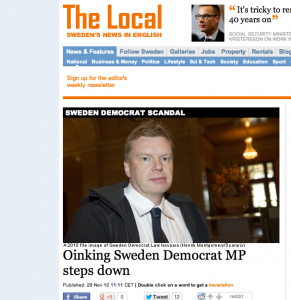
Here’s an interesting story that took place in June 2010 in Sweden involving a far-right Sweden Democrat (SD) MP, Erik Almqvist, who got rowdy and started hurling racist and sexist insults in public, reports Swedish tabloid Expressen. The MP naturally denied everything until Expressen published today a video confirming what others claimed he said.

After repeated denials, Almqvist wrote on his Facebook page that while he didn’t remember what he said two-and-a-half years ago, he was “greatly remorseful.”

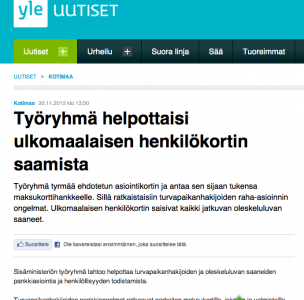
Party chairman Jimmie Åkesson has tried to improve the party’s xenophobic and anti-immigration image by announcing that the SD maintain a strict zero tolerance for racism. As a result of the scandal, Åkesson has asked Almqvist to not only resign from all positions of trust in the party but to consider resigning as MP as well.

Every one knows about the SD’s neo-Nazi roots and their crackpot statements against immigrants and Muslims. Anti-immigration was the most important message of their 2010 campaign. The ad, which was banned in Sweden, is one of many examples of their xenophobia.

http://www.youtube.com/watch?v=ewwYHTn_xxc

As everyone know, in neighboring Finland we have the Perussuomalaiset (PS), a close ideological ally of the SD. Contrary to Sweden, however, PS politicians can get away by saying similar or worse racist insults than Almqvist with little or no consequences.

Here is a link to a Migrant Tales’ blog entry that lists a shameful list of PS party members who got elected to city council thanks to their strong anti-immigration message.


ELTbites: What you can and can’t say in class

Posted on November 14, 2012 by Migrant Tales

By Richard Gresswell

This blog post is kind of a follow on from the previous one inspired by the film ‘Blackboards’. Watching it again brought back memories of the many Kurdish students I’ve had the pleasure of teaching during my time as an ESOL tutor. I want to tell you a story about one of those students.

I was teaching a ‘typical’ ESOL class, a group of people bringing with them their rich cultures, languages and life experiences to the classroom but at the same time a feeling of the weight of the world’s problems resting there, and often on the shoulders of the teacher, or at least it felt that way at times. As always I was attempting to conduct a fine balancing act between allowing students to say what they wanted to, while guarding against causing offence to others.

I found it hard at times, and there were always cracks appearing all over the place with arguments breaking out here and there but nothing too worrying. I recall once saying to the class ‘we shouldn’t speak about politics’ – quite a ridiculous thing to say really, but I was at a loss with how to deal with the on-going political discussions that seemed to cause such division among the learners.

One day in class, the students were having to carry out some exam preparation with a rather banal task of ‘describe a past event in 150 words’ (yawn). No idea where these rubric writers get their ideas from – How about ‘tell me a story’ – the students had plenty of those, and were good at telling them too. Anyway the students started their writing in class and then finished it off for homework. One Kurdish student who we shall call Hamed (not real name of course) handed me his essay by hand at the beginning of the next class. I put the carefully written and presented piece of writing on the desk next to me and started class. But I was intrigued by it, the way Hamed had personally given it to me at the beginning of the lesson. So I waited impatiently for the break so I could read it.

Now this is how the story went (in my words from memory)

I will describe my past event – I remember one day. It was a terrible day. I was ten years old. We were running away. It was terrible, people were crying and dying. We were in the mountains, it was cold, very cold. We were frightened of soldiers all the time. Sometimes we stopped to have a rest. We didn’t have any food or water. Sometimes we stopped to bury people because they were dead and we buried them there. I was very sad but my life is better now. I know I shouldn’t talk about politics, I’m sorry Mr Richard.

Read original blog entry here.

This piece was reprinted by Migrant Tales with permission.

Schuurmudgeon: Sanoma, your ignorance is not sexy

Posted on November 13, 2012 by Migrant Tales

By Jos Schuurmans

“Hello? This is the nineteen-thirties calling. Can we have our nazi family snap shots back, please?”

How is it possible that Sanoma, one of Finland’s largest, most professional and most respected media firms, gets away with publishing a cosy, three-page family portrait of far-right MP Jussi Halla-aho in its November 1, 2012, issue of Me Naiset, the mainstream human interest women’s magazine?

Headlined, Jussi and Hilla Halla-aho: “Intelligence is sexy”, the article (web-version here) runs photos of Halla-aho and his wife at home and at the diner table with their children. On the cover of the magazine they are quoted as saying:

“Home is a place where one doesn’t need to face criticism.”

Well… tell that to the visible immigrants whose homes have fallen prey to arson attacks from anti-immigration extremists in recent years!

Halla-aho is a contender to the leadership of the far-right ‘Perussuomalaiset’ party. Not hindered by political correctness, his blog writings are crudely critical of immigration and multiculturalism. He has been convicted by the country’s Supreme Court of enticing intolerance.

Yet the article doesn’t go into details concerning his political actions or agenda. The closest writer Essi Myllyoja and photographer Milka Alanen come to touching upon his controversial track record is this:

“(…) Jussi is a man who evokes emotions – even fears. His radical opinions and provocative blog articles have taken him even to court. But when Kerttu jumps onto Jussi’s lap and drowns her father in kisses, what springs to mind is that there is surely also a softer side to the man. (…)”

Excuse me, I feel slightly nauseous. Saisinko vatin, kiitos?

In June 2012, following Halla-aho’s appeals after conviction in lower courts, the Supreme Court of Finland found him guilty of both disturbing religious worship and ethnic agitation. He was sentenced to pay fines as well as to remove parts from his blog.

Halla-aho had remarked that the prophet Muhammad was a paedophile, and Islam a religion of paedophilia, because Muhammad had intercourse with his 9-year-old wife and according to Sunnah Mohammed’s life is exemplary in every way.

He also asked if it could be stated that robbing passers-by and living on taxpayers’ expense are cultural and possibly genetic characteristics of Somalis. This was apparently stated in sarcastic response to a Finnish columnist who wrote that drinking excessively and fighting when drunk were cultural and possibly genetic characteristics of Finns.

The Supreme Court considered the blog posts’ descriptions to be defaming and abusive to an ethnic group. It found the writing in itself to evoke intolerance, contempt and possibly even hatred. (Sources via Wikipedia, Wikiquotes, HS.fi, Migrant Tales)

Of course the man’s unattractive political accomplishment is very disturbing and a cause of outrage in itself. We’ve known for a while that Timo Soini’s Perussuomalaiset (which translates into ‘True Finns’, although the party adopted ‘The Finns’ as its official English name in August 2011) harbor dangerously right-wing elements and it’s really objectionable that the party leader doesn’t seem to have made any effort to dis-associate them from his movement.

The far-right thugs in this country are receiving way too much air time already and I wouldn’t want to add to that.

But with this article in Me Naiset, the boundaries of what is considered to be acceptable in mainstream journalism are being pushed to a new level. This should not be allowed to pass without notice.

It’s staggering that Sanoma can publish such politically and historically ignorant fluff without causing a public outrage and without repercussions for its insensitive and irresponsible management.

This piece was reprinted by Migrant Tales with permission.

MP Hirvisaari claims PS anti-immigration message not strong enough

Posted on November 13, 2012 by Migrant Tales

Perussuomalaiset (PS) MP James (Erkki Kalevi) Hirvisaari claims that his party did poorly in the municipal elections because it wasn’t as outspoken on immigration issues as before the 2011 parliamentary elections, according to YLE. Migrant Tales disagrees. The PS did poorly in the municipal elections because of the crackpot stuff they say and do to gain attention, listeners or votes. 

Contrary to what Hirvisaari claims, the PS and his band of Counterjihadists tried very hard to raise immigration issues during the last municipal elections. See the long list of blog entries below that were published by Migrant Tales that show that Hirvisaari and other PS politicians tried to gain attention and votes by fueling anti-immigration, anti-Islam, anti-Roma and homophobic sentiment.

Moreover, the anti-immigration message of the PS sounds like a broken record at this stage. The more it plays, the more their lies and opportunism are exposed. The public, media and politicians are not eating out of their hands as they did before last year’s parliamentary elections.

Politicians like Hirvisaari in the PS, with his usual witch-hunt comments about Islam and immigrants, is one reason why the party has lost popularity and credibility with voters.

One of the PS MP’s many bizarre comments were made after Anders Brevik went on the rampage killing in cold blood 77 Norwegians on July 22, 2011.

On his Uusi Suomi blog he blamed “immigration policy” and “100% rape cases by foreigners [sic!]” for Norway’s worst tragedy after World War 2. “A sensible immigration policy could have lowered tensions and helped avoid many problems as well as the atrocity [in Norway],” he wrote. “And we still can. In Finland as well.”

Hirvisaari, who was convicted for hate speech in December, has not only lost touch with his party but with his constituents.

Here are some blog entries that Migrant Tales published before the October municipal elections that had a strong anti-immigration, anti-Islam and homophobic message:

  • The Finnish city of Kemi gives us Harri Turtiainen of the PS (Nov. 11)
  • More Mamukriit-Looks candidates of Finland (Oct. 30)
  • The majority of Mamukriit-Looks candidates got elected to office in Finland (Oct. 29)
  • PS anti-immigration candidates did well in the Finnish municipal elections (Oct. 29)
  • CHEATS! (Oct. 26)
  • Timo Soini on racism: See no evil, hear no evil (Oct. 25)
  • What do Finland’s political parties think about refugees and immigrants? (Oct. 24)
  • Parliament debates practicalities of expulsion from Finland (Oct. 21)
  • Immigrants that look down on other immigrants (Oct. 19)
  • Banning circumcision would be the first step in undermining religious freedom in Finland (Oct. 14)
  • The PS’ shameful and opportunistic stand on refugees (Oct. 10)
  • Ajankohtainen kakkonen: Four immigrant candidates (Oct. 4)
  • The PS campaigns for closed-door policy for refugees (Oct. 1)
  • The Rautiainen scandal: The PS’ short and selective memory (Sept. 26)
  • Perussuomalaiset candidate: Kill the prime minister, finance minister and boil Muslims alive (Sept. 25)
  • PS of Pori: Nazi motto to kick off the municipal elections of October (Sept. 24)
  • PS candidate: Vote for me and I will solve the refugee problem from Africa with rice (Sept. 20)
  • Racism, Counterjihadism and neo-Nazism sit well with the PS (Sept. 16)
  • An interesting blog that follows far-right candidates in Finland’s municipal elections (Sept. 14)
  • How sincere is PS MP Immonen about Finnish Karelia? (Sept. 8)
  • Halla-aho takes another swipe at Finland’s Somali community (Aug. 22)
  • PS MP James Hirvisaari does it again (Aug. 17)
  • Using rape statistics to fuel ethnic prejudism and racism (Aug. 4)
  • Finnish anti-immigration party MP claims homosexuality to be a “disability in sexual development” (Aug. 1)
  • James and Jussi out of control (July 25)
  • Let’s play fill in the blanks with with far-right Finnish MP James Hirvisaari (July 17)
  • Monikulttuurisuus ei ole poliittinen ideologia (July 9)
  • Have the PS and MP Tossavainen of Finland ever heard of the Non-Discrimination Act? (June 26)
  • Finnish anti-immigration party seeks to ban begging (June 5)
  • Will the PS succeed at its vicious campaign against immigrants and visible minorities? (May 6)
  • The PS and the municipal election: Vicious campaign against immigrants and minorities (Apr. 24)
  • PS MP Hakkarainen instigates social-media lynch mob from Singapore  (Apr. 21)
  • Anti-immigration groups in Finland plan vicious campaign as the municipal election nears in October (Mar. 25)


Reports: Greatest threat to immigrants are not far-right groups in Sweden

Posted on November 12, 2012 by Migrant Tales

Two reports published on November 9 in Sweden show that the greatest threat to immigrants and visible minorities in that country aren’t far-right groups, but everyday intolerance and racism from white Swedes.

What does this report say about Sweden and suggest about how foreigners are treated in Finland? Contrary to our neighbor, Finland’s third-largest party in parliament, the Perussuomalaiset (PS), is staunchly xenophobic and against immigrants.

Relatives of the PS, the Sweden Democrats, are a minor force in parliament.

Cecilia Englung said: “The biggest challenge is to tackle the problem of everyday xenophobia by comments, evil staring and other negative behaviors toward non-ethnic Sweden.”

One of the reports asked 1,490 students about racism. Half of them, who were born elsewhere than Sweden, had experienced racism (28% said there is racism at their school and 24% knew of a racist assault at school).

Martin Luther King had a point when he said: “History will have to record that the greatest tragedy of social transition was not the striden clamor of the bad people, but the appalling silence of the good people.”

MLK had a point but how many of those people he mentions were actually that “good?”

PS’ Halla-aho eyes party leadership

Posted on November 10, 2012 by Migrant Tales

Perussuomalaiset (PS) party far-right anti-immigration wing leader, MP Jussi Halla-aho, confirmed that he’s not ruling out vying for chairman of the radical populist party, according to MTV3, citing the Subin Enbuske & Linnanahde Crew TV show. 

”I’m in parliament and city council because enough people want me in these places,” he said, ”if they want me in some other place, I could even consider such a request.”

Apart from their racism and far-right ideology, politicians like Halla-aho are chronic narcissists, who score brownie points with voters by bashing weaker and more vulnerable groups in society.

The aim of these politicians is simple: do everything possible to hinder integration, acceptance and make life as difficult as possible for Finland’s newcomers and visible immigrants.

PS chairman Timo Soini has been a key factor in bringing such politicians to roost in Finland. He has given them a political voice through his party.

I pointed out in a recent blog entry that if I had the opportunity to draw a cartoon about Soini’s relationship with these far-right politicians, the setting would be a concentration camp in World War 2 with some infamous commandants like Rudolf Hoess and Franz Ziereis, hiding behind the PS leader.

Soini would state with a poker face: “Anti-Semitism isn’t an issue in our party.”

What Saul Schubak did wrong in Finland

Posted on November 10, 2012 by Migrant Tales

Saul Schubak, the National Coalition Party politician who said that ”inferior people” should not get child allowances, resigned Friday as vice president of the party’s youth wing. If there is a lesson to be learned from the Schubak scandal, it’s which group you insult. 

If Schubak speaks of ”inferior people” and gets dumped by his party for his statement, why doesn’t the same happen when the Perussuomalaiset (PS) and its anti-immigration extremists get showered with votes in elections?

The answer to this very simple question is obvious: Don’t insult the wrong group. Schubak insulted whites while the PS near-constantly insults immigrants and visible minorities.

The moral of the Schubak scandal? If you are going to insult people in Finland,  stay clear from white people especially if you have a Jewish background. Bashing immigrants and even visible minorities is, however, fine. You won’t lose face.

Schubak said in a statement that he ”did not mean to insult anyone” although that is exactly what he did.

The former National Coalition Party youth wing vice president said that politicians don’t take responsibility for what they say and do. Schubak, contrarily, does, which is why he is resigning, according to his words.

Pushing aside the melodramatics and political soap opera, Schubak is resigning because of what he said and to whom,  which made his position in the party untenable.

The National Coalition Party youth wing has been on other occasions a political thorn in the conservative party’s side.


  • Previous
  • 1
  • …
  • 391
  • 392
  • 393
  • 394
  • 395
  • 396
  • 397
  • …
  • 513
  • Next
Read more about documentary film
Read more

Recent Posts

  • Lahti is the latest city to prohibit the niqab and burka
  • Finland’s tabloids Iltalehti and Ilta-Sanomat are the pits
  • Riikka Purra’s Dr Jekyll and Mr Hyde mask
  • Double standards
  • Perussuomalaiset: Uusi logo, sama vanha juttu

Recent Comments

  1. Absolutely Socking: Racist Finnish Facebook group against human rights gets flooded with socks on Musta Barbaari’s mother and sister charged by the police in “ethnic profiling” case
  2. Ilkka Nuotio on Pekka Myrskylä: “Tilastot kertovat toista kuin poliittinen keskustelu”
  3. Genrih Soinkara on The war in Ukraine and the Russian-Finnish border crisis are showing Finland’s ugly side
  4. Ahti Tolvanen on Comment by Ahti Tolvanen on the Helsinki +50 conference
  5. Angel Barrientos on Angel Barrientos is one of the kind beacons of Finland’s Chilean community

Archives

  • June 2026
  • May 2026
  • April 2026
  • March 2026
  • February 2026
  • January 2026
  • December 2025
  • November 2025
  • October 2025
  • September 2025
  • August 2025
  • July 2025
  • June 2025
  • May 2025
  • April 2025
  • March 2025
  • February 2025
  • January 2025
  • December 2024
  • November 2024
  • October 2024
  • September 2024
  • August 2024
  • July 2024
  • June 2024
  • May 2024
  • April 2024
  • March 2024
  • February 2024
  • January 2024
  • December 2023
  • November 2023
  • October 2023
  • September 2023
  • August 2023
  • July 2023
  • June 2023
  • May 2023
  • April 2023
  • March 2023
  • February 2023
  • January 2023
  • December 2022
  • November 2022
  • October 2022
  • September 2022
  • August 2022
  • July 2022
  • June 2022
  • May 2022
  • April 2022
  • March 2022
  • February 2022
  • January 2022
  • December 2021
  • November 2021
  • October 2021
  • September 2021
  • August 2021
  • July 2021
  • June 2021
  • May 2021
  • April 2021
  • March 2021
  • February 2021
  • January 2021
  • December 2020
  • November 2020
  • October 2020
  • September 2020
  • August 2020
  • July 2020
  • June 2020
  • May 2020
  • April 2020
  • March 2020
  • February 2020
  • January 2020
  • December 2019
  • November 2019
  • October 2019
  • September 2019
  • August 2019
  • July 2019
  • June 2019
  • May 2019
  • April 2019
  • March 2019
  • February 2019
  • January 2019
  • December 2018
  • November 2018
  • October 2018
  • September 2018
  • August 2018
  • July 2018
  • June 2018
  • May 2018
  • April 2018
  • March 2018
  • February 2018
  • January 2018
  • December 2017
  • November 2017
  • October 2017
  • September 2017
  • August 2017
  • July 2017
  • June 2017
  • May 2017
  • April 2017
  • March 2017
  • February 2017
  • January 2017
  • December 2016
  • November 2016
  • October 2016
  • September 2016
  • August 2016
  • July 2016
  • June 2016
  • May 2016
  • April 2016
  • March 2016
  • February 2016
  • January 2016
  • December 2015
  • November 2015
  • October 2015
  • September 2015
  • August 2015
  • July 2015
  • June 2015
  • May 2015
  • April 2015
  • March 2015
  • February 2015
  • January 2015
  • December 2014
  • November 2014
  • October 2014
  • September 2014
  • August 2014
  • July 2014
  • June 2014
  • May 2014
  • April 2014
  • March 2014
  • February 2014
  • January 2014
  • December 2013
  • November 2013
  • October 2013
  • September 2013
  • August 2013
  • July 2013
  • June 2013
  • May 2013
  • April 2013
  • March 2013
  • February 2013
  • January 2013
  • December 2012
  • November 2012
  • October 2012
  • September 2012
  • August 2012
  • July 2012
  • June 2012
  • May 2012
  • April 2012
  • March 2012
  • February 2012
  • January 2012
  • December 2011
  • November 2011
  • October 2011
  • September 2011
  • August 2011
  • July 2011
  • June 2011
  • May 2011
  • April 2011
  • March 2011
  • February 2011
  • January 2011
  • December 2010
  • November 2010
  • October 2010
  • September 2010
  • August 2010
  • July 2010
  • June 2010
  • May 2010
  • April 2010
  • March 2010
  • February 2010
  • January 2010
  • December 2009
  • November 2009
  • October 2009
  • September 2009
  • August 2009
  • July 2009
  • December 2008
  • November 2008
  • October 2008
  • September 2008
  • August 2008
  • July 2008
  • June 2008
  • May 2008
  • April 2008
  • March 2008
  • February 2008
  • January 2008
  • November 2007
  • October 2007
  • September 2007
  • August 2007
  • July 2007
  • June 2007
  • May 2007

Categories

  • ?? Gia L?c
  • ????? ?????? ????? ???????? ?? ??????
  • ???????
  • @HerraAhmed
  • @mondepasrond
  • @nohatefinland
  • @oula_silver
  • @Varathas
  • A Pakistani family
  • äärioikeisto
  • Abbas Bahmanpour
  • Abdi Muhis
  • Abdirahim Hussein Mohamed
  • Abdirahim Husu Hussein
  • Abdirisak Mahamed
  • About Migrant Tales
  • activism
  • Adam Al-Sawad
  • Adel Abidin
  • Afrofinland
  • Ahmed IJ
  • Ahti Tolvanen
  • Aino Pennanen
  • Aisha Maniar
  • Alan Ali
  • Alan Anstead
  • Alejandro Díaz Ortiz
  • Alekey Bulavsev
  • Aleksander Hemon
  • Aleksanterinliitto
  • Aleksanterinliitto ry
  • Aleksanterinliitto ry:n hallitus
  • Alex Alex
  • Alex Mckie
  • Alexander Nix
  • Alexandra Ayse Albayrak
  • Alexis Neuberg
  • Ali Asaad Hasan Alzuhairi
  • Ali Hossein Mir Ali
  • Ali Rashid
  • Ali Sagal Abdikarim
  • Alina Tsui
  • Aline Müller
  • All categories
  • Aman Heidari
  • Amiirah Salleh-Hoddin & Jana Turk
  • Amin A. Alem
  • Amir Zuhairi
  • Amkelwa Mbekeni
  • Ana María Gutiérrez Sorainen
  • Anachoma
  • Anders Adlecreutz
  • Angeliina Koskinen
  • Anna De Mutiis
  • Anna María Gutiérrez Sorainen
  • Anna-Kaisa Kuusisto ja Jaakko Tuominen
  • Annastiina Kallius
  • Anneli Juise Friman Lindeman
  • Announcement
  • Anonymous
  • Antero Leitzinger
  • anti-black racism
  • Anti-Hate Crime Organisation Finland
  • Anudari Boldbaatar
  • Arshiya Nasser
  • Aspergers Syndrome
  • Asylum Corner
  • Asylum seeker 406
  • Athena Griffin and Joe Feagin
  • Autism
  • Avaaz.org
  • Awale Olad
  • Ayan Said Mohamed
  • AYY
  • Barachiel
  • Bashy Quraishy
  • Beatrice Kabutakapua
  • Beri Jamal
  • Beri Jamal and Enrique Tessieri
  • Bertolt Brecht
  • Boiata
  • Boodi Kabbani
  • Bruno Gronow
  • Carmen Pekkarinen
  • Çelen Oben and Sheila Riikonen
  • Chiara Costa-Virtanen
  • Chiara Costa-Virtanen
  • Chiara Sorbello
  • Christian Thibault
  • Christopher Wylie
  • Clara Dublanc
  • Dana
  • Daniel Malpica
  • Danilo Canguçu
  • David Papineau
  • David Schneider
  • Dexter He
  • Don Flynn
  • Dr Masoud Kamali
  • Dr. Faith Mkwesha
  • Dr. Theodoros Fouskas
  • Edna Chun
  • Eeva Kilpi
  • Emanuela Susheela
  • En castellano
  • ENAR
  • Enrique
  • Enrique Tessieri
  • Enrique Tessieri & Raghad Mchawh
  • Enrique Tessieri & Yahya Rouissi
  • Enrique Tessieri and Muhammed Shire
  • Enrique Tessieri and Sira Moksi
  • Enrique Tessieri and Tom Vandenbosch
  • Enrique Tessieri and Wael Che
  • Enrique Tessieri and Yahya Rouissi
  • Enrique Tessieri and Zimema Mhone
  • Epäluottamusmies
  • EU
  • Europe
  • European Islamophobia Report
  • European Islamophobia Report 2019,
  • European Union
  • Eve Kyntäjä
  • Ezequiel Caldeiro
  • Facebook
  • Fadumo Dayib
  • Faisa Kahiye
  • Farhad Manjoo
  • Fasismi
  • Finland
  • Fizza Qureshi
  • Flyktingar och asyl
  • Foreign Student
  • Fozia Mir-Ali
  • Frances Webber
  • Frida Selim
  • Gareth Rice
  • Ghyslain Vedeaux
  • Global Art Point
  • Great Replacement
  • Habiba Ali
  • Hami Bahadori
  • Hami Bahdori
  • Hamid
  • Hamid Alsaameere
  • Hamid Bahdori
  • Handshake
  • Harmit Athwal
  • Hassan Abdi Ali
  • Hassan Muhumud
  • Heikki Huttunen
  • Heikki Wilenius
  • Helsingin Sanomat
  • Henning van der Hoeven
  • Henrika Mälmsröm
  • Hser Hser
  • Hser Hser ja Mustafa Isman
  • Husein Muhammed
  • Hussain Kazemian
  • Hussain Kazmenian
  • Ibrahim Khan
  • Ida
  • Ignacio Pérez Pérez
  • Iise Ali Hassan
  • Ilari Kaila & Tuomas Kaila
  • Imam Ka
  • inside-an-airport
  • Institute of Race Relations
  • Iraqi asylum seeker
  • IRR European News Team
  • IRR News Team
  • Islamic Society of Norhern FInland
  • Islamic Society of Northern Finland
  • Islamophobia
  • Jacobinmag.com
  • Jallow Momodou
  • Jan Holmberg
  • Jane Elliott
  • Jani Mäkelä
  • Jari Luoto
  • Jari Taponen
  • Jegor Nazarov
  • Jenni Stammeier
  • Jenny Bourne
  • Jessie Daniels
  • Joe Davidow
  • Johannes Koski
  • John D. Foster
  • John Grayson
  • John Marriott
  • Jon Burnett
  • Jorma Härkönen
  • Jos Schuurmans
  • José León Toro Mejías
  • Josue Tumayine
  • Jouni Karnasaari
  • Juan Camilo
  • Jukka Eräkare
  • Julian Abagond
  • Julie Pascoet
  • Jussi Halla-aho
  • Jussi Hallla-aho
  • Jussi Jalonen
  • JusticeDemon
  • Kadar Gelle
  • Kaksoiskansalaisuus
  • Kansainvälinen Mikkeli
  • Kansainvälinen Mikkeli ry
  • Katherine Tonkiss
  • Kati Lepistö
  • Kati van der Hoeven-Lepistö
  • Katie Bell
  • Kättely
  • Kerstin Ögård
  • Keshia Fredua-Mensah & Jamie Schearer
  • Khadidiatou Sylla
  • Khadra Abdirazak Sugulle
  • Kiihotus kansanryhmää vastaan
  • Kirsi Crowley
  • Koko Hubara
  • Kristiina Toivikko
  • Kubra Amini
  • KuRI
  • La Colectiva
  • La incitación al odio
  • Laura Huhtasaari
  • Lauri Finér
  • Leif Hagert
  • Léo Custódio
  • Leo Honka
  • Leontios Christodoulou
  • Lessie Branch
  • Lex Gaudius
  • Leyes de Finlandia
  • Liikkukaa!
  • Linda Hyökki
  • Liz Fekete
  • M. Blanc
  • Maarit Snellman
  • Mahad Sheikh Musse
  • Maija Vilkkumaa
  • Malmin Kebab Pizzeria Port Arthur
  • Marcell Lorincz
  • Mari Aaltola
  • María Paz López
  • Maria Rittis Ikola
  • Maria Tjader
  • Marja-Liisa Tolvanen
  • Mark
  • Markku Heikkinen
  • Marshall Niles
  • Martin Al-Laji
  • Maryan Siyad
  • Matt Carr
  • Mauricio Farah Gebara
  • Media Monitoring Group of Finland
  • Micah J. Christian
  • Michael McEachrane
  • Michele Levoy
  • Michelle Kaila
  • Migrant Tales
  • Migrant Tales Literary
  • Migrantes News
  • Migrants' Rights Network
  • MigriLeaks
  • Mikko Kapanen
  • Miriam Attias and Camila Haavisto
  • Mohamed Adan
  • Mohammad Javid
  • Mohammad M.
  • Monikulttuurisuus
  • Monisha Bhatia and Victoria Canning
  • Mor Ndiaye
  • Muh'ed
  • Muhamed Abdimajed Murshid
  • Muhammed Shire
  • Muhammed Shire and Enrique Tessieri
  • Muhis Azizi
  • Musimenta Dansila
  • Muslimiviha
  • Musulmanes
  • Namir al-Azzawi
  • Natsismi
  • Neurodiversity
  • New Women Connectors
  • Nils Muižnieks
  • No Labels No Walls
  • Noel Dandes
  • Nuor Dawood
  • Omar Khan
  • Otavanmedia
  • Oula Silvennoinen
  • Paco Diop
  • Pakistani family
  • Pentti Stranius
  • Perussuomalaiset
  • perustuslaki
  • Petra Laiti
  • Petri Cederlöf
  • Pia Grochowski
  • Podcast-lukija Bea Bergholm
  • Pohjois – Suomen Islamilainen Yhdyskunta
  • Pohjois Suomen Islamilainen Yhyskunta
  • Polina Kopylova
  • Race Files
  • racism
  • Racism Review
  • Raghad Mchawh
  • Ranska
  • Rashid H. and Migrant Tales
  • Rasismi
  • Raul Perez
  • Rebecka Holm
  • Reem Abu-Hayyeh
  • Refugees
  • Reija Härkönen
  • Remiel
  • Reza Nasri
  • Richard Gresswell
  • Riikka Purra
  • Risto Laakkonen
  • Rita Chahda
  • Ritva Kondi
  • Robito Ibrahim
  • Roble Bashir
  • Rockhaya Sylla
  • Rodolfo Walsh
  • Roger Casale
  • Rostam Atai
  • Roxana Crisólogo Correa
  • Ruth Grove-White
  • Ruth Waweru-Folabit
  • S-worldview
  • Sadio Ali Nuur
  • Sami Rusanen
  • Sandhu Bhamra
  • Sara de Jong
  • Sarah Crowther
  • Sari Alhariri
  • Sarkawt Khalil
  • Sasu
  • Scot Nakagawa
  • Shabana Ahmadzai
  • Shada Islam
  • Sharon Chang blogs
  • Shenita Ann McLean
  • Shirlene Green Newball
  • Sini Savolainen
  • Sira Moksi
  • Sonia K.
  • Sonia Maria Koo
  • Steverp
  • Stop Deportations
  • Suldaan Said Ahmed
  • Suomen mediaseurantakollektiivi
  • Suomen Muslimifoorumi ry
  • Suomen viharikosvastainen yhdistys
  • Suomen viharikosvastainen yhdistys ry
  • Suomi
  • Supermen
  • Susannah
  • Suva
  • Syrjintä
  • Talous
  • Tapio Tuomala
  • Taw Reh
  • Teivo Teivainen
  • The Daily Show
  • The Heino
  • The Supermen
  • Thomas Elfgren
  • Thulfiqar Abdulkarim
  • Tim McGettigan
  • Tino Singh
  • Tito Moustafa Sliem
  • Tobias Hübinette and L. Janelle Dance
  • Transport
  • Trica Danielle Keaton
  • Trilce Garcia
  • Trish Pääkkönen
  • Trish Pääkkönen and Enrique Tessieri
  • Tuulia Reponen
  • Uncategorized
  • UNITED
  • University of Eastern Finland
  • Uyi Osazee
  • Väkivalta
  • Vapaa Liikkuvuus
  • Venla-Sofia Saariaho
  • Vieraskynä
  • W. Che
  • W. Che an Enrique Tessieri
  • Wael Ch.
  • Wan Wei
  • Women for Refugee Women
  • Xaan Kaafi Maxamed Xalane
  • Xassan Kaafi Maxamed Xalane
  • Xassan-Kaafi Mohamed Halane & Enrique Tessieri
  • Yahya Rouissi
  • Yasmin Yusuf
  • Yassen Ghaleb
  • Yle Puhe
  • Yuliet Tresa
  • Yve Shepherd
  • Zahra Khavari
  • Zaker
  • Zalina Ametova
  • Zamzam Ahmed Ali
  • Zeinab Amini ja Soheila Khavari
  • Zimema Mahone and Enrique Tessieri
  • Zimema Mhone
  • Zoila Forss Crespo Moreyra
  • ZT
  • Zulma Sierra
  • Zuzeeko Tegha Abeng
© 2026 Migrant tales | Powered by Minimalist Blog WordPress Theme