
Since March, hysteria has struck some municipalities in Finland. Even if it is not in the government program, the far-right anti-immigration Peruuomalaiset (PS)* have done their best to fuel anti-Muslim racism as the April 2027 general election nears.
One of the questions that the Finnish media, in particular the tabloids, which are responsible for reinforcing and spreading xenophobia and anti-Muslim racism, leads with a provocative headline: Lahti prohibits the burka at comprehensive schools.
The burka, which covers the face of a woman?
How many burka-users are there in Finland? According to some, there are none.
The term “burrka” was incorrectly used to mean niqab.
Should we be surprised that the initiative came from the council members of the PS?
Writes Ilta-Sanomat: “No widespread practice of covering the face has been observed in schools in Lahti. According to the initiators of the proposal, the issue concerns safety in the school environment.”
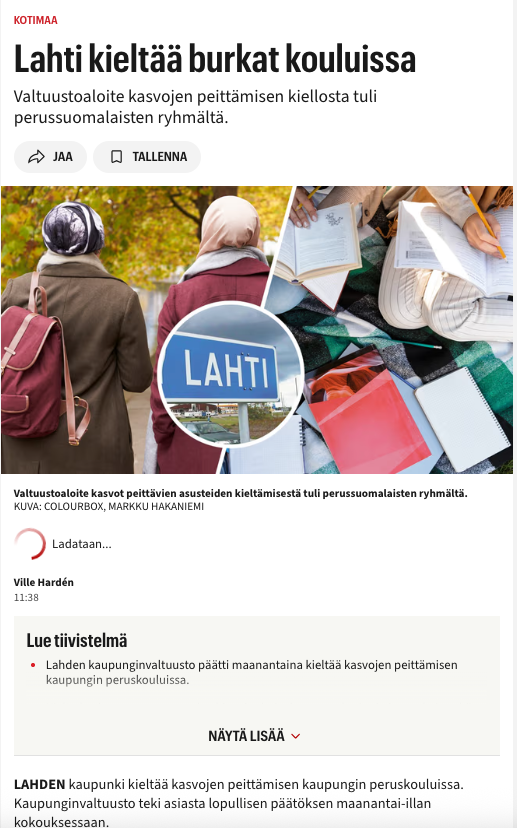
Read the original story here.
One of the characteristics of the ban is not only its mixed message, but the fact that at Finnish comprehensive schools, there is no widespread use of the niqab and buka, which is nonexistent. All of the initiatives to ban such clothing have come from the PS.
Even if it is clear that the PS are campaigning on their racism, the qustion that should concern us is why Swedish People’s Party Education Minister Anders Adlecreutz has not stood up for the Muslim pupils at schools but allowed such bans to spread? Caving into PS pressure, Adlecreutz approved the removal of Salam, a textbook used to teach Islam to comprehensive school pupils.
Even if the Finnish media were the last group to question the impact of such bans on Muslim pupils who don’t wear the niqab, none of them have asked why some cities like Espoo don’t mention the niqab and burka, but Vantaa does.
The answer is clear: hatred for Muslims is not only spread by the PS, but parties like the National Coalition Party have also joined the racist bandwagon.
Minister of Social Security Sanni Grahn-Laasonen (NCP) joined the PS and also called for a bn at schools of the niqab and burka.
In all of the municipalities that are debating the issue, the use of such Muslim dress can be counted on one’s fingers.
Farid Hafez, an associate teaching professor of international relations at William and Mary, one of the two editors of the European Islamophobia Report, warned that a ban serves as a precursor to a broader hijab ban since it sets a precedent. “Once such a ban is approved,” he said, “the expansion of the hijab ban could proceed from elementary schools to secondary schools, high schools, universities, and public agencies. This has been a stated goal in Austria.
