
This blog entry is dedicated to the late Donald Fields, Helsinki correspondent of the BBC, The Guardian, and Politiken to 1988, who wrote critically about Finlandisation.
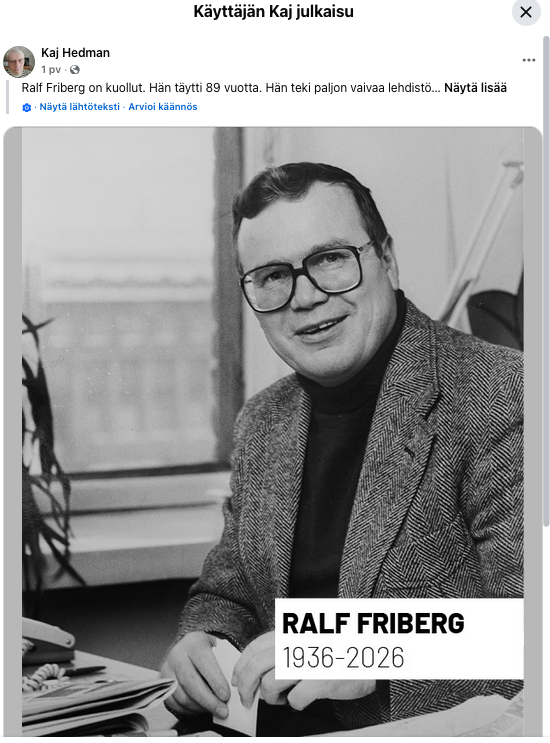
Ralf Friberg held several roles, from ambassador to the head of the foreign ministry’s press section, which closely watched what was written about Finland during the Cold War. His methods to shut them up. He was so ruthless that even one of his former colleagues gave him the nickname “Leonid.”
At one lunch meeting at Helsinki’s Savoy restaurant, Friberg suggested that before I write on the sensitive topic of Finlandisation, I should get in touch with him. I considered this outright censorship.
Details of our lunch date were published in Finland’s biggest daily, Apu magazine.
The following day after the story was published, I got phone calls from some of Friberg’s former employees who thanked me for what I did and said that Friberg was a terrible person who would go to any lengths to destroy a person’s career.
The revelation also exposed the open relationship that Friberg had with the Financial Times. He would directly complain to the editors about my writing.
The Financial Times had no problems with Finnfacts paying for their journalists’ visit to Finland as long as they published something positivve.
Groups like Finnfacts, under Matti Kohva, also monitored the foreign media. I remember an article Kohva wrote in Finn Niche, a publication edited by Olli Virtanen, in which he said his blood boiled whenever he heard foreign journalists cite Finlandisation.
Another person who supported the extreme censorship during the Cold War era was Pekka Karhuvaara.
Finnfacts worked closely with the foreign ministry, bribing foreign correspondents to write positive stories about Finland by paying for their trip and stay.
Threats were common back then. I once published a story in Cambio 16, a Spanish newsmagazine, about the contraband of Bibles to the former Soviet Union. I was told directly that if I do not stop writing such stories, I would be blacklisted.
At the time, I was blaklisted.
Mike Hofman published in 2014 his thesis (in Dutch) on how censorship and self-censorship happened in Finland during the Cold War.
Read the full thesis (in Dutch) and a synopsis in English here.
Here are some of the conclusions of Hoffman’s thesis:
- There are strong indications of government intervention in the media. Many of those interventions could be considered as censorship, according to the human rights organisation Amnesty International.
- The Finnish government and the Soviet embassy kept a close watch on the media in Finland. They would make it clear to journalists if they were not satisfied with an article.
- The government tried to influence foreign journalists in Finland.
- There was a lot of self-censorship in Finland. Criticism of the Soviet Union was out of the question. There have been cases where critical journalists were dismissed by their editors.
Up to now, I haven’t seen any credible study that highlights the abuses of the foreign office during the Cold War era.
It’s high time that this era should be exposed.