
An article in tabloid Iltalehti aims to reinforce readers about why “kids with migrant backgrounds” are a problem, but instead reveals the racist attitudes of the tabloid and of some comprehensive school teachers. I suspect that one of the reasons why Iltalehti uses anonymous sources is because no respecting teacher would go on the record with such claims.
Let’s dissect the article’s most outrageous claims:
- The article concerned why brown and black children, specifically Muslims, are marginalized and don’t want to be Finns, which affects their Finnish language-learning abilities. One good start would be to stop labeling them “children with migrant backgrounds.” The label alone excludes.
- One reason why kids don’t want to identify as Finns is that they are not even accepted as Finns. As mentioned above, why would some of these kids want to identify with white Finns, which the article labels “ethnic” Finns (kantasuomalainen), if their backgrounds are not taken into account?
- What about institutional racism and the xenophobic and bigoted comments by politicians in particular, like the Perussuomalaiset (PS)*, who have made their political message by spreading racism and lies about migrants? Would you want to be part of a society that holds you in contempt?
- I have said it before and will say it again: I never want to be a white Finn but a Finn on my terms. The article does not mention how these children could be seen and taught to be Finns on their terms.
- The article claims: “Some children with an immigrant background who were born in Finland do not speak Finnish well enough to attend school.” If this is the case, it reveals the failure of the school system and ineffective social policy. Nowhere is it mentioned in the article how we tackle this problem.
- Why do three teachers cited in the story speak anonymously? “Paula,” who teaches the Islman religion, claims that some of her students don’t want to be Finns. If “Paula” is a teacher, she should know better the importance of retaining your culture instead of erasing it. Over 1.2 million Finns emigrated from Finland between 1860 and 1999. Even the children of the first generation, still in their fifth generation, continue to see themselves as Finns. Is this strange? No.
- “Karla” is another consultant teacher who speaks anonymously in the article. She believes that the best way to solve Finnish-language learning issues is to send such families to the countryside. Apart from being illegal, I’m certain that some teachers feel this is an effective way to teach Finnish.
- “Helena” is a Finnish-language teacher who also appears anonymously in the story. She is in favor of limiting the number of non-Finnish-speaking students. There was a big discussion in 2011 about limiting the number of “students with foreign backgrounds” in classes. One of the questions that these polls asked over ten years ago is if public servants like teachers can limit or choose who they’ll teach. Can the police do the same? Is segregating schools by placing caps constitutional?
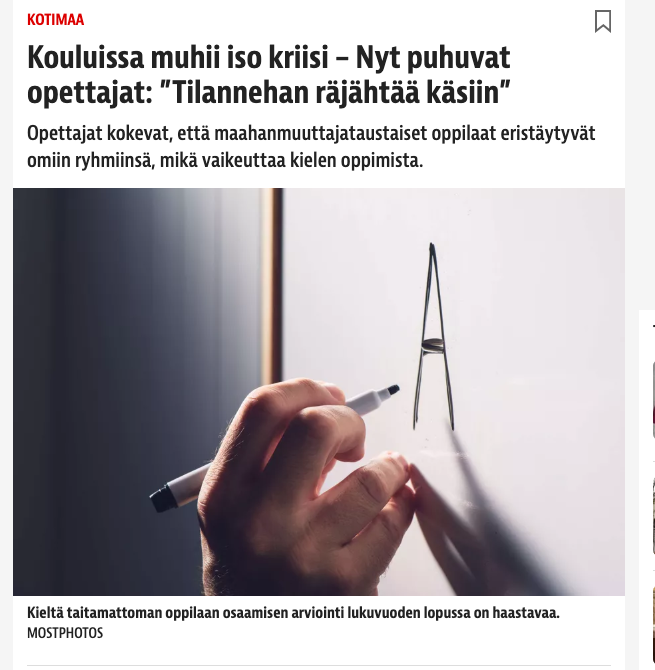
The Iltalehti article leads: “Kouluissa on suuri kriisi – opettajat puhuvat ääneen:
Opettajien mielestä maahanmuuttajataustaiset oppilaat eristäytyvät ryhmiinsä, mikä vaikeuttaa kielen oppimista.”
These types of stories in the Finnish media only serve to reinforce stereotypes and suspicion about migrants.
Shameful journalism.

Category: Enrique Tessieri