A Kanta-Häme district court that dropped charges against seven police officials and security guards for forcibly removing in 2017 two Muslim women’s hijabs will not be treated by the court in what remains of the year but in 2023, according to prosecutor Heidi Savurinne.
Two asylum seekers saw their hijabs removed forcibly in 2017 by the police and security guards because they refused to take them off for a photo. Finland does not allow Muslim women to wear the hijab if they enter the police force. Source: Yle
The case is significant from the view of religious freedom and equality before the law. Why are asylum seekers forced to remove their hijabs for police photos if those with residence permits don’t have to? As long as a woman’s face isn’t covered, EU law allows women to use the hijab for a passport picture.
It’s been over 40 years since a group of foreigners and Finns organized a demonstration from the Porthania’s University of Helsinki to the steps of parliament. It happened on a Tuesday, 19 October, and it was a very cold day.
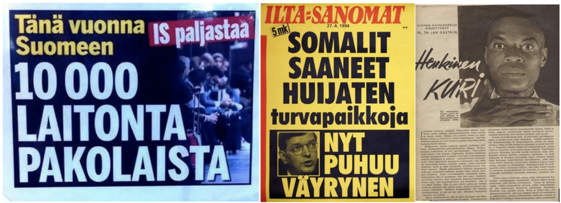
Tabloid Ilta-Sanomat, which has had a murky history for publishing and attacking Somalis and other migrants in the 1990s, publishes a story about two Romany women who shoplift 2,600 euros of merchandise.
Certainly, shoplifting is a crime, but what about when a tabloid publishes a story that reinforces stereotypes about a certain group? Considering that Ilta-Sanomat was responsible in the 1990s for fueling Finnish racism against groups like the Somalis, isn’t that “a crime” also?
In the Finnish media, tabloids like Ilta-Sanomat have published racist stories. From left to right: This year, Finland will receive 10,000 illegal refugees (sic!); The Somalis coned the authorities to give them asylum; (right) Suomen Kuvalehti wrote in 1940 that the Finnish soldier did not run away, but an African tribe in the Indian Ocean does.
Apart from pointing out that the two women had hidden the merchandise in their Romany dresses, one of the suspects had yelled and acted aggressively against the security guard.
What would have happened if the shoplifters had been white Finns? If it were news, the tabloid would probably lead with the following headline: “A white Finns shoplifts.”
Who would be interested in reading such a story?
In our opinion, the story about the Romany women shoplifters has no other role than exposing the reporter’s prejudices and racist stereotypes of Romany women.
#Astudio host Marja Sannikka kicks off the next topic on the talk show on gang violence with the following words that sound like a thriller: “Knives, violence, revenge. Finnish youth gang crime grows at a worrying pace.”
In the talk show, does Sannikka gives us any facts about “the worrying [growth] pace” of gang violence in Finland? Instead, she speaks to four youths in the Vantaa neighborhood of Tikkurilla who give their views on the topic without any facts.
“I think matters have got worse in the past two years,” says one, “while another says that “people act more aggressively than before.” Knives and other weapons are more common, according to them.
While – again, without any statistical data – it takes about 10 minutes for Sannikka to mention that magic scapegoat word, “person of foreign background.” According to her, the police claim that 90% of the gang members are “people of foreign background.”
If you make such a claim, the host should back it up with facts. Moreover, how many so-called “people of migrant backgrounds” belong to gangs? 90%? 70%? 30%? 1%? 0.001%?
Most first- and second-generation Finns don’t belong to gangs and do something more useful with their time.
Why does Sannikka use #astudio to label and victimize all migrant youths?
Police officer Markku Heinikari has no answers about the roots of this problem and what to do about it. Mika Mehmet, the social worker who grew up in two cultures, mentioned that it had to do with belonging and a weak sense of identity.
What Mehmet said is correct but did not go far enough: What about the role of racism and the lack of adequate social services? How do talk shows like the one by #astudio contribute to the problem?
Helsingin Sanomat, Finland’s largest-circulation daily, writes in an editorial about why the country needs labor migrants to secure economic growth and services offered by the welfare state. We are at a critical crossroads: It is the first time in history that more people die than there are newborns.
While the editorial invites debate on Finland’s serious demographic woes, it is misleading because it only highlights the usual talking points by leaving out new arguments offered by brown and black Finn migrant researchers.
The reaction of some Finns can turn violent against migrants and minorities, as we saw after the Turku stabbings in 2017 by a Moroccan asylum seeker. Source: Migrant Tales
The editorial bases its call for more labor migrants on the pension insurance group Varma CEO Risto Murto’s book, Puuttuvat puoli miljoonaa, The missing half a million.
Murto’s book does not reveal anything new about Finland’s demographic woes. Over one-fourth of about 8% of Finland’s foreign population in 2020 lives in Helsinki; in 2035, it will rise to over a third; the low employment levels of people who came to Finland as refugees.
While Murto does not explain why the employment level of Afghans, Iraqis, Somalis, and other people of color is low in Finland, he and Helsingin Sanomat leave out the fact that their employment level rises the longer they live in Finland.
For some odd reason, the Helsingin Sanomat editorial and Murto forget to mention that refugees in Finland comprise about 10% of all foreigners. As we know and have seen, Finland’s hostile environment against visible migrants spread by parties like the far-right Perussuomalaiset (PS)*, National Coalition Party (Kokoomus), Christian Democrats, and others.
When they attack foreigners, such parties speak of this group as one group, “migrants.”
Finland has historically shunned immigrants, even if it is a country of emigrants. In the 1970s, when hundreds of thousands of Finns were moving to Sweden, the country decided against labor immigration to plug the economically active population deficit.
Several questions arise on how Finland could be a magnet for labor migrants. Less bureaucracy, family reunification, child education, Finnish- and Swedish-language lessons.
Of all of the factors Murto believes would attract labor migrants, the most important one is missing: a migrant and minority-friendly society that is inclusive.
The latter is easier said than done. Historically and politically today, Finland has shot itself in the demographic leg by allowing its suspicion of outsiders to overtake the better of them.
Any serious student of Finnish society should eventually grasp that institutional racism is one of the mothers of all social ills in the country. Institutional racism gives cover to racists and to the toxic white saviors who do irreparable harm to migrants and minorities.
You don’t need a lot of research to figure out the latter. Look at people who have the power to enforce and regulate it.
If the issue is institutional racism, why does Finlan do so little to challenge it? One of many examples of discrimination is the labor market. Why do we rarely read in the media about the authorities clamping down on this problem? It is, instead, a new study over an old one highlighting this problem.
The answer reveals a sad truth: there is no intention or political will to change matters. The situation is what it is because they are supposed to be that way.
US social thinker James Baldwin put it in the following words:
Without any intention of changing matters, rest assured that most projects with newcomers will miss the mark or fail outright. The integration authorities will feed newcomers the usual half-truths about Finnish social justice, which is highly selective.
Unfortunately, the latter will happen with some of the blessings of our culturally diverse communities.
Even so, I am confident the more Finland’s culturally diverse population grows, the more evident this social ill will be, and the need to change it permanently.
How far will right-wing parties like the Moderate Party of Sweden go to make a pact with their political devils? How much populism and empty nationalism led to the demise of UK Prime Minister Liz Truss? These are valid questions for Finland’s National Coalition Party (Kokoomus), which is making similar pacts with populism.
Kokoomus, like the Moderate Party of Sweden, and the rapid downfall of UK Prime Minister Truss must have raised some concerns. An election strategy is needed for April, but peppered with toxic populism and anti-immigration soundbites?
Finland faces a lot of challenges. For one, it needs labor migrants but this is difficult to realize on a grand scale because the Perussuomalaiset, Kokoomus, and other parties that attack and see migrants as a threat.
Politicians make fiery speeches against migrants – note they speak of all migrants – and then expect people to move here. Even for some who live here, the environment looks and feels hostile.
If we continue down the road of populism and exclusive nationalism, it’s clear that our future spells ruin.
Yle’s reported Tuesday building a border fence between Finland and Russia. Reporting from Estonia’s capital Tallinn, Yle reporter Rain Kooli said that the wall between Estonia and Russia was to stop migrants – not asylum seekers – and illegal migrants.
The project, which the Finnish Border Guard is spearheading, will cost hundreds of millions of euros and take 3-4 years to build. The fence will be built by border crossing points and 10%-20% of the border with Russia.
Finland’s parliament passed in summer the border guard act that severely restricts the human rights of refugees to seek asylum. European Union Institute professor of international law and human rights Martin Scheinin said the new law would send Finland back thirty years.
While using terms such as “migrants” and “illegal migrants” and publishing pictures of far-right Perussuomnalaiset (PS)* head Riikka Purra and National Coalition Party chairperson Petteri Orpo as a lead picture, the state broadcaster editorializes the topic.
Fencing of the Finnish-Russian border will cost hundreds of millions of euros and take 3-4 years to build. Source: YleEven if all the parties approved the decision to build the border fence, Yle News published a picture of the far-right Perussuomnalaiset head, Rikka Purra, and National Coalition Party chief Petteri Orpo as the lead picture.One of his many infamous anti-immigration statements was when he equated asylum seekers coming from the Russian border as water from “a leaking roof.”
Why wasn’t there any analysis of the effectiveness of walls and if they work?
One analysis by Rand stated:” If a border wall provides the political space for addressing these more systemic problems, then it may still be a worthwhile investment. That said, the proposed wall on the U.S.-Mexico border—like all previous walls—should be viewed as a means to an end, rather than an end unto itself.”
Europe is good at hiding its very big dirty secrets. German news magazine Der Spiegel revealed the inhuman treatment of refugees at European borders by publishing a report on Frontex by the European anti-fraud office OLAF. And that’s not all: The Guardianreports that 92 naked refugees were rescued at the Greek-Turkish border.
Writes Der Spiegel: “The OLAF report led to [former Frontex head Fabrice] Leggeri’s resignation in spring 2022. But what the investigators have uncovered goes far beyond questions of individual liability. Even though it wasn’t the main focus of the investigation, the report relentlessly exposes how Greek border guards in the Aegean Sea abandon refugees at sea on inflatable life rafts to prevent them from exercising their right to apply for asylum.”
Tens of thousands of refugees attempting to cross the Mediterranean Sea have perished. The silence resembles the mass killings of Jews, Roma, and other state enemies in concentration camps. Even in my country of birth, Argentina, people elected not to see the abduction, torture, and murder of people by the military dictatorship.
“The question in the coming years will be whether taxpayer money will continue to be used to help break the law at the EU’s borders – or whether Frontex will be forced to comply with European law,” writes Der Spiegel.
A young and energetic woman called Anastasiia Diudina aims to fight Russian aggression and sees helping Ukrainian refugees as an important part of it.What is surprising is that some of the problems the asylum seekers faced at asylum reception centers in 2015 and beyond are faced by Ukrainians.
While Diudina stresses that the treatment of Ukrainian refugees depends on the asylum reception center, former culprits like Luona, a private company, and the Red Cross are mentioned as poor examples since “they are big organizations.”
“Just like in 2015 and 2016, when people from Iraq and the Middle East came to Finland, it’s important that asylum reception center staffers understand that people are fleeing war, mass killings, genocide are traumatized,” she said. “Many [Ukrainian] refugees have spent weeks inside a cellar while their city was bombarded.”
“Luona, for one, refugees [allege] that they don’t get any humane treatment from the staffers,” Diuidina continued. “At Luona, some refugees have been told to live elsewhere if they aren’t happy with how they are treated. If you are treated poorly [by a worker], you lose trust in those that are supposed to help you.”
The young activist mentioned cultural and language problems between reception center staffers and refugees. She said that many Ukrainians don’t speak English.
“There are long waiting lines to visit the nurse,” Diudina explained. “How to treat diabetes is a good example of how cultural misunderstanding leads to mistrust. In Ukraine, diet is an important part of diabetes treatment even if it is not used as a diabetes treatment in Finland”.
The diabetic does not understand why the reception center does not give him the right food. This may lead him to falsely believe that nobody cares for him, according to her.
Ylewrote about how poor food at Kyyhkylä near Mikkeli was a common source of friction.
The young activist said that many problems could be avoided if there were enough resources to help refugees at reception centers. According to her, staffers are overwhelmed with work.
“Is this the refugee problem?” she asked. “No, it is Migri’s [Finnish Immigration Service].”
In the face of open warfare, genocide and destruction, Anastasiia Diudina believes it is every Russian’s duty to help Ukrainians.
Present mistakes come from past mistakes
Remember former Center Party Prime Minister Juho Sipilä’s government when they had to deal with a record number of asylum seekers from mainly Iraq and Afghanistan? With the blessings of the National Coalition Party, Perussuomalaiset (PS)*, and the opposition, Finland passed draconian laws in 2016 to do away with pull factors.
If we are honest, those laws supposed to help asylum seekers and Ukrainian refugees are at the core of the problem. The same arguments used by understaffed and some unqualified staffers at asylum reception centers are made again: We had to do things in a rush, we don’t have the experience.
Diudina explained that there is a shortage of human resources, forcing some to be inflexible and do the minimum that the law requires.