Perussuomalaisten kansanedustaja Riikka Purra ei ole pelkkä kiusaaja mutta laskelmoiva ja opportunisti kiusaaja.
Mitä on kiusaaminen? Se on henkisen väkivallan muoto, jossa kiusaaja kohdistaa toiseen henkilöön tai ryhmään henkistä tai fyysistä aggressiota.
Kiusaaminen muodot kuuluvat mm. nimittelyä, leimaaminen, irvailua, perättömien ennakkoluulojen levittämistä ja sulkeminen kokonaisia ryhmiä ulkopuolelle.
Islamofobia ja ksenofobia ovat yhteiskunnallisia ja henkisiä sairaudet.
I am always amazed at how those who don’t lift a finger to challenge racism in our society are the ones who latch on like parasites to different programs. Institutional racism is one culprit that allows them to appear like they are doing something but in fact, are doing very little.
At the best they are maintaining the status quo.
In my opinion, another reason why there is very little oversight on our own racism is because each one of us is “an expert” on our culture, or how our culture oppresses others.
We don’t question such toxic attitudes or care to question them because they are also close “buddies” of institutional racism.
A quote by Martin Luther King Jr. sheds light on this situation, which is widespread in countries like Finland as well.
You may ask how we have arrived at this situation.
The answer is simple: It is the system and it is supposed to work this way.
There are a lot of fakes out there imitating the Finnish coat of arms and distorting and corrupting what it stands for. If you are going to become a naturalized Finn, you cannot fail this part of the citizenship test.
On paljon feikkejä, jotka imitoivat olevansa Suomen vaakuna ja vääristävät ja korruptoivat mitä se edustaa. Jos sinusta tule Suomen kansalainen, et voi vastata väärin tämä kysymys kansalaisuustestissä.
The correct answer is D. A (Juha Mäenpää), B (Ano Turtiainen, PS), and C (Mauri Peltokangas) are fakes and are members of the Islamophobic Perussuomalaiset* party. Oikea vastaus on D. A (Juha Mäenpää), B (Ano Turtiainen) ja C (Mauri Peltokangas) ovat feikkejä ja perussuomalaisia. Sources Facebook and google.com
The myth of an ideologically unified Finland isolated from the attitudes and practices of its ally, the Third Reich…the insensitivity toward these silenced histories provides a condition of continued racism and antisemitism.
Finland’s Holocaust: The silence of history(2015)
Perussuomalaiset (PS) MP Mauri Peltokangas is a racist hothead who has rage issues when opening his mouth. Like most PS politicians, he keeps to tradition by hating Muslims, mainly Somalis, as in the Facebook posting below.
What the hell, hell (mitä helevetti, helevetti): 2
The devil (perkele): 2
In his most recent racist diatribe, Peltokangas writes:
“Have good weekend friends, followers, and those who hate me. I was thinking with my wife in the garden department of the Kärkkäinen department store of Ylivieska. I thought why do I feel so at peace with myself. It just dawned on me that it is because you don’t hear any Mogadishu [Somalia] dialects, the yelling of goat-herders, and you cannot spot one camel or flying carpet in the parking section.
Finnishness is a virtue.”
Peltokangas communicates directly with his racist and Islamophobic followers, who appear to like what they are reading. He is also giving the thumbs up to antisemitism.
Should the PS MP’s toxic views surprise us about Somalis and Jews? Not really, since Peltokangas feels at home with neo-Nazis and is a member of the far-right Suomen Sisu association.
Juha Kärkkäinen is the owner of a company that bears his name in the background. Kärkkäinen has shopping centers in Ylivieska, Lahti, and Oulu. Apart from his stores, the owner has earned a dubious reputation for being one of the most prominent anti-Semites in Finland.
An appeals court in 2014 upheld a Ylivieska-Raahe court ethnic agitation ruling against Kärkkäinen for publishing anti-Semitic opinion pieces on Magneettimedia, reported YLE. Kärkkäinen was fined the previous year 45,000 euros for publishing anti-Semitic writings of Adrian Salbuch, Ted Pike, David Duke, and others as well as cartoons that bear a striking resemblance to the former Nazi tabloid, Der Strümer (1923-45).
As the quote above by the editors of Finland’s Holocaust: The silence of history state, it offers once again proves how a social ill like racism sees another day in Finland.
Like MP Ano Turtiainen said, getting a criminal conviction as a PS politician is like having a feather in one’s cap.
Other important factors that make the “feather shine in defiance” is the attitude of some Finns, who never stand up to racism but state hypocritically that they are against racism.
We don’t see things as they are, we see things as we are.
Anaïs Niin
The date and year are not important, but it is a weekday, not too long ago. Spring has arrived and spreads its magic to these sub-arctic latitudes after a long slumber. Leaves are budding everywhere; trees are stretching out their branch tips like a human with their arms upon awakening. The full moon, which seems like a white hole peeking into the darkness, shyly lightens the night as it follows you with thin clouds moving beside it, like waving silk in the sleepy wind.
I am driving alone on the motorway from Porvoo to Helsinki amid these ebon landscapes overflowing with beauty. Even if the night has robbed the forest of its individuality because it is now a solid clump of varying hues of darkness, everything is not what it seems…
Source: Statistics Finland.
We see things as they are
Like the dark forest teeming with life on the motorway to Helsinki, it is made up of infinite particles of matter and spontaneous events. It is very much like an image of our culture, also made up of individuals and endless intentions.
When I moved to Finland in 1978, my ethnic perceptions of the Finns did not differ very much from what was common knowledge at the time. The way we saw ourselves as a people and a nation had very much to do with the geopolitical circumstances of the cold war. Even if we were culturally hamstrung by such a reality, our political leaders, ethnographers, linguists, and others added to our sense of isolation.
On the foreign policy front, Finland did not officially belong to the East of the West. It was in a no man’s land reaping the best of both worlds. Linguistically and ethnically, we considered ourselves distant from the rest of Western Europe as well.
The forest is a mysterious place because its identity changes constantly. Photo: Enrique Tessieri
How many times as a child had I heard from my relatives that the Finns are a people that are not related to anyone in Europe except for with the Sami, Hungarians, and Estonian?
Ethnically speaking, the cold war was the most castrating period in Finland’s search for its cultural identity. Through the difficult circumstances of Superpower politics, Finns lost contact with their ethnic relatives like the Estonians, Ingrians, and in many ways with the children of the hundreds of thousands of Finnish migrants who lived abroad.
If it were for the parents of these migrant children, who encouraged them to visit their grandparents in Finland during summer, such cultural bonds would not have been lost forever.
It does not surprise me that even after the Soviet Union’s fall from grace in the last decade, some policymakers in the country are slowly acknowledging a new group of Finns called the New Finns. What these bureaucrats do not understand, however, is that these so-called New Finns have always existed but had not been acknowledged by the authorities.
Things as we are
One of the first scientific books given to me on Finland was written by social policy professor Heikki Waris. In his good on the Finns, he stated that one of the outstanding features that characterized Finland was its homogeneous population.
But how ethnically and homogenous it is? At the time of Wars’ statement, close to one million Finns lived as migrants outside of Finland’s borders. What about the children of these Finnish migrants, who grew up in both cultures, and kept strong bonds with Finland by visiting this country regularly during the summers?
Possibly Wars’ claim could have shed more truth if it read in the following manner: Finns are not ethnically homogenous but have been made culturally homogenous through the circumstances of history, geography, and geopolitics.
Some studies now claim that Finns are not ethnically isolated as previously believed and that they are quite “mixed” genetically with other groups in Central Europe.
The US government asked American anthropologist Margaret Mead after the bombing of Pearl Harbor by the Japanese in 1942 to carry out a national character study on the new nation America was at war with. The reasoning behind the study was to bring forth some “national traits” of the Japanese so that the US could wage a more effective war against its new foe.
The so-called national character study by Mead did not bear any fruit and concluded that it was impossible to produce a clean list of traits that characterize the Japanese. On the contrary, Japanese culture is made up of an infinite number of sub-cultures and, therefore, impossible to categorize stereotypically.
Considering that Japan must have been a much more isolated country at the time when compared with Finland, what would have Mead’sconclusions been if she had done a similar study of the Finns?
To go back once again to the sublime forest and night that hugs the motorway from Provoo and Helsinki, who can seriously say that there are not an infinite amount of factors at play in creating such a state of beauty?
We must also begin to see ourselves as we are, and not like historical and geopolitical circumstances have dictated in the past.
Kuka levittää valeuutisia maahanmuuttajista ja turvapaikanhakijoista? Olennainen kysymys on miksi he levittävät valetietoa?
Jos katsotaan tietyt ryhmät kuten Perussuomalaiset, valetieto ja pelonlietsonta houkuttelevat äänestäjät.
Kaikki eduskuntavaaleissa jossa Perussuomalaiset ovat menestyneet on ollut valeuutisten, liioittelun ja/tai pelonliestonan avulla. “Jytkyvuosi” 2011 oli täynnä kirjoituksia joka leimasivat kokonaisia ihmisryhmiä; vuonna 2015 ja 2019 eduskuntavaaleissa tuli apu Perussuomalaisille Tapanilan ja Oulun seksuaali hyväksikäytön tapauksista.
Molemmissa tapauksissa Perussuomalaiset saivat ilmasta mainonta lehdistössä, joka ylireagoi ja leimaasi kokonaisia ryhmiä kuten Somalit tai Muslimit.
Korona-aika on osoittanut oppositiopuolueiden kykenemättömyyden ajatella kansan hyvinvointia ja ihmisten oikeuksista tärkeintä, oikeutta elämään. Oppositiopoliitikot eivät siksi nyt keksi mitään avauksia, joilla olisi tarkoitus. Kun hallituksen koronapolitiikka on pääosin onnistunutta, on vaikea asiaperusteilla löytää mitään arvosteltavaakaan. Ainoa, mitä oppositiolta päivästä toiseen eduskunnassa kuulemme on se, että lentokentältä päästettiin ihmiset matkustamaan koteihinsa.
Galluppien myötä herää toivoo, että kokoomus tai edes kokoomuksen äänestäjät huomaisivat, että nykykokoomus on ajautunut väärille teille. Taloudesta huolehtiminen ei ole koskaan hyvinvointivaltiossa merkinnyt pelkästään yritysvaltaa ja laput silmillä omaisuuden haalimista. Mahdollisuuksien tasa-arvo on ennen merkinnyt, että kaikille annetaan, tarvittaessa järjestetään, mahdollisuus.
Kun kokoomus seuraavassa puoluekokouksessaan valitsee puolueelle johdon, olisi tarkkaan katsottava, mitä on tyrkyllä puolueväen nuoremmasta päästä.
Nyt nostan esille yhden kommentin ja Lepomäen vastauksen siihen tuon kirjoituksen herättämässä keskustelussa Uuden Suomen Puheenvuorossa 27.9.2010.
Petri Kivikangas kyselee Lepomäeltä:
Herääkin kysymys: mitä pitäisi tehdä?
Käytännössä vaihtoehtoja on kaksi.
Jatketaan entiseen malliin ja “kuollaan pois” kulttuurillisessa mielessä
Pyritään torjumaan islamisaatio rajoittamalla muslimitaustaisten maahanmuuttoa, ja nostamalla kantaväestön syntyvyyttä.
Euroopan valtapuolueet ovat tällä hetkellä vielä enimmäkseen vaihtoehto 1:n kannalla, muutamia harvoja poikkeuksia (esim. Sveitsi) lukuunottamatta. Vaihtoehto 2. on poliittisesti äärimmäisen epäkorrekti, kuten Ruotsinkin vaalit osoittivat. Vaihtoehto 2. on myös erittäin vaikea toteuttaa, sillä syntyvyyden nostaminen ei ole mikään helppo tehtävä. Kylmä fakta kuitenkin on, että vain lisääntymiskykyiset kansat selviävät.
Maahanmuuton rajoittaminen voi kenties hidastaa länsimaisen sivilisaation tuhoutumista, mutta todellinen muutos edellyttää syntyvyyden nostamista.
ja Lepomäki vastaa:
Kakkoskohtaasi: Mielestäni ensimmäinen teko olisi ainakin alkaa rajoittaa sosiaalivaltiota. Tällä hetkellä länsimaiset valtiot tukevat sekä tyhjäntoimittamista että lisääntymistä erityisesti matalan ansiotason perheissä (oli etninen tausta mikä hyvänsä). Yhteiskunnan pitäisi kannustaa toimeliaisuuteen.
Jos valtion kustannuksella elämisen mahdollisuuksia rajoitettaisiin, se vähentäisi automaattisesti myös sellaisten ihmisten maahanmuuttoa, joilla ei ole aikomustakaan työllistyä ja sitä kautta integroitua uuteen kotimaahansa.
Mielestäni kantaväestön supistuminen ei ole akuutein ongelma – voimme muokata yhteiskuntarakenteemme (alkaen eläkejärjestelmästä http://elinalepomaki.fi/ajatukset/elakejarjestelma-vaatii-taysremontin-j…) sellaiseksi, ettei se edellytä kaikissa olosuhteissa pyramidin muotoista väestörakennetta. Kansakunnan säilymisen kannalta syntyvyydenkin on toki jollain aikavälillä käännyttävä takaisin edes “säilyttävälle” tasolle, joka joidenkin arvioiden mukaan on 2,1 lasta per nainen. Siihen on olemassa eri ratkaisuja ja palaan niihin seuraavassa kirjoituksessa.
Eiväthän nuo Lepomäen ajatukset vähääkään poikkea perussuomalaisesta valtavirrasta. Näiden ajatusten turvin Lepomäki pyrki ja pääsi kansanedustajaksi. Kun nuorisojärjestön varapuheenjohtaja Saul Schubak pari vuotta myöhemmin puhui samasta asiasta samoin ajatuksin käyttäen termiä ”heikompi aines”, hän joutui eroamaan varapuheenjohtajan paikalta, mutta jatkaa edelleen puolueessa. Elina Lepomäki on saanut jatkaa politiikkaansa ylistettynä nuorisoprinsessana.
Toivottavasti kokoomuslaiset miettivät nyt tarkkaan, mikä on uudessa maailmanjärjestyksessä heidän paikkansa.
Taistelevatko he yhä ankarasti oman viiteryhmänsä varallisuuden keskittämisestä entistä pienemmälle osalle kansasta, rakentavat muurit villojensa ympärille ja jatkavat grillausta Cheekin vanhojen levyjen tahdissa tanssien?
Vai onko sittenkin oikeistopolitiikassakin mahdollista ottaa huomioon ilmastonmuutos, tulevat pandemiat ja vesipula ja keskittyä selviytymiseen yhdessä, myös vähäosaisista huolta pitäen?
Perhe-elämä ja lapset kuuluvat kaikkien tavoiteltaviksi, jos se heistä hyvältä ajatukselta tuntuu. Myös heillä, jotka joskus tulevaisuudessa ehkä joutuvat työttömiksi, sairastuvat tai menettävät puolisonsa, on nyt oikeus unelmoida perheestä, seurustella ja jättää ehkäisy. On yhä lupa rakastua villisti ja haluta lapsi rakastamansa ihmisen kanssa, vaikka omakotitalo Westendissä ei koskaan olisi edes unelmissa. Ja yhä on totta se, että kaikilla meillä ihmisillä on perustavaa laatua oleva tarve pärjätä, elättää itsemme ja perheemme työtä tehden ja ahertaen. Etnisestä taustasta riippumatta, TIETYSTI!
Niitä kokoomuksen kannattajia, jotka ajattelevat, että asia on näin, kehotan harkitsemaan muiden puolueiden äänestämistä.
On väitetty, että meillä ei ole nyt varaa hyvinvointivaltioon. Sodan jälkeen meillä ei ollut mitään, mutta hyvinvointivaltion me yhdessä rakensimme.
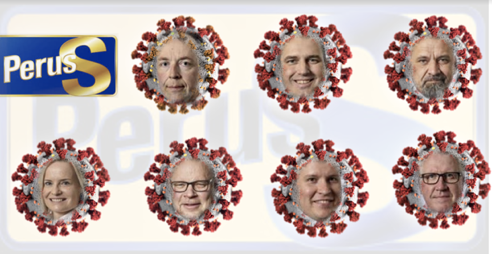
Here are some symptoms of the coronavirus: fever, dry cough, sore throat, tiredness, headaches, loss of taste, and smell. Here are some symptoms of the PS virus: racism, Islamophobia, bigotry, climate denial, conspiracy theories, mediocracy, pro-Putin, and incompetence.
Like Covid-19, which fools and infects healthy cells, the PS virus also enters and infects institutions like parliament. The PS got a foothold in the Finnish political system by pulling fast ones on voters, spreading hate, and giving overly simplistic answers to complex questions.
We need a vaccine for the Covid-19 and PS viruses.
For the latter, the antibodies to kill the PS virus are empathy, caring, and anti-racism education based on social equality for all.
Perussuomalaiset MPs (upper row lefrt to right): Jussi Halla-aho, Jani Mäkelä, Mauri Peltokangas, (lower row left to right) Riikka Purra, Ano Turtiainen, Ville Tavio and Veikko Vallin. Cartoon by Hamid H. Alsammarraee.
The PS virus cannot be compared with a temporary hiccup. It is more lethal than that. If we are not careful, it can mutate Finland into Hungary and Poland, or worse.
Below are some more examples of the PS virus and what it has infected our democracy from MAGA caps to adulations to Trump.
Two PS MPs, Vilhelm Junnila and Veikko Vallin giving the thumbs up to former President Urho Kekkonen (1956-82). With or without disinfectant and beams of light, the PS is Finland’s most pro-Trump party. Source: FacebookOn June 4, 2019, Halla-aho tweets: “I dig him. Trump is the best thing that has happened in a long time to the United States and to the Western world.”
The family is the natural and fundamental group unit of society and is entitled to protection by society and the State.
Article 16 of the UN Declaration of Human Rights
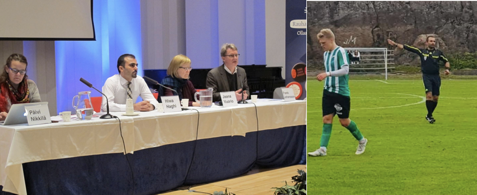
Hiwa Haghi is an Iranian Kurd who has lived in Finland since 2004. In many respects, he’s the ideal migrant: speaks Finnish fluently, is employed, and does youth work for at least nine associations. One of his passions is football.
According to some people, Haghi is a respected member of the community for three reasons: he turned opportunity into success through hard work and perseverance.
As Haghi has placed his trust in his new home country, he hopes and expects that the feeling is mutual.
He got, however, a crude surprise from the Finnish foreign ministry in January when they turned down his sixty-five-year-old father’s and younger brother’s visa application. He applied for the visas the previous month.
Hiwa Hagh’s father and younger brother. Source: Hiwa Hagh’s family album.
“After spending over 3,200 euros in translations, legalizations of documents, trips to [the capital] Teheran [from northwest Iran], lots of energy, stress, time and dealing with red-tape,” he continued, “I was disappointed when the foreign ministry turned down my father’s and brother’s visa application.”
In the ordeal to bring his relatives to Finland, push eventually turned to shove when the Finnish Embassy in Teheran charged his brother 70 euros to cover for postage costs for the letter that officially denied them the visas.
The sum asked by the embassy is considerate, considering that the average salary is in Iran is about 100 euros a month.
“They justified the charge due to Covid-19.” he continued. “This was the reason why they did not allow my brother to retrieve the letter from the embassy and wanted to mail it.”
Haghi has filed a formal complaint and appeal to the foreign ministry for refusing his father and brother the visas.
Hiwa Hagi is a member of a number of associations. He likes to ref football matches as well. Source: Hagi’s family album.
The Iranian Kurd believes that matters have become more difficult for people from Muslim countries due to 2015, when a record number of asylum seekers came to Finland.
He suspects the reason why the foreign ministry turned down the visa applications was that it didn’t believe that his father and brother would return to Iran after their visit.
In 2010, when Haghi’s father and mother visited Finland, there were no problems in getting visas for them.
A number of questions arose during the visa application. Haghi’s father, who has no formal education and is a farmer, had to give a day-by-day program of his stay in Finland.
“When they asked him [at the embassy] about going to the swimming hall with his grandchildren, they even asked the name of the place,” he said, “naturally, my father did not know the answer.”
One matter that Haghi wanted to make clear to the foreign ministry is that his father and brother have no reason not to return to Iran.
Haghi said that their visit is especially important to his 7.5- and 2-year boy and girl, respectively. When his parents visited Finland in 2010, his children weren’t yet born.
Hiwa Haghi and his parents when the visited Finland in 2010. Source: Hagi’s family album.
“My children ask me a lot of times when their grandfather and uncle will come to Finland,” he said. “I cannot tell them the truth, so I blame it on the coronavirus pandemic.”
Haghi stated that his grandfather’s and brother’s visit would be important for him as well since they could see how he’s succeeded in Finland.
Like many families, Haghi’s children are multicultural. They speak Finnish as well as Kurdish fluently.