And also, may people fleeing war, injustice and poverty find that place over the hill where they can build a better life. Give us strength as well to build a strong and vibrant culturally diverse Finland that lives in peace and reaps all the good things.
Give us strength to beat racism and all forms of discrimination so we can live in a country that respects who we are.
It is my sincere wish. The struggle continues despite a bit of momentary fanfare now.
If I had to choose the worst journalism in Finland this year, that would be the media coverage to the sexual assault cases of minors that took place from November 2018 to before the parliamentary elections of April 14.
If you speak with some Muslims in Oulu, they will tell you that the hysteria died down after the April parliamentary elections.
In all fairness, I would like to point out that Finland has, fortunately, newsmagazines like Suomen Kuvalehti and other regional papers that try to report fairly and objectively about the plight of Muslims and minorities in Finland.
Many stories published in the Finnish media reinforce stereotypes about Muslims. This story, published in September 2018, is one of the worst examples. The woman wearing a niqab in the picture does not represent a political party even if the story was about niqab and burka bans in Finland. The picture was taken down shortly after it was published. Source: Yle.
If one can describe the frenzy that was fuelled by the media, police, and politicians concerning the Oulu sexual assault cases, it would be similar to the incitement of a lynch mob before they are about to hang a person in public.
Even if a real lynching is different from one that takes place on social media, both have the same aim. If a real lynching publicly murders a person, a social media lynching kills over and over again a scapegoat, which is often an ethnic group.
Turkish writer Mehmet Muran Ildan described the act of lynching in the following words: “A society with lynch culture needs a big zoo, not for the animals definitely, but for the very people themselves!”
When the media is in “lynch mode,” fair reporting is the first victim that is sacrificed. State Broadcasting Company Yle is a sad example of the latter. It threw in the dustbin and permitted its prejudices and biased reporting to get the best of it.
Just like the coverage of the Oulu sexual assault cases, the coverage of the repatriation of about 11 Finnish women and 30 children from the al-Hol camp in Syria was characterized by disinformation and lack of information. This illustration used in a Helsingin Sanomat story has women apparently wearing burkas even if they use niqabs. See Migrant Tales.
An example of Yle’s biased and unbalanced reporting were the stories it published between November 27 and February 13 on the Oulu sexual assault cases. A total of 77 stories were published during the period under review. In one day, Yle published 13 stories about the topic!
Even if it appeared from the media, police statements and politicians that Finland was suffering an epidemic of sexual abuses by migrants, only eight were convicted and given prison sentences.
While not criticising the media, Päivi Happonen, a Yle reporter, wrote in her blog the over-enthusiastic communications policy of the Oulu police. “So what bad did [Oulu police’s communication] inflict?” she asked. “A lot. Many have the impression that Oulu became the crime capital of Finland, where asylum seekers rape all the children they can.”
The unbalanced and overzealous reporting spread fear as well in the Muslim community. According to Imam Abdul Mannan of Oulu, Muslims did not feel safe and avoided going to the city center.
Another matter that sparked excesses by the media’s reporting was that parliamentary and European parliamentary elections were going to be held in April and May, respectively. Politicians from the governing party demanded tougher laws on crime and even tests on Finnish values to asylum seekers. The City of Oulu went as far as to ban asylum seekersfrom visiting daycare centres and elementary schools.
Even if the governing National Coalition Party and Center Party attempted to gain from the situation with their ever-get-tough stance on “people of foreign origin,” which is code for non-EU citizen or Muslim, the party that reaped the most from the situation was the Islamophobic and populist Perussuomalaiset (PS).*
This is reinforced by opinion polls published monthly by Helsingin Sanomat, and Yle. Yes, you read correctly: monthly polls.
One such poll showed the popularity of the PS rising by an impressive 13.7 percentage points in a year, from 8.7% to 22.4% in November.
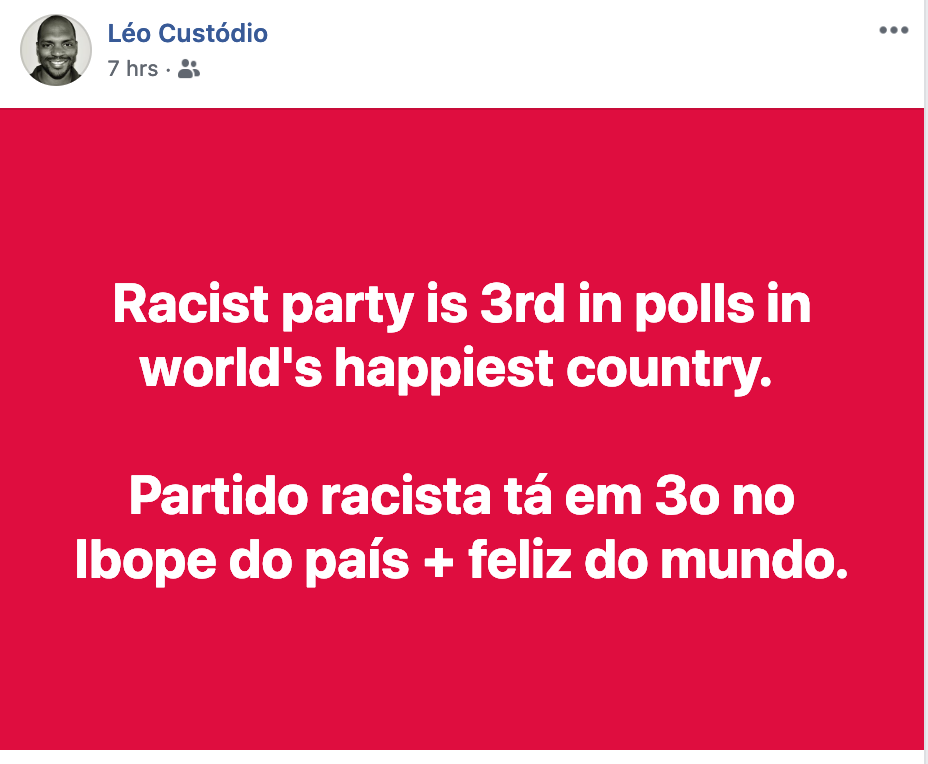
Léo Cutódio published at the end of March the following posting on Facebook. In March, a Yle poll showed the PS with 15.1% and trailing behind the Social Democratic Party and the National Coalition Party.
Emilia Palonen, a University of Helsinki lecturer, was quoted as confirming that “anti-immigration sentiment” is the cause for the rise in popularity of the PS. Even if Palonen does not state it directly, one of the causes of the growth in such anti-immigration sentiment is due to Oulu.
One wonders how a country like Finland, which scores high on the World Press Freedom Index, so many important newspapers get it wrong when it comes to writing about Muslims and minorities.
There are various reasons why news coverage of Muslims and other minority groups is unbalanced:
Muslim and minority sources and experts are rarely used as authorities in a balanced news story.
The media too often paint Muslims, and minorities with a single brush and underline a narrative of “Us” versus “Them.”
There are no Muslim editors and there is an underwhelming number of visible minorities working in newsrooms as staffers.
Some media continue to give inflated respectability, importance, and space to Islamophobes and xenophobes.
Helsingin Sanomat’s staff is celebrating the daily’s 130th anniversary in November. Do you see any minorities? Only one person in the picture has a so-called foreign-sounding name. With about 16% of Helsinki’s population is non-white Finnish, Muslims and minorities are underrepresented in the newsroom. Source: Helsingin Sanomat.
If there is something that publications like Helsingin Sanomat and Yle could do is to write critically about the racism and Islamophobia in parties like the PS and not to treat their politicians in a neural-friendly manner.
The media is a crucial watchdog that looks over people’s rights irrespective of their backgrounds. If Finland doesn’t watch out, and especially its media, the slippery slope to Viktor Orbán’s Hungary is not too faraway.
Dedicated to the racist politicians, political parties and groups in Finland.
And let’s be clear. I am talking about the Perussuomalaiset (PS)*, National Coalition Party (Kokoomus), Christian Democrats, neo-Nazi groups and websites like Hommaforum. Some politicians that come to mind are Jussi Halla-aho, Riikka Purra, Ville Tavio, Matias Turkkila, Ano Turtiainen, Mauri Peltokangas, Juha Mäenpää, Junes Lokka, Tiina Wiik, Wille Rydman, Petteri Orpo, Sari EssayahPaula Risikko and a long list of others.
The late Toni Morrison (1931-2019) exposed the tiny soul of the racist.
“[but] when you take it [from the racist] away, I take your race away, the only thing you got is your little self, and what is that? What are you without racism? Are you any good? Are you still strong? Still smart? Do you still like yourself?”
The Finnish media should stop using a bazooka to kill an ant.
Is the Finnish media fair when it reports about migrants and minorities like Muslims? Is its reporting biased and unbalanced?The Oulu sexual assault cases and the debate surrounding the al-Hol are the latest examples.
Certainly, State Broadcasting Company Yle’s coverage of the Oulu sexual assault cases is a low point and an example of overkill. From November 27 to February 13 is a case in point. Back then, the state-owned broadcaster published a whopping 77 stories on the topic. On January 14, Yle published 13 stories about the issue.
Not only did the media cover the story disproportionately, but politicians and even the police poured fuel on the flames of suspicion and racism. Matters got so bad that Muslims feared to go to the city center and were barred by the city of Oulu from visiting child-care centers and elementary schools.
Even if the media, politicians and the police suggested that the sexual assaults of Oulu pointed to an epidemic, only eight were convicted.
Another example of overkill by the Finnish media is the repatriation of some 30 children, and possibly their mothers to Finland.
Helsingin Sanomat published 36 stories that dealt with the al-Hol camp in Syria. Source: Helsingin Sanomat.
Just like in the stories written about Oulu cases earlier this year, Yle published 71 stories during twenty days (December 2-21), with Helsingin Sanomat publishing 36. The average number of stories that Yle and Helsingin Sanomat published daily was 3.5 and 1.8 stories, respectively.
The most active day for Yle was December 19, when it published 11 stories, and for Helsingin Sanomat it was December 17 and 16, when it published six stories a day apiece.
Considering that Finland does have good journalists like Jessica Aro and the country scores second on the World Press Freedom Index after Norway, I wonder where the Finnish media would stand on its coverage of minorities like Muslims?
The top-six countries on the World Press Freedom Index, Norway, Finland, Sweden, Holland, Denmark, and Switzerland, are inflicted by social ills like Islamophobia. Add to the latter the underwhelming size of minorities working as staffers, and we can decipher why media coverage is biased and unbalanced.
Considering that 16% of Helsinki’s population is not white Finnish, Helsingin Sanomat appears to not have a single journalist who is a minority and a full-time staffer. Source: Helsingin Sanoamt.
How do we get more balanced and less biased reporting of minorities? One important step would be to hire more journalists who don’t have only a white perspective of society.
“Mielestäni kahta asiaa. Ensinnäkin sitä, että kokoomuksen puheenjohtaja Petteri Orpo on sanonut, että näitä (al-Holin suomalaisia) lapsia ei pidä auttaa, jos se tarkoittaa näiden äitien auttamista. Hallituksen linja lähtee siitä, että nämä lapset, joista monet ovat alle viisivuotiaita, taaperoita, päiväkoti-ikäisiä lapsia, heitä pitää auttaa, lapsen etu pitää olla ensisijainen. Tämä ei ole kokoomuksen linja, ja minun mielestäni kokoomuksen linja on tässä suhteessa väärä.
Toinen asia. jota olen peräänkuuluttanut ja josta meidän hallituksemme tulee kyllä pitämään kiinni on se että kunnioitetaan meidän oikeusvaltiotamme, sitä että meillä on vallan kolmijako-oppi. Hallitus, eduskunta, poliitikot tekevät poliittisia linjauksia, poliittisia päätöksiä, mutta me emme tee päätöksiä yksilöiden hengestä ja elämästä, me emme tee päätöksiä yksilötasolla. Se on sitten viranomaisten tehtävä, joilla se toimivaltuus on. Mielestäni tästä pitää pitää kiinni. Olin aika ihmeissäni siitä, että kokoomuksen suunnalta tämä erittäin voimakkaasti kyseenalaistettiin ja sanottiin, että hallitus piilottelee virkamiesten selän takana. Näinhän ei ole. Meillä on oikeusvaltiorakenteet ja niistä kaikissa tilanteissa pitää kiinni.”
Helsingin Sanomat carried out a survey asking if Pirkka-Pekka Petelius did the right thing to apologize to the Saami for mocking them in a racist manner in the Hymyhuulet show (1987-88). The survey showed that 57% thought that Petelius was wrong to apologize, while only 29% said that he did the right thing; 14% had no opinion.
The most vigorous opposition to the apology came from the 50-69-year age group. Two-thirds of them considered the apology wrong. Those who were under 30 years had higher education and voted for the Left Alliance, and Green League party were the most favorable.
Petelius, who is a Green League MP, said that he was surprised by the reaction his apology produced.
“I’ve experienced quite heinous accusations, threats, and hate speech for apologizing to an indigenous group [like the Saami],” he was quoted as saying in Helsingin Sanomat. “Incomprehensible. It is my business to convene the Saami and apologize to them for the impact that my sketches have had. ”
Finnish white privilege #67
The Helsingin Sanomat survey is not only an indication of the deep roots of Finnish white privilege but of white fragility as well.
Robin Diangelo describes as white fragility in her best-selling book, “White Fragility.” She states that most white people “are absolutely not receptive to finding out their impact on other people.” She also mentions that the reaction caused by white fragility is nothing fragile but hostile.
If Petelius’ apology can create such a knee-jerk reaction of hate and hostility, ask yourself how many Finns would be ok with living with people of color and treating them as equals.
The reaction to Petelius’ apology also shows the ethnic and racist bubble the country continues to live in and who calls the ethnic-racial shots. Hint: It isn’t the minorities.
Migrant Tales has written numerous stories about how the Finnish media frames minorities and people of color. What is most incredible about his fact is that it continues in the Finnish media and even by Helsingin Sanomat, the county’s most important daily.
If there is one criticism of Finland’s media, it is, in many cases, its lack of fairness and overkill when it writes about migrants and minorities. In many cases, the scene appears like a person (the media) trying to kill an ant (Muslims) with a bazooka.
Apart from unfairness, the Finnish media is biased and unbalanced when it writes about minorities like Muslims.
Yle’s coverage of the Oulu sexual assault cases from November 27 to February 13 is a case in point. Back then, the state-owned broadcaster published a whopping 77 stories on the topic. On January 14, Yle published 13 stories about the topic.
How many people have been tried and convicted in the Oulu sexual assault cases? Only eight, but some believe that the hysteria generated by the media and politicians gave the Islamophobic Perussuomalaiset (PS)* party a significant boost in the recent parliamentary elections.
Another example of media hysteria is the hype about the fate of a handful of Finnish women and children in the al-Hol refugee camp in Syria.
Finland’s media needs to get real and to come to terms with its past and present racism, which is strongly denied. An apology and hiring minorities to the newsroom would be an essential first step.
The Finnish media could also start taking a clearer stand on racism and discrimination in our society by writing editorials. One of these topics could be on populism and how it is hreatening our Nordic way of life.
Finnish magazines like Hymy in the 1990s did not hide their racism. In this story about Lola Odusaga, elected Miss Finland in 1996, offers readers answers to the following questions: Does a black person get a tan, bruise and do teeth shine at night? See the original blog post (in Finnish) here.
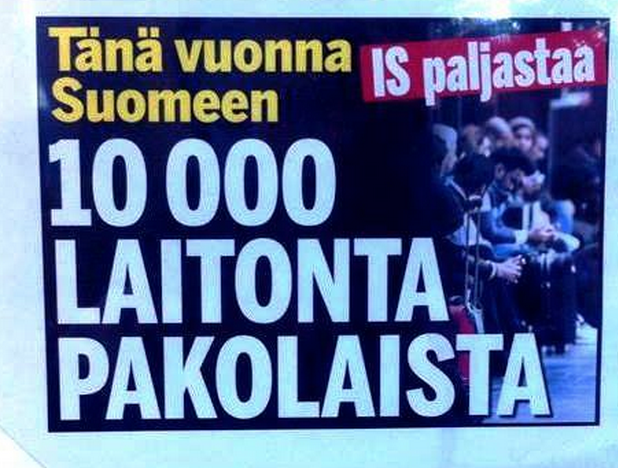
Tabloids like Ilta-Sanomat and Iltalehti have a questionable record when it comes to coverage of minorities like Muslims in Finland. This billboard of 2015 claims that this year Finland will get 10,000 “illegal” refugees. What is an “illegal” refugee? There is no such thing. Source: Ilta-Sanomat.An Ilta-Sanomat billboard that claims that the Somalis in the early 1990s swindled the authorities n getting refugee status. Source: Ilta-Sanomat.Believe it or not, but in the 1990s, Somalis who would not go back to thir former homeland was big “news.” it was news to publish that the Somalis were not going back to their homeland but planned to make Finland their home. Source: llta-Sanomat.
A 10-year-old child in a department store in Tampere was attacked by a man with a knife. The suspect took two swings at the child but his father was able to stop the attack. Even if the suspect was a white Finn, and fearing a social media storm on social media, the police announced that the suspect “does not have a foreign origin.”
“A person with foreign origin” is code for a non-EU citizen or a person of color.
To put it simply, and if this happened in the UK, the police would write in the statement that the suspect isn’t a person of color, Muslim, Jew or any other minority.
These types of statements by the police racialize crime and cave in to the anti-immigration populism of parties like the Perussuomalaiset.*
Finland’s biggest daily Helsingin Sanomat published a story about a Finnish woman who impersonated a Japanese tourist asking dumb questions to Finns. The show was so popular that it even won a Venla award, a Finnish version of the USAmerican Emmy Award.
That was in 2014.
Why would Helsingin Sanomat, a newspaper with vast resources and power, like to commemorate a Finn that impersonates a Japanese tourist? What’s the joke, and isn’t this racist and embarrassing that a daily wouldn’t even ask if this show is offensive to the Asian community in Finland?
Is this racist? Sure it is because it spreads stereotypes of the Japanese. It is also shameful considering that Finland’s most prominent daily still publishes these types of stories in 2019 uncritically.
In the Helsingin Sanomat story, there is no mention if this is racist and if it insults Asian communities of Finland. Read the full story (in Finnish) here.
One may ask why such stories ever get past the copy editors and why no one at the daily asked if these types of stories were ever ok?
Helsingin Sanomat recently celebrated its 130h anniversary. See any people of color or minorities, even if about 16% of Helsinki’s population are not white Finns? Source: Helsingin Sanomat.
The answer to that question could probably be found in the picture above, where there isn’t a single visible minority on the Helsingin Sanomat staff, even if about 16% of Helsinki’s population comprises of migrants and non-white Finns.
Prime Minister Sanna Marin announced today that Finland would assist in the repatriation of some 30 Finnish children in the al-Hol camp in Syria, according to Yle.She said that Finland had no obligation to help the mothers.
While the announcement was expected after President Sauli Niinistö stated his view on the matter Sunday, it’s clear that the decision by the government is political.
University of Helsinki family law researcher, Sanna Mustasaari, warned about the danger of mixing politics with the al-Hol children’s welfare.
“The mothers weren’t helped because it was [a] political [decision],” she said on Yle’s A-Studio, adding that “under no circumstances” should the child welfare authorities, in searching for legal reasons to help the child, allow politics to influence their decision.
University of Helsinki family law researcher Sanna Mustasaari. Source: Yle.