A Finnish woman called Nina that came to talk this week to a group of demonstrators that want more support for the besieged people of Mosul in northern Iraq.
Nina told the crowed that we must do much more to help the people in Mosul as in Aleppo in Syria. ?
One of the demonstrators, Mohammad M. and others present from Mosul, have approached international and local organizations to lend support under the title, “Save the People of Mosul.”
Below are the biggest concerns for the people of that city:
Fears of the destruction of the entire city and the forced displacement of people and the imposition of a deadly siege on the city;
Condemnation for using forbidden weapons in battle such as chemical weapons, which is considered a war crime;
We demand the United Nation (UN) and the international community to halt the indiscriminate shelling of the ancient city and to provide rapid and urgent humanitarian aid for displaced people who are dying almost daily due to lack of medication and food;
What is happening in Mosul is a great crime against humanity. Mosul has become a devastated city. There is significant international neglect of children, women and the elderly, who are being killed every day in the city;
We acknowledgement the temporary efforts by the Finnish Red Cross to help those people in need in Mosul;
Demand an end to the scorched earth policy;
All those groups fighting for control of Mosul are using heavy artillery, rockets, and heavy machine guns. The only victims are the civilians. The use of such heavy weapons that target civilians must stop;
We urge the UN to force all those taking part in the fighting to refrain immediately from targeting civilians and stop the destruction of Mosul.
Demonstrators showing support and solidarity for the besieged people of Mosul. A Finnish woman called Nina had attended the demonstration and told about the dire situation in Mosul after having visited the northern Iraqi city recently.
Ever since Finnish President Sauli Niinistö characterized the ongoing debate on migrants, migration, asylum seekers and minorities as a debate between two extremes, the big question is who is the other extreme?
This “two-extreme” characterization of the debate by Niinistö and government ministers like Paula Risikko reveals their ignorance and objection to the debate. It shows as well their hope that the debate will be between white people in this country.
As everyone knows, Migrant Tales together with many anti-racism activists do not consider ourselves as “extremists” but normal folk that support human rights, Nordic values and cultural diversity.
It’s clear that politicians like Niinistö, the government and many others see these types of values with suspicion and contempt. That is one reason why they dub the debate as “two extremes.”
US President Richard Nixon, facing impeachment and a challenge from liberal and progressive sectors, used the same tactic by stating that it was a minority that opposed him and that law-abiding USAmericans, the silent majority, like the Okie from Muskogee, who was behind him.
Todo empezó allá por 1944 cuando Rodolfo Walsh tenía 17 años y contestó un aviso en un diario porteño de la Editorial Hachette, situado en pleno centro de la capital, en la calle Maipú 41. La editorial buscaba un traductor del inglés al castellano de carácter permanente.
En aquel entonces, Hachette tuvo por muchos años unas ediciones de bolsillo literatura universal, libros para la juventud, la divulgación científica y otra dedicada a la novela policial. La novela policial tiene un desarrollo muy grande durante los años 40 en los Estados Unidos, y se seleccionaba obras de escritores de novelistas policiales que se traducían del inglés al castellano. “Entonces, una de las personas que se presentó para el trabajo fue Rodlfo Walsh,” dice Horacio GuillermoManiglia, hijo de Horacio Aníbal Maniglia, quien había contratado a Walsh en Hachette. “El era joven y por ser un argentino de familia irlandesa y haberse educado en colegios irlandeses, obviamente conocía muy bien el idioma inglés.”
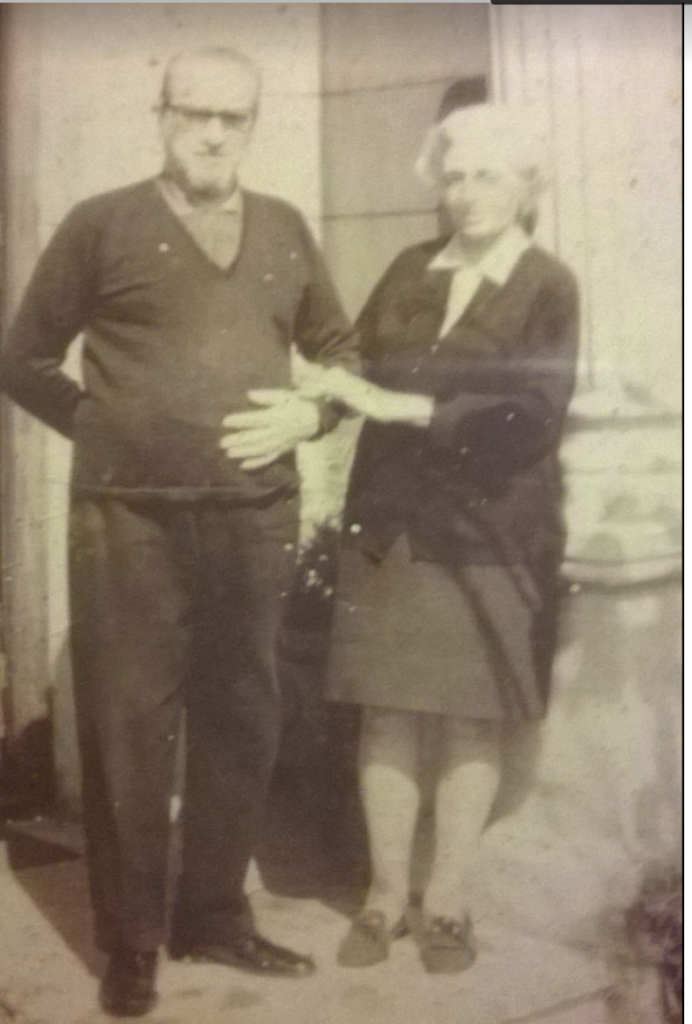
Horacio Aníbal Maniglia y su esposa Carmen en la puerta de su casa de la calle José Bonifacio en Buenos Aires.
Maniglia dice que su padre, Walsh le pareció ser una persona muy inteligente y muy capaz, y es por eso que lo tomó como empleado permanente.
“Se desempeñó muy bien y a los veinte años le toco a Walsh hacer el servicio militar,” continua Maniglia. “Hizo el servicio militar y le mantuvieron el puesto porque ya había acreditado sus capacidades. En 1953 publica su primer libro, ‘Variaciones en rojo,’ y se lo dedica a mi padre.”
Según Maniglia hijo, la relación que tenía su padre con Walsh era de una amistad intelectual y profesional. “Los dos eran traductores de libros y amantes de la literatura y del buen cuento literario,” dice.
Como se sabe, Walsh empezó a interesarse en la política a raíz de algunos acontecimientos políticos muy famosos. En el año 1955 se produce un golpe de estado, el 16 de septiembre, llamado irónicamente la Revolución Libertadora, cuando derrocan al presidente Juan Domingo Perón, instigados por los general Pedro Eugenio Aramburu y su vicepresidente, el almirante Isaac Francisco Rojas. “Al año siguiente (1956), se produce un levantamiento militar en contra de Aramburu (encabezado por los generales Juan José Valle y Raúl Tanco), que es reprimido con gran violencia,” continua Maniglia. “Clandestinamente, se lleva a algunos de los implicados a un descampado situado en José León Suárez (en las afueras de la ciudad de Buenos Aires), y allí se los fusila a todos, excepto a uno.”
Es entonces cuando Walsh empieza una larga investigación, luego de haber obtenido un mensaje escrito de un desconocido en un bar de la ciudad de La Plata, diciendo que “todos los fusilados no están muertos.” Comienza el gran trabajo investigativo de Walsh para localizar a esta persona sobreviviente y escribir su célebre libro Operación Masacre.
“Como todo se debía hacer en gran secreto,” continua Maniglia, “Walsh se veía obligado a cambiar de domicilio y a no estar siempre en el mismo lugar. Temía sufrir alguna represalia porque estaba investigando y metiendo la nariz donde no debía. Mi papá le ofreció en esta circunstancia una casa muy modesta que tenía en Pontevedra, en las afueras de la Capital Federal, y Walsh aceptó porque no tenía muchas opciones para refugiarse.”
Maniglia hijo, quien tenía en aquel entonces sus 17-18 años, acompañó a Walsh a esa casa en invierno, porque su padre, Horacio Aníbal, no pudo hacerlo por razones de trabajo. El se acuerda que Walsh había tomado su máquina de escribir portátil para empezar a escribir su obra.
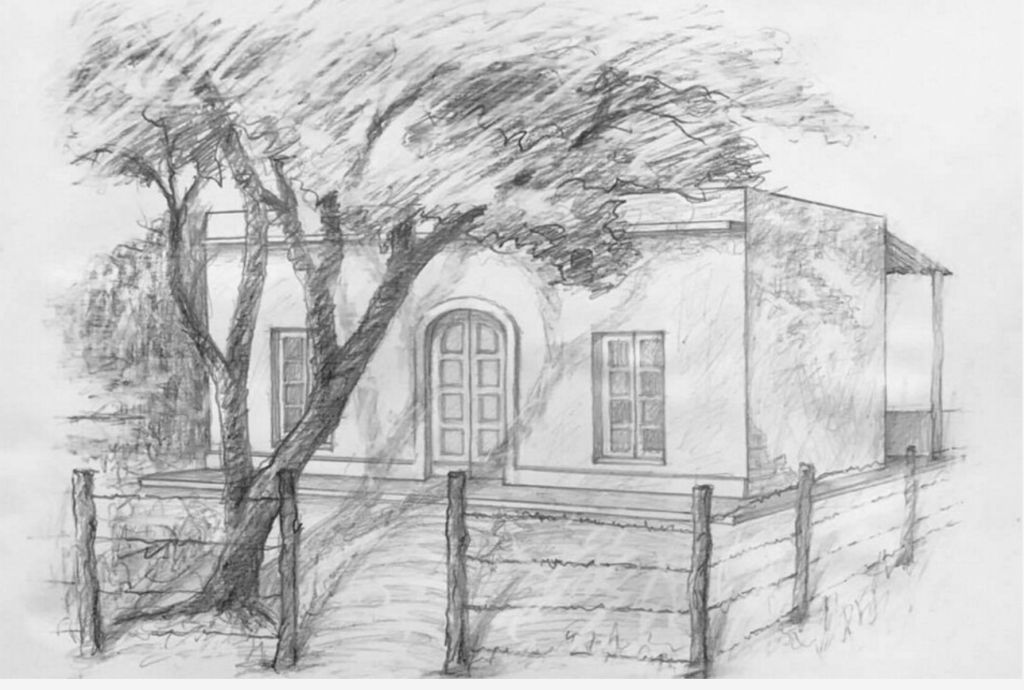
La casa donde Walsh se alojó por poco tiempo era de unos 50 a 60 metros cuadrados, y tenía dos ambientes grandes después de la cocina y un baño. Construida a fines del siglo XIX, estaba hecha con ladrillos que no se usaban más, puertas de madera de cuatro pulgadas, ventanas que nacían a 20 cm del piso hacia arriba, con rejas. No tenía electricidad y había que usar faroles. “Ampliamos la galería de atrás y la hicimos más ancha,” dice. “Una característica de la casa era que no tenía ninguna calefacción,porque en realidad nosotros no íbamos nunca, salvo por un momento en el verano.”
La casa donde se alojó Rodolfo Walsh en Pontevedra. Dibujo por Horacio Guillermo Maniglia.
Walsh se alojó allí 3 ó 4 días, o a lo sumo una semana, hasta que el frío lo obligó a huir. “Cuando lo vi, me dijo jocosamente que prefería morir a quedarse allí otro día,” continua. “A pesar de que en el dormitorio tenía una cama con dos mantas de lana hechas por los indígenas del norte y que tenían un espesor de un centímetro cada una, el frío era insoportable y el único lugar donde había calefacción era la cocina.”
Desde Pontevedra, Walsh se había trasladado a vivir a la región del Delta del Paraná, donde terminó de escribir “Operación masacre.”
Veinte años mas tarde, el viernes 25 de marzo de 1977, en la esquina porteña de San Juan y Entre Ríos, es abatido a balazos por un grupo de tareas de la notoria Escuela de Mecánica de la Armada (ESMA). No me acuerdo de esa fecha y qué estuve haciendo. Estoy casi seguro que visité a mi tío Horacio Aníbal en Flores, pero de Walsh y su relación con él no hablamos, hasta que me lo contó su hijo en 2015.
Sin duda, la Argentina había perdido, hace exactamente cuatro décadas, a un gran periodista y luchador social. La modesta historia de la relación de mi tío con Walsh, cuando aún no había llegado a la fama, la pude rescatar de pura casualidad. Es como cuando él se encontró una tarde con el mensaje “hay un fusilado que vive,” en aquel bar de La Plata, que le cambió su vida y la del país para siempre.
A new study published Tuesday by the interior ministry and carried out by Vaasa University raises some disturbing questions. What does the survey address and what does it reveal?
One of the many claims of the survey is that those surveyed want a more dispassionate public debate about asylum policies.
An interior ministry statement reads: “Finns would like to be able to discuss asylum policy without the fear of being stigmatized; the discourse should be relevant and fact-based. The issues that were highlighted in the discourse on asylum policy were social polarization, promotion of integration activities during the asylum seeking process and the impact of the asylum seeker situation on security.”
Other findings of the survey reveal already known tough public views about asylum seekers. For example, 82% of the respondents felt that it should be made perfectly clear to those asylum seekers that get a residence are obliged to follow our social rules and that language courses should be emphasized (87%).
The survey doesn’t tell us what those “rules” are for the simple fact they most likely don’t know either.
Other findings of the survey published in Helsingin Sanomat include: 83% responded that if an asylum seeker lies in the the interview process to get asylum it should affect directly his or her chances of getting a residence permit; 78% felt that the police should forcibly deport those who get rejected for asylum if they do not leave the country.
Other matters that the survey showed was that asylum seekers cause social conflicts (59%), increase crime (57%) and the threat of terrorism (64%).
It’s clear from the comments of far-right Suomi Ensin protestors and even of some Helsinki city councilors that they want the #righttolive demonstration that has been going on since February to end. Even so, far-right demonstrators are confident that the police and Finnish political establishment is on their side that they video and upload an attack against two demonstrators of the #righttolive camp.
Writes Saku Timonen in his blog: “This [far-right] Suomi ensin groupconstantly stirs conflict and provokes [the #righttolife demonstrators]. They would like to fight and when they’re about to they use an illegal weapon [spray].”
One of the most disturbing matters about the incident is the police, who are nowhere around and allegedly dragged their feet to capture the perpetrator, one of which is
Imagine if the asylum seeker demonstrators would have acted in the same way as these thugs?
Guess who uploaded this video? Right, Marco de Wit of far-right Suomen Ensi (Finland First). They have tried everything to make the lives of the asylum seekers protesting peacefully as difficult as possible. Interior Minister Paula Risikko visited the Suomen Ensi camp in February and gave them a thumbs up.
Writes Helsingin Sanomat: “At the end of the incident, a little over 20-year-old man’s face was sprayed [by the Finnish perpetrators with a pepper spray]. After this happened, the victim went to the closest restaurant to wash his face but he was followed by the group that had sprayed him [in the face]. These [Finns] threatened the man for a short while in the restaurant, according to the police.”
The hate speech and provocations are real.
Migrant Tales published a video below on Wednesday and attracted over 6,200 views.
Ihmisrotuja on vain yksi. Sen nimi on ihminen. Siksi rasismi on käsitteenäkin virheellinen. Sen lisäksi se on surullinen ja pöyristyttävä. Niiden ulkoisesti havaittavien seikkojen, jotka tekevät meistä iloisesti erilaisia, kuten sukupuoli, alkuperä, fyysiset ominaisuudet tai äidinkieli, ei tule olla peruste minkäänlaiselle syrjinnälle. Syrjimättömyys on osa inhimillisyyttä ja osa hyvänä ihmisenä olemista.
Suomi ei ole koskaan ollut, ei ole nykyään eikä toivottavasti tule koskaan olemaankaan etnisesti yhtenäinen kansakunta. Suomi on moninainen maa. Vain erilaisten ihmisten kohtaamisesta ja erilaisten ajatusten yhteen sovittamisesta syntyy uutta ja kestävää. Uutta ajattelua, uusia tapoja toimia, uusia tapoja tuottaa tavaroita ja palveluja. Moninaisuus ei ole vain poliittinen tavoite, vaan myös ja varsinkin osa arkipäivää.
Maahanmuuttoviraston Migrin linjan mukaan toissijaisen suojelun saaminen Irakissa edellyttää, että turvapaikanhakijalla on henkilökohtaiset perusteet vainolle:
Migrin mielikuvituksella ei ole rajoja kun keksitään syitä miksi vaino EI olisi henkilökohtaista:
25-vuotias turvapaikanhakija Bagdadista on työskennellyt amerikkalaisille ja joutunut vuonna 2013 tappouhkausten kohteeksi koska häntä on pidetty vakoojana. Vuonna 2014 uhkaukset ovat jatkuneet ja perheen taloa on ammuttu. Vuonna 2016 isä on siepattu ja äiti pahoinpidelty.
Mutta koska oikeudenloukkaukset ovat kohdistuneet vuonna 2014 ja 2016 koko perheeseen ja myös todistajia on uhkailtu, Migrin mielestä vaino ei ole henkilökohtaista eikä pelko objektiivisesti perusteltua.
Migri kirjoittaa perusteluissaan näin:
”Koska olit perheesi kokemaa uhkausta ja ampumavälikohtausta ennen siirtynyt asumaan kotikaupunkisi sisällä toiselle alueelle, ja uhkausten sisältönä oli muualle siirtyminen, uhkaus ei ole voinut kohdistua sinuun henkilökohtaisesti. Asiassasi ei ole myöskään esitetty mitään mikä antaisi perusteltua syytä epäillä, että vuoden 2014 uhkaus ja ampumavälikohtaus olisivat syy-yhteydessä vuonna 2013 saamaasi uhkaukseen ja aiempaan työhösi tai että niiden takana olisivat samat tahot… perheesi kotiin on hyökätty 2016, äitisi pahoinpidelty, isäsi siepattu ja asiasta tehty rikosilmoitus. Asiassa ei ole esitetty mitään, mikä antaisi perusteltua syytä epäillä, että nämä tapahtumat liittyisivät suoranaisesti sinun saamiisi uhkauksiin tai ampumavälikohtaukseen.”
Kuitenkin samaisessa KHO:n päätöksessä, johon Migri viittaa, toissijainen suojelu on myönnetty turvapaikanhakijalle, vaikka henkilöön itseensä ei ollut kohdistunut uhkaa:
“Muutoksenhakijan isällä on henkilökohtaisia ja vakavia kokemuksia mielivaltaisesta väkivallasta Bagdadissa. Nämä kokemukset…eivät yksin osoita, että…vaara koskisi juuri muutoksenhakijaa. Nämä kokemukset on kuitenkin otettava huomioon arvioitaessa koskeeko ulkomaalaislain 88 pykälän 1 momentin 3 momentissa tarkoitettu vaara juuri häntä.”
Seuraavassa turvapaikanhakijan negatiivinen päätös:
Olet hakenut Suomesta kansainvälistä suojelua. Olet kertonut turvapaikkapuhuttelussa hakevasi Suomesta kansainvälistä suojelua, koska olet saanut aseelliselta ryhmittymältä uhkauksia sen takia, että olet työskennellyt aiemmin amerikkalaisten joukkojen kanssa ja perheesi taloa on ammuskeltu.
Asianajajan toimittamat lisäselvitykset, joiden mukaan kotiinne on hyökätty, jolloin äitisi on pahoinpidelty, ja isäsi on siepattu, asiasta on tehty rikosilmoitus, joka on toimitettu Maahanmuuttovirastoon pahoinpidellyn äitisi valokuvien kanssa.
Finnish Perussuomalaiset (PS)* parliamentary group leader Sampo Terho wrote a decade ago in Kanava an essay with the classic far-right populist rhetoric about the threat of migration. His point of view in the essay is not only sinister but was a central argument used by parties like the PS to attract voters and that their racism was “normal.”
UPDATED (20.3): By publishing this baloney in a respected publication like Kanava, Terho’s aim is to substantiate his racist points of views.
Many politicians who wrote racist things in the past and which helped them get elected want us to forget.
We cannot and should not forget for the sake of decency and respect for future generations.
Terho is not just any PS MP with racist views, but one that is vying to become chairman of the anti-immigration party after Timo Soini steps down in early June.
In a letter to the editor to Helsingin Sanomat, Terho claims that his or Halla-aho’s election to the helm of the party will not force it a path of “sheer darkness and evil.”
Columnist Yrjö Rautio wrote in Helsingin Sanomat Friday that if either Terho or Halla-aho become chairman of the PS it would not only mean the end of Soini’s populist project but a slip into “sheer darkness and evil.”
We disagree with part of Rautio’s analysis. The PS was always a party of “sheer darkness and evil” and its main architect is Soini.
Who is Terho anyway and what are his thoughts about migration and cultural diversity?
Even if the PS MP has tried to hide what he wrote in Kanava, it is a classic example of the racism and ethnocentrism that is spread by far-right and right-wing populist anti-immigration groups at the time to instill fear, hostility and racism against migrants and minorities.
Let’s look at some of the main points of Terho’s essay headlined, “European’s past and future.”
Mosul is a city located in the north of Iraq and the scene of some heavy fighting between groups like Isis and the Iraqi army. It has left hundreds of thousands of people from the area displaced. These people are being helped by Finnish and European relief organizations.
Making matters worse is the Iraqi government, corruption and its total lack of caring for the Mosul civilian population.
“We want people in Finland to get a first-hand view of the humanitarian crisis in that city,” said one of the organizers, Muhammad M. “A Finnish women who recently visited the city will tell us about what she saw.”
According to Muhammad M., much of the reporting from Mosul has been under the protection of the Iraqi army but that the Finnish woman that went there visited the camps were there are some 250,000 displaced people.
“The Swedish media has pretty good coverage of what happens in Mosul but it’s the opposite in Finland,” he concluded. “I hope a lot of people attend the event.”
Perussuomalaiset (PS)* chairman Timo Soini announced after being at the helm of the anti-immigration party for twenty years that he’ll step down as chairman in June. The narrative and the way that some newspapers and politicians are picturing Soini is a good example of Finland’s denial of racism.
Who gave a voice and platform to politicians that have made their political careers on spreading racism and bigotry like Jussi Halla-aho, Sampo Terho, Olli Immonen, James Hirvisaari, Tony Halme and a very long list of others? All you have to do is to take a look at the hateful quotes these politicians have made against migrants and minorities to understand the connection between Soini and them.
Why is it difficult to exclude and call out a party like the PS, Soini and its politicians as racist bigots?
The answer is simple: Very little to no cultural and ethnic diversity.
Racism doesn’t impact them directly and it’s invigorating for some of them to watch since they reinforce their closet racism.
PS MP and leader of the party’s parliamentary group Sampo Terho is worried about white Europeans becoming a minority due to Muslims. Source: Verkkouutiset.
While there are many examples of how our denial of racism is perpetuated, a few recent examples highlight how it’s done. One of these is Social Democratic Party MEP Liisa Jaakonsaari who said in last week’s A-studio:Talk that Soini was now ok because “he’s not a racist.”
“I respect Timo Soini,” she said. “He has said a number of times that he isn’t a racist, even if I want votes of the racists, I’m not racist [he’s said].”