Migrant tales
Menu
  • #MakeRacismHistory “In Your Eyes”
  • About Migrant Tales
  • It’s all about Human Rights
  • Literary
  • Migrant Tales Media Monitoring
  • NoHateFinland.org
  • Tales from Europe
Menu

Month: October 2016

A naturalized Finn who returned to a “safe” country like Afghanistan and was killed last month

Posted on October 31, 2016 by Migrant Tales

The Finnish Immigration Service (Migri) announced in May that countries like Iraq, Afghanistan, and Somalia are “safe” to return refugees who get their asylum applications rejected. Migrant Tales documented two deaths and one shooting of Iraqi asylum seekers that returned recently to Iraq. 

When asked about such cases, Migri tweets the following: “Good morning Marianne. Without confirmation we cannot comment on the fate of those [asylum seekers] that have been refused to stay [in Finland].”

na%cc%88ytto%cc%88kuva-2016-10-31-kello-21-28-03

We would like to introduce Reza Hasani, a naturalized Finn originally from Afghanistan, who got shot and killed on September 19, or seven days after he got married in the capital Kabul.

Continue reading “A naturalized Finn who returned to a “safe” country like Afghanistan and was killed last month”

Tampereen perussuomalaisten puheenjohtaja on islamivastainen

Posted on October 31, 2016 by Ana María Gutiérrez Sorainen

Terhi Kiemunki, jonka vastaan on nostettu syytteet kiihottamisesta kansanryhmää vastaan nousi  viikonloppuna Tampereen perussuomalaisten johtoon yksimielisesti.

“Syyttäjän mukaan Kiemungin blogikirjoituksessa paneteltiin ja solvattiin islaminuskoisia. “

Nyt tuli selväksi Tampereen perussuomalaisten ajattelu. He antavat tukensa Kiemungin kaltaisille “ajattelijoille”. Samalla kun perussuomalaisten pamput kiemurtelevat tuoleissa kun heiltä kysytään miksi antavat tilaa rasisteille ja rasismille. Toimittajat eivät enää edes kysy, koska ilmeisesti rasismista on tullut normi tai kuten Jan Vapaavuori sanoi Uuden Suomen jutun mukaan, Suomi “puolipersuistui”.  “Suomessa media ja muut puolueet flirttailevat iloisesti perussuomalaisten kanssa, ja ikään kuin pyrkivät tekemään siitä tavanomaista puoluetta siinä missä muutkin. Tämä on poliittiselle kulttuurille turmiollista, Vapaavuori sanoi.”

Kiemunki työskentelee yhä yhden perussuomalaisen kansanedustajan avustajana. Mitä se kertoo Suomen eduskunnasta? Mitä sanovat Jan Vapaavuoren puoluekaverit hallituksesta ja Keskustalaiset ministerit ja kansanedustajat? Hallituspuolueet tekevät niin mielellään yhteistyötä Terhi Kiemungin kaltaisten suomalaisten kanssa.

Puolueiden “puolipersuistuiminen” ei kerro paljoakaan kaikista suomalaisista ja se näkyy ehkä puolueiden kannatuksessa tai/ja poliittisissa loikissa. http://www.savonsanomat.fi/kotimaa/T%C3%A4m%C3%A4n-vaalikauden-poliittiset-loikat-ovat-hy%C3%B6dytt%C3%A4neet-eniten-keskustaa/864184?pwbi=6994b542cc933650bc64f94176a449deSavon Sanomien mukaan kaikista puolueista perussuomalaiset ovat eniten menettäneet valtuutettuja. Perussuomalaisten valtuustopaikkojen määrä on vähentynyt kuntavaalien jälkeen 70:llä. Lähtijöitä on ollut ainakin 86 ja tulijoita ainakin 16.

Toive toisenlaisesta Suomesta kuin Kiemungin Suomi elää vahvasti monissa suomalaisissa.  Media voisi puhua perussuomalaisista oikeilla termeillä: äärioikeistoystäväälisenä- ja jopa rasismimyönteisenä puolueena.

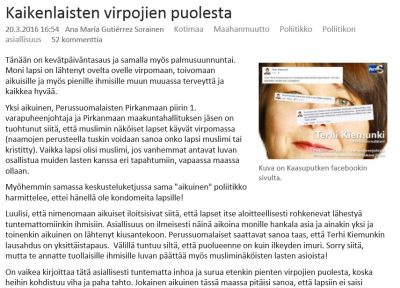
Kirjoitus on ilmestynyt Uuden Suomen Puheenvuoron palveluksessa. Samassa paikassa, jossa ilmestyi kuvassa oleva kirjoitus Terhi Kiemungin pääsiäisnoitien kommenteista.

kiemu


Two Iraqi asylum seekers who returned to “safe” Iraq and were killed

Posted on October 31, 2016 by Migrant Tales

In May and much to the surprise of many, especially asylum seekers and concerned citizens, the Finnish Immigration Service (Migri) announced that countries like Iraq, Afghanistan, and Somalia were safe to return asylum seekers.

Migrant Tales reported in September about Mohammed Khulbus Idnan’s return to “safe” Iraq after waiting for a year for his residence permit without luck. He returned to Baghdad to be at his mother’s side since she was going to die. He returned and was lucky: He got shot six times and survived.

Two other persons weren’t as lucky as Khulbus Idnan when they returned in summer to “safe” Iraq. Both of them were killed by bombs.

Hussein Ali Shawi Al-Frajas was twenty-nine years old when a bomb planted in his car detonated and ripped him in half from the waist down. We have pictures that show him inside the car that we won’t publish because they are so shocking.

Al-Frajas had been in Baghdad only three days before he was killed.

He left Finland after Migri had turned down his asylum application. He was a father of two.

na%cc%88ytto%cc%88kuva-2016-10-30-kello-23-53-13

Hussein Ali Shawi Al-Frajas died in summer three days after his return to Baghdad from Oulu, Finland.

The second young man to die in summer is Ahmed Kadhim Ali Alsultani, who returned back to Baghdad because he missed his two children and wife. He had come to Finland in September and waited for months without luck for a decision from Migri.

Continue reading “Two Iraqi asylum seekers who returned to “safe” Iraq and were killed”

The Finnish Immigration Service, with the blessings of the government, aims to separate migrant parents from their children

Posted on October 30, 2016 by Migrant Tales

In August, the Finnish Immigration Service (Migri)  is reported to have given asylum reception center instructions that only their children can stay at the reception center if the parents have their asylum application turned down and won’t leave the country, according to MTV.

The Red Cross has already said that it won’t comply with Migri’s instructions because they breach the UN Convention on the Rights of the Child, which Finland has ratified, and the association’s values to treat asylum seekers in a humane manner.

“We don’t want to worsen with our actions their vulnerability,” Red Cross legal advisor Jani Leino was quoted as saying.

Migrant Tales confirms that the Red Cross told asylum seekers at some camps that they won’t be abandoned by the association. “You will not be neglected or kicked out of the reception center,” an asylum seeker told us over the phone. “We are here to support you.”

While the Red Cross will not comply to Migri’s instructions, it would be interesting to see if private companies like Luona and Mehiläinen feel the same way about offering support and not abandoning those that they now serve.

na%cc%88ytto%cc%88kuva-2016-10-30-kello-17-04-31

Read the full story here.

Finland’s government, which is one of the most hostile and anti-immigration seen in a long time, believes that the only way to deal with asylum seekers and migrants in Finland is to prohibit and pass inhumane laws like the tightening of family reunification guidelines.

Continue reading “The Finnish Immigration Service, with the blessings of the government, aims to separate migrant parents from their children”

Case Villa Meri: Is the job of an asylum reception center to promote the well-being or suffering of those they serve?

Posted on October 29, 2016 by Migrant Tales

“Silence is beautiful” is a saying that most people in this country will appreciate but if the authorities don’t act and keep the public in suspense, that silence can turn into poison in a country like Finland where there are interest groups that make it their business to spread hatred, victimize and destroy the good name of migrants.

There are many examples we could cite of this “silence,” or inaction that encourages apathy.

Silence also fuels speculation, which in turn greases the wheels of those that spread racism, bigotry, and hatred.

Good examples of that  social gangrene are MV and Nykysuomi and others that rob, spin and spoonfeed to their readers their daily dose of racism with lies and exaggerations about migrants.

The existence of these types of publications, which have a readership and are supported by some politicians of anti-immigration parties like the Perussuomalaiset (PS)*,  show that many are trying to cash in on xenophobia because such a social ill brings attention and power.

The Villa Meri asylum reception center, run by a private company that profits from people’s suffering, is at the center of a scandal fed by silence due to the rape of a 15-year-old.


na%cc%88ytto%cc%88kuva-2016-10-29-kello-18-24-54


Read the full complaint here.

While not all asylum reception centers are managed poorly, there are others that do a good job. One important matter that a well-functioning center requires is good management that is available to the people they serve and offer shelter.

Continue reading “Case Villa Meri: Is the job of an asylum reception center to promote the well-being or suffering of those they serve?”

Discurso del escritor Jari Tervo en la apertura de la Feria del Libro de Helsinki

Posted on October 29, 2016 by Ana María Gutiérrez Sorainen

Jari Tervo es, sin duda alguna, uno de los escritores más conocidos y leidos de Finlandia. El 27 de octubre, Tervo fue el encargado de abrir la Feria del Libro de Helsinki y su discurso ha despertado interés público.

El discuros de Jari Tervo está cargado de humanismo, respeto a los derechos humanos y de una crítica contundente hacia la Unión Europea, el gobierno finlandés de Juha Sipilä y Turquía de Erdo?an. Debido a lo antes dicho, considero que este discurso merece ser traducido a todos los idiomas del planeta. El discurso ha sido publicado en la página web del evento.

El discurso es bastante extenso y al principio pensé traducir solamente unos párrafos, pero cuando leí todo el texto comprendí que era una pena no traducirlo todo. El discurso está en cursiva y entre paréntisis aparecen algunas de mis anotaciones:

Feria del Libro de Helsinki, 27 de octubre de 2016

Queridos amigos y queridas amigas. Bienvenidos y bienvenidas a la Feria del Libro de Helsinki.

Este otoño en Finlandia hay paz, excepto la brutal violencia nazista. Vivimos tales tiempos que una frase tan excéntrica es la fiel descripción de nuestra patria.

¿Por qué aquí en Finlandia ahora hay tanta paz? ¿Por qué a Finlandia no llegan decenas de miles de solicitantes de asilo, como en el otoño anterior?

Porque nosotros, los finlandeses, como miembros de la Unión Europea, le hemos delegado a Turquía la ayuda a las personas en dificultades. Nuestro subcontratista es un país gobernado dictatorialmente y cuyo jefe considera que el reciente golpe de estado es un regalo de Dios. El golpe ha hecho posible el endurecimiento de la disciplina, latigazos, el encarcelamiento de miles de personas y el afianzamiento de la autocracia en Turquía.

Esto hay que decirlo con mucho cuidado. Nosotros los finlandeses, en conjunto con los demás europeos, hemos confiado el cuidado de los derechos humanos a Turquía, país que nunca llegará a ser miembro de la Unión Europea precisamente porque no respeta los derechos humanos.

Es decir que nosotros compramos palmeras de Groelandia y hielo de Sahara. Esto es sencillamente una realidad surrealista.

Cuando Erdogan, el presidente de Turquía, mutila y enjaula a sus propios ciudadanos, se puede pensar en que si la gente que escapa de la guerra en Siria recibe aunque sea ese mismo trato de él. Claro que no lo recibe.

La Unión Europea le compra a Turquía los servicios de almacenamiento de personas. Esta es una de las tratas de seres humanos más grandes de la historia, pero no es llamada trata de seres humanos.

En Turquía, la gente es almacenada en contenedores, tiendas de campaña, en estaciones de trenes, debajo de puentes, a la interperie.

Los países del planeta son clasificados de diferentes formas. También son clasificados según la manera en que los principios del estado de derecho son puestos en práctica en cada país.  Un estado de derecho significa un estado en el que los que tienen el poder  están bajo las mismas leyes al igual que los demás ciudadanos o los solicitantes de asilo. Un estado derecho significa también un estado en el que se matienen vigentes los derechos humanos fundamentales.

En una lista reciente de estado de derecho (World Justice Project) los países nordicos aparecen como los primeros. El primero es Dinamarca, el segundo Noruega, el tercero es Finlandia y el cuarto Suecia.

Turquía, el socio de nosotros los civilizados europeos en asuntos de derechos humanos y comercio de armas, no tiene éxito. Nigeria, Sierra Leona, Liberia y Uzbekistán son mejores estados de derecho que Turquía.  Todos estos son estados en los que los derechos de las personas son raros, al azar y arbitrarios.

Cuando nosotros, los europeos, creemos que compramos derechos humanos de Turquía, pisoteamos nuestro patrimonio humanitario y cristiano. Estos días no son para nada los momentos de esplendor de Europa.

El racismo, la extrema derecha y el nacionalismo se expanden por nuestro continente. Pocos páises han evitado ser contagiados. Tampoco los países modelos de las estadísticas, los países nórdicos, lo han evitado.

Cuando un nazi comete un acto de violencia brutal en el centro de Helsinki, el euurodiputado del partido  los Finlandeses Verdaderos considera que es un acto “lamentable a nivel individual”. El jefe del grupo parlamentario de los Finlandeses Verdaderos, Juho Eerola, describe la violencia nazista como “coincidencia triste”. La violencia política brutal no es nunca una “coincidencia triste”. Cuando un murciélago en su vuelo nocturno choca con las aspas de un molino de viento, eso es una coincidencia triste. (Esta última frase tiene qque ver con la opinión que tiene alguna gente de ese partido político sobre los molinos de viento y el daño que los mismos causan a los murciélagos).

Nuestro primer ministro Juha Sipilä escribe en su diario: “Durante las semanas anteriores han sucedido actos de violencia, que preocupan ampliamente a las personas y debilitan nuestro sentimiento de seguridad. La policía investiga tanto lo ocurrido en la plazoleta de la estación de ferrocarriles como lo ocurrido en Otanmäki.” (Cerca del centro de acogida de otanmäki encontraron a un ciudadano muerto y dos solicitantes de asilo han sido detenidos y el caso está siendo estudiado por las autoridades.)

Ambos actos de violencia son repudiables y los culpables recibirán su castigo a su debido tiempo, pero la equiparación de ambos actos de esa manera es una locura. Según Sipilä, el primer ministro de Finlandia, el sentimiento de seguridad de los finlandeses es trastornado por dos organizaciones extremistas: los nazis y los solicitantes de asilo.

El primer ministro a dicho a los medios de difusión que él no quiso decir eso, pero sí eso fue lo que dijo.

Como un país pequeño, típicamente, en Finlandia se busca el camino del medio porque parece seguro. También se busca camino del medio donde no existe. Entre los defensores y los que están en contra de los derechos humanos no existe un camino del medio y tampoco solución producto de negociación. Los derechos humanos o son respetados o no. El camino del NO nos lleva al infierno.

Los dirigentes políticos finlandeses saben que la xenofobia es una fuerza política fuerte en nuestro país. Los xenofobos votan y sus sentimientos no deben ser ofendidos innecesariamente. Hay que ayudarles cerca de donde viven, es decir aquí.

Esta interpretación es inevitable: la política finlandesa está siendo rehén de los xenofobos. Por eso hacen falta víctimas mortales para que el primer ministro dé una declaración aguada.

El parlamento de Finlandia suele mostrar su inclinación cultural visitando una vez al año la ópera, el teatro o el cine. Eso es algo bueno. ¿Podría el parlamento de Finlandia comprarles una vez al año un libro de ficción finlandés a los parlamentarios? ¿O es que eso podría despertar cólico cultural peligroso en “Arkadianmäki”? (Arkadianmäki es el nombre de la colina donde se encuentra el edificio del parlamento de Finlandia.)

Comprendo muy bien que de los parlamentarios y sus cónyugues toman bellas fotos cuando, cuando llegan a la ópera con ropa de domingo. Los parlamentarios leyendo libros no interesan mucho a los medios de difusión. ¿Pero podría resolverse este problema?

Leer libros de ficción sigue siendo la mejor manera de ponerse en la piel de otra persona. Promueve nuestra capacidad de empatía. Es solamente una palabra civilizada, no hay que temerle. Significa compasión.

Si no se vive con empatía, no se vive. “Ellei elä myötä, ei elä ollenkaan.”

No menosprecio el conocimiento, pero no puedo  dejar de citar las ideas de una de las personas más inteligentes de este mundo, del físico Albert Einsteinin: La imaginación es más importante que el conocimiento porque la imaginación no tiene límites.

Vuelvo un momento a la migración internacional que intentamos impedir con dinero. Esta crisis no es en su esencia económica o administrativa sino ética y humana. Por eso tiene solución.

Ese mismo problema moral fue pensado por el filósofo chino Confucio. Desde China la idea se expandió a través de los siglos al judaísmo y al cristianismo.  Se menciona en casi todas las religiones de alguna manera. Es una idea ingenua e infantil. 

“Trata a los demás como quieras que te trataran a ti”. “Niin kuin te tahdotte ihmisten tekevän teille, niin tehkää te heille.”

Gracias.

Jari Tervo

http://messukeskushelsinki.fi/press-release/jari-tervon-avajaispuhe-helsingin-kirjamessuilla-27-10-2016/

Jari Tervo nació en la ciudad de Rovaniemi el 2 de febrero de1959. Tervo ha escrito una veintena de libros entre novelas y cuentos. A comienzos de su carrera escribió poesía. Algunas de sus obras son:  “El hijo del policía” y “Goliat”, obra satírica publicada en el año 2009.  Tervo ha escrito también guiones de televión y ha sido galardonado con diversos premios nacionales.

UPDATE: How can a rape of an adolescent visitor happen at the Villa Meri asylum reception center?

Posted on October 28, 2016 by Migrant Tales

Migrant Tales published Thursday a story about a list of complaints by an asylum seeker of the Villa Meri reception center of Rauma, located 91 kilometers north of the southwestern city of Turku. The reception the story got was quite a surprise considering that present and former volunteers of Villa Meri accused me of racism, hating and using all asylum seekers, hating all reception center workers, and of having an agenda.

UPDATE: Migrant Tales will have news on the case Saturday.

One of these volunteers even threatened to sue me.

For what? For publishing what an asylum seeker’s list of complaints?

Doesn’t the Villa Meri asylum reception center have any rules about who can speak on behalf of the reception center? If not, it shows that there is either mismanagement or no management at the center.

The same complaints that were given to Migrant Tales in March from asylum seekers at Villa Meri hadn’t changed in November with the horrific exception that a rape of an adolescent was committed.

Migrant Tales was heatedly criticized on Facebook’s Rasmus by former and present volunteers of Vill Meri for asking a sensible question: How is it possible that an adolescent visitor gets raped at the center?


na%cc%88ytto%cc%88kuva-2016-10-28-kello-19-29-43


To that question, we heard some of the most incredible excuses like it’s not the job of the staff to watch over asylum seekers and visitors like children. The staff isn’t  responsible for what happened hto the adolescent, was echoed by another visitor.

While the Finnish Immigration Service (Migri) doesn’t give recommendations to asylum centers on how to improve security, it’s the security guards job at the center to ensure the staff’s and asylum seekers’ safety.

I’d be very surprised if an exhaustive investigation isn’t being conducted now to find out why an adolescent was raped at the center. Even if some claim that the staff and management aren’t responsible for what happened, they are if negligence can be proven.

Some asylum centers in Finland take precautions. One such center in southern Finland does the following:

1) visitors are watched by the staff; (2) corridors are watched by camera; (3) empty rooms are locked (the rape at Villa Meri took place in an empty unlocked room); (4) there are areas of the camp that are off limits to visitors and asylum seekers.

Will such measures prevent a rape? It will make it harder for someone who has rape on his mind.

On top of possible negligence, there’s another factor that incriminates the staff and management. The asylum seekers allegedly warned them that something bad could happen to the adolescent that was raped. They alleged the adolescent had a “bad reputation” (sic!) because she hung around men and boys, which is taboo for single adolescents and women in some Middle East regions.

Why weren’t the warnings of the asylum seekers taken on board and acted upon?

If the asylum seekers are to be believed, relations with the manager of the camp, Päivi Nikkola, are poor as with the staff. Moreover, the camp manager is never around and impossible for the asylum seekers to meet and talk with her.

It may well be that some heads may roll at Villa Meri for what happened.

But the most important matter that we can learn from what happened is to not commit the same mistakes committed at the reception center in Rauma.

The Villa Meri center is run by Hoivapalvelu Metsätähti, a private company owned by Mehiläinen.


UPDATE: Problems at Rauma’s Villa Meri asylum reception persist and have gotten worse

Posted on October 27, 2016 by Migrant Tales

In March, Migrant Tales reported about the problems at the Villa Meri asylum reception of Rauma, a western Finnish city located 91 kilometers north of Turku. Some of these problems, which were cited back then, persist and have gotten worse. 

Some of the problems cited at the reception center about eight months ago were threats to deport asylum seekers to Iraq, bullying, no contact with the manager Päivi Nikkola, bad food, no places for children to play, no access to a doctor, among other complaints.

Apparently, matters have gotten so bad at the reception center that the manager doesn’t communicate any longer with the residents.

UPDATE: What do asylum reception centers do to avoid rape and other bodily harm to people?

1) visitors are watched by the staff; (2) corridors are watched by camera; (3) empty rooms are locked (the rape that took place at the reception center was allegedly in an empty room); (4) there are areas of the camp that are off limits to visitors and asylum seekers.


na%cc%88ytto%cc%88kuva-2016-10-27-kello-13-40-05

Previous stories published by Migrant Tales in March.

The residents of the asylum reception center, which are all families and today number 70-80 persons, sent in spring a complaint to the parliamentary ombudsman.

While the complaint and hunger strike were made about eight months ago, the problems at the center persist and have gotten worse. A rape occurred at the reception center. If the asylum seekers are to be believed, the rape could have been prevented if there was better communication with the staff and manager.

The Villa Meri asylum reception center is a private company run by Hoivapalvelu Metsälahti, a subsidiary owned by Mehiläinen.

After speaking with an asylum seeker at the center Wednesday, these are the complaints that he made:

  • The manager, Nikkola, is never present. The staff sent her the complaints by asylum seekers but she refused to meet with them. The answer that the staff gave to the asylum seekers is that the manager is too busy to meet with them;
  • Whenever the asylum seekers ask for something, a staffer answers that he or she must wait for approval from the manager. They never get an answer;
  • Some of the asylum-seeker residents claim that poor communication with the manager and staff was what led to a rape at the reception center;
  • There are three suspects in the rape case: a father, his son, who is a minor, and a third person;
  • The asylum seekers told the management of the camp on a number of occasions to not let the young girl in the reception center because she had “a bad reputation” (becaue she hung around with a boy)  and warned something bad could happen to her;*
  • The minor suspected of rape is allegedly the victim’s boyfriend;*
  • The food served at the center was one complaint that the asylum seekers had and which led to a hunger strike in March.

Continue reading “UPDATE: Problems at Rauma’s Villa Meri asylum reception persist and have gotten worse”

The new Other face of Finland is beautiful

Posted on October 26, 2016 by Migrant Tales

Every story that I read about the new faces of Finland, which is much older than anyone would care to admit, I get excited and inspired. In a flash, I see everything and understand who I am. For a fleeting moment, my thoughts are in perfect balance with my gut feelings and who I am: I belong here, always have and always will. 

An interview in Ylioppilaslehti below is a wonderful example of how not only Finland has changed from a country that believed incorrectly it was monocultural to one that is today ever-culturally, ethnically and linguistically diverse.

It is the job of the Other Finns to spearhead Finland to a new Finnish identity in the new century.

And the person in the article below, an attractive young woman, states the following at the end of the story:

“It’s absurd that a Finn in the year 2016 is forced to fight for his own identity and whether he belongs to that imagined community called Finland. We cannot build Finland, defend it by excluding a large number of people because they’re not like the rest and because they came from somewhere else.

Many don’t understand that Finnish identity is changing. It has already changed. It’s high time that we grow accustomed to this.”


na%cc%88ytto%cc%88kuva-2016-10-26-kello-17-12-36

Read the full story here.

In the 1970s when I visited my grandparents every summer from Southern California, some people didn’t believe that I was from Argentina because nobody from such a distant country visited Finland.

Continue reading “The new Other face of Finland is beautiful”

(Migrants’ Rights Network) The Calais Jungle – a beacon for the fight against refugee injustice

Posted on October 25, 2016 by Migrant Tales

Don Flynn

Näyttökuva 2015-5-3 kello 12.52.32

The Jungle camp in Calais has challenged the indifference of official Europe to the plight of refugees for close on two decades. It has survived previous attempts at demolition. As long as the grievances that gave rise to remain it will come back to haunt the conscience of the continent.

As you read this CRS police squads, acting on French government orders, will once again be destroying the make-shift homes and personal property of the 9000 people who are trying to survive in the Calais refugee camp.

They have returned to this task sporadically over the years.  In April 2009 a determined effort to close the camp led to the arrest of 109, with bulldozers destroying the tents of around 800 refugees.

Regrouped after assault

Within weeks the victims of this assault had regrouped and the Jungle was up-and-running again.  Another dawn raid in September the same year saw 276 refugees arrested, but the camp survived and even flourished as the wretched home for thousands of people who could find nowhere else to live.

Heedless of past failures to vanquish the refugees, the French government ordered another clearance in January.  This one displaced around 1000 people.  The forcible eviction was accompanied by efforts to get the refugees to accept alternative accommodation in 125 metal shipping containers. Take-up has been patchy.

Instead French NGOs report there are at least eleven other camps in the region.  The biggest is in Grande-Synthe, near Dunkirk. Others are in Boulogne, Dieppe and Le Havre. Smaller ‘jungles’ pop up across the Pay du Nord and Normandy at road junctions and petrol stations – almost anywhere where port-bound traffic slows and there is a chance to jump in the back of a lorry that might possibly be en route to England.

Continue reading “(Migrants’ Rights Network) The Calais Jungle – a beacon for the fight against refugee injustice”

  • 1
  • 2
  • 3
  • 4
  • Next
Read more about documentary film
Read more

Recent Posts

  • Finland’s tabloids Iltalehti and Ilta-Sanomat are the pits
  • Riikka Purra’s Dr Jekyll and Mr Hyde mask
  • Double standards
  • Perussuomalaiset: Uusi logo, sama vanha juttu
  • Taco Trump

Recent Comments

  1. Absolutely Socking: Racist Finnish Facebook group against human rights gets flooded with socks on Musta Barbaari’s mother and sister charged by the police in “ethnic profiling” case
  2. Ilkka Nuotio on Pekka Myrskylä: “Tilastot kertovat toista kuin poliittinen keskustelu”
  3. Genrih Soinkara on The war in Ukraine and the Russian-Finnish border crisis are showing Finland’s ugly side
  4. Ahti Tolvanen on Comment by Ahti Tolvanen on the Helsinki +50 conference
  5. Angel Barrientos on Angel Barrientos is one of the kind beacons of Finland’s Chilean community

Archives

  • June 2026
  • May 2026
  • April 2026
  • March 2026
  • February 2026
  • January 2026
  • December 2025
  • November 2025
  • October 2025
  • September 2025
  • August 2025
  • July 2025
  • June 2025
  • May 2025
  • April 2025
  • March 2025
  • February 2025
  • January 2025
  • December 2024
  • November 2024
  • October 2024
  • September 2024
  • August 2024
  • July 2024
  • June 2024
  • May 2024
  • April 2024
  • March 2024
  • February 2024
  • January 2024
  • December 2023
  • November 2023
  • October 2023
  • September 2023
  • August 2023
  • July 2023
  • June 2023
  • May 2023
  • April 2023
  • March 2023
  • February 2023
  • January 2023
  • December 2022
  • November 2022
  • October 2022
  • September 2022
  • August 2022
  • July 2022
  • June 2022
  • May 2022
  • April 2022
  • March 2022
  • February 2022
  • January 2022
  • December 2021
  • November 2021
  • October 2021
  • September 2021
  • August 2021
  • July 2021
  • June 2021
  • May 2021
  • April 2021
  • March 2021
  • February 2021
  • January 2021
  • December 2020
  • November 2020
  • October 2020
  • September 2020
  • August 2020
  • July 2020
  • June 2020
  • May 2020
  • April 2020
  • March 2020
  • February 2020
  • January 2020
  • December 2019
  • November 2019
  • October 2019
  • September 2019
  • August 2019
  • July 2019
  • June 2019
  • May 2019
  • April 2019
  • March 2019
  • February 2019
  • January 2019
  • December 2018
  • November 2018
  • October 2018
  • September 2018
  • August 2018
  • July 2018
  • June 2018
  • May 2018
  • April 2018
  • March 2018
  • February 2018
  • January 2018
  • December 2017
  • November 2017
  • October 2017
  • September 2017
  • August 2017
  • July 2017
  • June 2017
  • May 2017
  • April 2017
  • March 2017
  • February 2017
  • January 2017
  • December 2016
  • November 2016
  • October 2016
  • September 2016
  • August 2016
  • July 2016
  • June 2016
  • May 2016
  • April 2016
  • March 2016
  • February 2016
  • January 2016
  • December 2015
  • November 2015
  • October 2015
  • September 2015
  • August 2015
  • July 2015
  • June 2015
  • May 2015
  • April 2015
  • March 2015
  • February 2015
  • January 2015
  • December 2014
  • November 2014
  • October 2014
  • September 2014
  • August 2014
  • July 2014
  • June 2014
  • May 2014
  • April 2014
  • March 2014
  • February 2014
  • January 2014
  • December 2013
  • November 2013
  • October 2013
  • September 2013
  • August 2013
  • July 2013
  • June 2013
  • May 2013
  • April 2013
  • March 2013
  • February 2013
  • January 2013
  • December 2012
  • November 2012
  • October 2012
  • September 2012
  • August 2012
  • July 2012
  • June 2012
  • May 2012
  • April 2012
  • March 2012
  • February 2012
  • January 2012
  • December 2011
  • November 2011
  • October 2011
  • September 2011
  • August 2011
  • July 2011
  • June 2011
  • May 2011
  • April 2011
  • March 2011
  • February 2011
  • January 2011
  • December 2010
  • November 2010
  • October 2010
  • September 2010
  • August 2010
  • July 2010
  • June 2010
  • May 2010
  • April 2010
  • March 2010
  • February 2010
  • January 2010
  • December 2009
  • November 2009
  • October 2009
  • September 2009
  • August 2009
  • July 2009
  • December 2008
  • November 2008
  • October 2008
  • September 2008
  • August 2008
  • July 2008
  • June 2008
  • May 2008
  • April 2008
  • March 2008
  • February 2008
  • January 2008
  • November 2007
  • October 2007
  • September 2007
  • August 2007
  • July 2007
  • June 2007
  • May 2007

Categories

  • ?? Gia L?c
  • ????? ?????? ????? ???????? ?? ??????
  • ???????
  • @HerraAhmed
  • @mondepasrond
  • @nohatefinland
  • @oula_silver
  • @Varathas
  • A Pakistani family
  • äärioikeisto
  • Abbas Bahmanpour
  • Abdi Muhis
  • Abdirahim Hussein Mohamed
  • Abdirahim Husu Hussein
  • Abdirisak Mahamed
  • About Migrant Tales
  • activism
  • Adam Al-Sawad
  • Adel Abidin
  • Afrofinland
  • Ahmed IJ
  • Ahti Tolvanen
  • Aino Pennanen
  • Aisha Maniar
  • Alan Ali
  • Alan Anstead
  • Alejandro Díaz Ortiz
  • Alekey Bulavsev
  • Aleksander Hemon
  • Aleksanterinliitto
  • Aleksanterinliitto ry
  • Aleksanterinliitto ry:n hallitus
  • Alex Alex
  • Alex Mckie
  • Alexander Nix
  • Alexandra Ayse Albayrak
  • Alexis Neuberg
  • Ali Asaad Hasan Alzuhairi
  • Ali Hossein Mir Ali
  • Ali Rashid
  • Ali Sagal Abdikarim
  • Alina Tsui
  • Aline Müller
  • All categories
  • Aman Heidari
  • Amiirah Salleh-Hoddin & Jana Turk
  • Amin A. Alem
  • Amir Zuhairi
  • Amkelwa Mbekeni
  • Ana María Gutiérrez Sorainen
  • Anachoma
  • Anders Adlecreutz
  • Angeliina Koskinen
  • Anna De Mutiis
  • Anna María Gutiérrez Sorainen
  • Anna-Kaisa Kuusisto ja Jaakko Tuominen
  • Annastiina Kallius
  • Anneli Juise Friman Lindeman
  • Announcement
  • Anonymous
  • Antero Leitzinger
  • anti-black racism
  • Anti-Hate Crime Organisation Finland
  • Anudari Boldbaatar
  • Arshiya Nasser
  • Aspergers Syndrome
  • Asylum Corner
  • Asylum seeker 406
  • Athena Griffin and Joe Feagin
  • Autism
  • Avaaz.org
  • Awale Olad
  • Ayan Said Mohamed
  • AYY
  • Barachiel
  • Bashy Quraishy
  • Beatrice Kabutakapua
  • Beri Jamal
  • Beri Jamal and Enrique Tessieri
  • Bertolt Brecht
  • Boiata
  • Boodi Kabbani
  • Bruno Gronow
  • Carmen Pekkarinen
  • Çelen Oben and Sheila Riikonen
  • Chiara Costa-Virtanen
  • Chiara Costa-Virtanen
  • Chiara Sorbello
  • Christian Thibault
  • Christopher Wylie
  • Clara Dublanc
  • Dana
  • Daniel Malpica
  • Danilo Canguçu
  • David Papineau
  • David Schneider
  • Dexter He
  • Don Flynn
  • Dr Masoud Kamali
  • Dr. Faith Mkwesha
  • Dr. Theodoros Fouskas
  • Edna Chun
  • Eeva Kilpi
  • Emanuela Susheela
  • En castellano
  • ENAR
  • Enrique
  • Enrique Tessieri
  • Enrique Tessieri & Raghad Mchawh
  • Enrique Tessieri & Yahya Rouissi
  • Enrique Tessieri and Muhammed Shire
  • Enrique Tessieri and Sira Moksi
  • Enrique Tessieri and Tom Vandenbosch
  • Enrique Tessieri and Wael Che
  • Enrique Tessieri and Yahya Rouissi
  • Enrique Tessieri and Zimema Mhone
  • Epäluottamusmies
  • EU
  • Europe
  • European Islamophobia Report
  • European Islamophobia Report 2019,
  • European Union
  • Eve Kyntäjä
  • Ezequiel Caldeiro
  • Facebook
  • Fadumo Dayib
  • Faisa Kahiye
  • Farhad Manjoo
  • Fasismi
  • Finland
  • Fizza Qureshi
  • Flyktingar och asyl
  • Foreign Student
  • Fozia Mir-Ali
  • Frances Webber
  • Frida Selim
  • Gareth Rice
  • Ghyslain Vedeaux
  • Global Art Point
  • Great Replacement
  • Habiba Ali
  • Hami Bahadori
  • Hami Bahdori
  • Hamid
  • Hamid Alsaameere
  • Hamid Bahdori
  • Handshake
  • Harmit Athwal
  • Hassan Abdi Ali
  • Hassan Muhumud
  • Heikki Huttunen
  • Heikki Wilenius
  • Helsingin Sanomat
  • Henning van der Hoeven
  • Henrika Mälmsröm
  • Hser Hser
  • Hser Hser ja Mustafa Isman
  • Husein Muhammed
  • Hussain Kazemian
  • Hussain Kazmenian
  • Ibrahim Khan
  • Ida
  • Ignacio Pérez Pérez
  • Iise Ali Hassan
  • Ilari Kaila & Tuomas Kaila
  • Imam Ka
  • inside-an-airport
  • Institute of Race Relations
  • Iraqi asylum seeker
  • IRR European News Team
  • IRR News Team
  • Islamic Society of Norhern FInland
  • Islamic Society of Northern Finland
  • Islamophobia
  • Jacobinmag.com
  • Jallow Momodou
  • Jan Holmberg
  • Jane Elliott
  • Jani Mäkelä
  • Jari Luoto
  • Jari Taponen
  • Jegor Nazarov
  • Jenni Stammeier
  • Jenny Bourne
  • Jessie Daniels
  • Joe Davidow
  • Johannes Koski
  • John D. Foster
  • John Grayson
  • John Marriott
  • Jon Burnett
  • Jorma Härkönen
  • Jos Schuurmans
  • José León Toro Mejías
  • Josue Tumayine
  • Jouni Karnasaari
  • Juan Camilo
  • Jukka Eräkare
  • Julian Abagond
  • Julie Pascoet
  • Jussi Halla-aho
  • Jussi Hallla-aho
  • Jussi Jalonen
  • JusticeDemon
  • Kadar Gelle
  • Kaksoiskansalaisuus
  • Kansainvälinen Mikkeli
  • Kansainvälinen Mikkeli ry
  • Katherine Tonkiss
  • Kati Lepistö
  • Kati van der Hoeven-Lepistö
  • Katie Bell
  • Kättely
  • Kerstin Ögård
  • Keshia Fredua-Mensah & Jamie Schearer
  • Khadidiatou Sylla
  • Khadra Abdirazak Sugulle
  • Kiihotus kansanryhmää vastaan
  • Kirsi Crowley
  • Koko Hubara
  • Kristiina Toivikko
  • Kubra Amini
  • KuRI
  • La Colectiva
  • La incitación al odio
  • Laura Huhtasaari
  • Lauri Finér
  • Leif Hagert
  • Léo Custódio
  • Leo Honka
  • Leontios Christodoulou
  • Lessie Branch
  • Lex Gaudius
  • Leyes de Finlandia
  • Liikkukaa!
  • Linda Hyökki
  • Liz Fekete
  • M. Blanc
  • Maarit Snellman
  • Mahad Sheikh Musse
  • Maija Vilkkumaa
  • Malmin Kebab Pizzeria Port Arthur
  • Marcell Lorincz
  • Mari Aaltola
  • María Paz López
  • Maria Rittis Ikola
  • Maria Tjader
  • Marja-Liisa Tolvanen
  • Mark
  • Markku Heikkinen
  • Marshall Niles
  • Martin Al-Laji
  • Maryan Siyad
  • Matt Carr
  • Mauricio Farah Gebara
  • Media Monitoring Group of Finland
  • Micah J. Christian
  • Michael McEachrane
  • Michele Levoy
  • Michelle Kaila
  • Migrant Tales
  • Migrant Tales Literary
  • Migrantes News
  • Migrants' Rights Network
  • MigriLeaks
  • Mikko Kapanen
  • Miriam Attias and Camila Haavisto
  • Mohamed Adan
  • Mohammad Javid
  • Mohammad M.
  • Monikulttuurisuus
  • Monisha Bhatia and Victoria Canning
  • Mor Ndiaye
  • Muh'ed
  • Muhamed Abdimajed Murshid
  • Muhammed Shire
  • Muhammed Shire and Enrique Tessieri
  • Muhis Azizi
  • Musimenta Dansila
  • Muslimiviha
  • Musulmanes
  • Namir al-Azzawi
  • Natsismi
  • Neurodiversity
  • New Women Connectors
  • Nils Muižnieks
  • No Labels No Walls
  • Noel Dandes
  • Nuor Dawood
  • Omar Khan
  • Otavanmedia
  • Oula Silvennoinen
  • Paco Diop
  • Pakistani family
  • Pentti Stranius
  • Perussuomalaiset
  • perustuslaki
  • Petra Laiti
  • Petri Cederlöf
  • Pia Grochowski
  • Podcast-lukija Bea Bergholm
  • Pohjois – Suomen Islamilainen Yhdyskunta
  • Pohjois Suomen Islamilainen Yhyskunta
  • Polina Kopylova
  • Race Files
  • racism
  • Racism Review
  • Raghad Mchawh
  • Ranska
  • Rashid H. and Migrant Tales
  • Rasismi
  • Raul Perez
  • Rebecka Holm
  • Reem Abu-Hayyeh
  • Refugees
  • Reija Härkönen
  • Remiel
  • Reza Nasri
  • Richard Gresswell
  • Riikka Purra
  • Risto Laakkonen
  • Rita Chahda
  • Ritva Kondi
  • Robito Ibrahim
  • Roble Bashir
  • Rockhaya Sylla
  • Rodolfo Walsh
  • Roger Casale
  • Rostam Atai
  • Roxana Crisólogo Correa
  • Ruth Grove-White
  • Ruth Waweru-Folabit
  • S-worldview
  • Sadio Ali Nuur
  • Sami Rusanen
  • Sandhu Bhamra
  • Sara de Jong
  • Sarah Crowther
  • Sari Alhariri
  • Sarkawt Khalil
  • Sasu
  • Scot Nakagawa
  • Shabana Ahmadzai
  • Shada Islam
  • Sharon Chang blogs
  • Shenita Ann McLean
  • Shirlene Green Newball
  • Sini Savolainen
  • Sira Moksi
  • Sonia K.
  • Sonia Maria Koo
  • Steverp
  • Stop Deportations
  • Suldaan Said Ahmed
  • Suomen mediaseurantakollektiivi
  • Suomen Muslimifoorumi ry
  • Suomen viharikosvastainen yhdistys
  • Suomen viharikosvastainen yhdistys ry
  • Suomi
  • Supermen
  • Susannah
  • Suva
  • Syrjintä
  • Talous
  • Tapio Tuomala
  • Taw Reh
  • Teivo Teivainen
  • The Daily Show
  • The Heino
  • The Supermen
  • Thomas Elfgren
  • Thulfiqar Abdulkarim
  • Tim McGettigan
  • Tino Singh
  • Tito Moustafa Sliem
  • Tobias Hübinette and L. Janelle Dance
  • Transport
  • Trica Danielle Keaton
  • Trilce Garcia
  • Trish Pääkkönen
  • Trish Pääkkönen and Enrique Tessieri
  • Tuulia Reponen
  • Uncategorized
  • UNITED
  • University of Eastern Finland
  • Uyi Osazee
  • Väkivalta
  • Vapaa Liikkuvuus
  • Venla-Sofia Saariaho
  • Vieraskynä
  • W. Che
  • W. Che an Enrique Tessieri
  • Wael Ch.
  • Wan Wei
  • Women for Refugee Women
  • Xaan Kaafi Maxamed Xalane
  • Xassan Kaafi Maxamed Xalane
  • Xassan-Kaafi Mohamed Halane & Enrique Tessieri
  • Yahya Rouissi
  • Yasmin Yusuf
  • Yassen Ghaleb
  • Yle Puhe
  • Yuliet Tresa
  • Yve Shepherd
  • Zahra Khavari
  • Zaker
  • Zalina Ametova
  • Zamzam Ahmed Ali
  • Zeinab Amini ja Soheila Khavari
  • Zimema Mahone and Enrique Tessieri
  • Zimema Mhone
  • Zoila Forss Crespo Moreyra
  • ZT
  • Zulma Sierra
  • Zuzeeko Tegha Abeng
© 2026 Migrant tales | Powered by Minimalist Blog WordPress Theme