Migrant tales
Menu
  • #MakeRacismHistory “In Your Eyes”
  • About Migrant Tales
  • It’s all about Human Rights
  • Literary
  • Migrant Tales Media Monitoring
  • NoHateFinland.org
  • Tales from Europe
Menu

Month: January 2015

Institute of Race Relations: ‘Apologists for terrorism:’ dissent and the limits of free expression

Posted on January 30, 2015 by Migrant Tales

Frances Webber

Freedom of thought, expression and inquiry is under renewed threat from governments which, paradoxically, claim to be fighting to preserve freedom of expression in Europe.

freedom-of-expression

The ongoing case of a Belgian prison teacher issued with a work ban on national security grounds, and other disturbing cases of exclusion and criminalisation that have occurred in France since the Paris massacres, need to be placed at the centre of mainstream debate.

When Belgian prison teacher and human rights defender Luk Vervaet was finally told why he was barred from going to any Belgian prison – and he had had to fight for years for the right to know – it was his activism in support of freedom of expression and association, his solidarity work in defence of prisoners, and his work on Palestine which were held to justify the ban.The security services cited his membership of organisations such as CLEA (Committee for Freedom of Expression and Association), his involvement with the International Parliamentary Union for Palestine, his former membership of the Belgian Workers’ Party (PTB) and his founding of a party Egalité (which he had since left).

Blurring the boundaries

None of the organisations cited was proscribed, none of the activities unlawful, nor has Vervaet ever made any secret of his campaigning activities for victims of injustice in Belgium, Palestine or elsewhere. He had no criminal record and was highly regarded by prison governors. Three years ago the Conseil d’Etat, Belgium’s constitutional court, had ruled the work ban illegal. But the minister refused either to revoke the ban or to offer compensation. And when Vervaet took his case for reparation back to court, the Brussels first-instance court upheld his exclusion, and the destruction of his livelihood, as justified on national security grounds.

How could the first-instance court reach this decision, in the face of the constitutional court’s unequivocal condemnation of the work ban? Its arguments, which are difficult to convey, seem to come straight out of the pages of Kafka. But in a nutshell, the judges reasoned that the higher court was ruling only on the manner of the ban (the failure to inform Vervaet of the reasons or give him a right to be heard), and not on its merits – an interpretation Vervaet and his lawyers roundly reject. That it was the justice minister, of all people, who persuaded the court not to follow the Conseil d’Etat ruling reveals a lack of respect for the rule of law in the ministry which should be doing most to uphold it. An order that Vervaet – who has been unable to work since 2009 owing to the ban – pay six thousand euros in costs for his unsuccessful application, completed the legal mockery.

What were the ‘national security’ grounds which justified destroying a man’s livelihood? According to the court, a ‘vague suspicion’ that ‘the defence of supposed victims of anti-terrorist laws could have led him to cross the line from legitimate defence of justice to the support of ideologies indirectly justifying terrorism’ made it ‘understandable that in the context of the security of the prison regime, [allowing him into prisons] was a risk they could not take.’

The judgment enshrines the blurring of the distinction between peaceful political action against injustice and support for terrorism. Support for Palestine becomes support for terrorism; campaigning against the inhuman treatment of prisoners is seen as support for the prisoners’ crimes. The court meekly accepted this logic, according to which European MPs who support the International Parliamentary Union for Palestine should all be barred from their posts for support of an ideology ‘indirectly justifying terrorism’. Its refusal to uphold the right to express dissenting or unpopular opinions reveals the narrowing limits of free expression.

Lopsided freedom

The contradictions and distortions surrounding free expression multiplied in the febrile atmosphere after the Paris massacres. In the city where in July 2014 a rally to protest the deaths of hundreds in Israel’s invasion of Gaza was banned, the rally in support of freedom of expression was led by some of the most virulent oppressors of press freedom in Egypt, Russia, Turkey and Algeria, a BBC reporter’s clumsy and, according to some, anti-Semitic reference to Palestinian suffering led to calls for his dismissal, and a suburban mayor banned acclaimed anti-jihadist film Timbuktu by Mauretanian director Abderrahmane Sissako because, made by a Muslim, it was bound to support jihad – these were just some of the multiple ironies created by a ‘free speech’ harnessed to the interests of the powerful and used to discipline the powerless.

The ‘right to offend’ in the name of freedom of speech has almost been elevated to a public duty, as media outlets including the Guardian were called cowards for refusing to reproduce Charlie Hebdo’s most provocative and racialised cartoons of the Prophet, and London’s Victoria and Albert museum faced accusations of self-censorship after it withdrew from display a depiction of Mohammed. But as several commentators including Seumas Milne have pointed out, while ‘the right to single out one religion for abuse has been raised to the status of a core liberal value’, there has been little tolerance for freedom of expression for Muslims, in the country which banned the headscarf in schools and the burqa in any public place, whose former president demanded that foreigners ‘melt into the national community’ and attacked halal meat, prayers outside mosques and minarets. According to Amnesty International, in the aftermath of the massacres at least sixty-nine arrests were made in one week in France for speech deemed to ‘defend terrorism’. In addition to the well-publicised prosecution of Dieudonné (who has regularly been prosecuted for anti-Semitic hate speech) for his Facebook message ‘I feel like Charlie Coulibaly’, a drunk and mentally disturbed French-Tunisian man received six months’ imprisonment for shouting support for the attackers as he passed a police station in Bourgoin-Jallieu, south-east France, while a drunk driver who hit another vehicle and expressed similar sentiments when arrested received four years in prison.[1] A Poitiers philosophy teacher was suspended for four months and reported to police for ‘defence of terrorism’ for ‘inappropriate comments’ following the minute’s silence for the victims, and a 15-year-old youth who posted on Facebook an ironic take on one of Charlie Hebdo’s most offensive cartoons [2] was detained and charged with defending terrorism. Even the Syndicat de la Magistrature (Magistrates’ Association) condemned the government crackdown.
In some French schools the atmosphere was like a witch-hunt. When an eight-year-old boy replied to his teacher’s question ‘Are you Charlie?’ with ‘No, they insult my religion, I’m with the terrorists’, the head was summoned, and asked the boy the same question three times in front of the class. The child and his father were reported to police, who questioned them for two hours on suspicion of defending terrorism. Another apologist for terrorism’ was a thirteen-year-old French Muslim child in the southern Loire region who blurted out in a classroom debate that the perpetrators of the Paris massacres ‘were right’, who found himself excluded from school, held in police custody for twenty-four hours and taken to court under the counter-terrorism laws. At least forty children were reported to police for their classroom responses, out of some 200 ‘incidents’ in French schools reported to the education ministry.

Policing the classroom

As some French teachers have observed, such extreme punitive reactions to children’s fumbling attempts to articulate their sense of unfairness teach them nothing, other than to keep their mouths shut. Children who say something provocative in a classroom are not dangerous demagogues seeking to manipulate idealism and strong emotions in the cause of violence. Treating the juvenile testing of boundaries as dangerous, to be punished under laws designed against terrorist violence, shows a serious failure of understanding, as well as potentially ruining educational and career prospects for life.

One teacher, trying to understand the hostility of her teenage black and Muslim French-born students to the minute’s silence imposed in all public offices and schools for the massacre’s victims, mused on how the education system had failed on its promise of equality and entrenched social exclusion. Her students questioned the double standards which saw ugly and hate-filled anti-Semitic mockery rightly condemned, while ugly and hate-filled anti-Islamic mockery was held up as glorious examples of secular free speech in a society which excluded them.

A society which seeks to integrate its minorities must listen to them. But angry young Muslims are not listened to, only monitored, for words which suggest support for terrorism. In the aftermath of the massacres, French politicians announced new counter-terror measures including the adoption of the PREVENT programme pioneered in the UK, as well as even tougher penalties for online ‘defence of terrorism’. British educationalists believe the PREVENT strategy has further stigmatised Muslim communities, while the fear of surveillance has stifled classroom debate. Teachers, afraid to allow young people to test the boundaries in open discussion of difficult subjects, are failing to teach them to think – leaving them vulnerable to emotion-led responses to injustice, including violence. ‘Strong language and strong views are much better aired within facilitated educational processes that are set against multiple perspectives, than in private spaces where no challenge or learning is encouraged’, argue Ted Cantle and Paul Thomas. ‘PREVENT has not … encouraged open political debate and education about the sort of domestic and international political issues that may anger some young Muslims and attract them towards more radical groups.’

The Counter-Terrorism and Security Bill currently going through the UK parliament seeks to make this monitoring and reporting compulsory, with sanctions for failure to comply, which will further entrench alienation and anger. In some areas an Orwellian surveillance mentality has already taken hold: in September 2014, Lancaster University Students’ Union president Laura Clayson found police photographing two posters displayed in her office, against fracking and Israel’s attacks on Gaza. Challenged, they said she was potentially committing a public order offence.

Enforcing the new orthodoxies

When education is redefined, in the words of Howard Hotson of the Council for the Defence of British Universities, as ‘a paid-for service to acquire the skills needed to advance the UK’s prosperity’, there is no room for thought, debate or dissent. It is not just ‘extremist’ speakers or political ideas which are banned from schools and campuses, either: no radical, non-orthodox economics which questions free-market theories is taught in British universities (or in those of many other countries). Liberal democracies are becoming increasingly uncomfortable with thinking, questioning citizens who inquire into or expose corrupt links between politicians and global corporations, sweetheart tax deals and foreign policy priorities which lead to complicity with torture and renditions. With Chelsea Manning serving thirty-five years and Edward Snowden in exile for believing the world had a right to know what our security services were doing, exposure of the burgeoning security state is itself now ferociously punished under the guise of indirect support for terrorism.

Frank La Rue, UN special rapporteur on the promotion and protection of freedom of opinion and expression, warned two years ago that the defence of national security must not be used as grounds for harassing journalists who investigate sensitive subjects such as human rights abuses. In the UK, investigative journalists are deemed a threat to GCHQ information security on a par with terrorists or hackers, their confidential communications with sources are intercepted by police and security services with no requirement of judicial authorisation. In the UK, state surveillance and harassment of journalists who reveal government wrongdoing, such as British state complicity with rendition and torture, led Society of Editors’ head Bob Satchwell to protest that ‘Journalism is not a crime and should not be treated as such’.

We need to fight for the freedom of expression that allows marginalised voices to be heard, that helps young people to learn to think, and that listens to unwelcome truths rather than seeking to suppress them.

RELATED LINKS

See Mohamed Ouachen’s filmed interview (in French) with Luk Vervaet about his case here.

See also:

‘More state power, not free speech, the likeliest we-are-Charlie result‘

‘The west is a variegated place for free speech: Teju Cole, Unmournable bodies‘

Thanks to Naima Bouteldja for her additional research. References: [1] ‘France invokes law to detain dozens’, International New York Times 16 January 2015. [2] The original cartoon, and the version posted by the boy which landed him in court, can be seen on the Electronic Intifada website, here.  

The Institute of Race Relations is precluded from expressing a corporate view: any opinions expressed are therefore those of the authors.

Read original story here.

This piece was reprinted by Migrant Tales with permission.

Social media Frankensteins

Posted on January 30, 2015 by Migrant Tales

Ever wondered how a wannabe becomes a social media hit by spreading hatred and racism? There are a lot of these types of politicians and characters around who with low budgets become famous and even get elected thanks to social media. They are called #SocialMediaFrankensteins. 

Näyttökuva 2015-1-30 kello 9.13.37

With the help of social media and many blind followers, some of these #SocialMediaFrankensteins have become household names because of their hate appeal.

In Finland some who come to mind are MEP Jussi Halla-aho and his faithful follower Muutos 2011 MP James Hirvisaari as well as many others like MPs Olli Immonen, Juho Eerola, Teuvo Hakkarainen, and others.

Isn’t it odd that the majority of them are members of the Perussuomalaiset (PS)* party?

#SocialMediaFrankensteins can be organizations too because they use social media to spread their bigotry. Some of these are: Pegida, English Defense League, PS, Danish People’s Party, Sweden Democrats, Geert Wilders of the Party for Freedom, Front National of France…

This clip from the original Frankenstein movie of 1931 shows the mad Dr. Frankenstein rejoicing after he awakens a human monster from the dead. “It’s alive! It’s alive! It’s alive!..” he yells at the top of his voice. “Now I know how it feels to be god!”


The same revelation that Dr. Frankenstein makes, how it feels to be god, is what #SocialMediaFrankensteins feel after they get followers and become a household name from the wannabe cemetery.

What is a #SocialMediaFrankenstein and how does it relate to the 1931 monster movie starring Boris Karloff?

  • A monster like Frankenstein spreads indiscriminately terror with his hatred. He kills everyone who gets in his way;
  • #SocialMediaFrankensteins spread indiscriminately terrorize whole communities with their racism and bigotry. They label and victimize whole group by painting them with a single brush;
  • A monster like Frankenstein becomes famous only after it stars in a movie;
  • #SocialMediaFrankensteins become famous after they publish their racist diatribe on social media;
  • A monster like Frankenstein is finally burned alive and sent back to the land of the dead;
  • #SocialMediaFrankensteins meet their fate after they get caught at their own game of racism. They are burned online;
  • Frankenstein dies but we never forget his terror;
  • #SocialMediaFrankensteins die and, like the Holocaust, we never forget the terror they spread.


Näyttökuva 2015-1-30 kello 8.36.18
 PS MEP Jussi Halla-aho is a good example of a #SocialMediaFrankenstein. He was created thanks to social media and a xenophobic party like the PS. The poster reads: “Charlie Hebdo 7.1.2015 12 dead. Popcorn thank you. In another place people die while another person eats popcorn and enjoys the show. Let’s not forget to be humans. Your country thanks you.” PS. Source: Paljastettu. 


* The Finnish name for the Finns Party is the Perussuomalaiset (PS). The names adopted by the PS, like True Finns or Finns Party, promote in our opinion nativist nationalism and xenophobia. We therefore prefer to use the Finnish name of the party on our postings. 

Former PS councilman Risto Helin is a key suspect in an aggravated pimping case

Posted on January 29, 2015 by Migrant Tales

Does anyone remember councilman Risto Helin of the western Finnish city of Vaasa, who resigned from the Perussuomalaiset (PS)* party in August 2013 after he became a suspect in an aggravated pimping case? Remember when the councilman who, among other things likes to wear white power blood & honor t-shirts, gave a Hitler clock to a neo-Nazi group in Vaasa?   Yep. That’s him: Risto Helin. His trial will begin on February 17.  who is now on trial for pimping, according to MTV3. 

Helin, who says he’ll continue to work as a councilman despite that he’s on trial, didn’t want to comment about the case.

One matter that surprises a lot of people about Helin is how a person with neo-Nazi sympathies and who is now on trial for aggravated pimping ever got elected to city council in the first place.

The answer is in the April 2011 parliamentary elections: How did a populist anti-EU, anti-immigration, homophobic and especially anti-Islam party like the PS win 39 seats from 5 in 2007?

For one it shows that there are a lot of people in this country who don’t feel uncomfortable with fascism and neo-Nazis.


Näyttökuva 2015-1-28 kello 8.44.06


Read full story (in Finnish) here.

* The Finnish name for the Finns Party is the Perussuomalaiset (PS). The names adopted by the PS, like True Finns or Finns Party, promote in our opinion nativist nationalism and xenophobia. We therefore prefer to use the Finnish name of the party on our postings. 


Pegida tries to get a foothold in Finland

Posted on January 27, 2015 by Migrant Tales

Pegida, a self-proclaimed “anti-Islamization” movement, which saw its leader Lutz Bachmann bow out after he posted a picture where he impersonated Htiler, is trying to get a foothold in Finland. The movement, which has established a Facebook page in Finland with 1,800 likes, has spread from Germany to other Nordic countries like Denmark, Norway and Sweden. 

It is ironic that Finland’s largest daily Helsingin Sanomat writes about Pegida Finland on the 70th anniversary of Auschwitz’ liberation by the Russians in World War 2.

Since intolerance, bigotry and outright hatred of groups are based on outright lies, anti-immigration groups and politicians like Pegida must constantly change their arguments.

Pegida appears to be a new type of Islmophobic English Defense League with extremist and overblown views of Islam and the threat it poses.

One of the aims of Pegida in Finland is that Europe must stop taking refugees especially from Muslim countries.

Näyttökuva 2015-1-27 kello 21.25.07


It’s clear that movements like Pegida can become a great threat to our society since their ultimate aim is to exclude and maintain a climate of hatred and suspicion in Europe of minorities like Muslims.

Don’t be surprised if you find numerous members of the Perussuomalaiset (PS)* party as some of Pegida Finland’s most active members.

* The Finnish name for the Finns Party is the Perussuomalaiset (PS). The names adopted by the PS, like True Finns or Finns Party, promote in our opinion nativist nationalism and xenophobia. We therefore prefer to use the Finnish name of the party on our postings. 


Reija Härkönen: Vieläkö voi Suomen vaaleissa menestyä rasismilla ja vastakkainasettelulla?

Posted on January 25, 2015 by Migrant Tales

Reija Härkönen

Perussuomalaisille sana maahanmuuttopolitiikka tarkoittaa oman maan maahanmuuttajien jatkuvaa tarkkailua, juoruilua ja mustamaalausta. Yleensä mitään ratkaisevaa ei ilmene ja joudutaankin tyytymään ulkomaisiin kohu-uutisiin.

Näyttökuva 2015-1-25 kello 9.53.32

Tom Packalénilla, perussuomalaisten poliisikansanedustajalla, oli viime syksynä kuitenkin onnenpäivät, kun itähelsinkiläiset syrjäytyneet lapset ja nuoret syyllistyivät törkeään katuväkivaltaan. Tuolloisen arveluttavan julkisen esiintymisen ja ”tiettyjen maahanmuuttajaryhmien” syyllistämisen jälkeen Packalén kutsuttiin Radio Helsinkiin keskustelemaan rasismista nuoren maahanmuuttajanaisen, Maryan Abdulkarimin, kanssa. On aika hämmästyttävää, kuinka vähällä ja ilman mitään jälkipuintia Packalénin annettiin luikerrella ja ylimielistellä läpi tuostakin, vaikka hän syyti 40 minuutin aikana useita valheita eikä vastannut, useista pyynnöistä huolimatta, keskustelukumppaninsa suoriin, oikeutettuihin kysymyksiin.

Kohta neljä vuotta toimineella kansanedustajalla ei ollut mitään näkemystä siitä, mitä pitäisi tehdä hänen havaitsemansa somaliongelman ratkaisemiseksi. Siitä ei kuulemma saa puhua. Tuon asian vuoksi hän kuitenkin kertoo lähteneensä kansanedustajaksi.

Kysymys on kuitenkin syrjäytyneistä nuorista, joukossa monta kantasuomalaistakin nuorta.

Packalén väitti tuon keskustelun kuluessa kahteen eri kertaan painokkaasti, että hänen ollessaan viisi vuotta Helsingin poliisin operatiivisen työn johtajana, hänen työvuoroillaan ei maahanmuuttajiin kohdistuvaa väkivaltaa kerta kaikkiaan ollut, mutta tietyt maahanmuuttajaryhmät – somalit – pahoinpitelivät suomalaisia jatkuvasti sairaalakuntoon.

Aikamoinen väite. Hänen vastaväittelijänsä osasi heti todeta, että se ei pidä paikkaansa.

Kyseenalaisia väitteitään Packalén perusteli useaan otteeseen Optulan, Oikeuspoliittisen tutkimuslaitoksen tutkimuksella. Tutkimus maahanmuuttajista rikosten uhreina ja tekijöinä kertoo seuraavaa:

Somalialaisten maahanmuuttajien suhteellinen osuus väkivaltarikoksista oli tarkasteltavalla kahden vuoden (2010 – 2011) jaksolla suuri, 6,4 kertainen kantasuomalaisiin nähden. Toisaalta myös heidän riskinsä joutua pahoinpitelyrikoksen uhriksi oli 6,5 kertainen suomalaisiin verrattuna.

Afrikkalaiset pahoinpitelivät 772 kertaa. Uhreista oli suomalaisia 386, afrikkalaisia 324. Tässä luvussa ovat muutkin afrikkalaiset maahanmuuttajat, ei pelkästään somalit.

Kantasuomalaiset tekivät 28170 pahoinpitelyrikosta, uhreista oli maahanmuuttajia 7 % eli 1972.

Afrikkalaisen ollessa pahoinpitelyn uhrina (566 rikosta), tekijöistä oli suomalaisia 226, ja afrikkalaisia sama määrä, 226.

Suomalaiset olivat uhreina 28071 pahoinpitelyssä, hakkaajista 86 % oli suomalaisia, viisi prosenttia suomenruotsalaisia ja Suomessa syntyneitä vieraskielisiä, 9 % syntyperästä ei ole tietoa. Eurooppalaisperäisiä pahoinpitelijöistä oli 2180, he olivat tekijöinä melkein puolessa kaikista maahanmuuttajien tekemistä pahoinpitelyistä.

Kun näitä lukuja katsoo, luulisi Packaléninkin työvuoroille osuneen muutama suomalainen hakkaamassa suomalaista – ja varsin harva tapaus, jossa somalipoika hakkaa suomalaisen sairaalakuntoon. Eikä siis pidä paikkaansa sekään Packalénin väite, että länsimaiset maahanmuuttajat eivät häiriötä aiheuta.

Huolestuttavaa tässä on se, että entinen poliisi käyttää poliisin arvovaltaa ja julistaa julkisessa radiokeskustelussa selviä valheita ja rasistisesti värittyneitä väitteitä, joiden tarkoituksena on vain ja ainoastaan somalimaahanmuuttajien mustamaalaus. Kun hän on vieläpä kansaedustaja, on tilanne vakava. Kysymys on silloin siitä, että rasismi on meillä jo syvällä rakenteissa, Suomen korkeimmassa lakia säätävässä elimessä. Tuollakin esiintymisellään Packalén antoi kansalaisille valtuutuksen luopua sivistyksen myötä syntyneistä moraalisäännöistä ja antautua ihmisen alhaisimpien tunteiden valtaan: halveksia, syrjiä ja sortaa jokaista vähänkin erilaista ja itseä heikompaa.

Uutta tämä ei tietysti ole, Packalén on kannanotoillaan osoittanut kuuluvansa perussuomalaisten halla-aholaiseen falangiin, jonka politiikan ydin on rasistinen: rotujen sekoittumisen estäminen.

Suuri osa suomalaisista on varmasti jo havainnut, millaista politiikkaa perussuomalaiset tekevät. Puolueen julkirasismi varmasti on yksi syy siihen, että yhä useampi suhtautuu nihkeästi perussuomalaisiin. Etenkin suurimmalle osalle naisista on jo pelkkä ajatus perussuomalaisten kanssa työskentelystä täysin mahdoton. Onkin yllättävää, että Timo Soini jälleen kerran nosti rinnalleen Jussi Halla-ahon ja valtuutti tämän laatimaan puolueen maahanmuutto-ohjelman vaaleihin. Tällä teolla Timo Soini osoitti vielä kerran, että hänelle ovat tärkeämpiä rasistisella kiihottamisella hankitut äänet, ei niinkään Suomessa asuvien hyvinvointi ja rauhanomainen rinnakkaiselo.

Optulan tutkimuksen mukaan afrikkalaisten maahanmuuttajien riski joutua rasistisen pahoinpitelyrikoksen uhriksi on yli 4,5-kertainen maahanmuuttajien keskimääräiseen riskiin verrattuna. Se oli myös määrällisesti merkittävää, 10 – 20 % pahoinpitelyistä oli rasistisesti motivoituneita. (Suurempi luku on saatu, kun vertailuaineiston luvut on kerrottu viharikoskatsauksen perusteella lasketulla oikaisukertoimella).

Afrikkalaisiin maahanmuuttajiin kohdistuneiden rasististen väkivaltarikosten tekijät olivat pääosin, 92-prosenttisesti, suomalaisia.

Meillä olisi edelleen mahdollisuus estää rasismin laajeneminen ja vastakkainasettelu maahanmuuttajien ja kantasuomalaisten välillä. Meillä on hyvät resurssit ja pääosin vilpitön, rehellinen ja hyvää tahtova kansa. Perussuomalaisten kansanedustajien toiminnalla vastakkainasettelu ei tule poistumaan – päinvastoin.

Tuossa radiolähetyksessä Tom Packalén sanoi, että jokainen ihminen on oman kulttuurinsa suurlähettiläs. Millaisia suurlähettiläitä me seuraavissa vaaleissa valitsemme?

Linkki Radio Helsingin lähetykseen:

https://www.radiohelsinki.fi/podcast/34586/?Tom+Packal%E9n+ja+Maryan+Abdulkarim+kinasivat+rasismista

Linkki Optulan tutkimukseen:

http://www.optula.om.fi/material/attachments/optula/julkaisut/tutkimuksia-sarja/XZ5bk8f2H/265_Lehti_ym_2014.pdf

Alkuperäisen blogikirjoituksen voi lukea tästä.

Tämä blogikirjoitus julkaistiin Migrant Talesissä luvalla.

FC Persia gets suspended by the Finnish Football Federation after players walk out of game in protest

Posted on January 24, 2015 by Migrant Tales

FC Persia got suspended from the Finnish indoor football league for walking out in protest during the middle of a match on Sunday when it was playing against a team from Pori. FC Persia captain Omar Razaki was quoted as saying on Turun Sanomat that the players had had enough of poor and partial refereeing.

“It was the same story last year,” he continued.” We complained to the Finnish Football Federation but nothing happened.”

Näyttökuva 2015-1-24 kello 13.46.23

Read full story (in Finnish) here.


Christian Thibault, executive director of Liikkukaa! – Sports for All, told Migrant Tales that it’s unfortunate what happened in Turku and that matters had to come to this.

“Why didn’t the Finnish Football Federation react to FC Persia’s complaint?” he said. “At least there would have been a dialogue and differences could have been resolved.”

Even if the size of the migrant community has grown rapidly in Finland, the number of migrant football teams in Helsinki has fallen from 25 to 5 in the past 5 years, according to Thiabault.

Adrián Soto is a Chilean who used to play for Venceremos, one of Finland’s first migrant football teams, during 1979-87, isn’t surprised about FC Persia’s complaints about poor and partial refereeing.

“I remember that the referees were partial when I played for Venceremos and we usually got more red cards easier than players of the Finnish team,” he said. “We knew this problem but never walked out of a game in protest like FC Persia.”

Veneremos has changed its name in 1992 to Colo Colo.

Thiabualt said that his association is ready to help in these types of situations.

“Liikkukaa! – Sports For All has developed methods and has good experience in using them in cases like the one in Turku with FC Persia,” he said. “We are always happy to help out if needed.”


When will Finland change its suspicious views of migrants and cultural diversity?

Posted on January 24, 2015 by Migrant Tales

Christian Thibault, chairman of Rasmus, told Migrant Tales a while back something significant about how matters change in Finland concerning migrants in this country. He said that the Finnish Football Federation wasn’t very active in providing referee courses in different languages. When they noticed that ere was a chronic shortage of referees, matters changed. 

In the same way the the Finnish Football Federation understood that it must serve people that speak different languages in this country, it is pretty much what is going on in Finland concerning our ever-growing cultural diversity. We speak a lot about integration, two-way adaption, but what happens at the end of the day is assimilation, one-way adaption.

images (1)

Assimilation, or one-way adaption, is an expectation that society won’t change no matter how many people from different cultures and religions move to your country. The process is a bit like sitting on a sofa and telling newcomers that they must adapt to me. There are many types of sofas like in the above picture that could represent regions or countries. All have the sofas, however, have the same expectation in assimilation: I have privileges, you don’t. I therefore call the shots in this country.  Source: Sairafurniture.


So the first step, when Finland starts to notice that it needs migrants to do those jobs that they don’t want to and when they notice that migrants work for less and twice as much as any white Finns, only then will matters begin to change. 

The latter attitude change is only the first step. We’re still light years away from other subsequent steps where migrants and non-white Finns will be treated equally by this society.

That last stage, which is the core of our struggle in this country, will take generations. We can always speed up the process by forming a social movement like the Civil Rights Movement in the United States (1955-68).

White Finns don’t have to worry about migrants rising up and demanding equal rights because too many of us are more conservative and anti-immigration than some white Finns.

Some may choose to be Finnish Uncle Toms, or Teemu-setäs, or mamus as a means to gain greater acceptance.


UPDATE (Jan. 24): Migrant Tales’ 2015 Hall of Fame of poor journalism

Posted on January 24, 2015 by Migrant Tales

Migrant Tales’2015 Hall of Fame of poor journalism will be updated separately. To see other examples of opinionated journalism in Finland about cultural diversity, please go to this link. 

Jan. 24

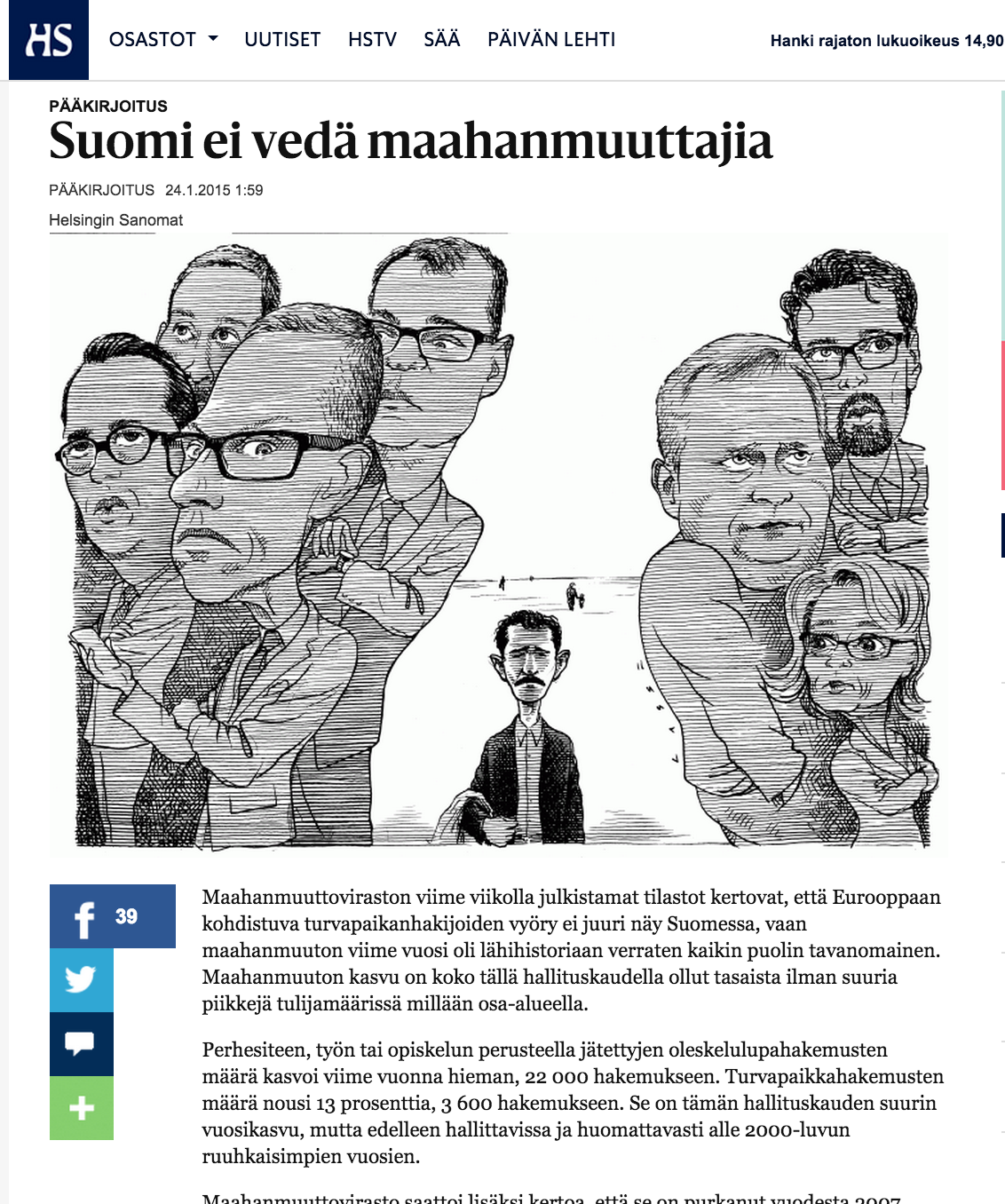
Suomi ei vedä maahanmuuttajia (Helsingin Sanomat)

What was left out? Today’s editorial on Helsingin Sanomat headlined, “Finland doesn’t attract migrants,” defends the country’s tightening of family reunification laws but surprisingly agrees with the anti-immigration populists, the Perussuomalaiset (PS),* that Finland should invest more in integration and offer more Finnish-language courses to newcomers. Is this only mentioned by the PS? Why does Helsingin Sanomat single out the PS in this respect? Do they want to make up with the anti-immigration party? Even if learning the local language is important, it isn’t a passport to equal membership in society. In Spain, where there are many Latin Americans, racism and social exclusion are common despite the fact that such migrants speak Spanish as their native tongue. Integration is a two-way process (not mentioned in the editorial) and certainly one reason why so few skilled migrants come to Finland is due to a number of factors like how do Finns relate to cultural diversity and Otherness? The cartoon depicts the prevailing attitude in all political parties: See no migrant, hear no migrant, speak no migrant.

Näyttökuva 2015-1-24 kello 11.07.56


YLE A-Studio: Let’s talk about stereotypes of Islam and jihadism

Posted on January 23, 2015 by Migrant Tales

What was the message that Thursday’s YLE A-Studio program on jihadism attempted to convey with the help of background pictures in light of the Charlie Hebdo attack? Was it that Muslim women wear niqabs and that jihadists wear masks and are pissed off? Is that the underlying tone that YLE A-Studio want to convey to viewers about Muslims and jihadism? 

Thanks to Maryan Abdulkarim, Sadek Elway and Silvia Akar, the show didn’t go down that regrettable path, at least not too far.

The other guest Atte Kaleva, who is running for parliament in April for the National Coalition Party, had other opinions when he attempted to paint Islam with a single brush.

Kaleva, who is an army captain that was kidnapped and later freed by al-Qaeda in Yemen in 2013, makes a pretty incredible by standing by affirming what he said earlier about Islam that it is a “hostile, intolerant and militant religion.”

It was a good matter that Helsinki University Arabic language lecturer, Sylvia Akar, put matters into perspective and exposed Kaleva’s ethnocentrism. She asked how the Bible differs from Kaleva’s comments about the Koran.

“I shy away from [those that claim] that Islam is this or that,” she said. “Islam isn’t one whole and no adjective can describe it.”

Reza Aslam, a University of California at Riverside professor, has stated that religions are not violent but the people who form part of them.

Näyttökuva 2015-1-23 kello 7.34.42
See whole program (in Finnish) here.


Some good points brought on the talk show by by Abdulkarim was how fascism in Europe is similar to a movement like the Islamic State. Both try to construct a homogenous picture of society where there is no room for minorities, said Abdulkarim.

Elwan asked a very good question as well: Who are the jihadists?

Thanks to Abdulkarim, Elwan and Akar that the program did not end up picturing Islam as A-Studio’s background pictures that portrayed a woman wearing a niqab and men as masked jihadists.

Näyttökuva 2015-1-23 kello 9.27.11
What feelings does this picture of a masked woman bring out when compared with a woman wearing a niqab? The text in the picture states that there is nothing more subversive and profane than a group of women below saying, saying to themselves: We women.


Or does it boil down to this below?

Näyttökuva 2015-1-8 kello 19.56.09


Reija Härkönen: Tehdäänpä perussuomalaiseen malliin tilastoista totta

Posted on January 22, 2015 by Migrant Tales

Reijä Härkönen 

Hyvinkäällä oli vuodenvaihteessa asukkaita 46413, naapurikaupungissa Riihimäellä 29384. Vuosina 2013 – 2014 Riihimäellä sattui suojatieonnettomuuksia 13. Yksi niistä johti jalankulkijan kuolemaan. Samana ajanjaksona Hyvinkäällä sattui suojateillä myös 13 onnettomuutta, kuolonuhreja ei ollut.

Näyttökuva 2015-1-22 kello 22.31.10

Mikä niitä hämäläisiä oikein vaivaa? Jos lasketaan suojatieonnettomuuksien määrä 1000 asukasta kohti, niin Riihimäellä autolla suojatietä ylittävien jalankulkijoiden ja pyöräilijöiden päälle ajavien suhdeluku on 0,44, kun se Hyvinkäällä, uusmaalaisten kaupungissa, on vain 0,28. Siis Riihimäellä 57 % suurempi! Kaiken lisäksi riihimäkeläiset tappavat autolla suojateillä 100 % enemmän, kuin hyvinkääläiset.

Onko hämäläisillä geeneissä halu hurjastella autolla lähimmäisistä välittämättä? Vai johtuuko se suuremmasta alkoholin käytöstä? Monet hyvinkääläiset ovat sitä mieltä, että Riihimäellä on selvästi enemmän alkoholisteja ja onhan siitä tilastojakin, rattijuopumuksiakin siellä on aina ollut enemmän. Mistä johtuu, että hämäläiset eivät ole yhtä hyvin kuin uusmaalaiset sopeutuneet suomalaiseen kulttuuriin ja oppineet noudattamaan Suomen lakeja? Pitäisikö riihimäkeläisillä allekirjoituttaa sellainen paperi, jossa sitoutuvat niitä noudattamaan?

Olisiko hallituksen ja eduskunnan mietittävä keinoja, kuinka voidaan paremmin kotouttaa hämäläiset? Vai olisiko jo vihdoin aika tehdä ratkaisuja, joilla olisi jotakin tehoa. Miksi ei voitaisi laatia lakeja, että hämäläiset, jotka rikkovat lakia, karkotetaan maasta? Näin voitaisiin estää suuri määrä suojatieonnettomuuksia ja kuolemia ja päihdehoidon kulut vähenisivät.

Ja ennen kaikkea – eivätkö perussuomalaiset nuoret voisi järjestää pilapiirroskilpailun, jossa aiheena olisivat riihimäkeläiset?

Tällä samalla logiikalla arvioivat perussuomalaiset ja eräät kokoomuslaiset ”poliitikot” maahanmuuttajien rikollisuutta. Etenkin raiskausrikokset ovat sellaisia, joilla on mukava nostattaa tunteita ja kerätä poliittisia irtopisteistä: ulos maasta, jos somali raiskaa, muukalaiset eivät sopeudu Suomen KULTTUURIIN.

Kerrottakoon esimerkkinä vielä yksi todellinen luku vuoden 2013 tilastoista: oikeudessa rangaistukseen tuomittiin raiskauksesta, törkeästä raiskauksesta tai sukupuoliyhteyteen pakottamisesta kaikkiaan 130 Suomessa vakituisesti asuvaa henkilöä. Näistä kaksi (2) oli maassa vakituisesti asuvia Somalian kansalaisia.

Itse olen sitä mieltä, että sekä hämäläiset että somalialaiset voivat jäädä maahan ja voimme kaikki asustaa täällä maatamme rakentaen ja toisiamme – myös naapurikaupungin väkeä – rakastaen. Rikolliset noin yleensä ottaen parantakoot tapansa, autoilijat kunnioittakoot suojateitä ja persut ja muut kiipijät alkakoot tehdä kunniallista politiikkaa.

Alkuperäisen blogikirjoituksen voi lukea tästä.

Tämä blogikirjoitus julkaistiin Migrant Talesissä luvalla.

  • 1
  • 2
  • 3
  • 4
  • Next
Read more about documentary film
Read more

Recent Posts

  • Finland’s tabloids Iltalehti and Ilta-Sanomat are the pits
  • Riikka Purra’s Dr Jekyll and Mr Hyde mask
  • Double standards
  • Perussuomalaiset: Uusi logo, sama vanha juttu
  • Taco Trump

Recent Comments

  1. Absolutely Socking: Racist Finnish Facebook group against human rights gets flooded with socks on Musta Barbaari’s mother and sister charged by the police in “ethnic profiling” case
  2. Ilkka Nuotio on Pekka Myrskylä: “Tilastot kertovat toista kuin poliittinen keskustelu”
  3. Genrih Soinkara on The war in Ukraine and the Russian-Finnish border crisis are showing Finland’s ugly side
  4. Ahti Tolvanen on Comment by Ahti Tolvanen on the Helsinki +50 conference
  5. Angel Barrientos on Angel Barrientos is one of the kind beacons of Finland’s Chilean community

Archives

  • June 2026
  • May 2026
  • April 2026
  • March 2026
  • February 2026
  • January 2026
  • December 2025
  • November 2025
  • October 2025
  • September 2025
  • August 2025
  • July 2025
  • June 2025
  • May 2025
  • April 2025
  • March 2025
  • February 2025
  • January 2025
  • December 2024
  • November 2024
  • October 2024
  • September 2024
  • August 2024
  • July 2024
  • June 2024
  • May 2024
  • April 2024
  • March 2024
  • February 2024
  • January 2024
  • December 2023
  • November 2023
  • October 2023
  • September 2023
  • August 2023
  • July 2023
  • June 2023
  • May 2023
  • April 2023
  • March 2023
  • February 2023
  • January 2023
  • December 2022
  • November 2022
  • October 2022
  • September 2022
  • August 2022
  • July 2022
  • June 2022
  • May 2022
  • April 2022
  • March 2022
  • February 2022
  • January 2022
  • December 2021
  • November 2021
  • October 2021
  • September 2021
  • August 2021
  • July 2021
  • June 2021
  • May 2021
  • April 2021
  • March 2021
  • February 2021
  • January 2021
  • December 2020
  • November 2020
  • October 2020
  • September 2020
  • August 2020
  • July 2020
  • June 2020
  • May 2020
  • April 2020
  • March 2020
  • February 2020
  • January 2020
  • December 2019
  • November 2019
  • October 2019
  • September 2019
  • August 2019
  • July 2019
  • June 2019
  • May 2019
  • April 2019
  • March 2019
  • February 2019
  • January 2019
  • December 2018
  • November 2018
  • October 2018
  • September 2018
  • August 2018
  • July 2018
  • June 2018
  • May 2018
  • April 2018
  • March 2018
  • February 2018
  • January 2018
  • December 2017
  • November 2017
  • October 2017
  • September 2017
  • August 2017
  • July 2017
  • June 2017
  • May 2017
  • April 2017
  • March 2017
  • February 2017
  • January 2017
  • December 2016
  • November 2016
  • October 2016
  • September 2016
  • August 2016
  • July 2016
  • June 2016
  • May 2016
  • April 2016
  • March 2016
  • February 2016
  • January 2016
  • December 2015
  • November 2015
  • October 2015
  • September 2015
  • August 2015
  • July 2015
  • June 2015
  • May 2015
  • April 2015
  • March 2015
  • February 2015
  • January 2015
  • December 2014
  • November 2014
  • October 2014
  • September 2014
  • August 2014
  • July 2014
  • June 2014
  • May 2014
  • April 2014
  • March 2014
  • February 2014
  • January 2014
  • December 2013
  • November 2013
  • October 2013
  • September 2013
  • August 2013
  • July 2013
  • June 2013
  • May 2013
  • April 2013
  • March 2013
  • February 2013
  • January 2013
  • December 2012
  • November 2012
  • October 2012
  • September 2012
  • August 2012
  • July 2012
  • June 2012
  • May 2012
  • April 2012
  • March 2012
  • February 2012
  • January 2012
  • December 2011
  • November 2011
  • October 2011
  • September 2011
  • August 2011
  • July 2011
  • June 2011
  • May 2011
  • April 2011
  • March 2011
  • February 2011
  • January 2011
  • December 2010
  • November 2010
  • October 2010
  • September 2010
  • August 2010
  • July 2010
  • June 2010
  • May 2010
  • April 2010
  • March 2010
  • February 2010
  • January 2010
  • December 2009
  • November 2009
  • October 2009
  • September 2009
  • August 2009
  • July 2009
  • December 2008
  • November 2008
  • October 2008
  • September 2008
  • August 2008
  • July 2008
  • June 2008
  • May 2008
  • April 2008
  • March 2008
  • February 2008
  • January 2008
  • November 2007
  • October 2007
  • September 2007
  • August 2007
  • July 2007
  • June 2007
  • May 2007

Categories

  • ?? Gia L?c
  • ????? ?????? ????? ???????? ?? ??????
  • ???????
  • @HerraAhmed
  • @mondepasrond
  • @nohatefinland
  • @oula_silver
  • @Varathas
  • A Pakistani family
  • äärioikeisto
  • Abbas Bahmanpour
  • Abdi Muhis
  • Abdirahim Hussein Mohamed
  • Abdirahim Husu Hussein
  • Abdirisak Mahamed
  • About Migrant Tales
  • activism
  • Adam Al-Sawad
  • Adel Abidin
  • Afrofinland
  • Ahmed IJ
  • Ahti Tolvanen
  • Aino Pennanen
  • Aisha Maniar
  • Alan Ali
  • Alan Anstead
  • Alejandro Díaz Ortiz
  • Alekey Bulavsev
  • Aleksander Hemon
  • Aleksanterinliitto
  • Aleksanterinliitto ry
  • Aleksanterinliitto ry:n hallitus
  • Alex Alex
  • Alex Mckie
  • Alexander Nix
  • Alexandra Ayse Albayrak
  • Alexis Neuberg
  • Ali Asaad Hasan Alzuhairi
  • Ali Hossein Mir Ali
  • Ali Rashid
  • Ali Sagal Abdikarim
  • Alina Tsui
  • Aline Müller
  • All categories
  • Aman Heidari
  • Amiirah Salleh-Hoddin & Jana Turk
  • Amin A. Alem
  • Amir Zuhairi
  • Amkelwa Mbekeni
  • Ana María Gutiérrez Sorainen
  • Anachoma
  • Anders Adlecreutz
  • Angeliina Koskinen
  • Anna De Mutiis
  • Anna María Gutiérrez Sorainen
  • Anna-Kaisa Kuusisto ja Jaakko Tuominen
  • Annastiina Kallius
  • Anneli Juise Friman Lindeman
  • Announcement
  • Anonymous
  • Antero Leitzinger
  • anti-black racism
  • Anti-Hate Crime Organisation Finland
  • Anudari Boldbaatar
  • Arshiya Nasser
  • Aspergers Syndrome
  • Asylum Corner
  • Asylum seeker 406
  • Athena Griffin and Joe Feagin
  • Autism
  • Avaaz.org
  • Awale Olad
  • Ayan Said Mohamed
  • AYY
  • Barachiel
  • Bashy Quraishy
  • Beatrice Kabutakapua
  • Beri Jamal
  • Beri Jamal and Enrique Tessieri
  • Bertolt Brecht
  • Boiata
  • Boodi Kabbani
  • Bruno Gronow
  • Carmen Pekkarinen
  • Çelen Oben and Sheila Riikonen
  • Chiara Costa-Virtanen
  • Chiara Costa-Virtanen
  • Chiara Sorbello
  • Christian Thibault
  • Christopher Wylie
  • Clara Dublanc
  • Dana
  • Daniel Malpica
  • Danilo Canguçu
  • David Papineau
  • David Schneider
  • Dexter He
  • Don Flynn
  • Dr Masoud Kamali
  • Dr. Faith Mkwesha
  • Dr. Theodoros Fouskas
  • Edna Chun
  • Eeva Kilpi
  • Emanuela Susheela
  • En castellano
  • ENAR
  • Enrique
  • Enrique Tessieri
  • Enrique Tessieri & Raghad Mchawh
  • Enrique Tessieri & Yahya Rouissi
  • Enrique Tessieri and Muhammed Shire
  • Enrique Tessieri and Sira Moksi
  • Enrique Tessieri and Tom Vandenbosch
  • Enrique Tessieri and Wael Che
  • Enrique Tessieri and Yahya Rouissi
  • Enrique Tessieri and Zimema Mhone
  • Epäluottamusmies
  • EU
  • Europe
  • European Islamophobia Report
  • European Islamophobia Report 2019,
  • European Union
  • Eve Kyntäjä
  • Ezequiel Caldeiro
  • Facebook
  • Fadumo Dayib
  • Faisa Kahiye
  • Farhad Manjoo
  • Fasismi
  • Finland
  • Fizza Qureshi
  • Flyktingar och asyl
  • Foreign Student
  • Fozia Mir-Ali
  • Frances Webber
  • Frida Selim
  • Gareth Rice
  • Ghyslain Vedeaux
  • Global Art Point
  • Great Replacement
  • Habiba Ali
  • Hami Bahadori
  • Hami Bahdori
  • Hamid
  • Hamid Alsaameere
  • Hamid Bahdori
  • Handshake
  • Harmit Athwal
  • Hassan Abdi Ali
  • Hassan Muhumud
  • Heikki Huttunen
  • Heikki Wilenius
  • Helsingin Sanomat
  • Henning van der Hoeven
  • Henrika Mälmsröm
  • Hser Hser
  • Hser Hser ja Mustafa Isman
  • Husein Muhammed
  • Hussain Kazemian
  • Hussain Kazmenian
  • Ibrahim Khan
  • Ida
  • Ignacio Pérez Pérez
  • Iise Ali Hassan
  • Ilari Kaila & Tuomas Kaila
  • Imam Ka
  • inside-an-airport
  • Institute of Race Relations
  • Iraqi asylum seeker
  • IRR European News Team
  • IRR News Team
  • Islamic Society of Norhern FInland
  • Islamic Society of Northern Finland
  • Islamophobia
  • Jacobinmag.com
  • Jallow Momodou
  • Jan Holmberg
  • Jane Elliott
  • Jani Mäkelä
  • Jari Luoto
  • Jari Taponen
  • Jegor Nazarov
  • Jenni Stammeier
  • Jenny Bourne
  • Jessie Daniels
  • Joe Davidow
  • Johannes Koski
  • John D. Foster
  • John Grayson
  • John Marriott
  • Jon Burnett
  • Jorma Härkönen
  • Jos Schuurmans
  • José León Toro Mejías
  • Josue Tumayine
  • Jouni Karnasaari
  • Juan Camilo
  • Jukka Eräkare
  • Julian Abagond
  • Julie Pascoet
  • Jussi Halla-aho
  • Jussi Hallla-aho
  • Jussi Jalonen
  • JusticeDemon
  • Kadar Gelle
  • Kaksoiskansalaisuus
  • Kansainvälinen Mikkeli
  • Kansainvälinen Mikkeli ry
  • Katherine Tonkiss
  • Kati Lepistö
  • Kati van der Hoeven-Lepistö
  • Katie Bell
  • Kättely
  • Kerstin Ögård
  • Keshia Fredua-Mensah & Jamie Schearer
  • Khadidiatou Sylla
  • Khadra Abdirazak Sugulle
  • Kiihotus kansanryhmää vastaan
  • Kirsi Crowley
  • Koko Hubara
  • Kristiina Toivikko
  • Kubra Amini
  • KuRI
  • La Colectiva
  • La incitación al odio
  • Laura Huhtasaari
  • Lauri Finér
  • Leif Hagert
  • Léo Custódio
  • Leo Honka
  • Leontios Christodoulou
  • Lessie Branch
  • Lex Gaudius
  • Leyes de Finlandia
  • Liikkukaa!
  • Linda Hyökki
  • Liz Fekete
  • M. Blanc
  • Maarit Snellman
  • Mahad Sheikh Musse
  • Maija Vilkkumaa
  • Malmin Kebab Pizzeria Port Arthur
  • Marcell Lorincz
  • Mari Aaltola
  • María Paz López
  • Maria Rittis Ikola
  • Maria Tjader
  • Marja-Liisa Tolvanen
  • Mark
  • Markku Heikkinen
  • Marshall Niles
  • Martin Al-Laji
  • Maryan Siyad
  • Matt Carr
  • Mauricio Farah Gebara
  • Media Monitoring Group of Finland
  • Micah J. Christian
  • Michael McEachrane
  • Michele Levoy
  • Michelle Kaila
  • Migrant Tales
  • Migrant Tales Literary
  • Migrantes News
  • Migrants' Rights Network
  • MigriLeaks
  • Mikko Kapanen
  • Miriam Attias and Camila Haavisto
  • Mohamed Adan
  • Mohammad Javid
  • Mohammad M.
  • Monikulttuurisuus
  • Monisha Bhatia and Victoria Canning
  • Mor Ndiaye
  • Muh'ed
  • Muhamed Abdimajed Murshid
  • Muhammed Shire
  • Muhammed Shire and Enrique Tessieri
  • Muhis Azizi
  • Musimenta Dansila
  • Muslimiviha
  • Musulmanes
  • Namir al-Azzawi
  • Natsismi
  • Neurodiversity
  • New Women Connectors
  • Nils Muižnieks
  • No Labels No Walls
  • Noel Dandes
  • Nuor Dawood
  • Omar Khan
  • Otavanmedia
  • Oula Silvennoinen
  • Paco Diop
  • Pakistani family
  • Pentti Stranius
  • Perussuomalaiset
  • perustuslaki
  • Petra Laiti
  • Petri Cederlöf
  • Pia Grochowski
  • Podcast-lukija Bea Bergholm
  • Pohjois – Suomen Islamilainen Yhdyskunta
  • Pohjois Suomen Islamilainen Yhyskunta
  • Polina Kopylova
  • Race Files
  • racism
  • Racism Review
  • Raghad Mchawh
  • Ranska
  • Rashid H. and Migrant Tales
  • Rasismi
  • Raul Perez
  • Rebecka Holm
  • Reem Abu-Hayyeh
  • Refugees
  • Reija Härkönen
  • Remiel
  • Reza Nasri
  • Richard Gresswell
  • Riikka Purra
  • Risto Laakkonen
  • Rita Chahda
  • Ritva Kondi
  • Robito Ibrahim
  • Roble Bashir
  • Rockhaya Sylla
  • Rodolfo Walsh
  • Roger Casale
  • Rostam Atai
  • Roxana Crisólogo Correa
  • Ruth Grove-White
  • Ruth Waweru-Folabit
  • S-worldview
  • Sadio Ali Nuur
  • Sami Rusanen
  • Sandhu Bhamra
  • Sara de Jong
  • Sarah Crowther
  • Sari Alhariri
  • Sarkawt Khalil
  • Sasu
  • Scot Nakagawa
  • Shabana Ahmadzai
  • Shada Islam
  • Sharon Chang blogs
  • Shenita Ann McLean
  • Shirlene Green Newball
  • Sini Savolainen
  • Sira Moksi
  • Sonia K.
  • Sonia Maria Koo
  • Steverp
  • Stop Deportations
  • Suldaan Said Ahmed
  • Suomen mediaseurantakollektiivi
  • Suomen Muslimifoorumi ry
  • Suomen viharikosvastainen yhdistys
  • Suomen viharikosvastainen yhdistys ry
  • Suomi
  • Supermen
  • Susannah
  • Suva
  • Syrjintä
  • Talous
  • Tapio Tuomala
  • Taw Reh
  • Teivo Teivainen
  • The Daily Show
  • The Heino
  • The Supermen
  • Thomas Elfgren
  • Thulfiqar Abdulkarim
  • Tim McGettigan
  • Tino Singh
  • Tito Moustafa Sliem
  • Tobias Hübinette and L. Janelle Dance
  • Transport
  • Trica Danielle Keaton
  • Trilce Garcia
  • Trish Pääkkönen
  • Trish Pääkkönen and Enrique Tessieri
  • Tuulia Reponen
  • Uncategorized
  • UNITED
  • University of Eastern Finland
  • Uyi Osazee
  • Väkivalta
  • Vapaa Liikkuvuus
  • Venla-Sofia Saariaho
  • Vieraskynä
  • W. Che
  • W. Che an Enrique Tessieri
  • Wael Ch.
  • Wan Wei
  • Women for Refugee Women
  • Xaan Kaafi Maxamed Xalane
  • Xassan Kaafi Maxamed Xalane
  • Xassan-Kaafi Mohamed Halane & Enrique Tessieri
  • Yahya Rouissi
  • Yasmin Yusuf
  • Yassen Ghaleb
  • Yle Puhe
  • Yuliet Tresa
  • Yve Shepherd
  • Zahra Khavari
  • Zaker
  • Zalina Ametova
  • Zamzam Ahmed Ali
  • Zeinab Amini ja Soheila Khavari
  • Zimema Mahone and Enrique Tessieri
  • Zimema Mhone
  • Zoila Forss Crespo Moreyra
  • ZT
  • Zulma Sierra
  • Zuzeeko Tegha Abeng
© 2026 Migrant tales | Powered by Minimalist Blog WordPress Theme