Migrant tales
Menu
  • #MakeRacismHistory “In Your Eyes”
  • About Migrant Tales
  • It’s all about Human Rights
  • Literary
  • Migrant Tales Media Monitoring
  • NoHateFinland.org
  • Tales from Europe
Menu

Month: May 2014

The euro elections have shown parties like the PS to be hostile to development aid, immigrants, minorities and gays

Posted on May 22, 2014 by Migrant Tales

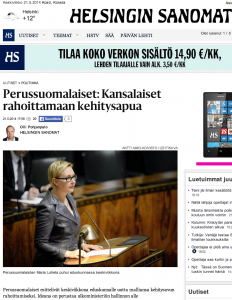
It’s clear that if we allowed ourselves to be spoon-fed by the populism and anti-EU, homophobic and anti-immigration rhetoric of the Perussuomalaiset (PS) party, minorities would always be threatened with social exclusion. PS MP Maria Lohela, who is said to turn into a Ms Hyde if you mention the word “Islam” to her, offered in parliament another one of her party’s “great” ideas on how to scrap development aid.

Lohela suggested a new development aide model for Finland that would be financed by taxpayers and that the role of the state would be to offer tax incentives so that people could give money to development aid out of their own pockets, according to Finland’s largest daily,  Helsingin Sanomat.


Näyttökuva 2014-5-22 kello 7.50.18

Read full story (in Finnish) here.


While it’s clear that Lohela and the PS loathe helping less-fortunate people living in development countries, the most recent proposal is just as absurd as the one the MP made earlier this year concerning gay marriage. Lohela said that Finland didn’t have to pass same-sex marriage legislation since homosexuals could marry the opposite sex.

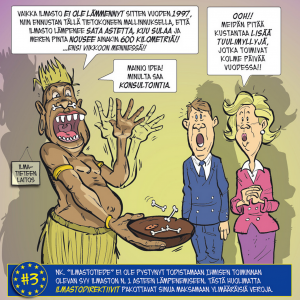
With euro elections ending on May 25, the party has made very public its anti-immigration and racist views, like with the publishing of a racist cartoon below denouncing climate change as a hoax predicted by African “medicine men.”

Näyttökuva 2014-5-19 kello 11.07.36


Read full story on Migrant Tales here.


A poll by Helsingin Sanomat of Finnish MEP’s showed that the PS to be the most eager in wanting to restrict the free movement of people within the EU.

Näyttökuva 2014-5-22 kello 8.18.45


PS MEP candidates were the most for limiting free movement of people in the EU. Read full story (in Finnish) here.


Taking into account the type of Europe the PS wants to forge, which is very similar to far-right Danish People’s Party and UKIP, people should get out and vote against these these types of anti-EU, homophobic, anti-immigration and especially anti-Islam parties.

Why? Because we are against the model they’re trying to create for Europe since it would polarize our society and bolster intolerance and hatred of migrants and other minorities.

Why do countries that have built  a model social welfare state in the Nordic region want to support parties like the PS? Shouldn’t they instead challenge the root of the problem, which is poverty, inequality, racism and intolerance.


Integration by perkele

Posted on May 20, 2014 by Migrant Tales

Some have heard of the expression of management by perkele, which means swift decision-making by management and where your opinion as an employee counts little. In Finland the goal is integration, or two-way adaption, but what happens on too many occasions is integration by perkele. 

Integration by perkele has a clear message: This is our country, perkele, and don’t forget it! Since this is my country, you are going to adapt to me. In plain English integration by perkele means assimilation.

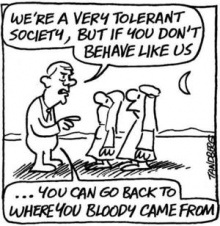
The cartoon below offers a good example of integration by perkele.

220px-svvalues_narrowweb_300x3080

How do you recognize integration by perkele? Here are some good examples:

  • They have to adapt to us;
  • We’ve always done things this way;
  • Read my lips: This is our country!
  •  Learn Finnish!
  • Too bad you’re not white like me;
  • If you don’t like our country, you can always move elsewhere;
  • Maassa maan tavalla, or in Rome do as the Romans do;
  • “Debating immigrant issues in this country doesn’t mean you’re racist”
  • The Perussuomalaiset* aren’t against immigrants and they’re not racist.

Is integration by perkele an effective way to adapt migrants and minorities? If you want an answer to the that question, why not ask Amerindians, who were victims of systematic genocide, the Roma, Muslims and gays in Russia, Poles in the UK, Turks in Germany, Moroccans and Latin Americans in Spain, Africans in France, asylum-seekers in Greece as well as other migrants and minorities?

Certainly they’ll tell you about the hostility they face daily thanks to integration by perkele.

* The Finnish name for the Finns Party is the Perussuomalaiset (PS). The names adopted by the PS, like True Finns or Finns Party, promote in our opinion nativist nationalism and xenophobia. We therefore prefer to use the Finnish name of the party on our postings. 


Migrants’ Rights Network: The anti-immigrant message stumbles, but who will come out on top?

Posted on May 19, 2014 by Migrant Tales

By Don Flynn*

Don_web_0

Only a few days left before the vote in the European and local election poll. The anti-immigrant hardliners are taking flack after an inept radio interview performance by the leading Ukipper. But has the liberal mainstream the gumption to allow it forge past them with an optimistic message about diversity?


For anyone concerned with the rights of migrants, the gloomiest prognosis of where we might be four days ahead of polling for the European Parliamentary and local elections was that a strong anti-immigration narrative was being injected into the public discussion by the mainstream parties and this was pointing to a landslide victory for parties demanding a clampdown on the movement of people.

“Are you thinking what we are thinking?”

But despite the platform that the Ukippers have managed to create for themselves and the prominence given to their ‘They are After Your Job’ message it is still not clear that the populist right wing party is ruling the roost in quite the way they hoped.

Nigel Farage’s ‘car crash’ interview with LBC’s James O’Brien last week was the first occasion when the man who appeared immune to bad news seemed to have come unstuck with the wider public. His floundering attempt to explain why anxiety about hearing foreign languages being spoken on trains drained away a good deal of the credibility he has had with voters who appreciated his ‘cheeky chappie’ view of the world. The unease mounted as he went on to disparage Romanians, claiming that anxiety about having them as neighbours was bound to be justified by common-sense.

The misgivings that began to be aired after this interview do not yet amount to a wholesale rejection of the xenophobic messages that have been coded into the UKIP campaign. The desire to register a protest against the mainstream parties remains strong amongst a large section of the population and it will seem to many that a vote for Farage’s party will be the best way to do this.

But at the same time a sense of the repugnance to overtly anti-immigrant messages can be seen as making itself felt as we move closer to polling day. It is a mood rather similar to the one that scuppered the chances of Michael Howard when he led the Conservative general election campaign in 2005, when his ‘Are you thinking what we are thinking?’ message had the effect of reminding at least a segment of voters that politicians can mess with you head and lead you in directions which, in your heart of hearts, you really don’t want to go.

Political parties and their messages

When the history of this election campaign comes to be written it might well prove to be the case that the most significant turning point with regard to the public mood on immigration has come from the currents that cluster around the Conservative party rather than the centre left. Back at the beginning of May the centre right think tank Policy Exchange published its report, Portrait of Modern Britain, which predicted the rise of the proportion of black and minority ethnic people in the UK from their present 14% to around one-third of the population by the mid-century.

The report provided an account of communities which are at ease with their identities as being both black, Asian and British citizens and, if anything, even more committed to the future of the country than many amongst their white counterparts. The message that trailed across the media for a few critical days was that we do not have to be overwhelmed with anxiety about diversity and should indeed be more confident that society is sufficient robust and adaptable to allow us to be optimistic about the future.

If this piece of Tory research provided reasons for thinking that anti-immigrant paranoia might yet be turned, the same cannot be said for the Labour party’s main contribution to the discussion these past few weeks. The party’s leader has continued to hark on the theme of immigration eroding living standards and needing to be controlled as part of his strategy of coming to the aid of the ‘squeezed middle classes.’

At one point Mr Miliband seemed to be marking out a distinct approach to the public conversation when he set out his view in speeches that the exploitation of migrant workers needed to be tackled through rigorous enforcement of the minimum wage and control of agencies that channelled migrants into low paid jobs.

If there was merit in this basic idea it needed to be developed with a clear argument about the nature of the rights that ought to be in the grasp of all newcomers to the UK to ensure that they were able to join the ranks of other groups who were fighting against poverty and marginalisation.

But this has not happened and what was once an interesting idea is now in danger of morphing into UKIP-lite, with anxiety about migrants’ presence in the labour market taking the place of them speaking their own languages on public transport.

After the elections…

In just a few days time new political debate will replace the one about who comes top of the election popularity poll. The speculation will have to give way to the evidence and the question then to be answered is what 22 May and its European and local elections have really revealed to us about the state of the public mood about, amongst other issues, the vexed question of immigration.

Our bet is that the answer will require a much more nuanced understanding of what is going on other than the simplistic interpretation of it showing an inexorable rise of anti-immigrant sentiment.

The other part of the picture will be the signs of a public mood which is beginning to rally xenophobia and wanting a more progressive politics which will help us to feel more at ease, rather than more anxious, about the increasing diversity of our communities.  We can only hope that there will be enough politicians around on that day who are sufficiently canny to clock the emergence of this mood, and ready to put in the work to help it flourish in the mainstream.

Read original story here.

This piece was reprinted by Migrant Tales with permission.

* Don Flynn, the MRN Director, leads the organization’s strategic development and coordinates MRN’s policy and project work. he is a regular and sought-after speaker at conferences, seminars and lectures on behalf of MRN. 

A racist cartoon by the PS, a Finnish anti-EU, anti-immigration, homophobic and especially anti-Islam party

Posted on May 19, 2014 by Migrant Tales

Does the Perussuomalaiset (PS) party have issues with racism? Many will agree that they do starting from MPs like Jussi Halla-aho, who were sentenced for ethnic agitation, to city of Kemi councilman, Harri Turtiainen, who shamefully posted racist slogans of the Ku Klux Klan and US American Nazi party on his Facebook page.

The intolerance of the PS is well known. Their anti-EU, anti-immigration, homophobic and especially anti-Islam message repeats itself over and over again like a broken record.

One of the many political stunts of the PS is attempted surrealism. They claim, for example, not to be racist but near-constantly post and make racist comments. They  claim they are against the EU but we still don’t know if they want us to terminate membership or ditch the euro.

Below is another example of how the party drives home its anti-EU message. The cartoon, which tries to show that climate change is something that African medicine men predict is not only racist, but insulting.

Näyttökuva 2014-5-19 kello 11.07.36
Read original posting (in Finnish) here.


Anti-immigration Europe: The fruits you harvest depend on the seed you plant

Posted on May 18, 2014 by Migrant Tales

In many respects, Europe looks like a region that is running scared with a notable part of its population seeking to support populist, anti-immigration and even neo-Nazi parties that offer no credible solutions to issues like rising unemployment, poverty and estrangement from our political institutions. 

IMG_3515

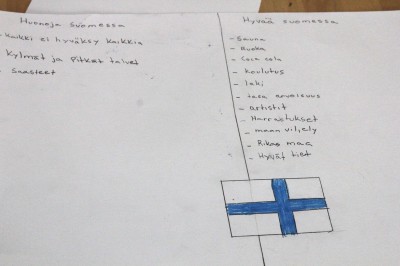
If students from a small town in Eastern Finland did a poster advertising Finland, what push and pull factors would they highlight for migrants?


In Finland, some politicians are learning slowly but surely that it’s a very bad idea to flirt with these right-wing populist parties like the Perussuomalaiset (PS) that are anti-EU, anti-immigration, homophobic and especially anti-Islam.

In many respects, those right-wing populist political forces they flirted with not only paved the way for a new political landscape in Finland after 2011, but marked their eventual political demise. A case in point is former Social Democrat party chairman Jutta Urpilainen, who flirted with the PS in 2010 with her infamous maassa maan tavalla statement, or in Rome do as the Romans do.

Taking into account the avalanche of bigotry at the time especially after 2008 thanks to the PS and many of its politicians like Jussi Halla-aho, James Hirvisaari and others, Urpilainen’s quote was seen as offensive to migrants living in this country. Instead of promoting Social Democratic values like social equality and inclusion, Urpilainen’s statement singled out and victimized non-ethnic Finns.

Another politician the PS should thank for helping them become one of Finland’s four largest parties is National Coalition Party Prime Minister Jyrki Katainen, who said before the 2011 parliamentary elections that “debating immigrant issues in this country doesn’t mean you’re racist.”


If politicians like Katainen or Urpilainen think it was fair game to victimize migrants, is it then ok to be a bigot, sexist or homophobic in Finland? Shouldn’t human rights, Nordic welfare state values like social equality, non-discrimination be defended by politicians? Why do they give with their silence and lack of leadership the green light to others to bully migrants and minorities?

A part of the answer to the latter question lies in the fact that migrants and minorities are vulnerable and easy targets with little power in their respective countries. Anti-immigration politicians get their inspiration from apathetic migrants and the mood swings of society that they help create.

The same mistake that the Social Democrats and National Coalition Party committed in 2010 is happening in other parts of Europe like in the United Kingdom. Conservative Prime Minister David Cameron has become more anti-immigration and anti-EU in order to appease UKIP. He has helped the anti-EU, anti-immigration, homophobic and especially anti-Islam party to grow into a formidable political force that is now threatening his party in the Euro elections.

This video clip UKIP’s Farage when effectively cross-examined by James O’Brien on LBC. Finnish journalists could learn a lot from this interview.


What have we learned from the UKIP and PS cases? One important lesson is not to suck up to the arguments of  populist parties that aim to polarize society. Instead of parroting their intolerance, politicians should take part in an open debate with them and expose them for what they are: a sham.

Politicians should answer simple questions like why are racism and prejudice hazardous to society?

One of the examples they could give is the stereotype that women don’t excel in math. How do you think a woman feels as a minority in an advanced math class with other males? Consider the pressure and stress she has to face daily to prove that she’s just as good, if not even better at math, than her male classmates. Think of the power and potential that would be released from that woman if she weren’t a target of prejudice.

Rubén Blades is a famous salsa singer from Panama, who said in one of his songs, Siembra (harvest), that Latin Americans everywhere shouldn’t allow their conscience to die and be careful with the seed they plant because the fruits they’ll harvest depend on that seed.

In the song, Blades states that the seed that needs to be planted are those of affection and humility. They are the ones that will give hope to future generations.

But with the rise of right-wing populist, anti-immigration and even far-right parties in Europe today, what kind of seed are we planting and what will be its fruits?


In the hands of white Finnish privilege, our ever-growing cultural and ethnic diversity is a pathway of good intentions and social exclusion

Posted on May 17, 2014 by Migrant Tales

Or is the saying: “The road to hell is paved with good intentions?”

One would think that the great amount of effort put into Finland’s educational system would help it to come to grips with social ills like racism and xenophobia. If we look at the political landscape of Finland, and how hostile this country has become for some migrants and visible minorities, it shows that something vital like tolerance and respect weren’t taught enough at school never mind at home.

Näyttökuva 2014-3-19 kello 20.36.26

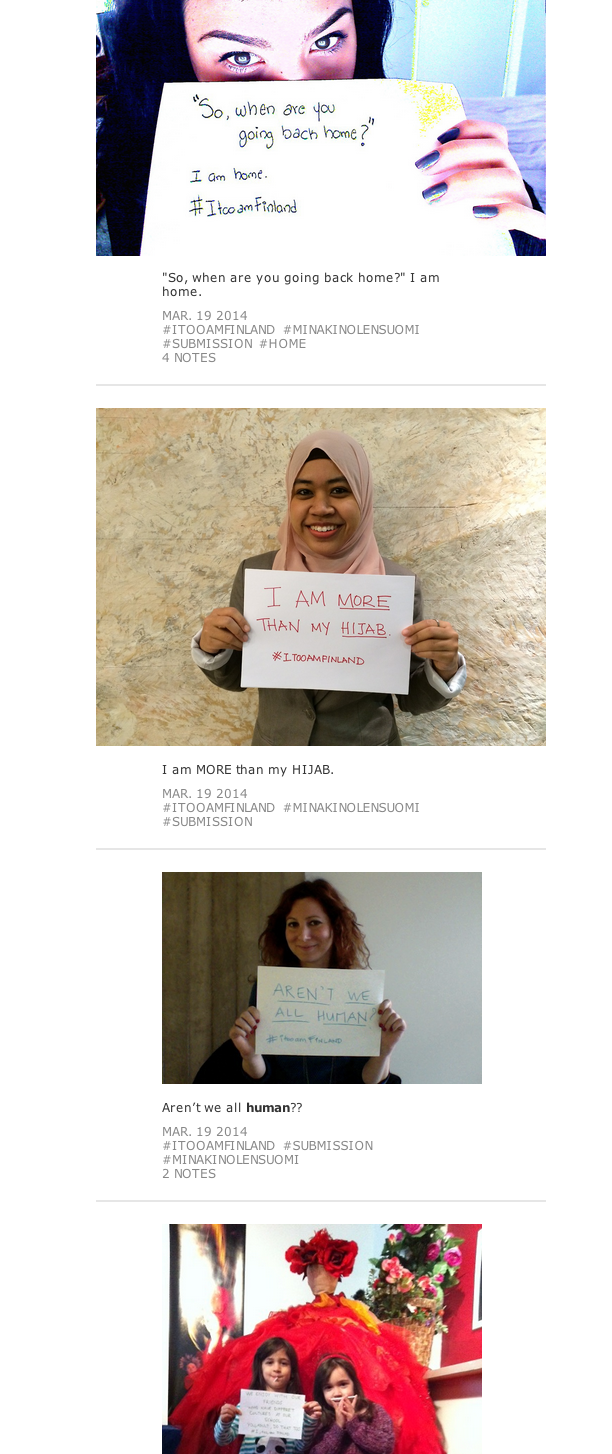
The #I, too, am Finland! campaign was a very successful way of promoting inclusion.

It’s ironic that all those things that made Finland into a successful country today, even like its military victories of the Winter War (1939-49) against a vastly outnumbered Red Army, are threatening us today.

Take for instance the Winter War, when Finland was attacked by the former Soviet Union on November 30, 1939. Not only do we know of the military exploits of the Finnish army during that gruelling 105-day war, but how it helped to unite a country by healing the wounds of the 1918 Civil War.

If the Winter War did a lot to unify the country, it reinforced as well our suspicions of Russia, which still exist today, and of the outside world.

Certainly living next to an autocratic state like the USSR can bring out the worst or the best in any nation.

The worst that our relationship with out giant eastern neighbor has fuelled is xenophobia and hostility to cultural diversity. With the help of negative attitudes of foreigners, building of social constructs and laws like the Restricting Act of 1939, were easy to keep in force for decades. For one they helped us as well to “forget” the over 1.2 million Finns that emigrated from this land between 1860 and 1999 and what they contributed to our diverse Finnish identity.

For these reasons and others, Finland was never a breeding ground for cultural diversity but a hostile place for it.

Since white Finnish-speaking Finland has monopolized this “privilege,” which gives it near-total control of political, economic and social power, it’s clear why some Finns are today so uneasy about our ever-growing cultural and ethnic diversity.

I for one am an optimist about Finland’s bright future as a culturally and ethnically diverse nation. I’m optimistic because our diversity as a nation is a fact, not a social construct like white Finnish privilege.

If we don’t succeed at challenging matters like intolerance, we run the risk of impoverishing ourselves.

It’ll be like be on a road to impoverishment where we’ll smile cordially at each other with the best intentions to the road to hell.

Pew Research Center survey: Anti-immigration and anti-minority sentiment runs high before Euro elections

Posted on May 17, 2014 by Migrant Tales

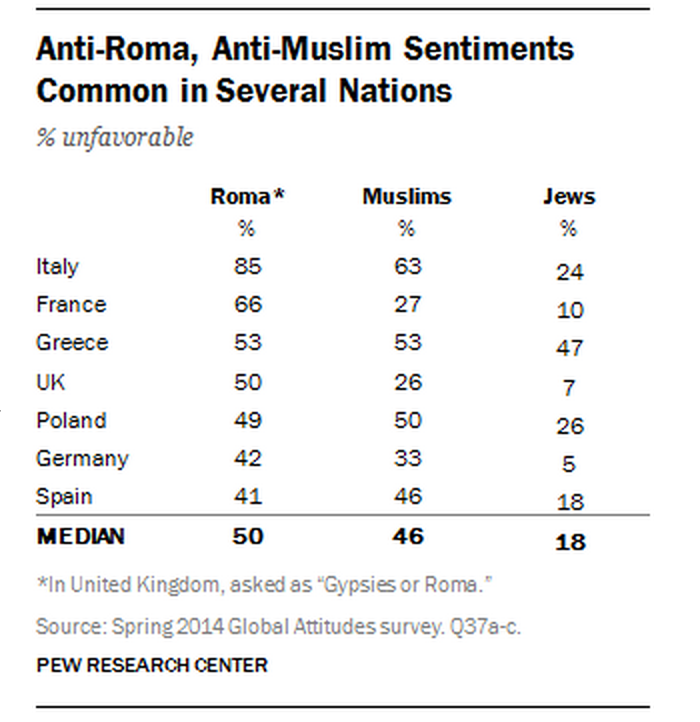
Pew Research Center, a Washington-based “fact tank,” reveals in a survey just before the European parliamentary elections on May 22-25 that anti-immigration and anti-minority sentiment runs  in countries like Poland, Germany, France, UK, Spain, Italy and Greece.

Euro MEP candidates like Jussi Halla-aho and Juho Eerola of the PS have used anti-immigration sentiment to attract voters. Halla-aho’s visit in February to Lieksa in eastern Finland is a good example of how he promotes anti-immigration sentiment by demonizing Muslims.

Some parties with strong anti-immigration campaigns include Britain’s UKIP, a close ideological ally of the Perussuomalaiset (PS) of Finland, France’s National Front, Greece’s neo-Nazi Golden Dawn.

Näyttökuva 2014-5-17 kello 0.36.00

The Pew Research Center survey revealed that an average of 55% of respondents in the seven EU countries said they want fewer migrants. The strongest anti-immigration sentiment was found in Greece (86%) followed by Italy (80%).

If views of migrants was negative, so were attitudes of minorities like the Roma, Muslims and to a lesser extent Jews.

The survey revealed that the Roma are viewed as the most unfavorable (50%) minority with the Muslims (46%) trailing closely behind. While attitude towards Jews weren’t as negative as those towards the Roma and Muslims, they were especially high in Greece (47%), Poland (26%) and Italy (24%).

Still confused about how racist parties like the UKIP are? Check out this video clip below where the head of the UKIP, Nigel Farage, answers some hard questions in the same way that PS chairman Timo Soini did when he was interviewed on BBC’s Hard Talk in 2013.

UKIP’s Farage political views are very similar to Soini’s. Listening to the interview by LBC’s James O’Brien of Farage shows close similarities of how Soini speaks to the Finnish media. 


Migrants’ Rights Network: Public moods on free movement: Should we just follow the herd?

Posted on May 15, 2014 by Migrant Tales

Don Flynn*

Don_web_0


The new report on free movement in the EU from IPPR argues that pro-migration groups have to triangulate their advocacy with the antagonistic moods that currently hold sway. But do they need to go quite so stridently in the direction of arguing that they dictate the need for a ‘new course’ reigning in on some EU migrant rights?

Na?ytto?kuva 2014-5-15 kello 7.53.01

Read full blog entry here.

Immigration is not currently very popular with the voting public in the UK and indeed the citizens of most of the countries of the developed industrial world. The evidence of countless opinion polls scream out this headline fact and it is incumbent on even the greatest enthusiast of the benefits that come from the cross border movement of people to acknowledge the fact.

“Europe, free movement and the UK: Charting a new course”

In its latest report on immigration policy, IPPR argues that the apparent strength of public opposition to immigration “has to be treated with respect”. Even more than this, it says that it is sufficient ground for proclaiming a “new course” with regard to one aspect of control policy; the free movement of people under the terms of the treaties of the European Union.

IPPR has taken on itself the task of thinking about the types of social democratic policies that might have a chance of becoming popular with a plurality of politically active citizens and this seems to require that we have to take the views they have on the world as they come and steer a course around with this uppermost in mind. It is an approach which largely discounts the possibility that mass public opinion might change rapidly over short periods of time; such shifts as might occur happen only at glacial pace. In the meantime, we just have to live with them.

This being the case the report tells us that a dissection of public opinion is needed in order to identify the things that people are asking for from their politicians and then see how much of this can be offered up within a decent social democratic framework. According to IPPR what they want is not much more than an assurance that immigration is not undermining the conditions of life which the settled population has secured for itself and that the public services that attend to welfare and well-being distribute their goods on principles that most people would recognise as being fair. In addition they want to know that the authorities are equipped with the power to act against people who fall into the category of being ‘bad’ and undesirable immigrants by deporting them from the country.

If this is the case, the report has a suite of policies to offer the general public, ranging from the Swedish-style contracts for agency workers, strengthening the work of the Gangmasters Licensing Authority (GLA), a localised system registration of all residents, English language classes for all who need them, making sending states responsible for social security of their citizens for longer periods after they migrate, and EU funding to cover the cost of returning migrants whose attempts to establish themselves in another state has not worked out.

There is a lot that is very sensible in this list and an outfit like MRN, being concerned primarily with the rights of migrants, would want to pitch in with support for anything that improves the lot of workers on temporary and agency contracts, access to affordable language courses, and something that places a duty of local and regional authorities to collect better data on the economic and social profiles of their resident populations.

What does the public want?

But how much of what is being revealed about opposition to immigration in public opinion polls is really answered by a set of policies of this sort? The people who do the most through and rigorous job of interpreting their meaning tell us that they consistently underscore two basic facts, which are that, firstly, people quite simply don’t like immigrants very much irrespective of whether they can be fitted into the category of the good, contribution-positive sort which immigration control policy is supposed to privilege, or they really are ‘bad ‘uns’.

Yet, and this is the second finding that the psephologists proclaim from their research, it seems that the majority of people at least do not hold these feelings of dislike for immigrants very deeply. They are quick to tell us that they would rather not bother having to deal with the complexities that come from living cheek by jowl with foreigners, but the numbers who appear to really want to make a big issue out of it is actually rather small. Moan and groan they might; but in a very British way, the great majority will keep calm and carry on.

There are both opportunities and dangers in dealing with the issue of public opinion in the way IPPR suggests. The opportunities come from being able to set out the list of broadly progressive social measures that do stand a chance of allaying at least some of the fears and anxieties which immigration seems to raise for some people. But the danger is that the proposal will be interpreted as evidence that an important though minority strand of thinking on the issue, that of pro-immigration progressives, are conceding to at least some elements of the argument that the free movement of people is not working out as a social and economic policy and needs to be brought to an end.

keep_calm_BLUE

Successful policy

The report itself goes to some length to explain that free movement is one of the most successful of the EU’s measures and will need to be preserved if Europe is to remain a prosperous region in the world. Is there really any need at this moment in time to concede any aspect of this positive case to political forces that are trying to catch and apparently rising tide of nationalistic and even xenophobic moods?

Perhaps we should not allow ourselves to make the mistake of thinking that public moods and attitudes change only slowly. Over time spans of a decade or two they in fact can show enormous scope for complete turnaround, with views on issues like the equality of women and the rights of gay people being overturned in the space of a generation.

Advocates for liberal approaches to immigration should not close themselves to the possibility that this might also prove to be the case in the issue that they care about. Somewhere out there, nurtured perhaps amongst a group of people now planning their post university careers and the places they will be taken to, is the view that immigration is a part of reality and, as the campaigners for gay rights grew adept at explaining to us, we should all just get used to it. It would be a shame if, just at the point when this view of the world might be winning some purchase, the centre left has funked the argument and has got round to thinking pessimism about migration is perfectly understandable, and that is the reality we had just better get used to.

Read original story here.

This piece was reprinted by Migrant Tales with permission.

* Don Flynn, the MRN director, leads the ogranization’s strategic development and coordinates MRN’s policy and project work. He is a regular and sought-after speaker at conferences, seminars and lectures on behalf of MRN.

 

If you went back 200 generations, how many grandparents would you have?

Posted on May 12, 2014 by Migrant Tales

Whenever I look at the chart below I think about the one-sidedness of genealogical studies and the justification of “blue blood.”  This simple chart show tear to shreds any justification that we haven’t mixed with other ethnic groups if we all once migrated from Africa. 

The question isn’t how different we are but how closely related we are.

Kuvankaappaus 2013-6-10 kello 8.23.30

YLE Puhe: Maahanmuutto on kriisi

Posted on May 12, 2014 by Migrant Tales

Vieraaseen maahan muuttaminen voi olla aikamoinen haaste. Erityisen vaikeaa se voi olla ihmiselle, joka on paennut sotaa, mutta vaikka muuttaisi työn tai rakkauden perässä, voi uudessa kulttuurissa riittää nieltävää.

Näyttökuva 2014-5-12 kello 14.34.29

Kuuntele ohjelma tästä.

Lanttulataamossa puhuttiin maahanmuutosta kriisinä sekä tietysti siitä, miten siitä selviää. Yksinäisyys, ulkopuolisuus, masennus ja ahdistus voivat piinata. Niinsanotun kuherruskuukauden jälkeen sotaa, kidutusta ja väkivaltaa kokeneiden traumat saattavat nousta pintaan. Miten tämä pitäisi huomioida? Miten sopeutumista voi helpottaa?

Vieraina olivat asiantuntija Suvi Piironen ja kriisityöntekijä Arja Riipinen Suomen Mielenterveysseuran SOS Kriisikeskuksesta. Monikulttuurisuuskoordinaattori Enrique Tessieri Otavaopistosta kertoo omista ja opiskelijoiden kokemuksista.

Toimittajina Heidi Laaksonen ja Jarmo Laitaneva.

  • Previous
  • 1
  • 2
  • 3
  • Next
Read more about documentary film
Read more

Recent Posts

  • Finland’s tabloids Iltalehti and Ilta-Sanomat are the pits
  • Riikka Purra’s Dr Jekyll and Mr Hyde mask
  • Double standards
  • Perussuomalaiset: Uusi logo, sama vanha juttu
  • Taco Trump

Recent Comments

  1. Absolutely Socking: Racist Finnish Facebook group against human rights gets flooded with socks on Musta Barbaari’s mother and sister charged by the police in “ethnic profiling” case
  2. Ilkka Nuotio on Pekka Myrskylä: “Tilastot kertovat toista kuin poliittinen keskustelu”
  3. Genrih Soinkara on The war in Ukraine and the Russian-Finnish border crisis are showing Finland’s ugly side
  4. Ahti Tolvanen on Comment by Ahti Tolvanen on the Helsinki +50 conference
  5. Angel Barrientos on Angel Barrientos is one of the kind beacons of Finland’s Chilean community

Archives

  • June 2026
  • May 2026
  • April 2026
  • March 2026
  • February 2026
  • January 2026
  • December 2025
  • November 2025
  • October 2025
  • September 2025
  • August 2025
  • July 2025
  • June 2025
  • May 2025
  • April 2025
  • March 2025
  • February 2025
  • January 2025
  • December 2024
  • November 2024
  • October 2024
  • September 2024
  • August 2024
  • July 2024
  • June 2024
  • May 2024
  • April 2024
  • March 2024
  • February 2024
  • January 2024
  • December 2023
  • November 2023
  • October 2023
  • September 2023
  • August 2023
  • July 2023
  • June 2023
  • May 2023
  • April 2023
  • March 2023
  • February 2023
  • January 2023
  • December 2022
  • November 2022
  • October 2022
  • September 2022
  • August 2022
  • July 2022
  • June 2022
  • May 2022
  • April 2022
  • March 2022
  • February 2022
  • January 2022
  • December 2021
  • November 2021
  • October 2021
  • September 2021
  • August 2021
  • July 2021
  • June 2021
  • May 2021
  • April 2021
  • March 2021
  • February 2021
  • January 2021
  • December 2020
  • November 2020
  • October 2020
  • September 2020
  • August 2020
  • July 2020
  • June 2020
  • May 2020
  • April 2020
  • March 2020
  • February 2020
  • January 2020
  • December 2019
  • November 2019
  • October 2019
  • September 2019
  • August 2019
  • July 2019
  • June 2019
  • May 2019
  • April 2019
  • March 2019
  • February 2019
  • January 2019
  • December 2018
  • November 2018
  • October 2018
  • September 2018
  • August 2018
  • July 2018
  • June 2018
  • May 2018
  • April 2018
  • March 2018
  • February 2018
  • January 2018
  • December 2017
  • November 2017
  • October 2017
  • September 2017
  • August 2017
  • July 2017
  • June 2017
  • May 2017
  • April 2017
  • March 2017
  • February 2017
  • January 2017
  • December 2016
  • November 2016
  • October 2016
  • September 2016
  • August 2016
  • July 2016
  • June 2016
  • May 2016
  • April 2016
  • March 2016
  • February 2016
  • January 2016
  • December 2015
  • November 2015
  • October 2015
  • September 2015
  • August 2015
  • July 2015
  • June 2015
  • May 2015
  • April 2015
  • March 2015
  • February 2015
  • January 2015
  • December 2014
  • November 2014
  • October 2014
  • September 2014
  • August 2014
  • July 2014
  • June 2014
  • May 2014
  • April 2014
  • March 2014
  • February 2014
  • January 2014
  • December 2013
  • November 2013
  • October 2013
  • September 2013
  • August 2013
  • July 2013
  • June 2013
  • May 2013
  • April 2013
  • March 2013
  • February 2013
  • January 2013
  • December 2012
  • November 2012
  • October 2012
  • September 2012
  • August 2012
  • July 2012
  • June 2012
  • May 2012
  • April 2012
  • March 2012
  • February 2012
  • January 2012
  • December 2011
  • November 2011
  • October 2011
  • September 2011
  • August 2011
  • July 2011
  • June 2011
  • May 2011
  • April 2011
  • March 2011
  • February 2011
  • January 2011
  • December 2010
  • November 2010
  • October 2010
  • September 2010
  • August 2010
  • July 2010
  • June 2010
  • May 2010
  • April 2010
  • March 2010
  • February 2010
  • January 2010
  • December 2009
  • November 2009
  • October 2009
  • September 2009
  • August 2009
  • July 2009
  • December 2008
  • November 2008
  • October 2008
  • September 2008
  • August 2008
  • July 2008
  • June 2008
  • May 2008
  • April 2008
  • March 2008
  • February 2008
  • January 2008
  • November 2007
  • October 2007
  • September 2007
  • August 2007
  • July 2007
  • June 2007
  • May 2007

Categories

  • ?? Gia L?c
  • ????? ?????? ????? ???????? ?? ??????
  • ???????
  • @HerraAhmed
  • @mondepasrond
  • @nohatefinland
  • @oula_silver
  • @Varathas
  • A Pakistani family
  • äärioikeisto
  • Abbas Bahmanpour
  • Abdi Muhis
  • Abdirahim Hussein Mohamed
  • Abdirahim Husu Hussein
  • Abdirisak Mahamed
  • About Migrant Tales
  • activism
  • Adam Al-Sawad
  • Adel Abidin
  • Afrofinland
  • Ahmed IJ
  • Ahti Tolvanen
  • Aino Pennanen
  • Aisha Maniar
  • Alan Ali
  • Alan Anstead
  • Alejandro Díaz Ortiz
  • Alekey Bulavsev
  • Aleksander Hemon
  • Aleksanterinliitto
  • Aleksanterinliitto ry
  • Aleksanterinliitto ry:n hallitus
  • Alex Alex
  • Alex Mckie
  • Alexander Nix
  • Alexandra Ayse Albayrak
  • Alexis Neuberg
  • Ali Asaad Hasan Alzuhairi
  • Ali Hossein Mir Ali
  • Ali Rashid
  • Ali Sagal Abdikarim
  • Alina Tsui
  • Aline Müller
  • All categories
  • Aman Heidari
  • Amiirah Salleh-Hoddin & Jana Turk
  • Amin A. Alem
  • Amir Zuhairi
  • Amkelwa Mbekeni
  • Ana María Gutiérrez Sorainen
  • Anachoma
  • Anders Adlecreutz
  • Angeliina Koskinen
  • Anna De Mutiis
  • Anna María Gutiérrez Sorainen
  • Anna-Kaisa Kuusisto ja Jaakko Tuominen
  • Annastiina Kallius
  • Anneli Juise Friman Lindeman
  • Announcement
  • Anonymous
  • Antero Leitzinger
  • anti-black racism
  • Anti-Hate Crime Organisation Finland
  • Anudari Boldbaatar
  • Arshiya Nasser
  • Aspergers Syndrome
  • Asylum Corner
  • Asylum seeker 406
  • Athena Griffin and Joe Feagin
  • Autism
  • Avaaz.org
  • Awale Olad
  • Ayan Said Mohamed
  • AYY
  • Barachiel
  • Bashy Quraishy
  • Beatrice Kabutakapua
  • Beri Jamal
  • Beri Jamal and Enrique Tessieri
  • Bertolt Brecht
  • Boiata
  • Boodi Kabbani
  • Bruno Gronow
  • Carmen Pekkarinen
  • Çelen Oben and Sheila Riikonen
  • Chiara Costa-Virtanen
  • Chiara Costa-Virtanen
  • Chiara Sorbello
  • Christian Thibault
  • Christopher Wylie
  • Clara Dublanc
  • Dana
  • Daniel Malpica
  • Danilo Canguçu
  • David Papineau
  • David Schneider
  • Dexter He
  • Don Flynn
  • Dr Masoud Kamali
  • Dr. Faith Mkwesha
  • Dr. Theodoros Fouskas
  • Edna Chun
  • Eeva Kilpi
  • Emanuela Susheela
  • En castellano
  • ENAR
  • Enrique
  • Enrique Tessieri
  • Enrique Tessieri & Raghad Mchawh
  • Enrique Tessieri & Yahya Rouissi
  • Enrique Tessieri and Muhammed Shire
  • Enrique Tessieri and Sira Moksi
  • Enrique Tessieri and Tom Vandenbosch
  • Enrique Tessieri and Wael Che
  • Enrique Tessieri and Yahya Rouissi
  • Enrique Tessieri and Zimema Mhone
  • Epäluottamusmies
  • EU
  • Europe
  • European Islamophobia Report
  • European Islamophobia Report 2019,
  • European Union
  • Eve Kyntäjä
  • Ezequiel Caldeiro
  • Facebook
  • Fadumo Dayib
  • Faisa Kahiye
  • Farhad Manjoo
  • Fasismi
  • Finland
  • Fizza Qureshi
  • Flyktingar och asyl
  • Foreign Student
  • Fozia Mir-Ali
  • Frances Webber
  • Frida Selim
  • Gareth Rice
  • Ghyslain Vedeaux
  • Global Art Point
  • Great Replacement
  • Habiba Ali
  • Hami Bahadori
  • Hami Bahdori
  • Hamid
  • Hamid Alsaameere
  • Hamid Bahdori
  • Handshake
  • Harmit Athwal
  • Hassan Abdi Ali
  • Hassan Muhumud
  • Heikki Huttunen
  • Heikki Wilenius
  • Helsingin Sanomat
  • Henning van der Hoeven
  • Henrika Mälmsröm
  • Hser Hser
  • Hser Hser ja Mustafa Isman
  • Husein Muhammed
  • Hussain Kazemian
  • Hussain Kazmenian
  • Ibrahim Khan
  • Ida
  • Ignacio Pérez Pérez
  • Iise Ali Hassan
  • Ilari Kaila & Tuomas Kaila
  • Imam Ka
  • inside-an-airport
  • Institute of Race Relations
  • Iraqi asylum seeker
  • IRR European News Team
  • IRR News Team
  • Islamic Society of Norhern FInland
  • Islamic Society of Northern Finland
  • Islamophobia
  • Jacobinmag.com
  • Jallow Momodou
  • Jan Holmberg
  • Jane Elliott
  • Jani Mäkelä
  • Jari Luoto
  • Jari Taponen
  • Jegor Nazarov
  • Jenni Stammeier
  • Jenny Bourne
  • Jessie Daniels
  • Joe Davidow
  • Johannes Koski
  • John D. Foster
  • John Grayson
  • John Marriott
  • Jon Burnett
  • Jorma Härkönen
  • Jos Schuurmans
  • José León Toro Mejías
  • Josue Tumayine
  • Jouni Karnasaari
  • Juan Camilo
  • Jukka Eräkare
  • Julian Abagond
  • Julie Pascoet
  • Jussi Halla-aho
  • Jussi Hallla-aho
  • Jussi Jalonen
  • JusticeDemon
  • Kadar Gelle
  • Kaksoiskansalaisuus
  • Kansainvälinen Mikkeli
  • Kansainvälinen Mikkeli ry
  • Katherine Tonkiss
  • Kati Lepistö
  • Kati van der Hoeven-Lepistö
  • Katie Bell
  • Kättely
  • Kerstin Ögård
  • Keshia Fredua-Mensah & Jamie Schearer
  • Khadidiatou Sylla
  • Khadra Abdirazak Sugulle
  • Kiihotus kansanryhmää vastaan
  • Kirsi Crowley
  • Koko Hubara
  • Kristiina Toivikko
  • Kubra Amini
  • KuRI
  • La Colectiva
  • La incitación al odio
  • Laura Huhtasaari
  • Lauri Finér
  • Leif Hagert
  • Léo Custódio
  • Leo Honka
  • Leontios Christodoulou
  • Lessie Branch
  • Lex Gaudius
  • Leyes de Finlandia
  • Liikkukaa!
  • Linda Hyökki
  • Liz Fekete
  • M. Blanc
  • Maarit Snellman
  • Mahad Sheikh Musse
  • Maija Vilkkumaa
  • Malmin Kebab Pizzeria Port Arthur
  • Marcell Lorincz
  • Mari Aaltola
  • María Paz López
  • Maria Rittis Ikola
  • Maria Tjader
  • Marja-Liisa Tolvanen
  • Mark
  • Markku Heikkinen
  • Marshall Niles
  • Martin Al-Laji
  • Maryan Siyad
  • Matt Carr
  • Mauricio Farah Gebara
  • Media Monitoring Group of Finland
  • Micah J. Christian
  • Michael McEachrane
  • Michele Levoy
  • Michelle Kaila
  • Migrant Tales
  • Migrant Tales Literary
  • Migrantes News
  • Migrants' Rights Network
  • MigriLeaks
  • Mikko Kapanen
  • Miriam Attias and Camila Haavisto
  • Mohamed Adan
  • Mohammad Javid
  • Mohammad M.
  • Monikulttuurisuus
  • Monisha Bhatia and Victoria Canning
  • Mor Ndiaye
  • Muh'ed
  • Muhamed Abdimajed Murshid
  • Muhammed Shire
  • Muhammed Shire and Enrique Tessieri
  • Muhis Azizi
  • Musimenta Dansila
  • Muslimiviha
  • Musulmanes
  • Namir al-Azzawi
  • Natsismi
  • Neurodiversity
  • New Women Connectors
  • Nils Muižnieks
  • No Labels No Walls
  • Noel Dandes
  • Nuor Dawood
  • Omar Khan
  • Otavanmedia
  • Oula Silvennoinen
  • Paco Diop
  • Pakistani family
  • Pentti Stranius
  • Perussuomalaiset
  • perustuslaki
  • Petra Laiti
  • Petri Cederlöf
  • Pia Grochowski
  • Podcast-lukija Bea Bergholm
  • Pohjois – Suomen Islamilainen Yhdyskunta
  • Pohjois Suomen Islamilainen Yhyskunta
  • Polina Kopylova
  • Race Files
  • racism
  • Racism Review
  • Raghad Mchawh
  • Ranska
  • Rashid H. and Migrant Tales
  • Rasismi
  • Raul Perez
  • Rebecka Holm
  • Reem Abu-Hayyeh
  • Refugees
  • Reija Härkönen
  • Remiel
  • Reza Nasri
  • Richard Gresswell
  • Riikka Purra
  • Risto Laakkonen
  • Rita Chahda
  • Ritva Kondi
  • Robito Ibrahim
  • Roble Bashir
  • Rockhaya Sylla
  • Rodolfo Walsh
  • Roger Casale
  • Rostam Atai
  • Roxana Crisólogo Correa
  • Ruth Grove-White
  • Ruth Waweru-Folabit
  • S-worldview
  • Sadio Ali Nuur
  • Sami Rusanen
  • Sandhu Bhamra
  • Sara de Jong
  • Sarah Crowther
  • Sari Alhariri
  • Sarkawt Khalil
  • Sasu
  • Scot Nakagawa
  • Shabana Ahmadzai
  • Shada Islam
  • Sharon Chang blogs
  • Shenita Ann McLean
  • Shirlene Green Newball
  • Sini Savolainen
  • Sira Moksi
  • Sonia K.
  • Sonia Maria Koo
  • Steverp
  • Stop Deportations
  • Suldaan Said Ahmed
  • Suomen mediaseurantakollektiivi
  • Suomen Muslimifoorumi ry
  • Suomen viharikosvastainen yhdistys
  • Suomen viharikosvastainen yhdistys ry
  • Suomi
  • Supermen
  • Susannah
  • Suva
  • Syrjintä
  • Talous
  • Tapio Tuomala
  • Taw Reh
  • Teivo Teivainen
  • The Daily Show
  • The Heino
  • The Supermen
  • Thomas Elfgren
  • Thulfiqar Abdulkarim
  • Tim McGettigan
  • Tino Singh
  • Tito Moustafa Sliem
  • Tobias Hübinette and L. Janelle Dance
  • Transport
  • Trica Danielle Keaton
  • Trilce Garcia
  • Trish Pääkkönen
  • Trish Pääkkönen and Enrique Tessieri
  • Tuulia Reponen
  • Uncategorized
  • UNITED
  • University of Eastern Finland
  • Uyi Osazee
  • Väkivalta
  • Vapaa Liikkuvuus
  • Venla-Sofia Saariaho
  • Vieraskynä
  • W. Che
  • W. Che an Enrique Tessieri
  • Wael Ch.
  • Wan Wei
  • Women for Refugee Women
  • Xaan Kaafi Maxamed Xalane
  • Xassan Kaafi Maxamed Xalane
  • Xassan-Kaafi Mohamed Halane & Enrique Tessieri
  • Yahya Rouissi
  • Yasmin Yusuf
  • Yassen Ghaleb
  • Yle Puhe
  • Yuliet Tresa
  • Yve Shepherd
  • Zahra Khavari
  • Zaker
  • Zalina Ametova
  • Zamzam Ahmed Ali
  • Zeinab Amini ja Soheila Khavari
  • Zimema Mahone and Enrique Tessieri
  • Zimema Mhone
  • Zoila Forss Crespo Moreyra
  • ZT
  • Zulma Sierra
  • Zuzeeko Tegha Abeng
© 2026 Migrant tales | Powered by Minimalist Blog WordPress Theme