Migrant tales
Menu
  • #MakeRacismHistory “In Your Eyes”
  • About Migrant Tales
  • It’s all about Human Rights
  • Literary
  • Migrant Tales Media Monitoring
  • NoHateFinland.org
  • Tales from Europe
Menu

Month: September 2013

Thai berry pickers in Finland are between a rock and a hard place

Posted on September 22, 2013 by Migrant Tales

I’ve been watching with concern the plight of Thai berry pickers in Finland. You don’t have to be too smart to understand that what is happening is exploitation at its best. It’s ok to treat these berry pickers and pay them a pittance because they are from Thailand and not organized.

We have seen this story of exploitation over and over again throughout history. You’ll be shafted if you’re not organized and do not know how to demand and fight for your rights.

Fifty berry pickers have decided to fight for their rights and better working conditions.

An article by Helsingin Sanomat showed that these berry pickers, who pay for their plane tickets, insurance and lodging while in Finland, make 2,40 euros an hour.
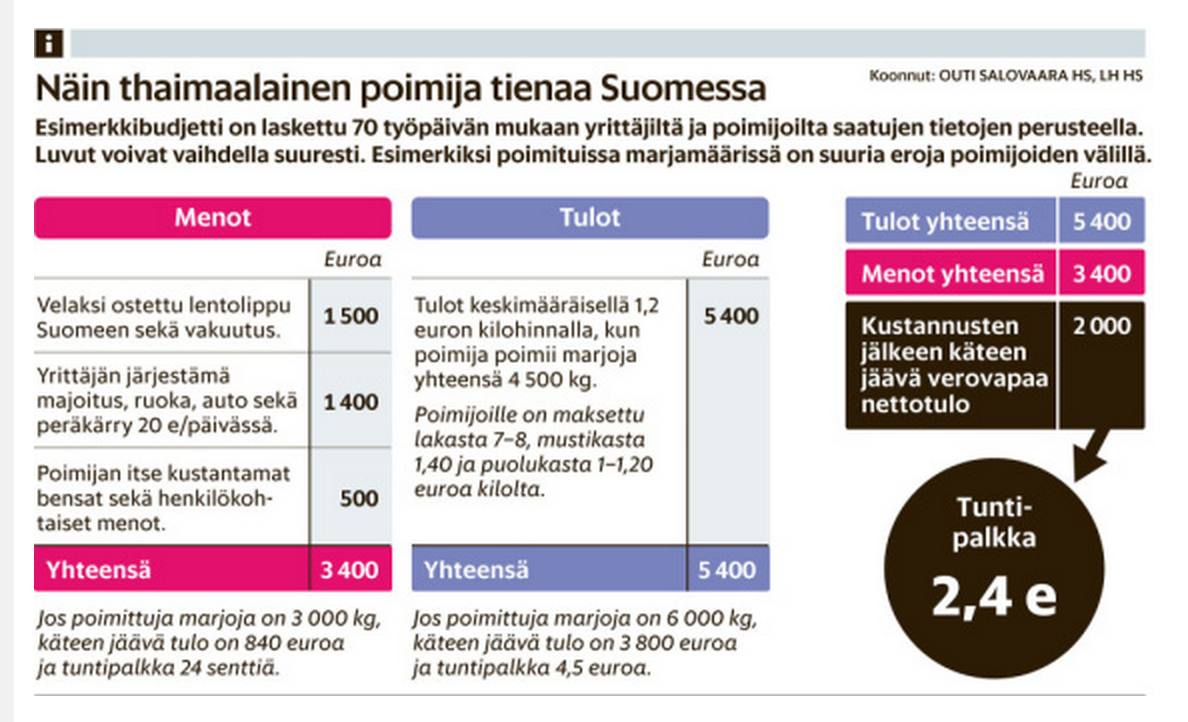
Kuvankaappaus 2013-9-22 kello 15.46.20This table published by Helsingin Sanomat shows how Thai berry pickers make 2.40 an hour. There expenses (plane tickets, insurance equipment) amounts to 3,400 euros. If the pickers sell their berries at 1.20 euros/kilo and pick an average of 5,400 kilograms of berries, that leaves them with 5,400 euros.  The sum varies depending on how much the person picks.

If you’d pay a Finn that amount of money they’d be up in arms.

I asked one of my sons if he’d work for 2.40 euros per hour.

“Are you crazy?!” he said. “I could make more from [the social welfare paid by] Kela.”

On top of low pay, berry pickers may work up to 15-hour days seven days a week for a few months. The pickers take all of the risk (buy the ticket and hope there’s a good harvest waiting for them).

One news story on Jyväskylä-based daily Keskisuomalainen showed what happened to one of the berry pickers earnings.

Chanchai Konmas, who is one of fifty pickers protesting against Ber-Ex, said that his total salary this month amounted to 1,750 euros, which is not enough to pay the loan he took in Thailand to come to Finland. The company deducted 726 euros from his salary for car and lodging expenses.

Migrant Tales plans to write on the plight of the berry pickers in Finland later this week.
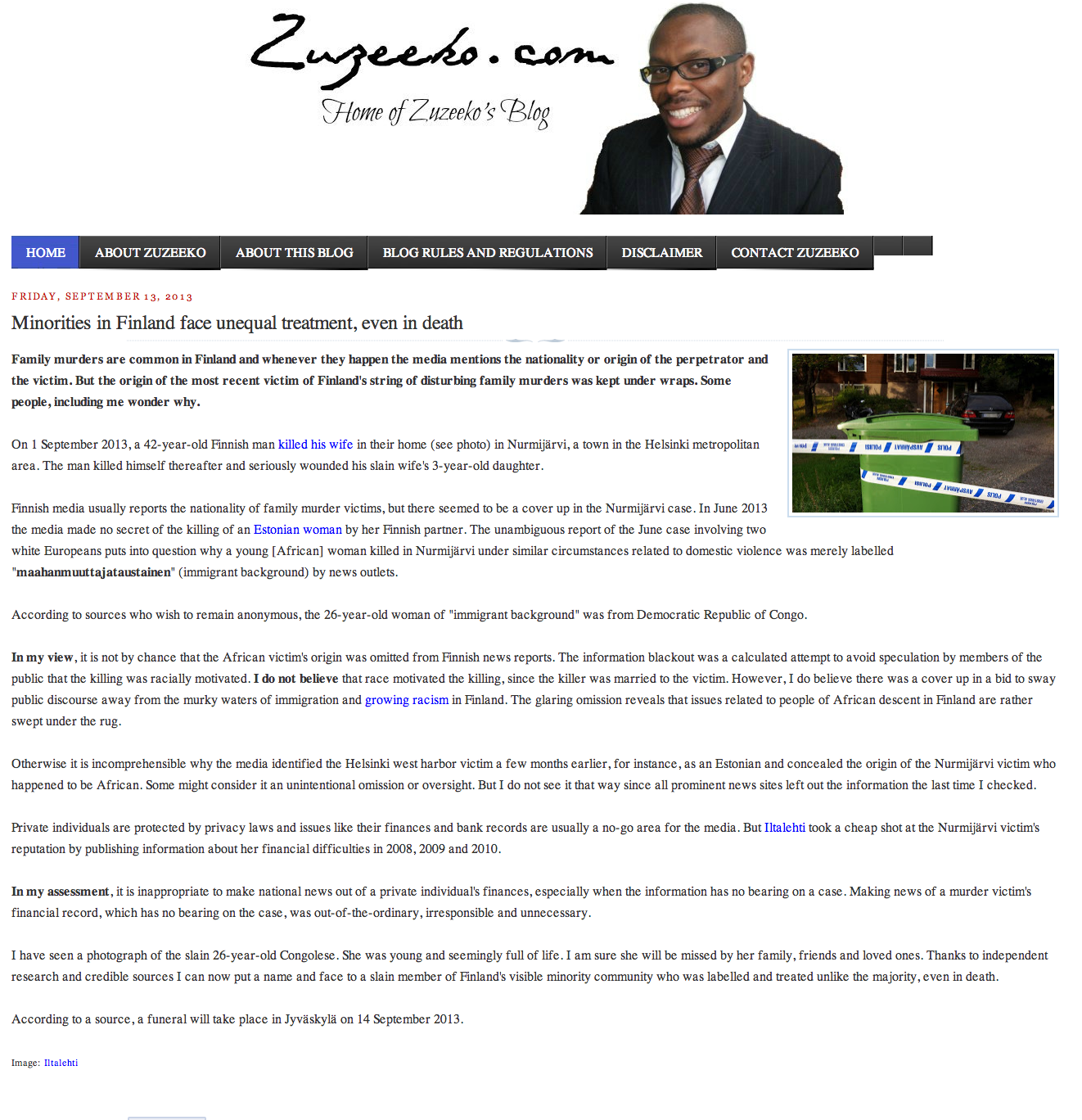
Zuzeeko’s blog: Minorities in Finland face unequal treatment, even in death

Posted on September 22, 2013 by Migrant Tales

Zuzeeko Tegha Abeng*

Family murders are common in Finland and whenever they happen the media mentions the nationality or origin of the perpetrator and the victim. But the origin of the most recent victim of Finland’s string of disturbing family murders was kept under wraps. Some people, including me wonder why.

Kuvankaappaus 2013-9-22 kello 13.55.26

On 1 September 2013, a 42-year-old Finnish man killed his wife in their home (see photo) in Nurmijärvi, a town in the Helsinki metropolitan area. The man killed himself thereafter and seriously wounded his slain wife’s 3-year-old daughter.

Finnish media usually reports the nationality of family murder victims, but there seemed to be a cover up in the Nurmijärvi case. In June 2013 the media made no secret of the killing of an Estonian woman by her Finnish partner. The unambiguous report of the June case involving two white Europeans puts into question why a young [African] woman killed in Nurmijärvi under similar circumstances related to domestic violence was merely labelled “maahanmuuttajataustainen” (immigrant background) by news outlets.

According to sources who wish to remain anonymous, the 26-year-old woman of “immigrant background” was from Democratic Republic of Congo.

In my view, it is not by chance that the African victim’s origin was omitted from Finnish news reports. The information blackout was a calculated attempt to avoid speculation by members of the public that the killing was racially motivated. I do not believe that race motivated the killing, since the killer was married to the victim. However, I do believe there was a cover up in a bid to sway public discourse away from the murky waters of immigration and growing racism in Finland. The glaring omission reveals that issues related to people of African descent in Finland are rather swept under the rug.

Otherwise it is incomprehensible why the media identified the Helsinki west harbor victim a few months earlier, for instance, as an Estonian and concealed the origin of the Nurmijärvi victim who happened to be African. Some might consider it an unintentional omission or oversight. But I do not see it that way since all prominent news sites left out the information the last time I checked.

Private individuals are protected by privacy laws and issues like their finances and bank records are usually a no-go area for the media. But Iltalehti took a cheap shot at the Nurmijärvi victim’s reputation by publishing information about her financial difficulties in 2008, 2009 and 2010.

In my assessment, it is inappropriate to make national news out of a private individual’s finances, especially when the information has no bearing on a case. Making news of a murder victim’s financial record, which has no bearing on the case, was out-of-the-ordinary, irresponsible and unnecessary.

I have seen a photograph of the slain 26-year-old Congolese. She was young and seemingly full of life. I am sure she will be missed by her family, friends and loved ones. Thanks to independent research and credible sources I can now put a name and face to a slain member of Finland’s visible minority community who was labelled and treated unlike the majority, even in death.

According to a source, a funeral will take place in Jyväskylä on 14 September 2013.

Read original blog entry here.

*Zuzeeko Tegha Abeng is an associate editor of Migrant Tales. 

Landmark decision in Finland: On September 29, 2013 Sikh busman can wear turban at work

Posted on September 22, 2013 by Migrant Tales

Busman Gill Sukhdarshan Singh told Migrant Tales that his employer, Veolia Transport of Vantaa, has agreed to allow him to wear a turban at work from Sunday, September 29. The Southern Finland Regional State Administrative Agency, which ruled in June that a turban ban by the employer was discriminatory, gave the bus company until the end of September to redress the matter.  

1841_10200981251358565_585995347_n

Gill Sukhdarshan Singh shaking hands with National Coalition Party Prime Minister Jyrki Katainen. Source: Sukhdarshan Singh. 

“This is a big victory [for acceptance of cultural diversity] thanks in particular to the [Finnish] media,” he said. “They played an important role.”

Apart from being a landmark case, it is a first step in the right direction to promote acceptance and respect for cultural diversity and tolerance at the workplace.

Sukhdarshan Singh recommended other immigrants to go to the authorities to resolve similar matters disputes if an agreement cannot be reached with the employer. 

“In Finland things are done peacefully,” he said.  “This is important to keep in mind when seeking change.”


YLE in English: Finnish Sports Federation apologizes after 75 years to a Finnish-Jewish runner

Posted on September 21, 2013 by Migrant Tales

As Finland races into the depths of the new century and distances itself from the Winter (1939-40) and especially from the Continuation War (1941-44), I’m certain that there will be more proof about our collusion with Nazi Germany. One such story appeared Friday, when YLE in English reported on the Finnish Sports Federation’s (SUL) apology to a Jewish runner. 

Kuvankaappaus 2013-9-21 kello 11.17.33

Read full story here.

In a 1938 athletics meet, a Jewish runner of the Helsinki Makkabi sports club was placed fourth despite winning the 100-meter dash race.

The sprint runner, Abraham Tokazier, won the race but Arne Savolainen was declared the winner with Tokazier coming in fourth.

The apology by SUL took 75 years and was only possible after Finnish author Kjell Westö mentioned the incident in his new book, “Kangastus 38.”

”Any manipulation or distortion of results is shocking and against basic sporting values,” SUL chairman Vesa Harmaakorpi said in a statement. ”The judges clearly made a mistake in the 1938 meet. I would like to offer a humble apology to the athlete and his relatives on behalf of the Finnish Sports Federation.”

Leo-dan Bensky, honorary chairman of Makkabi Helsinki, said that the apology wasn’t good enough since SUL doesn’t want to retrospectively change the result of the race.

”It’s a step in the right direction, but until the result has been corrected, we don’t see the matter as resolved,” he was quoted as saying on YLE in English.

Historians like Simo Muir and Malthe Gasche state in a book called “Finland’s Holocaust” that Urho Kekkonen, the Finnish Sports Federation chairman and Finland’s president (1953-81), may have influenced the final result of the 1938 race.

Image1-3_edited-11

Finland was allied militarily with Nazi Germany during the Continuation War. Why is it still so difficult to open up this questionable period? Was Finland Adolf Hitler’s ally because it hated and wanted revenge against the Soviet Union or was it because it generally believed in Nazi Germany’s new world order and racial policies?

Citing newspapers from the time, Muir and Gasche state that there was a drive to make sure that Finnish Jewish athletes did not participate or represent the country in the 1940 Olympic Games in Helsinki.

Helsingin Sanomat claims that there may have been high-ranking Nazi German officials at the 1938 athletics meet, which forced SUL to change the final result.


Does Finland promote two-way or one-way adaption of immigrants?

Posted on September 21, 2013 by Migrant Tales

Our integration law promotes two-way adaption as opposed to assimilation, which is a one-way process. Section 17 of the Finnish Constitution states that each person living in this country has the right to maintain and develop their own language and culture. What do these two important laws mean in practice and how are they applied?

Sensible Finns understand what cultural diversity implies but a poll published by Helsingin Sanomat Friday shows that 53% fully (22%) or partially agreed (31%) that immigrants should aim at becoming as Finnish as possible. That compares with 48% in 2011 an 37% in 2006.

While these types of surveys are problematic because they reveal more the prejudices of the respondents, market research companies and the newspapers that publish the poll results, it shows, among other things, general expectations that give little to no insight on how to move ahead as our society becomes more diverse.

What does being Finnish imply never mind mean? Are we using the nineteenth century cultural yardstick or a totally different one in this century to make our society more inclusive to new groups who are and want to be Finnish according to their cultural backgrounds?

The crux of the matter, in my opinion, is that our ideal is two-way adaption but the rule is one-way assimilation.

This can be even be seen in our exemplary educational system, where we still promote “us” and “them” by openly labeling third-culture pupils as children “with immigrant backgrounds” (maahanmuuttajataustainen).

I personally believe that Finland is on the right track and should continue to promote and defend its present laws that ensure cultural diversity.

If you think of it, the whole debate on immigration and refugees presently taking place in this country hinges on one important point: acceptance of cultural diversity. Do we accept people moving to our country who are from different cultures? What must we give up in order to accommodate these new groups and what must these newcomers do to be included?

We have always spoken of two-way acceptance and respect on Migrant Tales. Why? Because it is inclusive and the most effective way to integrate people.

Why would you want to have a system that fuels prejudice and intolerance? At the end of the day our prejudices will cost us dearly because they will fuel social exclusion and high unemployment already so evident in many European countries.

Even if Finland is a society that has the right tools and resources to promote two-way acceptance and respect between groups, or cultural diversity, our prejudices continue to be part of the problem. They don’t permit us to have a clearer bigger picture of how to move ahead.

The answers and models that can be employed are lying right under our very noses. We have good laws and Nordic democratic values in this country to build a vibrant society where we can celebrate our diversity.

The challenge then is applying these laws and values to include Finland’s new inhabitants.

It’s that simple.

Helsingin Sanomat poll reveals Finns’ opposition to cultural diversity

Posted on September 20, 2013 by Migrant Tales

A poll commissioned by Helsingin Sanomt, Finland’s largest-circulation daily, reveals that 53% of those polled agreed (22%) or partially agreed (31%) that immigrants should aim at becoming as Finnish as possible. That compares with 18% and 30%, respectively, in 2011. If there is something worrying that the poll shows, it’s Finland’s growing opposition to cultural diversity. 

Kuvankaappaus 2013-9-20 kello 20.08.06

 Compared with 2006, when the poll was first taken, a growing number of Finns want immigrants to adopt their values and culture. Read full story here.  

What the poll doesn’t make clear is what becoming Finnish means.

Those that are in favor of one-way adaption, or assimilation, would probably have a difficult time explaining what being or becoming Finnish means or implies.

The poll is another sad example of how newspapers perceive immigrants and Finland’s ever-growing cultural diversity.

The question asked by the poll is similar to asking white people if they think there is racism in our country or if they would want more immigrants to move here. The answers we’d get are obvious.

Moreover, the poll reveals contradictions of how some Finns feel the law should be applied to immigrants and visible minority groups.

If Section 17 of the Finnish Constitution defends every person’s right in this country to maintain and develop their own language and culture, why do the majority of those polled by Helsingin Sanomat disagree? What does it reveal about our attitudes to people who are different from us?

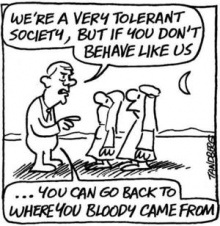
It’s pretty clear that it shows how intolerance functions in Finland. The following cartoon below says it all.

220px-svvalues_narrowweb_300x3080

These type of polls not only show our intolerance and prejudices, they reveal as well similar attitudes of the Finnish media that publish them. They show a worrying trend: Finland’s growing opposition to our cultural diversity as more immigrants move to this country.


How Syrian refugees fleeing war show how the Finnish media gives (again) racists inflated respectability and importance

Posted on September 19, 2013 by Migrant Tales

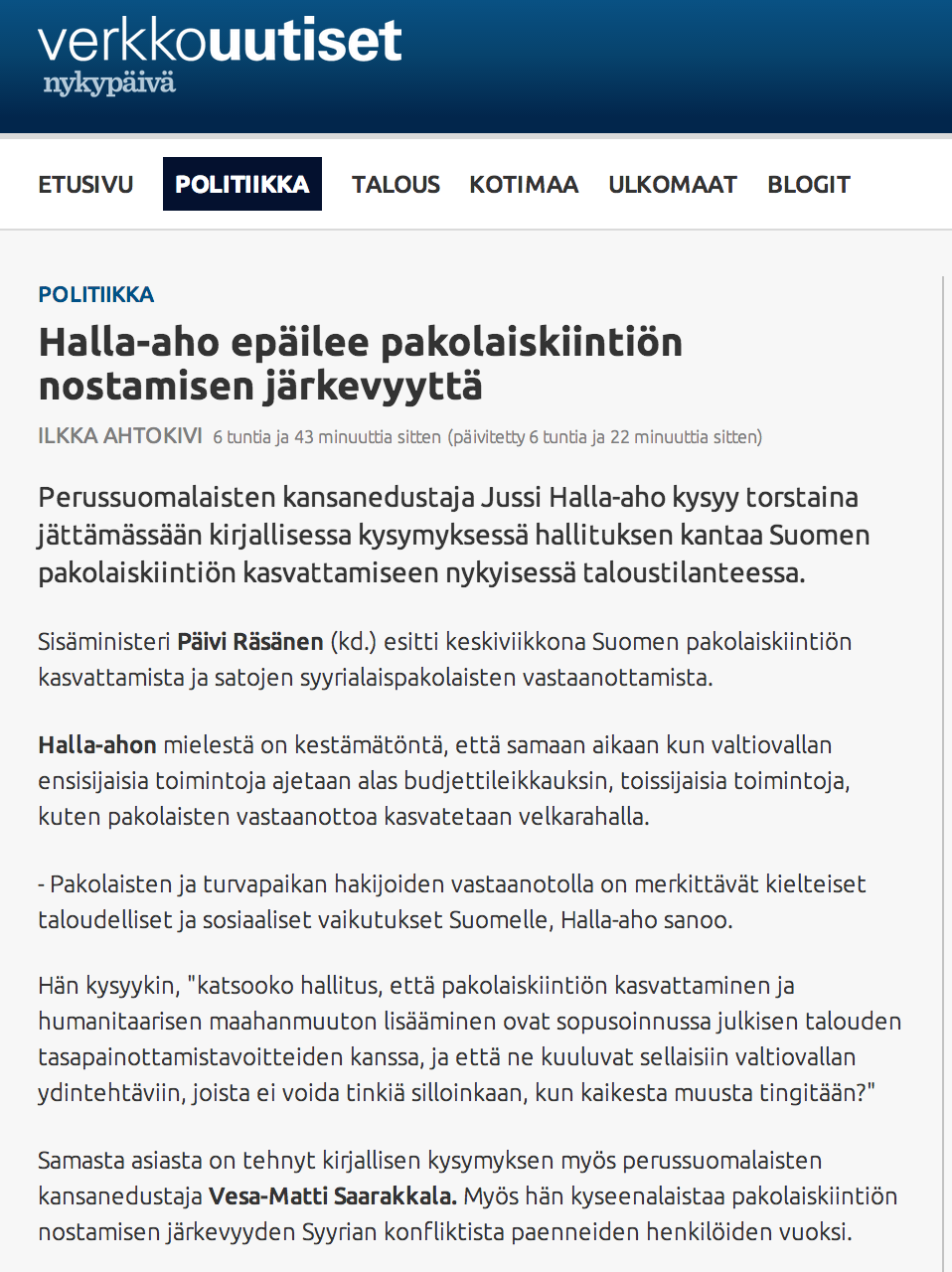
Migrant Tales published a while back a story about how the media gives racists and radical anti-immigration groups inflated respectability and importance. Why should we care what a Perussuomalaiset (PS) MP like Jussi Halla-aho, who was on top of it convicted for ethnic agitation, thinks about giving asylum to Syrian refugees? 

Kuvankaappaus 2013-9-19 kello 20.41.58

Verkkouutiset is run by the National Coalition Party. Read full story here.

Why should the media care if another PS MP like James Hirvisaari, who was convicted for ethnic agitation as well, is “forced” to resigns from an extremist association like Suomen Sisu but supports a far right and racist group like the Finnish Defense League?

And what would you say about PS MP Vesa-Matti Saarakkala, who has sent a written question to parliament about the government’s plan to give asylum to a few hundred refugees from Syria?

Certainly all of the above have some newsworthiness. The PS is an anti-immigration, anti-Islam and anti-gay party. MPs like Halla-aho, Hirvisaari and Saarakkala, who are the most vociferous opponents of cultural diversity, are expressing their opposition to government policy, which is already pretty thin to begin with when it comes to Syrian refugees.

Here’s the question we should probably ponder: How is it possible that a country like Finland, which knows too well what the suffering of war and refugees are, is doing so little to help refugees fleeing a country that is suffering one of the worst sectarian bloodbaths in modern history?

Folks, we’re talking about granting a few hundred Syrian refugees asylum to our country, while our neighbor Sweden, has already given permanent residency to half of the Syrian refugees and announced it will give 8,000 more residency. 

Is the “news” Halla-aho’s or Saarakkala’s lowly opinions of refugees, or that Sweden is giving thousands resident permits to Syrians while we’re having a philosophical discussion about why we should even let in a few hundred?

Why isn’t there anything written by Ilkka or Verkkouutiset that compares our response to the Syrian refugees question with Sweden’s?Aren’t we always competing against our eternal rival in the west in almost everything?

True, Finland’s worst rivals are Sweden. But we don’t compete in some areas that really count and are important, like giving shelter to those fleeing war.

In that match, Finland gets romped every time 6-0 against Sweden.


Turku Islamic Center suffers attack over the weekend

Posted on September 17, 2013 by Migrant Tales

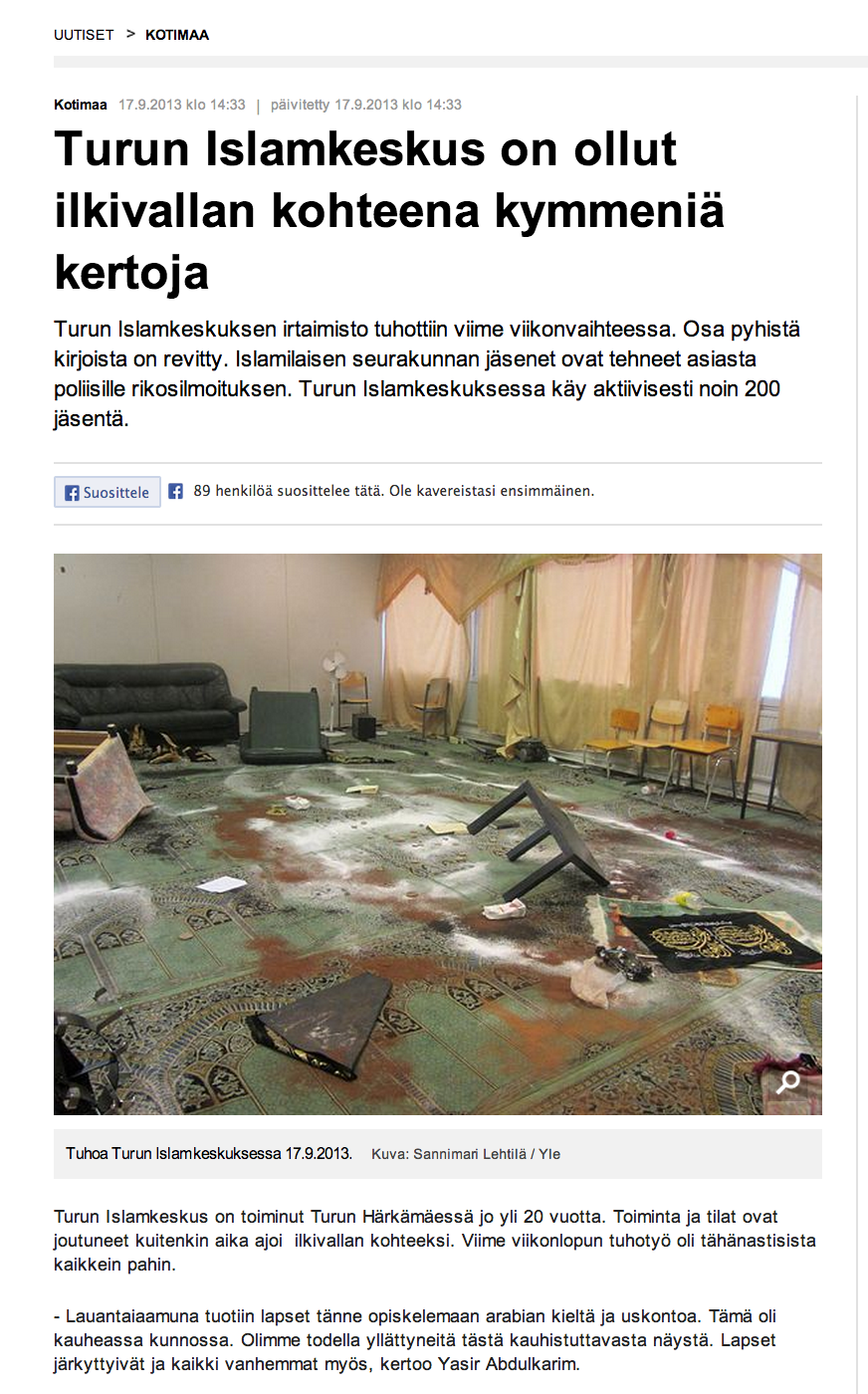
The Turku Islamic Center, which has served the Muslim community of the southwestern city for over twenty years, was attacked over the weekend, according to YLE. Apart form destroying furniture, spreading salt and flour on the ground, a number of Korans were torn. Some 200 Muslims attend the Turku Islamic Center. 

The police have been notified and are investigating the attack.

This is not the first time that a non-protestant church has been attacked in Turku. Three years ago, a Buddhist temple suffered an arson attack in September 2010.

The attacks against the Buddhist temple and now to the Turku Islamic Center reveals the ugly face of intolerance that has lifted its head in Finland. When politicians in parliament base their political support on spreading hatred and racism, only a naive person would believe that such attitudes have no consequences.

Another matter that surprises Migrant Tales is why was such a serious incident reported on Monday by Turun Sanomat? This act, which should outrage sensible people because it reveals that some will take the law into their own hands to make their point, appears to suffer from the silence of politicians and civic leaders.

Migrant Tales strongly condemns such attacks.

Kuvankaappaus 2013-9-18 kello 0.12.31 Read full story (in Finnish) here.

”On Saturday we brought our children here to study the Arabic language and religion,” said Yari Adbulkarim. ”This was in terrible shape. We were really surprised and shocked from what we saw. The children were shocked as were all of the parents.”

Abbdulkarim said that the center had been attacked on other occasions but nothing compares to what happened over the weekend.

”It is a deep insult when the Holy Book is torn,” said Abdulkarim, ”It’s really a big thing. The Holy Book is the Holy Book.”


Government talks in Norway are a preview of what may happen in Finland in 2015 with the PS

Posted on September 17, 2013 by Migrant Tales

Take a close look at Norway if you want to see what may happen in Finland after the 2015 parliamentary elections, when the right-wing populist Perussuomalaiset (PS) may be in government.The populist anti-immigration Progress party (FrP) of Norway will form part of a coalition government with the Conservative Party (Høyre), Christian Democrats and Liberals.

If the Conservative Party can accept to govern with a party that used to have mass killer Anders Breivik as a member, certainly the Center Party of Finland, if it wins the next parliamentary elections, won’t have any problems governing with the PS, even if some of its members have been sentenced for ethnic agitation.

Kuvankaappaus 2013-9-17 kello 12.03.41

Read full story here.

Parties like the FrP, PS, Danish People’s Party, Sweden Democrats and other of the Nordic region, which are anti-EU, anti-immigration and especially anti-Islam, are a good example of the intolerance and racism that has creeped into Nordic politics.

How do these parties work and what is their role in strengthening intolerance and institutional racism in their respective countries? They function as watchdogs gaining our attention, even our sympathies, with the help of fear-mongering and spreading intolerance thanks to our prejudices.

Their strategy is simple: The best way of maintaing things as they are is not to challenge or question anything. If in doubt, blame the immigrant or minority x.

Eyeing power, it’s natural that parties like the FrP want to sound sensible just before the formation of a new government.

A good way of finding out the real issues and cut through the snow job is to watch closely what politicians deny and, most importantly, what they don’t say.

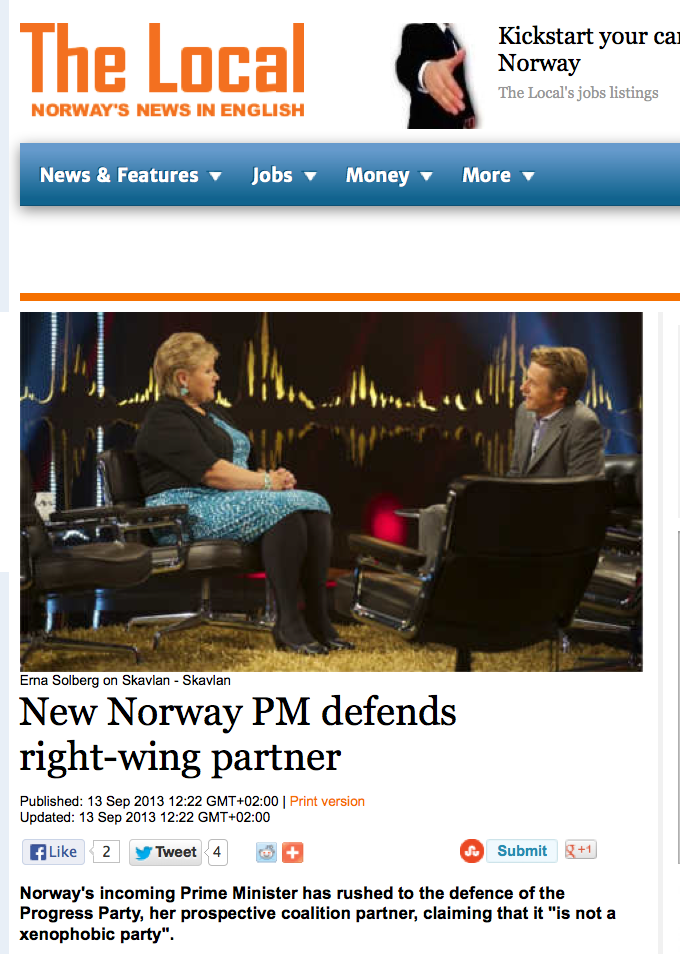
The new incoming Norwegian prime minister, Erna Solberg, claims in an interview with The Local that the FrP ”is not a xenophobic party.”

She continues: ”…Parts of the immigration policy they [FrP] are pushing for have already been implemented elsewhere in the Nordic region.”

Solberg doesn’t elaborate but let’s get it straight from the FrP party leader’s mouth, Siv Jensen.

https://www.youtube.com/watch?v=KWkIL41HQ40&feature=player_embedded#t=0

Apart from playing down the FrP’s anti-immigration and anti-Islam stances, one of the most incredible things I hears Jensen say in another interview with The Local  was that she was against Norwegian immigration policy, not immigrants.

According to political editor Martine Aurdal of the daily Dagbldet, who is Jensen’s biographer, claimed that after 22/7, when Breivik killed   77 people, the leader of the FrP has left out more extreme rhetoric from her speech.

Why?

Because it sounds awkward especially after what Breivik did and certainly doesn’t win you over votes.

So what’s the lesson we can learn from all this?

Attitudes and xenophobia remain intact. The only matter that changes is the message.

Artist Kiba Lumberg: “Don’t box me in!”

Posted on September 16, 2013 by Migrant Tales

In order to understand Kiba Lumberg, 57, you need to know some Finnish history, the plight of minorities like the Roma, and what it is like to live in worlds shaded by different hues of grey. Since this story is about an artist who doesn’t want to conform to set norms imposed on her by society, it’s useless for me to fence her in with the help of words. 

Roma Pavilion, Lumberg, Crazy Artist Diary

Kiba Lumberg, Diary of a Mad Artist,  2010–11. Her work has been widely published in comic books, illustrations and scripts.

If there’s a quote that could possibly describe Lumberg, who wants to stay as faraway as possible from ethnic labels, it’s what Martin Luther King Jr. said in his famous ”I have a dream” speech of 1963:

”I have a dream that my four little children will one day live in a nation where they will not be judged by the color of their skin but by the content of their character.”

No other person is better qualified than Lumberg to throw a monkey wrench in the works of those who want to box people in groups and dress them up with stereotypes.

Lumberg was raised by Romany parents and is a lesbian.

”I’m against anyone boxing me in an ethnic group because I am first and foremost a human being,” she said. ”I’m against groups, like heterosexuals, who try to torpedo who I am.”

She says that the heterosexual world is so imposing in our society that it doesn’t permit her to share her experiences and stories with others.

“As a lesbian you are seen as a threat because you change the so-called natural order of things of heterosexuals,” she said. ”What about my relationships with people who are important in my life?  Why can’t I openly share them with others?”

Not being white but a member of a minority like the Roma and a lesbian in Finland not only makes it hard for some people to accept you, but the same rejection and suspicion comes from the Roma community.

Lumberg states emphatically that she doesn’t seek the acceptance of any group.

Understanding the struggles that she has faced to find her identity and sense of balance, it shouldn’t come to any surprise that much of her artwork deals with issues like multiple identities, gender diversity, sexual politics, cultural understanding and otherness. All these are essential if we live a culturally diverse society that is not only heterosexual but respects sexual minorities as well, she said.

“In a way I understand what the Perussuomalaiset are saying because their message of intolerance comes from fear,” she said. ”For a multicultural society to work, it not only requires mutual acceptance and respect between people and groups, but similarly not bowing to any culture at the cost of who you are and what you think. Respecting human rights is key.”

Lumberg adds that while group identity is important, we should never forget the person as an individual human being and his or her right to choose his or her lifestyle and thoughts independently.

The artist, who ran for parliament in 2011 on the Left Alliance ticket, admits that ethnicity does play a role in Finland and can impact a person’s life.

Help how can I get

Kiba Lumberg, Diary of a Mad Artist, 2010–11.

“In Finland it’s usually easier to get a job and get ahead in life if you are white,”  she said, adding that the 10,000-strong Romany minority doesn’t need any lessons on what prejudice and racism are because they have lived in this country for five centuries.

Suzana Milevska in Call the Witness Roma Pavilion, a review of Lumberg’s 2010-11 exhibition, sums up who the artist is as a person, or how her gender and sexual orientation have joined hands and created a multifaceted identity full of contradictions, which have worked in her favor.

She writes: ”Yet life on the edge of these two worlds could be exactly the space where a new subjectivity is born, a loudly speaking subject who testifies about her disenchantments, while simultaneously constructing her singular destiny with confidence.”

Doesn't look good

Kiba Lumberg, Diary of a Mad Artist, 2010–11.

I would take what Milevska wrote a bit further to a poem I wrote a long, long time ago. It was about a transgender cowboy, who was a communist that lived in Texas during the Cold War. 

The transgender cowboy represents for some the worst thing a person can be in a state that is not only openly conservative, but anti-communist and anti-gay. Even so, there’s one side of the poem that you must understand to get it: It takes raw guts to be openly those things in Texas.

That’s why the transgender cowboy is the bravest son of a bitch to ever ride the West.

  • Previous
  • 1
  • 2
  • 3
  • 4
  • Next
Read more about documentary film
Read more

Recent Posts

  • Finland’s tabloids Iltalehti and Ilta-Sanomat are the pits
  • Riikka Purra’s Dr Jekyll and Mr Hyde mask
  • Double standards
  • Perussuomalaiset: Uusi logo, sama vanha juttu
  • Taco Trump

Recent Comments

  1. Absolutely Socking: Racist Finnish Facebook group against human rights gets flooded with socks on Musta Barbaari’s mother and sister charged by the police in “ethnic profiling” case
  2. Ilkka Nuotio on Pekka Myrskylä: “Tilastot kertovat toista kuin poliittinen keskustelu”
  3. Genrih Soinkara on The war in Ukraine and the Russian-Finnish border crisis are showing Finland’s ugly side
  4. Ahti Tolvanen on Comment by Ahti Tolvanen on the Helsinki +50 conference
  5. Angel Barrientos on Angel Barrientos is one of the kind beacons of Finland’s Chilean community

Archives

  • June 2026
  • May 2026
  • April 2026
  • March 2026
  • February 2026
  • January 2026
  • December 2025
  • November 2025
  • October 2025
  • September 2025
  • August 2025
  • July 2025
  • June 2025
  • May 2025
  • April 2025
  • March 2025
  • February 2025
  • January 2025
  • December 2024
  • November 2024
  • October 2024
  • September 2024
  • August 2024
  • July 2024
  • June 2024
  • May 2024
  • April 2024
  • March 2024
  • February 2024
  • January 2024
  • December 2023
  • November 2023
  • October 2023
  • September 2023
  • August 2023
  • July 2023
  • June 2023
  • May 2023
  • April 2023
  • March 2023
  • February 2023
  • January 2023
  • December 2022
  • November 2022
  • October 2022
  • September 2022
  • August 2022
  • July 2022
  • June 2022
  • May 2022
  • April 2022
  • March 2022
  • February 2022
  • January 2022
  • December 2021
  • November 2021
  • October 2021
  • September 2021
  • August 2021
  • July 2021
  • June 2021
  • May 2021
  • April 2021
  • March 2021
  • February 2021
  • January 2021
  • December 2020
  • November 2020
  • October 2020
  • September 2020
  • August 2020
  • July 2020
  • June 2020
  • May 2020
  • April 2020
  • March 2020
  • February 2020
  • January 2020
  • December 2019
  • November 2019
  • October 2019
  • September 2019
  • August 2019
  • July 2019
  • June 2019
  • May 2019
  • April 2019
  • March 2019
  • February 2019
  • January 2019
  • December 2018
  • November 2018
  • October 2018
  • September 2018
  • August 2018
  • July 2018
  • June 2018
  • May 2018
  • April 2018
  • March 2018
  • February 2018
  • January 2018
  • December 2017
  • November 2017
  • October 2017
  • September 2017
  • August 2017
  • July 2017
  • June 2017
  • May 2017
  • April 2017
  • March 2017
  • February 2017
  • January 2017
  • December 2016
  • November 2016
  • October 2016
  • September 2016
  • August 2016
  • July 2016
  • June 2016
  • May 2016
  • April 2016
  • March 2016
  • February 2016
  • January 2016
  • December 2015
  • November 2015
  • October 2015
  • September 2015
  • August 2015
  • July 2015
  • June 2015
  • May 2015
  • April 2015
  • March 2015
  • February 2015
  • January 2015
  • December 2014
  • November 2014
  • October 2014
  • September 2014
  • August 2014
  • July 2014
  • June 2014
  • May 2014
  • April 2014
  • March 2014
  • February 2014
  • January 2014
  • December 2013
  • November 2013
  • October 2013
  • September 2013
  • August 2013
  • July 2013
  • June 2013
  • May 2013
  • April 2013
  • March 2013
  • February 2013
  • January 2013
  • December 2012
  • November 2012
  • October 2012
  • September 2012
  • August 2012
  • July 2012
  • June 2012
  • May 2012
  • April 2012
  • March 2012
  • February 2012
  • January 2012
  • December 2011
  • November 2011
  • October 2011
  • September 2011
  • August 2011
  • July 2011
  • June 2011
  • May 2011
  • April 2011
  • March 2011
  • February 2011
  • January 2011
  • December 2010
  • November 2010
  • October 2010
  • September 2010
  • August 2010
  • July 2010
  • June 2010
  • May 2010
  • April 2010
  • March 2010
  • February 2010
  • January 2010
  • December 2009
  • November 2009
  • October 2009
  • September 2009
  • August 2009
  • July 2009
  • December 2008
  • November 2008
  • October 2008
  • September 2008
  • August 2008
  • July 2008
  • June 2008
  • May 2008
  • April 2008
  • March 2008
  • February 2008
  • January 2008
  • November 2007
  • October 2007
  • September 2007
  • August 2007
  • July 2007
  • June 2007
  • May 2007

Categories

  • ?? Gia L?c
  • ????? ?????? ????? ???????? ?? ??????
  • ???????
  • @HerraAhmed
  • @mondepasrond
  • @nohatefinland
  • @oula_silver
  • @Varathas
  • A Pakistani family
  • äärioikeisto
  • Abbas Bahmanpour
  • Abdi Muhis
  • Abdirahim Hussein Mohamed
  • Abdirahim Husu Hussein
  • Abdirisak Mahamed
  • About Migrant Tales
  • activism
  • Adam Al-Sawad
  • Adel Abidin
  • Afrofinland
  • Ahmed IJ
  • Ahti Tolvanen
  • Aino Pennanen
  • Aisha Maniar
  • Alan Ali
  • Alan Anstead
  • Alejandro Díaz Ortiz
  • Alekey Bulavsev
  • Aleksander Hemon
  • Aleksanterinliitto
  • Aleksanterinliitto ry
  • Aleksanterinliitto ry:n hallitus
  • Alex Alex
  • Alex Mckie
  • Alexander Nix
  • Alexandra Ayse Albayrak
  • Alexis Neuberg
  • Ali Asaad Hasan Alzuhairi
  • Ali Hossein Mir Ali
  • Ali Rashid
  • Ali Sagal Abdikarim
  • Alina Tsui
  • Aline Müller
  • All categories
  • Aman Heidari
  • Amiirah Salleh-Hoddin & Jana Turk
  • Amin A. Alem
  • Amir Zuhairi
  • Amkelwa Mbekeni
  • Ana María Gutiérrez Sorainen
  • Anachoma
  • Anders Adlecreutz
  • Angeliina Koskinen
  • Anna De Mutiis
  • Anna María Gutiérrez Sorainen
  • Anna-Kaisa Kuusisto ja Jaakko Tuominen
  • Annastiina Kallius
  • Anneli Juise Friman Lindeman
  • Announcement
  • Anonymous
  • Antero Leitzinger
  • anti-black racism
  • Anti-Hate Crime Organisation Finland
  • Anudari Boldbaatar
  • Arshiya Nasser
  • Aspergers Syndrome
  • Asylum Corner
  • Asylum seeker 406
  • Athena Griffin and Joe Feagin
  • Autism
  • Avaaz.org
  • Awale Olad
  • Ayan Said Mohamed
  • AYY
  • Barachiel
  • Bashy Quraishy
  • Beatrice Kabutakapua
  • Beri Jamal
  • Beri Jamal and Enrique Tessieri
  • Bertolt Brecht
  • Boiata
  • Boodi Kabbani
  • Bruno Gronow
  • Carmen Pekkarinen
  • Çelen Oben and Sheila Riikonen
  • Chiara Costa-Virtanen
  • Chiara Costa-Virtanen
  • Chiara Sorbello
  • Christian Thibault
  • Christopher Wylie
  • Clara Dublanc
  • Dana
  • Daniel Malpica
  • Danilo Canguçu
  • David Papineau
  • David Schneider
  • Dexter He
  • Don Flynn
  • Dr Masoud Kamali
  • Dr. Faith Mkwesha
  • Dr. Theodoros Fouskas
  • Edna Chun
  • Eeva Kilpi
  • Emanuela Susheela
  • En castellano
  • ENAR
  • Enrique
  • Enrique Tessieri
  • Enrique Tessieri & Raghad Mchawh
  • Enrique Tessieri & Yahya Rouissi
  • Enrique Tessieri and Muhammed Shire
  • Enrique Tessieri and Sira Moksi
  • Enrique Tessieri and Tom Vandenbosch
  • Enrique Tessieri and Wael Che
  • Enrique Tessieri and Yahya Rouissi
  • Enrique Tessieri and Zimema Mhone
  • Epäluottamusmies
  • EU
  • Europe
  • European Islamophobia Report
  • European Islamophobia Report 2019,
  • European Union
  • Eve Kyntäjä
  • Ezequiel Caldeiro
  • Facebook
  • Fadumo Dayib
  • Faisa Kahiye
  • Farhad Manjoo
  • Fasismi
  • Finland
  • Fizza Qureshi
  • Flyktingar och asyl
  • Foreign Student
  • Fozia Mir-Ali
  • Frances Webber
  • Frida Selim
  • Gareth Rice
  • Ghyslain Vedeaux
  • Global Art Point
  • Great Replacement
  • Habiba Ali
  • Hami Bahadori
  • Hami Bahdori
  • Hamid
  • Hamid Alsaameere
  • Hamid Bahdori
  • Handshake
  • Harmit Athwal
  • Hassan Abdi Ali
  • Hassan Muhumud
  • Heikki Huttunen
  • Heikki Wilenius
  • Helsingin Sanomat
  • Henning van der Hoeven
  • Henrika Mälmsröm
  • Hser Hser
  • Hser Hser ja Mustafa Isman
  • Husein Muhammed
  • Hussain Kazemian
  • Hussain Kazmenian
  • Ibrahim Khan
  • Ida
  • Ignacio Pérez Pérez
  • Iise Ali Hassan
  • Ilari Kaila & Tuomas Kaila
  • Imam Ka
  • inside-an-airport
  • Institute of Race Relations
  • Iraqi asylum seeker
  • IRR European News Team
  • IRR News Team
  • Islamic Society of Norhern FInland
  • Islamic Society of Northern Finland
  • Islamophobia
  • Jacobinmag.com
  • Jallow Momodou
  • Jan Holmberg
  • Jane Elliott
  • Jani Mäkelä
  • Jari Luoto
  • Jari Taponen
  • Jegor Nazarov
  • Jenni Stammeier
  • Jenny Bourne
  • Jessie Daniels
  • Joe Davidow
  • Johannes Koski
  • John D. Foster
  • John Grayson
  • John Marriott
  • Jon Burnett
  • Jorma Härkönen
  • Jos Schuurmans
  • José León Toro Mejías
  • Josue Tumayine
  • Jouni Karnasaari
  • Juan Camilo
  • Jukka Eräkare
  • Julian Abagond
  • Julie Pascoet
  • Jussi Halla-aho
  • Jussi Hallla-aho
  • Jussi Jalonen
  • JusticeDemon
  • Kadar Gelle
  • Kaksoiskansalaisuus
  • Kansainvälinen Mikkeli
  • Kansainvälinen Mikkeli ry
  • Katherine Tonkiss
  • Kati Lepistö
  • Kati van der Hoeven-Lepistö
  • Katie Bell
  • Kättely
  • Kerstin Ögård
  • Keshia Fredua-Mensah & Jamie Schearer
  • Khadidiatou Sylla
  • Khadra Abdirazak Sugulle
  • Kiihotus kansanryhmää vastaan
  • Kirsi Crowley
  • Koko Hubara
  • Kristiina Toivikko
  • Kubra Amini
  • KuRI
  • La Colectiva
  • La incitación al odio
  • Laura Huhtasaari
  • Lauri Finér
  • Leif Hagert
  • Léo Custódio
  • Leo Honka
  • Leontios Christodoulou
  • Lessie Branch
  • Lex Gaudius
  • Leyes de Finlandia
  • Liikkukaa!
  • Linda Hyökki
  • Liz Fekete
  • M. Blanc
  • Maarit Snellman
  • Mahad Sheikh Musse
  • Maija Vilkkumaa
  • Malmin Kebab Pizzeria Port Arthur
  • Marcell Lorincz
  • Mari Aaltola
  • María Paz López
  • Maria Rittis Ikola
  • Maria Tjader
  • Marja-Liisa Tolvanen
  • Mark
  • Markku Heikkinen
  • Marshall Niles
  • Martin Al-Laji
  • Maryan Siyad
  • Matt Carr
  • Mauricio Farah Gebara
  • Media Monitoring Group of Finland
  • Micah J. Christian
  • Michael McEachrane
  • Michele Levoy
  • Michelle Kaila
  • Migrant Tales
  • Migrant Tales Literary
  • Migrantes News
  • Migrants' Rights Network
  • MigriLeaks
  • Mikko Kapanen
  • Miriam Attias and Camila Haavisto
  • Mohamed Adan
  • Mohammad Javid
  • Mohammad M.
  • Monikulttuurisuus
  • Monisha Bhatia and Victoria Canning
  • Mor Ndiaye
  • Muh'ed
  • Muhamed Abdimajed Murshid
  • Muhammed Shire
  • Muhammed Shire and Enrique Tessieri
  • Muhis Azizi
  • Musimenta Dansila
  • Muslimiviha
  • Musulmanes
  • Namir al-Azzawi
  • Natsismi
  • Neurodiversity
  • New Women Connectors
  • Nils Muižnieks
  • No Labels No Walls
  • Noel Dandes
  • Nuor Dawood
  • Omar Khan
  • Otavanmedia
  • Oula Silvennoinen
  • Paco Diop
  • Pakistani family
  • Pentti Stranius
  • Perussuomalaiset
  • perustuslaki
  • Petra Laiti
  • Petri Cederlöf
  • Pia Grochowski
  • Podcast-lukija Bea Bergholm
  • Pohjois – Suomen Islamilainen Yhdyskunta
  • Pohjois Suomen Islamilainen Yhyskunta
  • Polina Kopylova
  • Race Files
  • racism
  • Racism Review
  • Raghad Mchawh
  • Ranska
  • Rashid H. and Migrant Tales
  • Rasismi
  • Raul Perez
  • Rebecka Holm
  • Reem Abu-Hayyeh
  • Refugees
  • Reija Härkönen
  • Remiel
  • Reza Nasri
  • Richard Gresswell
  • Riikka Purra
  • Risto Laakkonen
  • Rita Chahda
  • Ritva Kondi
  • Robito Ibrahim
  • Roble Bashir
  • Rockhaya Sylla
  • Rodolfo Walsh
  • Roger Casale
  • Rostam Atai
  • Roxana Crisólogo Correa
  • Ruth Grove-White
  • Ruth Waweru-Folabit
  • S-worldview
  • Sadio Ali Nuur
  • Sami Rusanen
  • Sandhu Bhamra
  • Sara de Jong
  • Sarah Crowther
  • Sari Alhariri
  • Sarkawt Khalil
  • Sasu
  • Scot Nakagawa
  • Shabana Ahmadzai
  • Shada Islam
  • Sharon Chang blogs
  • Shenita Ann McLean
  • Shirlene Green Newball
  • Sini Savolainen
  • Sira Moksi
  • Sonia K.
  • Sonia Maria Koo
  • Steverp
  • Stop Deportations
  • Suldaan Said Ahmed
  • Suomen mediaseurantakollektiivi
  • Suomen Muslimifoorumi ry
  • Suomen viharikosvastainen yhdistys
  • Suomen viharikosvastainen yhdistys ry
  • Suomi
  • Supermen
  • Susannah
  • Suva
  • Syrjintä
  • Talous
  • Tapio Tuomala
  • Taw Reh
  • Teivo Teivainen
  • The Daily Show
  • The Heino
  • The Supermen
  • Thomas Elfgren
  • Thulfiqar Abdulkarim
  • Tim McGettigan
  • Tino Singh
  • Tito Moustafa Sliem
  • Tobias Hübinette and L. Janelle Dance
  • Transport
  • Trica Danielle Keaton
  • Trilce Garcia
  • Trish Pääkkönen
  • Trish Pääkkönen and Enrique Tessieri
  • Tuulia Reponen
  • Uncategorized
  • UNITED
  • University of Eastern Finland
  • Uyi Osazee
  • Väkivalta
  • Vapaa Liikkuvuus
  • Venla-Sofia Saariaho
  • Vieraskynä
  • W. Che
  • W. Che an Enrique Tessieri
  • Wael Ch.
  • Wan Wei
  • Women for Refugee Women
  • Xaan Kaafi Maxamed Xalane
  • Xassan Kaafi Maxamed Xalane
  • Xassan-Kaafi Mohamed Halane & Enrique Tessieri
  • Yahya Rouissi
  • Yasmin Yusuf
  • Yassen Ghaleb
  • Yle Puhe
  • Yuliet Tresa
  • Yve Shepherd
  • Zahra Khavari
  • Zaker
  • Zalina Ametova
  • Zamzam Ahmed Ali
  • Zeinab Amini ja Soheila Khavari
  • Zimema Mahone and Enrique Tessieri
  • Zimema Mhone
  • Zoila Forss Crespo Moreyra
  • ZT
  • Zulma Sierra
  • Zuzeeko Tegha Abeng
© 2026 Migrant tales | Powered by Minimalist Blog WordPress Theme