Migrant tales
Menu
  • #MakeRacismHistory “In Your Eyes”
  • About Migrant Tales
  • It’s all about Human Rights
  • Literary
  • Migrant Tales Media Monitoring
  • NoHateFinland.org
  • Tales from Europe
Menu

Month: June 2013

Racism Review: Interracial Cheerios – What We’re Still Ignoring

Posted on June 17, 2013 by Migrant Tales

MT Comment: What would happen if such a commercial were aired in Finland and in other parts of Europe? 

________________

A recap for those of you who haven’t been following the cereal saga. On May 28 General Mills aired a YouTube Cheerios ad featuring a Black father, White mother and their young biracial daughter.

The 30-second clip was immediately bombarded with racist remarks referencing Nazis, “troglodytes” and “racial genocide.” It got so many negative reactions the comment section was taken down a day later. It is now impossible to verify any of the racist vitriol that was submitted there. But that wasn’t the end of it anyway. Commenters on the cereal’s Facebook page said they found the commercial “disgusting” and it made them “want to vomit.” One viewer expressed shock that a Black father would stay with this family writing the mother was, “More like single parent in the making. Black dad will dip out soon.” Simultaneously a Reddit stream on the ad turned into a debate about the accuracy or likelihood of the mixed-race family comprising a Black man and White woman, rather than a Black woman and White man. The negative responses drew explosive and infuriated attention across the Internet and then media. The result was an overwhelming and massive outpouring of support. America rushed to defend the bi-racial family en masse. Now, if you Google “Cheerios ad,” there will be no end to the pages and pages of results you find. Indeed as I write, the commercial has received close to 3.5 million views. The comments section is still disabled.

http://www.youtube.com/watch?v=kYofm5d5Xdw

A couple weeks later, the saga seems to be coming to a close. Americans are still a little shaken but ultimately appeased by the final tally (i.e. the dramatic outnumbering of positive to negative responses). To date however the discussion never really included an examination of some critical points that could have propelled us forward. And so we may continue to tread water. First, we have been greatly influenced here by a history we like to forget and neglect. We have long feared interracial unions particularly between Black men and White women because they presumably pose the greatest “threat” to White male control. Remember, 18th and 19th century opposition to race mixing aimed to protect White male interests in an era of colonial expansion. While Black women’s lives were tragically treated as inconsequential, male freedom to choose a White partner made access to White women a barometer of power. For instance, when White men, who held the highest position of privilege, crossed the racial border in having consentual and nonconsentual relationships with Black women, they were seldom penalized. But Black men who crossed, or who were even suspected of crossing the racial divide by having relations with White women, were severely beaten or killed. These social politics rooted themselves in stereotypes that still profoundly affect us:

Black men are thought to lust after white women; white men are thought to be envious of black male sexuality; black women are supposed to be more sexually satisfying than white women; and white women are dehumanized as trophies in competition between men…The system of racial apartheid and oppression that defined the early years of this country’s racial history remains in force today. Racial and sexual stereotypes are still very powerful, and double standards still abound. White men were ever vigilant about black men’s sexual access to white women – and they still are.1

Second, I think it’s worth asking which character really had us up in arms. The mother, the father, or the CHILD?? I suggest it was the body/appearance/phenotype of a young multiracial child who centrally sparked this race controversy. Her character represented living proof of sex between a Black man and White woman, fanning an age-old fear of Black male virility and the dismantling of White supremacy. The Cheerios child also embodied a commitment to longevity on the part of her parents. This was not a tale of dangerous romance swept up on wild winds, but the story of a steadfast family living their every day life. The message being, we’re not going anywhere; a direct challenge and deconstruction of what has long been the dominant American family prototype (i.e. White heterosexual parents and their White children, a dog and house with white picket fence).

What’s perhaps even more important to note here however is the way a multiracial body again became a platform for race deconstruction while its voice and experience went largely unnoticed and unacknowledged. And how we continue to avoid having race conversations with mixed children and perhaps most children in general. Much of the Cheerios debate has been dichotomous and adultcentric, focusing on interracial partnership/marriage and the Black/White divide. But we need to ask ourselves, how does the divide translate for the mixed race child? Does she herself feel divided when she sees she is poised precariously on a tight rope in “the middle”? These are the children of the future and they are being asked to represent race redefinition without the privilege of weighing in. Case in point, when MSNBC interviewed the child actress, Grace Colbert, and her real-life parents, her Black father was asked most of the race questions. His daughter meanwhile bore silent witness while sitting attentively at his side. And when Grace’s White mother, sitting on her other side, was asked if the backlash had “pushed sensitive conversations at home” with the kids, mom answered, “Not really. Um our kids are very open. And you know they – I inquired about, to my daughter, about it and she actually just thought the attention was because she had a great smile. So. She really had no idea.” This answer was given within obvious close hearing range of Grace’s fully capable ears. Grace just wordlessly continued to flash her great smile. But we are left to wonder – what was she really thinking?…

~ Sharon Chang blogs at MultiAsianFamilies

Note 1. See Root, Maria P. P. Love’s Revolution: Interracial Marriage. Philadelphia: Temple University Press, 2001. Print.

Read original blog entry here.

This piece was reprinted by Migrant Tales with permission.

Ariela Patterson: The right to be me on my terms

Posted on June 17, 2013 by Migrant Tales

One of the biggest challenges facing Finland in the new century is to come to terms with its ever-growing cultural diversity. While some Finns have no problems with this, others oppose it. Finland’s cultural diversity is, however, something that nobody can stop. There are today tens of thousands of Finns with multicultural backgrounds.

Ariela Patterson, 23, is one of them. Her father is from the United States and her mother is Finnish. How does she see Finland’s new face and what challenges await it today and tomorrow?

Migrant Tales: How did you feel about your Finnish identity when you were growing up in Finland?

Ariela Patterson: Since I haven’t travelled abroad a lot I can’t really compare because I am Finnish. I know I have as much of a right to be here as any person.

MT: What was the most important decision you made to come to terms with your identity?

AP: The most important decision I made was to accept who I am. It happened through an internet forum that touched briefly on race/ethnicities. I can’t remember what the person wrote, but it shook me to my core. It was something like,”don’t let others define you as a person. We are all individuals, human beings. Someone will love you because of who you are, not because of your skin color or the ethnicity you represent.”

MT: How old were you then?

AP: I was eighteen. I had trouble with my identity before I made that discovery about myself that changed my life. I felt before that I didn’t belong to either my African-American or Caucasian side. I was raised by my Finnish mother in Finland so it was difficult to identify with my African American side, especially because of the way the media portrayed, and still does to some extent, African-Americans.

MT: Did you fit in easily before?

AP: I was always the ”American girl” in Finland. So when I went to visit my relatives in the US, I thought I’d feel right at home. I did until my cousin introduced me to her friends as her ”Finnish cousin.” I now found myself in the same situation as in Finland but reversed. The feeling of not belonging anywhere was slowly eating away at me from the inside and I felt like my mother didn’t understand either because she’d never been in my situation.

MT: What happened then?

AP: So one evening, when I was 18, I decided that I won’t live up to stereotypes imposed by others. All I wanted is to just be me. It hasn’t been easy for me after this revelation since I’m still in the process of fully accepting who I am. Even so, I can now look back and look at myself in the mirror with pride because I am “me.”

MT: Another important decision you made was to extend your hand to those who don’t accept you.

AP: The majority of people, or all I’d say, who don’t accept me have never taken the time to know me. They have their prejudices that fence them in even before I’ve managed to blink an eye in their direction. Maybe they’ve had bad experiences with others and that’s why they generalize and stereotype people. They may have other reasons as well. I bet if they’d sit down and got to know me they’d walk out with a totally different view.

MT: What kind of pressure do you feel for being different from the majority?

AP: I feel that I represent every person who looks ”foreign” in this country. If I act badly, I feel I help them to judge every foreign-looking person in the future in a negative manner. This is a very stressful situation to be in considering that I was born and lived here all my life.

MT: What is racism to you?

AP: Racism is to me a worldwide disease that spreads. It’s a mixture of prejudice, ignorance, envy, anger and fear. In my opinion, only a fool will willingly pass it along to their children. I don’t know if racism will ever fully disappear but I hope that we can live one day in a post racist world.

MT: What does Finnishness mean to you?

AP: Being tolerant, acceptant and respecting other people.

MT: Do you feel that Finnish society is more open of its cultural diversity?

AP: Some people are more acceptant than others. But I’ve noticed that the darker your skin tone is, the more skeptical people are towards you.

MT: Do you think Finland will become a more tolerant society in the future?

AP: I think it will change for the better. But I also think there will always be an opposing group that will pin the blame for their problems on others.


OECD study states that immigration boosted Finnish economy

Posted on June 17, 2013 by Migrant Tales

An OECD study claims that immigration boosted the Finnish economy by 0.16% in 2011 including pensions. This revelation is a blow to anti-immigration pundits, who commonly claim that immigration drains social welfare resources and offers no economic benefits.

As Migrant Tales has shown over and over again the red herrings, urban tales and outright racism of anti-immigration parties like the Perussuomalaiset (PS) of Finland, it’s nothing more than a storm in a tea-cup and a way to feed their opportunistic political careers by attracting voters with the help of fear.

The study showed that  the economies of countries like Luxembourg, Switzerland and Italy benefited the most from immigration while Germany, France and Poland showed the contrary.

Due to the deep global recession after 2008, migration into OECD countries rose by 2% to almost 4 million more n 2011 versus the previous year. Migration to the EU rose by 15% after declining by almost 40% during 2009-11.

While matters may appear to have improved, the job market has worsened sharply for immigrants rising by 5 percentage points to over 4 million unemployed  in 2008-12 compared with a 3 point jump for natives. One out of two immigrants have been out of work for over 12 months.

Immigrant youth and low-skilled migrants from Latin America and North Africa have been the hardest hit.

“More jobs for immigrants would create big economic benefits for them and their host countries,” the OECD states. “Raising the employment level of high educated and immigrant women to the level of natives would create major fiscal gains for countries such as France, Belgium and Sweden with large long-standing immigrant populations. ”

The OCED says fighting discrimination is vital: “The report assesses the level of discrimination across countries and finds its extent much higher than previously thought. Generally, a person with an immigrant-sounding name, for example, has to send at least twice as many applications to get a job interview than one with a non-immigrant name.”

Sounds familiar, no?

Aspergers and Ableism Part 1: Introductions

Posted on June 16, 2013 by Barachiel

brain

The following is part of a personal statement I originally wrote to apply for the International Student Exchange Program (ISEP) last year, before I came to study in Finland and eventually settle in the Nordic countries. I plan to discuss the culture and challenges of the Autism/Asperger’s community, and how I believe the issue of the disabled is treated in the Nordics, over the course of the summer here on Migrant Tales. This will be the first part of a series, dealing with social issues related to neurodevelopmental disabilities and eventually introducing the concept of neurodiversity to a Finnish audience.

I am a third-year history student at Virginia Commonwealth University. I am applying for a Benjamin A. Gilman International Scholarship to fund my study-abroad to Germany this fall. I hope that this funding will aid me in my exploration of a culture that is totally apart from my own. I have developed a desire to walk on strange soil, meet with new people, and live in a country with an interesting history to be learned. I believe that the Gilman scholarship will offer me some financial security as I set out to do this—and will not take opportunity for granted should I be accepted.

My future plans, following my graduation in [Finland/Sweden], include starting parallel careers in scriptwriting for films and speechwriting for politics. I feel that my education in history, gained during my time both at VCU and at the two community colleges I attended beforehand, would serve me well in both professions. Historical knowledge could help me create scripts serving as allegories surrounding a person, an event, or an issue. Historical knowledge could also help me navigate cultural attitudes surrounding a particular topic, and engineer an effective political campaign.

I consider myself as coming from a diverse background—not because of a difference in race or nationality, but in mind. I have Asperger’s Syndrome, a high-functioning form of autism which affects how I neurologically register the emotions of myself and others. Several awkward encounters involving my disorder remind me of awkward encounters that happen between people of differing cultural backgrounds all the time. But despite my social mishaps, I have learned how to act around new people and handle myself in new environments; I feel that I could reasonably get along well at an international site.

I have experience interacting with foreign people, namely exchange students who have come to VCU either through ISEP or inter-collegiate partnerships. For the 2010-2011 academic year, I participated in VCU’s “buddy” program and was paired with a British biology student. This year, I have been paired with a German student studying urban planning. I guided them through American culture in several interactive ways, and my efforts were met with great appreciation by both the exchange students and the faculty members running VCU’s international office.

My immediate goal for integrating into my host country is to acquaint myself with its history and culture. I have read travel books, have taken history courses, and have gleaned information from news outlets in the host countries I am considering; by doing this, I aim to know which topics I can discuss with members of the host culture, which topics to avoid, and which topics related to America that might interest them. Another goal is to learn the dominant language(s) of the host country, which I am currently practicing for by taking classes in German at VCU.

I feel that my experience with Asperger’s Syndrome and with the exchange students at VCU has trained me for daily life in an unfamiliar place. My empathy and my patience with others have been made more resolute by my experiences, and I feel more mature for it. Once I am abroad, I plan on gaining the best knowledge from my experience in the most resolute posture possible. I am also going out of my way to learn about where I’m going and not come across as another “ignorant American” wherever I end up. I hope I am given a chance to prove that with the financial help I may receive through the Gilman scholarship.

Migrant Tales Literary: What Color is the Finnish Government?

Posted on June 16, 2013 by Migrant Tales

By Dana 

OLYMPUS DIGITAL CAMERA

There is a fist on earth, saying stop this crime oh human

There is a fist on parliament, shouting stop the lie oh liar men

Unresponsive Helsinki, there is a city in  Saami -land

 Has a shame building in it, there is a city in Finnish – land

Sham parliament, raw members oh they are fake – players

Pig fam, weak fam, narcissism fam oh they are racists

There is a fist for my thoughts, with five fingers for my rights

There is a heart in my sores, full of raining warning words

 I see Räsänen fight me, what do you want of me Päivi?

  You made war against me , I rest your case in pilvi*

They are not one, two and three, they are angry bees

They call themselves ministers, they are paranoid filled with fear

There is a fist on this gang, this is my fist and my wand

There is a wind on this wall, storm is hungry to hunt

What color is Finnish law?

What color is Finnish government?

What color is ur spirit ?

* pilvi = clouds, sky

How the Finnish police and media spread prejudice against Romanians and the Romany minority

Posted on June 16, 2013 by Migrant Tales

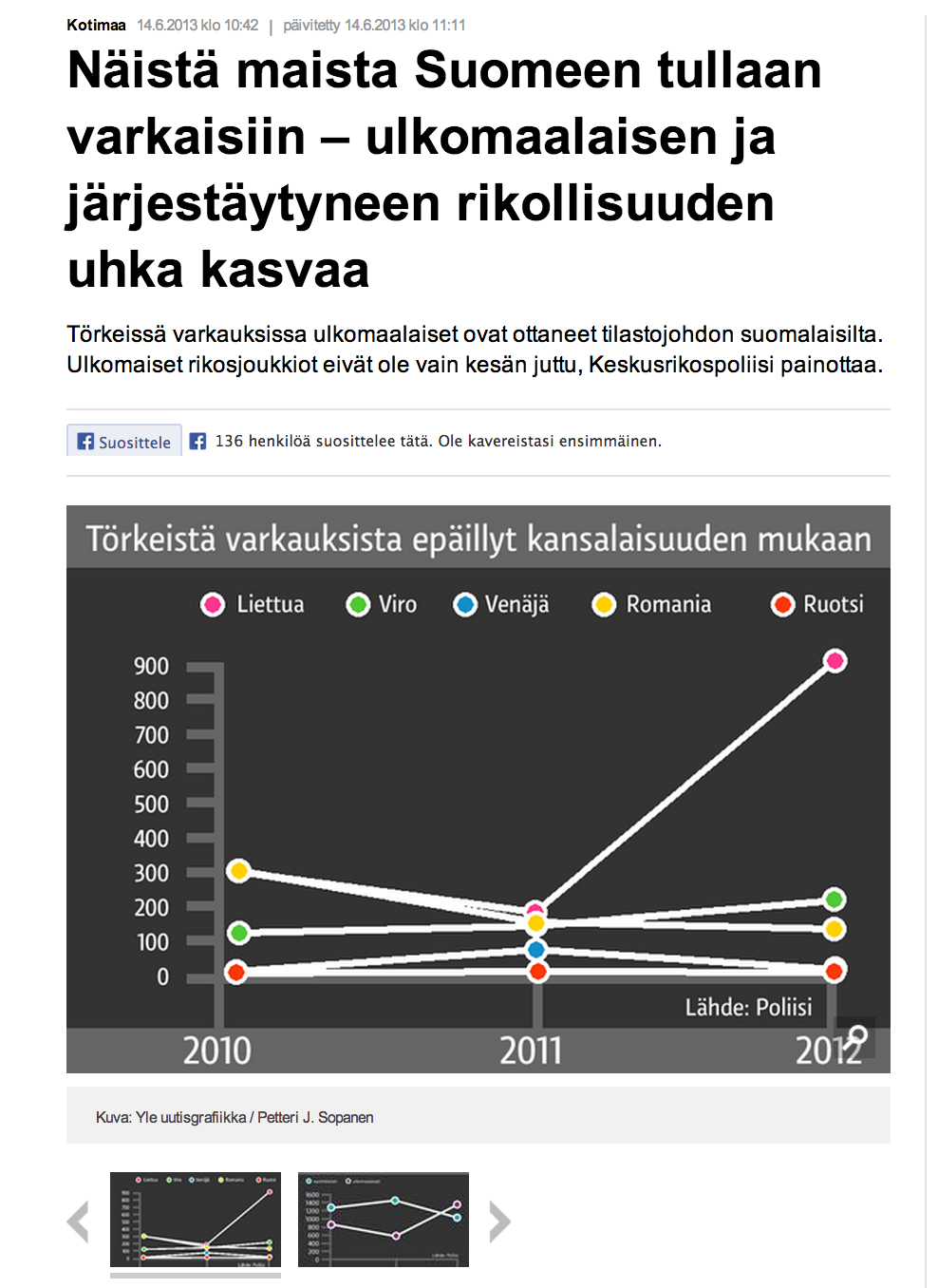
Here is a good example of how the police and media treat certain immigrant and ethnic groups publicly. A story on YLE tells us that the overwhelming amount of grand larceny cases committed by foreigners in Finland are by Lithuanians.  

Kuvankaappaus 2013-6-16 kello 10.12.43The majority of suspected grand larceny cases in Finland are  committed by Lithuanians. Why does the media and police give so much attention to Romanians as opposed to Lithuanians?  Is it because Lithuanians are white?  Why aren’t these questions asked by the national media? Read whole story here.

A police statement targeted in early June Romanians as being responsible for the spike in petty larceny and property crimes.

The statement shouldn’t surprise us since it is the way the media and police have reacted to Romanian and Bulgarian Roma that visit Finland. In many respects, it’s no different from how the media has spread fear of certain immigrant groups by pointing out “high” rape cases.

An A-Studio documentary  in August incredibly suggested that since there were seven rape convictions against Iraqi nationals, this suggested a trend and that this community “had a problem” and was prone to commit rape.

The A-Studio documentary reinforced the following prejudices that the Anti-Defamation League calls the “code words of hate:”

  • Immigrants are an army of invaders
  • Dehumanization
  • Immigrants bring crime and disease
  • Conspiracy theory

If we look at the police statement about Romanians, it cites two – yes two! – convictions, one for petty larceny and begging and another for unreported employment.

While it’s a good matter that the police investigate exploitation, abuse and crime, are they protecting the innocent and victims by spreading their prejudice and racism?

Certainly not.

The attitude of the police, media, and the silence of too politicians, shouldn’t  surprise us. Finland’s 10,000-strong Romany minority has lived here for 500 years.

They if anyone can tell about what it feels like to be socially excluded and discriminated for centuries.

Terveisiä Scriptablogista 12 syyskuuta 2008

Posted on June 15, 2013 by Migrant Tales

Yksi monista tuhansista Migrant Tales:ia vastaan kohdistetuista viesteistä, jonka muistan hyvin oli hyökkäys Jussi Halla-ahon Scriptablogista. Alla olevaa viestiä en unohda koskaan. Noin neljän tunnin sisällä, Migrant Talesin blogiin hyökättiin. Hyökkäys torjuttiin ja tänään olemme yksi luetuimpia anti-rasistisia blogeja Suomessa.

Nimi :Old No. 7Mitä teen :Kommentoin    Viesti :Mikäs mies tuo Enriikke Tessieeri on olevinaan? En oikein tykästynyt miehen teksteihin, tuntui vähän siltä että näppäimistöön kajotessaan Enriquella on alkanut pyryttää pahemman kerran.

Eipä sillä, varmasti Suomessa on syrjintää, ryssävihaa, sovinismia ynnämuuta, mutta mitä sitten? Eikö niitä voitaisi jo laskea suomalaiseen kulttuuriin, on niistä niin kauan valitettu. Ja kun ne olisivat virallisesti meidän kulttuuriamme, voisimme vedota silmät vetistäen tiedostaviin tahoihin että meidän kulttuuriamme on suojeltava maahanmuuttajien vastaavalta. Se luultavasti toimisi….Ai ei? Ainiin, unohdin ihan: Ennenkö voimme aloittaa kitisemisen, täytyy joka iikan käydä pyörimässä avotakassa tai hiilikellarissa. Jos ei sellaista ole lähellä, joku voi tulla hakemaan kauan paikallaan maanneen kahden euron kolikon sänkyni alta, ajanee saman asian.

Josta tulikin mieleeni että voisinkin siivota talouteni, tämä alkaa näyttää afgaanin majalta. Jatkakaa.     

12. syyskuuta 2008 16:53:35


How serious is the Future of Migration 2020 Strategy?

Posted on June 15, 2013 by Migrant Tales

The more I think of the government’s published white paper on immigration policy made public on Thursday, the more I have reason to worry.  Apart from omitting altogether the term multiculturalism and cultural from diversity in the Future of Migration 2020 Strategy, your suspicions aren’t put to rest by the Confederation of Finnish Industries (EK), which was critical of the policy statement. 

Riitta Wärn, an EK labor market specialist, said that the government white paper missed the mark.

“As someone who has been monitoring immigration policy for a long time, I don’t consider this to be a major change,” she was quoted as saying on YLE in English. “There’s not really anything surprising or new laid out in this policy.”

A comment I read on Facebook linked to Qbee Integrator  highlights Wärn’s frustration: “This people are so funny, I just imagine which young skilled immigrants they are talking about while they cannot employ young foreigners who graduated from their own Finnish high priced education system. People finish professional degrees, masters and PHD and they are subjected to shop cleaners and dish washers. Every year the country produces 10s of new immigrant Finnish graduates in nursing, health care and social services, only one 1% is employed on short term basis, yet we hear everyday that there are shortages.”

While the government should be commended for speaking out against racism and the importance of challenging discrimination in our society, one of the matters that shines through in white paper is the anti-immigration Perussuomalaiset (PS) party.  Sadly it’s not its chairman, Timo Soini, that we see claiming there aren’t any racists in the party, but its far right anti-immigration pundits. 

Speaking out against racism is important but equally important is to remain focused and on our toes to distinguish between official lip service and actual deeds.

If omitting the term “cultural” from diversity raises some questions and makes it more acceptable to anti-immigration groups, another worrisome term used in the white paper is “controlled immigration.”

 “Uncontrolled immigration” is a byword used by far right and right-wing populist anti-immigration groups like the PS to keep the country white. In other words, we don’t want any Muslims, Africans and other visible immigrants to migrate and live with us. 

Another big question mark over this white paper is the credibility of Interior Minister Päivi Räsänen, whose conservative Christian and views on cultural diversity get in the way of good judgement.

How on Earth can a politician like Räsänen who considers homosexuality an illness, wants to make begging illegal,  sees nothing wrong with ethnic profiling by the police and wants to tighten family reunification laws and policy seriously wants to improve the situation of immigrants and visible minorities in Finland? 

Considering that Finland is a young republic which invested a great deal of energy in undermining immigration and foreign investment to Finland, turning it into a successful and dynamic “diverse” society will take more than just a white paper.

Read the white paper (in Finnish) here. An English-language version will be available after summer.

Government announces Future of Migration 2020 Strategy

Posted on June 14, 2013 by Migrant Tales

The government published Thursday its Future of Migration 2020 Strategy. While these types of official strategy reports are important and offer a general view, the big question is if they gives us a bigger picture of the direction our society is heading in this century. 

Read the white paper (in Finnish) here. An English-language version will be available after summer.


Kuvankaappaus 2013-6-14 kello 12.22.53

Read council of state statement here.

One of the matters that surprised me about the strategy report is that it doesn’t use the term ”multiculturalism,” which has been replaced by the term diversity (moninaisuus). In English a good synonym for multiculturalism is cultural diversity. Why does the report only speak of diversity?

These kinds of omissions always raise concern about what the government really thinks of cultural diversity and, most importantly, how it should be promoted and defended.

The Confederation of Finnish Industries (EK) said that the white paper didn’t go far enough, reports YLE in English.

“As someone who has been monitoring immigration policy for a long time, I don’t consider this to be a major change,” says Riitta Wärn, an EK labor market specialist. “There’s not really anything surprising or new laid out in this policy.”

Another question mark is  Interior Minister Päivi Räsänen, who is liked by the anti-immigration Perussuomalaliset (PS) party for her conservative ideas about immigration and stated publicly that homosexuality is a sin.

The positive matter about the 2020 strategy is that it openly speaks out against racism and discrimination and how these latter social ills undermine good ethnic relations.

It states: ”The Future of Migration 2020 Strategy has a number of key objectives: managing the labour market; ensuring equal rights for all employees; improving employment opportunities for people from an immigrant background; pursuing a more successful integration policy; aiming at a faster processing of asylum applications; and fighting discrimination.”

While our laws in Finland ensure that immigrants and visible minorities will be treated equally before the law, it is quite another matter if this always happens in real life. More importantly, do we have the resources and the will to challenge intolerance?

The report suggests, however, that the government is serious about such matters.

WHO?

Posted on June 12, 2013 by Migrant Tales

By Dana

Who takes responsibility for the racist crimes in Finland?

Is that an easy question? The answer?

Is that a difficult question?..it needs an answer, however, because it is a question.

I have right to ask whom?

OLYMPUS DIGITAL CAMERA

Whom?

The President of Finland?

What responsibilities does a president have in Finland?

Parliament? Ministries?

What do ministers do in parliament?

So how do u feel about my questions? Are they a crime? Cant i ask questions?

Then tell me about freedom of speech in Finland?

Do u want more questions?

Hey, freedom of speech tell me about the freedom to commit crimes

And tell me more and more, bring it out bright and bright

Hey freedom of speech tell me about my human rights

I could not find them here, i got a response: fight and fight and fight

Hey freedom of speech tell me about my women’s rights

No/one explained them to me, i got insulted, ruthlessly

Hey freedom of speech have u seen brave people in the wind?

I wish to see brave ones, they are like cool weather in a hot night

Hey freedom of speech tell me about a normal life and sight

I dont have them here, sigh, they are full of pride and pride and pride

  • Previous
  • 1
  • 2
  • 3
  • 4
  • 5
  • Next
Read more about documentary film
Read more

Recent Posts

  • Finland’s tabloids Iltalehti and Ilta-Sanomat are the pits
  • Riikka Purra’s Dr Jekyll and Mr Hyde mask
  • Double standards
  • Perussuomalaiset: Uusi logo, sama vanha juttu
  • Taco Trump

Recent Comments

  1. Absolutely Socking: Racist Finnish Facebook group against human rights gets flooded with socks on Musta Barbaari’s mother and sister charged by the police in “ethnic profiling” case
  2. Ilkka Nuotio on Pekka Myrskylä: “Tilastot kertovat toista kuin poliittinen keskustelu”
  3. Genrih Soinkara on The war in Ukraine and the Russian-Finnish border crisis are showing Finland’s ugly side
  4. Ahti Tolvanen on Comment by Ahti Tolvanen on the Helsinki +50 conference
  5. Angel Barrientos on Angel Barrientos is one of the kind beacons of Finland’s Chilean community

Archives

  • June 2026
  • May 2026
  • April 2026
  • March 2026
  • February 2026
  • January 2026
  • December 2025
  • November 2025
  • October 2025
  • September 2025
  • August 2025
  • July 2025
  • June 2025
  • May 2025
  • April 2025
  • March 2025
  • February 2025
  • January 2025
  • December 2024
  • November 2024
  • October 2024
  • September 2024
  • August 2024
  • July 2024
  • June 2024
  • May 2024
  • April 2024
  • March 2024
  • February 2024
  • January 2024
  • December 2023
  • November 2023
  • October 2023
  • September 2023
  • August 2023
  • July 2023
  • June 2023
  • May 2023
  • April 2023
  • March 2023
  • February 2023
  • January 2023
  • December 2022
  • November 2022
  • October 2022
  • September 2022
  • August 2022
  • July 2022
  • June 2022
  • May 2022
  • April 2022
  • March 2022
  • February 2022
  • January 2022
  • December 2021
  • November 2021
  • October 2021
  • September 2021
  • August 2021
  • July 2021
  • June 2021
  • May 2021
  • April 2021
  • March 2021
  • February 2021
  • January 2021
  • December 2020
  • November 2020
  • October 2020
  • September 2020
  • August 2020
  • July 2020
  • June 2020
  • May 2020
  • April 2020
  • March 2020
  • February 2020
  • January 2020
  • December 2019
  • November 2019
  • October 2019
  • September 2019
  • August 2019
  • July 2019
  • June 2019
  • May 2019
  • April 2019
  • March 2019
  • February 2019
  • January 2019
  • December 2018
  • November 2018
  • October 2018
  • September 2018
  • August 2018
  • July 2018
  • June 2018
  • May 2018
  • April 2018
  • March 2018
  • February 2018
  • January 2018
  • December 2017
  • November 2017
  • October 2017
  • September 2017
  • August 2017
  • July 2017
  • June 2017
  • May 2017
  • April 2017
  • March 2017
  • February 2017
  • January 2017
  • December 2016
  • November 2016
  • October 2016
  • September 2016
  • August 2016
  • July 2016
  • June 2016
  • May 2016
  • April 2016
  • March 2016
  • February 2016
  • January 2016
  • December 2015
  • November 2015
  • October 2015
  • September 2015
  • August 2015
  • July 2015
  • June 2015
  • May 2015
  • April 2015
  • March 2015
  • February 2015
  • January 2015
  • December 2014
  • November 2014
  • October 2014
  • September 2014
  • August 2014
  • July 2014
  • June 2014
  • May 2014
  • April 2014
  • March 2014
  • February 2014
  • January 2014
  • December 2013
  • November 2013
  • October 2013
  • September 2013
  • August 2013
  • July 2013
  • June 2013
  • May 2013
  • April 2013
  • March 2013
  • February 2013
  • January 2013
  • December 2012
  • November 2012
  • October 2012
  • September 2012
  • August 2012
  • July 2012
  • June 2012
  • May 2012
  • April 2012
  • March 2012
  • February 2012
  • January 2012
  • December 2011
  • November 2011
  • October 2011
  • September 2011
  • August 2011
  • July 2011
  • June 2011
  • May 2011
  • April 2011
  • March 2011
  • February 2011
  • January 2011
  • December 2010
  • November 2010
  • October 2010
  • September 2010
  • August 2010
  • July 2010
  • June 2010
  • May 2010
  • April 2010
  • March 2010
  • February 2010
  • January 2010
  • December 2009
  • November 2009
  • October 2009
  • September 2009
  • August 2009
  • July 2009
  • December 2008
  • November 2008
  • October 2008
  • September 2008
  • August 2008
  • July 2008
  • June 2008
  • May 2008
  • April 2008
  • March 2008
  • February 2008
  • January 2008
  • November 2007
  • October 2007
  • September 2007
  • August 2007
  • July 2007
  • June 2007
  • May 2007

Categories

  • ?? Gia L?c
  • ????? ?????? ????? ???????? ?? ??????
  • ???????
  • @HerraAhmed
  • @mondepasrond
  • @nohatefinland
  • @oula_silver
  • @Varathas
  • A Pakistani family
  • äärioikeisto
  • Abbas Bahmanpour
  • Abdi Muhis
  • Abdirahim Hussein Mohamed
  • Abdirahim Husu Hussein
  • Abdirisak Mahamed
  • About Migrant Tales
  • activism
  • Adam Al-Sawad
  • Adel Abidin
  • Afrofinland
  • Ahmed IJ
  • Ahti Tolvanen
  • Aino Pennanen
  • Aisha Maniar
  • Alan Ali
  • Alan Anstead
  • Alejandro Díaz Ortiz
  • Alekey Bulavsev
  • Aleksander Hemon
  • Aleksanterinliitto
  • Aleksanterinliitto ry
  • Aleksanterinliitto ry:n hallitus
  • Alex Alex
  • Alex Mckie
  • Alexander Nix
  • Alexandra Ayse Albayrak
  • Alexis Neuberg
  • Ali Asaad Hasan Alzuhairi
  • Ali Hossein Mir Ali
  • Ali Rashid
  • Ali Sagal Abdikarim
  • Alina Tsui
  • Aline Müller
  • All categories
  • Aman Heidari
  • Amiirah Salleh-Hoddin & Jana Turk
  • Amin A. Alem
  • Amir Zuhairi
  • Amkelwa Mbekeni
  • Ana María Gutiérrez Sorainen
  • Anachoma
  • Anders Adlecreutz
  • Angeliina Koskinen
  • Anna De Mutiis
  • Anna María Gutiérrez Sorainen
  • Anna-Kaisa Kuusisto ja Jaakko Tuominen
  • Annastiina Kallius
  • Anneli Juise Friman Lindeman
  • Announcement
  • Anonymous
  • Antero Leitzinger
  • anti-black racism
  • Anti-Hate Crime Organisation Finland
  • Anudari Boldbaatar
  • Arshiya Nasser
  • Aspergers Syndrome
  • Asylum Corner
  • Asylum seeker 406
  • Athena Griffin and Joe Feagin
  • Autism
  • Avaaz.org
  • Awale Olad
  • Ayan Said Mohamed
  • AYY
  • Barachiel
  • Bashy Quraishy
  • Beatrice Kabutakapua
  • Beri Jamal
  • Beri Jamal and Enrique Tessieri
  • Bertolt Brecht
  • Boiata
  • Boodi Kabbani
  • Bruno Gronow
  • Carmen Pekkarinen
  • Çelen Oben and Sheila Riikonen
  • Chiara Costa-Virtanen
  • Chiara Costa-Virtanen
  • Chiara Sorbello
  • Christian Thibault
  • Christopher Wylie
  • Clara Dublanc
  • Dana
  • Daniel Malpica
  • Danilo Canguçu
  • David Papineau
  • David Schneider
  • Dexter He
  • Don Flynn
  • Dr Masoud Kamali
  • Dr. Faith Mkwesha
  • Dr. Theodoros Fouskas
  • Edna Chun
  • Eeva Kilpi
  • Emanuela Susheela
  • En castellano
  • ENAR
  • Enrique
  • Enrique Tessieri
  • Enrique Tessieri & Raghad Mchawh
  • Enrique Tessieri & Yahya Rouissi
  • Enrique Tessieri and Muhammed Shire
  • Enrique Tessieri and Sira Moksi
  • Enrique Tessieri and Tom Vandenbosch
  • Enrique Tessieri and Wael Che
  • Enrique Tessieri and Yahya Rouissi
  • Enrique Tessieri and Zimema Mhone
  • Epäluottamusmies
  • EU
  • Europe
  • European Islamophobia Report
  • European Islamophobia Report 2019,
  • European Union
  • Eve Kyntäjä
  • Ezequiel Caldeiro
  • Facebook
  • Fadumo Dayib
  • Faisa Kahiye
  • Farhad Manjoo
  • Fasismi
  • Finland
  • Fizza Qureshi
  • Flyktingar och asyl
  • Foreign Student
  • Fozia Mir-Ali
  • Frances Webber
  • Frida Selim
  • Gareth Rice
  • Ghyslain Vedeaux
  • Global Art Point
  • Great Replacement
  • Habiba Ali
  • Hami Bahadori
  • Hami Bahdori
  • Hamid
  • Hamid Alsaameere
  • Hamid Bahdori
  • Handshake
  • Harmit Athwal
  • Hassan Abdi Ali
  • Hassan Muhumud
  • Heikki Huttunen
  • Heikki Wilenius
  • Helsingin Sanomat
  • Henning van der Hoeven
  • Henrika Mälmsröm
  • Hser Hser
  • Hser Hser ja Mustafa Isman
  • Husein Muhammed
  • Hussain Kazemian
  • Hussain Kazmenian
  • Ibrahim Khan
  • Ida
  • Ignacio Pérez Pérez
  • Iise Ali Hassan
  • Ilari Kaila & Tuomas Kaila
  • Imam Ka
  • inside-an-airport
  • Institute of Race Relations
  • Iraqi asylum seeker
  • IRR European News Team
  • IRR News Team
  • Islamic Society of Norhern FInland
  • Islamic Society of Northern Finland
  • Islamophobia
  • Jacobinmag.com
  • Jallow Momodou
  • Jan Holmberg
  • Jane Elliott
  • Jani Mäkelä
  • Jari Luoto
  • Jari Taponen
  • Jegor Nazarov
  • Jenni Stammeier
  • Jenny Bourne
  • Jessie Daniels
  • Joe Davidow
  • Johannes Koski
  • John D. Foster
  • John Grayson
  • John Marriott
  • Jon Burnett
  • Jorma Härkönen
  • Jos Schuurmans
  • José León Toro Mejías
  • Josue Tumayine
  • Jouni Karnasaari
  • Juan Camilo
  • Jukka Eräkare
  • Julian Abagond
  • Julie Pascoet
  • Jussi Halla-aho
  • Jussi Hallla-aho
  • Jussi Jalonen
  • JusticeDemon
  • Kadar Gelle
  • Kaksoiskansalaisuus
  • Kansainvälinen Mikkeli
  • Kansainvälinen Mikkeli ry
  • Katherine Tonkiss
  • Kati Lepistö
  • Kati van der Hoeven-Lepistö
  • Katie Bell
  • Kättely
  • Kerstin Ögård
  • Keshia Fredua-Mensah & Jamie Schearer
  • Khadidiatou Sylla
  • Khadra Abdirazak Sugulle
  • Kiihotus kansanryhmää vastaan
  • Kirsi Crowley
  • Koko Hubara
  • Kristiina Toivikko
  • Kubra Amini
  • KuRI
  • La Colectiva
  • La incitación al odio
  • Laura Huhtasaari
  • Lauri Finér
  • Leif Hagert
  • Léo Custódio
  • Leo Honka
  • Leontios Christodoulou
  • Lessie Branch
  • Lex Gaudius
  • Leyes de Finlandia
  • Liikkukaa!
  • Linda Hyökki
  • Liz Fekete
  • M. Blanc
  • Maarit Snellman
  • Mahad Sheikh Musse
  • Maija Vilkkumaa
  • Malmin Kebab Pizzeria Port Arthur
  • Marcell Lorincz
  • Mari Aaltola
  • María Paz López
  • Maria Rittis Ikola
  • Maria Tjader
  • Marja-Liisa Tolvanen
  • Mark
  • Markku Heikkinen
  • Marshall Niles
  • Martin Al-Laji
  • Maryan Siyad
  • Matt Carr
  • Mauricio Farah Gebara
  • Media Monitoring Group of Finland
  • Micah J. Christian
  • Michael McEachrane
  • Michele Levoy
  • Michelle Kaila
  • Migrant Tales
  • Migrant Tales Literary
  • Migrantes News
  • Migrants' Rights Network
  • MigriLeaks
  • Mikko Kapanen
  • Miriam Attias and Camila Haavisto
  • Mohamed Adan
  • Mohammad Javid
  • Mohammad M.
  • Monikulttuurisuus
  • Monisha Bhatia and Victoria Canning
  • Mor Ndiaye
  • Muh'ed
  • Muhamed Abdimajed Murshid
  • Muhammed Shire
  • Muhammed Shire and Enrique Tessieri
  • Muhis Azizi
  • Musimenta Dansila
  • Muslimiviha
  • Musulmanes
  • Namir al-Azzawi
  • Natsismi
  • Neurodiversity
  • New Women Connectors
  • Nils Muižnieks
  • No Labels No Walls
  • Noel Dandes
  • Nuor Dawood
  • Omar Khan
  • Otavanmedia
  • Oula Silvennoinen
  • Paco Diop
  • Pakistani family
  • Pentti Stranius
  • Perussuomalaiset
  • perustuslaki
  • Petra Laiti
  • Petri Cederlöf
  • Pia Grochowski
  • Podcast-lukija Bea Bergholm
  • Pohjois – Suomen Islamilainen Yhdyskunta
  • Pohjois Suomen Islamilainen Yhyskunta
  • Polina Kopylova
  • Race Files
  • racism
  • Racism Review
  • Raghad Mchawh
  • Ranska
  • Rashid H. and Migrant Tales
  • Rasismi
  • Raul Perez
  • Rebecka Holm
  • Reem Abu-Hayyeh
  • Refugees
  • Reija Härkönen
  • Remiel
  • Reza Nasri
  • Richard Gresswell
  • Riikka Purra
  • Risto Laakkonen
  • Rita Chahda
  • Ritva Kondi
  • Robito Ibrahim
  • Roble Bashir
  • Rockhaya Sylla
  • Rodolfo Walsh
  • Roger Casale
  • Rostam Atai
  • Roxana Crisólogo Correa
  • Ruth Grove-White
  • Ruth Waweru-Folabit
  • S-worldview
  • Sadio Ali Nuur
  • Sami Rusanen
  • Sandhu Bhamra
  • Sara de Jong
  • Sarah Crowther
  • Sari Alhariri
  • Sarkawt Khalil
  • Sasu
  • Scot Nakagawa
  • Shabana Ahmadzai
  • Shada Islam
  • Sharon Chang blogs
  • Shenita Ann McLean
  • Shirlene Green Newball
  • Sini Savolainen
  • Sira Moksi
  • Sonia K.
  • Sonia Maria Koo
  • Steverp
  • Stop Deportations
  • Suldaan Said Ahmed
  • Suomen mediaseurantakollektiivi
  • Suomen Muslimifoorumi ry
  • Suomen viharikosvastainen yhdistys
  • Suomen viharikosvastainen yhdistys ry
  • Suomi
  • Supermen
  • Susannah
  • Suva
  • Syrjintä
  • Talous
  • Tapio Tuomala
  • Taw Reh
  • Teivo Teivainen
  • The Daily Show
  • The Heino
  • The Supermen
  • Thomas Elfgren
  • Thulfiqar Abdulkarim
  • Tim McGettigan
  • Tino Singh
  • Tito Moustafa Sliem
  • Tobias Hübinette and L. Janelle Dance
  • Transport
  • Trica Danielle Keaton
  • Trilce Garcia
  • Trish Pääkkönen
  • Trish Pääkkönen and Enrique Tessieri
  • Tuulia Reponen
  • Uncategorized
  • UNITED
  • University of Eastern Finland
  • Uyi Osazee
  • Väkivalta
  • Vapaa Liikkuvuus
  • Venla-Sofia Saariaho
  • Vieraskynä
  • W. Che
  • W. Che an Enrique Tessieri
  • Wael Ch.
  • Wan Wei
  • Women for Refugee Women
  • Xaan Kaafi Maxamed Xalane
  • Xassan Kaafi Maxamed Xalane
  • Xassan-Kaafi Mohamed Halane & Enrique Tessieri
  • Yahya Rouissi
  • Yasmin Yusuf
  • Yassen Ghaleb
  • Yle Puhe
  • Yuliet Tresa
  • Yve Shepherd
  • Zahra Khavari
  • Zaker
  • Zalina Ametova
  • Zamzam Ahmed Ali
  • Zeinab Amini ja Soheila Khavari
  • Zimema Mahone and Enrique Tessieri
  • Zimema Mhone
  • Zoila Forss Crespo Moreyra
  • ZT
  • Zulma Sierra
  • Zuzeeko Tegha Abeng
© 2026 Migrant tales | Powered by Minimalist Blog WordPress Theme