Migrant tales
Menu
  • #MakeRacismHistory “In Your Eyes”
  • About Migrant Tales
  • It’s all about Human Rights
  • Literary
  • Migrant Tales Media Monitoring
  • NoHateFinland.org
  • Tales from Europe
Menu

Month: January 2013

Pia Grochowski: The other side of ethnic cuisine

Posted on January 31, 2013 by Migrant Tales

By Pia Grochwoski

This month Six Degrees magazine ran multiple features on the theme of ethnic food and restaurants, “Dining with an Ethnic Twist: The popularity of ethnic restaurants in Finland continues to grow swiftly”. The proportion of ethnic restaurants in Finland continues to grow, making up 20% of the restaurant sector in Finland. It is worth noting many of these restaurants are also immigrant owned. Much of this is celebrated in that locals now have the chance to enjoy ethnic food closer to home: for vegetarians like myself it can become quite easy which restaurants to select when going out. Much of this is seen as supported as a representation of multiculturalism. What however is not talked about is the segmentation of the restaurant industry. Having worked a few years in the restaurant industry in Finland myself some key elements must be discussed before this is celebrated.

First of all, the restaurant industry is highly unregulated in terms of labour laws. Non-Finns working in these industries are often not appropriately informed of their rights, many of them can spend their entire days working in a restaurant that they don’t own. When I would meet colleagues after work some of them barely could orientate themselves in Helsinki as they never had the chance to leave their workplace. Others due to limited language ability are not capable of describing the abuse they face, or learn what is appropriate and decent working conditions. Immigrants can be easily exploited in the restaurant industry. They are also less likely to have the social ties or linguistic ability to direct a complaint. I do take care to watch for key elements of labour law abuse when visiting a restaurant, low prices, a single lonely worker running the whole place can be a telltale sign.

Secondly, there is an ethnic hierarchy in the industry. Immigrants make up a large portion of the restaurant sector, but similar too many other places in Finland face a glass ceiling. If you ever have the chance to go to a restaurant in central Helsinki, be it Italian, Finnish or other; much of the front end staff (wait staff, bartenders, host and hostesses) are Finnish or white. Finns working at ethnic restaurants (other than Finnish owned ethnic restaurants) are few and far between, this is a representation of differential pay increments. Ethnic restaurants often offer lower salaries. Back room staff (cooks, chefs, food-runners, dishwashers, cleaners) tends to be more diverse. I have rarely seen anything but an African-origin dishwasher. What surprises me about many I have spoken to is how well educated they are and their high language ability in Finnish and English. They could do much more than working as a dishwashing for less than 10€ and hour. The reason why they aren’t the elephant in the room we are all speaking of. There are few exceptions, however its apparent to me that many higher end restaurants seem to prefer a white face up front.

Which brings me to my final point. While there are some few changes being made up front: what is clear here, and what can’t be ignored is a clear barrier to immigrants in this sector-like many others. Many, if they want to advance in the sector would have to start their business: and hope it’s a success. This is facilitated by starttiraha, its one of the few avenues that is clearly open for immigrants to escape the dead end jobs in the restaurant business. The large portion of kebab shops for example aren’t are manifestation of Finnish demands for lean cuts of meat on bread: but rather a representation of a large portion of immigrants, particularly from the Middle East, unable to access decent employment by other means. Popularity and an interest in ethnic food make the starting up of ethnic restaurants more likely to be a success or lead to a sustainable livelihood.

Before celebrating the creation of ethnic restaurants, one should look at the social forces behind the fact that 3% of the population makes up 20% of a particular sector. One that is well documented to be one of the most exploitive.

PS’ second vice president doesn’t condemn but “gives advice”to Jyväskylä’s neo-Nazi attackers

Posted on January 31, 2013 by Migrant Tales

Perussuomalaiset (PS) second vice president, MP Juho Eerola, did not condemn the attacks in Jyväskylä by suspected neo-Nazi thugs but advised them how to do it more effectively, reports National Coalition Party’s online Verkkouutiset. Writes Eerola:  “The next time don’t look like “patriots” when you plan to enter such an event.  Don’t go as a group but be [inconspicuous] in the crowd.”

Kuvankaappaus 2013-1-31 kello 16.41.52

Eerola’s views are shameful if not worrisome. They reveal how some PS members  hold rights rights like freedom of speech and the right to assembly in contempt.

The PS MP denied on Friday’s Helsingin Sanomat that he was giving advice on how to carry out the attack and should express his ideas more precisely the next time.

Eerola’s aide, Ulla Pyysalo, had applied for membership in the neo-Nazi Suomen Kansallinen Vastarina (SKV) but refused to resign from her post unless she found a new job by the end of the year.

Eerola, whose sympathies with fascism are well known, defended Pyysalo and did not see any reason for her to resign. He said he’d be more worried if his aide belonged to a far-left organization.

One of the matters that  worries me about t people like Eerola and his band is they think they can rewrite history and put our way of life in cold storage in order to please their views, which are harmful to our society.


Interior minister: Far right isn’t “a big threat” despite what happened in Jyväskylä

Posted on January 31, 2013 by Migrant Tales

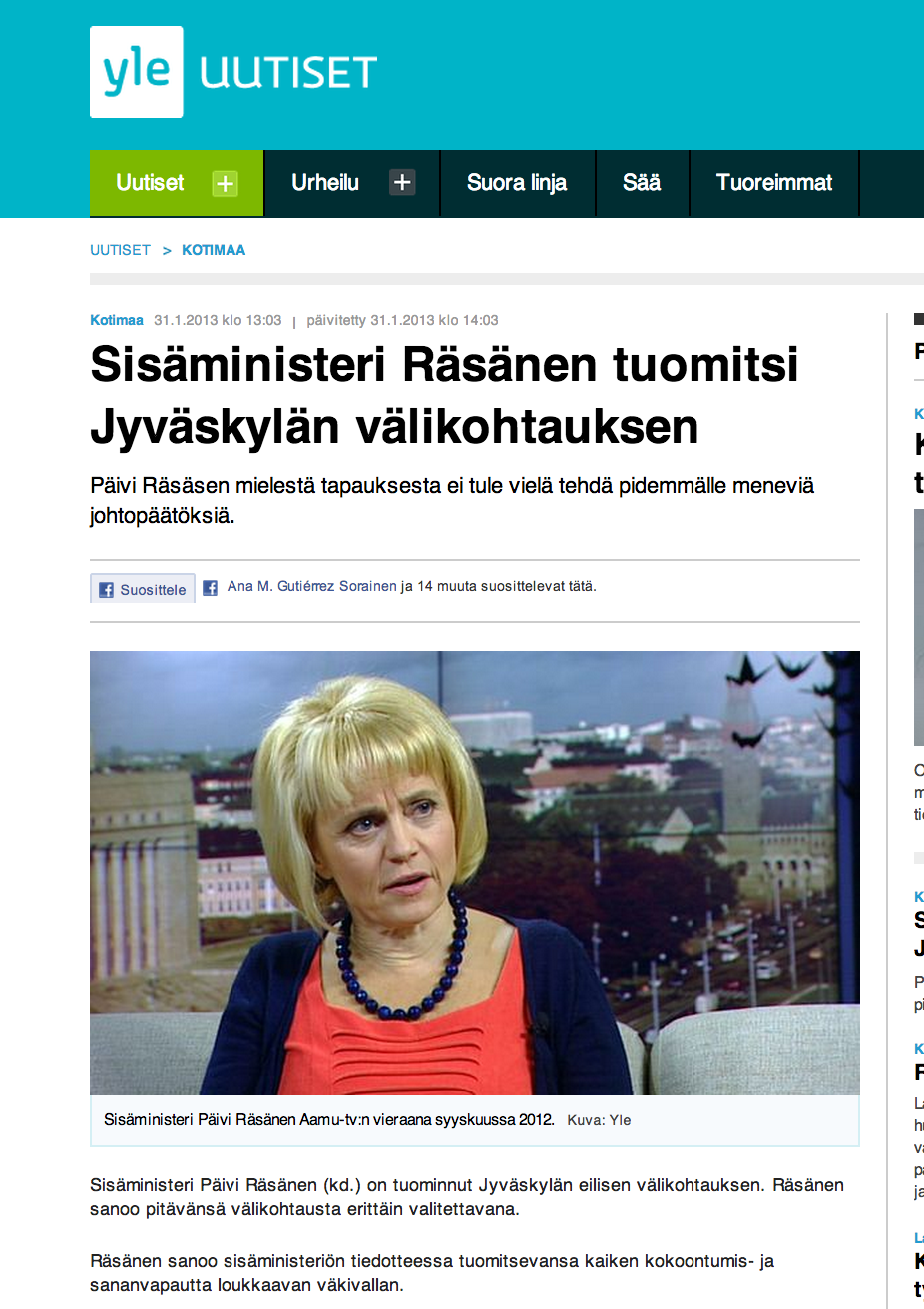
Christian Democrat Interior Minister Päivi Räsänen condemned the attack by three suspected neo-Nazi thugs in Jyväskylä as an assault against freedom of speech and the right to assembly, reports YLE. She didn’t consider, however, the far right to be a threat to Finland but said that the authorities aim to do more work to address social marginalization.  

Whether the far right is a threat or not to Finland depends on your perspective. If you are a white interior minister and a member of the Christian Democratic Party, maybe the threat of the far right isn’t such a pressing issue. 

The minister who is making such a statement believes homosexuality to be a sin, begging should be made illegal, and approves indirectly ethnic profiling by the police.

In many respects, it’s the same question if racism and discrimination are widespread or not in Finland.  If you are white it’s more difficult to grasp the problem than if you are a visible minority.   

Kuvankaappaus 2013-1-31 kello 14.54.03


While social marginalization may be one of the culprits that is fueling far right ideology in Europe and Finland, there are others like intolerance and prejudice taught at home.

Challenging far right ideology, and the 98 octane fuel (racism, xenophobia, prejudice, marginalization, among others) that feeds it, must be everyone’s priority.

The first important step is that our reaction to far right violence and its ideology should be first and foremost a reaction.

Räsänen’s views on what happened in Jyväskylä and its causes show a very meek rection.

Jyväskylä is (another) wakeup call to growing far right violence and intimidation

Posted on January 31, 2013 by Migrant Tales

Wednesday’s attack by neo-Nazi thugs at a book presentation in Jyväskylä is a wakeup call to the growing menace of far right violence in Finland. Was what happened in the central Finnish city a surprise? 

The answer is no if you ask researcher Vesa Puuronen of the University of Eastern Finland.

”When we consider recent political and ideidological developments in Finland and Europe,” he was quoted as saying on YLE in English, ”then this is by no means a surprising incident.”

Considering that a group of suspected neo-Nazi Suomen Kansalinen Vastarinta (SKV) members tried to disrupt a peaceful meeting where people were exercising their right to meet and express themselves is a cause for concern.

In many respects the rise of far right and neo-Nazi (see Hungary and Greece) are fuelling and emboldening likeminded groups in Finland. It would be naive to think that we are some island immune to their ideology.

One has only to go back to the April 2011 election, when the Perussuomalaiset (PS) party won a historic election victory to become Finland’s third-largest party in parliament.

While not all PS MPs and party members belong to the far right, a group led by MP Jussi Halla-aho  pretty much dictates policy on immigration and cultural diversity. Their view of on these issues is similar to other far right groups in Europe like the Sweden Democrats and Danish People’s Party.

As long as politicians, civil leaders, policy makers and the general public remain quiet and play down  the threat that far right groups in this country, we’ll be  emboldening them to new acts of violence. Racism, xenophobia and prejudice are some of the fuels that these groups thrive on to grow.

What happened in Jyväskylä is not only disgraceful, but a directattack against all of us who believe in the rule of law.

Suspected neo-Nazis attack book presentation event on the far right in Finland

Posted on January 30, 2013 by Migrant Tales

A group of men with bottles and knives barged in a book presentation in the central Finnish city of Jyväskylä on far-right extremism, according to Yle in English. The men, who called themselves ”patriots,” injured one of the body guards who was taken to hospital. The attackers fled the scene. 

Members of the neo-Nazi Suomen Kansalinen Vastarinta (SKV) are suspected to have attacked the book presentation.

Two of Äärioikesto Suomessa’s (Far right in Finland) three authors, Li Andersson and Mikael Brunila, were present at the event but weren’t hurt.

The police, who haven’t yet  caught the suspects, said that they are investigating the incident as aggravated assault.

MTV3 reported on the 10pm news that two of the attackers ave been identified but could not confirm if the police had apprehended them.

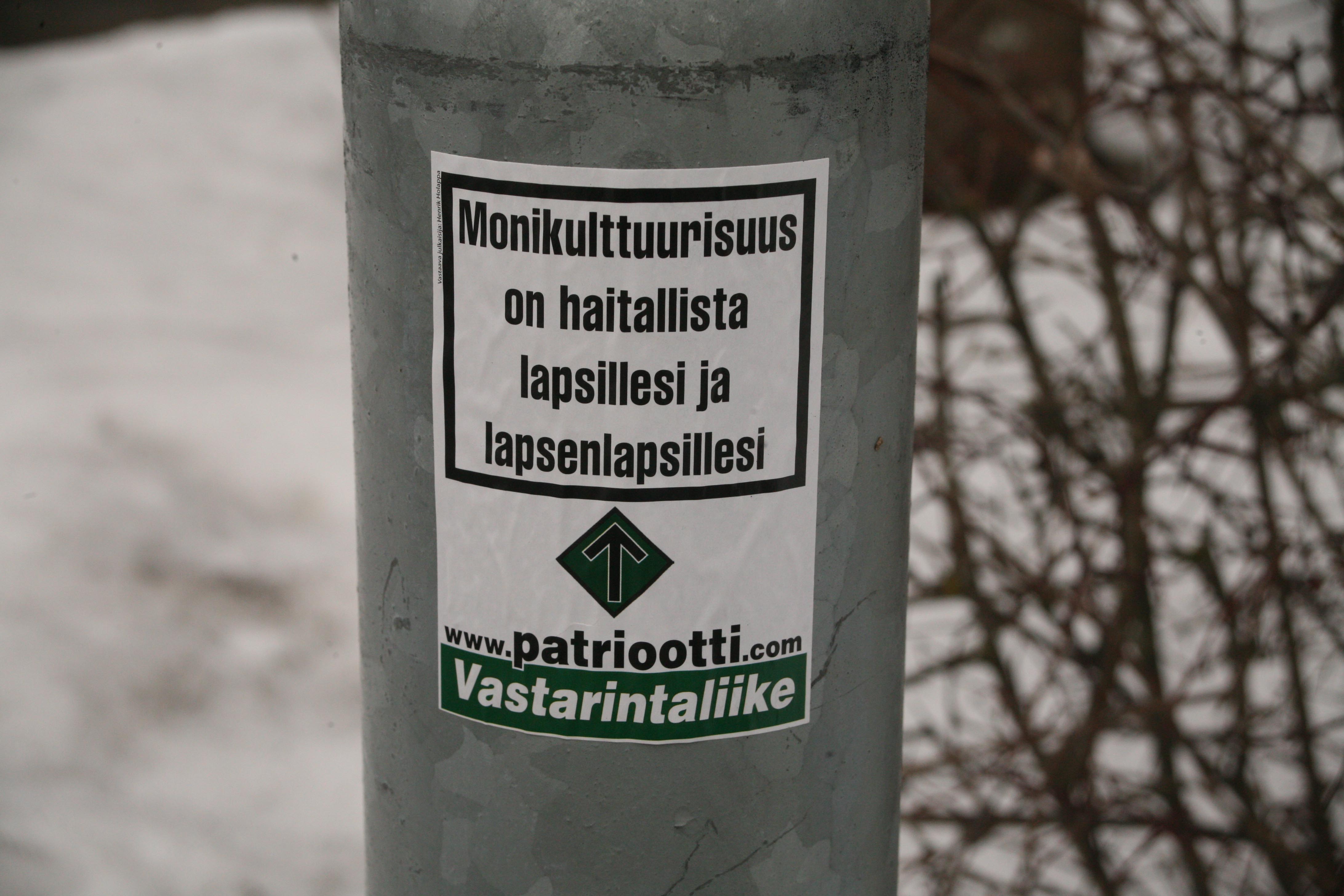
skvThis neo-Nazi SKV sticker was found in front of my home in spring.

The attack in Jyväskylä demonstrates that far right and neo-Nazi groups in Finland are getting bolder. 

Far right in Finland ‘s third author, Dan Koivulaakso, was attacked with pepper spray in June at a North Pride event in Oulu.

If the police would connect all the recent dots about the presence of far-right violence in this country, I’m certain that some would be concerned.

The same way that the police plays down the threat of these groups, it doesn’t appear too concerned either by the rising number of hate crimes and racism inflicting this country.

Kuvankaappaus 2013-1-30 kello 22.03.00

I spoke with Alain Minguet, a Green Party city councilor and president of JoMoni, over a year ago that something like what happend in Jyväskylä  could take place, or worse.

Many who write about racism in Finland get harassed. The first story I wrote about how badly Somali’s were treated in Mikkeli in the early 1990s for a major Finnish magazine landed me two death threats by phone. There was a third caller who harassed and insulted me over the phone.

The death threats and threats in general haven’t stopped. I filed a complaint to the police last spring about such cases but haven’t heard a word from them. The policeman investigating the case doesn’t even answer my phone calls.

Believe it or not, the police in Mikkeli and Pieksämäki have told me that I should not report racist harassment cases to the police.

It’s time for the authorities to get tough with neo-Nazi and far right groups that use violence and death threats to get across their message.


What does Finland’s integration law reveal about our society and expectations?

Posted on January 30, 2013 by Migrant Tales

A good question we can ask about Finland’s integration act is what it reflects about our views and expectations of newcomers. Can any law integrate people effectively?  

If you want to speak of one- or two-way adaption, one should ask some of Finland’s oldest minorities like the Roma and Saami what memories such a law may evoke.

Considering that children who spoke Saami at school in the 1960s were punished in Finland, it’s natural that there are a lot of bad feelings and distrust of white Finns’ intentions.

If we look at second- and third-generation Finns, we don’t even know what these people were supposed to integrate to. It’s sad that the answer to this question has been in some cases society’s indifference and rejection.

Apart form the lack of resources that the present integration law faces, another challenge is if it offers a big picture of our ever-growing culturally diverse society. How, for example, does it promote acceptance as well as respect for new Finnishness and other new identities?

It would be too simplistic to claim that the integration law is a utter failure. For one it keeps those who are hostile to our ever-growing cultural diversity at bay. Its existence permits it to indirectly integrate Finns as well to the idea that we are becoming a culturally diverse society.

What does the act reflect about our views and expectations of newcomers? In many respects it reflects our expectations and too little of those that are being integrated.  Thus we speak of two-way integration but in practice it’s one-way.

Canadian Social psychologist J. W. Berry highlighted three important matters in order to manage successfully a culturally diverse society. Even if he speaks of multiculturalism, it can apply well to Finland, which accepts culturally diversity in its laws.

Writes Berry:

  • In our view there needs to be general support for cultural diversity as a valuable resource for a society;
  • There should be overall low levels of prejudice in the population;  
  • There should be generally positive mutual attitudes among the various ethnocultural groups that constitute the society;
  • There needs to be a degree of attachment to the larger national society.

Do you agree?

Labels that fuel discrimination and racism in Finland

Posted on January 28, 2013 by Migrant Tales

When will Finns drop this discriminatory term: Finns with immigrant backgrounds? Many, I suspect, are and should be proud of their background. I am but what happens if these labels and terms ensure that you will continue to be treated as something less equal? 

What do you do if being labeled in such a way undermines your career chances and competing with white Finns for the best jobs?

Fred Dervin, a professor of multicultural education at the University of Helsinki, said the usage of such labels create inequality, especially if the person was born in this country.

“It is dangerous because we create [a sense of] inequality, since not everyone is given the same treatment or opportunities,” he was quoted as saying on YLE in English. 

Kuvankaappaus 2013-1-28 kello 6.59.02Part of the problem aren’t Finns labeling “others” as eternal outsiders, but those who are being labeled accept it! Some of them fall into the trap  and actually believe they are somehow less equal, or don’t have the right to be on equal terms with a white Finn because of their immigrant background.

Some will struggle during their lives to be as white as possible without ever understanding the beauty of their roots.  A valid question we should ask about integration in Finland is what are newcomers supposed to integrate to?  

If Dervin makes a case for those who were born in this country, I would take it even further: What about those that came here as children and have lived most of their lives in this country?

Why are they still considered “foreigners?” How many generations must they live in Finland in order to be accepted as equals?

The same matter that happens in countries with immigrants is happening in Finland but in a different context.  It’s the same discriminatory standard  used to exclude others from being treated as equals in society.

Identity is a personal matter. You are who you think you are. If some have an problem with this, it’s their problem, not yours. 

No matter how you cut it, we should start to better identify and discard from our speech those terms that fuel discrimination and inequality.


Migrant Tales literary: How high must a wall be to contain hope?

Posted on January 27, 2013 by Migrant Tales
Dedicated to the EU and Donald Trump

By Leo Honka

No wall can contain hope.

It’s a fact but go and build your high wall

To hide the destruction you’ve reaped:

pillaging riches, pillaging hope

leaving people and whole nations

devastated, without future.

12.jpg (1024Ã?683)

Source: Westmonster.

Now we’re knocking on your door

With a sentence in the form of a key:

Let us in!

No matter how high the walls you build

so you can’t see us

you always will.

Don’t fool yourself

high walls can never contain hope – and our despair.

The social tragedy of the family reunification problem of Somalis in Finland

Posted on January 27, 2013 by Migrant Tales

The Finnish Immigration Service states in a report (see page 4) that at the end of 2011 there were a total of 6,100 family reunification applications by Somalis living in the country. Even so, only 329 family reunifications took place on average annually between 1999 and 2010, according to the Refugee Advice Center.

No matter how one looks at the figures, there are very few family reunifications taking place in Finland among refugees.

Migrant Tales has reported on previous blog entries about the challenges that Somalis face if they want to be reunited with their families.

The Somalis are not a small community. They are the fourth-biggest foreign group (7,421) living in Finland in 2011 after the Estonians, Russians and Swedes, according to the Population Register Center. There were a total of 14,045 people who speak Somali as their mother tongue.

In many respects, the situation of the Somali community resembles the discrimination (without the obvious Jim Crow laws) that black people faced before the end of Civil Rights Movement in the United States in 1968. Prejudice, racism and outright hostility are some of the threats that some Somalis face in this country on a daily basis.

Contrary to USAmerican blacks, the Somalis come from a Muslim country that has been at civil war since the early 1990s.

The family reunification issue facing the Somali community is a ticking social time bomb that aims to undermine, not strengthen, its roots with this country.

Look at the plight of the Somali community in the following manner: You flee to Finland as a refugee, are granted asylum but the high price you’ll have to pay is living without your family indefinitely.

Even if a fifteen year old is considered an adult in Somalia, in Europe he or she is still a minor. What kind of country offers asylum to a minor but refuses him the right to live with his immediate family?

What happens if you live separated for ten years from your loved ones? How does that change you as a person and what scars does it leave on your family and children?

Kuvankaappaus 2013-1-27 kello 0.11.07

An article on Kouvolan Sanomat reports about the Somali family reunification problem and how some are getting organized to ask authorities to speed-up applications. The high amount of rejections has raised questions by the Somali community that tightened family reunification laws have been passed to hinder more Somalis moving to Finland, reports the Kouvola-based daily.

While the authorities will not admit it, the long application queues are intentional and offer only a short-term answer to an ever-growing social problem and tragedy, which is going to get worse.

Even if the authorities want to ensure that a person living in Finland can support his family, its wishful thinking that some refugee groups can make enough money to support their families any time soon.

Making torture and hate acceptable

Posted on January 26, 2013 by Migrant Tales

Even if the media in the United States speaks of torture as something recent, the truth is that it has been going on for a very long time. These type of barbaric interrogation techniques were widely used in the last century in regions like Latin America. The CIA and the United States trained and promoted torture and state-sponsored terrorism in places like the School of the Americas.

http://www.youtube.com/watch?v=V4eLYXJIZfg

Torture is not only a part of my history, but the legacy of millions of Latin Americans, Africans and Asians who are gripped today by drug wars, violence and poverty.  Matters have got so bad in the underdeveloped world that people are ready to risk their lives to migrate and work for slave wages.

One has to connect the historical dots when looking at undocumented migrants and immigration in general. It’s the same story taking place over and over again: we colonize, enslave, pillage, support dictatorships; we reap the greatest profit by promoting poverty and underdevelopment in these regions.

If you devastate a country’s democratic institutions and make a mockery of human rights, how can you on top of it ask people to live in the destruction you created?

It is surprising, if not incredible, that politicians in Europe still stigmatize migrants and refugees as “welfare shoppers.” Apart from exposing their greed, these types of politicians are making a clear statement: You have no right to opportunity and a better life.

The George W. Bush era (2000-08) not only brought to light the ugly face of USAmerica when it comes to torture and meddling in other countries’ affairs, it has inspired some critics to claim that Hollywood is now condoning it.

I personally have not seen the movie but if one surfs the web, one will find arguments for and against it.

Slavoj Žižek, a Slovenian cultural critic, wrote about Kathryn Bigelow’s film, Zero Dark Thirty,  on The Guardian:

”One doesn’t need to be a moralist, or naive about the urgencies of fighting terrorist attacks, to think that torturing a human being is in itself something so profoundly shattering that to depict it neutrally – ie to neutralise this shattering dimension – is already a kind of endorsement.”

Kuvankaappaus 2013-1-26 kello 8.30.39

Even Republican US Senator John McCain, a Vietnam POW who was tortured, has condemned the film.

”The story is torture does not work, it is hateful, it is harmful, incredibly harmful to the United States of America. And to somehow make people believe that it was responsible for the elimination of Osama Bin Laden is in my view unacceptable.”

In the same way some try to sell torture as acceptable is the same reasoning being used to convince us that social exclusion and exploitation of immigrants and visible minority group is fine.

Greedy businesses, and politicians at the service of the latter, reveal to us why matters will get worse before they improve.

Racism, prejudice, discrimination and social exclusion is all about defending the privilege of certain groups at the cost of others.

Undocumented immigrants are welcomed to Europe because it’s profitable in the short-term.

In the long-term, however, such contradictions and values will end up destroying us in the same way we destroyed other countries.


  • 1
  • 2
  • 3
  • 4
  • 5
  • Next
Read more about documentary film
Read more

Recent Posts

  • Finland’s tabloids Iltalehti and Ilta-Sanomat are the pits
  • Riikka Purra’s Dr Jekyll and Mr Hyde mask
  • Double standards
  • Perussuomalaiset: Uusi logo, sama vanha juttu
  • Taco Trump

Recent Comments

  1. Absolutely Socking: Racist Finnish Facebook group against human rights gets flooded with socks on Musta Barbaari’s mother and sister charged by the police in “ethnic profiling” case
  2. Ilkka Nuotio on Pekka Myrskylä: “Tilastot kertovat toista kuin poliittinen keskustelu”
  3. Genrih Soinkara on The war in Ukraine and the Russian-Finnish border crisis are showing Finland’s ugly side
  4. Ahti Tolvanen on Comment by Ahti Tolvanen on the Helsinki +50 conference
  5. Angel Barrientos on Angel Barrientos is one of the kind beacons of Finland’s Chilean community

Archives

  • June 2026
  • May 2026
  • April 2026
  • March 2026
  • February 2026
  • January 2026
  • December 2025
  • November 2025
  • October 2025
  • September 2025
  • August 2025
  • July 2025
  • June 2025
  • May 2025
  • April 2025
  • March 2025
  • February 2025
  • January 2025
  • December 2024
  • November 2024
  • October 2024
  • September 2024
  • August 2024
  • July 2024
  • June 2024
  • May 2024
  • April 2024
  • March 2024
  • February 2024
  • January 2024
  • December 2023
  • November 2023
  • October 2023
  • September 2023
  • August 2023
  • July 2023
  • June 2023
  • May 2023
  • April 2023
  • March 2023
  • February 2023
  • January 2023
  • December 2022
  • November 2022
  • October 2022
  • September 2022
  • August 2022
  • July 2022
  • June 2022
  • May 2022
  • April 2022
  • March 2022
  • February 2022
  • January 2022
  • December 2021
  • November 2021
  • October 2021
  • September 2021
  • August 2021
  • July 2021
  • June 2021
  • May 2021
  • April 2021
  • March 2021
  • February 2021
  • January 2021
  • December 2020
  • November 2020
  • October 2020
  • September 2020
  • August 2020
  • July 2020
  • June 2020
  • May 2020
  • April 2020
  • March 2020
  • February 2020
  • January 2020
  • December 2019
  • November 2019
  • October 2019
  • September 2019
  • August 2019
  • July 2019
  • June 2019
  • May 2019
  • April 2019
  • March 2019
  • February 2019
  • January 2019
  • December 2018
  • November 2018
  • October 2018
  • September 2018
  • August 2018
  • July 2018
  • June 2018
  • May 2018
  • April 2018
  • March 2018
  • February 2018
  • January 2018
  • December 2017
  • November 2017
  • October 2017
  • September 2017
  • August 2017
  • July 2017
  • June 2017
  • May 2017
  • April 2017
  • March 2017
  • February 2017
  • January 2017
  • December 2016
  • November 2016
  • October 2016
  • September 2016
  • August 2016
  • July 2016
  • June 2016
  • May 2016
  • April 2016
  • March 2016
  • February 2016
  • January 2016
  • December 2015
  • November 2015
  • October 2015
  • September 2015
  • August 2015
  • July 2015
  • June 2015
  • May 2015
  • April 2015
  • March 2015
  • February 2015
  • January 2015
  • December 2014
  • November 2014
  • October 2014
  • September 2014
  • August 2014
  • July 2014
  • June 2014
  • May 2014
  • April 2014
  • March 2014
  • February 2014
  • January 2014
  • December 2013
  • November 2013
  • October 2013
  • September 2013
  • August 2013
  • July 2013
  • June 2013
  • May 2013
  • April 2013
  • March 2013
  • February 2013
  • January 2013
  • December 2012
  • November 2012
  • October 2012
  • September 2012
  • August 2012
  • July 2012
  • June 2012
  • May 2012
  • April 2012
  • March 2012
  • February 2012
  • January 2012
  • December 2011
  • November 2011
  • October 2011
  • September 2011
  • August 2011
  • July 2011
  • June 2011
  • May 2011
  • April 2011
  • March 2011
  • February 2011
  • January 2011
  • December 2010
  • November 2010
  • October 2010
  • September 2010
  • August 2010
  • July 2010
  • June 2010
  • May 2010
  • April 2010
  • March 2010
  • February 2010
  • January 2010
  • December 2009
  • November 2009
  • October 2009
  • September 2009
  • August 2009
  • July 2009
  • December 2008
  • November 2008
  • October 2008
  • September 2008
  • August 2008
  • July 2008
  • June 2008
  • May 2008
  • April 2008
  • March 2008
  • February 2008
  • January 2008
  • November 2007
  • October 2007
  • September 2007
  • August 2007
  • July 2007
  • June 2007
  • May 2007

Categories

  • ?? Gia L?c
  • ????? ?????? ????? ???????? ?? ??????
  • ???????
  • @HerraAhmed
  • @mondepasrond
  • @nohatefinland
  • @oula_silver
  • @Varathas
  • A Pakistani family
  • äärioikeisto
  • Abbas Bahmanpour
  • Abdi Muhis
  • Abdirahim Hussein Mohamed
  • Abdirahim Husu Hussein
  • Abdirisak Mahamed
  • About Migrant Tales
  • activism
  • Adam Al-Sawad
  • Adel Abidin
  • Afrofinland
  • Ahmed IJ
  • Ahti Tolvanen
  • Aino Pennanen
  • Aisha Maniar
  • Alan Ali
  • Alan Anstead
  • Alejandro Díaz Ortiz
  • Alekey Bulavsev
  • Aleksander Hemon
  • Aleksanterinliitto
  • Aleksanterinliitto ry
  • Aleksanterinliitto ry:n hallitus
  • Alex Alex
  • Alex Mckie
  • Alexander Nix
  • Alexandra Ayse Albayrak
  • Alexis Neuberg
  • Ali Asaad Hasan Alzuhairi
  • Ali Hossein Mir Ali
  • Ali Rashid
  • Ali Sagal Abdikarim
  • Alina Tsui
  • Aline Müller
  • All categories
  • Aman Heidari
  • Amiirah Salleh-Hoddin & Jana Turk
  • Amin A. Alem
  • Amir Zuhairi
  • Amkelwa Mbekeni
  • Ana María Gutiérrez Sorainen
  • Anachoma
  • Anders Adlecreutz
  • Angeliina Koskinen
  • Anna De Mutiis
  • Anna María Gutiérrez Sorainen
  • Anna-Kaisa Kuusisto ja Jaakko Tuominen
  • Annastiina Kallius
  • Anneli Juise Friman Lindeman
  • Announcement
  • Anonymous
  • Antero Leitzinger
  • anti-black racism
  • Anti-Hate Crime Organisation Finland
  • Anudari Boldbaatar
  • Arshiya Nasser
  • Aspergers Syndrome
  • Asylum Corner
  • Asylum seeker 406
  • Athena Griffin and Joe Feagin
  • Autism
  • Avaaz.org
  • Awale Olad
  • Ayan Said Mohamed
  • AYY
  • Barachiel
  • Bashy Quraishy
  • Beatrice Kabutakapua
  • Beri Jamal
  • Beri Jamal and Enrique Tessieri
  • Bertolt Brecht
  • Boiata
  • Boodi Kabbani
  • Bruno Gronow
  • Carmen Pekkarinen
  • Çelen Oben and Sheila Riikonen
  • Chiara Costa-Virtanen
  • Chiara Costa-Virtanen
  • Chiara Sorbello
  • Christian Thibault
  • Christopher Wylie
  • Clara Dublanc
  • Dana
  • Daniel Malpica
  • Danilo Canguçu
  • David Papineau
  • David Schneider
  • Dexter He
  • Don Flynn
  • Dr Masoud Kamali
  • Dr. Faith Mkwesha
  • Dr. Theodoros Fouskas
  • Edna Chun
  • Eeva Kilpi
  • Emanuela Susheela
  • En castellano
  • ENAR
  • Enrique
  • Enrique Tessieri
  • Enrique Tessieri & Raghad Mchawh
  • Enrique Tessieri & Yahya Rouissi
  • Enrique Tessieri and Muhammed Shire
  • Enrique Tessieri and Sira Moksi
  • Enrique Tessieri and Tom Vandenbosch
  • Enrique Tessieri and Wael Che
  • Enrique Tessieri and Yahya Rouissi
  • Enrique Tessieri and Zimema Mhone
  • Epäluottamusmies
  • EU
  • Europe
  • European Islamophobia Report
  • European Islamophobia Report 2019,
  • European Union
  • Eve Kyntäjä
  • Ezequiel Caldeiro
  • Facebook
  • Fadumo Dayib
  • Faisa Kahiye
  • Farhad Manjoo
  • Fasismi
  • Finland
  • Fizza Qureshi
  • Flyktingar och asyl
  • Foreign Student
  • Fozia Mir-Ali
  • Frances Webber
  • Frida Selim
  • Gareth Rice
  • Ghyslain Vedeaux
  • Global Art Point
  • Great Replacement
  • Habiba Ali
  • Hami Bahadori
  • Hami Bahdori
  • Hamid
  • Hamid Alsaameere
  • Hamid Bahdori
  • Handshake
  • Harmit Athwal
  • Hassan Abdi Ali
  • Hassan Muhumud
  • Heikki Huttunen
  • Heikki Wilenius
  • Helsingin Sanomat
  • Henning van der Hoeven
  • Henrika Mälmsröm
  • Hser Hser
  • Hser Hser ja Mustafa Isman
  • Husein Muhammed
  • Hussain Kazemian
  • Hussain Kazmenian
  • Ibrahim Khan
  • Ida
  • Ignacio Pérez Pérez
  • Iise Ali Hassan
  • Ilari Kaila & Tuomas Kaila
  • Imam Ka
  • inside-an-airport
  • Institute of Race Relations
  • Iraqi asylum seeker
  • IRR European News Team
  • IRR News Team
  • Islamic Society of Norhern FInland
  • Islamic Society of Northern Finland
  • Islamophobia
  • Jacobinmag.com
  • Jallow Momodou
  • Jan Holmberg
  • Jane Elliott
  • Jani Mäkelä
  • Jari Luoto
  • Jari Taponen
  • Jegor Nazarov
  • Jenni Stammeier
  • Jenny Bourne
  • Jessie Daniels
  • Joe Davidow
  • Johannes Koski
  • John D. Foster
  • John Grayson
  • John Marriott
  • Jon Burnett
  • Jorma Härkönen
  • Jos Schuurmans
  • José León Toro Mejías
  • Josue Tumayine
  • Jouni Karnasaari
  • Juan Camilo
  • Jukka Eräkare
  • Julian Abagond
  • Julie Pascoet
  • Jussi Halla-aho
  • Jussi Hallla-aho
  • Jussi Jalonen
  • JusticeDemon
  • Kadar Gelle
  • Kaksoiskansalaisuus
  • Kansainvälinen Mikkeli
  • Kansainvälinen Mikkeli ry
  • Katherine Tonkiss
  • Kati Lepistö
  • Kati van der Hoeven-Lepistö
  • Katie Bell
  • Kättely
  • Kerstin Ögård
  • Keshia Fredua-Mensah & Jamie Schearer
  • Khadidiatou Sylla
  • Khadra Abdirazak Sugulle
  • Kiihotus kansanryhmää vastaan
  • Kirsi Crowley
  • Koko Hubara
  • Kristiina Toivikko
  • Kubra Amini
  • KuRI
  • La Colectiva
  • La incitación al odio
  • Laura Huhtasaari
  • Lauri Finér
  • Leif Hagert
  • Léo Custódio
  • Leo Honka
  • Leontios Christodoulou
  • Lessie Branch
  • Lex Gaudius
  • Leyes de Finlandia
  • Liikkukaa!
  • Linda Hyökki
  • Liz Fekete
  • M. Blanc
  • Maarit Snellman
  • Mahad Sheikh Musse
  • Maija Vilkkumaa
  • Malmin Kebab Pizzeria Port Arthur
  • Marcell Lorincz
  • Mari Aaltola
  • María Paz López
  • Maria Rittis Ikola
  • Maria Tjader
  • Marja-Liisa Tolvanen
  • Mark
  • Markku Heikkinen
  • Marshall Niles
  • Martin Al-Laji
  • Maryan Siyad
  • Matt Carr
  • Mauricio Farah Gebara
  • Media Monitoring Group of Finland
  • Micah J. Christian
  • Michael McEachrane
  • Michele Levoy
  • Michelle Kaila
  • Migrant Tales
  • Migrant Tales Literary
  • Migrantes News
  • Migrants' Rights Network
  • MigriLeaks
  • Mikko Kapanen
  • Miriam Attias and Camila Haavisto
  • Mohamed Adan
  • Mohammad Javid
  • Mohammad M.
  • Monikulttuurisuus
  • Monisha Bhatia and Victoria Canning
  • Mor Ndiaye
  • Muh'ed
  • Muhamed Abdimajed Murshid
  • Muhammed Shire
  • Muhammed Shire and Enrique Tessieri
  • Muhis Azizi
  • Musimenta Dansila
  • Muslimiviha
  • Musulmanes
  • Namir al-Azzawi
  • Natsismi
  • Neurodiversity
  • New Women Connectors
  • Nils Muižnieks
  • No Labels No Walls
  • Noel Dandes
  • Nuor Dawood
  • Omar Khan
  • Otavanmedia
  • Oula Silvennoinen
  • Paco Diop
  • Pakistani family
  • Pentti Stranius
  • Perussuomalaiset
  • perustuslaki
  • Petra Laiti
  • Petri Cederlöf
  • Pia Grochowski
  • Podcast-lukija Bea Bergholm
  • Pohjois – Suomen Islamilainen Yhdyskunta
  • Pohjois Suomen Islamilainen Yhyskunta
  • Polina Kopylova
  • Race Files
  • racism
  • Racism Review
  • Raghad Mchawh
  • Ranska
  • Rashid H. and Migrant Tales
  • Rasismi
  • Raul Perez
  • Rebecka Holm
  • Reem Abu-Hayyeh
  • Refugees
  • Reija Härkönen
  • Remiel
  • Reza Nasri
  • Richard Gresswell
  • Riikka Purra
  • Risto Laakkonen
  • Rita Chahda
  • Ritva Kondi
  • Robito Ibrahim
  • Roble Bashir
  • Rockhaya Sylla
  • Rodolfo Walsh
  • Roger Casale
  • Rostam Atai
  • Roxana Crisólogo Correa
  • Ruth Grove-White
  • Ruth Waweru-Folabit
  • S-worldview
  • Sadio Ali Nuur
  • Sami Rusanen
  • Sandhu Bhamra
  • Sara de Jong
  • Sarah Crowther
  • Sari Alhariri
  • Sarkawt Khalil
  • Sasu
  • Scot Nakagawa
  • Shabana Ahmadzai
  • Shada Islam
  • Sharon Chang blogs
  • Shenita Ann McLean
  • Shirlene Green Newball
  • Sini Savolainen
  • Sira Moksi
  • Sonia K.
  • Sonia Maria Koo
  • Steverp
  • Stop Deportations
  • Suldaan Said Ahmed
  • Suomen mediaseurantakollektiivi
  • Suomen Muslimifoorumi ry
  • Suomen viharikosvastainen yhdistys
  • Suomen viharikosvastainen yhdistys ry
  • Suomi
  • Supermen
  • Susannah
  • Suva
  • Syrjintä
  • Talous
  • Tapio Tuomala
  • Taw Reh
  • Teivo Teivainen
  • The Daily Show
  • The Heino
  • The Supermen
  • Thomas Elfgren
  • Thulfiqar Abdulkarim
  • Tim McGettigan
  • Tino Singh
  • Tito Moustafa Sliem
  • Tobias Hübinette and L. Janelle Dance
  • Transport
  • Trica Danielle Keaton
  • Trilce Garcia
  • Trish Pääkkönen
  • Trish Pääkkönen and Enrique Tessieri
  • Tuulia Reponen
  • Uncategorized
  • UNITED
  • University of Eastern Finland
  • Uyi Osazee
  • Väkivalta
  • Vapaa Liikkuvuus
  • Venla-Sofia Saariaho
  • Vieraskynä
  • W. Che
  • W. Che an Enrique Tessieri
  • Wael Ch.
  • Wan Wei
  • Women for Refugee Women
  • Xaan Kaafi Maxamed Xalane
  • Xassan Kaafi Maxamed Xalane
  • Xassan-Kaafi Mohamed Halane & Enrique Tessieri
  • Yahya Rouissi
  • Yasmin Yusuf
  • Yassen Ghaleb
  • Yle Puhe
  • Yuliet Tresa
  • Yve Shepherd
  • Zahra Khavari
  • Zaker
  • Zalina Ametova
  • Zamzam Ahmed Ali
  • Zeinab Amini ja Soheila Khavari
  • Zimema Mahone and Enrique Tessieri
  • Zimema Mhone
  • Zoila Forss Crespo Moreyra
  • ZT
  • Zulma Sierra
  • Zuzeeko Tegha Abeng
© 2026 Migrant tales | Powered by Minimalist Blog WordPress Theme