Migrant tales
Menu
  • #MakeRacismHistory “In Your Eyes”
  • About Migrant Tales
  • It’s all about Human Rights
  • Literary
  • Migrant Tales Media Monitoring
  • NoHateFinland.org
  • Tales from Europe
Menu

Month: November 2012

Swedish immigrant killer is sentenced to life in prison

Posted on November 24, 2012 by Migrant Tales

Peter Mangs, the Swedish gunman convicted of two murders and five attempted murders, was sentenced Friday by the Mälmö District Court to life in prison, reports ABC News, citing AP.  

The court found Mangs guilty in July  but his sentence was delayed pending a psychiatric evaluation that found him to be sane.

The forty-year-old man, who is a Swede of Finnish descent, killed his first victim in 2003 and terrorized Malmö during 2009-10. All of his victims were immigrants.

While we can debate how much anti-immigration and anti-Islam sentiment can encourage a man to murder others as we saw in Norway with Anders Breivik, racism and hate know no master. It can bite back at its keeper, and hard.

The Malmo Discrict Court ordered Mangs to pay 1.2 million kroner (140,000 euros) in compensation to to suverirs and their families.

AP reports that about 40% of Mälmö’s 300,000 inhabitants are first- and second-generation immigrants.

Race Council Cymru: “Under-reporting” racism in Wales (and Finland)

Posted on November 24, 2012 by Migrant Tales

The Police College of Finland may soon publish its hate crime statistics for 2011. Considering that hate crimes reported to the police in 2010 fell by 15% to 860 versus 1,007 cases from the previous year, one could ask how reliable such statistics are. Do they reveal hate crime cases in Finland or police attitudes towards hate crime? 

I would draw the attention of the Finnish police authorities to a Race Council Cymru study published by the BBC, which reveals how racism goes “under-reported” in Wales.

Ignorance of one’s rights, language barriers, fear of reprisals and lack of trust are some reasons why black and visible minorities don’t report racist harassment to the police, according to the study.

Heaven Crawley, director of the Centre for Migration Policy Research at Swansea University, said that not only did people endure “everyday racism,” they adapted to such abuse.  Adapting to such harassment could encourage one to not use public transport, cover up one’s skin so people cannot tell a person belongs to a minority, young women may prefer not to wear the hijab because it targets them for racist abuse.

People with ethnic minority backgrounds account for about 4% of Wales’ 3 million population, which is in percentage terms quite similar to the amount of immigrants (3.4%) living in Finland.

As I listened to the report, I could not avoid some parallels with what some immigrants had reported to me in Finland.

Below are some important findings of the “everyday racism” immigrants and visible minorities suffer in Wales:

  • When they get on the bus they may suffer verbal abuse;
  • They may be walking down the street and people may be shouting at them;
  • Racist abuse of minorities is pervasive at the workplace and school;
  • Instead of complaining, minorities don’t complain to the police but adapt their behavior;
  • Only a minority (one in five) report such incidents to the police.

Crawley cited the following factors why such cases weren’t reported to the authorities:

  • They didn’t know they could;
  • If they reported their incident they wouldn’t be taken seriously by the police;
  • Those that reported these incidents said no action had been taken.

Since it is possible that the “low” number of hate crimes reported to the police in Finland may reveal the tip of the iceberg of a more serious problem, such statistics may sadly reveal how little the police are doing to address the issue.

Add to the latter the negative debate in Finland concerning immigrants as well as Minister Päivi Räsänen’s tacit approval of ethnic profiling by the police, it’s pretty clear that there is a serious issue that needs addressing by society.


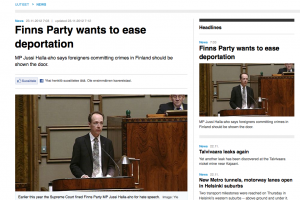
Halla-aho wants to ease deportation law

Posted on November 23, 2012 by Migrant Tales

Perussuomalaiset (PS) party MP Jussi Halla-aho and his far-right Suomen Sisu and anti-immigration cronies would like to tighten immigration laws further by making it easier to deport convicted foreigners, reports YLE in English. 

Presently, foreigners “may” be deported from Finland if they are convicted of a crime. Halla-aho wants the word “may” to be changed to “will” be deported.

If Halla-aho ever got his way, an adult who has lived most of his life in Finland but who isn’t a citizen would be automatically deported if he  or she committed a serious crime.

Halla-aho and his band appear to have nothing better to do except fuel suspicion and hostility towards certain groups like Muslims. Drafting laws that aim to ban circumcision or make it easier to deport convicted foreigners not only reveal their narrow-minded views, but their manifest contempt for diversity.

Their anti-immigration rhetoric and arguments, which have remained in a nineteenth-century time warp when Europe was a colonial power, have already struck a negative chord in Finland.

You know something has gone wrong for Halla-aho if even former interior minister,MP Kari Rajamäki, criticized the  proposal. He claimed that it was from the extremist Suomen Sisu associaiton.

Members of the PS, like anti-immigration hardliner MP Olli Immonen, didn’t take Rajamäki’s accusations lightly.  The MP, who is a Suomen Sisu member, said that Rajamäki was jealous of Halla-aho because he didn’t belong to the extremist association.

Racism and prejudice in Finland work in the same way here as elsewhere. Its main purpose is to show how different certain groups are in order to justify the existence of racism. If one looks at Halla-aho’s and the message of other anti-immigration politicians, it’s all about placing obstacles, victimizing and labeling whole groups wholesale to hinder their acceptance and integration.

Their message is reactive – rarely if ever proactive.

Two-way integration still has a long way to go in Finland

Posted on November 22, 2012 by Migrant Tales

What is the aim of Finland’s new integration law, which came into force in September 2011? While the law talks about two-way integration, what does it mean and how is it promoted? 

  Finland’s integration program is like an old abandoned Cadillac. It awakens our optimism but discourages us from acting because it is too costly to restore.

The fact that some politicians in Finland still speak of maassa maan tavala, or ”live in the country as they live, or leave,” reveals that there is still hostility against two-way integration.

Irrespective of the arguments, the key question we should ask is what are these country’s new inhabitants adapting to? Are they encouraged to throw away their cultures and learn how to live in a white Finns’ world? Or is the aim the creation of a healthy bicultural or multicultural identity and society?

There’s been a lot of debate in Finland about the “threat” of so-called ethnic “ghettos” in places like Helsinki and Turku’s Varisuo. Certainly matters like crime and unemployment are social issues that must be addressed by society in any neighborhood.

Why do some consider it a bad matter if ethnic groups and immigrants are concentrated in a neighborhood?

When Finns emigrated to different parts of the world like the Americas and Sweden, the aim was to be where other Finns lived. In my research of the Finns of Argentina, Colonia Finlandesa was a colony where up to the 1930s Finnish was spoken more than Spanish.

The promotion of assimilation as opposed to integration has given birth to a new underclass of second-generation Finns with immigrant backgrounds. Some live in a permanent gray zone where they not only experience animosity from the host culture but from their parents’ culture as well. Who is promoting their acceptance and bolstering their self-esteem?

Another distressing trend was a survey published in early 2011 in Opettaja magazine that reveals 41% of teachers polled would like to place limits on how many children with immigrant backgrounds can attend class.

Opposition to ethnically concentrated neighborhoods and schools reveals in my opinion support for assimilation and opposition to two-way integration.

A question: How are immigrants, never mind their children and grandchildren, ever going to create a sense of cultural pride, identity and self-esteem if the expectation is integration but the reality is assimilation?

I personally want to see a Finland that is culturally diverse where we can embrace and reap synergies from our diverseness.

The 10,000-strong Roma minority that has lived in Finland for 500 years is a good example and a warning of what happens to a group if they don’t assimilate.  The Roma have paid a very high price for not assimilating into white Finnish society through social exclusion and racism.

A Roma elder expressed to me the issue in the following terms: “Even if we have been discriminated against in Finland, we still hold our culture. Nobody can destroy that.”


Visible minorities and immigrant children – be yourselves and proud of it!

Posted on November 21, 2012 by Migrant Tales

A sentence can change your life. 

I will share with you one of the greatest moments in my life. It happened when I was in elementary school in Los Angeles, California. My fourth-grade teacher, Mr. Dean Arnold, offered me a sentence that changed my life. He said:  “You don’t have to be like a [white] American since you weren’t born here. Be yourself.”

I felt a huge weight off my shoulders the minute he told me to celebrate who I am and on my own terms.

I don’t know why Mr. Arnold felt compelled to tell me that I should be myself instead of adapting poorly to something else that would end up costing me my precious identity.

All children in Finland and in any country that respects human rights, irrespective if one or both of their parents are from another country, should be given the opportunity to be themselves. They should not only be allowed to celebrate their otherness without fear but encouraged to do so.

One important point, however, Mr. Arnold’s advice strengthened my sense of belonging in the U.S.


Is Timo Soini losing his grip of the PS?

Posted on November 19, 2012 by Migrant Tales

For those who haven’t noticed, Perussuomalaiset (PS) anti-immigration hardliners like MP Jussi Halla-aho and James Hirvisaari have tried to show their human side to the media. Halla-aho was recently interviewed with his wife Hilla on Me Naiset, while Hirvisaari writes on a blog entry hitherto-unheard empathy and understanding for his archenemy, the media.  

Some of Finland’s most notorious Counterjihadists are members of the PS. From (top right, left to right): Olli Immonen, James Hirvisaari, Matias Turkkila, Jussi Halla-aho, (second row) Juho Eerola, Freddy Van Wonterghem, Simon Elo, and Kai Haavikko.

Migrant Tales’ guest writer Jos Schuurmans wrote recently about Halla-aho’s interview on Me Naiset.

He wrote: “How is it possible that Sanoma, one of Finland’s largest, most professional and most respected media firms, gets away with publishing a cosy, three-page family portrait of far-right MP Jussi Halla-aho in its November 1, 2012, issue of Me Naiset, the mainstream human interest women’s magazine?”

The interview by Essi Myllyoja of the Halla-ahos is not only an insult to many immigrants and Finns, but shows how the media continues to be run by white Finns. By controlling the narrative, white Finns, or those that rule this country, ensure that what you hear and see are only the stories they want to be told.

If we are going to analyze why two of the PS’ most notorious Counterjihadists are trying to show a softer more human side of themselves, we’d have to study what is going on behind the scenes of chairman Timo Soini’s party.

Apparently there is a pretty serious fight for control of the party between Soini and Halla-aho. Halla-aho, who was convicted by the Supreme Court for defaming and inciting ethnic hatred in June, didn’t rule out the possibility on the Subin Enbuske & Linnanahde Crew TV show of challenging Soini for the party’s leadership.

The present situation within the PS is an outcome of the election blows it received after its historic victory in the April 2011 parliamentary elections. Since then it has been a rough downhill ride: Soini didn’t even make it to the second round of the presidential elections and the municipal elections of October were a clear disappointment.

Disgruntled by the situation and Soini’s leadership, Hirvisaari said recently that the party did poorly in the municipal elections because it wasn’t outspoken as before on immigration issues.

Taking into account that the PS’ anti-immigration candidates fared well in the municipal elections, it suggests that the undecided mainstream voters that gave their support for the party in 2011 have started to jump ship. What is remaining are the most loyal and radical elements, or those who vote for anti-immigration, anti-Islam, homophobic, and populist-conservative candidates.

Emboldened and scenting blood like a hungry pack of wolves, the Counterjihadists of the PS see this as an opportune moment to challenge Soini for the party’s leadership. They are determined to try again if they don’t succeed.

Halla-aho’s and Hirvisaari’s “tolerant” new look should be seen as a shameless ploy in league with many of the red herrings they have tried to feed the public.


Amkelwa Mbekeni: An African perspective of “The Marshal of Finland”

Posted on November 18, 2012 by Migrant Tales

By Amkelwa Mbekeni

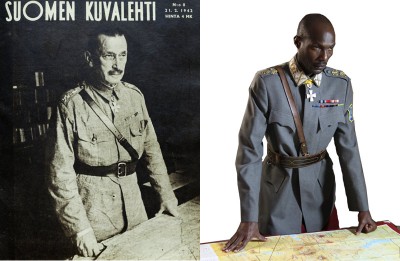
“They shouldn’t have made it in Kenya — that was a bad idea,” says a man I find myself sitting next to in a bus. I am in Helsinki, Finland, and seldom do I ever initiate conversation with a stranger in public transport, especially not here. It is as if there is an unwritten and unspoken rule that is observed by most within the Finnish society, but we are two Africans and in true African style, we do not hesitate to start exchanging pleasantries in this country where otherness is our relegated identity. He tells me he’s Kenyan and immediately my interest is piqued, for Kenya has recently occupied center stage in Finnish mainstream media. A moment earlier I had asked him the one question I had been itching to ask many a Kenyan national living in Finland: what do they think of The Marshal of Finland, the film recently shot in Kenya with a Kenyan cast about G.E. Mannerheim, Second World War head of the Finnish military, former president and national icon whose statue — on horseback — overlooks Helsinki’s main street, which is also named after him.

Erkko Lyytinen, a producer from the Finnish public broadcaster, Yle, and his Estonian colleague Ken Saan decided, in what can be described as an unusual move, to produce the much spoken of, long awaited and previously difficult to make film project on Mannerheim. Due to budgetary constraints, a decision was taken to do so in Kenya, using a local production company. Their initial estimation was that it would set them back to the tune of US$5000, however due to unforeseen circumstances, it is said the film ended up costing three times the estimated amount — and an unspeakable amount of public scrutiny.

I had been acutely aware that a heated debate had been ongoing around me, and I also had gathered that it had left a lot of feathers ruffled. Unfortunately, due to the language barrier, I had found myself on the outside looking in, which is why I felt the need to speak to more people; to find out more about the impact this film had on the society I live in. Somehow, someway, I felt involved.

Based on the sensationalist media coverage The Marshal of Finland took the country by storm, and elicited a reaction of outrage by offended members of the public. One tabloid claimed that “the people don’t approve of a black Mannerheim,” with the expected lack of explaining what is meant by ‘the people’. The allegation in general was that the Finnish public had been lied to and deceived by the Yle producer, who stood accused of having deliberately and underhandedly omitted to mention the fact that Mannerheim was to be played by an African and thus — according to them — making a mockery of the national hero.

But not only is the project about the actual film, it also is about a six part making of documentary series which portrays the chaotic and oftentimes frustrating process of filming in Kenya, having chosen to work with one of  the most affordable production companies available. The documentary is called “Operation Mannerheim”. Here’s the trailer:

http://www.youtube.com/watch?v=PvG4U6zpwDg

The documentary was aired on one of Yle’s less viewed channels and its content didn’t create as much debate as all preceding speculation of the film hinted at, however it helped me gain more insight into what the whole furor and media frenzy was about. This documentary series also clarified the motives of the film’s producer and it appears that his intentions were good; very ambitious even if a bit naïve, and how this film was, to a large extent, his project. Amongst other things, the documentary told its own story of working with Kenyan people, and both directly and indirectly reinforced the already existing stereotypes of poverty, inefficiency, lack of punctuality of Africans and so on. Another predictable sad story of Africa from a western perspective, one could say.

It is common knowledge that for most foreign nationals in Finland, the language barrier is a real handicap. It often leaves one feeling a little disadvantaged when it comes to following and keeping up with public debates. Barring from seeing the face of one Telley Savalas Otieno, the lead actor playing Gustaf Mannerheim, on all manner of tabloid newspaper on offer, I was pretty much in the dark about the details of what the fuss was all about until the film and documentary came out and even then I was, to a degree, relying on interpretation by my Finnish husband. Incidentally, it was also when the film and the documentary finally did come out that the public debate for the most part ended. The whole thing, it seemed, had mainly been pre-emptive and based on assumptions, rumours and guesses.

The Marshal of Finland is told from an African storytelling  perspective in a setting where a bunch of children are seated around a fire, listening to a grown-up — a grandfather figure — telling the story of a hero from a faraway land. The young African children imagine this story based on their frame of reference with all the characters looking like people they know; African.

“I thought it was an interesting idea. I guess I was more relieved than impressed after watching the film itself,” says Wanjiku wa Ngugi, a Kenyan in Finland who is the founder and director of the HAFF – Helsinki African Film Festival, when I asked her for her thoughts. “In terms of actual production, sound, picture quality, development of the storyline — perhaps more work could have been dedicated towards these. Otherwise for me it just looks like the film was not the point of the project, but the documentary. And if this is the case, I can say a huge opportunity was lost.”

At some point the film was said to be a Kenyan interpretation of the story of Gustav Mannerheim.

“The Marshal of Finland was not a Kenyan production,” replies Wanjiku, “It was a production done for the benefit of making a documentary, made to prove a point — or points — or introduce new ways of thinking about heroes, but what it most certainly was not, was a Kenyan film. It was just a film made in Kenya.”

“Besides,” she adds, “it’s as if the film was set up to fail, for the purposes of making an interesting documentary, and it was therefore a poor production artistically speaking.”

Previously, a mainstream Finnish production company also had played with the idea to make a film about Mannerheim. The plan was for Renny Harlin, the most accomplished Finnish Hollywood director (cue Cliffhanger, Die Hard 2, Deep Blue Sea etc.), to direct the film, but this project had publicly struggled with funding for years.

So having a Mannerheim film in the news was nothing particularly new.

Basically, as long as there has been talk about making a Mannerheim film, money has been the big issue and Yle, having no big budget either, employed the most cost effective means of production within the budding Kenyan film industry, while ultimately — one would assume — hoping for a high quality product.

Due to this small budget, the film is made under some unusual circumstances with often disastrous outcomes.

“If a production team is hired that doesn’t have much experience dealing with the production issues, much less dealing with a professional production of a film and with a minimalist budget, one can only expect the catastrophe that we saw on the documentary,” Wanjiku adds, “It is by no means a realistic standard of production of what Kenyans are capable of.”

Wanjiku wa Ngugi.

It had been frustration with the evident misinformation about Africa and African people that had lead Wanjiku to found HAFF. She had discovered that even Finland was susceptible to the negative representation of Africa and Africans in the news and Hollywood films. Having lived in this country for a few years, she has also been privy to the conversations that have been happening locally around issues of race and multiculturalism.

“It was disturbing how much hostility was showcased, but I think it also speaks to how Africans are viewed in Finland. And it all boils down to how much people really know about Africans. It is my hope that collaborations of this nature, if done genuinely, can help resolve some of the issues. It is important to note that there was also great support for the film, for the idea.”

At a press conference held before the movie premiered, a flustered Erkko stood in defense of his decision to film The Marshal of Finland in Kenya. As seen in the documentary, a few journalists bombard him with questions accusing him of wanting to provoke the people and for having no sensitivity towards how this film may affect the sensibilities of war veterans. It’s noteworthy to mention that, again, this is not a first time the story of Mannerheim has caused such controversy; in 2008, a twenty-seven-minute puppet animation suggested an alternative view on the Marshal’s sexual orientation.

This whole recent media driven debacle has been at least equally disturbing; mostly due to the apparent lack of awareness of the racist tone of some of the public views. Nothing can be said categorically, but if the bone of contention is the fact that Erkko failed to divulge ahead of time to the Finnish society that he would have an African to play the main role, then by logical extension, there seems to have been a problem with an African playing the main role. Even if only in the imaginations of African children as was the case in this film. The reason why this storyline was not a consideration in the public debate was because the offence was taken before the film was even out.

As the debate unraveled, more and more hostile responses were aired, on tabloids’ front pages (above) but especially via social media. One particularly unmistakable venomous tweet said only one word, “niggaheim”. This was tweeted not by a wayward, uninformed teenager, but by an opinion leader and journalist respected by many. This spoke volumes, and left me more confused about what to think of the whole convoluted story, wondering whether this was indeed a true reflection of the feeling of Finns by and large.

Considering that the face of Finland is gradually changing as more and more foreigners find their way here, the question of what effect this can have on relations between Africans and Finns after all is said and done, still remains. Has this even served as a mirror to reflect attitudes within a society?

“I thought that despite the backlash a conversation so badly needed in this country about race happened,” Wanjiku starts. “I think getting people out of their comfort zone is sometimes good — it may not look like it, but it really does help remove, people’s biased view of the world around them, even if only a little bit. In terms of a change between Kenyan nationals and Finnish society, I doubt that much difference happened as a result. I think it will take more than one controversial film to change how black people are viewed in this country.”

The debate around multiculturalism is a complicated one, compounded by the language barrier in Finland. Naima Mohamud, who is of Somali background, stated in a column in the nation’s leading newspaper that with this whole drama, the public broadcaster gave a lot of ammunition to the immigration skeptics and the ones leaning towards negative thoughts on multiculturalism. That it was the immigrants in Finland that got the short end of the stick as now the bigoted opinions expressed got veiled behind a shock of having a disgraced national hero.

Wanjiku, on the other hand, concludes on a more optimistic note, “I am hopeful. As much as the debate has moved to the extreme right, there are also others who are equally opposed to it.”

Perhaps by choosing to tell a Finnish story about a national hero, employing a foreign production company, casting foreign actors and shooting it in a foreign country, more than one story got told. A Finnish story was told using Kenyan actors, then the documentary with Finns telling a Kenyan story was made, and finally in Finnish tabloids, an African otherness story is told displaying extreme views as mainstream views.

But after all of this storytelling, the question is, at what cost have these stories been told?

The true face of the PS is being exposed by its poor election results

Posted on November 18, 2012 by Migrant Tales

There’s an interesting editoral on Saturdary’s Helsingin Sanomat (HS) that shows how close Nordic anti-immigration are when it comes to the support they received in recent elections and poll standings. Migrant Tales wrote six days after Anders Breivik murdered in cold blood 77 people on July 22, 2011 that the tide had turned for far right anti-immigration parties in the Nordic region. 

Writes HS: “In the last national elections of 2011, the Progress Party of Norway got 11.4% and the Danish People’s Party 12.3%. In the October municipal elections, the Perussuomalaiset received 12.3%. The amount of votes that the Sweden Democrats got in the parliamentary elections was 5.7%, but a number of polls show their support to be over 10%.”

Even if the Nordic region’s main anti-immigration parties took a beating in recent elections, they have shown, at least in Finland, their real face.  Even if PS chairman Timo Soini continues to play down the role of the anti-immigration vote in the historic April 2011 election, the recent poor showing of the party in the presidential and  municipal elections suggest that mainstream voters are ditching the party.

Some of the most loyal PS voters appear to be today those that vote for anti-immigration candidates. Is this one of the reasons why PS MP Jussi Halla-aho is planning to challenge Soini for the party’s leadership?

Those politicians that base their support on immigrant and visible minority bashing, need the PS as much as a human needs oxygen. Without the party they would shrivel up, become insignificant and die.  A good example is former PS city councilman Hemmo Koskiniemi. When the Rovaniemi PS branch refused to accept his candidacy for city council, Koskiniemi’s votes plummeted to 74 from 337 in 2008.

Soini and these candidates feed off each other politically. One needs the other.

HS claims that in the face of the Sweden Democrats‘ racism scandal, Soini’s problems are small. Maybe so, but the plunge in PS support  and the success of their strongly anti-immigration and Counterjihadist candidates in the municipal elections show that Soini may be in deep water soon.

The SD (and PS) are far-right anti-immigration parties

Posted on November 15, 2012 by Migrant Tales

There’s an interesting opinion piece on Swedish daily Dagens Nyheter about the Swedish Democrats (SD) and the spread of fascism or neofascism in the Scandinavian country.  While classifying a party as “fascist” may be problematic, there are certain ideological characteristics that expose its true political colors. 

Historian and journalist Henrik Arnstad writes: “Fascism is a deeply problematic word…But it is the name of a specific political ideology, which for the first time represented today in the Swedish parliament.”

In Finland we have the Perussuomalaiset (PS), which is a close ideological relative of the SD. There are many factors that unite as well as separate both parties. Nationalism is one of these.

Another matter that draws them together is their suspicion of cultural diversity.  As Arnstad writes about fascism, the SD (and many members of the PS) see cultural diversity as a threat to their perceived homogenous society.

The far-right in the PS, led by PS MP’s like Jussi Halla-aho, fear – like the SD – the loss of the country’s near-white society due to immigration.

Even if the SD and Counterjihadists in the PS bend over backwards to show their pro-Israeli stances, the Jewish community in Sweden fears that it is only a question of time when their true anti-Semitic nature is revealed.

“We know where these people are coming from,” Lena Posner, president of the Official Council of Jewish communities in Sweden, was quoted as saying on Haaretz. “They [SD] are Nazi sympathizers who, under their jackets, are still wearing their brown shirts.”

“They love Israel because that sort of rhetoric is in tune with their hatred for Muslims;” she adds. “That’s it.”

It would be naive to think that the PS does not house the same anti-Semitic and far-right feelings than the SD.


Racism scandal rips far-right Sweden Democrats

Posted on November 14, 2012 by Migrant Tales

Here’s an interesting story that took place in June 2010 in Sweden involving a far-right Sweden Democrat (SD) MP, Erik Almqvist, who got rowdy and started hurling racist and sexist insults in public, reports Swedish tabloid Expressen. The MP naturally denied everything until Expressen published today a video confirming what others claimed he said.

After repeated denials, Almqvist wrote on his Facebook page that while he didn’t remember what he said two-and-a-half years ago, he was “greatly remorseful.”

Party chairman Jimmie Åkesson has tried to improve the party’s xenophobic and anti-immigration image by announcing that the SD maintain a strict zero tolerance for racism. As a result of the scandal, Åkesson has asked Almqvist to not only resign from all positions of trust in the party but to consider resigning as MP as well.

Every one knows about the SD’s neo-Nazi roots and their crackpot statements against immigrants and Muslims. Anti-immigration was the most important message of their 2010 campaign. The ad, which was banned in Sweden, is one of many examples of their xenophobia.

http://www.youtube.com/watch?v=ewwYHTn_xxc

As everyone know, in neighboring Finland we have the Perussuomalaiset (PS), a close ideological ally of the SD. Contrary to Sweden, however, PS politicians can get away by saying similar or worse racist insults than Almqvist with little or no consequences.

Here is a link to a Migrant Tales’ blog entry that lists a shameful list of PS party members who got elected to city council thanks to their strong anti-immigration message.


  • Previous
  • 1
  • 2
  • 3
  • 4
  • Next
Read more about documentary film
Read more

Recent Posts

  • Finland’s tabloids Iltalehti and Ilta-Sanomat are the pits
  • Riikka Purra’s Dr Jekyll and Mr Hyde mask
  • Double standards
  • Perussuomalaiset: Uusi logo, sama vanha juttu
  • Taco Trump

Recent Comments

  1. Absolutely Socking: Racist Finnish Facebook group against human rights gets flooded with socks on Musta Barbaari’s mother and sister charged by the police in “ethnic profiling” case
  2. Ilkka Nuotio on Pekka Myrskylä: “Tilastot kertovat toista kuin poliittinen keskustelu”
  3. Genrih Soinkara on The war in Ukraine and the Russian-Finnish border crisis are showing Finland’s ugly side
  4. Ahti Tolvanen on Comment by Ahti Tolvanen on the Helsinki +50 conference
  5. Angel Barrientos on Angel Barrientos is one of the kind beacons of Finland’s Chilean community

Archives

  • June 2026
  • May 2026
  • April 2026
  • March 2026
  • February 2026
  • January 2026
  • December 2025
  • November 2025
  • October 2025
  • September 2025
  • August 2025
  • July 2025
  • June 2025
  • May 2025
  • April 2025
  • March 2025
  • February 2025
  • January 2025
  • December 2024
  • November 2024
  • October 2024
  • September 2024
  • August 2024
  • July 2024
  • June 2024
  • May 2024
  • April 2024
  • March 2024
  • February 2024
  • January 2024
  • December 2023
  • November 2023
  • October 2023
  • September 2023
  • August 2023
  • July 2023
  • June 2023
  • May 2023
  • April 2023
  • March 2023
  • February 2023
  • January 2023
  • December 2022
  • November 2022
  • October 2022
  • September 2022
  • August 2022
  • July 2022
  • June 2022
  • May 2022
  • April 2022
  • March 2022
  • February 2022
  • January 2022
  • December 2021
  • November 2021
  • October 2021
  • September 2021
  • August 2021
  • July 2021
  • June 2021
  • May 2021
  • April 2021
  • March 2021
  • February 2021
  • January 2021
  • December 2020
  • November 2020
  • October 2020
  • September 2020
  • August 2020
  • July 2020
  • June 2020
  • May 2020
  • April 2020
  • March 2020
  • February 2020
  • January 2020
  • December 2019
  • November 2019
  • October 2019
  • September 2019
  • August 2019
  • July 2019
  • June 2019
  • May 2019
  • April 2019
  • March 2019
  • February 2019
  • January 2019
  • December 2018
  • November 2018
  • October 2018
  • September 2018
  • August 2018
  • July 2018
  • June 2018
  • May 2018
  • April 2018
  • March 2018
  • February 2018
  • January 2018
  • December 2017
  • November 2017
  • October 2017
  • September 2017
  • August 2017
  • July 2017
  • June 2017
  • May 2017
  • April 2017
  • March 2017
  • February 2017
  • January 2017
  • December 2016
  • November 2016
  • October 2016
  • September 2016
  • August 2016
  • July 2016
  • June 2016
  • May 2016
  • April 2016
  • March 2016
  • February 2016
  • January 2016
  • December 2015
  • November 2015
  • October 2015
  • September 2015
  • August 2015
  • July 2015
  • June 2015
  • May 2015
  • April 2015
  • March 2015
  • February 2015
  • January 2015
  • December 2014
  • November 2014
  • October 2014
  • September 2014
  • August 2014
  • July 2014
  • June 2014
  • May 2014
  • April 2014
  • March 2014
  • February 2014
  • January 2014
  • December 2013
  • November 2013
  • October 2013
  • September 2013
  • August 2013
  • July 2013
  • June 2013
  • May 2013
  • April 2013
  • March 2013
  • February 2013
  • January 2013
  • December 2012
  • November 2012
  • October 2012
  • September 2012
  • August 2012
  • July 2012
  • June 2012
  • May 2012
  • April 2012
  • March 2012
  • February 2012
  • January 2012
  • December 2011
  • November 2011
  • October 2011
  • September 2011
  • August 2011
  • July 2011
  • June 2011
  • May 2011
  • April 2011
  • March 2011
  • February 2011
  • January 2011
  • December 2010
  • November 2010
  • October 2010
  • September 2010
  • August 2010
  • July 2010
  • June 2010
  • May 2010
  • April 2010
  • March 2010
  • February 2010
  • January 2010
  • December 2009
  • November 2009
  • October 2009
  • September 2009
  • August 2009
  • July 2009
  • December 2008
  • November 2008
  • October 2008
  • September 2008
  • August 2008
  • July 2008
  • June 2008
  • May 2008
  • April 2008
  • March 2008
  • February 2008
  • January 2008
  • November 2007
  • October 2007
  • September 2007
  • August 2007
  • July 2007
  • June 2007
  • May 2007

Categories

  • ?? Gia L?c
  • ????? ?????? ????? ???????? ?? ??????
  • ???????
  • @HerraAhmed
  • @mondepasrond
  • @nohatefinland
  • @oula_silver
  • @Varathas
  • A Pakistani family
  • äärioikeisto
  • Abbas Bahmanpour
  • Abdi Muhis
  • Abdirahim Hussein Mohamed
  • Abdirahim Husu Hussein
  • Abdirisak Mahamed
  • About Migrant Tales
  • activism
  • Adam Al-Sawad
  • Adel Abidin
  • Afrofinland
  • Ahmed IJ
  • Ahti Tolvanen
  • Aino Pennanen
  • Aisha Maniar
  • Alan Ali
  • Alan Anstead
  • Alejandro Díaz Ortiz
  • Alekey Bulavsev
  • Aleksander Hemon
  • Aleksanterinliitto
  • Aleksanterinliitto ry
  • Aleksanterinliitto ry:n hallitus
  • Alex Alex
  • Alex Mckie
  • Alexander Nix
  • Alexandra Ayse Albayrak
  • Alexis Neuberg
  • Ali Asaad Hasan Alzuhairi
  • Ali Hossein Mir Ali
  • Ali Rashid
  • Ali Sagal Abdikarim
  • Alina Tsui
  • Aline Müller
  • All categories
  • Aman Heidari
  • Amiirah Salleh-Hoddin & Jana Turk
  • Amin A. Alem
  • Amir Zuhairi
  • Amkelwa Mbekeni
  • Ana María Gutiérrez Sorainen
  • Anachoma
  • Anders Adlecreutz
  • Angeliina Koskinen
  • Anna De Mutiis
  • Anna María Gutiérrez Sorainen
  • Anna-Kaisa Kuusisto ja Jaakko Tuominen
  • Annastiina Kallius
  • Anneli Juise Friman Lindeman
  • Announcement
  • Anonymous
  • Antero Leitzinger
  • anti-black racism
  • Anti-Hate Crime Organisation Finland
  • Anudari Boldbaatar
  • Arshiya Nasser
  • Aspergers Syndrome
  • Asylum Corner
  • Asylum seeker 406
  • Athena Griffin and Joe Feagin
  • Autism
  • Avaaz.org
  • Awale Olad
  • Ayan Said Mohamed
  • AYY
  • Barachiel
  • Bashy Quraishy
  • Beatrice Kabutakapua
  • Beri Jamal
  • Beri Jamal and Enrique Tessieri
  • Bertolt Brecht
  • Boiata
  • Boodi Kabbani
  • Bruno Gronow
  • Carmen Pekkarinen
  • Çelen Oben and Sheila Riikonen
  • Chiara Costa-Virtanen
  • Chiara Costa-Virtanen
  • Chiara Sorbello
  • Christian Thibault
  • Christopher Wylie
  • Clara Dublanc
  • Dana
  • Daniel Malpica
  • Danilo Canguçu
  • David Papineau
  • David Schneider
  • Dexter He
  • Don Flynn
  • Dr Masoud Kamali
  • Dr. Faith Mkwesha
  • Dr. Theodoros Fouskas
  • Edna Chun
  • Eeva Kilpi
  • Emanuela Susheela
  • En castellano
  • ENAR
  • Enrique
  • Enrique Tessieri
  • Enrique Tessieri & Raghad Mchawh
  • Enrique Tessieri & Yahya Rouissi
  • Enrique Tessieri and Muhammed Shire
  • Enrique Tessieri and Sira Moksi
  • Enrique Tessieri and Tom Vandenbosch
  • Enrique Tessieri and Wael Che
  • Enrique Tessieri and Yahya Rouissi
  • Enrique Tessieri and Zimema Mhone
  • Epäluottamusmies
  • EU
  • Europe
  • European Islamophobia Report
  • European Islamophobia Report 2019,
  • European Union
  • Eve Kyntäjä
  • Ezequiel Caldeiro
  • Facebook
  • Fadumo Dayib
  • Faisa Kahiye
  • Farhad Manjoo
  • Fasismi
  • Finland
  • Fizza Qureshi
  • Flyktingar och asyl
  • Foreign Student
  • Fozia Mir-Ali
  • Frances Webber
  • Frida Selim
  • Gareth Rice
  • Ghyslain Vedeaux
  • Global Art Point
  • Great Replacement
  • Habiba Ali
  • Hami Bahadori
  • Hami Bahdori
  • Hamid
  • Hamid Alsaameere
  • Hamid Bahdori
  • Handshake
  • Harmit Athwal
  • Hassan Abdi Ali
  • Hassan Muhumud
  • Heikki Huttunen
  • Heikki Wilenius
  • Helsingin Sanomat
  • Henning van der Hoeven
  • Henrika Mälmsröm
  • Hser Hser
  • Hser Hser ja Mustafa Isman
  • Husein Muhammed
  • Hussain Kazemian
  • Hussain Kazmenian
  • Ibrahim Khan
  • Ida
  • Ignacio Pérez Pérez
  • Iise Ali Hassan
  • Ilari Kaila & Tuomas Kaila
  • Imam Ka
  • inside-an-airport
  • Institute of Race Relations
  • Iraqi asylum seeker
  • IRR European News Team
  • IRR News Team
  • Islamic Society of Norhern FInland
  • Islamic Society of Northern Finland
  • Islamophobia
  • Jacobinmag.com
  • Jallow Momodou
  • Jan Holmberg
  • Jane Elliott
  • Jani Mäkelä
  • Jari Luoto
  • Jari Taponen
  • Jegor Nazarov
  • Jenni Stammeier
  • Jenny Bourne
  • Jessie Daniels
  • Joe Davidow
  • Johannes Koski
  • John D. Foster
  • John Grayson
  • John Marriott
  • Jon Burnett
  • Jorma Härkönen
  • Jos Schuurmans
  • José León Toro Mejías
  • Josue Tumayine
  • Jouni Karnasaari
  • Juan Camilo
  • Jukka Eräkare
  • Julian Abagond
  • Julie Pascoet
  • Jussi Halla-aho
  • Jussi Hallla-aho
  • Jussi Jalonen
  • JusticeDemon
  • Kadar Gelle
  • Kaksoiskansalaisuus
  • Kansainvälinen Mikkeli
  • Kansainvälinen Mikkeli ry
  • Katherine Tonkiss
  • Kati Lepistö
  • Kati van der Hoeven-Lepistö
  • Katie Bell
  • Kättely
  • Kerstin Ögård
  • Keshia Fredua-Mensah & Jamie Schearer
  • Khadidiatou Sylla
  • Khadra Abdirazak Sugulle
  • Kiihotus kansanryhmää vastaan
  • Kirsi Crowley
  • Koko Hubara
  • Kristiina Toivikko
  • Kubra Amini
  • KuRI
  • La Colectiva
  • La incitación al odio
  • Laura Huhtasaari
  • Lauri Finér
  • Leif Hagert
  • Léo Custódio
  • Leo Honka
  • Leontios Christodoulou
  • Lessie Branch
  • Lex Gaudius
  • Leyes de Finlandia
  • Liikkukaa!
  • Linda Hyökki
  • Liz Fekete
  • M. Blanc
  • Maarit Snellman
  • Mahad Sheikh Musse
  • Maija Vilkkumaa
  • Malmin Kebab Pizzeria Port Arthur
  • Marcell Lorincz
  • Mari Aaltola
  • María Paz López
  • Maria Rittis Ikola
  • Maria Tjader
  • Marja-Liisa Tolvanen
  • Mark
  • Markku Heikkinen
  • Marshall Niles
  • Martin Al-Laji
  • Maryan Siyad
  • Matt Carr
  • Mauricio Farah Gebara
  • Media Monitoring Group of Finland
  • Micah J. Christian
  • Michael McEachrane
  • Michele Levoy
  • Michelle Kaila
  • Migrant Tales
  • Migrant Tales Literary
  • Migrantes News
  • Migrants' Rights Network
  • MigriLeaks
  • Mikko Kapanen
  • Miriam Attias and Camila Haavisto
  • Mohamed Adan
  • Mohammad Javid
  • Mohammad M.
  • Monikulttuurisuus
  • Monisha Bhatia and Victoria Canning
  • Mor Ndiaye
  • Muh'ed
  • Muhamed Abdimajed Murshid
  • Muhammed Shire
  • Muhammed Shire and Enrique Tessieri
  • Muhis Azizi
  • Musimenta Dansila
  • Muslimiviha
  • Musulmanes
  • Namir al-Azzawi
  • Natsismi
  • Neurodiversity
  • New Women Connectors
  • Nils Muižnieks
  • No Labels No Walls
  • Noel Dandes
  • Nuor Dawood
  • Omar Khan
  • Otavanmedia
  • Oula Silvennoinen
  • Paco Diop
  • Pakistani family
  • Pentti Stranius
  • Perussuomalaiset
  • perustuslaki
  • Petra Laiti
  • Petri Cederlöf
  • Pia Grochowski
  • Podcast-lukija Bea Bergholm
  • Pohjois – Suomen Islamilainen Yhdyskunta
  • Pohjois Suomen Islamilainen Yhyskunta
  • Polina Kopylova
  • Race Files
  • racism
  • Racism Review
  • Raghad Mchawh
  • Ranska
  • Rashid H. and Migrant Tales
  • Rasismi
  • Raul Perez
  • Rebecka Holm
  • Reem Abu-Hayyeh
  • Refugees
  • Reija Härkönen
  • Remiel
  • Reza Nasri
  • Richard Gresswell
  • Riikka Purra
  • Risto Laakkonen
  • Rita Chahda
  • Ritva Kondi
  • Robito Ibrahim
  • Roble Bashir
  • Rockhaya Sylla
  • Rodolfo Walsh
  • Roger Casale
  • Rostam Atai
  • Roxana Crisólogo Correa
  • Ruth Grove-White
  • Ruth Waweru-Folabit
  • S-worldview
  • Sadio Ali Nuur
  • Sami Rusanen
  • Sandhu Bhamra
  • Sara de Jong
  • Sarah Crowther
  • Sari Alhariri
  • Sarkawt Khalil
  • Sasu
  • Scot Nakagawa
  • Shabana Ahmadzai
  • Shada Islam
  • Sharon Chang blogs
  • Shenita Ann McLean
  • Shirlene Green Newball
  • Sini Savolainen
  • Sira Moksi
  • Sonia K.
  • Sonia Maria Koo
  • Steverp
  • Stop Deportations
  • Suldaan Said Ahmed
  • Suomen mediaseurantakollektiivi
  • Suomen Muslimifoorumi ry
  • Suomen viharikosvastainen yhdistys
  • Suomen viharikosvastainen yhdistys ry
  • Suomi
  • Supermen
  • Susannah
  • Suva
  • Syrjintä
  • Talous
  • Tapio Tuomala
  • Taw Reh
  • Teivo Teivainen
  • The Daily Show
  • The Heino
  • The Supermen
  • Thomas Elfgren
  • Thulfiqar Abdulkarim
  • Tim McGettigan
  • Tino Singh
  • Tito Moustafa Sliem
  • Tobias Hübinette and L. Janelle Dance
  • Transport
  • Trica Danielle Keaton
  • Trilce Garcia
  • Trish Pääkkönen
  • Trish Pääkkönen and Enrique Tessieri
  • Tuulia Reponen
  • Uncategorized
  • UNITED
  • University of Eastern Finland
  • Uyi Osazee
  • Väkivalta
  • Vapaa Liikkuvuus
  • Venla-Sofia Saariaho
  • Vieraskynä
  • W. Che
  • W. Che an Enrique Tessieri
  • Wael Ch.
  • Wan Wei
  • Women for Refugee Women
  • Xaan Kaafi Maxamed Xalane
  • Xassan Kaafi Maxamed Xalane
  • Xassan-Kaafi Mohamed Halane & Enrique Tessieri
  • Yahya Rouissi
  • Yasmin Yusuf
  • Yassen Ghaleb
  • Yle Puhe
  • Yuliet Tresa
  • Yve Shepherd
  • Zahra Khavari
  • Zaker
  • Zalina Ametova
  • Zamzam Ahmed Ali
  • Zeinab Amini ja Soheila Khavari
  • Zimema Mahone and Enrique Tessieri
  • Zimema Mhone
  • Zoila Forss Crespo Moreyra
  • ZT
  • Zulma Sierra
  • Zuzeeko Tegha Abeng
© 2026 Migrant tales | Powered by Minimalist Blog WordPress Theme