Migrant tales
Menu
  • #MakeRacismHistory “In Your Eyes”
  • About Migrant Tales
  • It’s all about Human Rights
  • Literary
  • Migrant Tales Media Monitoring
  • NoHateFinland.org
  • Tales from Europe
Menu

Tag: cold war

Is Finland on the path of becoming an isolationist, nationalistic and xenophobic country?

Posted on June 18, 2015 by Migrant Tales

Finland hasn’t been itself for a number of years, especially after a populist Euro-skeptic and anti-immigration party, the Perussuomalaiset (PS)*, rose to the political major leagues in the 2011 elections. 

Sadly Finland appears today lost politically. it is like a blind person using as its seeing-eye dog nationalism and xenophobia. It has become a country that has not only lost its self-confidence but in some cases fears its own shadow.

That shadow that it fears is in the form of the worst populism, nationalism and xenophobia. Challenging those three social ills is difficult for some Finns because what they are seeing is themselves in the mirror.

I am especially saddened by the present state of Finland. I am disappointed because I know this country has overcome great adversity and can do better. Blaming others and scapegoating is the way cowards do things.

Finland isn’t a country of the masses but of individuals who can make all the difference.

l_1084-medium1


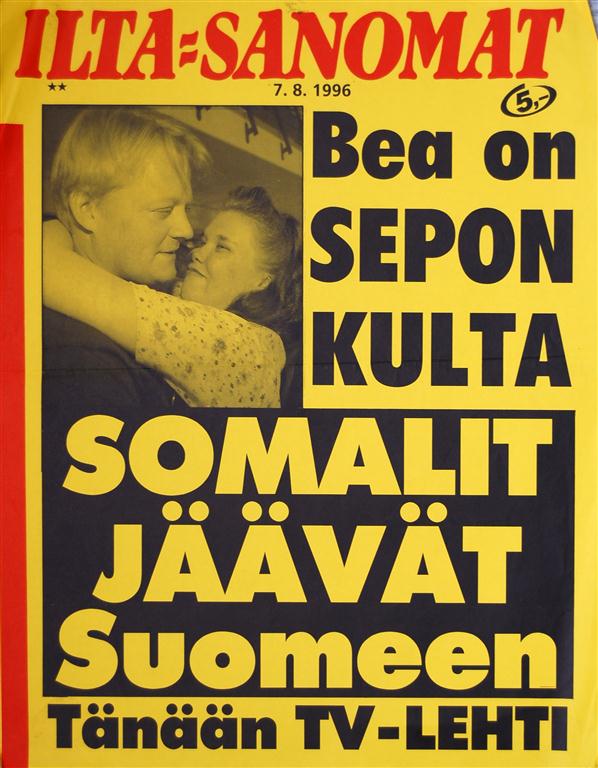
The roots of Finnish xenophobia can be found in the media. This billboard from tabloid Ilta-Sanomat states that the Somalis aren’t leaving but staying in Finland. Source: Migration Institute.

Continue reading “Is Finland on the path of becoming an isolationist, nationalistic and xenophobic country?”

The violent and hostile language of Finnish populists against Others

Posted on May 24, 2015 by Migrant Tales

For those that sighed with momentary relief and claimed that the new government’s immigration policy won’t be as bad as they expected haven’t seen anything yet. Behind the populist and nationalistic rhetoric coming from people like Perussuomalaiset (PS)* chairman Timo Soini, there’s nothing but suspicion and hostility against Finland’s migrant and ever-culturally diverse community.

What are we to make out of the new government’s policies as the mist clears? Soini gave us an eyeful Saturday when when he stated that “the blue and white” can be clearly seen in government policy.


Näyttökuva 2015-5-24 kello 21.20.30

Read full story (in Finnish) here.

What are we, Finland’s migrant and culturally diverse community, supposed to make out of such a nationalistic catchphrase?

Are we, the migrant and minority community in this country, who are struggling to survive by working and paying taxes, belong to that group that Soini labels Finnish labor?

What is even more shameful is that mainstream parties like the Center and National Coalition Party (NCP), who should know better, have with their complacent silence gone to bed with such rhetoric. The reason why they have accepted such rhetoric and a party like the PS in government is because they generally agree with the PS leader.

Continue reading “The violent and hostile language of Finnish populists against Others”

Finlandization was very bad for refugees, especially Soviet asylum seekers

Posted on July 31, 2014 by Migrant Tales

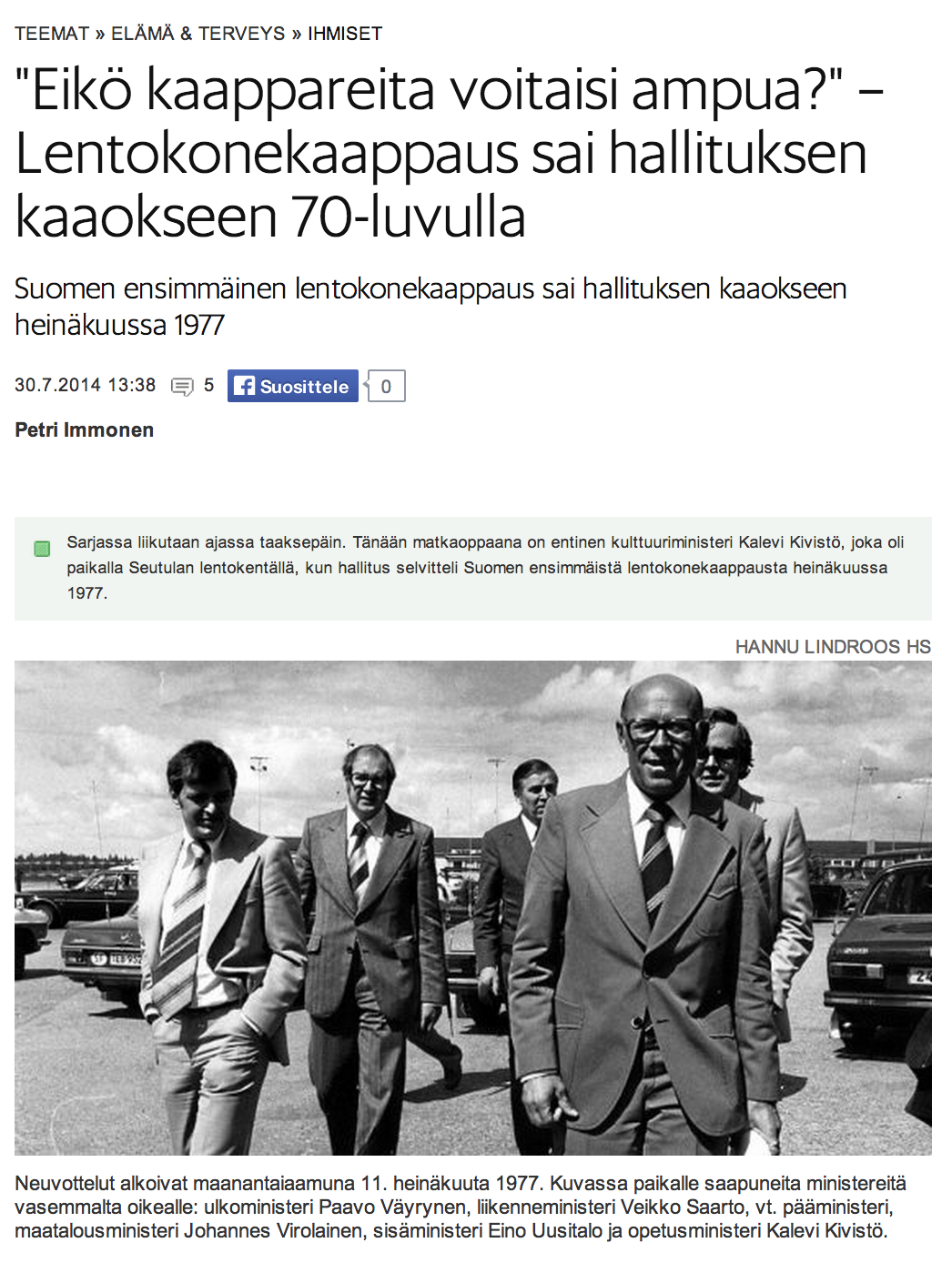
A story in Thursday’s Helsingin Sanomat shows that the shadow of Finlandization continues to hang deep on Finland even if the demise of the former Soviet Union ocurred in 1991. Even if the Helsingin Sanomat story writes about Finland’s first-ever airplane hijacking case in 1977 involving two Soviet citizens on an Aeroflot flight, it sheds an eerie light on a disgraceful era we should never repeat. 

For those who aren’t that familiar with how Finland returned Soviet citizens to the USSR even if they asked for asylum, the journalist doesn’t tell us why the Soviet hijacker wanted the pilot to fly to Stockholm but ended up instead landing the plane in Finland.

The hijackers wanted to fly to Sweden because they knew they’d get political asylum in that country. Even the pilots knew, which explains why they tricked the hijackers into thinking that they were going to land in Stockholm but ended up at the Helsinki-Vantaa Airport.

After almost twenty years of searching, I finally made contact with a former Soviet citizen who crossed the border but was sent back to the USSR in 1976. While there are stories written in the Estonian media about such refugees, the story I published in Apu magazine was one of the few ever published in Finland about the whole ordeal.

Näyttökuva 2014-7-31 kello 8.22.22


Read full story here.

It’s unfortunate that Finland isn’t still ready to debate and open up that murky period to investigation.

Writes American Interest about Finland and the cold war:

Usually intended as a pejorative, “Finlandization” describes the phenomenon that occurs when a small country living alongside a large and aggressive neighbor accepts a reduction of its sovereignty, particularly in the realm of foreign policy, in order to maintain independence. The term derives from the posture of neutrality that Finland adopted during the Cold War.

I would go as far as to suggest that one of the roots of Finland’s present-day xenophobia and anti-immigration sentiment, like with the rise of the Perussuomalaiset (PS) party in 2011, stem from the cold war era. It would be naive to believe that decades of geopolitical isolation and living next door to a country like the Soviet Union didn’t impact it.

Finland was during the cold war effectively a closed country to foreigners never mind foreign investment. Apart from wiping out the little cultural and ethnic diversity that this country enjoyed, the cold war era discouraged as well any serious debate about fascism in this country during the 1930s and especially in the Continuation War (1941-44), when we were an ally of Nazi Germany.

You may ask why Finland and it’s largest daily, Helsingin Sanomat, aren’t enthusiastic about opening up the stuffy dungeons of the past and our complex relations with Moscow.

A partial answer to that question lies in the picture on the Helsingin Sanomat story with Paavo Väyrynen, then foreign minister and today MEP.


Foreign Student editorial (February 1981): On immigrants living in Finland

Posted on April 30, 2014 by Migrant Tales

The Foreign Student was a short-lived but courageous newsletter of the Foreign Student Club of Helsinki. The humble publication appeared from January 1981 to January 1982 and lasted 11 issues. Much of the things the newsletter wrote about 35 years ago are still valid today. 

Surprisingly those that opposed what we wrote weren’t officials or Finns, but some migrants who were nervous about rocking too much the boat. As our reporting got bolder, the more opposition we got.

Despite what happened, we’re very proud of the Foreign Student for speaking out at the time against Finland’s discriminatory and arbitrary immigration policy.

Below is an editorial from the February 1981 issue.

Näyttökuva 2014-4-30 kello 10.37.35

ON IMMIGRANTS LIVING IN FINLAND

Immigration has been a major factor in the growth of countries in America such as the United States, Canada, Argentina etc. This constant injection of people from the four corners of the Earth put new strength and progress into the mainstream of the New World. This was essential to its greatness today.

The day and life of immigrants have changed if we compare it with a hundred or two hundred years ago. Today it is harder to immigrate because stricter controls have been enacted by receiving countries.

I am an Argentine-American-Finn (I still haven’t figured out how I should group these words, either alphabetically or just at rancom, from my mother’s side a Finn with Swedish and Dutch blood and from my father’s side with Italian and French ancestry.

The world has changed to say the least when “culture” and “ethnicity” are involved. Through history people have tended to mix more and more. This trend has not subsided.

The Swedish-Finns are the largest minority in this country. Also, we have the Gypsies and the Lapps as small minorities. According to the Finnish Statistical Yearbook for 1977 we find around 12,000 people living in Finland with non-Finnish passports. of course we have within this group a large minority of Finns who have opted for Swedish nationality and who are also living in Finland. Weill the future put new minority groups in Finland? The answer is in the affirmative. I have a Finnish fiancée and when we have children they will be part of a minority. Talking about Swedish-Finns we could also mention the Japanese-Finns, Italian-Finns, German-Finns, Kenyan-Finns, British-Finns, Thai-Finns and the list has almost no end.

The Interior Ministry must understand that our children and even we are becoming a larger and ever more important minority in Finland. We want to grow with our children having the same rights as anyone else. Finland is a humanistic, progressive and technologically advanced nation in the eyes of the world. Could we also see this tradition fall on the foreigners living her as permanent residents?

  Enrique Tessieri

Chairman, F.S.C

The shadow of the former USSR and its spell on Finland and source of xenophobia

Posted on December 19, 2013 by Migrant Tales

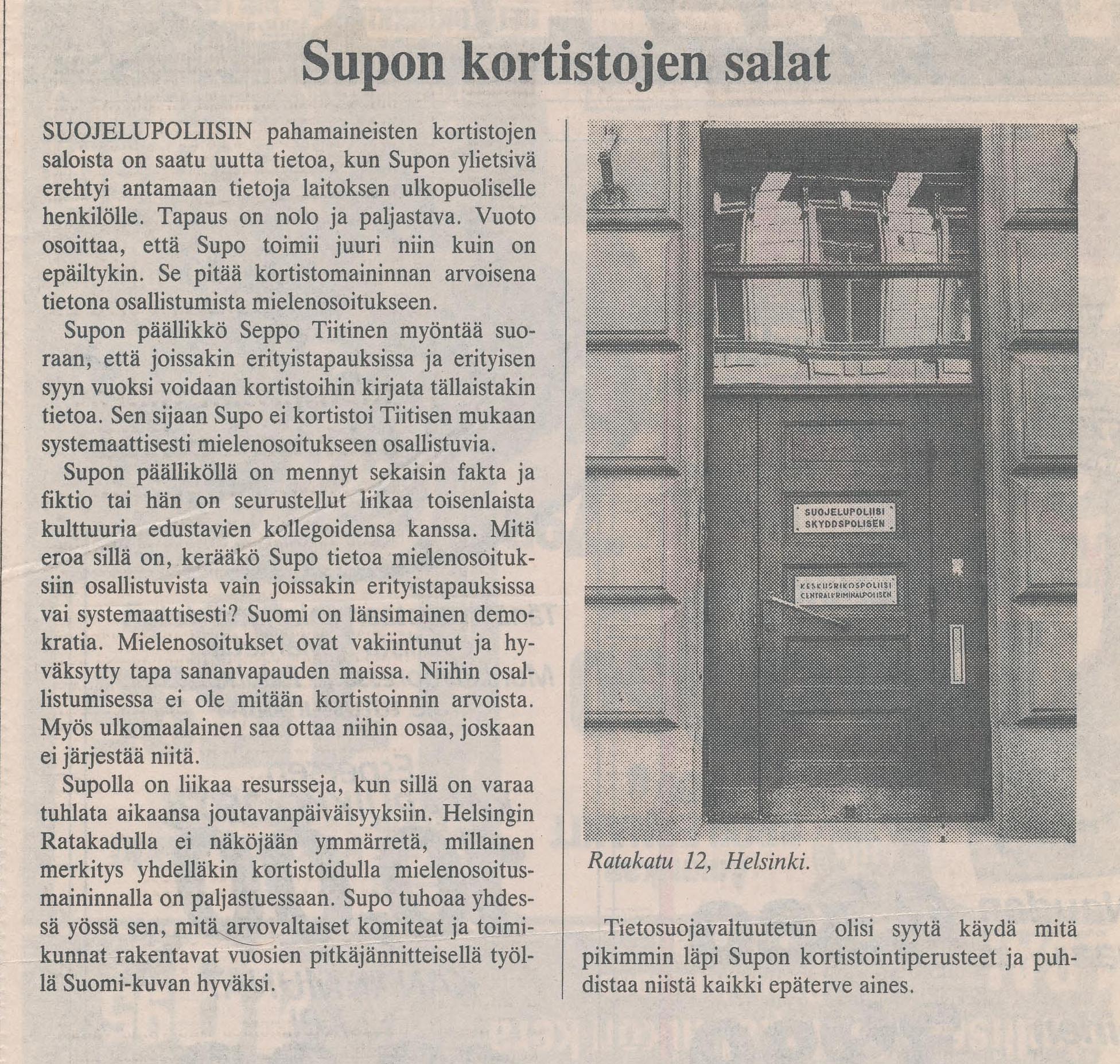
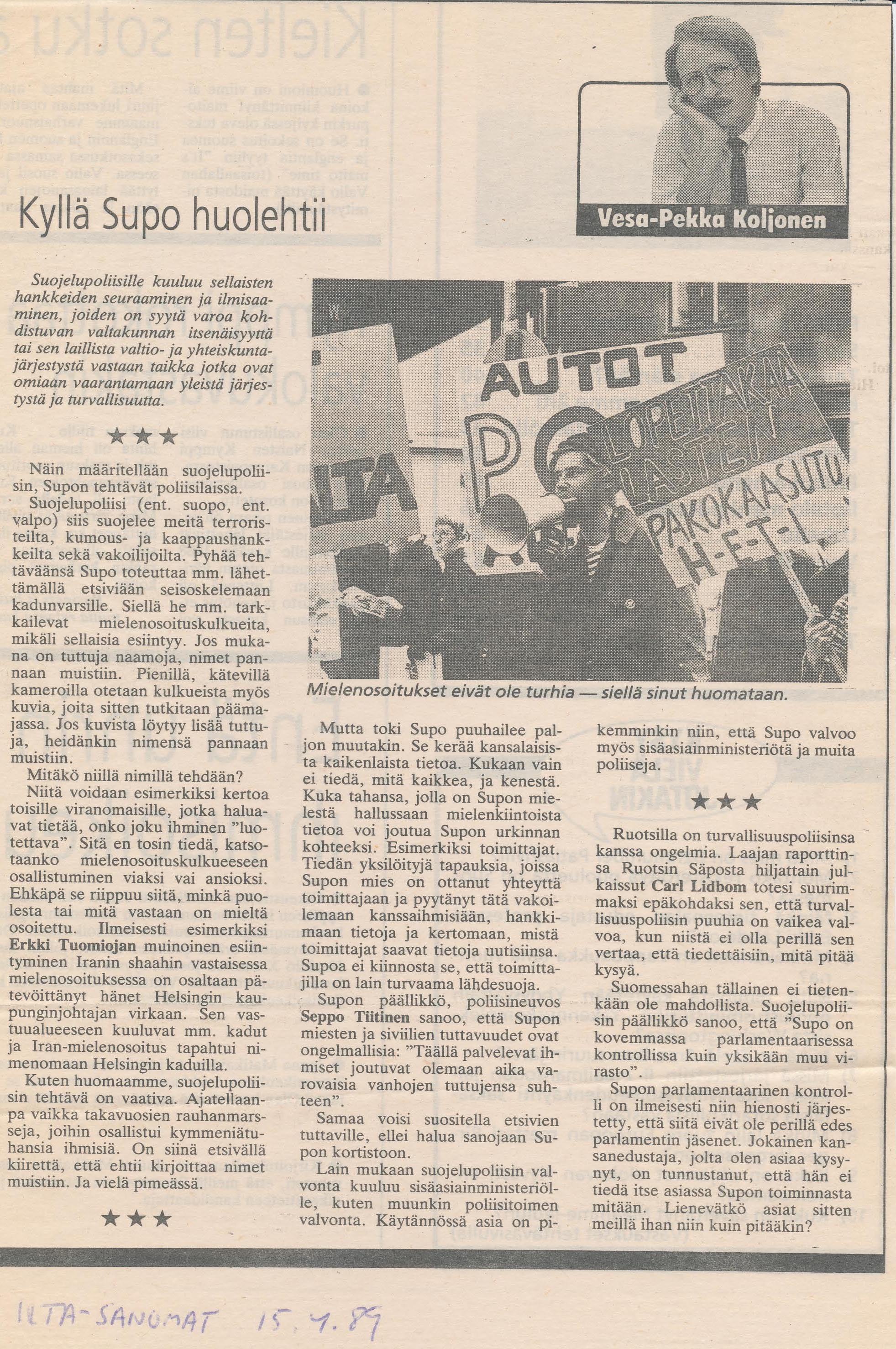
In the spring 1989 I was planning to travel to the Western African countries of Mali and Niger. Mali was cut out of my journey thanks to the Finnish Security Intelligence Service (Supo), which revealed to the honorary consul of Mali in Helsinki, Karl Jalkanen, what was written on my secret Interpol file.

Image1-40_edited-1

Here’s an editorial  by Helsingin Sanomat about what happened to me published on April 13, 1989.

The file that was revealed to Jalkanen is supposed to be secret since it has sensitive information about your personal life.

In an apparent state of inebriation, the honorary consul of Mali was highly suspicious about my travel plans to that African country. There was nothing suspicious about my motives since my plan was to do a travel story for Apu, Finland’s largest magazine at the time.

After Jalkanen made the phone call to Supo, it took about twenty minutes for his contact to call him back. The honorary consul said that I had taken part in three demonstrations, of which one I had organized. The Interpol files revealed as well that I was interested in human rights.

Image1-38_edited-1

Human rights didn’t apply to non-Finnish citizens, who couldn’t own land, control over 20% of a company, establish a newspaper as well as scores of other restrictions. This story was published in the 3/1989 issue of Ydin-lehti magazine.

I got in touch with the Office of the Data Protection Ombudsman and wrote what happened in Apu. Pessimistic that anything would happen to the Supo agent, I heard from the data protection ombudsman that the security intelligence agent had been reprimanded.

Even if the incident is a drop in the bucket when compared with  what Edward Snowden exposed in summer about massive global surveillance by the NSA, it was highly revealing since it showed how Finnish officials, like the secret police, perceived expats and immigrants.

Apart from being watched closely by Supo, another matter that the Interpol file revealed was that it had a network of immigrant informers.

Back in the Cold War days, human rights were considered in Finland as something “unpatriotic.” It was unpatriotic to speak out for human rights since it was in direct conflict with Finland’s sacrosanct foreign policy with the former Soviet Union. Since human rights were seen as a threat at the time, it has fueled the intolerance we see today. The price that Finland paid for its geopolitical isolation during the Cold War is it’s reluctance to interact today with the outside world in Finland.

Human rights was a big issue for me at the time due to the violations committed in Argentina under one of the region’s most ruthless dictatorships during 1976-83. Human rights became an important part of US foreign policy during  Jimmy Carter’s presidency (1977-81).

The protection and defense of human rights in Finland is a relatively new matter. It reveals why this country pursued such a draconian policy against immigrants never mind Soviet citizens that fled the country and sought asylum.

Image1-39_edited-1

One of the culprits of Finland’s xenophobia is the Cold War and the former Soviet Union. It was the breeding ground for the intolerance we find today in Finland.

Finland’s suspicion of human rights is best exemplified by its membership in the Council of Europe. Finland became in 1989, together with the principalities of Europe, the last Western European country to join the Council. Why did it take so long for it to become a member? Because it to be to vocal about human rights violations in the Soviet bloc.

Not only were human rights considered “unpatriotic” back then, but the very officials who ran things are still in office. Their view of the outside world is still that of a hostile place where we should react with suspicion instead of trust. It explains why some Finns still see foreigners as a threat and the rise of the anti-immigration Perussuomalaiset (PS) party in the 2011 elections.

Finland’s issues with intolerance and racism are tucked in the deep murky corners of its history. When Finland moves away from its present state of denial about its history and opens its past to critical and open scrutiny, only then we’ll know that we’ve taken a courageous step forward in accepting our ever-growing cultural diversity.

Opening up the past is our best insurance against a populist movement that wants to take us back to the times when writing these types of columns would not only get you blacklisted and part of smear campaign.


Edward Snowden would help to put to rest Finland’s Cold War legacy

Posted on July 2, 2013 by Migrant Tales

Wikileaks said in a statement that whistleblower Edward Snowden had asked for political asylum in twenty-one countries, one of which included Finland. Understanding Finland’s history and its historic suspicion of foreigners, granting a high-profile asylum seeker like Snowden asylum in Finland would not only help to put to rest for good our poor record but have an overall positive impact.  

Ever wonder why there are so few foreigners living in Finland? The answer is simple: Finland did everything possible to discourage immigrants and foreign investment to the country.

Finland had in force its first Aliens’ Act in 1983, or 65 years after independence. Before that, the Aliens’ Office was a police state where you didn’t have the right to appeal a decision.

Without any law that regulated immigration affairs in Finland, the Restricting Act of 1939 (law 219/1939) made sure that foreign companies and foreigners as well would be discouraged from coming to the country.

The Restricting Act of 1939 prohibited foreigners from owning real estate and acquiring a majority stake in Finnish companies – limiting this to 20% normally and 40% under special permission. The Act stipulated that foreigners could not own shares in sectors such as forestry, securities trading, transportation, mining, real estate and shipping.

Kuvankaappaus 2013-7-2 kello 10.00.25


Even if Finland was the first European country to give women the right to vote in 1906, it was not until 1984 when their children were granted automatic citizenship rights. Only the children of Finnish fathers were granted Finnish citizenship.

While it sounds strange, Finland adapted well and profited from its geopolitical isolation during the Cold War because it helped reinforce racist myths about Finnish ethnicity despite the fact that over 1.2 million people had emigrated from this country between 1860 and 1999.

The authorities like Finnish Security Intelligence Service (Supo) kept a close watch on immigrants.  Some of the matters that were written on my Supo-Interpol file that was accessed illegally by a person was that I was interested in human rights and organized a demonstration in 1981.

This sad legacy, which has improved from the dark days of the cold war, when Finland returned asylum seekers to the former Soviet Union with total disregard for their safety and human rights, is what still casts a shadow over our anti-immigration sentiment. The senior officials in the ministry of interior and in the Finnish Immigration Service grew up during the Cold War.

If Finns were brought up to see people who are different from them as enemies and reinforced with the help of its laws, it shouldn’t surprise us that an anti-immigration party like the Perussuomalaiset (PS) became the third larges in parliament in April 2011.

Snowden would do wonders to bolster Finland’s standing as a country that firmly stands for human rights and respects asylum seekers. It would help show how our negative attitudes and fears about immigrants and refugees are outdated.

Max Jakobson dies but his legacy and the cold war linger on

Posted on March 12, 2013 by Migrant Tales

This blog entry is dedicated to the late Donald Fields, Helsinki correspondent of the BBC, The Guardian and Politiken to 1988.  

I read with mixed thoughts about the death of Max Jakobson (1923-2013),  a diplomat who shaped Finland’s policy of neutrality during the cold war. While I am certain that he was an able diplomat, he was no friend of dissension or anyone who dared to question Helsinki’s sacrosanct foreign policy with Moscow. 

He didn’t hide his disdain for foreign correspondents as can be seen in the summer 1980 issue of Foreign Affairs: “…Finland is forever at the mercy of the itinerant columnist who after lunch and cocktails in Helsinki is ready to pronounce himself upon the fate of the Finnish people. A person visiting, say, London for the first time, who does not know English and has only a vague notion of the significance of Dunkirk or the role of Winston Churchill, would hardly be regarded as qualified to comment on the British scene today.”

Did cold war Finland have to treat the media with such contempt and overbearing censorship?

Future historians will shed light on that question.

Kuvankaappaus 2013-3-12 kello 0.31.46

Helsingin Sanomat writes about the death of Max Jakobson on Monday’s edition.

In the 1980s, people like Pekka Karhuvaara, Lasse Lehtinen, Matti Kohva, Ralf Friberg and others made sure that what you wrote about Helsinki-Moscow relations was to their liking and toed the official foreign policy line.

If you didn’t you were black listed, period.

The foreign ministry together with Finnfacts did everything possible to brighten Finland’s name by inviting foreign journalists to the country. They would pay their trips, stay, wine and dine them to win them over. Many, I’m certain, became good friends of this country after such freebies.

My first attempt to interview Jakobson was  in 1989 shortly after I started to work  for the Financial Times in Helsinki. First he accepted the interview but later canceled it.

I suspect the reason why Jakobson canceled the interview was because he had learned about my stand against the Soviet Union, Finnish foreign policy and especially those Soviet asylum seekers who were deported back to the former U.S.S.R.

I got my second chance when Christian Tyler of the Financial Times came to Finland to do a special  report on the eventual demise of the Soviet Union and its impact on Finland.  Tyler had an appointment with Jakobson and I tagged along.

This is what we wrote in The last wall in Europe, published in January 1991:

“Even Max Jakobson, the distinguished former diplomat and most eloquent apologist for Finland’s extreme post-war neutrality, agrees that the government has been traditionally inhospitable to immigrants and slow to respond to the turmoil around its borders. “The period of stagnation was not bad for Finland,” he said but he added: “There is nothing wrong with stagnation if you can do it on a high income level as we did.” Finland had no obligation to Soviet citizens, but rather an opportunity. “Our obligation is to look after our own interests.”

The foreign ministry wasn’t naturally happy with what we wrote. Tyler told me that he published in a separate story an interview with Jakobson, which was more favarable.

While the cold war is still too close to us to study objectively, I suspect that future researchers and historians will look at this period with mixed feelings. Even if we were able to build a successful Nordic welfare state after the armistice with Moscow in 1944, we were near-isolated form the world. Even if we lost hundreds of thousands of able workers who migrated to Sweden after World War 2, we kept our borders effectively closed to immigrants and the outside world.

No matter how much you tried to accept the foreign ministry’s and Jakobson’s view of Finland’s neutrality, it always boiled down to censorship and even greater doses of self-censorship. Thanks to Finland’s near-isolation, foreign investment was almost negligible thanks to the Restricting Act of 1939 (law 219/1939) and it was not until 1983, 65 years after independence, that Finland got its first Aliens Act.

What is the legacy that Jakobson and Finland’s cold war foreign policy left on Finland?

While both kept Finland from becoming a Warsaw Pact member, it came with a high price. The cost can be seen today in our attitudes and suspicion of foreigners, especially of Russians.

If we still believe that we are at war with Russia, how can we be an open society that aims to integrate newcomers?

If there is anything holding us back, it is the cold war legacy.

 

My naïvity and the Finns

Posted on December 30, 2012 by Migrant Tales

When I moved to Finland in December 1978, I wasn’t naïve about Finland, but super naïve. I was so confiding that I actually believed all Finns were honest.

IMG_0002

If happiness were a spider, it would spin a web to catch our good thoughts.

Apart from a strong admiration for the forests and people who inhabited this quiet corner of Europe, you may ask why I moved from a bustling metropolis like Los Angeles to a country that was thirty years ago provincial, far-flung and even hostile to outsiders.

I don’t have a good answer except that of all the countries I had lived in, Finland was the most difficult one to adapt back to. I didn’t want to return to California and the year and a half I had lived in Argentina during one of its most violent periods (1976-83) had changed my life completely.

Sometimes I regret not having grown up in Finland but when I think of the bullying Abdulah and Micah J. Christian endured at school, I am lucky that I grew up elsewhere.

One of the first matters that shocked me when I moved here was how little I knew about my former home country.

Today, nothing shocks me anymore about Finland.

Some of the biggest threats that we face today aren’t the challenges caused by our abuse of the environment and ever-growing cultural diversity, but by the weakening of our comprehensive social welfare system and taxing less the new rich.

The most important fact we forget when we become greedy is that we’re social animals. When the 1% forget that we thrive best in groups, that’s when the 99% starts to seek radical changes in our society by peaceful or violent means as we are presently seeing in the Arab world.

I stumbled by accident on an article written in a Chicago daily by Finnish-born Elmer A. Forsberg. The article, written in the 1930s, headlined Finland is called U.S. of Europe, claims that our country is like the U.S. because of its “business methods and efficiency.”

Forsberg continues: “The nature of the people seems to hold something in common with the [US]American people in their progressiveness, and the Finns might today well be called, in that sense, Yankees of northern Europe.”

The affirmation by some, that we are the most USAmerican country in Europe, is ludicrous to say the least. Being the most USAmerican country in Europe is just as absurd as claiming that USAmerica is the most Finnish country in North America.

Finland is different from the United States because it has a comprehensive social welfare system and laws that promote social equality. If USAmericans speak of “freedom” as an inalienable right, Finns speak of social equality (tasa-arvo) in the same manner.

Setting aside the recession, which is threatening our social welfare system and fueling social inequality at an ever-growing pace, we are being weakened as well by our weaning belief in social equality.

While it’s clear that social inequality is more prevalent in our society, nowhere is it more present than in the immigrant and visible minority communities.

Even if I was naïve about Finland when I moved here, I don’t regret making this country my home for so many years.

Returning back to my roots has helped me uncover one crucial fact: This is my home and I should do everything to defend my place and that of others in it.


Finland’s cold war era: media censorship and suspicion of the outside world

Posted on May 1, 2012 by Migrant Tales

 Enrique Tessieri

How much did censorship and self-censorship affect Finland during the cold war? The answer to that question lies in the dusty archives of Finland’s media. What kinds of editorial did Helsingin Sanomat write about the Hungarian uprising of 1956 and what did our major dailies say about what happened in Czechoslovakia in 1968?  What kind of press freedom was there in a country where discussing, never mind questioning, the official foreign policy line was forbidden?

Little was written about Finland in the English language media prior to European Union membership in 1995. Apart from Reuters and Associated Press, only the Financial Times (FT) wrote regularly about Finland. As FT Helsinki correspondent in 1989-91, I averaged about two stories a week.

Some of the stories that I filed to London and other European capitals weren’t liked by the Ministry for Foreign Affairs and associations like Finnfacts, whose job was to win over foreign correspondents with free all-expenses-paid visits to Finland.

It’s unbelievable, but I actually wrote the following in the 1991-92 edition of The Europe Review: “Democratic reforms that swept Eastern Europe during the end of 1989 [fall of the Berlin Wall]…brought new challenges to Finland’s foreign policy…Furthermore, hitherto-unknown debate on sensitive issues like EC [EU] membership and the Finnish-Soviet treaty of Friendship, Cooperation and Mutual Assistance [FCMA] were being openly debated by academicians and politicians as well as by the local press.”

Max Jakobson, a diplomat who helped shape Finland’s policy of neutrality during the cold war, didn’t hide his anger at those foreign correspondents who disagreed with the official foreign policy line.

In the summer 1980 issue of Foreign Affairs he wrote: “…Finland is forever at the mercy of the itinerant columnist who after lunch and cocktails in Helsinki is ready to pronounce himself upon the fate of the Finnish people. A person visiting, say, London for the first time, who does not know English and has only a vague notion of the significance of Dunkirk or the role of Winston Churchill, would hardly be regarded as qualified to comment on the British scene today.”

Contrary to Jakobson’s claims, there were correspondents who lived in Finland for many years and were well-informed about the situation. These included the late Donald Fields, whom I had the opportunity to meet and speak to before he passed away, and myself.

If there was one matter on which Fields and I disagreed with concerning Finland policy of neutrality, it was how it encouraged censorship of the media and human rights violations when it came to asylum-seekers from the former Soviet Union.

No matter how much you tried to accept the foreign ministry’s and Jakobson’s thinking on Finland’s neutrality, it always boiled down to a bigger issue: geopolitical isolation and suspicion of the surrounding world. Foreign investment was almost negligible thanks to the Restricting Act of 1939 and it was not until 1983, 65 years after independence, that Finland got its first Aliens’ Act.

The Restricting Act of 1939 prohibited foreigners from owning real estate and acquiring a majority stake in Finnish companies – limiting this to 20% normally and 40% under special permission. The Act stipulated that foreigners could not own shares in sectors such as forestry, securities trading, transportation, mining, real estate and shipping.

The Restricting Act of 1939, which was passed during the Great Depression, became redundant in 1992.

I once wrote a short story for Spain’s leading news magazine Cambio 16 in 1986 about the contraband trade in Bibles from Finland to the USSR.

A Finnish diplomat whom I knew in Madrid told me how furious they had been about what I had written. She said outright that if I continued to write about such topics, then I would be blacklisted by the foreign ministry.

The press section of the foreign ministry and Finnfacts were a pretty ruthless bunch ready to destroy your career if they could, and to complain directly to your employer, the foreign editor. Employees of the foreign ministry when I was FT correspondent included Ralf Friberg, Lasse Lehtinen and Pekka Karhuvaara. Matti Kohva was head of Finnfacts.

I once got into a public argument with Friberg when he suggested during a lunch at the Savoy Restaurant that I should consult him before writing about Helsinki-Moscow relations.

Foreign Student front cover from April 1981

Posted on April 1, 2012 by Migrant Tales

Migrant Tales publishes on and off stuff from the past like magazine stories and Finnish tabloid ads, or lööppi in Finnish. The Foreign Student was a short-lived but courageous newsletter of the Foreign Student Club of Helsinki. The humble publication existed from January 1981 to January 1982 and lasted 11 issues. It was probably the first-ever publication in Finland that spoke out critically against Finland’s then non-existent and arbitrary immigration policy.

The editorial headlined “Self-Censorship” is critical about the then Aliens’ Office, which operates like a state within a state.

 “Many of us deep inside want to do something constructive for the cause of foreigners here in Finland. We want deep inside to see a law [Finland’s first Aliens Act of 1983] protecting us, a law which will give us security. Also, many of us feel a deep nervousness of the Aliens Office…Is our situation hopeless? Are we doomed to sit in silence for the rest of our days [in Finland]? What to do?”

Sounds like the same argument today.

The editor of the Foreign Student was officially John Arnold.  The editorials were written by Enrique Tessieri.

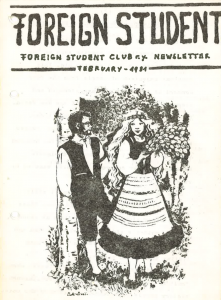
The front cover of the April 1981 issue represented the “ideal” foreigner, who never said anything bad nor raised a finger against the arbitrary treatment by the then Aliens Office. 

  • Previous
  • 1
  • 2
  • 3
  • 4
  • Next
Read more about documentary film
Read more

Recent Posts

  • Finland’s tabloids Iltalehti and Ilta-Sanomat are the pits
  • Riikka Purra’s Dr Jekyll and Mr Hyde mask
  • Double standards
  • Perussuomalaiset: Uusi logo, sama vanha juttu
  • Taco Trump

Recent Comments

  1. Absolutely Socking: Racist Finnish Facebook group against human rights gets flooded with socks on Musta Barbaari’s mother and sister charged by the police in “ethnic profiling” case
  2. Ilkka Nuotio on Pekka Myrskylä: “Tilastot kertovat toista kuin poliittinen keskustelu”
  3. Genrih Soinkara on The war in Ukraine and the Russian-Finnish border crisis are showing Finland’s ugly side
  4. Ahti Tolvanen on Comment by Ahti Tolvanen on the Helsinki +50 conference
  5. Angel Barrientos on Angel Barrientos is one of the kind beacons of Finland’s Chilean community

Archives

  • June 2026
  • May 2026
  • April 2026
  • March 2026
  • February 2026
  • January 2026
  • December 2025
  • November 2025
  • October 2025
  • September 2025
  • August 2025
  • July 2025
  • June 2025
  • May 2025
  • April 2025
  • March 2025
  • February 2025
  • January 2025
  • December 2024
  • November 2024
  • October 2024
  • September 2024
  • August 2024
  • July 2024
  • June 2024
  • May 2024
  • April 2024
  • March 2024
  • February 2024
  • January 2024
  • December 2023
  • November 2023
  • October 2023
  • September 2023
  • August 2023
  • July 2023
  • June 2023
  • May 2023
  • April 2023
  • March 2023
  • February 2023
  • January 2023
  • December 2022
  • November 2022
  • October 2022
  • September 2022
  • August 2022
  • July 2022
  • June 2022
  • May 2022
  • April 2022
  • March 2022
  • February 2022
  • January 2022
  • December 2021
  • November 2021
  • October 2021
  • September 2021
  • August 2021
  • July 2021
  • June 2021
  • May 2021
  • April 2021
  • March 2021
  • February 2021
  • January 2021
  • December 2020
  • November 2020
  • October 2020
  • September 2020
  • August 2020
  • July 2020
  • June 2020
  • May 2020
  • April 2020
  • March 2020
  • February 2020
  • January 2020
  • December 2019
  • November 2019
  • October 2019
  • September 2019
  • August 2019
  • July 2019
  • June 2019
  • May 2019
  • April 2019
  • March 2019
  • February 2019
  • January 2019
  • December 2018
  • November 2018
  • October 2018
  • September 2018
  • August 2018
  • July 2018
  • June 2018
  • May 2018
  • April 2018
  • March 2018
  • February 2018
  • January 2018
  • December 2017
  • November 2017
  • October 2017
  • September 2017
  • August 2017
  • July 2017
  • June 2017
  • May 2017
  • April 2017
  • March 2017
  • February 2017
  • January 2017
  • December 2016
  • November 2016
  • October 2016
  • September 2016
  • August 2016
  • July 2016
  • June 2016
  • May 2016
  • April 2016
  • March 2016
  • February 2016
  • January 2016
  • December 2015
  • November 2015
  • October 2015
  • September 2015
  • August 2015
  • July 2015
  • June 2015
  • May 2015
  • April 2015
  • March 2015
  • February 2015
  • January 2015
  • December 2014
  • November 2014
  • October 2014
  • September 2014
  • August 2014
  • July 2014
  • June 2014
  • May 2014
  • April 2014
  • March 2014
  • February 2014
  • January 2014
  • December 2013
  • November 2013
  • October 2013
  • September 2013
  • August 2013
  • July 2013
  • June 2013
  • May 2013
  • April 2013
  • March 2013
  • February 2013
  • January 2013
  • December 2012
  • November 2012
  • October 2012
  • September 2012
  • August 2012
  • July 2012
  • June 2012
  • May 2012
  • April 2012
  • March 2012
  • February 2012
  • January 2012
  • December 2011
  • November 2011
  • October 2011
  • September 2011
  • August 2011
  • July 2011
  • June 2011
  • May 2011
  • April 2011
  • March 2011
  • February 2011
  • January 2011
  • December 2010
  • November 2010
  • October 2010
  • September 2010
  • August 2010
  • July 2010
  • June 2010
  • May 2010
  • April 2010
  • March 2010
  • February 2010
  • January 2010
  • December 2009
  • November 2009
  • October 2009
  • September 2009
  • August 2009
  • July 2009
  • December 2008
  • November 2008
  • October 2008
  • September 2008
  • August 2008
  • July 2008
  • June 2008
  • May 2008
  • April 2008
  • March 2008
  • February 2008
  • January 2008
  • November 2007
  • October 2007
  • September 2007
  • August 2007
  • July 2007
  • June 2007
  • May 2007

Categories

  • ?? Gia L?c
  • ????? ?????? ????? ???????? ?? ??????
  • ???????
  • @HerraAhmed
  • @mondepasrond
  • @nohatefinland
  • @oula_silver
  • @Varathas
  • A Pakistani family
  • äärioikeisto
  • Abbas Bahmanpour
  • Abdi Muhis
  • Abdirahim Hussein Mohamed
  • Abdirahim Husu Hussein
  • Abdirisak Mahamed
  • About Migrant Tales
  • activism
  • Adam Al-Sawad
  • Adel Abidin
  • Afrofinland
  • Ahmed IJ
  • Ahti Tolvanen
  • Aino Pennanen
  • Aisha Maniar
  • Alan Ali
  • Alan Anstead
  • Alejandro Díaz Ortiz
  • Alekey Bulavsev
  • Aleksander Hemon
  • Aleksanterinliitto
  • Aleksanterinliitto ry
  • Aleksanterinliitto ry:n hallitus
  • Alex Alex
  • Alex Mckie
  • Alexander Nix
  • Alexandra Ayse Albayrak
  • Alexis Neuberg
  • Ali Asaad Hasan Alzuhairi
  • Ali Hossein Mir Ali
  • Ali Rashid
  • Ali Sagal Abdikarim
  • Alina Tsui
  • Aline Müller
  • All categories
  • Aman Heidari
  • Amiirah Salleh-Hoddin & Jana Turk
  • Amin A. Alem
  • Amir Zuhairi
  • Amkelwa Mbekeni
  • Ana María Gutiérrez Sorainen
  • Anachoma
  • Anders Adlecreutz
  • Angeliina Koskinen
  • Anna De Mutiis
  • Anna María Gutiérrez Sorainen
  • Anna-Kaisa Kuusisto ja Jaakko Tuominen
  • Annastiina Kallius
  • Anneli Juise Friman Lindeman
  • Announcement
  • Anonymous
  • Antero Leitzinger
  • anti-black racism
  • Anti-Hate Crime Organisation Finland
  • Anudari Boldbaatar
  • Arshiya Nasser
  • Aspergers Syndrome
  • Asylum Corner
  • Asylum seeker 406
  • Athena Griffin and Joe Feagin
  • Autism
  • Avaaz.org
  • Awale Olad
  • Ayan Said Mohamed
  • AYY
  • Barachiel
  • Bashy Quraishy
  • Beatrice Kabutakapua
  • Beri Jamal
  • Beri Jamal and Enrique Tessieri
  • Bertolt Brecht
  • Boiata
  • Boodi Kabbani
  • Bruno Gronow
  • Carmen Pekkarinen
  • Çelen Oben and Sheila Riikonen
  • Chiara Costa-Virtanen
  • Chiara Costa-Virtanen
  • Chiara Sorbello
  • Christian Thibault
  • Christopher Wylie
  • Clara Dublanc
  • Dana
  • Daniel Malpica
  • Danilo Canguçu
  • David Papineau
  • David Schneider
  • Dexter He
  • Don Flynn
  • Dr Masoud Kamali
  • Dr. Faith Mkwesha
  • Dr. Theodoros Fouskas
  • Edna Chun
  • Eeva Kilpi
  • Emanuela Susheela
  • En castellano
  • ENAR
  • Enrique
  • Enrique Tessieri
  • Enrique Tessieri & Raghad Mchawh
  • Enrique Tessieri & Yahya Rouissi
  • Enrique Tessieri and Muhammed Shire
  • Enrique Tessieri and Sira Moksi
  • Enrique Tessieri and Tom Vandenbosch
  • Enrique Tessieri and Wael Che
  • Enrique Tessieri and Yahya Rouissi
  • Enrique Tessieri and Zimema Mhone
  • Epäluottamusmies
  • EU
  • Europe
  • European Islamophobia Report
  • European Islamophobia Report 2019,
  • European Union
  • Eve Kyntäjä
  • Ezequiel Caldeiro
  • Facebook
  • Fadumo Dayib
  • Faisa Kahiye
  • Farhad Manjoo
  • Fasismi
  • Finland
  • Fizza Qureshi
  • Flyktingar och asyl
  • Foreign Student
  • Fozia Mir-Ali
  • Frances Webber
  • Frida Selim
  • Gareth Rice
  • Ghyslain Vedeaux
  • Global Art Point
  • Great Replacement
  • Habiba Ali
  • Hami Bahadori
  • Hami Bahdori
  • Hamid
  • Hamid Alsaameere
  • Hamid Bahdori
  • Handshake
  • Harmit Athwal
  • Hassan Abdi Ali
  • Hassan Muhumud
  • Heikki Huttunen
  • Heikki Wilenius
  • Helsingin Sanomat
  • Henning van der Hoeven
  • Henrika Mälmsröm
  • Hser Hser
  • Hser Hser ja Mustafa Isman
  • Husein Muhammed
  • Hussain Kazemian
  • Hussain Kazmenian
  • Ibrahim Khan
  • Ida
  • Ignacio Pérez Pérez
  • Iise Ali Hassan
  • Ilari Kaila & Tuomas Kaila
  • Imam Ka
  • inside-an-airport
  • Institute of Race Relations
  • Iraqi asylum seeker
  • IRR European News Team
  • IRR News Team
  • Islamic Society of Norhern FInland
  • Islamic Society of Northern Finland
  • Islamophobia
  • Jacobinmag.com
  • Jallow Momodou
  • Jan Holmberg
  • Jane Elliott
  • Jani Mäkelä
  • Jari Luoto
  • Jari Taponen
  • Jegor Nazarov
  • Jenni Stammeier
  • Jenny Bourne
  • Jessie Daniels
  • Joe Davidow
  • Johannes Koski
  • John D. Foster
  • John Grayson
  • John Marriott
  • Jon Burnett
  • Jorma Härkönen
  • Jos Schuurmans
  • José León Toro Mejías
  • Josue Tumayine
  • Jouni Karnasaari
  • Juan Camilo
  • Jukka Eräkare
  • Julian Abagond
  • Julie Pascoet
  • Jussi Halla-aho
  • Jussi Hallla-aho
  • Jussi Jalonen
  • JusticeDemon
  • Kadar Gelle
  • Kaksoiskansalaisuus
  • Kansainvälinen Mikkeli
  • Kansainvälinen Mikkeli ry
  • Katherine Tonkiss
  • Kati Lepistö
  • Kati van der Hoeven-Lepistö
  • Katie Bell
  • Kättely
  • Kerstin Ögård
  • Keshia Fredua-Mensah & Jamie Schearer
  • Khadidiatou Sylla
  • Khadra Abdirazak Sugulle
  • Kiihotus kansanryhmää vastaan
  • Kirsi Crowley
  • Koko Hubara
  • Kristiina Toivikko
  • Kubra Amini
  • KuRI
  • La Colectiva
  • La incitación al odio
  • Laura Huhtasaari
  • Lauri Finér
  • Leif Hagert
  • Léo Custódio
  • Leo Honka
  • Leontios Christodoulou
  • Lessie Branch
  • Lex Gaudius
  • Leyes de Finlandia
  • Liikkukaa!
  • Linda Hyökki
  • Liz Fekete
  • M. Blanc
  • Maarit Snellman
  • Mahad Sheikh Musse
  • Maija Vilkkumaa
  • Malmin Kebab Pizzeria Port Arthur
  • Marcell Lorincz
  • Mari Aaltola
  • María Paz López
  • Maria Rittis Ikola
  • Maria Tjader
  • Marja-Liisa Tolvanen
  • Mark
  • Markku Heikkinen
  • Marshall Niles
  • Martin Al-Laji
  • Maryan Siyad
  • Matt Carr
  • Mauricio Farah Gebara
  • Media Monitoring Group of Finland
  • Micah J. Christian
  • Michael McEachrane
  • Michele Levoy
  • Michelle Kaila
  • Migrant Tales
  • Migrant Tales Literary
  • Migrantes News
  • Migrants' Rights Network
  • MigriLeaks
  • Mikko Kapanen
  • Miriam Attias and Camila Haavisto
  • Mohamed Adan
  • Mohammad Javid
  • Mohammad M.
  • Monikulttuurisuus
  • Monisha Bhatia and Victoria Canning
  • Mor Ndiaye
  • Muh'ed
  • Muhamed Abdimajed Murshid
  • Muhammed Shire
  • Muhammed Shire and Enrique Tessieri
  • Muhis Azizi
  • Musimenta Dansila
  • Muslimiviha
  • Musulmanes
  • Namir al-Azzawi
  • Natsismi
  • Neurodiversity
  • New Women Connectors
  • Nils Muižnieks
  • No Labels No Walls
  • Noel Dandes
  • Nuor Dawood
  • Omar Khan
  • Otavanmedia
  • Oula Silvennoinen
  • Paco Diop
  • Pakistani family
  • Pentti Stranius
  • Perussuomalaiset
  • perustuslaki
  • Petra Laiti
  • Petri Cederlöf
  • Pia Grochowski
  • Podcast-lukija Bea Bergholm
  • Pohjois – Suomen Islamilainen Yhdyskunta
  • Pohjois Suomen Islamilainen Yhyskunta
  • Polina Kopylova
  • Race Files
  • racism
  • Racism Review
  • Raghad Mchawh
  • Ranska
  • Rashid H. and Migrant Tales
  • Rasismi
  • Raul Perez
  • Rebecka Holm
  • Reem Abu-Hayyeh
  • Refugees
  • Reija Härkönen
  • Remiel
  • Reza Nasri
  • Richard Gresswell
  • Riikka Purra
  • Risto Laakkonen
  • Rita Chahda
  • Ritva Kondi
  • Robito Ibrahim
  • Roble Bashir
  • Rockhaya Sylla
  • Rodolfo Walsh
  • Roger Casale
  • Rostam Atai
  • Roxana Crisólogo Correa
  • Ruth Grove-White
  • Ruth Waweru-Folabit
  • S-worldview
  • Sadio Ali Nuur
  • Sami Rusanen
  • Sandhu Bhamra
  • Sara de Jong
  • Sarah Crowther
  • Sari Alhariri
  • Sarkawt Khalil
  • Sasu
  • Scot Nakagawa
  • Shabana Ahmadzai
  • Shada Islam
  • Sharon Chang blogs
  • Shenita Ann McLean
  • Shirlene Green Newball
  • Sini Savolainen
  • Sira Moksi
  • Sonia K.
  • Sonia Maria Koo
  • Steverp
  • Stop Deportations
  • Suldaan Said Ahmed
  • Suomen mediaseurantakollektiivi
  • Suomen Muslimifoorumi ry
  • Suomen viharikosvastainen yhdistys
  • Suomen viharikosvastainen yhdistys ry
  • Suomi
  • Supermen
  • Susannah
  • Suva
  • Syrjintä
  • Talous
  • Tapio Tuomala
  • Taw Reh
  • Teivo Teivainen
  • The Daily Show
  • The Heino
  • The Supermen
  • Thomas Elfgren
  • Thulfiqar Abdulkarim
  • Tim McGettigan
  • Tino Singh
  • Tito Moustafa Sliem
  • Tobias Hübinette and L. Janelle Dance
  • Transport
  • Trica Danielle Keaton
  • Trilce Garcia
  • Trish Pääkkönen
  • Trish Pääkkönen and Enrique Tessieri
  • Tuulia Reponen
  • Uncategorized
  • UNITED
  • University of Eastern Finland
  • Uyi Osazee
  • Väkivalta
  • Vapaa Liikkuvuus
  • Venla-Sofia Saariaho
  • Vieraskynä
  • W. Che
  • W. Che an Enrique Tessieri
  • Wael Ch.
  • Wan Wei
  • Women for Refugee Women
  • Xaan Kaafi Maxamed Xalane
  • Xassan Kaafi Maxamed Xalane
  • Xassan-Kaafi Mohamed Halane & Enrique Tessieri
  • Yahya Rouissi
  • Yasmin Yusuf
  • Yassen Ghaleb
  • Yle Puhe
  • Yuliet Tresa
  • Yve Shepherd
  • Zahra Khavari
  • Zaker
  • Zalina Ametova
  • Zamzam Ahmed Ali
  • Zeinab Amini ja Soheila Khavari
  • Zimema Mahone and Enrique Tessieri
  • Zimema Mhone
  • Zoila Forss Crespo Moreyra
  • ZT
  • Zulma Sierra
  • Zuzeeko Tegha Abeng
© 2026 Migrant tales | Powered by Minimalist Blog WordPress Theme