Since the 2011 parliamentary election, when the Perussuomalaiset(PS)* won 39 seats from five in the previous election, the PS has consolidated its power – with the help of other mainstream parties like the National Coalition Party (NCP) – by spreading fear and lies about migrants.
Any sensible person understands that migration is a very powerful force that can offer a lot of benefits to the host country. In Finland, it has been the opposite: migration is not good unless you are a “super migrant.”
The Foreign Student started to write about Finland’s unfair immigration policy in 1981-82. Back then, some saw the ideal foreigner as the front cover of a soap commercial.
Wrote Migrant Tales in 2012: “These [xenophobic] politicians sound like they are reading to you the Sleeping Beauty fairy tale when Prince Charming wakes the beautiful princess with a kiss from her deep sleep. Anti-immigration politicians and parties don’t speak of Sleeping Beauty per se, but about super immigrants.”
It is incredible how much harm the PS has done to Finland by spreading fake news about migrants. Probably the most incredulous thing is how little has been written about the PS lie.
It is surprising that Finland’s national broadcaster, Yle, spreads xenophobia and suspicion of asylum seekers via its news reporting. Yle, never calls people attempting to enter Finland via the Finnish-Russian border asylum seekers but people who are attempting to enter the country illegally.
The narrative spread by Yle reporters is a toothless stenographic copy of the government’s harsh stance against such people. The arguments are the same ones as the government’s:
These people aren’t “real” asylum seekers because Russia is using them as pawns. This may be the case, but does it allow a country to deny a person’s human right right to asylum?
These people, who are also women and children, cannot be considered real asylum seekers because they live in a safe country like Russia.
They point to the violent pushbacks of Poland but forget to mention that the country was back then run by a xenophobic PiS government.
“From the region of Vyborg have come more seekers to the Finnish border.
The people seeking to enter Finland illegally are from Africa and the Middle East.”
Apart from practicing stenography journalism, Yle‘s reporting of the issue is one-sided and opinionated. Instead of hearing human rights organizations, Yle offers only a simple view where the main sources are – surprise, surpsie – the national boarder guard and the government.
The reporting by Yle is one-sided promoting hatred of brown asylum seekers.
Reading the news about how Prime Minister Petteri Orpo’s government plans to not comply with the right to seek asylum speaks volumes about Finland’s “R” problem. In many cases, the media, which acts more like a rubber stamp for the government on migration issues, is also part of the problem.
It is sad to see the treatment of the Russian community of Finland starting from President Sauli Niinistö, whose dislike of dual citizenship and asylum seekers is well documented.
Dual citizenship is a right guaranteed by Finnish law but it takes candidates, who should know better, to make incredulous nd demeaning statements that their dual citizenship should be revoked.
As a person who has lived in Finland for many decades, I am ashamed that we have politicians that want to score brownie points with xenophobia.
Finland is still far from regaining its former political composure after the April 2011 elections, which saw the right-wing populist Finns Party win a historic election victory by becoming the country’s third-largest political force in parliament after the National Coalition Party and the Social Democrats. Compared to the elections before 2011, the number of Finns Party MPs rose from five in 2007 to an astonishing 39.
Many political observers have wondered how an anti-EU, anti-immigration and especially anti-Islam party can become a major political force in Finland in only four years. My guess is the following: Our lack of cultural diversity. Finland’s foreign population totals today about 4% of the population. It is still too small to make a dent on national politics.
Certainly, there are other factors at play that helped the Finns Party to win the last parliamentary elections. There’s the euro crisis and the deep recession, which have helped far-right and right-wing populist parties to see unprecedented growth in today’s Europe. Even so, if Finland had larger ethnic and religious minorities, the result of the 2011 election would have been different.
Our large Finnish-American and Finnish-Canadian expatriate communities abroad are good examples how diversity has not only enriched Finnish culture but made it stronger.
One of the big debates going on in Finland is how our ever-growing immigrant population will change our country demographically and culturally. While we don’t have a precise answer to such questions because the future rarely reveals itself to us, the only matter we can say with some certainty is that our population will change in the next two decades.
The government of Prime Minister Petteri Orpo is anticipating with some dread the opening of the Finnish-Russian border on 14 January. In order to deny people the right to asylum, Orpo has gone as far as to suggest that asylum seekers should be sent directly back to Russia supposedly because it is a safe country.
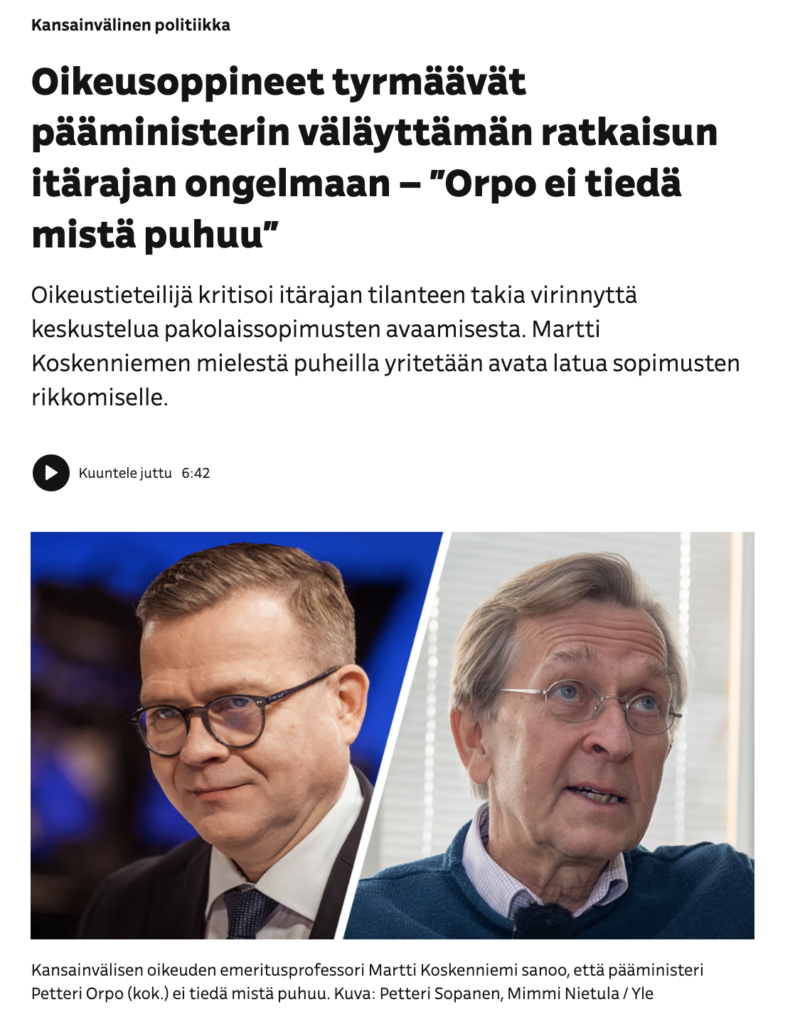
Such a suggestion, denying people the right to asylum, has received strong criticism from international law professor Martti Koskenniemi.
“I can only conclude that Orpo does not know what he is talking about,” Koskenniemi was quoted as saying in Yle. “Surely the prime minister is not proposing such a thing [like denying asylum with illegal pushbacks]. There is no need to use the English term. The proposal [by Orpo] is an excuse to breach international agreements.”
As Koskenniemi correctly asks, why haven’t politicians suggested any credible changes to international agreements on asylum?
The answer is a no-brainer: They don’t have any answers except for weakening human rights and trashing international agreements governing refugee and asylum rights.
Another important question that should concern us is what is the government’s new steps to further undermine human rights and civil rights? They are already doing this on a massive scale by weakening social, labor and migrant rights.
As far as Orpo’s government is concerned, its record on racism and human rights reveal an incompetence rarely seen in Finnish politics.
There only argument for breaching human rights is fear.
The only route of the government is to exit from power.
Russia is not unpredictable. In its operations against Finland, it exploits racism because Finland is a racist country.
The observation by writer Sofi Oksnanen is the only one I have read that reveals the government’s pushbacks and their draconian immigration and asylum policy. The government’s knee-jerk reaction to closing the Finnish-Russian border shows how Finnish politicians and the media have jumped on the populist-racist bandwagon.
Oksanen is a sharp writer and observer, especially of governments with autocratic intentions. It is surprising that the Finnish media, never mind politicians, have not dared to question the government’s policies but bowed instead to them.
Prime Minister Petteri Orpo can claim with a poker face its immigration policy isn’t racist because it is a copy of what is being done in other Nordic countries. Would it be fair to say that the immigration policy of all Nordic countries is then racist?
Article 3 – border control measures must be without prejudice to the rights of refugees and other people requesting international protection, in particular as regards the principle of non-refoulement.
Perussuomalaiset (PS)* FinnishInterior Minister Mari Rantnanen called herself Tuesday a “tough border lady” on A-studio. After opening two border checkpoints Thursday at Vaalima and Niirala, Rantnan announced they’d be closed again on Friday at 8 pm due to about 200 asylum seekers.
“We have seen an immediate resumption of illegal immigration at the eastern border [and therefore we will close to border again],” Rantanen was quoted as saying in Helsingin Sanomat.
Illegal immigration? Even Yle reporter Juulia Tillaeus at Vaalima, said Russia was allowing “illegal asylum seekers” to go to Finland.
Migrant Tales sent Juulia Tillaeus an email stating that her reporting was biased since there was no such thing as “illegal asylum seekers.” Such terms are used by anti-immigration politicians to discredit and dehumanize asylum seekers.
Send her an email ([email protected]) and ask her to stop labeling asylum seekers wrongly. Ask her to read at least the European Convenion on Human Rights.
The billboard was published om 2015-2016, claiming that 10,000 “illegal” refugees were coming to Finland. The claim that refugees are “illegal” is preposterous since such people have a right to ask for asylum in another country. The claim that refugees are coming to the country “illegally” is a good example of the xenophobia spread by the Finnish media. Source: Iltalehti
Regurgitating her favorite echo chamber hits about asylum seekers, one claim by Rantanen tops them all: such people coming from Russia are “a threat to national security.” Really? How?
After opening the two vborder crossings, the government decided to shut them the following day.Source: Yle News
When Rantanen speaks about asylum seekers, she reflects the ongoing toxic anti-immigration narrative so common in many EU countries.
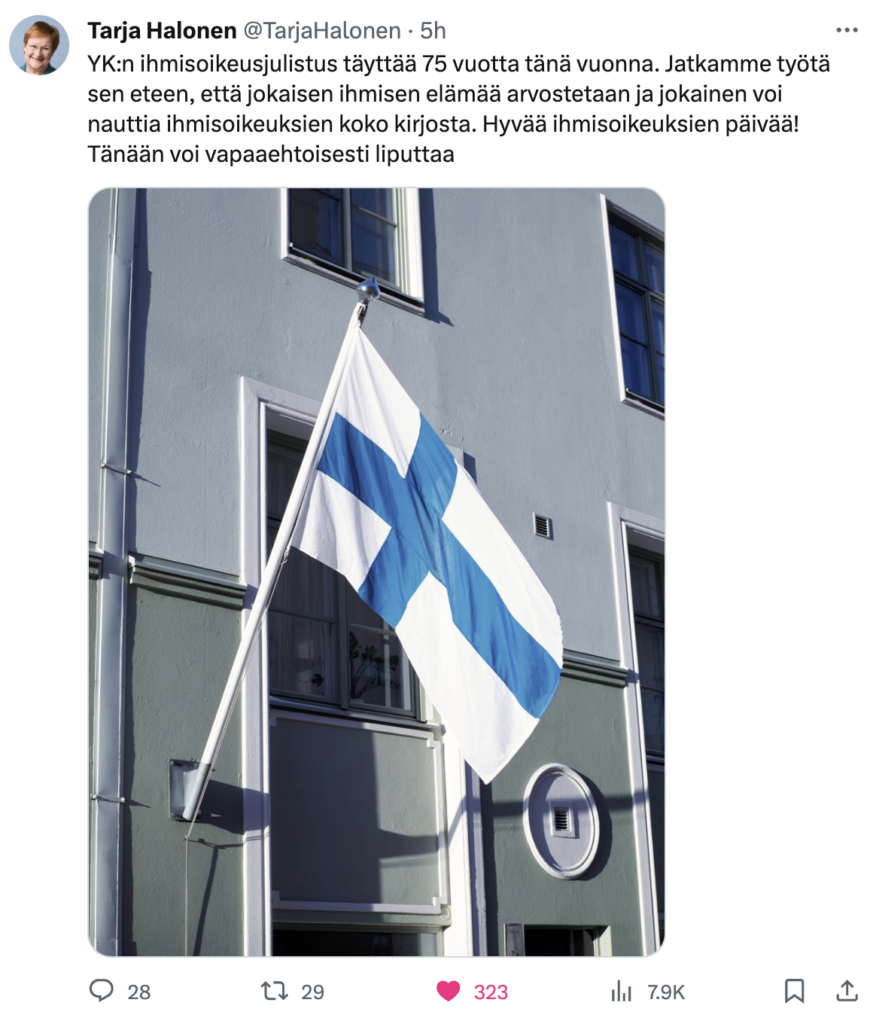
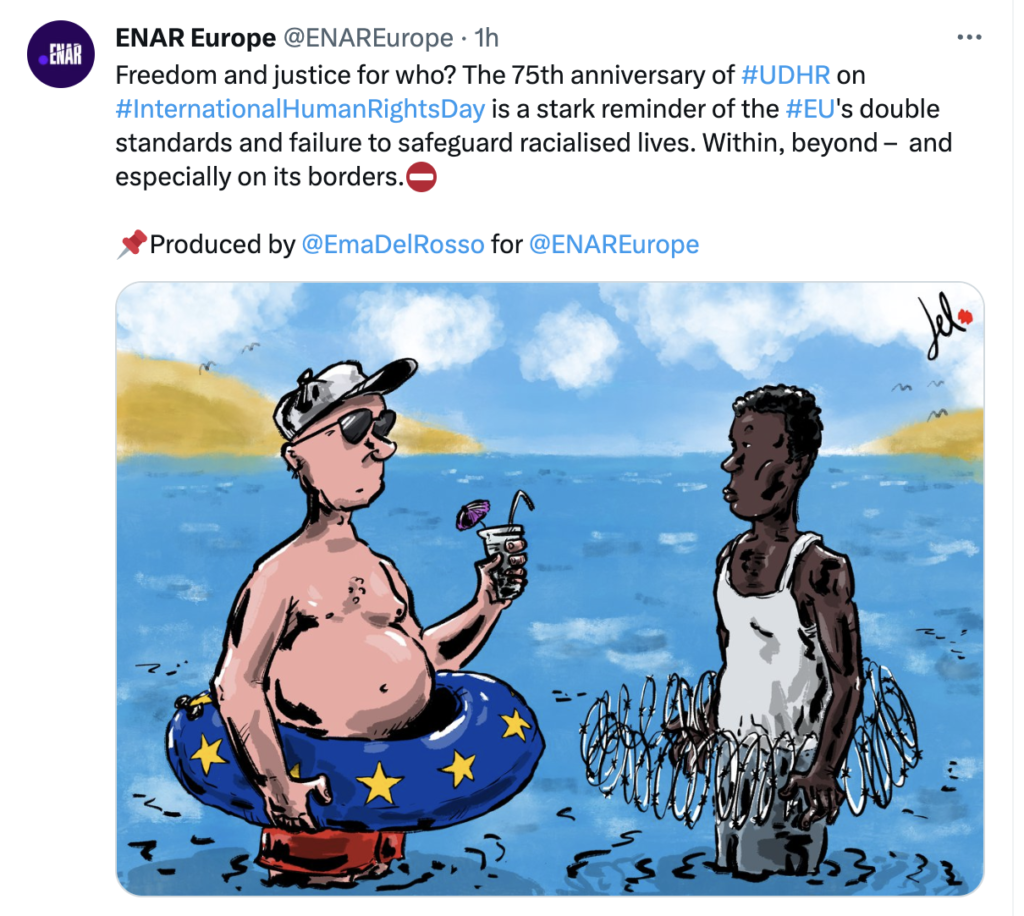
It is shameful, but obvious, why Prime Minister Petteri Orpo’s government, not one minister of the National Coalition Party and Perussuomalaiset,* mentions International Human Rights Day. Being white, driven by xenophobia and having a privileged life in Finland, it is understandable why such politicians see Human Rightsas a threat.
Former President Tarja Halonen (2000-2012) commemorated in a Tween below International Human Rights Day.
During the Cold War, Human Rights was a no-no in Finland because it questioned Finnish-Soviet relations. Finland joined the Council of Europe in 1989, 39 years after its founding in 1950, which held the banner of Human Rights high.
As an Argentinean who lived under a dictatorship in 1976-83, Human Rights have a special place in my heart. Thanks to such rights, Argentineans had a voice in the face of violent oppression.
In April 1978, I was stopped by the police at gunpoint in the street, detained and thrown in a police cell without the right to habeas corpus, a Human Right.
I still remember that autumn Saturday as if it were yesterday.
Dr. Faith Mkwesha is a Zimbabwean who did her doctorate in South Africa and now lives in Finland. She has worked in higher education in Africa for many years. She is currently a lecturer and researcher at the University of Helsinki, the Swedish School of Social Sciences, and the Centre of Ethnic Relations and Nationalism (CEREN). She founded the Ubuntu Nordic Academy (UNA), where she offers Ubuntu-centered courses and expert workshops for institutions, businesses, and politics on health and well-being.
“I registered UNA after being encouraged by a friend who liked the meaning and practices of Ubuntu/Unhu African philosophy when he heard me give lectures on Ubuntu centered relations and partnerships. He even went on to buy some books on Ubuntu to show me that what I teach is more meaningful than some of these books. You know i was not thinking of making this a business that contributes in society here in Finland. You know Ubuntu teaches us to be kind even to strangers, give them food because we say a visitor does not empty the granary, and to respect each other. Ubuntu is very relevant in any society, i even teach about Ubuntu in university. This inspired me to start SahWira Africa International NGO an organization grounded in Ubuntu to advocate for women and children´s rights. “ – Dr. Faith Mkwesha
In a Western society, embracing the concept of Ubuntu has tremendous potential to foster unity, acceptance, and prosperity. Rooted in African philosophy, Ubuntu emphasizes the interconnectedness of humanity and the idea that our well-being is intertwined with the well-being of others. By embracing this principle, Western societies can move toward a more communal and inclusive mindset, breaking down barriers and fostering a sense of shared responsibility. In a world often characterized by individualism, Ubuntu promotes empathy, cooperation, and mutual support – essential elements for addressing societal challenges. This philosophy can pave the way for a more compassionate and understanding society where diverse perspectives are not only tolerated but celebrated. Ultimately, the integration of Ubuntu into Western cultures can help build a more harmonious and prosperous community where the collective success of all is prioritized over individual achievement.
Among other very important things, Dr. Faith Mkwesha in her lecture below, “Ubuntu Centered Diversity,” highlights the profound importance of the deeply rooted Sankofa bird which is a rich tapestry of Akan culture. Sankofa embodies a profound philosophy that transcends time, encourages a reflective journey, and reminds us that understanding our roots is essential to personal and collective growth. This timeless wisdom resonates and echoes throughout the African diaspora, serving as a powerful beacon of cultural identity.
Amid the rise of far-right ideologies, Ubuntu is emerging as a powerful tool for healing and building a stronger society. Ubuntu serves as a counterforce to divisive narratives by championing interconnectedness and shared humanity. It encourages dialogue over discord and promotes understanding in the face of ideological polarization. The philosophy’s emphasis on collective well-being by dismantling the exclusivity often associated with far-right politics, it paves the way for a more inclusive and harmonious society. Ubuntu challenges the us-versus-them mentality and offers a way to heal societal fractures and build a resilient foundation rooted in empathy, cooperation, and shared prosperity. In times of political polarization, embracing Ubuntu becomes not only a cultural imperative but a pragmatic strategy for forging a more united and resilient future.
I invite you to embark on a transformative intellectual journey by watching a riveting lecture by Dr. Faith Mkwesha, which delves into Ubuntu Centered Diversity. The video, accessible via Ubuntu Nordic Academy’s YouTube channel, showcases Dr. Faith Mkwesha’s expertise and promises to provide valuable insights that could reshape our understanding of our society and how much Ubuntu is needed.
Much of Finland’s hostility towards asylum seekers and visible minorities lies on President Sauli Niinistö, who hosts today his last Independence Day gala. For some, like me, this is good news. Hopefully, Finland’s next president will have a greater understanding of migrants, cultural diversity and peace-building.
Ahti Tolvanen, who is a member of the Migrant Tales board, believes that President Niinistö failed in his job number one.
“One of the areas that President Niinist failed was maintaining Finland as a peacekeeping nation,” he said. “He just walked away from decades of a tradition in The Helsinki Spirit.”
The Helsinki Spirit was the basis of Finland’s foreign policy grounded on détente and non-involvement and not taking sides in conflicts.
President Niinistö dancing with his wife Jenni Haukio at the Independence Day gala.
During the past eight years of his mandate, President Niinistö has shown his hostility towards asylum seekers, especially Muslims, and other people of color. He was never a friend of such communities.
President Niinistö’s prejudices and apparent ignorance about racism are one source that feeds Finland’s hostile environment against migrants and minorities. Some of his comments and stances (see below) leave some scratching their heads.