Migrant tales
Menu
  • #MakeRacismHistory “In Your Eyes”
  • About Migrant Tales
  • It’s all about Human Rights
  • Literary
  • Migrant Tales Media Monitoring
  • NoHateFinland.org
  • Tales from Europe
Menu

Tag: xenophobia

Immigrants that look down on other immigrants

Posted on October 19, 2012 by Migrant Tales

The eagle never lost so much time, as when he submitted to learn of the crow.

William Blake

Some immigrants who have lived in Finland for many decades have adapted so well to this country that even their prejudices and stereotypes are just like those of the locals. Some, like Alain Chiaroni or Freddy Van Wonterghem, however, go beyond the call of duty to give Africans and visible minorities lessons on how they should integrate into Finnish society. 

What unites Chiaroni and Van Wanterghem other than they are both Perussuomalaiset (PS) party members? Answer: Their reactive views on cultural diversity and visible immigrants like Muslims and Africans.

At least Van Wonterghem, a native of Belgium, has failed miserably on the integration front. He got slapped in March with a 420-euro fine for inciting ethnic hatred against a group.

Despite having lived for 38 years in a foreign country, Chiaroni sounds like a nineteenth-century colonial master from France when he speaks of Somalis and Africans living in Finland.

“You could only get citizenship [in the late-1970s] if you had a sound background, a good education, a job in Finland, had Finnish- language skills, ties to Finland, were well-integrated into Finnish society, had two influential persons recommended you [for citizenship], etc…”, he writes in an Uusi Suomi blog entry.

He continues by stating that certain “political circles” in Finland are of the opinion that our country must adapt completely to those immigrants who move here.

“Has Finland lost its common sense?” he asks.

What Chiaroni forgets to ask is a more important question:  Why Finland had so few foreigners in the 1970s and why there was so little foreign investment in the country?

By around 1980, the biggest “foreign” group living in Finland were Swedes, who were mostly Finns that were naturalized Swedish citizens. In the 1970s, Finland’s foreign population totaled a mere 7,000 souls.

Moreover, Finland did everything possible to restrict foreign investment with the help of the Restricting Act of 1939.

Would I want to live in a country where foreigners, black people and visible immigrants were a rarity and where outside investment was the exception as opposed to the rule?

No thanks.

I like how Finland looks today with all its defects. It’s a million times better than in the Cold War years, when  your otherness followed you around like a shadow that marked you for the rest of your days.
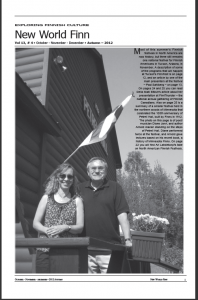
 

New World Finn: Open the doors

Posted on October 3, 2012 by Migrant Tales

Twenty-five years ago, when I worked briefly for the Buenos Aires Herald as a young reporter, I wrote a column about how Argentina’s past could come to haunt it in the future. The last military regime (1976-83) that ruled the country was one of the most ruthless that Latin America had seen during the last century. Tens of thousands of people disappeared in a civil war that was characterized by habeas corpus writs and the silence of cemeteries.

The same concern I wrote about in that column a long time ago has resurfaced in Europe today.

New World Finn is a quarterly exploring Finnish culture in the New World.
The column, Open the doors, raised the following points: “True, there is in present-day Argentina a consensus against military-run governments. However, even though these last years of democracy have instigated a new political era, there are still precious little questions being asked not only about our past – how different sectors such as politicians, unions, member of the clergy, historians, journalists, the U.S. embassy, among others, colluded in making a mockery of democracy and human rights – but most importantly, where we’re supposed to go from here.”

Could history be repeating itself again in Europe and Finland?

As our economic woes deepen in this part of the world, the louder we’re hearing the diatribes of far right and right-wing populist groups. We saw in Finland last year the rise of the Finns Party, which is anti-EU, anti-immigration and especially anti-Islam. The Finns Party, which only got 5 seats in 2007, won 39 seats in the last election!

The next hurdle for the Finns Party will be the municipal elections of October 28. A recent poll by YLE revealed that the Finns Party would be the biggest winner of the municipal election. If the party gets 15.8% of the votes as the poll suggests, it will be a big leap from 5.4% that the party got in the 2008 municipal elections. The poll sees that the National Coalition Party getting in October 22.7% compared with 23.5% in 2008. That would be followed by the Social Democrats with 18.7% (21.2%), and the Center Party with 16.6% (20.1%).

While all political parties in Finland are officially against all forms of racism and discrimination, it’s not clear what their real views are on the issue. How do they promote cultural diversity and how often do they speak out against racism? You will find in all Finnish parties members who are for or against immigrants and immigration. Even so, no other party has so many openly anti-immigration members like the Finns Party.

The Greens and Swedish People’s Party, and even the Left Wing Alliance with some reservations, appear to be the most open to immigration and cultural diversity, according to some polls.

“Intolerance is taking root throughout Europe and Finland. We witnessed with shock last year its ugliest side, when Anders Behring Breivik went on his murderous rampage killing 77 innocent victims. Europe witnessed this spring intolerance form a young Arab in Southern France who gunned down Jewish schoolchildren.

Contrary to North America, some claim that our view of ourselves as ethnic groups in Europe hinges too much on “race and blood.” The concept dates back to 1935, when a Jewish doctor in Germany was sent to a concentration camp for saving a patient’s life by donating his blood. This same idea, that blood and ethnicity are related, is how some Europeans see themselves ethnically today.

In order not to repeat the mistakes of the past, we have to look at our history. Finland, which was ravaged by internal and external wars during the first twenty-five years of its independence, built a model society based on respect, acceptance and social equality. The fruits of those efforts are everywhere today. In order to build the same type of society in this century, we must take great care not to exclude different ethnic groups.

We could look across the Atlantic as well for good cultural-diversity models. Even if racism is an issue in many parts of the Americas, countries like the United States, Canada, Brazil, Argentina and others understand that racism and discrimination are social ills that must be challenged.

The last paragraph of the Buenos Aires Herald column I wrote stated the following: “There are a lot of pending questions and, as long as Argentina does not accept the difficult challenge of answering them, the door of this country will remain closed, isolation will prevail, and despotism will one day flourish as it always has in the past. It will not come from abroad, however, as many would have us believe, but from our backyard.”

The column appeared in the autumn 2012 issue of New World Finn.

How much further? A film about the lives of refugees in Greece

Posted on September 14, 2012 by Migrant Tales

This documentary about refugees in Greece is a stark reminder of how Greek authorities and the European Union have turned their backs on asylum seekers and undocumented immigrants. The answer is not higher border fences or fear-mongering by politicians, but finding proactive solutions that take into account the needs and human rights of these people.

Eighty percent of the refugees that come from war-stricken areas flee to neighboring countries like Pakistan, where there are 1.7 million refugees. In the Dadaab refugee camp alone in Kenya there are a staggering 500,000  Somali refugees.

For the sake of comparison, 27 EU states have a total of 1.3 million refugees.

Traveling under a truck is one way that asylum seekers use to cross borders in Europe.

Says the European Council on Refugees and Exiles (ECRE) in a statement about the documentary, How much further:

Filmed in Athens between October 2011 and February 2012, in the midst of social, political and economic turmoil, the documentary raises the voices of those who have fled Afghanistan, Somalia or Sudan hoping to find refuge in Europe. After months or even years on the road, they arrive in Greece, a country whose population is facing the full brunt of the economic crisis and where the asylum and reception systems are completely dysfunctional. Most people see no option but to take to the road again in the hope of reaching a country that can receive them and consider their claim for asylum. But, once they have entered Greece, it is extremely difficult if not impossible to leave the country given the European policies that legally bind them to Greece.

This documentary is the fruit of the cooperation between ECRE, the Greek Forum of Refugees and the film maker Matthias Wiessler, and supported by the European Programme for Integration and Migration (EPIM).

Following the simultaneous premières in Brussels and Athens for World Refugee Day (20 June), How much further? has already been shown in two other screenings so far, at theEuropean Policy Institute and to the students of the Odysseus Network Summer School on European Law and Polciy on Immigration & Asylum.

To see documentary, How much further, click here.


Greece and its bad case of ethnic profiling and scapegoating

Posted on September 12, 2012 by Migrant Tales

The Greek Police announced that 16,836 foreign nationals were brought for questioning  during the first month that Xenios Zeus was instigated, according to the European Council on Refugees and Exiles (ECRE). A staggering 80% of those brought in for questioning were legal residents. Only 2,144 held by the police didn’t have their residence permits in order. 

Xenios Zeus, which was the ancient Greek god of hospitality, is a good example of how ineffective immigration policies and economic problems can force xenophobia to poison a society.

Sensible people understand that scapegoating immigrants for the country’s economic problems is a red herring. Greek politicians and civil servants, with the blessings of the public, are more interested in blaming defenseless immigrants and refugees  for Greece’s problems than themselves.

Whenever a person or a group scapegoats immigrants and minorities, it is a clear sign of cowardice and opportunism.

The Greek public should critically look at the country’s politicians, civil servants and financial sector and launch a “Xenios Zeus” to uproot corruption that festers in that country.

ECRE writes in a statement: ”Greek authorities claim that as a result of Xenios Zeus, the influx of illegal immigration in the area of Evros has been reduced by 84%. However, according to the newspaper ‘To Vima’, the “Xenios Zeus” operation has resulted in a dramatic increase in the smuggling tariffs for entering Greece from Turkey and leaving Greece for Italy. A few months ago, smugglers would request 2,500 to 3,000 Euro for a safe passage, while would-be migrants are now asked to pay up to 5,000 Euros.”

Groups like ECRE, Amnesty International, Human Rights Watch and the Greek Council of Refugees have criticized the massive police roundup of immigrants.


What kind of a threat do Finland’s Counterjihadists pose?

Posted on September 10, 2012 by Migrant Tales

It’s pretty clear that what goes up politically must eventually come down. Some groups, which have recently surged in popularity like the Perussuomalaiset (PS), could see their bubble burst quickly. While I wouldn’t count on anything like that happening anytime soon, it could be a totally different story for the hardline Counterjihadists of the party.  

The question that should concern us all is what will these radical members of the PS do if they see their popularity wean.

Do they have  a plan B? Will they take to the streets and incite more people to parrot their message of hate?

One of the most naive ideas that Counterjihadists hold is that they can keep their hate rhetoric on a short leash. Anders Breivik’s murderous rampage in Norway proved once again that racism and Islamophobia can bite back at its ideological master.

While we are already seeing greater violence to visible minorities and immigrants after last year’s PS election victory, the question is how do we challenge such a threat effectively?

Everyone knows that the hardcore Counterjihadist MPs of the PS are Jussi Halla-aho, James Hirvisaari and Olli Immonen.

If PS chairman Timo Soini wished, he could land a fatal political blow to the Counterjihadists by banishing them from the party. As a so-called taxi party (all of its members could fit in a taxi), they would no longer be a political force like they are today in the PS.

In many respects, Soini’s relationship with these extremists could be described as that of a junkie hooked on heroin. One hates being a junkie but it sure feels good to inject oneself with such a drug.

If Soini ever kicked out the Counterjihadists from the party, would these politicians go down without a fight?

It would be naive to think so.

Their message of hate would certainly get louder and their rhetoric more violent.

How sincere is PS MP Immonen about Finnish Karelia?

Posted on September 8, 2012 by Migrant Tales

Finnish Karelia, Salla, and Petsamo were territories ceded to the former Soviet Union after the Continuation War (1941-44).  Counterjihadist Perussuomalaiset (PS) MP Olli Immonen sent a parliamentary question Friday asking the government to investigate whether Russia offered in 1991 then President Mauno Koivisto (1982-94) the possibility to buy back the ceded region.

Koivisto, who was the country’s last cold war president, denied in a Helsingin Sanomat interview in 2007 (15 years later!) that then Russian President Boris Yeltsin had offered Finland the opportunity to buy back Finnish Karelia.

Finland used to look like a maiden before 1944. It lost part of its skirt (Finnish Karelia) and an arm (Petsamo) to the former Soviet Union after the war. 

Finnish Karelia represents everything that was and went wrong with Europe at the time. It is a small jigsaw puzzle of a terrible war that ended up costing the lives of an estimated 60 million people.

If the offer by Moscow to Helsinki is true, speculation has it that the sizable Russian population in the ceded region was one important reason why President Koivisto did not want to negotiate with the Russians.

In 1991, Finland’s immigrant population was miniscule, totaling 26,255, or 0.5% of the population.

Finns were back then – as today – very set in their ethnic perceptions of themselves and suspicion of the Russians continues to be high in Finland.

The interesting question to ask about the purchase of Finnish Karelia is what role did issues like ethnic and national ”purity,” Finland’s deep-seated cold war mentality and fear of its giant neighbor.

What kinds of passions does PS MP Immonen’s parliamentary question awaken? Is it another PS election ploy to incite nationalist sentiment and lure voters to the embattled party?

If Karelia were returned to Finland under the leadership of Immonen and the PS, what would they do about the Russian population and other ethnic minorities living there? What kind of ethnic cleansing would take place and how would it affect relations with Moscow? Would we return back to the same tensions that characterized Finnish-Soviet relations in the 1930s?

Since Immonen is a radical Counterjihadist who predicts a war between the Christian West and Islam, we should ask what political mileage does the PS MP want to get from such a parliamentary question.

While it is positive to debate our history openly, Immonen’s parliamentary question should be seen as a sham that exposes his ultra-nationalistic credentials.

Politicians  like Immonen don’t bring us closer to understanding the Karlian question, but take us further from it.


“After the immigrants, you’re next”

Posted on September 7, 2012 by Migrant Tales

This chilling phrase that was written on flyers in a gay clubbing district of Athens, Greece, is only the tip of the iceberg concerning the ever-growing violence and intolerance spreading throughout Europe.

Writes the Trumpet.com: “Masked men on motorbikes patrol the streets of Greece’s streets, attacking immigrants and driving off. Mobs armed with improvised weapons beat them in public squares. Neo-Nazis have been elected to Greece’s parliament, with slogans like “Foreigners out!” and “The garbage should leave the country!”

Would you call it far-right ideology? Fascism? Populist radical right thinking? Counterjihadist-spirited? Intolerance? Ignorance?

Since some politicians have no problems about lying to your face, use the following test to peel off their masks of deceit. Do a simple test: Take their denials and turn them into affirmations.

A racist will usually state, ”I’m not a racist,” and a populist radical right politician will claim that he’s not a radical.  Sensible people know that the opposite is the truth.

A good column on the Independent of the U.K. by Laurie Penny states that there isn’t anything wrong to draw parallels with what is going on in Europe today and Nazism of the 1930s.

Writes Penny: “Actual fascists in actual black shirts are actually marching around Athens waving swastikas and burning torches, and maiming and murdering ethnic minorities, and world governments appear frighteningly relaxed about it as long as the Greek people continue to pay off the debts of the European elite.”

In the Nordic region we have a few parties that would be more than happy to put in cold storage our civil liberties. Some of these are the Progress Party of Norway, Danish People’s Party, Sweden Democrats and the Perussuomalaiset (PS) of Finland.

One of the most surreal matters about the Nuremberg trials of Germany were the denials of the Nazi regime’s leaders. If they were to be believed, they had nothing to do with the estimated 60 million who perished in World War 2.

Let’s nip intolerance in the bud and save ourselves a lot of hardship in the future.

Counterjihad Trojan Horse in Finland

Posted on August 29, 2012 by Migrant Tales

Norwegian mass murderer Anders Breivik cited five Finnish groups in his manifesto, 2083 – A European Declaration of Independence. These were the Perussuomalaiset (PS) party, Suomen Sisu, Suomalaisuuden liitto, Suomen kansan sinivalkoiset and Vapaan Suomen liitto, according to a report by the Finnish Security Intelligence Service (SUPO).

Writes YLE in English: “Texts similar to the manifest of Anders Behring Breivik have been published in Finland which [Maria] Paaso says shows an ideological preparedness to commit violent acts.”

While these latter groups haven’t carried out the same type of terrorist acts like Breivik did in July 2011, both are strongly bonded by Counterjihadist and/or populist radical right (PRR) ideology.

Some well-known Counterjihadists in Finland are PS MP Jussi Halla-aho, MP James Hirvisaari, MP Olli Immonen and others.

Counterjihadism is a radical ideology that speaks out against immigration and the Islamization of Europe. Counterjihadists like Breivik blame “multiculturalism” for the spread of Islam in Europe.

As most sensible people know, multiculturalism is a Canadian integration policy that was implemented in the 1970s. Counterjihadist ideology, however, sees multiculturalism as an immigration policy that permits Muslims and non-Europeans to emigrate and live in Europe.

Some well-known European Counterjihadist websites are: gatesofvienna.blogspot.com, jihadwatch.org as well as brusselsjournal.com. To these you could add Halla-aho’s Scripta blog in Finland.

Contrarily, PRR groups base their ideology on populism, radicalism and right-wing position on the left-right scale.

Populism means hostility to representative-pluralist politics. The PRR sees democracy as nativist, authoritarian and populist, according to a study by the University of Leicester.

Breivik is an excellent example of what Counterjihadism and PRR ideology are and can breed in countries like Finland.  In Norway we tragically saw how it came to fruit.

The Internet is the breeding ground for Counterjihadist ideology in Europe and Finland. Some of these forums in Finland are Hommaforum and Scripta. Two PS members, Matias Turkkila and MP Halla-aho, are their editors respectively.

Turkkila was named in May by the PS as the new editor-in-chief of the party’s newspaper and web page.

The aim of Counterjihad and PRR groups is simple: keep Europe and Finland white (culturally and ethnically) and place as many obstacles on cultural diversity as possible.

One should never underestimate an ideology like Counterjihadism or any other one that is exclusive and bases its ideology on “race and blood.”

If there are threats to our Nordic and European way of life today, we will find them right under our noses. Two of these are definitely Counterjihadism and PRR.


Finland’s demographic landscape is changing (again)

Posted on August 28, 2012 by Migrant Tales

Finland is presently in the midst of one of its biggest demographic changes in its history due to the rapid growth of its immigrant community. Our ever-growing cultural diversity as a nation has brought out the best in many of us but has encouraged some of us to throw in the towel on sanity. 

Is Finland in danger of becoming a Hungary or Greece?

Those promoting Hungary’s far-right Jobbik or Greece’s neo-Nazi Golden Dawn party model on immigration and cultural diversity are none other than the usual band of extremists of parties like the Perussuomalaiset (PS), who see nothing wrong with these xenophobic and anti-Semitic groups.

They don’t see these parties as a danger because Jobbik and Golden Dawn promote the same matter as the PS: ethnic purity at any cost, even losing our Nordic liberal democracy to far-right extremism.

Migrant Tales wrote in a recent blog entry: “In many respects it [open discrimination of immigrants and visible minorities] will look like Russification all over again in the 2010s but with different players – the PS are the Russians and immigrants/visible minorities are personified through Eugen Schauman.”

When I moved to Finland a second time in the late-1970s, our foreign population totalled about 10,000 people, or around 0.2% of the population. Most of these so-called “foreigners” were Finnish expats who had moved back to the country.

The biggest national group living in Finland at the time were Finns who were naturalized Swedes.

Back then, Finland was in its own league when it came to cultural diversity. Albania was the other European country that resembled Finland. People joked back then that our country was the Albania of Europe since it had so few immigrants.

Our foreign population started to grow rapidly and steadily after it hit rock bottom in the 1970s, when it totaled about 7,000 souls. By 2002-03, Finland’s immigrant population passed the 100,000 barrier for the first time, reaching 103,687, or 2% of the population.

Our immigrant population totals today 183,133 (3.4%).

With the rise of far-right, populist and anti-immigration parties growing throughout Europe, we in Finland should be especially concerned about how such a trend could impact our country socially, politically and above all economically.

Finland needs right-wing populist and anti-immigration parties like a hole in the head.

We need more than ever today leadership and proactive solutions to make cultural diversity work.


The PS and the roosting chickens of intolerance

Posted on August 26, 2012 by Migrant Tales

The fact that 19.1% of Finnish voters gave their support to an anti-immigration and anti-EU party in April 2011 speaks volumes about who we are as a society. Many things can be said about the Perussuomalaiset (PS) and their election victory, but one matter stands out for me: The chickens of intolerance have come home to roost. 

Even if academics, the Finnish media and general public are still scratching their heads over what the PS represent, we at Migrant Tales have never had any doubts from day one.

In a recent blog entry, we wrote the following: ”The PS are an anti-EU, anti-immigration, anti-Islam, anti-gay and anti-minority rights party with ties to the far right.”

Classifying the PS as a far-right party reveals the same challenges that Norway had in declaring Anders Breivik sane after he carried out his murderous rampage in July 2011.

By declaring Europe’s first Counter-Jihadist mass-murderer sane, Norway sent an important political message: Our society and way of life are being seriously challenged by a violent ideology.

Instead of being complacent, what would happen if we in Finland had the courage and wisdom to clearly state that the PS is a Trojan Horse that flirts with the same ideology that encouraged Breivik to terrorize Norway and Europe?

Certainly those people who would not wish to answer the above-mentioned question are those who have the least to lose but the most to gain from the situation. Those that have the most to gain are parties like the PS and those that have the least to lose is your common white Finnish John Doe with a steady job.

It’s a completely different story, however, if you are a visible minority.

There is no simpler way to put it: The PS, like other anti-immigration and anti-Islam groups in this country and in Europe, are a threat to our way of life. Their growth and influence will mean ever-growing polarization and radicalization of our society.

If you are a political party or group that openly lobbies for greater social exclusion of different groups and lesser  minorities’ rights, the only outcome will be social strife.

In many respects it will look like Russification all over again in the 2010s but with different players: the PS are the Russians and immigrants/visible minorities are personified through Eugen Schauman.


  • Previous
  • 1
  • …
  • 69
  • 70
  • 71
  • 72
  • 73
  • 74
  • 75
  • …
  • 92
  • Next
Read more about documentary film
Read more

Recent Posts

  • Finland’s tabloids Iltalehti and Ilta-Sanomat are the pits
  • Riikka Purra’s Dr Jekyll and Mr Hyde mask
  • Double standards
  • Perussuomalaiset: Uusi logo, sama vanha juttu
  • Taco Trump

Recent Comments

  1. Absolutely Socking: Racist Finnish Facebook group against human rights gets flooded with socks on Musta Barbaari’s mother and sister charged by the police in “ethnic profiling” case
  2. Ilkka Nuotio on Pekka Myrskylä: “Tilastot kertovat toista kuin poliittinen keskustelu”
  3. Genrih Soinkara on The war in Ukraine and the Russian-Finnish border crisis are showing Finland’s ugly side
  4. Ahti Tolvanen on Comment by Ahti Tolvanen on the Helsinki +50 conference
  5. Angel Barrientos on Angel Barrientos is one of the kind beacons of Finland’s Chilean community

Archives

  • June 2026
  • May 2026
  • April 2026
  • March 2026
  • February 2026
  • January 2026
  • December 2025
  • November 2025
  • October 2025
  • September 2025
  • August 2025
  • July 2025
  • June 2025
  • May 2025
  • April 2025
  • March 2025
  • February 2025
  • January 2025
  • December 2024
  • November 2024
  • October 2024
  • September 2024
  • August 2024
  • July 2024
  • June 2024
  • May 2024
  • April 2024
  • March 2024
  • February 2024
  • January 2024
  • December 2023
  • November 2023
  • October 2023
  • September 2023
  • August 2023
  • July 2023
  • June 2023
  • May 2023
  • April 2023
  • March 2023
  • February 2023
  • January 2023
  • December 2022
  • November 2022
  • October 2022
  • September 2022
  • August 2022
  • July 2022
  • June 2022
  • May 2022
  • April 2022
  • March 2022
  • February 2022
  • January 2022
  • December 2021
  • November 2021
  • October 2021
  • September 2021
  • August 2021
  • July 2021
  • June 2021
  • May 2021
  • April 2021
  • March 2021
  • February 2021
  • January 2021
  • December 2020
  • November 2020
  • October 2020
  • September 2020
  • August 2020
  • July 2020
  • June 2020
  • May 2020
  • April 2020
  • March 2020
  • February 2020
  • January 2020
  • December 2019
  • November 2019
  • October 2019
  • September 2019
  • August 2019
  • July 2019
  • June 2019
  • May 2019
  • April 2019
  • March 2019
  • February 2019
  • January 2019
  • December 2018
  • November 2018
  • October 2018
  • September 2018
  • August 2018
  • July 2018
  • June 2018
  • May 2018
  • April 2018
  • March 2018
  • February 2018
  • January 2018
  • December 2017
  • November 2017
  • October 2017
  • September 2017
  • August 2017
  • July 2017
  • June 2017
  • May 2017
  • April 2017
  • March 2017
  • February 2017
  • January 2017
  • December 2016
  • November 2016
  • October 2016
  • September 2016
  • August 2016
  • July 2016
  • June 2016
  • May 2016
  • April 2016
  • March 2016
  • February 2016
  • January 2016
  • December 2015
  • November 2015
  • October 2015
  • September 2015
  • August 2015
  • July 2015
  • June 2015
  • May 2015
  • April 2015
  • March 2015
  • February 2015
  • January 2015
  • December 2014
  • November 2014
  • October 2014
  • September 2014
  • August 2014
  • July 2014
  • June 2014
  • May 2014
  • April 2014
  • March 2014
  • February 2014
  • January 2014
  • December 2013
  • November 2013
  • October 2013
  • September 2013
  • August 2013
  • July 2013
  • June 2013
  • May 2013
  • April 2013
  • March 2013
  • February 2013
  • January 2013
  • December 2012
  • November 2012
  • October 2012
  • September 2012
  • August 2012
  • July 2012
  • June 2012
  • May 2012
  • April 2012
  • March 2012
  • February 2012
  • January 2012
  • December 2011
  • November 2011
  • October 2011
  • September 2011
  • August 2011
  • July 2011
  • June 2011
  • May 2011
  • April 2011
  • March 2011
  • February 2011
  • January 2011
  • December 2010
  • November 2010
  • October 2010
  • September 2010
  • August 2010
  • July 2010
  • June 2010
  • May 2010
  • April 2010
  • March 2010
  • February 2010
  • January 2010
  • December 2009
  • November 2009
  • October 2009
  • September 2009
  • August 2009
  • July 2009
  • December 2008
  • November 2008
  • October 2008
  • September 2008
  • August 2008
  • July 2008
  • June 2008
  • May 2008
  • April 2008
  • March 2008
  • February 2008
  • January 2008
  • November 2007
  • October 2007
  • September 2007
  • August 2007
  • July 2007
  • June 2007
  • May 2007

Categories

  • ?? Gia L?c
  • ????? ?????? ????? ???????? ?? ??????
  • ???????
  • @HerraAhmed
  • @mondepasrond
  • @nohatefinland
  • @oula_silver
  • @Varathas
  • A Pakistani family
  • äärioikeisto
  • Abbas Bahmanpour
  • Abdi Muhis
  • Abdirahim Hussein Mohamed
  • Abdirahim Husu Hussein
  • Abdirisak Mahamed
  • About Migrant Tales
  • activism
  • Adam Al-Sawad
  • Adel Abidin
  • Afrofinland
  • Ahmed IJ
  • Ahti Tolvanen
  • Aino Pennanen
  • Aisha Maniar
  • Alan Ali
  • Alan Anstead
  • Alejandro Díaz Ortiz
  • Alekey Bulavsev
  • Aleksander Hemon
  • Aleksanterinliitto
  • Aleksanterinliitto ry
  • Aleksanterinliitto ry:n hallitus
  • Alex Alex
  • Alex Mckie
  • Alexander Nix
  • Alexandra Ayse Albayrak
  • Alexis Neuberg
  • Ali Asaad Hasan Alzuhairi
  • Ali Hossein Mir Ali
  • Ali Rashid
  • Ali Sagal Abdikarim
  • Alina Tsui
  • Aline Müller
  • All categories
  • Aman Heidari
  • Amiirah Salleh-Hoddin & Jana Turk
  • Amin A. Alem
  • Amir Zuhairi
  • Amkelwa Mbekeni
  • Ana María Gutiérrez Sorainen
  • Anachoma
  • Anders Adlecreutz
  • Angeliina Koskinen
  • Anna De Mutiis
  • Anna María Gutiérrez Sorainen
  • Anna-Kaisa Kuusisto ja Jaakko Tuominen
  • Annastiina Kallius
  • Anneli Juise Friman Lindeman
  • Announcement
  • Anonymous
  • Antero Leitzinger
  • anti-black racism
  • Anti-Hate Crime Organisation Finland
  • Anudari Boldbaatar
  • Arshiya Nasser
  • Aspergers Syndrome
  • Asylum Corner
  • Asylum seeker 406
  • Athena Griffin and Joe Feagin
  • Autism
  • Avaaz.org
  • Awale Olad
  • Ayan Said Mohamed
  • AYY
  • Barachiel
  • Bashy Quraishy
  • Beatrice Kabutakapua
  • Beri Jamal
  • Beri Jamal and Enrique Tessieri
  • Bertolt Brecht
  • Boiata
  • Boodi Kabbani
  • Bruno Gronow
  • Carmen Pekkarinen
  • Çelen Oben and Sheila Riikonen
  • Chiara Costa-Virtanen
  • Chiara Costa-Virtanen
  • Chiara Sorbello
  • Christian Thibault
  • Christopher Wylie
  • Clara Dublanc
  • Dana
  • Daniel Malpica
  • Danilo Canguçu
  • David Papineau
  • David Schneider
  • Dexter He
  • Don Flynn
  • Dr Masoud Kamali
  • Dr. Faith Mkwesha
  • Dr. Theodoros Fouskas
  • Edna Chun
  • Eeva Kilpi
  • Emanuela Susheela
  • En castellano
  • ENAR
  • Enrique
  • Enrique Tessieri
  • Enrique Tessieri & Raghad Mchawh
  • Enrique Tessieri & Yahya Rouissi
  • Enrique Tessieri and Muhammed Shire
  • Enrique Tessieri and Sira Moksi
  • Enrique Tessieri and Tom Vandenbosch
  • Enrique Tessieri and Wael Che
  • Enrique Tessieri and Yahya Rouissi
  • Enrique Tessieri and Zimema Mhone
  • Epäluottamusmies
  • EU
  • Europe
  • European Islamophobia Report
  • European Islamophobia Report 2019,
  • European Union
  • Eve Kyntäjä
  • Ezequiel Caldeiro
  • Facebook
  • Fadumo Dayib
  • Faisa Kahiye
  • Farhad Manjoo
  • Fasismi
  • Finland
  • Fizza Qureshi
  • Flyktingar och asyl
  • Foreign Student
  • Fozia Mir-Ali
  • Frances Webber
  • Frida Selim
  • Gareth Rice
  • Ghyslain Vedeaux
  • Global Art Point
  • Great Replacement
  • Habiba Ali
  • Hami Bahadori
  • Hami Bahdori
  • Hamid
  • Hamid Alsaameere
  • Hamid Bahdori
  • Handshake
  • Harmit Athwal
  • Hassan Abdi Ali
  • Hassan Muhumud
  • Heikki Huttunen
  • Heikki Wilenius
  • Helsingin Sanomat
  • Henning van der Hoeven
  • Henrika Mälmsröm
  • Hser Hser
  • Hser Hser ja Mustafa Isman
  • Husein Muhammed
  • Hussain Kazemian
  • Hussain Kazmenian
  • Ibrahim Khan
  • Ida
  • Ignacio Pérez Pérez
  • Iise Ali Hassan
  • Ilari Kaila & Tuomas Kaila
  • Imam Ka
  • inside-an-airport
  • Institute of Race Relations
  • Iraqi asylum seeker
  • IRR European News Team
  • IRR News Team
  • Islamic Society of Norhern FInland
  • Islamic Society of Northern Finland
  • Islamophobia
  • Jacobinmag.com
  • Jallow Momodou
  • Jan Holmberg
  • Jane Elliott
  • Jani Mäkelä
  • Jari Luoto
  • Jari Taponen
  • Jegor Nazarov
  • Jenni Stammeier
  • Jenny Bourne
  • Jessie Daniels
  • Joe Davidow
  • Johannes Koski
  • John D. Foster
  • John Grayson
  • John Marriott
  • Jon Burnett
  • Jorma Härkönen
  • Jos Schuurmans
  • José León Toro Mejías
  • Josue Tumayine
  • Jouni Karnasaari
  • Juan Camilo
  • Jukka Eräkare
  • Julian Abagond
  • Julie Pascoet
  • Jussi Halla-aho
  • Jussi Hallla-aho
  • Jussi Jalonen
  • JusticeDemon
  • Kadar Gelle
  • Kaksoiskansalaisuus
  • Kansainvälinen Mikkeli
  • Kansainvälinen Mikkeli ry
  • Katherine Tonkiss
  • Kati Lepistö
  • Kati van der Hoeven-Lepistö
  • Katie Bell
  • Kättely
  • Kerstin Ögård
  • Keshia Fredua-Mensah & Jamie Schearer
  • Khadidiatou Sylla
  • Khadra Abdirazak Sugulle
  • Kiihotus kansanryhmää vastaan
  • Kirsi Crowley
  • Koko Hubara
  • Kristiina Toivikko
  • Kubra Amini
  • KuRI
  • La Colectiva
  • La incitación al odio
  • Laura Huhtasaari
  • Lauri Finér
  • Leif Hagert
  • Léo Custódio
  • Leo Honka
  • Leontios Christodoulou
  • Lessie Branch
  • Lex Gaudius
  • Leyes de Finlandia
  • Liikkukaa!
  • Linda Hyökki
  • Liz Fekete
  • M. Blanc
  • Maarit Snellman
  • Mahad Sheikh Musse
  • Maija Vilkkumaa
  • Malmin Kebab Pizzeria Port Arthur
  • Marcell Lorincz
  • Mari Aaltola
  • María Paz López
  • Maria Rittis Ikola
  • Maria Tjader
  • Marja-Liisa Tolvanen
  • Mark
  • Markku Heikkinen
  • Marshall Niles
  • Martin Al-Laji
  • Maryan Siyad
  • Matt Carr
  • Mauricio Farah Gebara
  • Media Monitoring Group of Finland
  • Micah J. Christian
  • Michael McEachrane
  • Michele Levoy
  • Michelle Kaila
  • Migrant Tales
  • Migrant Tales Literary
  • Migrantes News
  • Migrants' Rights Network
  • MigriLeaks
  • Mikko Kapanen
  • Miriam Attias and Camila Haavisto
  • Mohamed Adan
  • Mohammad Javid
  • Mohammad M.
  • Monikulttuurisuus
  • Monisha Bhatia and Victoria Canning
  • Mor Ndiaye
  • Muh'ed
  • Muhamed Abdimajed Murshid
  • Muhammed Shire
  • Muhammed Shire and Enrique Tessieri
  • Muhis Azizi
  • Musimenta Dansila
  • Muslimiviha
  • Musulmanes
  • Namir al-Azzawi
  • Natsismi
  • Neurodiversity
  • New Women Connectors
  • Nils Muižnieks
  • No Labels No Walls
  • Noel Dandes
  • Nuor Dawood
  • Omar Khan
  • Otavanmedia
  • Oula Silvennoinen
  • Paco Diop
  • Pakistani family
  • Pentti Stranius
  • Perussuomalaiset
  • perustuslaki
  • Petra Laiti
  • Petri Cederlöf
  • Pia Grochowski
  • Podcast-lukija Bea Bergholm
  • Pohjois – Suomen Islamilainen Yhdyskunta
  • Pohjois Suomen Islamilainen Yhyskunta
  • Polina Kopylova
  • Race Files
  • racism
  • Racism Review
  • Raghad Mchawh
  • Ranska
  • Rashid H. and Migrant Tales
  • Rasismi
  • Raul Perez
  • Rebecka Holm
  • Reem Abu-Hayyeh
  • Refugees
  • Reija Härkönen
  • Remiel
  • Reza Nasri
  • Richard Gresswell
  • Riikka Purra
  • Risto Laakkonen
  • Rita Chahda
  • Ritva Kondi
  • Robito Ibrahim
  • Roble Bashir
  • Rockhaya Sylla
  • Rodolfo Walsh
  • Roger Casale
  • Rostam Atai
  • Roxana Crisólogo Correa
  • Ruth Grove-White
  • Ruth Waweru-Folabit
  • S-worldview
  • Sadio Ali Nuur
  • Sami Rusanen
  • Sandhu Bhamra
  • Sara de Jong
  • Sarah Crowther
  • Sari Alhariri
  • Sarkawt Khalil
  • Sasu
  • Scot Nakagawa
  • Shabana Ahmadzai
  • Shada Islam
  • Sharon Chang blogs
  • Shenita Ann McLean
  • Shirlene Green Newball
  • Sini Savolainen
  • Sira Moksi
  • Sonia K.
  • Sonia Maria Koo
  • Steverp
  • Stop Deportations
  • Suldaan Said Ahmed
  • Suomen mediaseurantakollektiivi
  • Suomen Muslimifoorumi ry
  • Suomen viharikosvastainen yhdistys
  • Suomen viharikosvastainen yhdistys ry
  • Suomi
  • Supermen
  • Susannah
  • Suva
  • Syrjintä
  • Talous
  • Tapio Tuomala
  • Taw Reh
  • Teivo Teivainen
  • The Daily Show
  • The Heino
  • The Supermen
  • Thomas Elfgren
  • Thulfiqar Abdulkarim
  • Tim McGettigan
  • Tino Singh
  • Tito Moustafa Sliem
  • Tobias Hübinette and L. Janelle Dance
  • Transport
  • Trica Danielle Keaton
  • Trilce Garcia
  • Trish Pääkkönen
  • Trish Pääkkönen and Enrique Tessieri
  • Tuulia Reponen
  • Uncategorized
  • UNITED
  • University of Eastern Finland
  • Uyi Osazee
  • Väkivalta
  • Vapaa Liikkuvuus
  • Venla-Sofia Saariaho
  • Vieraskynä
  • W. Che
  • W. Che an Enrique Tessieri
  • Wael Ch.
  • Wan Wei
  • Women for Refugee Women
  • Xaan Kaafi Maxamed Xalane
  • Xassan Kaafi Maxamed Xalane
  • Xassan-Kaafi Mohamed Halane & Enrique Tessieri
  • Yahya Rouissi
  • Yasmin Yusuf
  • Yassen Ghaleb
  • Yle Puhe
  • Yuliet Tresa
  • Yve Shepherd
  • Zahra Khavari
  • Zaker
  • Zalina Ametova
  • Zamzam Ahmed Ali
  • Zeinab Amini ja Soheila Khavari
  • Zimema Mahone and Enrique Tessieri
  • Zimema Mhone
  • Zoila Forss Crespo Moreyra
  • ZT
  • Zulma Sierra
  • Zuzeeko Tegha Abeng
© 2026 Migrant tales | Powered by Minimalist Blog WordPress Theme