Migrant tales
Menu
  • #MakeRacismHistory “In Your Eyes”
  • About Migrant Tales
  • It’s all about Human Rights
  • Literary
  • Migrant Tales Media Monitoring
  • NoHateFinland.org
  • Tales from Europe
Menu

Tag: xenophobia

Is your attitude towards racism determined by your upbringing and where you grew up?

Posted on November 23, 2013 by Migrant Tales

Some immigrants and visible minorities fight against intolerance their own way. Others, however, shy away from such a challenge by preferring to live in denial. Is the way you fight against intolerance dependent on what you learned at home and in your home country? 

If a white Russian learned to hate blacks and Muslims in his society, why would he start defending this group in Finland? What about those immigrants that come from countries where questioning authority is a no-no?

What about if you lived in a society where your ethnic group had privileged status but now you’ve lost that status? What about if you make a deal to accept that you’re a second-class citizen in your new home country as long as you are not relegated to third- or fourth-class status?

Just because a person is an immigrant doesn’t mean that he or she understands never mind is against racism. Those prejudices that you learned could be reinforced by the new home country.

While some white Finns try to justify their racism by claiming that some immigrants are racists, one can never compare the two.

Writes Migrant Tales in January:

“The fact that white Finns are the standard of everything in Finland is enough proof that they wield real power. White Finns don’t have to understand racism because they simply don’t have to. It’s not an issue because they are the standard of this society, the norm. Everyone else has a prefix attached to them like immigrant, immigrant descendant, black, Roma etc.”

IMG_0038

One of the great figures to emerge from the Civil Rights Movement was Martin Luther King Jr. He said: “Darkness cannot drive out darkness; only light can do that. Hate cannot drive out hate; only love can do that.”

The most important matter that the Civil Rights Movement taught me was that you can challenge a social ill like racism and beat it at its own game even if such a social ill believes that it is all-powerful and unbeatable.

If I use myself as an example, it’s clear that the African-American Civil Rights Movement in the United States  (1955-68) had a lasting impact on my life. It not only taught me how important it is to challenge a social ill like racism, but fight for change in a non-violent manner.

Images and my direct experience with that period lives on so strongly that I bring them up in talks in Finland.

Kuva 79

 Malcolm X is another exemplary fighter of the Civil Rights Movement. He said: “Racism is like a Cadillac, they bring out a new model every year.”

Racism leaves deep scars in some people. It has left such wounds in me.

One open scar was left by our elementary school’s first black pupil in the mid-1960s. He was bullied to such an extent by his classmates that the black child lasted about two weeks at our Hollywood, California, school.

I don’t remember his first name, but his last name was Brown. How can I remember such a fact about a classmate I knew briefly such a long time ago? One of the jokes that was made by one student went as follows: “What’s the color of shit? Brown!”

Imagine the power or racism to destroy another person’s self-esteem. My classmates were all children who came from so-called middle-class homes. Together they acted like a school of ferocious pirhanas attacking their prey.

Even if the principle of the school spoke to all of us about how we should treat the new black student with respect, he never spoke to us about our behavior.

How is racism perpetuated and reinforced in Finland? By denial and in so-called normal Finnish homes.

The Perussuomalaiset (PS) and its leader, Timo Soini, are good examples of the bullying and victimizing of immigrants and visible minorities in this country. As everyone knows, Soini is the so-called good cop of the anti-immigration party.

One of the PS’ biggest loose canons and racists, MP James Hirvisaari, was expelled from the party after he invited a friend to parliament, whom he took a picture of making a Nazi salute.

If it weren’t for the PS, and specifically because of Soini, it is doubtful that Hirvisaari would have ever been elected. As a member of the far-right Muutos 2011 party today, nobody is any longer interested what Hirvisaari thinks.

So yes, Soini and the PS are responsible for making racism and intolerance more acceptable in Finland. Letting him off the hook is a mistake. He is the wolf in sheep’s clothing.

We must remember, however, that it’s not only the PS that has issues with racism but every party in this country. The PS would have never obtained so much power without the complacency and cowardice of other mainstream parties.

Finland and Europe must not be lured into populism and xenophobia

Posted on November 21, 2013 by Migrant Tales

Denials by party leaders like Timo Soini that the Perussuomalaiset (PS) isn’t a xenophobic party, and the meek response of Finland’s mainstream parties to such a threat, speak volumes of the present state of this country. Who helped the political careers of xenophobes like Jussi Halla-aho, James Hirvisaari and others? Soini and the PS. 

Why do we forget this important fact? Possibly because we dread admitting that intolerance is a bigger problem than we want to believe.

Kuvankaappaus 2013-11-21 kello 8.51.01

Read full story here.

Believing that Soini is against racism as he often claims, it allowing him and intolerance off the hook.

Certainly racism and intolerance isn’t a problem for a white Finn never mind the head of the PS. It is, however, an issue for many in this country who aren’t white and those who struggle for acceptance in an ever-hostile anti-immigration atmosphere that has political support.

British shadow foreign secretary, Douglas Alexander, was quoted recently as saying on The Guardian that non-Jewish people must take a leading stand in defeating antisemitism in Europe. Speaking at the Nazi death camp at Auschwitz, he said that in the fight against antisemitism, silence was the “coconspirator of evil.”

Correct. If I were Alexander’s speech writer, I’d stress that it’s not only antisemitism that we should challenge, but all types of intolerance irrespective if that person is a Muslim, Roma, gay or belongs to any other minority.

He said that the rise of antisemitism was “deeply troubling” in the face of the far right making significant gains in the 2014 European parliamentary elections.

Will we begin to raise our voices against intolerance when it snatches power?

By then it will be too late.


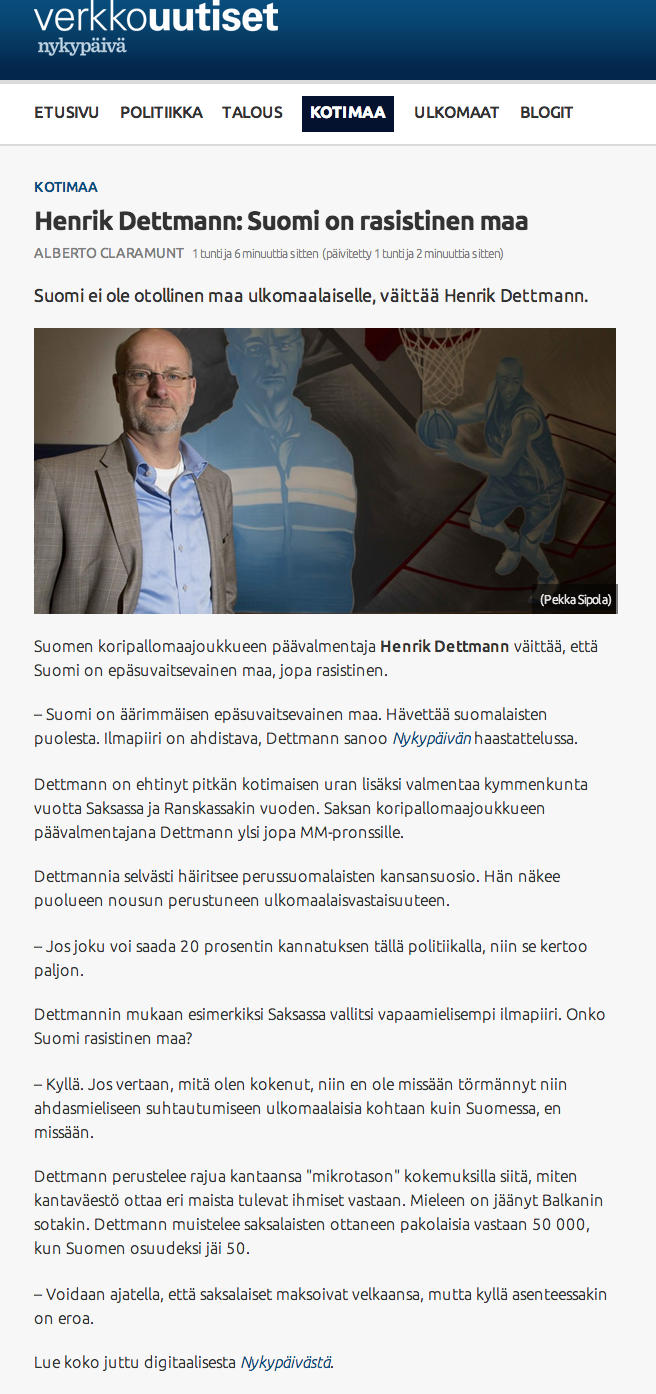
Henrik Dettmann: Finland is an “extremely intolerant” country

Posted on November 18, 2013 by Migrant Tales

Is Finland a racist country? Henrik Dettmann, head coach of the Finnish national basketball team, agrees and claims that Finland is an ”extremely intolerant” country that isn’t a favorable place for foreigners.

Kuvankaappaus 2013-11-18 kello 12.47.24

Read full story here.

“Yes [Finland is a racist country],” Dettmann is quoted as saying on Verkkouutiset. “If I compare what I have experienced [in different countries], nowhere have a bumped into such narrow-minded attitudes towards foreigners as in Finland, nowhere else.”

He said that if a party like the Perussuomalaiset get 20% of the votes in an election  by fueling anti-immigration sentiment, that already says a lot about the present state of Finland.

Dettmann has worked as a coach of the German and French national basketball teams.

It is a positive sign that more Finns are speaking out against racism in this country, which continues to be denied or played down.

If we had the opportunity to move twenty years ahead in time, how would we look at Finland’s darkest period in the new century?

One matter is for certain: Not enough voices spoke out against racism and intolerance.

Time has shown us that our anti-racism efforts in Finland haven’t been in vain

Posted on November 14, 2013 by Migrant Tales

It was only a few years ago when Migrant Tales was openly challenged by some for speaking out against racism in Finland. According to the more hostile commentators that posted on our site back then, racism didn’t exist in this country. If it existed, it was minor and exceptional.

Even after the anti-immigration and anti-EU Perussuomalaiset (PS) party scored their historic election victory in 2011, some Finns continued to live in denial about this social ill.  As intolerance was played down, Finland become an ever-hostile place for immigrants and visible minorities.

Here’s one comment Allan in May 2011 that sums it up:

That is exactly what Enrique is trying to achieve with his hate speech, or has already along with your kind of sycophants. Always there is a foreigner anything happens it is “racism” be it from having to pay a bus ticket and someone not sitting next to him, its “racism”. So that is why there is no racism in Finland, as it is all imagined. Boy called wolf one time too many.

Allan’s comment about racism in Finland is highly revealing because it shows how intolerance is able to see another day thanks to denial.

The question is no longer whether there is racism in Finland or not, but to what extent this social illness has found roots in this country. Those roots of intolerance are very deep and cover a wide area.

Still in denial?

Why then do some Finns still refuse to recognize that there are “other” Finns, who have the same rights as they to live here?

Why don’t you ask immigrants and visible minorities if they feel secure in Finland? How can they be if they are underemployed or unemployed? Why not ask third-culture children who, despite having lived all their lives here, are still labelled as pupils “with immigrant backgrounds” by teachers?

Why not ask why such youths have a greater chance of becoming marginalized than white Finns?

Why are we asking this question over and over again, if there is racism in Finland, if we have the answer and proof? Ever thought about asking the Romany minority of Finland, which have lived here for five centuries?

Tim Wise puts the whole issue in the following manner when he speaks of white privilege in the United States:

To be a person of color in this country, is to always have to know what the other guy thinks. It is to always have to know what the other person thinks about you. I you don’t, if you for one minute, you forget what other people think, your life is in danger.

The intolerance that Wise speaks of is already here in Finland and will reach the same intensity as in the United States if we do not take concrete steps to challenge such a social ill.

But why should a white Finn challenge intolerance? He’s the top dog, a member of the dominant group.

Sensible people understand that if racism isn’t challenged in our society, the biggest loser we’ll be the whole of society. White Finns will be able to keep their privilege but at a huge social cost.

To find a good answer whether intolerance is an issue in this country, it’s important to listen to those that are at the receiving end like Laura Eklund Nhaga.

I hope that more Finns, especially those with non-white backgrounds, stand up for their rights like this young woman.  

http://www.youtube.com/watch?v=sGts9CSbz1Y&list=PLUE9_qAC5gmHAME78ahFkFtCP5o1uG9T2


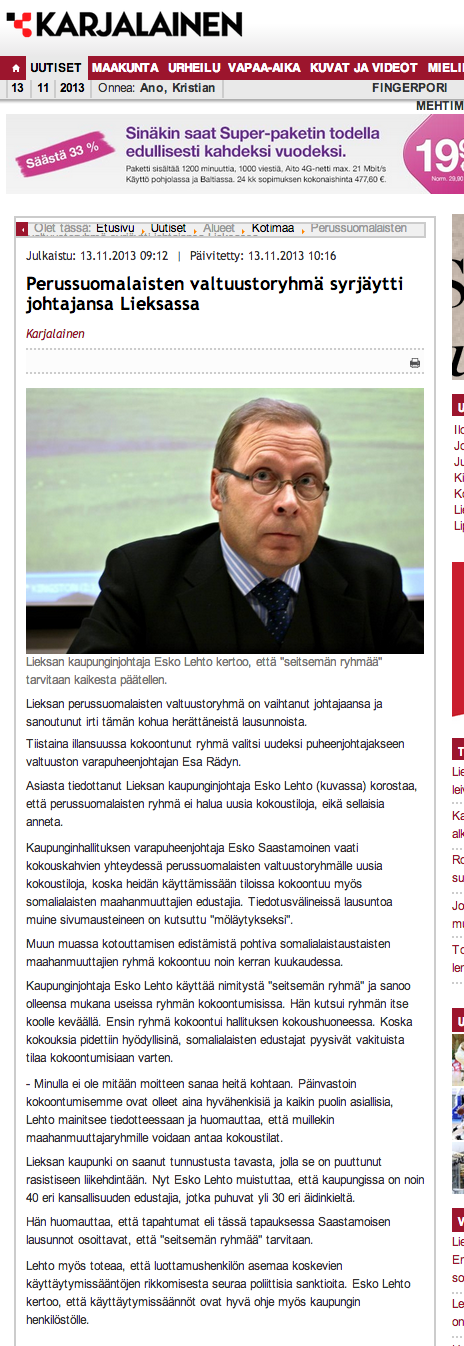
Lieksa, Finland, councilperson who wanted a “Somali-free” meeting room gets sacked as the PS’ town council leader

Posted on November 13, 2013 by Migrant Tales

Esko Saastamoinen, the Perussuomalaiset (PS) councilperson from Lieksa who demanded that a ”Somali-free” meeting room for his delegation, has been sacked as the PS’ town council leader, according to Karjalainen, a Joensuu-based daily. 

Saastamoinen was, however,  able to retain his post as the party’s Lieksa town board first vice president.

The PS councilperson faces as well charges for ethnic agitation and discrimination.

Kuvankaappaus 2013-11-13 kello 20.00.35

The former PS town council leader “demanded” at a public meeting on Monday that his delegation be given a new meeting room because it was being used by a Somali working group, according to YLE in English. 

The demand made by Saastamoinen for a new meeting room, which had been supported by another PS councilperson, was made in the presence of Lieksa Lehti editor Marja Mölsä, who published the news.

In an earlier story published by Iltalehti, in which the town secretary gave in to the Lieksa PS’ demands for a new meeting room, was flatly denied Wednesday by the town’s Mayor Esko Lehto.

He said that ”under no circumstances” will the PS councilpersons be given a new meeting room as the town secretary had confirmed in an earlier Iltalehti story.

The question we should ask after this latest scandal by the PS is why Saastamoinen and another PS councilperson, who supported the idea of a new meeting room, are still members of the party.

Certainly there would be outrage if a politician made a similar demand in a country like the United Kingdom or the United States.

This affair shows once again that the PS still treat nicely their racists.

It reveals as well why racism is still considered “normal” and encouraged in some parts of Finland.


Lieksa town secretary caves in to PS demands for “Somali-free” meeting room

Posted on November 12, 2013 by Migrant Tales

An earlier story, which claimed that a Perussuomalaiset (PS) Lieksa town council leader doesn’t want to be in the same room where a Somali group meets once a month, has been corrected by Karjalainen, a Joensuu-based daily. It is not the PS town council leader, Esko Saastamoninen, making such a demand but the PS councilpersons of Lieksa. 

Lieksa’s town secretary confirmed to tabloid Iltalehti Tuesday that the PS councilpersons will get a new meeting room.

What did I just read?! Yes, right, Lieksa’s town secretary caved in to PS’ demands for a ”clean room” where Somalis don’t meet once a month.

It’s difficult to weigh what is more offensive: The PS town councilmen’s demand or the town secretary’s compliance.

Saastamoinen wanted a clean room because he said that Somalis are carriers of different types of diseases and therefore the PS town councilmen didn’t want to meet in the same room as they.

Abdirahim Hussein, a Center Party politician who was born in Somalia, demanded that Saastamoinen should resign from his post as the PS’ town council head, according to Suomenmaa.

Kuvankaappaus 2013-11-12 kello 23.42.15

 Read full story (in Finnish) here.

“He shouldn’t be in politics,” he said. “Does he mean that Somalis aren’t clean? It is a defamation against us. These types of statements shouldn’t be acceptable.”

They are unacceptable and they should have no place in our society. Racists use a number of arguments to drive home their arguments. One of these is that immigrants carry different types of diseases.

The PS are the third-largest party in the Lieksa town council with eight councilpersons after the Social Democrats and Center Party. The anti-immigration and anti-EU party gained in Lieksa 22.5% of the votes in the 2012 municipal election, which is a 16.1% rise from 2008.


PS leader of Lieksa, Finland, refuses to be in the same room where Somalis meet

Posted on November 12, 2013 by Migrant Tales

Taking into account all the problems and positive solutions that have been found in the town of Lieksa in the region of South Karelia concerning its over 200-strong Somali community, it is disturbing that a city councilmen like Esko Saastamoinen, Perussuomalaiset (PS) town council leader, states he doesn’t want to be in the same room where Somalis meet once a month.

Saastamoinen, who is the town councilman leader of the PS, made his comment on Joensuu-based Karjalainen, which cites the local Lieksan Lehti.

Kuvankaappaus 2013-11-12 kello 13.39.51

Read full story (in Finnish) here.

Here’s a good indication why matters got off the wrong foot in Lieksa, which has been in the national spotlight due to the ethnic tension there.

Matters have improved a lot since then.

According to Saastamoinen, the PS want a ”clean meeting room” to meet.

What are we to think about this?

For one, Saastamoinen puts into question the good work that many are doing to integrate refugees into Finnish society.  It reveals as well the intolerance and xenophobia that has afflicted Finland through a party like the PS.

In many respects, Saastamoinen sounds like the racist white Southerners of the 1950s or how leaders of the National Front in the UK reacted to immigrants in the 1970s.

In plain English it’s called racism with a capital ”R.”

Is silence an effective response to racism?

Posted on November 7, 2013 by Migrant Tales

One of the questions we should ask ourselves is what should our response be to those that are hostile to migrants, visible minorities and our ever-growing cultural diversity. Should silence be the answer? 

One of the matters that I have learned through my many years of studying and writing about cultural diversity, is that silence should never be the answer to intolerance. What, then, should our reaction be?

Here’s a good answer: Our reaction to intolerance of any kind should be first and foremost a reaction.

There are many ways to react to racism and intolerance. On Migrant Tales we do it by writing.

Here are some things to take into account when you formulate a response:

  • Intolerance enjoys silence and intimidates people to be quiet. Silence is the water that feeds intolerance. Cut off its nourishment by cutting off its supply of silence.
  • React to intolerance in a firm but civil manner. Start of the discussion by stating, I disagree with you…
  • You’d be surprised how people change their views (at least publicly) when you make it known to them that racism is shameful and unacceptable.
  • Be informed by reading as much as you can about cultural diversity and intolerance.
  • Learn the language and arguments of those who promote intolerance. It’s not very difficult to figure out their arguments, which are simplistic and appeal to the racism of the listener.
  • One common argument used by racists is pointing out and grossly exaggerating “migrant problems” without offering any solutions.
  • An absolute favorite argument of the racists to justify their racism is: “They are so different from us that they will never adapt to our society.”
  • Racists like to generalize. It permits them to exaggerate and fear-monger.
  • No matter how much of an anti-racist you consider yourself to be, ask yourself “dumb questions” over and over again like why is racism bad.

It’s clear that some Finns are having a not only having a hard time accepting the fact that we are becoming a more culturally diverse society, but believe naively that newcomers who move to Finland are supposed to somehow become white like them.

Some denigrating terms and sayings used by the majority to impose their rule on minorities include maassa maan tavalla, or in Rome do as the Romans do. Other ones are maahanmuuttajataustainen, or person or pupil with immigrant background, and mamu, the nickname for maahanmuuttaja, or immigrant. 

There are two good ways to figure out if a label for a certain group or minority is ok:

  • Is the label to identify a group or minority made up by majority to single out the minority or by the minority to identify itself?
  • Does the label promote social equality or inequality?

What we are seeing in Finland and elsewhere are microaggressions on a much wider scale against migrants and visible minorities. These microaggressions are nothing more than the unwritten rules imposed by the majority on different minorities.

Derald Wing Sue’s defines microaggressions as occurring unconsciously and underline inclusion-exclusion and superiority-inferiority. They are the everyday putdowns, insults that aim to undermine the dignity of those who are marginalized.

So what should our response to racism be?

It should be first and foremost a response.

What kind of a response?

We live in a democratic country. Use all the means open to you to create change.

Be brave.


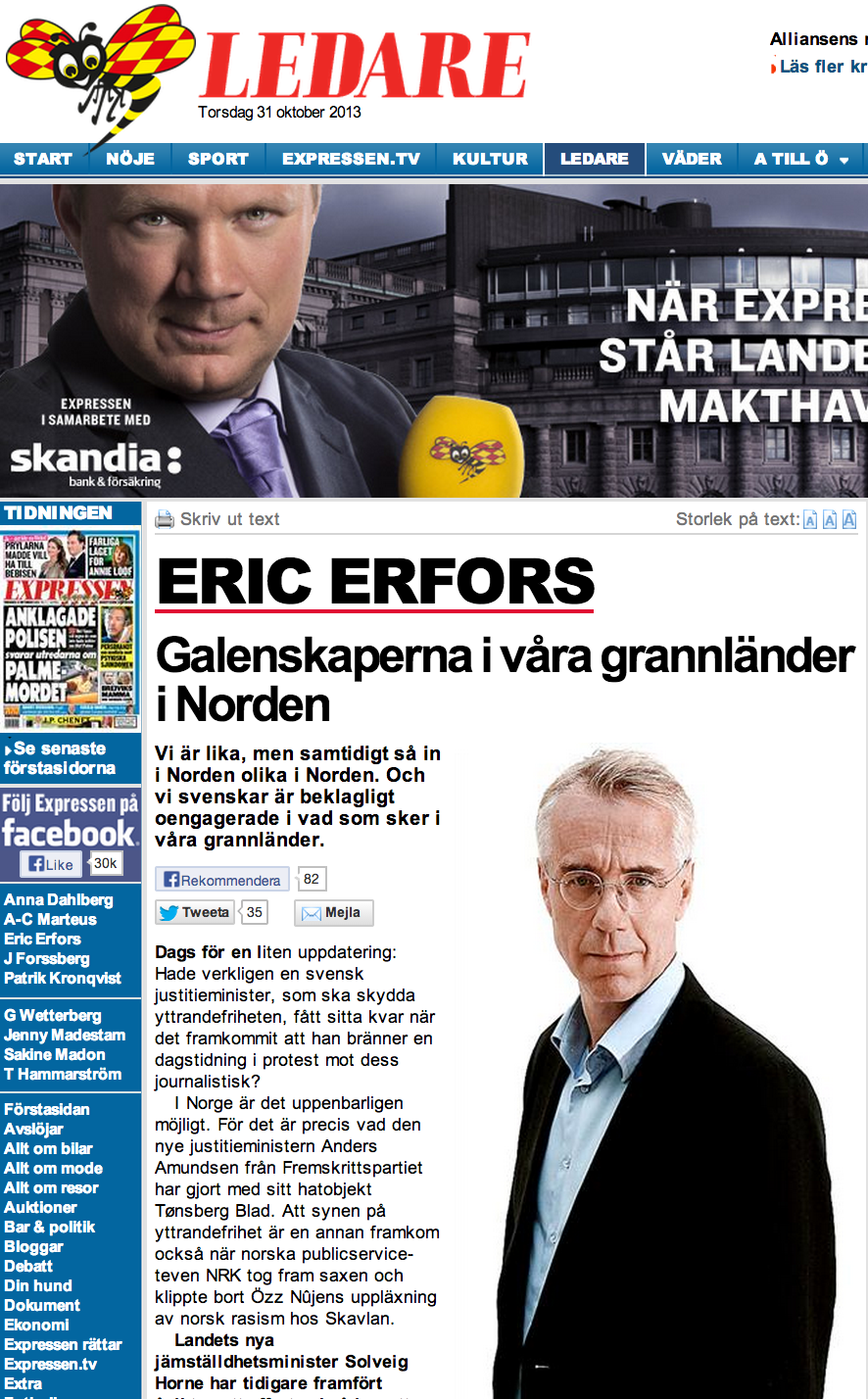
Columnist Eric Erfors of Sweden’s Expressen: What do Halla-aho and Räsänen say about the state of Finland today?

Posted on November 2, 2013 by Migrant Tales

Finland needs every now and then a wake-up call from the outside world. Columnist Eric Erfors of the Swedish tabloid Expressen, asks how is it possible that a person like Perussuomalaiset (PS) MP Jussi Halla-aho, which he calls a ”pure racist,” was eligible to become a deputy member of Finland’s delegation to the Council of Europe?

Erfors considered Halla-aho’s appointment to the Council of Europe as asking a pyromaniac to extinguish a fire.

Kuvankaappaus 2013-11-2 kello 7.16.36

Read full story (in Swedish) here.

Erfors states that it would be highly unlikely that Halla-aho would be accepted in the far-right anti-immigration Sweden Democrats. ”No [he wouldn’t be accepted] because it would be in conflict with its new image, which the party is trying to create” he writes.

Another Finnish politician that didn’t receive high marks on his column was Christian Democrat Interior Minister Päivi Räsänen, whose lowly views of gays, immigrants who aren’t Christians and minorities like the Roma are well-known.

It shouldn’t surprise anyone why Räsänen’s approval rating among the PS is so high.

The interesting question that Erfors poses to us in Finland is how did we arrive to such a point where a “pure racist” like Halla-aho was elected to parliament and ultra-conservative Räsänen appointed interior minister? What does it reveal about the present state of this country?

For one, it shows that the views of these two politicians have a home in Finland and go down well with many voters. But we’d have to look at Finland’s history to understand why we vote a “pure racist” to parliament and approve an ultra-conservative in government.

During most of our independence, Finland viewed the outside world with mistrust and did everything possible to discourage immigrants and foreign investment from coming to this country. Imagine the myths and “us”-versus-“them” mentality you have to drive home to reinforce your suspicions of foreigners from one generation to the next.

Halla-aho’s and Räsänen’s “appeal” is today a liability to Finland because it, if anything, is impoverishing this country politically, socially and what’s important, economically.

Instead of finding proactive solutions to our problems as is common in a Nordic welfare democracy, we are regressing in our worst prejudices with the weapon of scapegoating.

Finland needs leadership to challenge these threats that have already impacted our society in a negative manner.

I’m certain that leadership will come when our cultural diversity is strong enough and can stand on its feet.


Reija Härkönen: Jussi Halla-aho’s actions in parliament

Posted on November 1, 2013 by Migrant Tales

Reija Härkönen

When Jussi Halla-aho was getting prepared for the parliamentary elections, on the last day before the election day on April 16, 2011, he once again urged the anti-immigrant voters to act, thanked his own people (meaning the anti-immigrant circle) for their good work and the True Finns (Perussuomalaiset) of Helsinki and the neighborhood of Kontula for the arrangements. He said:

“I want to remind you once again that our importance in the future depends solely on the number of votes we get. Therefore, it is important that all of my supporters go to the polls, even if they have the assurance that I’ll get elected anyway.

I urge the rest of the country to vote for other True Finns, so that we can get as large group as possible [in parliament].”

Halla-aho also endorsed True Finn candidates whom his followers could vote for in the rest of Finland. Not that the True Finns party needed such a success, but the anti- immigrant so-called nuivat candidates needed it in order to get behind them a large parliamentary group.

In the same context, Halla-aho published for the last time his pre-election speech. It contains some doomsday text, but when read by a clearly articulate, shy-looking young man, the effect is somewhat tragicomic. This probably explains why the site with the text and video was taken down from the Internet. Fortunately everything can be found on the Internet, even Halla-aho’s campaign agenda:

http://web.archive.org/web/20110519104548/http://halla-aho.com/index.php/etusivu/loppurutistus-osa-11-16-4-2011/

Halla-aho headlined his speech “Change is possible,”  and wrote:

“We are facing a historic upheaval. On 6.4.2011 will open a window of opportunity. This window will close on the actual election day 17.4. The decisions you make in this timeframe will define Finland’s direction for years to come.

There are two reasons why these are the most important elections of Finland’s post-war period. First, they take a stand on important questions. If there is no radical change in immigration policy now, the social and economic consequences are going to be massive and largely irreversible.

This is not just trivial intimidation. In these elections we shall make up our minds whether we shall take the course of Sweden, France, Britain and Germany. We need not do so.”

The speech also mentioned briefly the EU, reducing aid to developing countries and supporting recreational shooters, but its main emphasis was  “immigration-criticism” and his long and self-sacrificing work, the loss of men, and fear-mongering that Finland is doomed to ruin unless “change” happens now: 

“In no previous elections have the voters had the same opportunity to express themselves as now. After years of criticism of immigration [policy], our project culminates in these elections, and it is the culmination of the True Finns immigration-critical candidates.

This is a fact, which everybody knows deep down inside. The entire media and all the other political parties are unanimously attacking the True Finns group for the simple reason that a change in immigration policy hinges on whether we win or lose. 

Our success in the election is what is being monitored. Our electoral victory is what is feared. If we win this election, the change can not be stopped. If we lose this election, our criticism of immigration [policy]shall be deemed as rejected and the multicultural steamroller will move on.”

On his familiar Hommaforum forum, Halla-aho summed up the last-minute atmosphere by quoting Tolkien:

“A great doom awaits you, either to rise above the height of all your fathers since the days of Elendil, or to fall into darkness with all that is left of your least.”

The election victory, which was christened jytky, became a reality. On Hommaforum, Halla-aho seemed to be a bit interested in a ministerial post, even though it was a little scary at the same time:

“It is clear that the mere visibility and a staggering number of votes forced to give me a reasonably visible and symbolically important task, but my honest opinion is that staying in the background actually offers a member of parliament like me the best possible potential. A prominent role should be given to those with the best technical know-how, and who do raise too many passions in people.”

The True Finns decided to fight it out in the opposition, but the administration committee chairmanship tasted sweet to Halla-aho. He signaled from the plenary session of April 25, 2011 the following:

“These are great days, and the proportions of the anti-immigrant revolution will be fully understood only in a longer perspective. Conversely, the tolerant people [anti-racists] will live in a nightmare, which they would not have been able to imagine a moment ago.”

In his blog on the same day, Halla-aho starts preparing his excited supporters for the precepts of  his parliamentary work and that results would not happen immediately:

“The writing to create political influence on the Internet, by its own conditions, often feels like a carnival.  It aims to ‘entertain’ the audience and attract attention. In political decision-making, especially at the highest levels of Government and in Parliament, this may not be the most efficient way of doing things. Influencing requires the maintenance of relations, particularly to official servants and other politicians, and decision-making takes place largely behind the scenes, at coffee tables and in corridors. Political decision-making is not entertaining and not transparent, and in this respect we need to adjust to the rules. In politics you need to advance in small steps, not thunderously.”

“You have given us your trust in the election. It will be measured in the next election. Until then, I ask you to trust that we will do our best, even if we are less visible in the public eye, and regardless of what the media are reporting about us.  Evaluate the achievements in the course of four years, not in real time.”

Such a less public and behind-the-scenes strategy did not please everyone, and Halla-aho was forced to defend his strategy:

” When I say to play by the rules of the house, I just mean the method, not giving up our principles. Most of you probably knew that.”

“Compromises are inevitable in politics.  Let us imagine a situation in which we promised a stop on family reunifications, if we agree, during the election period, not to change the status of [mandatory] Swedish at schools.”

“What should I do? What would be the about-turns, and a betrayal to voters?”

“Which in general is the most important thing: the preservation of the halo and the integrity of the anti-immigrant representatives or the fact that the anti-immigrant agenda will be promoted?”

Family reunification is in  Halla-aho’s opinion the worst problem of our immigration policy. Reuniting families means, in his mind, that women and children will arrive, who in turn will give rise to more men, women and children. This would, after all, not be too bad, of course, since Halla-aho himself has a family of four children. This would, however, be in conflict with the aims of the far-right extreme nationalist Suomen Sisu association, which is openly against the “unnatural mixing of peoples” and following “the Swedish, French, German and British course”.

After “sending tanks” to the streets of Greece, and after being for a short time expelled from his parliamentary group and losing the administration committee presidency in the summer of 2012, Halla-aho reassured his supporters on Hommaforum:

“The promise of  ‘change of tactics’ means that in my debate I will focus to not give the other party ‘easy pickings.'”

Halla-aho has seemingly been focused to believe that the always-sharp Swedish People’s Party MP Jörn Donner has sold himself cheap and believes the True Finns have calmed down as a party. When MP James Hirvisaari was kicked out of the True Finns and formed his own parliamentary group (Muutos 2011) for showing too visibly what the anti-immigration wing of the party really thought, Halla-aho will continue to influence matters behind the scenes. This is what he’s done:

Legal Initiatives

  • The Act amending the Penal Code , Chapter 17 (the law of breaching the sanctity of religion) 20/09/2013
  • The Penal Code Chapter 11, § 10 of the Council (the law on ethnic agitation) 09/20/2013
  • Law of the Firearms Act on 02.07.2013
  • Law of the Firearms Act on 02.07.2013
  • Law of the Firearms Act on 02.07.2013
  • Law of the Firearms Act 6 § on 07/02/2013
  • Law of the Firearms Act 6 § on 07/02/2013
  • Law of changing the Aliens Act § 51 and § 149 on 29.10.2012

Budget Initiatives

  • Refugees and asylum-seekers: of the proposed appropriation reduction of 28.9.2012
  • The EU Solidarity and Management of Migration Flows program SOLID subject to the proposed reduction of funds of 28.9.2012
  • The Ombudsman for Minorities and the National Discrimination Tribunal: the proposed reduction of the operating expenditure of 28.9.2012
  • “European Finland”: the proposed reduction of state aid allocation of 28.9.2012
  • The retired Presidents: the proposed reduction of the cost appropriation of 8.9.2012

Written Questions

  • The obligation to criminalize ethnic agitation 10/25/2013
  • Deportation of persons receiving a negative asylum or a residence permit 10/11/2013
  • Teacher’s possibilities of intervening disturbances in school 19/04/2013
  • International criminalization of faith criticism 29.11.2012
  • Refugee status and subsidiary protection status, the abolition of 22.8.2012

With the help of firearm laws, the anti-immigrant True Finns are working to change the direction of Finland’s preparedness to an external threat. One way to prepare for such a threat is for Finnish homes to be armed and home owners should carry more robust weapons than just pistols and air rifles.

Easier access to weapons and firearms is an important matter in the eyes of Halla-aho’s supporters. As soon as the parliamentary work had started, Halla-aho passed the firearms trainer course and made sure that the media and Hommaforum knew about this.

Halla-aho’s intention, revealed on Hommaforum, is to become an effective politician: “If the opposition wants to really affect things, one must be able to influence the government’s party representatives, and to be able to do it means being nice and sober”

He may already have had a little bit of success in this. Or maybe it’s just the general male mentality: “It’s harmless for boys to play with guns” which made MP Kari Rajamäki to approve of Halla-aho’s initiatives and state: “These are quite reasonable proposals.”

All in all, Halla-aho has acted exactly the way he promised his voters and the True Finns by suppressing refugees, suppressing minorities, and facilitating access to guns. In addition, he seeks as well to change the law on ethnic agitation so that Muslims and immigrants can be insulted publicly with impunity.

Taxpayers are paying Halla-aho to do this type of work as well as paying the salary of other True Finn MPs. These representatives are also – as sad  it is to say – the representatives of our people around the world.

  • Previous
  • 1
  • …
  • 57
  • 58
  • 59
  • 60
  • 61
  • 62
  • 63
  • …
  • 92
  • Next
Read more about documentary film
Read more

Recent Posts

  • Finland’s tabloids Iltalehti and Ilta-Sanomat are the pits
  • Riikka Purra’s Dr Jekyll and Mr Hyde mask
  • Double standards
  • Perussuomalaiset: Uusi logo, sama vanha juttu
  • Taco Trump

Recent Comments

  1. Absolutely Socking: Racist Finnish Facebook group against human rights gets flooded with socks on Musta Barbaari’s mother and sister charged by the police in “ethnic profiling” case
  2. Ilkka Nuotio on Pekka Myrskylä: “Tilastot kertovat toista kuin poliittinen keskustelu”
  3. Genrih Soinkara on The war in Ukraine and the Russian-Finnish border crisis are showing Finland’s ugly side
  4. Ahti Tolvanen on Comment by Ahti Tolvanen on the Helsinki +50 conference
  5. Angel Barrientos on Angel Barrientos is one of the kind beacons of Finland’s Chilean community

Archives

  • June 2026
  • May 2026
  • April 2026
  • March 2026
  • February 2026
  • January 2026
  • December 2025
  • November 2025
  • October 2025
  • September 2025
  • August 2025
  • July 2025
  • June 2025
  • May 2025
  • April 2025
  • March 2025
  • February 2025
  • January 2025
  • December 2024
  • November 2024
  • October 2024
  • September 2024
  • August 2024
  • July 2024
  • June 2024
  • May 2024
  • April 2024
  • March 2024
  • February 2024
  • January 2024
  • December 2023
  • November 2023
  • October 2023
  • September 2023
  • August 2023
  • July 2023
  • June 2023
  • May 2023
  • April 2023
  • March 2023
  • February 2023
  • January 2023
  • December 2022
  • November 2022
  • October 2022
  • September 2022
  • August 2022
  • July 2022
  • June 2022
  • May 2022
  • April 2022
  • March 2022
  • February 2022
  • January 2022
  • December 2021
  • November 2021
  • October 2021
  • September 2021
  • August 2021
  • July 2021
  • June 2021
  • May 2021
  • April 2021
  • March 2021
  • February 2021
  • January 2021
  • December 2020
  • November 2020
  • October 2020
  • September 2020
  • August 2020
  • July 2020
  • June 2020
  • May 2020
  • April 2020
  • March 2020
  • February 2020
  • January 2020
  • December 2019
  • November 2019
  • October 2019
  • September 2019
  • August 2019
  • July 2019
  • June 2019
  • May 2019
  • April 2019
  • March 2019
  • February 2019
  • January 2019
  • December 2018
  • November 2018
  • October 2018
  • September 2018
  • August 2018
  • July 2018
  • June 2018
  • May 2018
  • April 2018
  • March 2018
  • February 2018
  • January 2018
  • December 2017
  • November 2017
  • October 2017
  • September 2017
  • August 2017
  • July 2017
  • June 2017
  • May 2017
  • April 2017
  • March 2017
  • February 2017
  • January 2017
  • December 2016
  • November 2016
  • October 2016
  • September 2016
  • August 2016
  • July 2016
  • June 2016
  • May 2016
  • April 2016
  • March 2016
  • February 2016
  • January 2016
  • December 2015
  • November 2015
  • October 2015
  • September 2015
  • August 2015
  • July 2015
  • June 2015
  • May 2015
  • April 2015
  • March 2015
  • February 2015
  • January 2015
  • December 2014
  • November 2014
  • October 2014
  • September 2014
  • August 2014
  • July 2014
  • June 2014
  • May 2014
  • April 2014
  • March 2014
  • February 2014
  • January 2014
  • December 2013
  • November 2013
  • October 2013
  • September 2013
  • August 2013
  • July 2013
  • June 2013
  • May 2013
  • April 2013
  • March 2013
  • February 2013
  • January 2013
  • December 2012
  • November 2012
  • October 2012
  • September 2012
  • August 2012
  • July 2012
  • June 2012
  • May 2012
  • April 2012
  • March 2012
  • February 2012
  • January 2012
  • December 2011
  • November 2011
  • October 2011
  • September 2011
  • August 2011
  • July 2011
  • June 2011
  • May 2011
  • April 2011
  • March 2011
  • February 2011
  • January 2011
  • December 2010
  • November 2010
  • October 2010
  • September 2010
  • August 2010
  • July 2010
  • June 2010
  • May 2010
  • April 2010
  • March 2010
  • February 2010
  • January 2010
  • December 2009
  • November 2009
  • October 2009
  • September 2009
  • August 2009
  • July 2009
  • December 2008
  • November 2008
  • October 2008
  • September 2008
  • August 2008
  • July 2008
  • June 2008
  • May 2008
  • April 2008
  • March 2008
  • February 2008
  • January 2008
  • November 2007
  • October 2007
  • September 2007
  • August 2007
  • July 2007
  • June 2007
  • May 2007

Categories

  • ?? Gia L?c
  • ????? ?????? ????? ???????? ?? ??????
  • ???????
  • @HerraAhmed
  • @mondepasrond
  • @nohatefinland
  • @oula_silver
  • @Varathas
  • A Pakistani family
  • äärioikeisto
  • Abbas Bahmanpour
  • Abdi Muhis
  • Abdirahim Hussein Mohamed
  • Abdirahim Husu Hussein
  • Abdirisak Mahamed
  • About Migrant Tales
  • activism
  • Adam Al-Sawad
  • Adel Abidin
  • Afrofinland
  • Ahmed IJ
  • Ahti Tolvanen
  • Aino Pennanen
  • Aisha Maniar
  • Alan Ali
  • Alan Anstead
  • Alejandro Díaz Ortiz
  • Alekey Bulavsev
  • Aleksander Hemon
  • Aleksanterinliitto
  • Aleksanterinliitto ry
  • Aleksanterinliitto ry:n hallitus
  • Alex Alex
  • Alex Mckie
  • Alexander Nix
  • Alexandra Ayse Albayrak
  • Alexis Neuberg
  • Ali Asaad Hasan Alzuhairi
  • Ali Hossein Mir Ali
  • Ali Rashid
  • Ali Sagal Abdikarim
  • Alina Tsui
  • Aline Müller
  • All categories
  • Aman Heidari
  • Amiirah Salleh-Hoddin & Jana Turk
  • Amin A. Alem
  • Amir Zuhairi
  • Amkelwa Mbekeni
  • Ana María Gutiérrez Sorainen
  • Anachoma
  • Anders Adlecreutz
  • Angeliina Koskinen
  • Anna De Mutiis
  • Anna María Gutiérrez Sorainen
  • Anna-Kaisa Kuusisto ja Jaakko Tuominen
  • Annastiina Kallius
  • Anneli Juise Friman Lindeman
  • Announcement
  • Anonymous
  • Antero Leitzinger
  • anti-black racism
  • Anti-Hate Crime Organisation Finland
  • Anudari Boldbaatar
  • Arshiya Nasser
  • Aspergers Syndrome
  • Asylum Corner
  • Asylum seeker 406
  • Athena Griffin and Joe Feagin
  • Autism
  • Avaaz.org
  • Awale Olad
  • Ayan Said Mohamed
  • AYY
  • Barachiel
  • Bashy Quraishy
  • Beatrice Kabutakapua
  • Beri Jamal
  • Beri Jamal and Enrique Tessieri
  • Bertolt Brecht
  • Boiata
  • Boodi Kabbani
  • Bruno Gronow
  • Carmen Pekkarinen
  • Çelen Oben and Sheila Riikonen
  • Chiara Costa-Virtanen
  • Chiara Costa-Virtanen
  • Chiara Sorbello
  • Christian Thibault
  • Christopher Wylie
  • Clara Dublanc
  • Dana
  • Daniel Malpica
  • Danilo Canguçu
  • David Papineau
  • David Schneider
  • Dexter He
  • Don Flynn
  • Dr Masoud Kamali
  • Dr. Faith Mkwesha
  • Dr. Theodoros Fouskas
  • Edna Chun
  • Eeva Kilpi
  • Emanuela Susheela
  • En castellano
  • ENAR
  • Enrique
  • Enrique Tessieri
  • Enrique Tessieri & Raghad Mchawh
  • Enrique Tessieri & Yahya Rouissi
  • Enrique Tessieri and Muhammed Shire
  • Enrique Tessieri and Sira Moksi
  • Enrique Tessieri and Tom Vandenbosch
  • Enrique Tessieri and Wael Che
  • Enrique Tessieri and Yahya Rouissi
  • Enrique Tessieri and Zimema Mhone
  • Epäluottamusmies
  • EU
  • Europe
  • European Islamophobia Report
  • European Islamophobia Report 2019,
  • European Union
  • Eve Kyntäjä
  • Ezequiel Caldeiro
  • Facebook
  • Fadumo Dayib
  • Faisa Kahiye
  • Farhad Manjoo
  • Fasismi
  • Finland
  • Fizza Qureshi
  • Flyktingar och asyl
  • Foreign Student
  • Fozia Mir-Ali
  • Frances Webber
  • Frida Selim
  • Gareth Rice
  • Ghyslain Vedeaux
  • Global Art Point
  • Great Replacement
  • Habiba Ali
  • Hami Bahadori
  • Hami Bahdori
  • Hamid
  • Hamid Alsaameere
  • Hamid Bahdori
  • Handshake
  • Harmit Athwal
  • Hassan Abdi Ali
  • Hassan Muhumud
  • Heikki Huttunen
  • Heikki Wilenius
  • Helsingin Sanomat
  • Henning van der Hoeven
  • Henrika Mälmsröm
  • Hser Hser
  • Hser Hser ja Mustafa Isman
  • Husein Muhammed
  • Hussain Kazemian
  • Hussain Kazmenian
  • Ibrahim Khan
  • Ida
  • Ignacio Pérez Pérez
  • Iise Ali Hassan
  • Ilari Kaila & Tuomas Kaila
  • Imam Ka
  • inside-an-airport
  • Institute of Race Relations
  • Iraqi asylum seeker
  • IRR European News Team
  • IRR News Team
  • Islamic Society of Norhern FInland
  • Islamic Society of Northern Finland
  • Islamophobia
  • Jacobinmag.com
  • Jallow Momodou
  • Jan Holmberg
  • Jane Elliott
  • Jani Mäkelä
  • Jari Luoto
  • Jari Taponen
  • Jegor Nazarov
  • Jenni Stammeier
  • Jenny Bourne
  • Jessie Daniels
  • Joe Davidow
  • Johannes Koski
  • John D. Foster
  • John Grayson
  • John Marriott
  • Jon Burnett
  • Jorma Härkönen
  • Jos Schuurmans
  • José León Toro Mejías
  • Josue Tumayine
  • Jouni Karnasaari
  • Juan Camilo
  • Jukka Eräkare
  • Julian Abagond
  • Julie Pascoet
  • Jussi Halla-aho
  • Jussi Hallla-aho
  • Jussi Jalonen
  • JusticeDemon
  • Kadar Gelle
  • Kaksoiskansalaisuus
  • Kansainvälinen Mikkeli
  • Kansainvälinen Mikkeli ry
  • Katherine Tonkiss
  • Kati Lepistö
  • Kati van der Hoeven-Lepistö
  • Katie Bell
  • Kättely
  • Kerstin Ögård
  • Keshia Fredua-Mensah & Jamie Schearer
  • Khadidiatou Sylla
  • Khadra Abdirazak Sugulle
  • Kiihotus kansanryhmää vastaan
  • Kirsi Crowley
  • Koko Hubara
  • Kristiina Toivikko
  • Kubra Amini
  • KuRI
  • La Colectiva
  • La incitación al odio
  • Laura Huhtasaari
  • Lauri Finér
  • Leif Hagert
  • Léo Custódio
  • Leo Honka
  • Leontios Christodoulou
  • Lessie Branch
  • Lex Gaudius
  • Leyes de Finlandia
  • Liikkukaa!
  • Linda Hyökki
  • Liz Fekete
  • M. Blanc
  • Maarit Snellman
  • Mahad Sheikh Musse
  • Maija Vilkkumaa
  • Malmin Kebab Pizzeria Port Arthur
  • Marcell Lorincz
  • Mari Aaltola
  • María Paz López
  • Maria Rittis Ikola
  • Maria Tjader
  • Marja-Liisa Tolvanen
  • Mark
  • Markku Heikkinen
  • Marshall Niles
  • Martin Al-Laji
  • Maryan Siyad
  • Matt Carr
  • Mauricio Farah Gebara
  • Media Monitoring Group of Finland
  • Micah J. Christian
  • Michael McEachrane
  • Michele Levoy
  • Michelle Kaila
  • Migrant Tales
  • Migrant Tales Literary
  • Migrantes News
  • Migrants' Rights Network
  • MigriLeaks
  • Mikko Kapanen
  • Miriam Attias and Camila Haavisto
  • Mohamed Adan
  • Mohammad Javid
  • Mohammad M.
  • Monikulttuurisuus
  • Monisha Bhatia and Victoria Canning
  • Mor Ndiaye
  • Muh'ed
  • Muhamed Abdimajed Murshid
  • Muhammed Shire
  • Muhammed Shire and Enrique Tessieri
  • Muhis Azizi
  • Musimenta Dansila
  • Muslimiviha
  • Musulmanes
  • Namir al-Azzawi
  • Natsismi
  • Neurodiversity
  • New Women Connectors
  • Nils Muižnieks
  • No Labels No Walls
  • Noel Dandes
  • Nuor Dawood
  • Omar Khan
  • Otavanmedia
  • Oula Silvennoinen
  • Paco Diop
  • Pakistani family
  • Pentti Stranius
  • Perussuomalaiset
  • perustuslaki
  • Petra Laiti
  • Petri Cederlöf
  • Pia Grochowski
  • Podcast-lukija Bea Bergholm
  • Pohjois – Suomen Islamilainen Yhdyskunta
  • Pohjois Suomen Islamilainen Yhyskunta
  • Polina Kopylova
  • Race Files
  • racism
  • Racism Review
  • Raghad Mchawh
  • Ranska
  • Rashid H. and Migrant Tales
  • Rasismi
  • Raul Perez
  • Rebecka Holm
  • Reem Abu-Hayyeh
  • Refugees
  • Reija Härkönen
  • Remiel
  • Reza Nasri
  • Richard Gresswell
  • Riikka Purra
  • Risto Laakkonen
  • Rita Chahda
  • Ritva Kondi
  • Robito Ibrahim
  • Roble Bashir
  • Rockhaya Sylla
  • Rodolfo Walsh
  • Roger Casale
  • Rostam Atai
  • Roxana Crisólogo Correa
  • Ruth Grove-White
  • Ruth Waweru-Folabit
  • S-worldview
  • Sadio Ali Nuur
  • Sami Rusanen
  • Sandhu Bhamra
  • Sara de Jong
  • Sarah Crowther
  • Sari Alhariri
  • Sarkawt Khalil
  • Sasu
  • Scot Nakagawa
  • Shabana Ahmadzai
  • Shada Islam
  • Sharon Chang blogs
  • Shenita Ann McLean
  • Shirlene Green Newball
  • Sini Savolainen
  • Sira Moksi
  • Sonia K.
  • Sonia Maria Koo
  • Steverp
  • Stop Deportations
  • Suldaan Said Ahmed
  • Suomen mediaseurantakollektiivi
  • Suomen Muslimifoorumi ry
  • Suomen viharikosvastainen yhdistys
  • Suomen viharikosvastainen yhdistys ry
  • Suomi
  • Supermen
  • Susannah
  • Suva
  • Syrjintä
  • Talous
  • Tapio Tuomala
  • Taw Reh
  • Teivo Teivainen
  • The Daily Show
  • The Heino
  • The Supermen
  • Thomas Elfgren
  • Thulfiqar Abdulkarim
  • Tim McGettigan
  • Tino Singh
  • Tito Moustafa Sliem
  • Tobias Hübinette and L. Janelle Dance
  • Transport
  • Trica Danielle Keaton
  • Trilce Garcia
  • Trish Pääkkönen
  • Trish Pääkkönen and Enrique Tessieri
  • Tuulia Reponen
  • Uncategorized
  • UNITED
  • University of Eastern Finland
  • Uyi Osazee
  • Väkivalta
  • Vapaa Liikkuvuus
  • Venla-Sofia Saariaho
  • Vieraskynä
  • W. Che
  • W. Che an Enrique Tessieri
  • Wael Ch.
  • Wan Wei
  • Women for Refugee Women
  • Xaan Kaafi Maxamed Xalane
  • Xassan Kaafi Maxamed Xalane
  • Xassan-Kaafi Mohamed Halane & Enrique Tessieri
  • Yahya Rouissi
  • Yasmin Yusuf
  • Yassen Ghaleb
  • Yle Puhe
  • Yuliet Tresa
  • Yve Shepherd
  • Zahra Khavari
  • Zaker
  • Zalina Ametova
  • Zamzam Ahmed Ali
  • Zeinab Amini ja Soheila Khavari
  • Zimema Mahone and Enrique Tessieri
  • Zimema Mhone
  • Zoila Forss Crespo Moreyra
  • ZT
  • Zulma Sierra
  • Zuzeeko Tegha Abeng
© 2026 Migrant tales | Powered by Minimalist Blog WordPress Theme