Migrant tales
Menu
  • #MakeRacismHistory “In Your Eyes”
  • About Migrant Tales
  • It’s all about Human Rights
  • Literary
  • Migrant Tales Media Monitoring
  • NoHateFinland.org
  • Tales from Europe
Menu

Tag: United Kingdom

Should Finns trust the police?

Posted on June 23, 2013 by Migrant Tales

“…when the laws have ceased to be executed, as this can only come from the corruption of the republic, the state is already lost.”

Montesquieu (1689-1755)

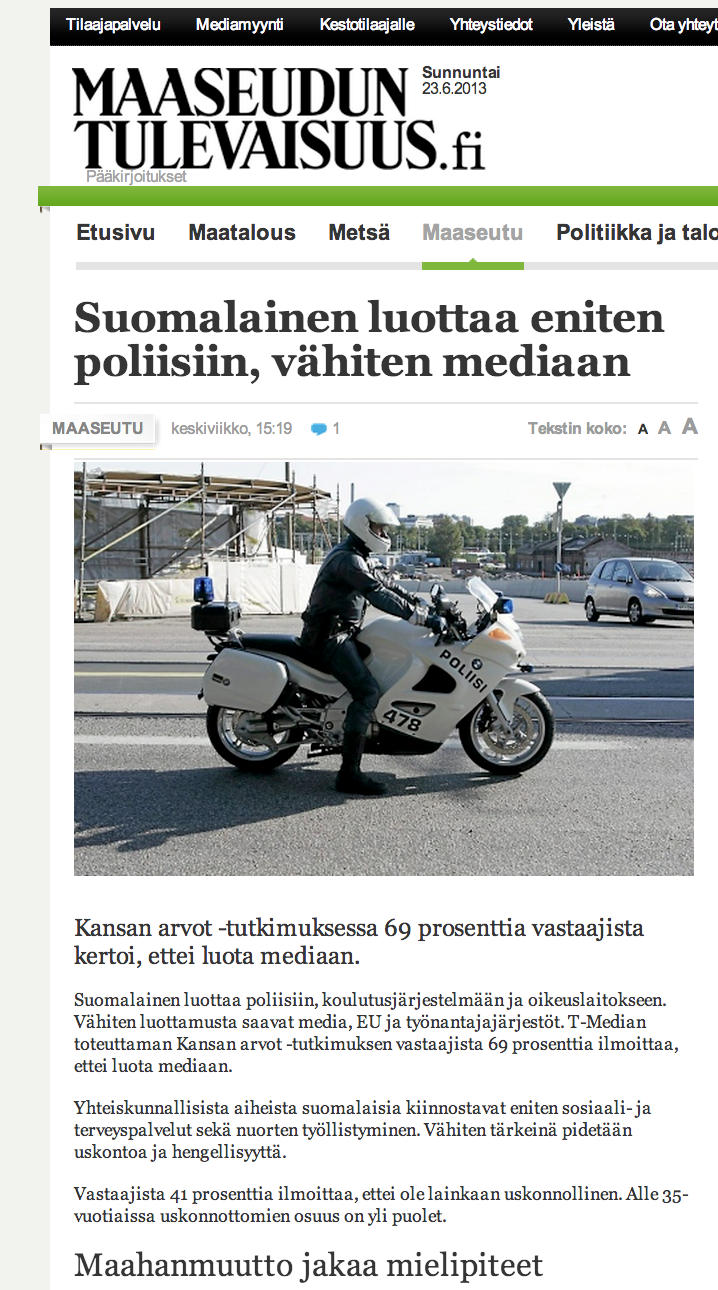
A survey by T-Media reveals that Finns trust the most the police, educational and justice system and the least the media, EU and employer’s associations. Of those surveyed, 69% responded that they didn’t trust the media.

Kuvankaappaus 2013-6-23 kello 14.01.30

Even  if close to two-thirds of Finns trust their police, should we in light of the revelations by Edward Snowden of vast global surveillance by the National Security Agency (NSA) and GCHQ?

A good case in point is a request  by the Finnish Security Intelligence Service (Supo) for increased surveillance powers.

One matter that should worry us is not the Supo request per se but how little some Finnish politicians, the media and public appear to care for oversight and transparency, which are crucial to the survival of our Nordic welfare state democracy.

Would the police and Supo abuse such power if they got greater surveillance rights?

The proper question we should ask, however, is what guarantees does the public have that the police and Supo will not go as far as theNSA and GCHQ? Do we have any idea how much we are being surveyed in Finland?

The best way to secure trust and an effective checks and balance system through proper oversight is paradoxically mistrust.  It would be naive, even reckless, to believe that the police and other agencies that claim to defend and guarantee our security will always do so in our best interest. Power always corrupts.

Just like corporations can get greedy, so can military and public institutions.  Securing support and vast funding means putting out a lot of spin and hype in order to instil fear in the public that we are constantly under threat.

Asking the military and national security agencies to make the world a more secure place is like asking a madman to make the world saner.

It will never happen.


Migrant Rights’ Network: UKIP has an advantage that is not based on concrete policy proposals

Posted on May 11, 2013 by Migrant Tales

By Awale Olad

The aftermath of the UKIP surge in the polls in the local elections has led to a lot of soul searching in mainstream politics. To the detriment of the Conservative Party whilst also hacking away at both the support of the Labour and Liberal Democrats parties, UKIP emerged as the third most popular party in Britain today.  

But a lot has to be said for the state parliament finds itself in 2013. In 2008, the UK entered its longest and harshest economic crisis in 60 years, mainly caused by an unhinged financial sector. Economic growth has been almost non-existent since then.

In 2009, parliamentarians were publicly crucified for living lavishly on expenses paid by the taxpayer and trust in politicians plummeted considerably. MPs are yet to be acquitted by the court of public opinion.

In 2010 the public decided that there was to be no overall winner at the General Election, which took the country into a new political direction – mainly consensus politics. And in 2011 the phone hacking scandal in the press erupted and shook the nation considerably.

With some in the public now openly engaged in warfare with mainstream politicians and further compounded by a politically apathetic majority, UKIP vacuuming up the votes in the space left unoccupied was inevitable.

The public managed to deliver a puncture to the political spectrum in revenge for what Andrew Rawnsley refers to a ‘resentment felt by many voters that Britain is run in their own interests and those of their friends by a lookalike metropolitan elite who are all implicated in the economic mess.’ However, there is a case to be argued for the need to modernise, and move with the changing demographics of the country, if the parties want to be seen to be fit for government.

YouGov’s analysis of the results for the Observor on Sunday shows that UKIP voters worry mostly about the economy (59%) and immigration (51%), very disproportionately to voters as a whole that worry about immigration (31%). They also tend to be Tory voters who live in the Midlands, who are older and predominantly working class men. But coming second in South Shields would have sent chills down the spine of Labour Party strategists as well.

UKIP doesn’t currently have a clear-cut policy on immigration. It’s ‘undergoing a review and update’ according to its website.  So rhetoric as opposed to actual policies drove its recent successes, which mobilised their supporters, who dislike today’s political class, to the ballot boxes.

David Cameron almost immediately came under pressure to change tack on a number of issues but mainly to bring forward the promised referendum on Europe. His Tory government and friendly backbench colleagues have toured the studios to pour cold water over the idea, and suggested the public needed to deliver a Tory majority in 2015 for the referendum, given that their Coalition partners and the Opposition would kill it off at the first reading in parliament. Good excuse, but will probably do little to win back support from their dissenting base.

Pollsters and political commentators will continue to dissect the results of last week’s local election results and will be conjuring up future predictions of how well UKIP will do at next year’s European and local elections. Cameron’s greatest difficulty is trying to effectively deliver his government’s programme of work without having to do a volte-face on a number of issues, in particular, immigration.

His record will show that he reduced immigration as promised and that’s how he should be judged – it’s also very likely that given the sluggish economy, senior minsters may have an allergic reaction to further draconian measures on immigration and a telling sign that senior Tories are happy with the current flow of immigration is the lack of primary legislation that has come forward to reduce immigration to the level of the early 90s.

The Coalition government continues to control immigration by tweaking Labour’s Points Based System (PBS). Not a single bit of primary legislation aimed at controlling immigration numbers has been introduced under a Tory Prime Minister since Edward Heath.

Nadine Dorries MP brainstormed the recent Eastleigh by-election results in which UKIP voters ‘lapped up’ the need for an Australian-style immigration system… much like the UK’s existing PBS, which is based on the Australian PBS. This is further confused by the fact that UKIP hasn’t got an immigration policy – so if the rhetoric is more draconian than its actual concrete proposals, then it can be argued that UKIP accepts the mainstream consensus on immigration policy, which gives them an illogical advantage that needs to be challenged.

The Tories are unlikely to change tack immediately in response to UKIP’s recent surge. They may (rightly) be banking on their tribe to return home and defend them against a Labour onslaught in 2015.

However, from now until the next General Election, the Conservatives are expected to experience a slump in their support at the ballot box. Now is the time to think of new ways to neutralise the UKIP appeal and attract Labour and Lib Dem supporters if they are to perform better in the 2015 election.

Read original story here.

This piece was reprinted by Migrant Tales with permission.


How ideologically alike is the PS with the UKIP and BNP?

Posted on May 11, 2013 by Migrant Tales

The recent local election victory of the anti-EU and anti-immigration UKIP of Britain is a good example of what Finland experienced with the rise of the Perussuomalaiset (PS) in April 2011. While the United Kingdom and Finland are vastly different countries, the knee-jerk reaction of the ruling parties to right-wing populism and rhetoric is strikingly similar.

Instead of challenging the anti-EU and anti-immigration stance of the UKIP or PS, the Tories of the UK and Kokoomus and Social Democrats of Finland bowed to the political threat by mimicking the UKIP’s and PS’ message, respectively.

In Finland, Kokoomus and the Social Democrats have paid a dear price for their lack of leadership in challenging an anti-EU, anti-immigration and especially anti-Islam party. The only party that didn’t parrot too much the PS’ rhetoric was the Center Party, which was the biggest loser in the 2011 election.

Apart from being aided by being in the opposition, the Center Party’s decision to not mimic the PS appears to have paid off handsomely.

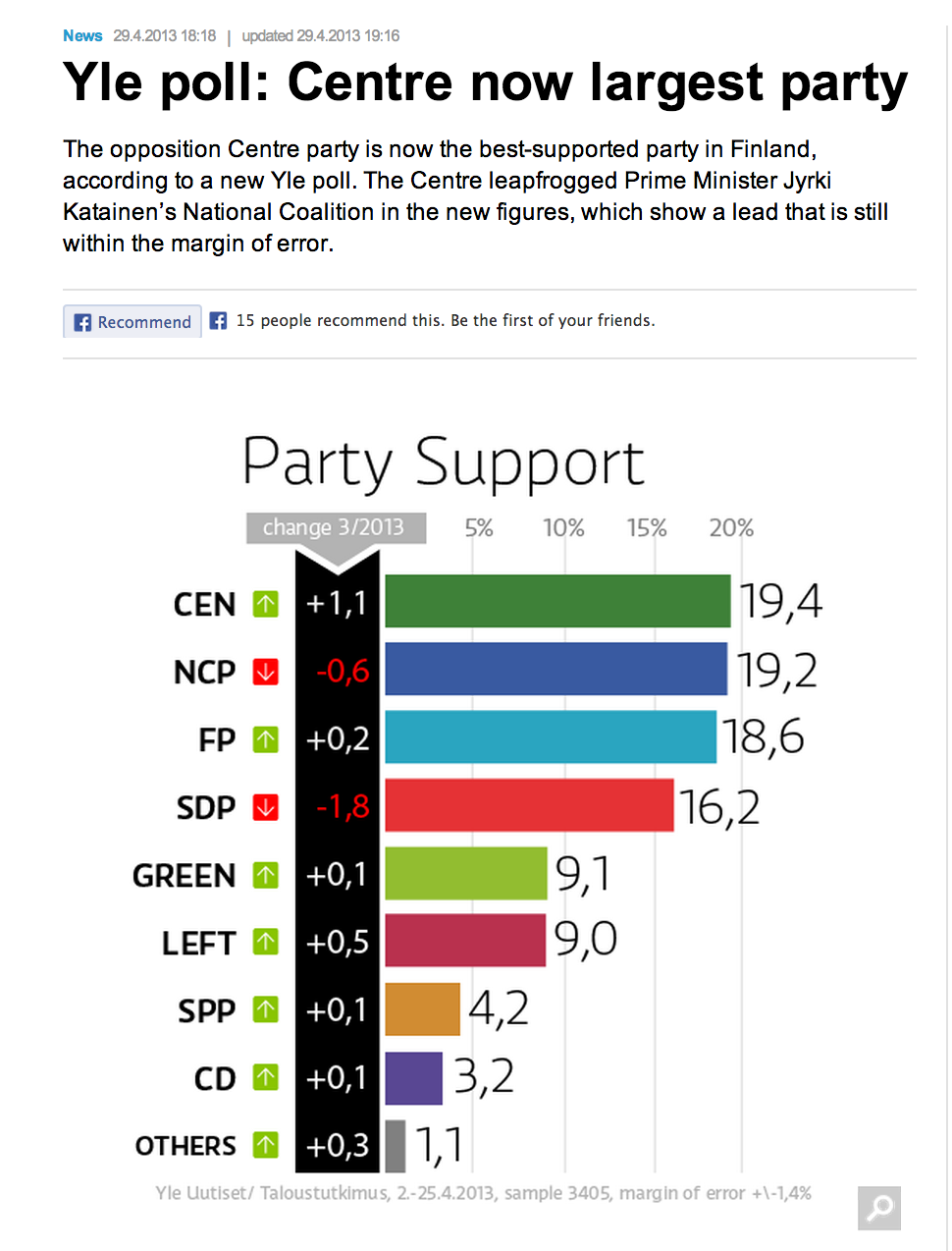
A recent YLE poll showed the Center Party to be the most popular in the country today.  Cameron, Kokoomus and the Social Democratic Party of Finland prove that you pay a high political price if you don’t challenge a threat posed by parties like the UKIP and PS.

Kuvankaappaus 2013-5-11 kello 11.56.39

Sweden offers a good example of how to deal with groups that rely on the far right extremist, anti-EU and anti-immigration vote.  All of the mainstream parties in Sweden have given the political cold shoulder to the Sweden Democrats. I am certain that in the long run, the Swedish answer to an intolerant party will pay off politically.

The political problem in Finland is the opposite to what is happening in Sweden. By accepting to sit at the same table as a party that promotes intolerance is synonymous to accepting their views and undermining your principles and values.

We must stand up for what we think is right. Accepting a society that basis itself on intolerance of immigrants, visible minorities and the outside world will end up doing more harm to a country than good.

What kind of country will Finland and Britain be if Timo Soini and Nigel Farage of the PS and UKIP, respectively, became prime ministers?

The answer: disaster.

One of the consequences of a UKIP and PS election victory would be to instigate a witch hunt against immigrants and visible immigrants.

That will happen in the UK when they reform Britain’s immigration system. Apart from regulating migrant access to the National Health Service (NHS), landlords will be able to check on immigrant tenants.

It is surprising that Cameron, who should know better, wants to scapegoat migrants and the EU to save his party’s hide from the UKIP.

Numerous studies show that immigrants use less social welfare than natives. This is logical since immigrants have to work twice as hard and be twice as good to match a native. Using social welfare would undermine a migrant’s competitiveness in the labor market.

Cameron will end up paying a costly political price for his anti-EU and anti-immigration stances.

Who are the PS?

One way of understanding who the PS is ideologically is by asking what are the differences between its close ally, the UKIP, and the far right anti-immigration and openly racist British National Party (BNP).

A survey published by The Guardian sheds light on this question.

Kuvankaappaus 2013-5-11 kello 11.55.06

The ideological similarities between the UKIP and BNP are strikingly alike on how the PS markets itself politically and its relationship with far right groups such as Suomen Sisu and Suomalaisuuden liitto. Is it a surprise why the  far-right Islamophobic English Defence League supports the UKIP and why some members of the PS support the Finnish Defense League?

Writes the Guardian: ”UKIP is not a right-wing extremist party, but on the doorsteps of voters it is often pushing the same message as the extreme right, and this is reflected in our results.”

This latter conclusion unveils the PS for what it is: A party like the UKIP that attempts to give a moderate view of itself because it would lure more voters but appeals to the extreme right. Thus there are more similarities between the UKIP, BNP and the PS than there are differences.

That is one of many reasons why Soini has spoken in the past to three UKIP party conferences as in this video clip.

Migrants’ Rights Network: EU Free Movement Under Threat

Posted on November 8, 2012 by Migrant Tales

Stewart Jackson’s Ten Minute Rule motion to curb EU free movement rights passed the first hurdle on its way to becoming law. Let’s hope no one in government seriously considers it as official policy.

Conservative MP Stewart Jackson continues his campaign against “barking mad” European Union law which supports the free movement of people across EU borders.

The motion put forward today in parliament states that EU citizens are to be allowed to enter and live in the UK only if they have a prior job offer, no criminal record, are in good health and remain barred from claiming social benefits. While Private Members’ Bills usually don’t get far in parliament, this should be seen as a bellwether for moods in government circles which are determined to place greater impediments in the way of exercising rights available to citizens under EU law.

Read the full article on the Huffington Post.

Read original story here.

This piece was reprinted by Migrant Tales with permission.


Timo Soini on racism: See no evil, hear no evil

Posted on October 25, 2012 by Migrant Tales

It is surprising how a politician like Timo Soini of the Perussuomalaiset (PS) party can argue anything he wants on television about immigrants and visible minorities. His objection to positive discrimination on a debate on MTV3 Wednesday is a case in point. 

Migrant Tales has  written in the past about colorblind racism, which is one of the most common forms of racism in Finland. On the surface, racial colorblindness may sound fair but the truth is that skin color and ethnic background still play powerful roles in our society.

Writes Psychology Today: “Colorblindness is the racial ideology that posits the best way to end discrimination is by treating individuals as equally as possible, without regard to race, culture, or ethnicity…However, colorblindness alone is not sufficient to heal racial wounds on a national or personal level. It is only a half-measure that in the end operates as a form of racism.”

I still have a hard time figuring out what is worse: Soini’s colorblind statements or the fact that some journalists and politicians still don’t challenge this form of racism more strongly.

Imagine what a political scandal Soini would have faced if he asked to abolish positive discrimination in countries that are culturally diverse and have large immigrant populations.  The PS chairman’s stand on the issue is in the same political league as other far-right parties like the British National Party, Danish People’s Party and teabaggers of the U.S.

I met a member of Hommaforum at a seminar recently who was totally against positive discrimination. Sitting next to us was a black woman from Africa.

I asked him if he thought that Finland was today a society that was way past racism and discrimination. “Do ethnicity and cultural background play a role?” I asked. “What you are saying is that it makes no difference whether you are black or white.”

It’s clear that the PS’ stand on immigration and cultural diversity suffers from colorblindness.

The party’s declaration against all forms of racism in May 2011 is a good example of the colorblind racism that afflicts the PS.

The party may claim that it is for labor immigration and that it has a handful of white immigrant candidates running for city council.  This is only a red herring that aims to cover up the party’s issues with cultural diversity.

Here is a recent blog entry by Migrant Tales that puts in perspective the PS’ thinking on what kinds of immigrants should apply to come to Finland and how they should integrate into our society.


James and Jussi out of control

Posted on July 25, 2012 by Migrant Tales

As the municipal elections of October near, Perussuomalaiset (PS) MPs, James Hirvisaari and Jussi Halla-aho, are doing everything possible to bolster the sagging popularity of the right-wing populist party. It’s unclear, however, if they are attempting to stir up support for the Suomen Sisu wing of the party or for the PS.

In their usual style, one of the MPs throws a furious right against decency while the other swings a left at the country’s judicial system. 
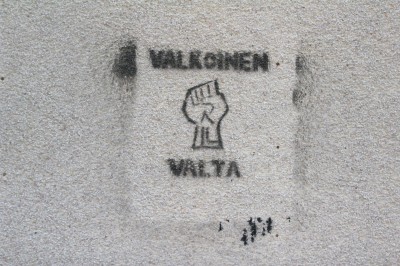
Graffiti on a school wall in Mikkeli that reads “white power” in Finnish.

Both MPs, who have built their political careers on victimizing and fueling suspicion of immigrants, are out of control. Even PS chairman Timo Soini appears perplexed. His silence speaks a thousand volumes about the present state of the party.

In the same crude style that Hirvisaari customarily attacks immigrants, he now targets Finland’s political parties. He slammed on Facebook  the National Coalition Party (Kokoomus) for being an elitist party, the Social Democrats for supporting “freeloading multiculturalism,” as well as the  Greens and Left Alliance for being homosexual parties. 

This video clip reveals what Hirvisaari thinks about same-sex marriages, which is just as questionable as his views on cultural diversity.

After the Finnish Supreme Court fined Halla-aho in June for defaming religion and inciting ethnic hatred, the PS MP removed the passages on his blog that got him in trouble but replaced them with links, which permit the reader to read the original text. 

The police has contacted Halla-aho about the links and told him that they should be removed. He told YLE that he would not remove them even if the police and Supreme Court order it.  

Writing about Hirvisaari and Halla-aho reminded me of a story JusticeDemon brought to my attention on the Guardian and which took place this month in England.  

The story shows how some Pakistani men in a sex case made the national headlines, while similar cases involving white men went largely unreported by the national media. 

Just as different immigrant groups in England have been labeled and accused of being pimps luring innocent white English adolescents into prostitution, muggers and looters, Halla-aho, Hirvisaari and others have stigmatized immigrants in the same way. 

A favorite label placed on Muslims and Africans in Finland is that they are “leeches” and “gang rapists.”

Migrant Tales has shown beyond any doubt that rape statistic by Hirvisaari and others are bogus. 

The victim of a rape crime can be a person who has been abused sexually or one that has been accused unjustly of such a crime. The fabricated rape case in Lammi, in which Halla-aho and Hirvisaari used in their blog writings to show that refugees are a menace to our society, is a case in point.

Despite the fact that all rape charges were dropped, Halla-aho and Hirvisaari never apologized for sending a social media lynch mob against the asylum seeker.

Writes the Guardian about a similar case in England:  “By now surely everyone knows the case of the eight men convicted of picking vulnerable underage girls off the streets, then plying them with drink and drugs before having sex with them. A shocking story. But maybe you haven’t heard. Because these sex assaults did not take place in Rochdale, where a similar story led the news for days in May, but in Derby earlier this month.”  

“Fifteen girls aged 13 to 15, many of them in care, were preyed on by the men. And though they were not working as a gang, their methods were similar – often targeting children in care and luring them with, among other things, cuddly toys. But this time, of the eight predators, seven were white, not Asian. And the story made barely a ripple in the national media.”

And concludes: “Make no mistake, the Rochdale crimes were vile, and those convicted deserve every year of their sentences. But where, amid all the commentary, was the evidence that this is a racial issue; that there’s something inherently perverted about Muslim or Asian culture?”

When we accuse whole groups of a certain crime what we do is reveal our most entrenched prejudices.



Migrants’ Rights Network: The battle on family migration will be a long one, but we can win

Posted on July 16, 2012 by Migrant Tales

By Ruth Grove-White

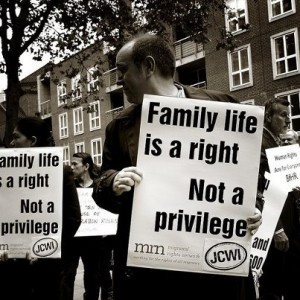
Every now and again there are changes to the immigration rules which even writers for the Daily Mail voice their objections to. The new rules on family migration to the UK, which came into force on Monday, represent a major assault on family life for Brits and migrants alike. Campaigners now need to work on bringing political opposition to the rules out from behind closed doors.

Monday’s changes to the family migration rules are significant: the UK now ranks among the toughest of Western democracies on family reunification policies.

Among other changes, the government has introduced a new income requirement of £18,600 per year for people who wish to bring a foreign partner to live with them in the UK. This means an estimated 47% of the UK working population would not qualify to bring their overseas spouse or partner here in the future.

The Home Office estimates up to 18,500 people every year will be prevented from coming to join family members here as a result. This may be helpful in inching the government towards lower net migration levels, but will be devastating for the families who are kept apart as a result.

Although the family migration changes have been politically controversial, much opposition has been confined to back rooms in Whitehall rather than aired in public. Press reports earlier this year hinted at internal battles between Lib Dems and Conservatives on family migration, with children and families minister Sarah Teather rumoured to be particularly resistant to tough rule changes.

Although these issues were officially resolved, behind closed doors there is reportedly still opposition among some Lib Dem MPs to the new rules.

Labour has also found itself in a tangled position over the family migration changes. Despite vocal opposition to the family rules among key players such as front bencher Kate Green MP and home affairs committee chair Keith Vaz MP, the Labour front bench has not yet expressed a clear position against these rules.

Still in the midst of a policy review, there has seemingly been reluctance to wade into a debate that could result in Labour once again being painted as soft on immigration. But never say never. What is certain is that the fight for family rights will continue and it has the scope to build political support.

Now that the family migration rules have come into force there will be growing evidence about their negative impacts, with particular problems anticipated for young couples, Asian families, and in parts of the UK with low average incomes.

Families who are affected can help to overturn these rules in the future by writing to their MPs, joining campaigns and building solidarity with others who are affected.

If the evidence can be amassed, Monday’s changes potentially offer up a future political opportunity: to speak out on an immigration issue that will affect thousands of Brits as well as migrants in the UK. And as the next general election draws nearer we hope to see quiet support develop into concerted political leadership, that points the UK in a different direction on family migration.

This article first appeared on the Left Foot Forward website on 11th July 2012.

Read original story here.

This piece was reprinted by Migrant Tales with permission.


Go for the values and weaknesses of a group if you aim to destroy their self-esteem

Posted on July 7, 2012 by Migrant Tales

How would you go about destroying the self-esteem of a group? If you were an anti-immigration politician, certainly you’d target the group’s values (religion) and exploit your racist arguments by pointing the finger at their most vulnerable weaknesses, like high unemployment. 

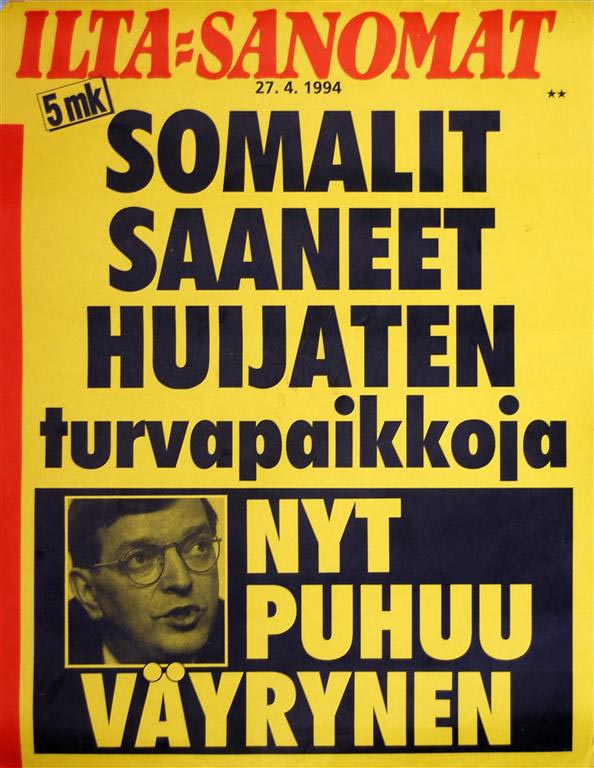
Prejudice and racism are diehard social ills because they take generations to wear off.  It may have taken a few months to label a small group of Somali refugees that came to Finland in the early 1990s, but it will be a very long time before they wash off their stigma.

The Romany minority of Finland are a good example of how negative labels can follow a group like a shadow for centuries.

 The Ilta-Sanomat tabloid claims that Somalis swindled authorities in granting them political asylum in Finland.

If it wasn’t a tabloid billboard that spread and reinforced racism and suspicion of groups like the Somalis in the 1990s, the icing on the cake was provided by the tacit silence of the politicians and society in general.  Even if one group was being singled out, it was an attack on all immigrants living in this country at the time.

As the old saying claims, there is no evil that lasts 100 years. In the United States, it took centuries to end slavery before we saw the rise of the Civil Rights Movement in the 1950s and 1960s. The Arab Spring movements last year are good recent examples of how “no evil can last 100 years.”

There is a problem with the saying, however, since it implies that evil cannot exist over 100 years because a person cannot live past that age. History reveals that evil is more like Methuselah, the Biblical figure that lived to be 969 years old.

The findings of a study in Britain published exclusively by the Guardian claim that unchecked corporate power, unrepresentative politicians and apathetic voters are fueling today the decline of British democracy.  The same illness has spread to other parts of Europe, like Finland.

The Guardian writes: “A study into the state of democracy in Britain over the last decade warns that it is in ‘long-term terminal decline’ as the power of corporations keeps growing, politicians become less representative of their constituencies and disillusioned citizens stop voting or even discussing current affairs.”

Finnish society, which used to be perceived as the least corrupt country in the world, according to Transparency International, has had its image seriously tarnished by greedy politicians and corporate leaders.

In the same way that corruption undermines a society’s values and sends it into decline, similarly prejudice and racism constitute serious threat to it as well.

If people are excluded socially and their only aim in life it to live off welfare, certainly they have every right to challenge their situation.

The only way you can avoid violence in society is by empowering people to change their situation through our democratic institutions. Two matters can happen if people lose faith in them: indefinite (very costly) social exclusion and/or violence.

In Europe not thinking today about how to tackle social exclusion and racism is thinking little or erroneously.

Thus the roots of the problem are not the marginalized groups, far-right parties or opportunistic anti-immigration politicians, but our apathy, greed and the fact that some of us have forgotten that we are social animals.


Migrants’ Rights Network: Border controls against Greece? Be afraid – be very afraid……

Posted on May 28, 2012 by Migrant Tales

By Don Flynn

The sun has been brilliant over (most) of the UK for four whole days in a row and we are all extraordinarily happy. But if there’s an inkling of truth in the weekend’s news that emergency border control plans are being prepared against the arrival of Greek citizens, abandon hope for the balmy days of summer for years to come…..

The news, circulated over the last few days, that the Home Office is preparing contingency plans to control borders in the event of Greek exit from the euro can be read as evidence of just how bad the government thinks the crisis has the potential to become.

The only circumstances in which such a measure would be permissible under the terms of EU law are if a situation threatening basic public security arises. This has been permitted on limited occasions in the past, for example with the threat of public disorder instigated by travelling football hooligans, as during the European football championship in Germany in 2000, or the actions against anti-globalisation protestors intending to visit Genoa, Italy, in 2001 during the time of a G8 summit in the city.

More recent attempts to limit movement rights across EU frontiers have been intensely controversial.  In  April 2011 complaints were made against the French government’s alleged  violation of rules of the Schengen Agreementwhen it reintroduced visa checks at its border with Italy with the intention of preventing the entry of North African nationals. The accusation here was that France had acted against its duty of solidarity with the Italian authorities by failing to undertake any assessment of the situation in Italy as a consequence of refugee movements induced by the ‘Arab Spring’ in Tunisia, and by not working in collaboration with its partners to deal with any issues arising.

Pity the poor middle classes

Schengen issues don’t arise in the context of what the Home Office is reporting to be considering in relation to Greece.  Furthermore, the matter here is reported as being pressures arising from the movement of Greek citizens, rather than third country nationals, as in the French-Italian affair.

What can be expected if Greece does exit from the eurozone at any time in the near future, or even in the less dramatic case of continued super-austerity in the country?  It can be expected that any person with euro-denominated assets to protect will want to ensure they are safely out the country if a ‘Grexit’ becomes inevitable. The UK’s readiness to convert crisis-hit euros into sterling will justify the cost of a trip to London for those who can still afford it.  But the prospect of even longer queues to clear passport control at Heathrow seems feeble enough justification for not helping out the Greek middle classes in their hour of need, particularly when it is likely to be on terms of exchange considerably to the advantage of UK financial services.

The prospect of waves of currency transfers on the part of the Hellenic petty bourgeoisie doesn’t seem to be the scenario Mrs May is most in fear of during these next few months however.  More likely she has in mind the flight of workers seeking opportunities to earn a wage given that this will not be possible for very many in their own country.  The UK will doubtless be attractive to some of  these refugees from economic disaster as they contemplate life outside their Mediterranean homeland.

Us, or Germany?

There are an estimated 300,000 Greek citizens already in Britain, and with 10.7 million left in Greece there’s some scope for growing that part of the UK’s population.  Don’t raise your hopes too high though – a similar sized community is also established in Germany and with the economy of that country now enjoying growth and sucking in migrants at 16-year record levels, we can expect a fair bit of competition in terms of getting ‘the brightest and the best’.

Let’s get back to the fundamental question is whether EU law will even allow the Brits to put up the shutters against the arrival of Greek nationals.  As explained above, in the absence of a plausible argument that they are coming here to consume large quantities of lager and riot over either the fortunes of their football team or the iniquities of global capitalism, the answer has to be no.

EU Directives make it absolutely clear however that restrictions on the right of free movement across frontiers “shall not be invoked to service economic ends.” This means that it will be a non-starter for the Home Office to argue that any exceptional measures are need to limited the rights of Greek citizens to come to the UK grounds in order to protect the jobs market for people already here.

End of the world as we know it?

But then again we are talking about circumstances that will arise from a disaster of such proportions – a Greek exit – that contamination will rip right the way across the southern European countries and savage the viability of every national economy on the continent for a decade to come.  All bets are off on just about any issue in these circumstances.  Whole chunks of European integration are likely to be thrown into reverse as borders are reinvented and nations begin to argue with one another about the proper way to divide up the assets which have accrued in a now-failed European single market.  Nothing can be ruled out if this happens, including, for anyone who knows anything about the history of this region of the world, the re-emergence of national rivalry, rising political and economic tension, and even war between states.

It is dangers of this order which make the business of getting a united Europeto work again of absolutely critical importance to us all.  Maintaining the right of free movement across national frontiers for citizens (and indeed, extending this to the entire region’s non-citizen residents) is a big part of what has to be preserved if things are not to take further turns for the worse.  Because of this the UK government should be told to stop its irresponsible talk of curtailing free movement rights and get us back on track to escape austerity and return to growth.

Read original story here.

This piece was reprinted by Migrant Tales with permission.

Migrant Rights’ Network of the UK: The Elephant in the Workplace – Why it’s time we talked about migration and labour exploitation

Posted on May 22, 2012 by Migrant Tales


Dr Sam Scott*

Certainly, it is rare for evidence of worker mistreatment to come to the fore but this does not mean, in our opinion, that it is ipso facto rare. Partly, the challenge is one of identifying workplace exploitation and persuading victims to come forward with evidence. Partly, it is about how as a society we define workplace exploitation, how it is legislated against, and how this legislation is policed. 

Trade Union membership is as low today as it was in the 1940s. Amidst the various worker protests against austerity measures, it has tended to be white-collar professionals, principally in the public services, who have been able to exert collective will, via union or professional group membership, in an attempt to protect eroding rights. Those in vulnerable employment in the UK – an estimated 2 million workers according to the TUC – do not to join unions in the main and so struggle to protect themselves from exploitative employers.

The cleaners, farm workers, production line operatives, au pairs, domestic servants, car washers, waiters and waitresses, the list could go on, are largely cast adrift, atomised and struggling to carve out a living at the bottom of the UK labour market. Their labour is not on the label, is not even evident when we look behind the label, and, in fact, has largely been written out of the social history of the late twentieth and early twenty-first century. The invisible hand of the market is now the low-wage worker and, interestingly, since the mid-1990s, this hand has become increasing migrant in origin.

New research funded by the Joseph Rowntree Foundation identifies this link between workplace exploitation and immigration via a case study of the UK food industry. Using evidence from 62 migrant workers (mainly Polish, Chinese, Latvian and Lithuanian) spread across five areas of the UK (London, Liverpool, South-West England, Lincolnshire and east-Central Scotland) the report highlights why migrants are at particular risk of exploitation. Specifically, it is their constrained economic circumstances, limited English, widespread use of tied housing, and reliance on gangmasters that renders migrants vulnerable to severe forms of exploitation: what we term ‘forced labour’.

If I had known English, I would have gone to find a new job, I would have looked for anything, but it was the beginning here and I really did not have any other options. (Sally, woman, 32, Polish)

What do we mean by forced labour? Well the JRF report identifies 14 ‘practices’ that we consider to be part of the forced labour crime (forced labour has been a criminal offence since 2009). Some of the most noteworthy practices are as follows:

  • Upfront fees/debt bondage­ – many migrants paid fees to gangmasters to travel to the UK and to secure work. This often indebted migrants and/or led them into exploitative work and housing.
  • Productivity targets and surveillance –  targets and monitoring gave workers little opportunity for social interaction at work. Pressure was intense: “It was completely crazy, rushing, shouting constantly … they can stand behind your back with a stopwatch and see how many chickens you are packing per minute … Here you are a robot, a machine.” (Izabela, woman, 44, Polish)
  • Non-/under-payment of wages – this was remarkably common, and migrants seemed unable to get back pay they were owed. A popular tactic was to deduct a few hours’ pay each week: “The boss was very, very stingy. When I worked ten hours, he would note it down as six or seven hours. Always a few hours less … Every week when the payday came, we had to argue with the boss … ”. (Li Xia, man, 42, Chinese)
  • Underwork/indebtedness – LMIs recruited even when work was scarce, because they charged workers fees for finding work, however limited, and/or for travel, accommodation and other bills. The more workers they had, the more charges they could levy; it could be in LMIs’ interests to provide workers with just enough hours to pay these charges. This left migrants with no spare money to escape their exploiters, furthering dependency.
  • Tied Accommodation – poor accommodation was often linked to exploitation. Interviewees talked of overcrowded (e.g. five people in one caravan), sub-standard, overpriced housing. “I was shocked … the caravan is for 5 people … One of the girls sleeps in the living room …” (Victoria, woman, 21, Bulgarian).

The research clearly shows that the bottom of the labour market can be a truly inhospitable place. Fear and a sense of powerlessness are pervasive and there is no collective union engagement to alleviate this and push for improvements, quite the contrary. The question then is whether we could do more to prevent forced labour and more to empower low-wage migrant workers in an attempt to halt any decline in workplace standards?

A starting point may be to think about why news headlines concerned with improving workers’ rights are so rare and why the issue of tackling workplace exploitation is so infrequently raised in policy speeches? Regrettably, it usually takes a shocking event – i.e. death at work – for people to take note. However, the reality for most victims is that forced labour is about everyday and often quite incremental forms of exploitation that only collectively and cumulatively combine to constitute a criminal act. The elephant in the workplace is not, in other words, as simple as might be implied when we glimpse its occasional monolithic shadow.

*Dr Sam Scott is an associate lecturer at the Department of Geography, University of Exeter. He has been researching international migration for the past decade and has published work on both skilled and low-wage labour migration, mainly from within the European Union. His latest research – with Professor Gary Craig (Wilbeforce Institute) and Dr Alistair Geddes (University of Dundee) – looks at experiences of forced labour in the UK food industry.

Read original story here.

This piece was reprinted by Migrant Tales with permission.

  • Previous
  • 1
  • …
  • 3
  • 4
  • 5
  • 6
  • 7
  • Next
Read more about documentary film
Read more

Recent Posts

  • Finland’s tabloids Iltalehti and Ilta-Sanomat are the pits
  • Riikka Purra’s Dr Jekyll and Mr Hyde mask
  • Double standards
  • Perussuomalaiset: Uusi logo, sama vanha juttu
  • Taco Trump

Recent Comments

  1. Absolutely Socking: Racist Finnish Facebook group against human rights gets flooded with socks on Musta Barbaari’s mother and sister charged by the police in “ethnic profiling” case
  2. Ilkka Nuotio on Pekka Myrskylä: “Tilastot kertovat toista kuin poliittinen keskustelu”
  3. Genrih Soinkara on The war in Ukraine and the Russian-Finnish border crisis are showing Finland’s ugly side
  4. Ahti Tolvanen on Comment by Ahti Tolvanen on the Helsinki +50 conference
  5. Angel Barrientos on Angel Barrientos is one of the kind beacons of Finland’s Chilean community

Archives

  • June 2026
  • May 2026
  • April 2026
  • March 2026
  • February 2026
  • January 2026
  • December 2025
  • November 2025
  • October 2025
  • September 2025
  • August 2025
  • July 2025
  • June 2025
  • May 2025
  • April 2025
  • March 2025
  • February 2025
  • January 2025
  • December 2024
  • November 2024
  • October 2024
  • September 2024
  • August 2024
  • July 2024
  • June 2024
  • May 2024
  • April 2024
  • March 2024
  • February 2024
  • January 2024
  • December 2023
  • November 2023
  • October 2023
  • September 2023
  • August 2023
  • July 2023
  • June 2023
  • May 2023
  • April 2023
  • March 2023
  • February 2023
  • January 2023
  • December 2022
  • November 2022
  • October 2022
  • September 2022
  • August 2022
  • July 2022
  • June 2022
  • May 2022
  • April 2022
  • March 2022
  • February 2022
  • January 2022
  • December 2021
  • November 2021
  • October 2021
  • September 2021
  • August 2021
  • July 2021
  • June 2021
  • May 2021
  • April 2021
  • March 2021
  • February 2021
  • January 2021
  • December 2020
  • November 2020
  • October 2020
  • September 2020
  • August 2020
  • July 2020
  • June 2020
  • May 2020
  • April 2020
  • March 2020
  • February 2020
  • January 2020
  • December 2019
  • November 2019
  • October 2019
  • September 2019
  • August 2019
  • July 2019
  • June 2019
  • May 2019
  • April 2019
  • March 2019
  • February 2019
  • January 2019
  • December 2018
  • November 2018
  • October 2018
  • September 2018
  • August 2018
  • July 2018
  • June 2018
  • May 2018
  • April 2018
  • March 2018
  • February 2018
  • January 2018
  • December 2017
  • November 2017
  • October 2017
  • September 2017
  • August 2017
  • July 2017
  • June 2017
  • May 2017
  • April 2017
  • March 2017
  • February 2017
  • January 2017
  • December 2016
  • November 2016
  • October 2016
  • September 2016
  • August 2016
  • July 2016
  • June 2016
  • May 2016
  • April 2016
  • March 2016
  • February 2016
  • January 2016
  • December 2015
  • November 2015
  • October 2015
  • September 2015
  • August 2015
  • July 2015
  • June 2015
  • May 2015
  • April 2015
  • March 2015
  • February 2015
  • January 2015
  • December 2014
  • November 2014
  • October 2014
  • September 2014
  • August 2014
  • July 2014
  • June 2014
  • May 2014
  • April 2014
  • March 2014
  • February 2014
  • January 2014
  • December 2013
  • November 2013
  • October 2013
  • September 2013
  • August 2013
  • July 2013
  • June 2013
  • May 2013
  • April 2013
  • March 2013
  • February 2013
  • January 2013
  • December 2012
  • November 2012
  • October 2012
  • September 2012
  • August 2012
  • July 2012
  • June 2012
  • May 2012
  • April 2012
  • March 2012
  • February 2012
  • January 2012
  • December 2011
  • November 2011
  • October 2011
  • September 2011
  • August 2011
  • July 2011
  • June 2011
  • May 2011
  • April 2011
  • March 2011
  • February 2011
  • January 2011
  • December 2010
  • November 2010
  • October 2010
  • September 2010
  • August 2010
  • July 2010
  • June 2010
  • May 2010
  • April 2010
  • March 2010
  • February 2010
  • January 2010
  • December 2009
  • November 2009
  • October 2009
  • September 2009
  • August 2009
  • July 2009
  • December 2008
  • November 2008
  • October 2008
  • September 2008
  • August 2008
  • July 2008
  • June 2008
  • May 2008
  • April 2008
  • March 2008
  • February 2008
  • January 2008
  • November 2007
  • October 2007
  • September 2007
  • August 2007
  • July 2007
  • June 2007
  • May 2007

Categories

  • ?? Gia L?c
  • ????? ?????? ????? ???????? ?? ??????
  • ???????
  • @HerraAhmed
  • @mondepasrond
  • @nohatefinland
  • @oula_silver
  • @Varathas
  • A Pakistani family
  • äärioikeisto
  • Abbas Bahmanpour
  • Abdi Muhis
  • Abdirahim Hussein Mohamed
  • Abdirahim Husu Hussein
  • Abdirisak Mahamed
  • About Migrant Tales
  • activism
  • Adam Al-Sawad
  • Adel Abidin
  • Afrofinland
  • Ahmed IJ
  • Ahti Tolvanen
  • Aino Pennanen
  • Aisha Maniar
  • Alan Ali
  • Alan Anstead
  • Alejandro Díaz Ortiz
  • Alekey Bulavsev
  • Aleksander Hemon
  • Aleksanterinliitto
  • Aleksanterinliitto ry
  • Aleksanterinliitto ry:n hallitus
  • Alex Alex
  • Alex Mckie
  • Alexander Nix
  • Alexandra Ayse Albayrak
  • Alexis Neuberg
  • Ali Asaad Hasan Alzuhairi
  • Ali Hossein Mir Ali
  • Ali Rashid
  • Ali Sagal Abdikarim
  • Alina Tsui
  • Aline Müller
  • All categories
  • Aman Heidari
  • Amiirah Salleh-Hoddin & Jana Turk
  • Amin A. Alem
  • Amir Zuhairi
  • Amkelwa Mbekeni
  • Ana María Gutiérrez Sorainen
  • Anachoma
  • Anders Adlecreutz
  • Angeliina Koskinen
  • Anna De Mutiis
  • Anna María Gutiérrez Sorainen
  • Anna-Kaisa Kuusisto ja Jaakko Tuominen
  • Annastiina Kallius
  • Anneli Juise Friman Lindeman
  • Announcement
  • Anonymous
  • Antero Leitzinger
  • anti-black racism
  • Anti-Hate Crime Organisation Finland
  • Anudari Boldbaatar
  • Arshiya Nasser
  • Aspergers Syndrome
  • Asylum Corner
  • Asylum seeker 406
  • Athena Griffin and Joe Feagin
  • Autism
  • Avaaz.org
  • Awale Olad
  • Ayan Said Mohamed
  • AYY
  • Barachiel
  • Bashy Quraishy
  • Beatrice Kabutakapua
  • Beri Jamal
  • Beri Jamal and Enrique Tessieri
  • Bertolt Brecht
  • Boiata
  • Boodi Kabbani
  • Bruno Gronow
  • Carmen Pekkarinen
  • Çelen Oben and Sheila Riikonen
  • Chiara Costa-Virtanen
  • Chiara Costa-Virtanen
  • Chiara Sorbello
  • Christian Thibault
  • Christopher Wylie
  • Clara Dublanc
  • Dana
  • Daniel Malpica
  • Danilo Canguçu
  • David Papineau
  • David Schneider
  • Dexter He
  • Don Flynn
  • Dr Masoud Kamali
  • Dr. Faith Mkwesha
  • Dr. Theodoros Fouskas
  • Edna Chun
  • Eeva Kilpi
  • Emanuela Susheela
  • En castellano
  • ENAR
  • Enrique
  • Enrique Tessieri
  • Enrique Tessieri & Raghad Mchawh
  • Enrique Tessieri & Yahya Rouissi
  • Enrique Tessieri and Muhammed Shire
  • Enrique Tessieri and Sira Moksi
  • Enrique Tessieri and Tom Vandenbosch
  • Enrique Tessieri and Wael Che
  • Enrique Tessieri and Yahya Rouissi
  • Enrique Tessieri and Zimema Mhone
  • Epäluottamusmies
  • EU
  • Europe
  • European Islamophobia Report
  • European Islamophobia Report 2019,
  • European Union
  • Eve Kyntäjä
  • Ezequiel Caldeiro
  • Facebook
  • Fadumo Dayib
  • Faisa Kahiye
  • Farhad Manjoo
  • Fasismi
  • Finland
  • Fizza Qureshi
  • Flyktingar och asyl
  • Foreign Student
  • Fozia Mir-Ali
  • Frances Webber
  • Frida Selim
  • Gareth Rice
  • Ghyslain Vedeaux
  • Global Art Point
  • Great Replacement
  • Habiba Ali
  • Hami Bahadori
  • Hami Bahdori
  • Hamid
  • Hamid Alsaameere
  • Hamid Bahdori
  • Handshake
  • Harmit Athwal
  • Hassan Abdi Ali
  • Hassan Muhumud
  • Heikki Huttunen
  • Heikki Wilenius
  • Helsingin Sanomat
  • Henning van der Hoeven
  • Henrika Mälmsröm
  • Hser Hser
  • Hser Hser ja Mustafa Isman
  • Husein Muhammed
  • Hussain Kazemian
  • Hussain Kazmenian
  • Ibrahim Khan
  • Ida
  • Ignacio Pérez Pérez
  • Iise Ali Hassan
  • Ilari Kaila & Tuomas Kaila
  • Imam Ka
  • inside-an-airport
  • Institute of Race Relations
  • Iraqi asylum seeker
  • IRR European News Team
  • IRR News Team
  • Islamic Society of Norhern FInland
  • Islamic Society of Northern Finland
  • Islamophobia
  • Jacobinmag.com
  • Jallow Momodou
  • Jan Holmberg
  • Jane Elliott
  • Jani Mäkelä
  • Jari Luoto
  • Jari Taponen
  • Jegor Nazarov
  • Jenni Stammeier
  • Jenny Bourne
  • Jessie Daniels
  • Joe Davidow
  • Johannes Koski
  • John D. Foster
  • John Grayson
  • John Marriott
  • Jon Burnett
  • Jorma Härkönen
  • Jos Schuurmans
  • José León Toro Mejías
  • Josue Tumayine
  • Jouni Karnasaari
  • Juan Camilo
  • Jukka Eräkare
  • Julian Abagond
  • Julie Pascoet
  • Jussi Halla-aho
  • Jussi Hallla-aho
  • Jussi Jalonen
  • JusticeDemon
  • Kadar Gelle
  • Kaksoiskansalaisuus
  • Kansainvälinen Mikkeli
  • Kansainvälinen Mikkeli ry
  • Katherine Tonkiss
  • Kati Lepistö
  • Kati van der Hoeven-Lepistö
  • Katie Bell
  • Kättely
  • Kerstin Ögård
  • Keshia Fredua-Mensah & Jamie Schearer
  • Khadidiatou Sylla
  • Khadra Abdirazak Sugulle
  • Kiihotus kansanryhmää vastaan
  • Kirsi Crowley
  • Koko Hubara
  • Kristiina Toivikko
  • Kubra Amini
  • KuRI
  • La Colectiva
  • La incitación al odio
  • Laura Huhtasaari
  • Lauri Finér
  • Leif Hagert
  • Léo Custódio
  • Leo Honka
  • Leontios Christodoulou
  • Lessie Branch
  • Lex Gaudius
  • Leyes de Finlandia
  • Liikkukaa!
  • Linda Hyökki
  • Liz Fekete
  • M. Blanc
  • Maarit Snellman
  • Mahad Sheikh Musse
  • Maija Vilkkumaa
  • Malmin Kebab Pizzeria Port Arthur
  • Marcell Lorincz
  • Mari Aaltola
  • María Paz López
  • Maria Rittis Ikola
  • Maria Tjader
  • Marja-Liisa Tolvanen
  • Mark
  • Markku Heikkinen
  • Marshall Niles
  • Martin Al-Laji
  • Maryan Siyad
  • Matt Carr
  • Mauricio Farah Gebara
  • Media Monitoring Group of Finland
  • Micah J. Christian
  • Michael McEachrane
  • Michele Levoy
  • Michelle Kaila
  • Migrant Tales
  • Migrant Tales Literary
  • Migrantes News
  • Migrants' Rights Network
  • MigriLeaks
  • Mikko Kapanen
  • Miriam Attias and Camila Haavisto
  • Mohamed Adan
  • Mohammad Javid
  • Mohammad M.
  • Monikulttuurisuus
  • Monisha Bhatia and Victoria Canning
  • Mor Ndiaye
  • Muh'ed
  • Muhamed Abdimajed Murshid
  • Muhammed Shire
  • Muhammed Shire and Enrique Tessieri
  • Muhis Azizi
  • Musimenta Dansila
  • Muslimiviha
  • Musulmanes
  • Namir al-Azzawi
  • Natsismi
  • Neurodiversity
  • New Women Connectors
  • Nils Muižnieks
  • No Labels No Walls
  • Noel Dandes
  • Nuor Dawood
  • Omar Khan
  • Otavanmedia
  • Oula Silvennoinen
  • Paco Diop
  • Pakistani family
  • Pentti Stranius
  • Perussuomalaiset
  • perustuslaki
  • Petra Laiti
  • Petri Cederlöf
  • Pia Grochowski
  • Podcast-lukija Bea Bergholm
  • Pohjois – Suomen Islamilainen Yhdyskunta
  • Pohjois Suomen Islamilainen Yhyskunta
  • Polina Kopylova
  • Race Files
  • racism
  • Racism Review
  • Raghad Mchawh
  • Ranska
  • Rashid H. and Migrant Tales
  • Rasismi
  • Raul Perez
  • Rebecka Holm
  • Reem Abu-Hayyeh
  • Refugees
  • Reija Härkönen
  • Remiel
  • Reza Nasri
  • Richard Gresswell
  • Riikka Purra
  • Risto Laakkonen
  • Rita Chahda
  • Ritva Kondi
  • Robito Ibrahim
  • Roble Bashir
  • Rockhaya Sylla
  • Rodolfo Walsh
  • Roger Casale
  • Rostam Atai
  • Roxana Crisólogo Correa
  • Ruth Grove-White
  • Ruth Waweru-Folabit
  • S-worldview
  • Sadio Ali Nuur
  • Sami Rusanen
  • Sandhu Bhamra
  • Sara de Jong
  • Sarah Crowther
  • Sari Alhariri
  • Sarkawt Khalil
  • Sasu
  • Scot Nakagawa
  • Shabana Ahmadzai
  • Shada Islam
  • Sharon Chang blogs
  • Shenita Ann McLean
  • Shirlene Green Newball
  • Sini Savolainen
  • Sira Moksi
  • Sonia K.
  • Sonia Maria Koo
  • Steverp
  • Stop Deportations
  • Suldaan Said Ahmed
  • Suomen mediaseurantakollektiivi
  • Suomen Muslimifoorumi ry
  • Suomen viharikosvastainen yhdistys
  • Suomen viharikosvastainen yhdistys ry
  • Suomi
  • Supermen
  • Susannah
  • Suva
  • Syrjintä
  • Talous
  • Tapio Tuomala
  • Taw Reh
  • Teivo Teivainen
  • The Daily Show
  • The Heino
  • The Supermen
  • Thomas Elfgren
  • Thulfiqar Abdulkarim
  • Tim McGettigan
  • Tino Singh
  • Tito Moustafa Sliem
  • Tobias Hübinette and L. Janelle Dance
  • Transport
  • Trica Danielle Keaton
  • Trilce Garcia
  • Trish Pääkkönen
  • Trish Pääkkönen and Enrique Tessieri
  • Tuulia Reponen
  • Uncategorized
  • UNITED
  • University of Eastern Finland
  • Uyi Osazee
  • Väkivalta
  • Vapaa Liikkuvuus
  • Venla-Sofia Saariaho
  • Vieraskynä
  • W. Che
  • W. Che an Enrique Tessieri
  • Wael Ch.
  • Wan Wei
  • Women for Refugee Women
  • Xaan Kaafi Maxamed Xalane
  • Xassan Kaafi Maxamed Xalane
  • Xassan-Kaafi Mohamed Halane & Enrique Tessieri
  • Yahya Rouissi
  • Yasmin Yusuf
  • Yassen Ghaleb
  • Yle Puhe
  • Yuliet Tresa
  • Yve Shepherd
  • Zahra Khavari
  • Zaker
  • Zalina Ametova
  • Zamzam Ahmed Ali
  • Zeinab Amini ja Soheila Khavari
  • Zimema Mahone and Enrique Tessieri
  • Zimema Mhone
  • Zoila Forss Crespo Moreyra
  • ZT
  • Zulma Sierra
  • Zuzeeko Tegha Abeng
© 2026 Migrant tales | Powered by Minimalist Blog WordPress Theme