Migrant tales
Menu
  • #MakeRacismHistory “In Your Eyes”
  • About Migrant Tales
  • It’s all about Human Rights
  • Literary
  • Migrant Tales Media Monitoring
  • NoHateFinland.org
  • Tales from Europe
Menu

Tag: United Kingdom

Institute of Race Relations: UKIP – legitimised by the media?

Posted on April 25, 2014 by Migrant Tales

MT insight: UKIP’s Nigel Farage and Perussuomalaiset party’s Timo Soini are close ideological allies. The only difference between these two politicians in the cultural and national context. If Farage lived in Finland he’d speak like Soini and vice versa. Thus to understand the PS you would have to understand the UKIP. 

_________________

John Grayson examines the way UKIP’s messages have been legitimised and in some cases promoted by the media.

The self-proclaimed leader of ‘the people’s army’ can relish his victory. Nigel Farage – whose party was once dismissed as a home for fruitcakes, loonies and closet racists – has established himself as a big beast in the political jungle. (Nick Robinson, BBC TV Political News Editor, ‘Farage v Clegg: the verdict’, 3 April 2014.)

I would think we have probably taken a third of the BNP vote directly from them, I don’t think anyone has done more, apart from Nick Griffin on Question Time, to damage the BNP than UKIP and I am quite proud of that. (Nigel Farage speaking to Chatham House think-tank, 31 March 2014.)

Näyttökuva 2014-4-25 kello 21.08.57

Read full story here.

In far-right mythology, Jean-Marie Le Pen was able to launch the Front National (FN) as a result of spectacular and ‘frighteningly charismatic’ appearances on French TV’s then flagship current affairs show L’Heure de Vérité (The Hour of Truth) in 1984.[1] This gave him the opportunity to introduce into political discourse far-right ideas which were previously kept out of the media.Le Pen’s influence was not eroded or even stalled by others getting the better of him in televised debates. Instead – and crucially for the FN strategy – hitherto taboo subjects, from Holocaust revisionism to myths about racial inequality, were reintroduced to the mainstream.

In October 2009, Nick Griffin, leader of the BNP, finally made it on to BBC’s Question Time – and dramatically fluffed it – hence Nigel Farage’s boast above. His appearance was linked to a decision by the Labour Cabinet to end their ‘no platform’ policy with the BNP, and Jack Straw was put up for the panel. But perhaps more interestingly, it was revealed by a former Question Time producer that this ‘grotesque stunt’ had been in the making since 2007. According to the journalist Daniel Trilling, the BBC was aiming to draw in viewers and the BNP on Question Time was ‘Punch and Judy politics at its height’.[2]

The promotion of far Right and racist politics as entertainment has continued with the BBC’s fascination with – and inadvertent promotion of – Nigel Farage’s UKIP. For many years, Farage has been adopted by the BBC as a ‘character’ who can usefully represent minority parties on Question Time. Since 2004 he has appeared twenty-six times; between 2009 and 2013 fourteen times, more than any other single politician of any party. Farage now has so much confidence in UKIP’s place in the showcase programme that in January 2014 he publicly accused the BBC of bias in choosing live audiences for Question Time when there are UKIP panellists. He wants the audiences ‘representative of opinion polls’, and questions whether the BBC is ‘being exploited by the hard left’ in its selections.

Over the past year the BBC has stood out amongst media outlets with the prominence it has given to Farage and UKIP. At UKIP’s recent spring conference in Torquay, the Telegraph reported:

The signs are that UKIP has arrived as a political force judging by the 20-strong list of foreign media that were accredited for the party’s Spring conference in Torquay including correspondents from Chinese state media, Le Monde in France, Mega TV in Greece and Swiss public radio. No one can outdo the BBC overstaffing an event. It sent 12 staff. One UKIP insider: ‘It’s like the Glastonbury festival.’

Farage himself has been given a very easy ride indeed with the British press and media – including the ‘liberal’ broadsheets. Decca Aitkenhead of the Guardian interviewed Farage in January 2013 and managed to almost joke about UKIP’s campaign in Rotherham in the previous November. She described Farage as ‘one of the most surprising politicians I have met – charismatic, funny, indefatigably good natured and essentially cheerful towards absolutely everyone, apart from the prime minister and Rotherham council’.

Page Hall, Sheffield

UKIP’s central campaign issue for the past year, the impending ‘invasion’ of EU migrant workers (particularly Roma people) from Romania and Bulgaria, has been constantly kept alive and revived by the BBC. When the ‘invasion’ did not happen, the BBC apparently decided to suggest that it already had, claiming that Roma people were causing mayhem on the streets and refusing to integrate. BBC programmes revived the moral panic instigated by David Blunkett’s November 2013 comments about the Page Hall area in Sheffield, despite the fact that the British local and national press, Czech and Slovak press, and British and European TV and radio had exhaustively covered the Page Hall story at the time. (Read an IRR News story by John Grayson: ‘Sheffield’s Roma, David Blunkett and an immoral racist panic’.)

Issues around Roma people in Page Hall were covered on the BBC’s The Truth about Immigration on 7 January by Nick Robinson, interviewing the same people interviewed in Sheffield by the British national press and TV and European journalists in November last year. The day before, Monday 6 January, BBC Radio Sheffield had devoted a whole morning to Page Hall. The regional BBC 1 Inside Out: Yorkshire and Lincolnshire had a report on the Roma by Benjamin Zephaniah, whose family had settled originally in Burngreave, adjacent to Page Hall, in the 1960s. On the morning of 7 January, the Radio 4 Today’s feature interview trailing The Truth about Immigration was with … Nigel Farage.

Most remarkable of all was the piece on the BBC Radio 4 Today programme on 28 March 2014[3] titled ‘Roma community must integrate more’, by John Humphrys himself, who had travelled to Sheffield with a crew to interview the same critics of the local Roma population who had featured in the BBC’s November and January interviews. In all of this, there was no new ‘news’ or developments over the four months of BBC scrutiny of a small group of Roma people on one obscure inner city road in Sheffield. But the Humphrys report did remind people (implicitly and at times explicitly) of David Blunkett’s warnings from November 2013 that ‘We have to change the behaviour and culture’ of Roma people in Page Hall. It also, of course, reminded everyone of UKIP’s claims of Roma from Bulgaria and Romania invading British cities. It was significant that Humphrys could not obtain even one interview with anyone in the local Roma community.

The BBC had obviously decided that the immigration debate was made up of UKIP’s agenda and its ‘facts’, which could be ‘balanced’ simply by making statements about the value of immigration. The net effect has been the elevation of a far-right populist party with no seats in Parliament, to the stature of a mainstream ‘big beast’ in British politics.

The second Farage/Clegg debate on the BBC

Earlier this year, Farage and Nick Clegg went ‘head-to-head’ in two high-profile televised debates. The BBC decided to screen the second of these on 2 April, giving it the full ‘election broadcast’ treatment, from just before 6 pm for three and a half hours to 9.37pm on its news channel, and made it available on the BBC website. The actual debate was broadcast on BBC2 and BBC News 24 at 7pm and repeated at 9pm the following day on the BBC Parliament channel. The BBC gave full coverage to the inevitable YouGov and ICOM/Guardian viewer polls, and access to the ‘Spin Room’ awash with journalists, politicians and spin doctors – just like the General Election debates of 2010. The debate was of course chaired by the voice of BBC election coverage, David Dimbleby.

What was never on the agenda was any scrutiny of Farage or UKIP. And as the political commentator Mehdi Hasan said:

Astonishingly, across two hours, on two broadcast media outlets, up against a well-informed opponent and taking questions from live studio audiences, Farage wasn’t questioned even once over UKIP’s dodgy far-right allies in the European Parliament, over UKIP MEP Gerard Batten’s dodgy anti-Muslim remarks or over his own dodgy remarks about being unable to hear people speaking English on his train. As I said: happy birthday, Nigel. You couldn’t have asked for a better gift from the pro-Europeans.

More TV debates and rows – and UKIP ever present

The BBC has not been alone in its promotion of UKIP. On Tuesday 17 February, while Channel 4 was showing a debate on its controversial series Benefits Street, over on Channel 5 was a programme billed as a Big British

mmigration Row. The Express and Daily Star, owned by Richard Desmond who also owns Channel 5, trailed the debate and had extensive coverage the day after – mainly about physical confrontations and verbal abuse from the self styled non-racist commentator Katie Hopkins. The two-hour show was certainly a ‘row’, with a former head of the Home Office claiming there was mass forgery of passports and papers by migrants, while celebrities swapped insults.

The sole politician on the programme was UKIP’s immigration spokesman MEP Gerard Batten (he of the dodgy anti-Muslim remarks). Prior to the debate, Channel 4 had commissioned YouGov to produce a poll which was announced as proving ‘70 per cent of people want a curb on immigration’ and which was used to frame the ‘facts about immigration’. Tim Stanley in the Telegraph described the programme as typical of debates generated by the issue of immigration: ‘[A] poisonous debate about race and class. The tone of the debate on the Big British Immigration Row testifies to the panic and hate that economic squeeze can generate.’

The Daily Express, UKIP and Patrick O’Flynn

The Big British Immigration Row certainly connected the UKIP agenda with campaigns which Desmond’s Daily Express has launched in recent years. The former political editor of the Express, Patrick O’Flynn, has now become the lead UKIP candidate for the East of England for the Euro elections in May. In January, O’Flynn became Communications Director for UKIP. He is a very experienced journalist and as former colleague Peter Oborne of the Telegraph put, it ‘a catch that UKIP can boast about’.

O’Flynn also has a controversial recent career with his statements on Muslims in the columns of the Express. In January, HOPE not Hate claimed that ‘The Express journalist regularly used his newspaper column to spew his particular brand of Islamophobia’, and the organisation highlights the following statements from 2008 (among others):

If we allow the uncontrolled expansion of non-integrated British Islam the character of our nation will be destroyed forever. To inflict the Muslim call to prayer on everyone with a Mosque in their area will have but one result – more so-called ‘white flight’ out of urban areas and the creation of more Islamic ghettos. (8 January)

To ordinary British ears the wail of the Mosque is not just an unwelcome racket, but an alien and threatening sound. (8 January)

Why should we trust Britain’s Muslims? (12 February)

On an economic level, the impact of Britain’s Muslims is massively negative. Research shows Muslim communities are typified by heavy levels of welfare dependency and low levels of wealth creation. (12 February)

Muslim urban ghettos have also reintroduced electoral fraud as a regular feature of British political life. (12 February)

It is, of course, by no means rare for political journalists to move into political PR. Guto Harri, for example, left the BBC to work for Boris Johnson; Craig Oliver went to Downing Street after nineteen years as a broadcast journalist and has now been joined by Graeme Wilson of the Sun, while Ed Miliband employs three former lobby journalists – Bob Roberts (Daily Mirror), Patrick Hennessy (Sunday Telegraph) and Tom Baldwin (Times). What is unusual though is for a political journalist to move to political PR and immediately seek political office.

The very experienced O’Flynn is perhaps one of the reasons UKIP has had such a successful media profile over the past months. On 27 March, he appeared in the ITV 1 Tonight special (The Truth about Immigration: a drain or an asset) which focused mainly on immigration in Peterborough. O’Flynn, again, was the only national party politician on the programme.

Channel 4 completed the TV mainstreaming of Nigel Farage with an hour-long profile on 31 March called Nigel Farage: who are you?, commissioned by self confessed rightwing libertarian Martin Durkin. Neil Midgley in the Telegraph perhaps said it all when he described the programme as ‘such a cloying tribute, even UKIP supporters must have found it a bit sickly to watch’.

In the press the Guardian continued the theme of xenophobic politicians as entertainment with a defence of Farage from Simon Jenkins on 3 April. After admitting UKIP has a similar approach to the FN in France, Jenkins argued that Farage was ‘in a long line of political eccentrics’ like Enoch Powell. He is ‘shrewdly rebellious’ like ‘Wilkes, Cobbett and even Tony Benn’, he continued, and at root he is ‘patently a Tory who should by rights be challenging Cameron from inside the party, not outside. A contest for the leadership between him and Boris Johnson would add vastly to the entertainment of the nation.’

Scanning the press and TV coverage of Nigel Farage and UKIP over the past few months, it is very hard to believe that only just over four years ago there was a national debate, as well as demonstrations outside the BBC, when Nick Griffin was welcomed into the national broadcaster’s studios. ‘The BBC’s decision to provide a platform for fascists to distort democracy remains nothing less than a disgrace’, said academic Jim Wolfreys in the Guardian at the time. Speaking about Jean-Marie Le Pen and his TV appearance back in 1984, Wolfreys pointed out that:

Racists and antisemites were emboldened. Their politics are not motivated by reason or defeated by clever turns of phrase, so their world view appeared vindicated by the profile and status conferred upon Le Pen by a compliant media. A craven political elite that capitulated to FN myths on law and order, immigration and asylum further enhanced this status.

Farage is certainly not Jean-Marie Le Pen but the historical analogy is apt.

RELATED LINKS

Read an IRR News story: ‘Sheffield’s Roma, David Blunkett and an immoral racist panic’

Read an IRR News story: ‘The shameful “go home” campaign

References: [1] Daniel Trilling, Bloody Nasty People: the rise of Britain’s far right, (London, Verso, 2012), p. 168. [2] Ibid. [3] I owe this reference to Marion Horton.

Read original story here.

This piece was reprinted by Migrant Tales with permission.


What can the PS mutate to if the political conditions are right?

Posted on March 13, 2014 by Migrant Tales

In order to understand what a party like the Perussuomalaiset (PS) are, look at how it rose to become Finland’s third-largest party in parliament in less than ten years.

The growth of the anti-EU, anti-immigration and especially anti-Islam PS has been impressive to say the least, rising from 5 MPs in the 2007 parliamentary elections to 39 MPs in 2011.

While many played down the party’s historic victory of 2011, the Euro MP elections in May and next year’s parliamentary elections in April will determine whether the PS will remain as one of the country’s biggest parties or return back to the minor political leagues where it came from.

The presidential and municipal elections of 2012 were a clear disappointment for the PS, mustering only 9.4% and 12.3% of the votes, respectively, which were a far cry from its historic victory of 2011, when it gained 19.05%.

One of the reasons that could shed light on the stellar growth of the PS is not only the euro crisis and the financial bailouts of countries like Greece and Portugal, but the growth of intolerance, nationalism and xenophobia throughout Europe. PS chairman Timo Soini, believes, however, that the main factor for the party’s historic victory two years ago was anti-EU sentiment.

Another matter that has made the PS popular with the voters is that it is all things to everyone, if that everyone is a voter who is a middle-aged white Finnish male. In many respects the rhetoric of the party is similar to the Tea Party of the United States, which tries to lure voters by using immigrants as scapegoats and promoting free-market capitalism.

The PS usually speaks in code to its voters and that is why it can have members who house racist views and claim that it doesn’t tolerate racism. Some, like PS MP Jussi Halla-aho, have been sentenced for ethnic agitation and can still enjoy the support of the party’s leadership.

One of the matters that should worry sensible Finns is not what the PS is, but what it can become.

A good sister party of the PS is the UK Independence Party (Ukip). Both parties are very similar ideologically but with some differences. The Ukip, for example, wants the United Kingdom to leave the EU while the jury is still out on the PS’ stance on the matter.

Both the PS and Ukip are anti-immigration and anti-Islam parties that cannot be still labelled as “far right” like the Danish People’s Party or Lega Nord of Italy.

Certainly in the ideological bubble of populist right-wing rhetoric, everything is possible, even changing and rewriting history to suit one’s intolerant views.

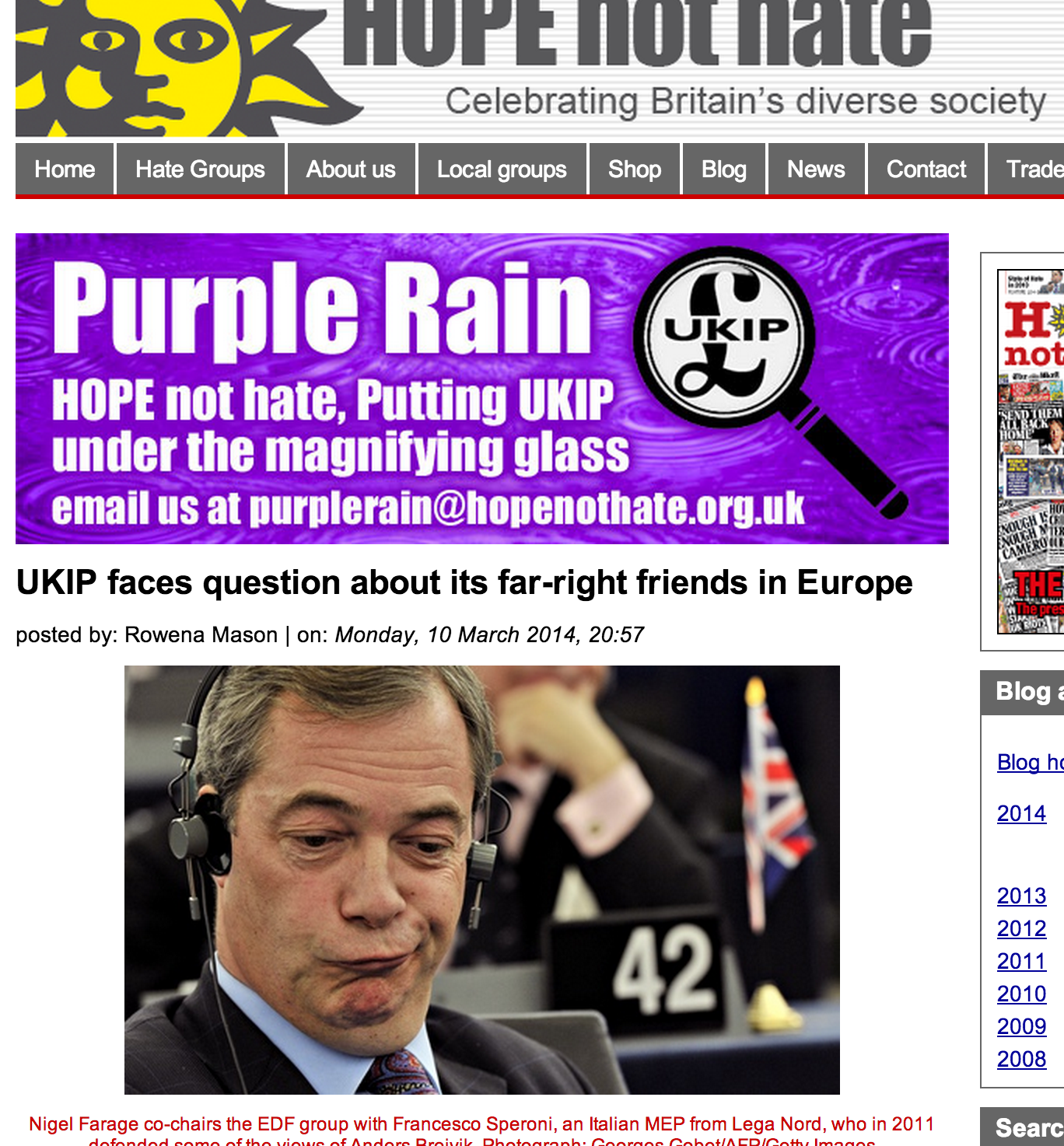
If you want to read a comprehensive review of the Ukip’s far-right ties in Europe, read what Rowena Mason wrote on the Purple Rain blog of the HOPE not hate website.

Näyttökuva 2014-3-13 kello 15.58.47

Read full column here.

The Ukip,like the PS, belongs to the Europe for Freedom and Democracy (EFD) group of the European parliament.

While the PS belongs the EFD group and has one Euro MP, Sampo Terho,

Arun Kundnani, author of The Muslims are Coming!, said recently that it was worrying that a party like the Ukip has links to people and parties that are Islamophobic and in the far right.

Why should we believe Soini and the PS when they claim that “they aren’t racist” or have far-right ties?

Jay Smooth’s recent video, How to tell someone they sound racist, offers us an answer. The PS, politicians from different parties, and the Finnish media, hide or wrongly focus their attention on the “they-are-racist” as opposed to the “that-sounded-racist” conversation.

There may be a number of reasons why their focus is away from the ball. Uncovering why would reveal a lot how intolerance has gained an ever-bigger foothold in countries like Finland.

“What they did conversation focuses on the person’s words and actions and why what they did and what they said was unacceptable,” said Smooth, adding that the problem with the they-are-racist conversation is that it will take your focus away from the issue.

The person that made the racist comment wins, you lose.


Migrants’ Rights Network: Brokenshire vs. Cable – Is immigration good or bad for the economy?

Posted on March 10, 2014 by Migrant Tales

Don Flynn*

Don_web_0

Is immigration just an accident, prompted by the selfish behaviour of the metropolitan elite, or a vital component in the functioning of a globalised economy? That was the issue at the heart of the spat between two government ministers last week. Decision on who is right will decide the future direction of immigration policy. 

The divisions which have been long known to divide the parties in the coalition came into spectacular view last week when two government ministers clashed in their interpretation of immigration facts in speeches given on separate public platforms.

To make the contest even more vivid a context was provided by the publication of a report setting out the analysis of the impact of immigration on employment undertaken by experts working at the Department for Business, Innovation and Skills (BIS) and the Home office.

The issue that the two minister, Business Secretary and senior figure in the Liberal Democrats, Vince Cable, and the newly appointed Conservative Minister for Immigration and Security, James Brokenshire, seems simple enough: has the level of immigration coming into the UK over the last fifteen years or so been bad for the British economy, or good?

For a long time the consensus amongst the economists has been that immigration has an overall positive effect which comes from increased labour market flexibility which allows businesses and services to make use of new technologies and innovations in the management of workforces. There is less agreement on just how large or significant this net benefit is, but even the biggest curmudgeons have conceded that it is on the positive side of the balance.

But agreement on this point has not moved the political side of the argument on very far. In a world of great complexity, news which is overall good across the board can obscure the fact that there have been some who have lost out. Knowing more about this is vitally important in order that decisions be taken as to what needs to be done to mitigate any harm that has arisen.

This, essentially, is the importance of understanding the evidence reviewed in the BIS/Home Office report. The authors helpfully summarised their views into three succinct points, paraphrased thus:

  • Overall there is relatively little evidence that migration has caused higher levels of unemployment amongst UK natives from the labour market in periods when the economy has been strong. However there is evidence for some labour market displacement in recent years when the economy was in recession.
  • During a recession, and when net migration volumes are high as in recent years, it appears that the labour market adjusts at a slower rate and some short-term impacts are observed.
  • Where there has been a displacement effect from a particular cohort of migrants, this dissipates over time – that is, any displacement impacts from one set of new arrivals gradually decline as the labour market adjusts, as predicted by economic theory.

If politicians were honest enough to address the implications of this summary of the evidence they would conclude that it really says little more than “get the economy out of recession and whatever negative effects have emerged from the impact of immigration will vanish.”

This is essentially the lesson that Mr Cable has taken from the report and it was the position he argued for in his Mansion House speech last week. Though it was just one fairly brief section of a talk on the wider state of the UK economy the Lib Dem minister set out the unequivocal view that immigration happens as normal consequence of a market economy that is required to function in conditions where trade and commerce have been globalised. As he put it, “Bear down on immigrants, and you lose some of the most dynamic, innovative and imaginative workers in your economy.”

The contrast with James Brokenshire’s speech could not be sharper. Whereas Cable sees the demand for migration arising from the circumstances of the globalisation of the economy, the immigration attributes it to the fecklessness of a slither of British society motivated by a selfish desire to protect their own comfort. The blame he loaded on a ‘metropolitan elite’ wanting cheap tradesman and nannies has got him into trouble with government and parliamentary colleagues who are taking advantage of the perks that come from labour market conditions which are flush with people willing to provide these services, but the bigger truth is that the creature comforts provided to the wealthy professional classes accounts for no more than a tiny fraction of the demand for migrants.

Across sectors like food processing and production, nowadays the biggest branch of manufacturing in the UK, the demand for migrants is effectively driven by the great body of ordinary consumers, whose modest wage levels have made the relatively low prices on offer at supermarket chains a critical part of their monthly budgets. The fillip that migrants gave to the flexibility of supply chains, from the farm fields, the packhouses and processing plants, with the possibility of just-in-time gang labour operating on zero hours contracts, has been a big part of the reason why the cost of living remained relatively stable throughout most of the noughties.

Similarly, though Daily Mail columnists and many MPs sneer at households that are on the lookout for plumbers and central heating engineers whose prices they can afford, or the services of carers for children or infirm adults, the fact is these people are not any sort of elite worth talking about, but ordinary women and men struggling very hard to make ends meet. For this group the appearance of Polish builders and Filipino nannies has been a godsend which has allowed heads to remain just above the water.

From this perspective there is a defence of immigration to be mounted from the standpoint of the ‘squeezed middle’, otherwise and more accurately described as the hard-pressed wage earners who have been battered from pillar to post by the impact, not of migration, but the global economic crisis that has ripped through the economy since 2008.

And now we have heard representatives of the Lib Dems and the Conservatives offer their different views on this issue, and it is becoming much clearer what issues are at stake in this discussion. It is nothing less than whether migrants, and indeed people who employ migrants, or purchase the goods and services provided by migrant labour, are to blame for the many things that are wrong in Britain today; or is it the wider failings of the this model of free market capitalism which have caused the economy to switch so rapidly from growth to deep and enduring recession?

The coalition government is deeply split on these issues, and on this point of fundamental importance, the Labour opposition has been largely silent. As we get deeper into election territory the business of sorting out our current, messy and often ill-informed public discussion on migration might well come down to whether Labour comes down on the Conservative side of the argument, or builds and refines the perspective offered by Vince Cable and co.

Read original story here.

This piece was reprinted by Migrant Tales with permission.

*Don Flynn, the MRN Director, leads the organisation’s strategic development and coordinates MRN’s policy and project work. He is a regular and sought-after speaker at conferences, seminars and lectures on behalf of MRN.

Finland and Europe must not be lured into populism and xenophobia

Posted on November 21, 2013 by Migrant Tales

Denials by party leaders like Timo Soini that the Perussuomalaiset (PS) isn’t a xenophobic party, and the meek response of Finland’s mainstream parties to such a threat, speak volumes of the present state of this country. Who helped the political careers of xenophobes like Jussi Halla-aho, James Hirvisaari and others? Soini and the PS. 

Why do we forget this important fact? Possibly because we dread admitting that intolerance is a bigger problem than we want to believe.

Kuvankaappaus 2013-11-21 kello 8.51.01

Read full story here.

Believing that Soini is against racism as he often claims, it allowing him and intolerance off the hook.

Certainly racism and intolerance isn’t a problem for a white Finn never mind the head of the PS. It is, however, an issue for many in this country who aren’t white and those who struggle for acceptance in an ever-hostile anti-immigration atmosphere that has political support.

British shadow foreign secretary, Douglas Alexander, was quoted recently as saying on The Guardian that non-Jewish people must take a leading stand in defeating antisemitism in Europe. Speaking at the Nazi death camp at Auschwitz, he said that in the fight against antisemitism, silence was the “coconspirator of evil.”

Correct. If I were Alexander’s speech writer, I’d stress that it’s not only antisemitism that we should challenge, but all types of intolerance irrespective if that person is a Muslim, Roma, gay or belongs to any other minority.

He said that the rise of antisemitism was “deeply troubling” in the face of the far right making significant gains in the 2014 European parliamentary elections.

Will we begin to raise our voices against intolerance when it snatches power?

By then it will be too late.


Migrants’ Rights Network: What is driving the ‘hostile environment’ idea (in the UK)?

Posted on November 14, 2013 by Migrant Tales

By Don Flynn*

Don_web_0


The announcement of yet more changes to the immigration rules will cause anxiety to run down the spine of many a legal migrant as they struggle to understand whether it has implications for them.

The government has declared that the intention behind the new Immigration Bill currently being considered by Parliament is to create a ‘hostile environment’ for the people it describes as ‘illegal’.

There is a tendency to think of this group of people as being entirely distinct from the larger body of legal migrants, who live their lives in accordance with the rules and regulations and never come into contact with the ‘illegals’.

It was this thought which encouraged the view set out by the Advertising Standards Agency (ASA) a few weeks back in its ruling as to whether the wording of the posters on the ‘Go Home or Face Arrest Vans’ used by the Home Office Border Force as a part of its Operation Vaken exercise in the summer was likely to give rise to anxiety or offence to settled people of recent immigrant origin.

The ASA expressed the view that it would not, since the legal migrant knows that she lives an existence that is vastly removed from that of those who have chosen to break the law. The sight of one of these vans trundling down her local high street was not something that she ought to worry about at all.

But the truth is that many so-called legal migrants spend a great deal of time worrying that they might end up as illegal migrants, or at least (and this would be just as bad) that other people will think that they might be illegal migrants.

This happens precisely because the worlds of the ‘legal’ and ‘illegal’ are not hermetically sealed off from one another but instead separated by a porous membrane of regulations which reach out and touch many aspects of everyday life, as well the big issues relating to border crossings and controls.

The truth is that migrants can become illegal for many reasons, including losing their jobs, or a row in the family that causes them to be excluded from the home. The precarious tightrope existence faced by many migrants means that their status often depends not just on their good behaviour, but on the conduct of family members, employers or college authorities.

The announcement of yet more changes to the immigration rules causes anxiety to run down the spine of many a legal migrant as they struggle to understand whether it has implications for them and if they ought to consider consulting a lawyer to double-check that they are still ‘legal’. Many will recall the HSMP Forum court case a few years ago, when a group of highly skilled migrants found themselves involved in expensive litigation with the Home Office after changes to the points-based system suddenly plunged them into an undesirable category.

Migrants can be denounced, traduced and trashed before the authorities for reasons that run from petty spite to outright racism. The Home Affairs Select Committee only last week expressed its concern that the Border Force didn’t seem to be doing enough to follow up tip-offs from members of the public who had phoned in to report a unwanted migrant in their neighbourhood. For all of these reasons and more, migrants will tell you that they often feel like they live in a suspicious society, with assessments made at every turn to establish whether they are the illegal immigrants we keep hearing about…

This is the reality of the ‘hostile environment’ that currently exists for migrants. It is a terrain of hidden crevices where one foot put wrong can send the individual into a world of uncertainty which can only be challenged by further rounds of legal representation, form-filling, evidence gathering, the payment of extortionately expensive fees and, if you are lucky, the opportunity to state your case before an independent immigration tribunal.

The Immigration Bill going through Parliament has to be condemned for the precise reason that it will make things worse, not just for the ‘illegals’, but for the much larger group of legal migrants who are already anxious that they might make an inadvertent slip and find themselves in a whole new world of insecurity.

The opportunity to ramp up the pressures on migrants will come from the increased involvement of yet more third parties – private landlords, bank staff, people issuing driving licences – in the business of checking immigration status. The facts that there will be many mistakes is an absolute certainty: the immigration officials now charged with this job make mistakes which run into the tens of thousands each year, so how can we expect a better standard of performance from other authorities even less well-equipped to properly interpret the immigration rules as they apply to individuals?

Perhaps the worst aspect of the Bill is the proposal to drastically reduce appeal rights against Home Office decisions on immigration applications. Poor decision-making is widespread amongst the immigration authorities, but at least those who can afford a decent solicitor to make their case against incompetence know that they currently have good chances of success. The latest figures show that up to 50% of appeals against Home Office decisions are supported by judges of the independent appeal authorities.

Will the Bill provide the government with the means to deter the types of immigrants who live outside the rules? We doubt it. The deterrence of illegal migration depends heavily on there being a common belief that the rules as they stand embody basic principles of justice, and that it is in the interests of the vast majority, including those subject to the rules, to uphold them.

The danger is that, with changes such as those in the Bill, the connections with fairness and justice are severed so that ever more migrants come to believe that the rules, rather than providing them with security, are intended to withhold precisely this from them and in its place offer a ‘hostile environment’. In this case we can be confident that more and more immigrants will steel themselves against such laws and their unfair effects, and learn instead how they might build resilience and survivability into the business of living and getting by in Britain.

If politicians are careless enough to allow that to happen, then rather than achieving better immigration management, we can expect instead to find ourselves living in an era of escalating loss of any semblance of control.

Read original story here.

This piece was reprinted by Migrant Tales with permission.

*Don Flynn, the MRN Director, leads the organisation’s strategic development and coordinates MRN’s policy and project work. He is a regular and sought-after speaker at conferences, seminars and lectures on behalf of MRN.

Racism in Finland: The media is part of the problem

Posted on August 25, 2013 by Migrant Tales

A party like the Perussuomalaiset (PS), which has capitalized politically on xenophobia and racism, claims that the Finnish media picks on it unfairly. The fact is, however, that the PS could have never achieved what it did in the April 2011 election without the help of the media, which gave its racists inflated respectability and importance.

If the PS criticize today the media for being biased against them, is it an indication that the Finnish media has become more critical of, and is less inclined to, give racists credibility and importance as in the past?

The documentary gives a warning at the end: “The most important thing we’re saying is don’t trust the media. Don’t take television, the press, radio [and social media] at face value and above all don’t take them sitting down.”

The Finnish media is not the only one that has been taken for a ride by racists and anti-immigration politicians.  We saw this happen in Britain in the 1970s and 1980s with John Kingsley Read, founder of the xenophobic National Front, and Enoch Powell’s “Rivers of Blood” speech.

Powell claimed in the 1968 speech that the influx of black immigrants from Commonwealth countries caused him to be “filled with foreboding.” He claimed that he seemed to see a race war emerging where our rivers would end up “foaming with much blood.” Powell’s speech was given 45 years ago. Britain’s immigrant population has grown many fold since then. Where are those rivers of blood that Powell warned us of?

I’ve jotted down some notes from a 1984 documentary that shows how racists in Britain were given “inflated respectability and importance” with the help of the media.

The mistakes that the media made in Britain are happening in Finland today. It’s important that we study what occurred in Britain because the media plays an important role in shaping our attitudes and reinforcing our prejudices. Such prejudices are then reinforced by mainstream political parties, which gave the xenophobic and racist message of parties like the PS political credibility.

In sum, there was and still is very little critical thinking by the media concerning the so-called immigrant and cultural diversity issue. Instead of reporting news, too many reporters, editors and the media editorialize their prejudices when reporting the news, which should aim at being fair and well-balanced.

Read of the National Front claimed that immigrants were tearing toilet bowels and placing their feces in back alleys apparently because they had never used a Western toilet before. While the BBC reporter didn’t question this claim when he interviewed Read, he did some investigating and found out that it was completely untrue, according to the local council and health authorities.

Politicians like Jussi Halla-aho, James Hirvisaari, Olli Immonen, Juho Eerola and others have used the same tricks as Read by inflating rape and crime statistics committed by immigrants. Rarely if ever did reporters question if these claims are true.

I would go as far as to say that if the Finnish media would have done its job effectively, it is highly doubtful that the PS could have won 39 seats from 5 in the previous election.

In the same way that Read rose to prominence on its xenophobic message that struck fear in people, the PS copied what groups like the National Front did. Apart from allowing unsubstantiated racist slander to be published freely, editors like Helsingin Sanomat’s Saska Saarikoski gave PS MP Jussi Halla-aho greater respectability and recognition. His ex wife, Anja Snellman, believed that she was defending Halla-aho’s right to free speech but in fact it was her Islamophobia and prejudices that were the issue. One publication that has done a lot to spread racist myths in Finland is Uusi Suomi. Much of the bogus and inflated rape claims by PS candidates like Halla-aho and Hirvisaari were spread from Uusi Suomi. Common mistakes by the Finnish media when reporting on migration and minorities:    

  • White sources are always used as authorities when immigrants and minorities are the topic
  • Editors of Finland’s main dailies are white Finns
  • Immigrant and visible minority voices are rarely if ever permitted to make their case
  • Rarely if ever do editors ask if the source of the”immigrant problem” are whites
  • We give inflated respectability and importance to racists because they mirror our attitudes
  • In Finland, the stronger racism became, the more airtime it gets
  • The rise of racism in our society and our coverage of it reveals how unbalanced and uncritical our media is
  • When it comes to fighting racism, the media are part of the problem


How tabloids like Ilta-Sanomat reinforce our prejudices against immigrants and refugees

Posted on July 31, 2013 by Migrant Tales

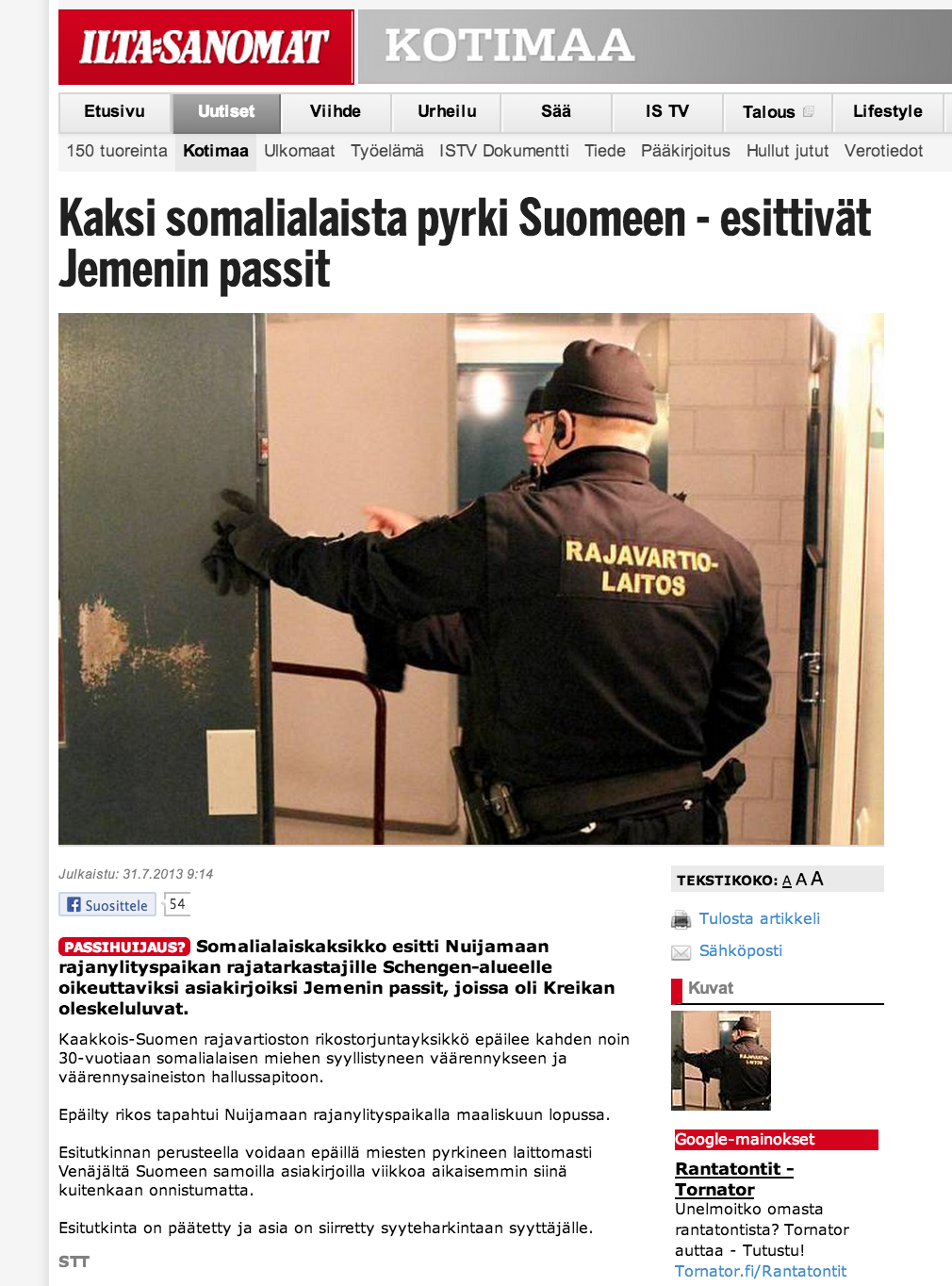
Tabloids like Ilta-Sanomat have a lot to learn about fairness, which is the cornerstone of all good news reporting. But tabloids aren’t interested in fairness but in sensationalism. A story by Ilta-Sanomat is headlined: ”Two Somalis use [fake] Yemeni passports to travel to Finland.” 

Even if the story suggests that these Somalis are committing a crime because they travel with false passports, there is much more to the case than meets the eye. If the reporters would have bothered to read a related story on 4 News in the UK, the angle of their story would have probably been different.

According to 4 News, hundreds of asylum seekers who used false passports to travel to the UK in the past ten years were abused and wrongly convicted.  As a result, the court of appeal quashed the convictions of five victims because they were denied a justifiable defense of the charge.

None of the lawyers told one of the victims like “Jonathan,” who appears on the program, any chance of defending himself. The lawyers advised Jonathan to plead guilty to the charges, which landed him a conviction and a six-month prison sentence.

Apart from having a criminal record, which worsened his chances of finding employment, he was denied for seven years the right to see his wife and child in the U.S. His conviction denied him a visa.

Go here to see the 4 News report.

Kuvankaappaus 2013-7-31 kello 15.12.24

Read full story here.

Migrant Tales has published numerous Ilta-Sanomat’s racist billboard ads from the 1990s, when Finland’s foreign population started to grow rapidly.

images (1)

Here’s a tabloid ad from 1992 where then MP Liisa Kulhia wants to put the Russian mafia and Somalis in their places.

The Finnish media reports near-constantly stories that reinforce intolerance of certain ethnic groups. But what can you expect if they don’t know better? If they don’t know better, any self-respecting reporter would get the facts right and rely as less as possible on his prejudices.

Anssi Honkanen’s and Renne Korppila’s Aamupoika radio program on NRJ, one of Finland’s most popular private radio stations, is one recent example of how hostility and intolerance of immigrants is promoted in Finland. The radio commentators claimed that there was a direct link to between crime rates/human trafficking and the Bulgarian and Romanian Roma who come to Finland to beg. 

I sent an email to the program challenging their urban tales but never got a reply from either Honkanen or Korppila never mind NRJ.

I wonder if NRJ paid any attention to an official police report in mid-July that Roma beggars aren’t victims of human trafficking or linked to organized crime?

As long as people like Honkanen and Korppila can get away with such racist statements, very little can change.

Migrants’ Rights Network: Immigration is an important factor in Conservative rise in the polls

Posted on July 29, 2013 by Migrant Tales

MT comment: Solid analysis by Awale Olad on what role the anti-immigrant message will play in the polls and upcoming elections in the United Kingdom. The delicate balancing act involves anti-immigration rhetoric, which could be ignited by the government’s Immigration Bill, and scaring away those votes it needs to capture, according to Olad.   

With Euro MP and parliamentary elections coming up in Finland in 2014 and 2015, respectively, will parties like the Perussuomalaiset (PS) beef up their anti-immigration rhetoric to capture voters? That is what is exactly happening at this moment. Why did the PS’ new party secretary, Riikka Slunga-Poutsalo, “demand” right after she was elected that Finland should tighten immigration policy?

The interesting question to ask is how much of a boost will the party’s anti-immigration message give the PS in both elections? 

____________

By Awale Olad

The Conservative Party has spent the best part of the past two years lagging behind the Labour Party in the polls until the most recent ICM poll. Most political commentators agree that the budget delivered by Chancellor George Osborne in 2012 was a critical factor in the reduction in Tory fortunes.

Kuvankaappaus 2013-7-29 kello 19.30.58

Read full story here.

Now that parliament has gone quiet for the summer recess, a cheery bunch of Tory MPs will be heading for their summer breaks riding high in the polls having wrested some support back from UKIP, which has put them neck and neck with the Labour Party. With two years to go, strategically, this is the best an incumbent government, trying to manage a sluggish economy, can hope for.

The Guardian’s Patrick Wintour adds:

The fall in the Ukip share may reflect the recent comparative decline in publicity for the party’s leader, Nigel Farage, and Downing Street’s persistent efforts to neutralise Ukip’s appeal by countering with a series of strong messages on immigration, welfare and a referendum on UK membership of the European Union.

With recent events, some could argue that a catalyst for a further rise in support for the Conservative Party is a mixture of the Tories toe-poking Labour on their links with Unite the Union coupled with Theresa May’s final showdown with Abu Qatada, who managed to successfully secure a treaty with the Jordanian government, and send him home. This undoubtedly could be a contributing factor to their fortune in future polls and has been ‘good news story’ for the Tories in recent weeks.

Number 10 will continue to try and neutralise UKIP’s support but it will certainly fall short of electoral success. The reality, as Tory pollster Lord Ashcroft often points out, is what really matters to voters is the economy and jobs.

Both Ashcroft and Wintour agree that these salient issues would ultimately give the Tories a chance of winning the next election. Seducing Tory/UKIP swing voters by going hard on immigration will only win back support in constituencies the Tories need to hold. The Conservatives will need to expand their reach by campaigning on more potent issues, and in particular, raise their game in courting migrant and BME voters. Ashcroft writes:

All in all, the first half of 2013 represents a time of stagnation that we could hardly afford. We have a good case to make on many of the policy areas on which we have lost ground, including crime, immigration, welfare reform and the economy. But people will only hear that case if we use the available air time to make it. The latest round of parliamentary scandal will make people all the more resistant to what we have to say, and the spending review later this month makes it all the more necessary to show we are doing what people expect of us. There is no more time to waste.

Ashcroft is clearly irritated by his Party’s internal squabbles and the cyclical one-upmanship with Labour (generally not the greatest indicator of public mood and feeling) as time-wasting exercises. Tough immigration rhetoric braced with harsh policies will not win the Conservatives the general election but it will consociate the UKIP appeal, which is the first step towards building a coalition of supporters, according to Tory strategists.

The government’s upcoming Immigration Bill will be an interesting dog-fight internally within Conservative MPs and externally with the Labour Party. If the Coalition manages to find time to debate this Bill, the government would need to be careful not to ignite drastic anti-immigration rhetoric that will do little to attract exactly those votes it will increasingly need to capture.

Read original story here.

This piece was reprinted by Migrant Tales with permission.
UK study links hate crime with far right EDL

Posted on July 4, 2013 by Migrant Tales

A study in the UK finds that members of the far right English Defense League (EDL) were linked to a third of the abuses against Muslims last year. Almost two in every three cases of anti-Muslim incidents go unreported in the UK, according to Teesside University’s Centre for Fascist, Anti-Fascist and Post-Fascist Studies. 

Kuvankaappaus 2013-7-4 kello 21.15.44

Read full report here.

Takin onboard the findings of the UK study, we could ask the same question in Finland. Is there a connection in the rise of hate crimes in Finland to the 2011 election victory of the anti-immigration Perussuomalaiset (PS) party?

Contrary to the EDL, the Finnish Defense League is too small to have the same impact as its sister organization in the UK.  The only group with such clout is the PS.

A story reported by Migrant Tales in early 2012 appears to reinforce the latter claim. A story on Kajaani-based daily  Kainuun Sanomat claimed that racist abuse and attacks on the Somali community in Finland started to rise after the PS election victory.

Refugee of the year (2011) Saido Mohammed was quoted as saying: “After the parliamentary election [Somalis that live in] Helsinki have said that they are spat at daily.”

After the 2011 election, traffic on Migrant Tales has soared as well. This is not only an indication that immigrants are concerned about their situation in Finland, it has apparently emboldened racists and those who are opposed to cultural diversity to come out of the closet.

The study in the UK on anti-Muslim sentiment is based on the Tell Mama online helpline, where victims can report about abuse and harassment.

Kuvankaappaus 2013-7-4 kello 21.13.22

Visit Tell Mama online site here.

The report states that there’s been a 150% rise in anti-Muslim hate crime in London from January to May.

Attacks against Muslims have picked up especially after the murder of Lee Rigby in May. This is in contrast to another claim that around half of the mosques and Muslim centers in Britain have been targets of Islamophobic attacks since 9/11, according to The Independent.

The interesting question we should ask is why isn’t there a study in Finland that would show the same findings as those in the UK? Is this due to lack of political will or that Finnish society still continues to play down intolerance?


Migrant Rights’ Network: Campaign for the Right to Family life – next steps

Posted on June 28, 2013 by Migrant Tales

By Ruth Grove-White

Those affected and campaigning against the new rules on family migration will know that we are fast-approaching their 1-year anniversary on 9 July. Over the next couple of months there is plenty that you will be able to do to raise awareness and ask the Government to think again.

Kuvankaappaus 2013-6-28 kello 8.29.34

See original story here.

During the year since the Government announced its changes to the family migration rules, MRN has heard from hundreds of families who have been kept apart from one another – couples split across continents, young children separated from parents, elderly relatives kept apart from relatives who wish to care for them in the UK.

There has been plenty of coverage of the heartache caused by these changes in the media, highlighted in papers including the Evening Standard (here and here), the Telegraph, and Independent.

So what can be done now?

Here’s a heads-up on some of the opportunities over the coming months to make your voices heard:

  • Launch of the APPG Family Migration inquiry report on 10th June – the final report of the APPG family migration inquiry will be available for download from the APPG website from 10 June. As an informal inquiry this report will not carry the weight of a Select Committee report. However it will provide an important evidence base to build further scrutiny of the rules.

  • Parliamentary debates on family migration, June/July – as a result of widespread concerns among parliamentarians about these rules, there are now plans to debate the rules on the floor of both the House of Commons and the House of Lords over the next two months. As soon as we know the dates for those debates, we will let groups and affected families know how to feed in.
  • Divided Families Day on 9th July – the most important way of supporting parliamentarians who want to debate these rules is to show that there is a groundswell of concern from many corners. MRN, JCWI, BritCits, the Family Immigration Alliance and many others will be working together over the coming weeks to organise a series of activities around Parliament from 4pm on 9th July. All details will be circulated nearer the time, but the date should be put in your diary now! Activities will include:

    • Demonstration outside the Home Office – 4pm
    • Meet your MP session
    • Public parliamentary meeting with high profile speakers – 6pm

Keep a close eye on the MRN website, as well as those of other groups involved in campaigning on this issue, for further information on how you can get involved and show Government that it needs to think again.

EXPLORE MORE

  • FAMILY MIGRATION

Read original story here.

This piece was reprinted by Migrant Tales with permission.

  • Previous
  • 1
  • 2
  • 3
  • 4
  • 5
  • 6
  • 7
  • Next
Read more about documentary film
Read more

Recent Posts

  • Finland’s tabloids Iltalehti and Ilta-Sanomat are the pits
  • Riikka Purra’s Dr Jekyll and Mr Hyde mask
  • Double standards
  • Perussuomalaiset: Uusi logo, sama vanha juttu
  • Taco Trump

Recent Comments

  1. Absolutely Socking: Racist Finnish Facebook group against human rights gets flooded with socks on Musta Barbaari’s mother and sister charged by the police in “ethnic profiling” case
  2. Ilkka Nuotio on Pekka Myrskylä: “Tilastot kertovat toista kuin poliittinen keskustelu”
  3. Genrih Soinkara on The war in Ukraine and the Russian-Finnish border crisis are showing Finland’s ugly side
  4. Ahti Tolvanen on Comment by Ahti Tolvanen on the Helsinki +50 conference
  5. Angel Barrientos on Angel Barrientos is one of the kind beacons of Finland’s Chilean community

Archives

  • June 2026
  • May 2026
  • April 2026
  • March 2026
  • February 2026
  • January 2026
  • December 2025
  • November 2025
  • October 2025
  • September 2025
  • August 2025
  • July 2025
  • June 2025
  • May 2025
  • April 2025
  • March 2025
  • February 2025
  • January 2025
  • December 2024
  • November 2024
  • October 2024
  • September 2024
  • August 2024
  • July 2024
  • June 2024
  • May 2024
  • April 2024
  • March 2024
  • February 2024
  • January 2024
  • December 2023
  • November 2023
  • October 2023
  • September 2023
  • August 2023
  • July 2023
  • June 2023
  • May 2023
  • April 2023
  • March 2023
  • February 2023
  • January 2023
  • December 2022
  • November 2022
  • October 2022
  • September 2022
  • August 2022
  • July 2022
  • June 2022
  • May 2022
  • April 2022
  • March 2022
  • February 2022
  • January 2022
  • December 2021
  • November 2021
  • October 2021
  • September 2021
  • August 2021
  • July 2021
  • June 2021
  • May 2021
  • April 2021
  • March 2021
  • February 2021
  • January 2021
  • December 2020
  • November 2020
  • October 2020
  • September 2020
  • August 2020
  • July 2020
  • June 2020
  • May 2020
  • April 2020
  • March 2020
  • February 2020
  • January 2020
  • December 2019
  • November 2019
  • October 2019
  • September 2019
  • August 2019
  • July 2019
  • June 2019
  • May 2019
  • April 2019
  • March 2019
  • February 2019
  • January 2019
  • December 2018
  • November 2018
  • October 2018
  • September 2018
  • August 2018
  • July 2018
  • June 2018
  • May 2018
  • April 2018
  • March 2018
  • February 2018
  • January 2018
  • December 2017
  • November 2017
  • October 2017
  • September 2017
  • August 2017
  • July 2017
  • June 2017
  • May 2017
  • April 2017
  • March 2017
  • February 2017
  • January 2017
  • December 2016
  • November 2016
  • October 2016
  • September 2016
  • August 2016
  • July 2016
  • June 2016
  • May 2016
  • April 2016
  • March 2016
  • February 2016
  • January 2016
  • December 2015
  • November 2015
  • October 2015
  • September 2015
  • August 2015
  • July 2015
  • June 2015
  • May 2015
  • April 2015
  • March 2015
  • February 2015
  • January 2015
  • December 2014
  • November 2014
  • October 2014
  • September 2014
  • August 2014
  • July 2014
  • June 2014
  • May 2014
  • April 2014
  • March 2014
  • February 2014
  • January 2014
  • December 2013
  • November 2013
  • October 2013
  • September 2013
  • August 2013
  • July 2013
  • June 2013
  • May 2013
  • April 2013
  • March 2013
  • February 2013
  • January 2013
  • December 2012
  • November 2012
  • October 2012
  • September 2012
  • August 2012
  • July 2012
  • June 2012
  • May 2012
  • April 2012
  • March 2012
  • February 2012
  • January 2012
  • December 2011
  • November 2011
  • October 2011
  • September 2011
  • August 2011
  • July 2011
  • June 2011
  • May 2011
  • April 2011
  • March 2011
  • February 2011
  • January 2011
  • December 2010
  • November 2010
  • October 2010
  • September 2010
  • August 2010
  • July 2010
  • June 2010
  • May 2010
  • April 2010
  • March 2010
  • February 2010
  • January 2010
  • December 2009
  • November 2009
  • October 2009
  • September 2009
  • August 2009
  • July 2009
  • December 2008
  • November 2008
  • October 2008
  • September 2008
  • August 2008
  • July 2008
  • June 2008
  • May 2008
  • April 2008
  • March 2008
  • February 2008
  • January 2008
  • November 2007
  • October 2007
  • September 2007
  • August 2007
  • July 2007
  • June 2007
  • May 2007

Categories

  • ?? Gia L?c
  • ????? ?????? ????? ???????? ?? ??????
  • ???????
  • @HerraAhmed
  • @mondepasrond
  • @nohatefinland
  • @oula_silver
  • @Varathas
  • A Pakistani family
  • äärioikeisto
  • Abbas Bahmanpour
  • Abdi Muhis
  • Abdirahim Hussein Mohamed
  • Abdirahim Husu Hussein
  • Abdirisak Mahamed
  • About Migrant Tales
  • activism
  • Adam Al-Sawad
  • Adel Abidin
  • Afrofinland
  • Ahmed IJ
  • Ahti Tolvanen
  • Aino Pennanen
  • Aisha Maniar
  • Alan Ali
  • Alan Anstead
  • Alejandro Díaz Ortiz
  • Alekey Bulavsev
  • Aleksander Hemon
  • Aleksanterinliitto
  • Aleksanterinliitto ry
  • Aleksanterinliitto ry:n hallitus
  • Alex Alex
  • Alex Mckie
  • Alexander Nix
  • Alexandra Ayse Albayrak
  • Alexis Neuberg
  • Ali Asaad Hasan Alzuhairi
  • Ali Hossein Mir Ali
  • Ali Rashid
  • Ali Sagal Abdikarim
  • Alina Tsui
  • Aline Müller
  • All categories
  • Aman Heidari
  • Amiirah Salleh-Hoddin & Jana Turk
  • Amin A. Alem
  • Amir Zuhairi
  • Amkelwa Mbekeni
  • Ana María Gutiérrez Sorainen
  • Anachoma
  • Anders Adlecreutz
  • Angeliina Koskinen
  • Anna De Mutiis
  • Anna María Gutiérrez Sorainen
  • Anna-Kaisa Kuusisto ja Jaakko Tuominen
  • Annastiina Kallius
  • Anneli Juise Friman Lindeman
  • Announcement
  • Anonymous
  • Antero Leitzinger
  • anti-black racism
  • Anti-Hate Crime Organisation Finland
  • Anudari Boldbaatar
  • Arshiya Nasser
  • Aspergers Syndrome
  • Asylum Corner
  • Asylum seeker 406
  • Athena Griffin and Joe Feagin
  • Autism
  • Avaaz.org
  • Awale Olad
  • Ayan Said Mohamed
  • AYY
  • Barachiel
  • Bashy Quraishy
  • Beatrice Kabutakapua
  • Beri Jamal
  • Beri Jamal and Enrique Tessieri
  • Bertolt Brecht
  • Boiata
  • Boodi Kabbani
  • Bruno Gronow
  • Carmen Pekkarinen
  • Çelen Oben and Sheila Riikonen
  • Chiara Costa-Virtanen
  • Chiara Costa-Virtanen
  • Chiara Sorbello
  • Christian Thibault
  • Christopher Wylie
  • Clara Dublanc
  • Dana
  • Daniel Malpica
  • Danilo Canguçu
  • David Papineau
  • David Schneider
  • Dexter He
  • Don Flynn
  • Dr Masoud Kamali
  • Dr. Faith Mkwesha
  • Dr. Theodoros Fouskas
  • Edna Chun
  • Eeva Kilpi
  • Emanuela Susheela
  • En castellano
  • ENAR
  • Enrique
  • Enrique Tessieri
  • Enrique Tessieri & Raghad Mchawh
  • Enrique Tessieri & Yahya Rouissi
  • Enrique Tessieri and Muhammed Shire
  • Enrique Tessieri and Sira Moksi
  • Enrique Tessieri and Tom Vandenbosch
  • Enrique Tessieri and Wael Che
  • Enrique Tessieri and Yahya Rouissi
  • Enrique Tessieri and Zimema Mhone
  • Epäluottamusmies
  • EU
  • Europe
  • European Islamophobia Report
  • European Islamophobia Report 2019,
  • European Union
  • Eve Kyntäjä
  • Ezequiel Caldeiro
  • Facebook
  • Fadumo Dayib
  • Faisa Kahiye
  • Farhad Manjoo
  • Fasismi
  • Finland
  • Fizza Qureshi
  • Flyktingar och asyl
  • Foreign Student
  • Fozia Mir-Ali
  • Frances Webber
  • Frida Selim
  • Gareth Rice
  • Ghyslain Vedeaux
  • Global Art Point
  • Great Replacement
  • Habiba Ali
  • Hami Bahadori
  • Hami Bahdori
  • Hamid
  • Hamid Alsaameere
  • Hamid Bahdori
  • Handshake
  • Harmit Athwal
  • Hassan Abdi Ali
  • Hassan Muhumud
  • Heikki Huttunen
  • Heikki Wilenius
  • Helsingin Sanomat
  • Henning van der Hoeven
  • Henrika Mälmsröm
  • Hser Hser
  • Hser Hser ja Mustafa Isman
  • Husein Muhammed
  • Hussain Kazemian
  • Hussain Kazmenian
  • Ibrahim Khan
  • Ida
  • Ignacio Pérez Pérez
  • Iise Ali Hassan
  • Ilari Kaila & Tuomas Kaila
  • Imam Ka
  • inside-an-airport
  • Institute of Race Relations
  • Iraqi asylum seeker
  • IRR European News Team
  • IRR News Team
  • Islamic Society of Norhern FInland
  • Islamic Society of Northern Finland
  • Islamophobia
  • Jacobinmag.com
  • Jallow Momodou
  • Jan Holmberg
  • Jane Elliott
  • Jani Mäkelä
  • Jari Luoto
  • Jari Taponen
  • Jegor Nazarov
  • Jenni Stammeier
  • Jenny Bourne
  • Jessie Daniels
  • Joe Davidow
  • Johannes Koski
  • John D. Foster
  • John Grayson
  • John Marriott
  • Jon Burnett
  • Jorma Härkönen
  • Jos Schuurmans
  • José León Toro Mejías
  • Josue Tumayine
  • Jouni Karnasaari
  • Juan Camilo
  • Jukka Eräkare
  • Julian Abagond
  • Julie Pascoet
  • Jussi Halla-aho
  • Jussi Hallla-aho
  • Jussi Jalonen
  • JusticeDemon
  • Kadar Gelle
  • Kaksoiskansalaisuus
  • Kansainvälinen Mikkeli
  • Kansainvälinen Mikkeli ry
  • Katherine Tonkiss
  • Kati Lepistö
  • Kati van der Hoeven-Lepistö
  • Katie Bell
  • Kättely
  • Kerstin Ögård
  • Keshia Fredua-Mensah & Jamie Schearer
  • Khadidiatou Sylla
  • Khadra Abdirazak Sugulle
  • Kiihotus kansanryhmää vastaan
  • Kirsi Crowley
  • Koko Hubara
  • Kristiina Toivikko
  • Kubra Amini
  • KuRI
  • La Colectiva
  • La incitación al odio
  • Laura Huhtasaari
  • Lauri Finér
  • Leif Hagert
  • Léo Custódio
  • Leo Honka
  • Leontios Christodoulou
  • Lessie Branch
  • Lex Gaudius
  • Leyes de Finlandia
  • Liikkukaa!
  • Linda Hyökki
  • Liz Fekete
  • M. Blanc
  • Maarit Snellman
  • Mahad Sheikh Musse
  • Maija Vilkkumaa
  • Malmin Kebab Pizzeria Port Arthur
  • Marcell Lorincz
  • Mari Aaltola
  • María Paz López
  • Maria Rittis Ikola
  • Maria Tjader
  • Marja-Liisa Tolvanen
  • Mark
  • Markku Heikkinen
  • Marshall Niles
  • Martin Al-Laji
  • Maryan Siyad
  • Matt Carr
  • Mauricio Farah Gebara
  • Media Monitoring Group of Finland
  • Micah J. Christian
  • Michael McEachrane
  • Michele Levoy
  • Michelle Kaila
  • Migrant Tales
  • Migrant Tales Literary
  • Migrantes News
  • Migrants' Rights Network
  • MigriLeaks
  • Mikko Kapanen
  • Miriam Attias and Camila Haavisto
  • Mohamed Adan
  • Mohammad Javid
  • Mohammad M.
  • Monikulttuurisuus
  • Monisha Bhatia and Victoria Canning
  • Mor Ndiaye
  • Muh'ed
  • Muhamed Abdimajed Murshid
  • Muhammed Shire
  • Muhammed Shire and Enrique Tessieri
  • Muhis Azizi
  • Musimenta Dansila
  • Muslimiviha
  • Musulmanes
  • Namir al-Azzawi
  • Natsismi
  • Neurodiversity
  • New Women Connectors
  • Nils Muižnieks
  • No Labels No Walls
  • Noel Dandes
  • Nuor Dawood
  • Omar Khan
  • Otavanmedia
  • Oula Silvennoinen
  • Paco Diop
  • Pakistani family
  • Pentti Stranius
  • Perussuomalaiset
  • perustuslaki
  • Petra Laiti
  • Petri Cederlöf
  • Pia Grochowski
  • Podcast-lukija Bea Bergholm
  • Pohjois – Suomen Islamilainen Yhdyskunta
  • Pohjois Suomen Islamilainen Yhyskunta
  • Polina Kopylova
  • Race Files
  • racism
  • Racism Review
  • Raghad Mchawh
  • Ranska
  • Rashid H. and Migrant Tales
  • Rasismi
  • Raul Perez
  • Rebecka Holm
  • Reem Abu-Hayyeh
  • Refugees
  • Reija Härkönen
  • Remiel
  • Reza Nasri
  • Richard Gresswell
  • Riikka Purra
  • Risto Laakkonen
  • Rita Chahda
  • Ritva Kondi
  • Robito Ibrahim
  • Roble Bashir
  • Rockhaya Sylla
  • Rodolfo Walsh
  • Roger Casale
  • Rostam Atai
  • Roxana Crisólogo Correa
  • Ruth Grove-White
  • Ruth Waweru-Folabit
  • S-worldview
  • Sadio Ali Nuur
  • Sami Rusanen
  • Sandhu Bhamra
  • Sara de Jong
  • Sarah Crowther
  • Sari Alhariri
  • Sarkawt Khalil
  • Sasu
  • Scot Nakagawa
  • Shabana Ahmadzai
  • Shada Islam
  • Sharon Chang blogs
  • Shenita Ann McLean
  • Shirlene Green Newball
  • Sini Savolainen
  • Sira Moksi
  • Sonia K.
  • Sonia Maria Koo
  • Steverp
  • Stop Deportations
  • Suldaan Said Ahmed
  • Suomen mediaseurantakollektiivi
  • Suomen Muslimifoorumi ry
  • Suomen viharikosvastainen yhdistys
  • Suomen viharikosvastainen yhdistys ry
  • Suomi
  • Supermen
  • Susannah
  • Suva
  • Syrjintä
  • Talous
  • Tapio Tuomala
  • Taw Reh
  • Teivo Teivainen
  • The Daily Show
  • The Heino
  • The Supermen
  • Thomas Elfgren
  • Thulfiqar Abdulkarim
  • Tim McGettigan
  • Tino Singh
  • Tito Moustafa Sliem
  • Tobias Hübinette and L. Janelle Dance
  • Transport
  • Trica Danielle Keaton
  • Trilce Garcia
  • Trish Pääkkönen
  • Trish Pääkkönen and Enrique Tessieri
  • Tuulia Reponen
  • Uncategorized
  • UNITED
  • University of Eastern Finland
  • Uyi Osazee
  • Väkivalta
  • Vapaa Liikkuvuus
  • Venla-Sofia Saariaho
  • Vieraskynä
  • W. Che
  • W. Che an Enrique Tessieri
  • Wael Ch.
  • Wan Wei
  • Women for Refugee Women
  • Xaan Kaafi Maxamed Xalane
  • Xassan Kaafi Maxamed Xalane
  • Xassan-Kaafi Mohamed Halane & Enrique Tessieri
  • Yahya Rouissi
  • Yasmin Yusuf
  • Yassen Ghaleb
  • Yle Puhe
  • Yuliet Tresa
  • Yve Shepherd
  • Zahra Khavari
  • Zaker
  • Zalina Ametova
  • Zamzam Ahmed Ali
  • Zeinab Amini ja Soheila Khavari
  • Zimema Mahone and Enrique Tessieri
  • Zimema Mhone
  • Zoila Forss Crespo Moreyra
  • ZT
  • Zulma Sierra
  • Zuzeeko Tegha Abeng
© 2026 Migrant tales | Powered by Minimalist Blog WordPress Theme