Migrant tales
Menu
  • #MakeRacismHistory “In Your Eyes”
  • About Migrant Tales
  • It’s all about Human Rights
  • Literary
  • Migrant Tales Media Monitoring
  • NoHateFinland.org
  • Tales from Europe
Menu

Tag: United Kingdom

Migrants’ Rights Network: Reasons to be cheerful about migrants’ rights in 2015

Posted on January 6, 2015 by Migrant Tales

Don Flynn* 

Don_web_0

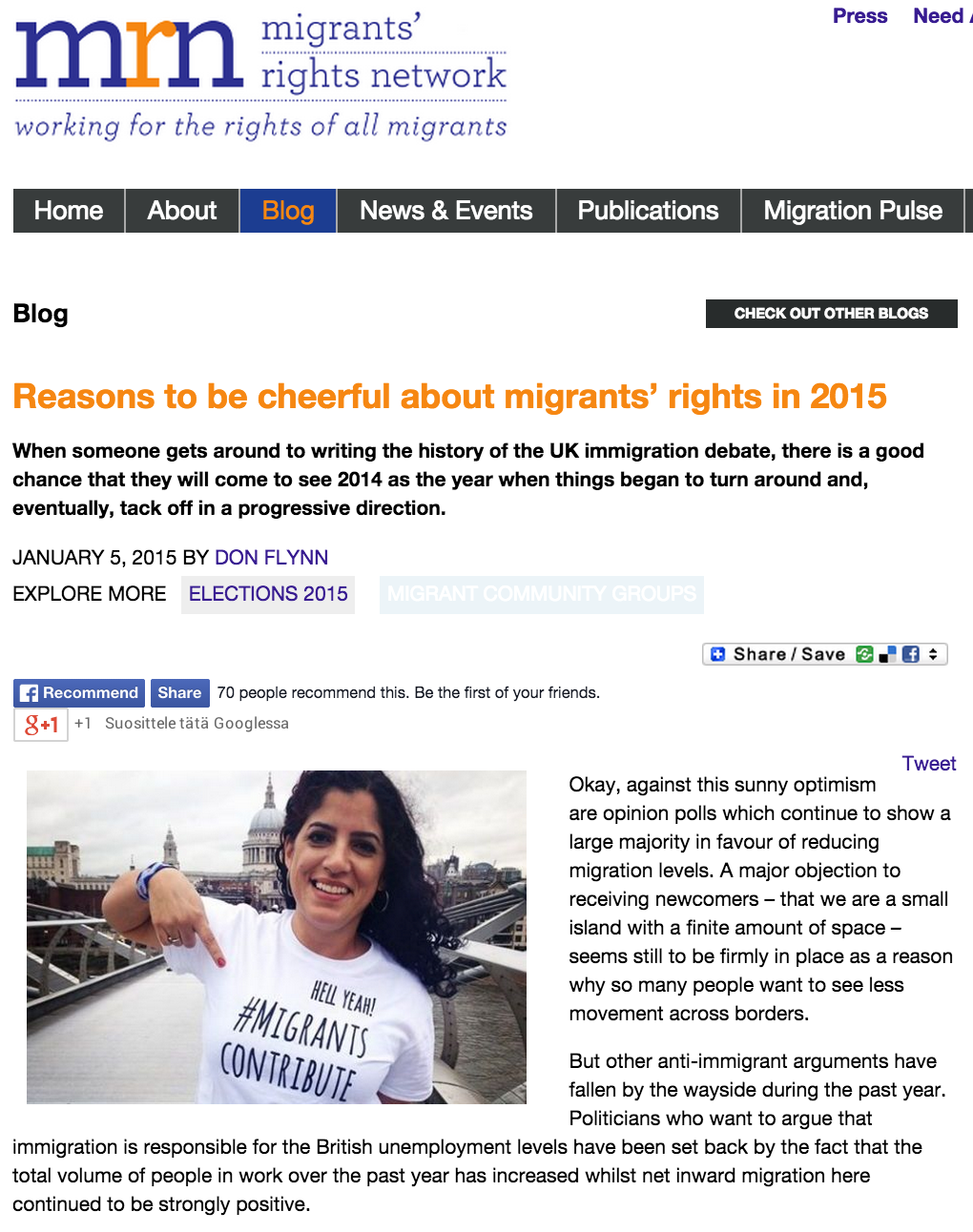
When someone gets around to writing the history of the UK immigration debate, there is a good chance that they will come to see 2014 as the year when things began to turn around and, eventually, tack off in a progressive direction.

Näyttökuva 2015-1-6 kello 23.21.24

Read original blog entry here.


Okay, against this sunny optimism are opinion polls which continue to show a large majority in favour of reducing migration levels. A major objection to receiving newcomers – that we are a small island with a finite amount of space – seems still to be firmly in place as a reason why so many people want to see less movement across borders.

But other anti-immigrant arguments have fallen by the wayside during the past year.  Politicians who want to argue that immigration is responsible for the British unemployment levels have been set back by the fact that the total volume of people in work over the past year has increased whilst net inward migration here continued to be strongly positive.

Even the claim that high levels of migration create pressure on our public services has been eclipsed by the evidence that public spending cuts mandated by the austerity agenda have been the real culprit behind longer waiting times and more restricted resources. If migration shows up in any way in the news stories of struggling A&E departments and hard-pressed social care it is more likely to be through the image of migrant doctors, nurses, care workers and ancillary staff battling to keep things going, in defiance of inadequate budgets to do the job.

Also on the positive side is the evidence of a sector of public opinion which seems utterly resistant to the idea that migrants are to blame for the difficulties of recent years.  Across the country the figure is around 20 – 25% of the public, but its real significance lies in the groups of people where these views are concentrated.  Young people who have grown up in families and communities with histories of migration are rejecting the idea that migrants are to blame and are most likely to see their presence in the neighbourhoods and towns where they live as evidence of dynamism and opportunity.

We should also be encouraged by the support for this viewpoint among forward-thinking elements in all the main political parties.  Groups of Conservatives as much as Labourites and Lib Dems have conceded this point and are increasingly visible in policy dialogues as they try to work out ways to reconcile the new reality of migration with their wider philosophical commitments.

This is a good place to be as we think about what groups working to support migrants might do as the challenge of a general election looms in May.  The ‘migrants contribute’ message is one that needs to be taken up and reinforced in towns and regions across the country.  Better still, we should be looking to build local platforms which can marshal the basic facts and data on the ways migrants are contributing to local communities, and work out how to get these out through regional media.

But we should also look for the chance to raise the ante in the public conversation by making the case that so much more could be achieved if newcomers were accepted as active partners in tackling fundamental problems, like housing, quality jobs, health services, education, inequality and the negativity of racism and xenophobia where it exists.

This means that as well as proclaiming “Hell Yeah, Migrants Contribute!” during the coming months, we should also say “And it’s high time they got a Fairer Deal out of immigration policy!”

MRN has offered up its ideas on how this can be done in the ‘Migrants Manifesto’ which has been endorsed by 120 organisations across the country.  We are planning for intensive activity across the coming weeks to get these ideas out as widely as possible and engage with people as they work out the messages that are coming across during the course of the election campaign.

We are keen to hear from all people who are interested in joining in this effort to get across positive messages about migration.  Drop us a line at [email protected] if you would like to get involved!

So, from all of us at MRN, here’s wishing you a Happy New Year and the very best for all your hopes that 2015 will be a year in which things truly turn around!

The “Hell Yeah – Migrants Contribute!” t-shirt in the picture has been produced by the #MigrantsContribute! coalition of campaigning groups.  Check them out at http://www.migrants-contribute.org.uk. You can get your t-shirt from MRN priced at £12 + £1 post and packing (total £13).  Please indicate your preferred size, L, M or S.

Read original story here.

This piece was reprinted by Migrant Tales with permission.

* Don Flynn, the MRN director, leads the ogranization’s strategic development and coordinates MRN’s policy and project work. He is a regular and sought-after speaker at conferences, seminars and lectures on behalf of MRN.

Migrants’ Rights Network: Out with the old, in with the new: 2014 ends as it began

Posted on December 23, 2014 by Migrant Tales

Awale Olad*

Awale_web


It seems that 2014 will end with yet more news on immigration. This time it involves the Home Secretary, Theresa May, and her push to change the immigration rules in order to require that all international students graduating at UK universities leave the country on completion of their course.

Näyttökuva 2014-12-23 kello 8.52.02

Read full story here.

MRN closed the year a full 12 months ago with an account of a ‘rag, tag and bobtail’ Parliamentary debate on immigration which took place in Westminster Hall.

At that time it involved the MP for Amber Valley, Nigel Mills making a last minute attempt to stop the lifting of the transitional controls which had prevented Bulgarians and Romanians accessing jobs in the mainstream labour market for the previous seven years. He lost the vote and the Immigration Bill accelerated towards the becoming law.

It seems that 2014 will end with yet more news of jostling and elbowing within the ranks of the government parties on immigration. This time it involves the Home Secretary, Theresa May, and her push to change the immigration rules in order to require that all international students graduating at UK universities leave the country on completion of their course. At the moment they are permitted to remain in the country to apply for jobs under the terms of Tier 2, or setup a business in Tier 1, extend their PHD in Tier 4, or gain work experience in Tier 5, of the Points-Based Scheme (PBS).

Mrs May thinks that by ending these routes to an extension of residence permits will address a problem she says exists which involves international students staying on without permission and thereby adding to the numbers of irregular migrants in the country.

It is hard to credit the sense of this idea.  The students who are permitted to remain under the terms of the PBS are not adding to the numbers of people breaking the immigration rules for the simple reason that they have been told by her government department that they can remain in compliance with those rules. The actual numbers affected here would be around 6,000 students, a mere 3 percent of the overall 176,000 that came to the UK in 2014.

Plenty of critical voices have spoken up to protest against the daftness of an idea that hits at the interests of one of Britain’s most successful service industries – namely higher education – which has a poll position to maintain in the highly competitive global race to attract fee-paying students to its universities and colleges. Her partners in the coalition government, the Lib Dems, have rushed to brand it as a ‘silly’ idea.

One suspects that there will be others as equally alarmed. International students have provided a rich flow of talent to many British businesses looking for employers who will help prise open access for their goods and services in overseas markets. If recovery from the deepest recession in a century is to continue it will be because these companies have the skills in their staff teams which can access business opportunities aboard and do the sort of deals that allow small and medium sized enterprises to grow stronger and win more orders.

There is also the sense that this proposal is purely a cynical political attack on foreign students as part of the cat and mouse game between key players jostling for the leadership of the Conservative Party with the Prime Minister and as a result Theresa May is deliberately undermining David Cameron on the issue of student migration. The Prime Minister has been part of a search party sent to India on many occasions to calm anxieties about Theresa May’s student rhetoric, which is hurting UK universities, and this latest announcement will certainly be viewed as a clear shot at Downing Street in response to the cull of special advisors linked to May, who are currently seeking safe Conservative parliamentary seats.

Major problems arise from this verbal jousting:

  1. It only caters to the mainstream media who like to stir up the Westminster bubble. Politicians will look silly, public trust will continue to plummet, and students, universities, and SMEs are the only real victims.
  2. This latest announcement will do more damage to the current declining popularity of UK universities. It will give succour to Australia, the UK’s main competition, which is currently attracting higher levels of Indian students that would have at one time scrambled for the UK. The closure of the previous Tier 1 post-study work visa has done much damage to the UK’s attractiveness abroad.

The Tory backbench revolt on the issue of Bulgarians and Romanians failed at the end of last year, and, even with 50,000 people from these countries registering in the UK labour force, the evidence is clearly on the side that they slotted into the jobs market and have been doing their bit to help the country grow out of the doldrums.

This time the insurgency has come not from the Conservative backbenches, but one of its most prominent ministers in government. We have to hope that Mrs May’s colleagues will see that it is, like her previous attempts to introduce the visa bonds and go home vans, a non-starter for SMEs and the UK’s ability to be a global competitor.

Read original story here.

This piece was reprinted by Migrant Tales with permission.

*Awale Olad is the Public & Parliamentary Affairs Officer at MRN, coordinating the work of the All-Party Parliamentary Group on Migration, supporting parliamentarians and policy makers on establishing a cross-party consensus on immigration policy.

Migrants’ Rights Network: David Cameron’s EU migration speech – what impact on migrants’ rights?

Posted on December 1, 2014 by Migrant Tales

Ruth Grove-White*

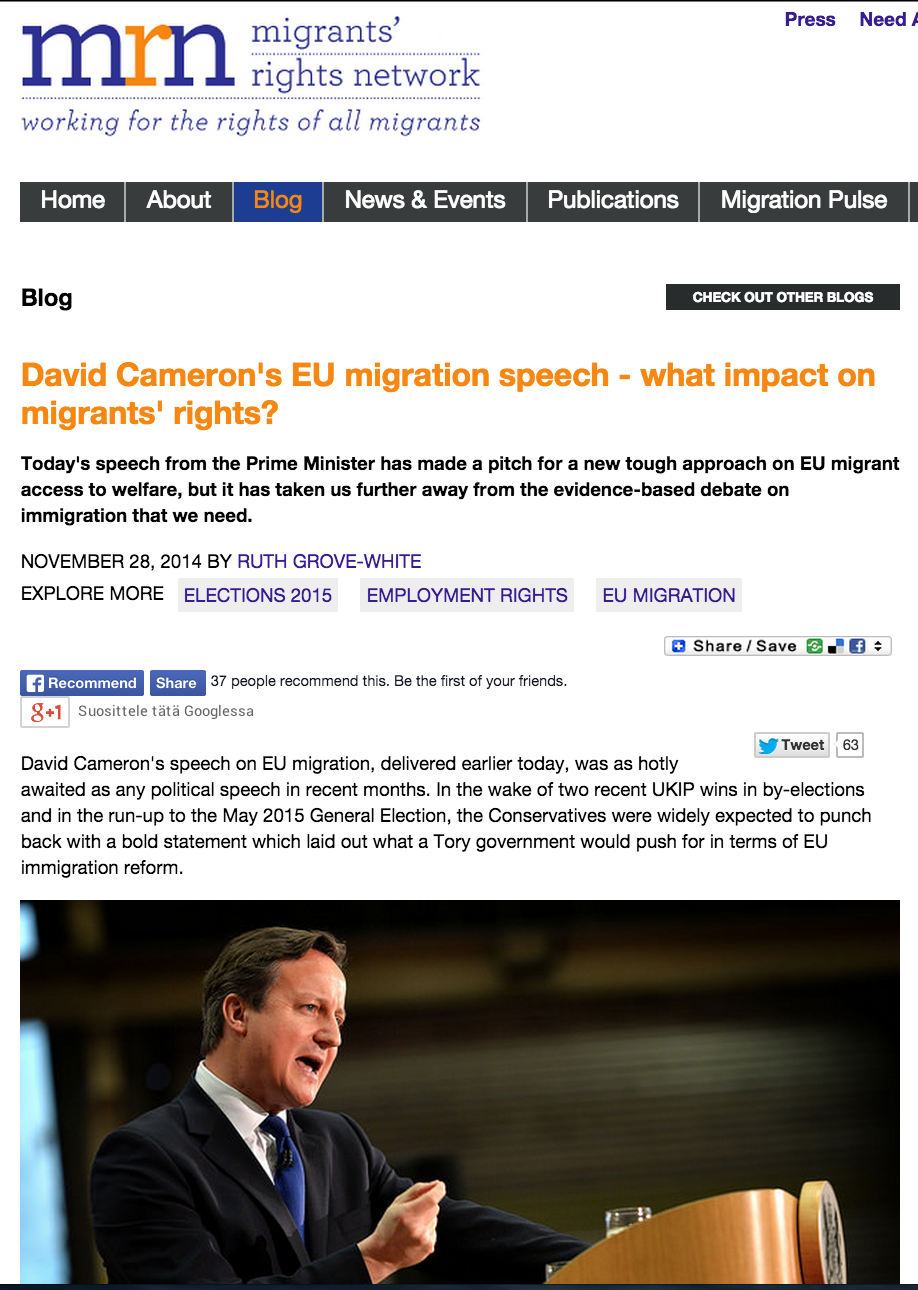
Today’s (28.11) speech from the Prime Minister has made a pitch for a new tough approach on EU migrant access to welfare, but it has taken us further away from the evidence-based debate on immigration that we need.

Näyttökuva 2014-12-1 kello 13.19.14

Read full story here.


David Cameron’s speech on EU migration, delivered earlier Friday, was as hotly awaited as any political speech in recent months. In the wake of two recent UKIP wins in by-elections and in the run-up to the May 2015 General Election, the Conservatives were widely expected to punch back with a bold statement which laid out what a Tory government would push for in terms of EU immigration reform.

In the event the speech was a clever piece of political positioning. The PM rejected the temptation to introduce the more lurid proposals hoped for by some Conservative Euro-sceptic backbenchers, such as emergency brakes on EU migration and caps on numbers. Instead he chose a relatively measured tone which aimed his pitch to the public straight down into the centre-ground, and was at pains to reject an overtly anti-immigration stance. This was a call for the continuation of EU free movement but with ‘tough approach to welfare’ – in other words, a UK within which EU migrants can still come here, but have their eligibility for state support significantly scaled-back.

As such Cameron has received plaudits for having apparently made a legitimate attempt to address concerns firmly planted in the public mind about EU migration and access to welfare. Elements of his pitch have been openly supported by organisations ranging from Labour, the Lib Dems and a number of thinktanks. But there has seemed to be little enthusiasm for defending the principle of welfare entitlement for EU migrant workers on the grounds of basic fairness…

For our part, MRN has a number of objections to the content of Cameron’s speech – here are three of them:

1. It does nothing to move us towards a more evidence-based and fair immigration debate

Yes, the tone of this speech was measured, but its implications were not. By putting EU migrant access to benefits at the heart of his speech Cameron has given credence to one of the biggest myths about EU migration – that there is a significant take-up of welfare benefits by this group of workers.

All the statistics show otherwise. We know that less than 10% of all EU migrants claim any kind of welfare, which includes in-work benefits for those working in low-wage jobs. EU migrants contribute £20 billion more in taxes than they take out in any kind of welfare or social security. According to Open Europe, as of February 2014, only 2.5% of total unemployment benefits claimants were EU migrants. Government data for 2013 suggests that only 6.4% of workers claiming tax credits in the UK are from the EU. And just four per cent of new social housing lettings in England in 2012-13 were to people from the European Union – almost all went to people who have been here for five years or longer. The evidence all points in the same direction, but the message sent out to the public today has been the opposite.

The truth is that we have to put this down as yet another missed opportunity to reframe the public conversation about EU migration and advance proposals which could allay fears and point to a more positive engagement with the issue. We needed to hear more about how, if some EU migration creates pressures in certain areas or on certain services, they could be tackled. How could local public service providers or authorities better support local integration? Why are so many EU migrants stuck in low-paid work that British people don’t want to do? Cameron made a brief and welcome acknowledgement that more resources would be needed in these areas, but otherwise allowed his proposals to centre on the more hyped area of welfare support.

2. These policies would create a cohort of workers on poverty wages

A centrepiece of this speech was the proposal to cut in-work benefits, with the claim that this will deter EU migrant workers from coming to the UK in the future. Maybe some will be put off coming, but there are real grounds for concern that a ‘crackdown’ on EU migrant benefits will also create a new cohort of vulnerable workers in the UK. These workers will be able to come and do the lowest-paid jobs in sectors with very little regulation, whilst paying their taxes but with no safety net of welfare support whatsoever.

Many EU migrants are coming here do low-paid but vital jobs like looking after our sick and elderly in care homes. Cutting protections for those in low-wage work would tip them into vulnerability, forcing them to live on incomes between 30% and 60% less than their British counterparts. There would be no complaint from exploitative employers who would find they now have an EU migrant workforce which is desperate to work long hours and accept all manner of ill-treatment if it will help them to make a liveable wage. Instead of accepting this proposal, we should be demanding that the Government introduce wages for all workers at the bottom end of the labour market which are adequate to live on, rather than requiring a top-up from the welfare system in order to make them decent.

3. This speech will do little to solve the public’s disquiet about immigration.

It seems unlikely that Cameron’s speech will do anything to ease public concerns about immigration. We know that there is no magic bullet on this issue, particularly because of its embeddedness in wider issues relating to the economy, education, housing and welfare. But today is a reminder that immigration is, as ever, vulnerable to being held hostage to politics. Short-term promises and pledges – such as today’s suggestion that EU migration can be substantially reduced as a result of these reforms – will in the end do little to build confidence if there is no real delivery. And we think it unlikely that today’s proposals would substantially reduce EU migration for the simple reason that EU migrants do not come to the UK to claim benefits.

Instead, we expect that the main outcome of this speech will be to build the pressure around today’s whipping boy – EU migrants – while continuing to deflect attention from the wide range of policies which are embedding social injustice and inequality across our society. It might be that for the time being Mr Cameron has won a point or two, but with real problems stacking up now and into the foreseeable future around the position of vulnerable migrants, we see no reason for anyone else to celebrate it.

Read original story here.

This piece was reprinted by Migrant Tales with permission.

*Ruth Grove-White is MRN’s Policy Director, responsible for developing the network’s responses to Government policy and legislation, leading on MRN parliamentary work and supporting the Director in representing the organization.

Do you think David Cameron should be given ‘a medal’ for immigration?

Posted on November 15, 2014 by Migrant Tales

Finnish Prime Minister Alexsander Stubb continues to surprise us. This time he proposed giving the UK, or Prime Minister David Cameron, ‘a medal’ for immigration. Taking into account how Cameron sees himself threatened by the UKIP and how he’s caved in to anti-immigration and anti-EU rhetoric, the distinction proposed by Stubb is odd to say the least. 

Cameron’s anti-immigration rhetoric is nothing new.

One of the matters that becomes clear in Martin Barker’s The New Racism (1981) is that the same anti-immigration sound bites are used today. Prime Minister Margaret Thatcher claimed before the 1979 general election on BBC Radio 4 that Britain was being ‘swamped’ by immigrants and alien cultures.

Remember when Cameron warned how Britain was going to be swamped by Bulgarians and Romanians that on January 1, 2014? Such claims were totally false.

Why do politicians make such irresponsible statements that victimize whole groups? Is it because they lack backbone and seek political gains at any cost? Is it because immigrants and minorities are easy targets to bully publicly?

Näyttökuva 2014-11-15 kello 1.10.07


Read full story here.


I never could understand how a country that was a colonial and imperialist power like the UK is so touchy about immigration. Since Cameron is into populist anti-immigration rhetoric, certainly we can make a case for the abuse of hundreds of millions of people under colonialism. What about its complicity in the slave trade?

Whatever happened to that Subb before the 2011 parliamentary elections, when he took a strong stand against the xenophobia, racism and ignorance gripping the debate on immigration and immigrants in Finland?

Should we give the Finnish prime minister ‘a medal’ for forgetting that intolerance and populist anti-immigration rhetoric, parroted by Cameron, have little to do with our Nordic values?


Migrants’ Rights Network: Yes, migrants are net contributors, but they are also our partners in challenging inequality and injustice

Posted on November 10, 2014 by Migrant Tales

Migrant Tales’ insight: Another fine essay by Don Flynn, which brings to mind recent claims by the Perussuomalaiset (PS)* party that migration costs the country up to 2 billion euros. The estimation is only a guess by the PS and which forget to calculate that the majority of migrants in Finland work, pay taxes and consume. They conveniently forgot to mention as well a recent OECD report that migration had boosted Finland’s economic growth in 2011 by 0.16%, including pensions. 

_____________

Don Flynn*

Don_web_0

We heard last week that recent migrants have contributed £20 billion to UK revenues. But the real gains from migration will come when newcomers can take their place in the fight against inequality and xenophobia.

Näyttökuva 2014-11-10 kello 18.03.41

Read full blog entry here. 


Last week’s report from academics at University College London on the fiscal impacts of migration to the UK is just the latest in a whole sequence which has made the case that, far from being a charge on the tax payer, the migration that developed over the course of the 2000s, has brought in a cohort of net contributors.

We can expect that this steady accumulation of evidence supporting the view that migration does generate positive effects is to open up space in the political mainstream for the argument that immigration policy should incline towards openness rather than closure. Advocacy in support of groups like international students and skilled migrants has already advanced to the point where it has the ear of leading ministers with Vince Cable at BIS being particularly outspoken.

Arguments in favour of more openness on immigration policy represent both opportunities and challenges for groups working to support the rights of migrants. Opportunities in the sense that they undermine the ‘commonsense’ presumption that society is better protected when it imposes strict control over the movement of non-nationals; challenged because so much of the discussion revolves around the election of the types of migrant for whom borders will be relatively open.

MRN has always resisted the idea that a simple formula is available which will assist state functionaries in a decision-making process about who is the ‘good’ immigrant, as opposed to the undesirable. The slogan which the Home Office has raised to official status, branding its policies as aiming to select ‘the brightest and the best’ seems especially inane as the evidence accumulates that the gains for the welfare of the population are just as likely to come from any newcomer who aims to fill whatever niche if offered up and to meet the demands for taxes that will inevitably come their way.

This week we will be launching the ‘Migrant Manifesto’ which we think is really needed if we are going to build the communities in the UK which can really meet all the challenges of living in our modern globalised world and at the same tackle all the growing problems that come from inequality and social exclusion.

This means going beyond the simple celebration of the fact that migrants contribute more in taxes than they take out in services. Our Manifesto will call for acknowledgment of the fact that the immigration policies of recent years have created a hugely uneven playing field for newcomers, with rights to secure residence status, to challenge the unfair decisions of the authorities, to sponsor the admission of family members, to access the public services which they pay for from their tax contributions, to escape from the dangers of exploitation in the workplace, and generally to live without the fear of the constant demand to produce papers that ‘prove’ identity and legal status, all being badly eroded.

Our view is that policies on the way migration is managed should be as much about basic human values and they are about extracting economic advantages over people deliberately made vulnerable because of their status as non-nationals. If we thing that it is permissible to squeeze more out of migrants than it is out of citizens then we will be held back from challenging inequality and the gross injustices that emerge from racism and xenophobia.

Our ‘Migrant Manifesto’ campaign will go live after its launch this coming Wednesday.

What it calls for has been outlined in a series of blogs on this website over the past six weeks. The full text will be public after the launch and we are offering it up as an opportunity for discussion and, hopefully, a spur to campaigning activity during the next six months.  A special website will be launched very soon to help sustain the momentum of this work.

To recap on what we are calling for, check these blogs from the last few weeks

  • End the ‘hostile environment’
  • Protect a right to family life
  • Give European migrants a fair deal
  • Improve the immigration system for all
  • End the exploitation of migrant workers
  • Protect the interests of international students 

We hope that these calls for action will resonate with groups working with migrant communities right the way across the country.  The Migrant Manifesto will make progress only if it is taken up and developed by people who can affirm its basic propositions, but also add and take them further forward.

We welcome your comments about this campaign and will look forward to hearing from you all.

Read original story here.

This piece was reprinted by Migrant Tales with permission.

* Don Flynn, the MRN director, leads the ogranization’s strategic development and coordinates MRN’s policy and project work. He is a regular and sought-after speaker at conferences, seminars and lectures on behalf of MRN.

* The Finnish name for the Finns Party is the Perussuomalaiset (PS). The English names of the party adopted by the PS, like True Finns or Finns Party, promote in our opinion nativist nationalism and xenophobia. We therefore prefer to use the Finnish name of the party on our postings.

Institute of Race Relations: Language testing of asylum claimants – a flawed approach

Posted on August 8, 2014 by Migrant Tales

By Aisha Maniar

Following a critical Supreme Court judgment on the Home Office’s use of controversial language analysis tests to determine the nationality of asylum seekers, Aisha Maniar asks: why does the government insist on using these tests?
Näyttökuva 2014-8-8 kello 7.32.53
Read orginal posting here.


Language is a crucial element of the identity of each and every one of us, and a marker of social and cultural inclusion. Over the past twenty years, it has increasingly been used by western states as a means of determining political and bureaucratic identity – nationality – and consequently to reject the claims of undocumented asylum seekers on the basis that the language they speak is not that of their claimed country of origin. And where a language analysis places the claimant’s linguistic origin elsewhere than the country from which they are seeking asylum, not only is the asylum claim rejected, but removal is, in many cases, to the wrong country, which the language analysis deems them to come from.

Decisions made by the immigration authorities in asylum cases can be a matter of life and death. Can language, which has only a tenuous link to nationality – a stateless person has the former but not the latter – provide a reliable tool in determining the origin of asylum seekers?

Language analysis

Language analysis testing in determination of asylum claims is a relatively new area of linguistics, first used in the mid-1990s in Scandinavian countries, and now used elsewhere in Europe as well as in Australia, New Zealand and Canada. Some countries have their own government department providing the service, but most, including the UK, outsource it to small commercial companies. There is no set method for such testing, but in the UK, a typical language analysis[1] involves a taped telephone interview of the asylum seeker by a language analyst, lasting around twenty to thirty minutes, during which the analyst works through a standard list of questions and carries out a linguistic analysis and ‘knowledge assessment’[2] of the interviewee’s knowledge and experience of their stated country/region of origin. With a linguist, the analyst then assesses, to one of five degrees of certainty, whether the interviewee originates in the claimed country. The report can be produced within fifteen minutes of the interview, and is often treated as conclusive.

Following a pilot on several nationalities – including Iraqis, Afghans and Tamils who at the time made up a large number of applicants – the method has been used in the UK for the past decade, but has been subject to much criticism.

Sprakab

The UK Home Office uses the linguistic analysis services of Swedish company Skandinavisk Språkanalys AB, or Sprakab, a private commercial company which works almost exclusively for governments and in the public sector, providing similar services to the governments of Canada, Australia and the Netherlands, among others. Sprakab says that it has carried out over 40,000 tests in its fourteen-year history and currently provides 4,000 tests annually worldwide. Given that the ultimate purpose of such testing is to help determine entitlement to protection under international law, the use of a private profit-based corporation is a key criticism. The company’s insistence on the anonymity of its linguists and analysts ‘for their own safety’ has also been criticised for hampering transparency and understanding of the decision-making process.[3]

According to Sprakab’s website: ‘The results are very reliable and […] provide a clear picture of an individual’s language background’, yet before a court, the company manager ‘agreed that linguistic analysis could not determine a nationality’; ‘an individual’s language background’ is not an indicator of their nationality.[4]

Unqualified analysts, unreliable results

There is confusion over the role and qualifications of analysts and linguists employed by Sprakab. Home Office guidance[5] states that ‘Sprakab analysts have linguistics backgrounds and experience in dialectology’ and linguists ‘have the equivalent of a master’s degree in either linguistics or phonetics’. In many cases, this has proved not to be true. Very often the linguist is qualified in a related field (such as having a language degree) and the analyst’s main qualification is the ability to speak a language. Many analysts are employed to analyse the mother-tongue competency of asylum seekers in languages which they themselves do not have as a first language.

Additionally, Sprakab’s own standards lack the scientific accuracy one should expect of a forensic linguistic procedure. In over two decades of language analysis testing by Sprakab and other similar companies, there is no empirical evidence that language analysis bears any relevance to the determination of the citizenship or nationality of any individual. The general consensus among professional linguists and experts who provide testimony in court is that language analysis testing is not fit for purpose. Dr Derek Nurse, an expert on the minority Somali Bajuni community, describes the Sprakab analyses and conclusions he has examined as ‘brief, careless, lacking in supporting evidence, and unconvincing’. Other experts have called it ‘unwise‘ to rely on Sprakab reports to make legal decisions, with one submission to parliament stating that the process is‘deeply flawed, unprofessional, flies in the face of expert opinion, and infringes the Human Rights of large numbers of vulnerable individuals’.

Language matters

A large number of basic linguistic errors that undermine Sprakab’s purported experience and expertise have been pointed out. For example, contrary to the assumptions behind the tests, monolingualism is not the norm in many societies. In addition, the method does not take code-switching into account, a phenomenon in which a bilingual or multilingual speaker alternates between two or more languages, or language varieties, in a single conversation; it is often done unconsciously. It is also common for a speaker of a minority language to speak automatically in the dominant/majority language of a country/region when speaking to people outside of their own community. Nonetheless, a taped recording of less than thirty minutes is expected to provide certainty in assessing an individual’s nationality.

Other language issues that are ignored are more specific to refugee communities. For example, years and decades of war and upheaval can have a massive impact on the language patterns of a whole region – whole groups of people are dislocated, within and outside borders – and new social interactions are born. In addition, the reality of refugee diasporas is that generations now grow up and live permanently displaced in refugee camps in bordering countries. This dislocation inevitably affects the language of whole communities. Trauma can also have an impact on linguistic ability.[6]

In the case of the Somali Bajunis, who are almost always assessed as being Kenyan Swahili speakers, experts observed other issues such as, for example, the fact that the average educational level of members of this island community may not equip them to answer ‘knowledge assessment’ questions about Somali politics and history. Many Bajunis are not familiar with using telephones; in at least one case, it was the first time the interviewee had ever used a telephone.[7] Several experts have also reported that applicants seem ‘afraid and confused‘ by the impersonal telephone interview approach.

Language analysis cannot determine nationality

Leaving aside the methodology applied, the main criticism, particularly among professional linguists, is that such tests are of limited value, and in particular ‘cannot be used reliably to determine national origin, nationality or citizenship’, as these are ‘political or bureaucratic characteristics, which have no necessary connection to language’.[8] In recognition of the growing use (and misuse) of language tests for determination of origin, in 2004, a group of international linguists produced Guidelines for the Use of Language Analysis in Relation to Questions of National Origin in Refugee Cases, mainly for the use of governments and decision-makers, to emphasise the limitations of language testing and to deal with the difficulties. They point out that language tests can disclose the region of socialisation, but conclude that ‘language analysis should be used with considerable caution in addressing questions of national origin, nationality or citizenship’. The Guidelines, which offer clear and practical instructions for the use and limits of language testing, have since been endorsed by many professional linguistic organisations, including the British Association for Applied Linguistics (BAAL) and the International Association of Forensic Linguists (IAFL). But neither the Home Office nor Sprakab follow the Guidelines (they both have their own), and a decade on from their introduction, persisting problems show that they have not had quite the intended effect on the government and non-linguist decision-makers.

‘Anti-asylum seeker agenda’

Refugee advocates argue that language analysis testing is a ‘way of getting around the legal barriers‘ to send people back to war-torn countries. The UK has an obligation under European human rights and international refugee law to consider asylum claims and to provide protection to those fleeing persecution and violence. According to Dr Diana Eades, the use of language analysis testing falls within a ‘wider anti-asylum seeker agenda’.

One needs to look no further than the politicised language of the Home Office guidance: ‘The purpose of language analysis … is to assist in identifying an individual’s true place of origin where it is in doubt [and] deter fraudulent claims based on false claims of origin for actual or perceived benefit’. Testing is conducted ‘either because particular doubts are held’ or ‘because an inadequately documented individual claims to be a nationality/national origin that may be targeted under an exemption to the Equality Act 2010’.[9] The scales are weighted against the applicant before the interview has even taken place.

As of February 2013, an exemption has been applied to all asylum applicants claiming Syrian, Kuwaiti or Palestinian nationality, so if inadequately documented, they are automatically tested, and not just where there is ‘doubt’. The rationale for this is circular: language analysis testing, in particular between October 2011 and May 2012 (done, of course, by Sprakab) showed that ‘abuse was particularly apparent for [these] three claimed nationalities or national origins’.

Taken in the context of the UK’s response to Syria, the world’s largest refugee crisis in recent years, the purpose may be simply to deter applicants from that country. The UN estimates that approximately 2.7 million people have fled the war in Syria in the past few years, with the vast majority seeking refuge in neighbouring countries. In Britain, only fifty people have been accepted as refugees this year under the government’s Vulnerable Persons Relocation package, which was adopted by the government only after a big public campaign. In the case of Somalis, widely targeted by such testing, it has been claimed that ‘applicants may have undergone language analysis simply because they claimed to be Somali, rather than because of doubts about them as individuals’.[10]  Whole groups of people are targeted rather than considering individual applications on their own merits, as required under the Refugee Convention.

Legal challenges

Over the past decade, legal challenges, using expert criticisms frequently based on the Guidelines, have resulted in some improvements to language analysis testing in the UK, and a large number of Home Office decisions made on the basis of such analyses are overturned at appeal, at great cost to the Home Office. But legal decisions have left the basic structure of language testing intact. In a test case brought by a Somali Bajuni woman, the panel of judges at the Upper Tribunal gave guidance on how Sprakab reports are to be used, endorsing them subject to certain safeguards. The case, RB (Somalia), was subsequently upheld in all main respects by the Court of Appeal in 2012. It controversially ruled that where the analyst expressed ‘a high degree of certainty’, little further evidence would be needed to establish the interviewee’s nationality – giving the green light to the Home Office to present language analysis as ‘conclusive’ evidence that asylum seekers were not from their claimed country. The approach was compounded by analysts expressing their opinions as to the general credibility of the interviewee, based on answers to ‘knowledge’ questions. Both these abuses were nailed by the Supreme Court in Secretary of State for Home Department (Appellant) v MN and KY (Respondents) (Scotland). MN and KY both claimed to be from the minority Benadiri clan, which in KY’s case at least was sufficient to make her a refugee, and in both cases, Sprakab testing was relied on to reject their asylum applications. The analysts claimed they were Kenyans and not Somalis. The anonymous Sprakab analyst assessing KY had not visited Somalia since 1990 (eighteen years before the test took place), was not an analyst for her language and, while university-educated, had no background in linguistics or languages. Adding his own value judgement to her ‘knowledge assessment’, he stated ‘Her knowledge sounds rehearsed’.

The Supreme Court endorsed the Scottish Court of Session’s ruling that the Sprakab analysis could not be relied on, adding that Sprakab analysts should not go beyond their scope as experts by offering their opinion on an asylum seeker’s credibility – ‘Expert witnesses should never act or appear to act as advocates’ – and that if anonymity is to be granted to analysts, there must be safeguards for the context within which this applies.

In many ways, the Supreme Court ruling simply endorsed the rules set out in the Guidelines as well as the Home Office’s own guidance – such as not relying on language analysis testing alone – and those of Sprakab. But unlike the experts, the court did not question the purpose of language analysis or call for its use to be abandoned.

Two plus two equals five

There are many reasons why asylum seekers arrive without documentation or adequate proof of their identity. It does not make the work of those tasked with processing their claim any easier. Nonetheless, Britain has a history of policies of deterrence of asylum seekers, and its record as one of the biggest arms manufacturers and exporters in the world, and its support for warmongers and war criminals which make it (albeit indirectly) a major producer of refugees, do not allay concerns that language analysis, along with other quasi-scientific approaches,[11] are designed for deterrence rather than for scientific accuracy. Untested approaches such as language analysis testing will inevitably be the norm, in spite of the costs involved. A redacted 2012 study on the impacts and economic costs and benefits of language analysis testing offers no clear conclusions on the benefits of this approach, but concedes that asylum applications have been steadily falling in recent years.

There may be some benefit in language testing, but ultimately the decision made is political. The reasons for which individuals seek asylum and for which it is granted or denied are also political. The very premise for this approach is couched in political terms. As Diana Eades states, ‘the ultimate problem here is not a linguistic one. Linguists are not responsible for, nor qualified to, provide a solution to this problem, namely the validation of nationality claims’. Language testing may be an answer, but not if validating the nationality of asylum seekers is the question.

Read original story here.

This piece was reprinted by Migrant Tales with permission.

[1] See Home Office asylum process guidance: ‘Language analysis’. [2] See discussion in Secretary of State for the Home Department v MN and KY [2014] UKSC 30. [3] For this and many other criticisms see the decision by the Inner House of the Court of Session in MN and KY’s case. [4] See Secretary of State v MN and KY above. [5] See note 1 above. [6] See in particular the report by D Nurse, Overview of Sprakab linguistic analyses of Bajuni refugee claims 2004-2010 (2010, modified 2013). [7] Cited by the Inner House of the Court of Session in MN and KY’s case, note 3 above. [8] From the Guidelines for the use of language analysis in relation to questions of national origin in refugee cases. See an earlier IRR News article, ‘The use and abuse of language analysis in asylum cases’ (21 July 2005). [9] An exemption to the Equality Act 2010, granted by ministerial authorisation, allows immigration officers to discriminate against groups defined by nationality, national or ethnic origin for the purposes of immigration control, by, for example, subjecting members of such groups to more intensive examination or carrying out additional tests. [10] See Sarah Craig, ‘The use of language analysis in asylum decision-making in the UK – a discussion’ in Journal of Immigration, Asylum and Nationality Law (2012) 255. [11] For other quasi-scientific approaches to assessment of origin see ‘Bad science?’, IRR News (24 September 2009). See also Craig, note 10 above.
 

Migrants’ Rights Network: Court of Appeal rules against challenge to lawfulness of family immigration rules

Posted on July 11, 2014 by Migrant Tales

Migrant Tales’ insight: The drama and pain continues in the United Kingdom after this unfair ruling…

________________

The long-awaited judgment of the Court of Appeal in the case ‘MM’ on the matter of the lawfulness of the UK immigration rules setting income levels for the sponsorship of non-EEA family members was made public this morning. 

Näyttökuva 2014-7-11 kello 21.24.14

The Court ruled that the Secretary of State’s rules, though discriminatory in their effect, had a legitimate objective and were for this reason not unlawful.

The immigration rule which was subject to the proceedings requires the British resident sponsor of a non-EEA spouse to demonstrate an income of at least £18,600 per annum in order that a visa be issued.  In the event that a non-EEA national child is being sponsored a further £3,800 per annum income is required for the first child and £2,400 for each additional child after that. Provisions also exist for the sponsor to demonstrate a means to support through the savings of amounts indicated by the rules being available.

In a case in the High Court in which judgment was given 2013 Mr Justice Blake had ruled that the rules were a disproportionate interference with the UK resident’s right to family life under the terms of Article 8 of the European Convention of Human Rights.  This was the issue being considered on an appeal by the Secretary of State.

In a long ruling on the matter the Court set out the view that, although the rule did discriminate against people with modest incomes they were not inherently irrational given the government’s legitimate aim in limiting the impact of immigration on public funds.

The Court held that the Secretary of State had demonstrated the rationality of the rules she had brought into effect by basing them on a report prepared by the Migration Advisory Committee and also the evidence of hard work done by her team of senior civil servants.

A low bar is set for the standard of the evidence which the Secretary of State is bound to consider to establish the rationality of her policy, with the judgment stating that it does not have to be based on “irrefutable empirical evidence” of the link between the policy and its social aim: it is  “… enough that she should have a rational belief that the policy will, overall, achieve the identified aim.”

The ruling will disappoint the thousands of UK residents who have been denied the opportunity to establish a family life in this country with their dependents.  However, whilst the Court ruling deals, for the time being, with the issue of the proportionality and lawfulness of the rules themselves, it still leaves the door open to challenges on the part of individuals that, in their specific case, a decision to refuse a family visa has no rational connection to the objective of protecting public funds.

There are believed to be around 4,000 applications for family visas with the border authorities which have been held up whilst awaiting the decision from the Court of Appeal.  One of the positive features of today’s developments is that these will now proceed to a decision.  Any that fail will now have the opportunity to appeal on the individual grounds of unfairness and disproportionality on the basis of their own facts.

The full Court decision is set out in the attached file.

Documents:
Appeal Court Judgment in MM v SSHD

Read original story here.

This piece was reprinted by Migrant Tales with permission.

Migrants’ Rights Network: No-one should be afraid to say where they are from

Posted on July 8, 2014 by Migrant Tales

Roger Casale*

new_europeans

The climate of fear and antipathy towards newcomers to the UK from Europe hurts individuals in their day-to-day lives. We in the UK should take a moment to reflect on what these negative attitudes and behaviours say about us as a national community. Migrants hold a mirror up to the host nation. What we choose to see in that mirror is very much up to us.

Näyttökuva 2014-7-8 kello 6.49.16

Read original blog entry here.


At the beginning of April, a young woman came to my door collecting for Battersea Cats and Dogs Home. We have one dog and two cats in our house so we struck up a good conversation.

It turned out that the young woman was a trained lawyer, about to start a Masters course at UCL. “That’s wonderful” I said,  “I noticed a slight accent in your voice, do you mind if I ask where you were born?”

“I’m afraid I can’t tell you that” the young woman replied “ in Britain it is considered a weakness if you come from my country”.

It may me feel very uncomfortable to think that things had got to this point in Britain.

This young woman, with so much to offer this country, felt that the climate of opinion was so negative in Britain – and this in London – that she was unable to acknowledge where she came from.

“Well you’ve knocked on the right door,” I replied, “because I am part of an organisation called New Europeans, which is working with other groups to change the narrative on migration.”

The young woman’s name is Mihaela. I gave her the contact details for New Europeans and she then told me she is from Romania and offered to help with our campaigns.

“Thank you, I said, we need you, but don’t get distracted from your studies! The UK also needs your contribution and I wish you every success!”

Two years ago, we all celebrated with the world at the London Olympics. Britain showed a face that was warm, open, tolerant, welcoming and strong.

Above all, we celebrated our diversity as a nation – our unity in diversity. There were no trucks driving around the streets at that time with pointy fingers telling immigrants to go home.

One reason why this nation needs migration is because men and women from other countries help to remind us who we are.

They hold the mirror up to us. We see our shortcomings but we also see our own potential, including our potential for change.

The challenge of change upsets many people – the idea that things can be done differently, that life doesn’t always have to go on as before.

The migrant, the outsider, represents change, embodies change in the journey he or she has made to be with us in Britain today.

Without migration, Britain can neither sustain its economy and public services nor grow as a nation and as a community.

We are fortunate in Britain that we are a country of migration, a nation of migrants.

We are fortunate in Britain that we are a country in which you can still breathe the air of freedom.

We are fortunate in Britain that people like Mihaela come here to study, to work and to contribute to our society.

This does not make the British better or worse than anybody else – but it does mean that we are a nation, which is able to understand and celebrate difference. Migrants remind us who we are.

New Europeans have joined the Migrants Contribute campaign because we firmly believe that migration is a powerful and positive force in our society.

It is high time that we the ‘open’, ‘tolerant’, ‘fair-minded’, ‘diverse’, British were shaken up and reminded of that fact.

And as for the politicians who play politics with the issue of migration – well in my view, we need to send a clear, simple, co-ordinated message with these three words “Don’t you dare!”.

We want to live in a country where Mihaela and others like her feel comfortable and proud to say where they come from, don’t we?

Read original story here.

This piece was reprinted by Migrant Tales with permission.


* Roger Casale is the Chair of New Europeans, a civil society movement promoting the rights of European citizens, including the right to live and work in any EU member state. He is an independent government affairs adviser. Previously he was the Labour MP for Wimbledon and a parliamentary private secretary in the Foreign Office.

Migrants’ Rights Network: Immigration statistics to be debated for 3 hours in the House of Commons

Posted on June 24, 2014 by Migrant Tales

Awale Olad

Awale_web


MPs are set to debate the political minefield of migration statistics this Thursday, 26 June. The Lords will also debate the right to work for asylum seekers.

Na?ytto?kuva 2014-6-24 kello 13.10.42

Read full blog entry here.


The Westminster Hall debate will be led by Bernard Jenkins MP, the Chair of the Public Administration Select Committee, which looked into migration statistics last year and published a critical report of how the government was recording statistics and ensuring a proper mechanism to manage migration numbers in the UK existed.

The committee’s inquiry considered various factors that record migration and took oral and written evidence from key experts including Dr Scott Blinder from Migration Observatory at the University of Oxford and Professor John Salt of the Migration Research Unit at UCL. Civil servants from the Office of National Statistics (ONS) and the Home Office also faced questioning from MPs.

There was an appeasing attitude from the cross-party group of MPs who looked at migration statistics with an open mind, especially at around the time of screaming and scaremongering by backbench MPs who wanted to close the borders to Romanian and Bulgarian (A2) migrants. Some newspapers said that the UK was set to be flooded by millions of EU migrants and the United Kingdom Independence Party filled the vacuum when the government refused to release projections of potential arrivals from the A2 countries.

So it was somewhat unsurprising that the government took almost a year to respond to the committee’s report, which was published in July 2013. It gave the government an opportunity to pour cold water over any suggestions that the UK was set to receive a disproportionate number of A2 migrants. The committee was particularly critical of the government’s dependence on the International Passenger Survey; they also urged the government to rapidly move on to the e-borders scheme, and improve the ability of the ONS to gather accurate estimates of migration data.

In terms of the net migration target, the committee’s recommendations are congenial to the government’s efforts, however, it falls just short of saying that a net migration target is both confusing and unnecessary – the committee recommended that the government ‘should do more to enable better public understanding of migration’, which the government agreed to.

The debate on Thursday will bring together hostile as well as friendly voices on immigration. The ever thorny issue of immigration numbers – something that shouldn’t be misconstrued with migration statistics in general – will certainly be the instruction that could potentially take this debate into hostile territory.

The government, however, has an opportunity to engage with a committee of highly informed cross-party parliamentarians who will be able to debate constructively with them on the factors that create the hostility around migration numbers. Three hours of debate on statistics alone could suck the energy out of both ministers and others, but a central figure could raise the tempo of the debate if one calls for the dropping of the net migration target, potentially wrong-footing both the Coalition and the Labour party on how best to deal with immigration policy post next year’s general election.

Read original story here.

This piece was reprinted by Migrant Tales with permission.

*Awale Olad is the Public & Parliamentary Affairs Officer at MRN, coordinating the work of the All-Party Parliamentary Group on Migration, supporting parliamentarians and policy makers on establishing a cross-party consensus on immigration policy.

Challenging urban tales about migrants and ourselves should be our first and foremost priority

Posted on June 17, 2014 by Migrant Tales

After contributing regularly for Migrant Tales and reading and answering some of the over 30,000 comments we have received in the past seven years, a bigger picture emerges. This has been reinforced by my work at a folk high school, where the majority of the students on campus aren’t white Finns.

languages

As Don Flynn of Migrants’ Right Network wrote, it’s crucial especially today that migrant community groups start working together to challenge the urban tales spread by opportunistic politicians in order to make a positive case for migration.

One such campaign he mentions is #MigrantsContribute!

He writes: ”[The group is] a social media-style name for a campaign that aims to bust into the mainstream with its core message that, far from being the unwelcome border crossers looking for a free ride so often presented by unscrupulous politicians and headline writers, migrants come to the UK full of hope and expectation that they will have the opportunity to contribute fully as fully rounded people in British society, and not merely exist as dehumanized factors of economic production.”

In order to get into the mindset of the far-right populist and those that spread anti-immigration rhetoric, it’s important to spot the red herring(s).

Since some politicians of the Perussuomalaiset (PS)* of Finland, an anti-EU, anti-immigration, homophobic and especially anti-Islam party, built their political careers on a message of intolerance, it’s clear that they seek today to find some kind of legitimacy.

An effective way of doing this is by giving a more mainstream image of the party and of oneself.

While such political parties and politicians may want to forge a new image of themselves, the context hasn’t changed at all.

They use underhanded and cheap-trick arguments to achieve a mainstream facelift. These arguments change constantly because they are based mostly on hearsay. If they stayed put, they’d be exposed as lies in many cases.

One typical argument used today by anti-immigration politicians is the following: We aren’t against immigration.”

The problem with this odd affirmation is that they are against immigration. It’s like the Sleeping Beauty fairy tale. A white migrant Prince Charming appears, kisses the native Sleeping Beauty, she awakens and they live happily ever after in their white society.

If we dig a bit deeper into this claim by some anti-immigration parties and politicians, we’ll find another layer that is highly revealing. By wanting only white, or the right migrants, our real aim is to keep our society white. Thus anti-immigration groups are against non-white migrants because they loathe cultural diversity.

Another important matter that Migrant Tales has taught me is to be especially careful with those that offer simplistic answer to complex questions like integration.

One of the most common simplistic arguments used in Finland – in my opinion – is learn Finnish or Swedish and problem solved: You’re integrated!

Learning the local language is crucial and plays an important part in the migrants adaption to his or her new homeland, but it isn’t, however, a panacea to integration.

By giving into simplistic arguments like “just learn the language,” we forget other equally important issues like why integration should be the rule but too often everyone expects you to assimilate. There are many other factors we lose sight of as well: acceptance, inclusion, respect for cultural diversity, identifying pitfalls like poor performance of third-culture children at school, ethnic profiling, high migrant unemployment, poverty, health and social exclusion.


* The Finnish name for the Finns Party is the Perussuomalaiset (PS). The names adopted by the PS, like True Finns or Finns Party, promote in our opinion nativist nationalism and xenophobia. We therefore prefer to use the Finnish name of the party on our postings. 


  • Previous
  • 1
  • 2
  • 3
  • 4
  • 5
  • 6
  • 7
  • Next
Read more about documentary film
Read more

Recent Posts

  • Finland’s tabloids Iltalehti and Ilta-Sanomat are the pits
  • Riikka Purra’s Dr Jekyll and Mr Hyde mask
  • Double standards
  • Perussuomalaiset: Uusi logo, sama vanha juttu
  • Taco Trump

Recent Comments

  1. Absolutely Socking: Racist Finnish Facebook group against human rights gets flooded with socks on Musta Barbaari’s mother and sister charged by the police in “ethnic profiling” case
  2. Ilkka Nuotio on Pekka Myrskylä: “Tilastot kertovat toista kuin poliittinen keskustelu”
  3. Genrih Soinkara on The war in Ukraine and the Russian-Finnish border crisis are showing Finland’s ugly side
  4. Ahti Tolvanen on Comment by Ahti Tolvanen on the Helsinki +50 conference
  5. Angel Barrientos on Angel Barrientos is one of the kind beacons of Finland’s Chilean community

Archives

  • June 2026
  • May 2026
  • April 2026
  • March 2026
  • February 2026
  • January 2026
  • December 2025
  • November 2025
  • October 2025
  • September 2025
  • August 2025
  • July 2025
  • June 2025
  • May 2025
  • April 2025
  • March 2025
  • February 2025
  • January 2025
  • December 2024
  • November 2024
  • October 2024
  • September 2024
  • August 2024
  • July 2024
  • June 2024
  • May 2024
  • April 2024
  • March 2024
  • February 2024
  • January 2024
  • December 2023
  • November 2023
  • October 2023
  • September 2023
  • August 2023
  • July 2023
  • June 2023
  • May 2023
  • April 2023
  • March 2023
  • February 2023
  • January 2023
  • December 2022
  • November 2022
  • October 2022
  • September 2022
  • August 2022
  • July 2022
  • June 2022
  • May 2022
  • April 2022
  • March 2022
  • February 2022
  • January 2022
  • December 2021
  • November 2021
  • October 2021
  • September 2021
  • August 2021
  • July 2021
  • June 2021
  • May 2021
  • April 2021
  • March 2021
  • February 2021
  • January 2021
  • December 2020
  • November 2020
  • October 2020
  • September 2020
  • August 2020
  • July 2020
  • June 2020
  • May 2020
  • April 2020
  • March 2020
  • February 2020
  • January 2020
  • December 2019
  • November 2019
  • October 2019
  • September 2019
  • August 2019
  • July 2019
  • June 2019
  • May 2019
  • April 2019
  • March 2019
  • February 2019
  • January 2019
  • December 2018
  • November 2018
  • October 2018
  • September 2018
  • August 2018
  • July 2018
  • June 2018
  • May 2018
  • April 2018
  • March 2018
  • February 2018
  • January 2018
  • December 2017
  • November 2017
  • October 2017
  • September 2017
  • August 2017
  • July 2017
  • June 2017
  • May 2017
  • April 2017
  • March 2017
  • February 2017
  • January 2017
  • December 2016
  • November 2016
  • October 2016
  • September 2016
  • August 2016
  • July 2016
  • June 2016
  • May 2016
  • April 2016
  • March 2016
  • February 2016
  • January 2016
  • December 2015
  • November 2015
  • October 2015
  • September 2015
  • August 2015
  • July 2015
  • June 2015
  • May 2015
  • April 2015
  • March 2015
  • February 2015
  • January 2015
  • December 2014
  • November 2014
  • October 2014
  • September 2014
  • August 2014
  • July 2014
  • June 2014
  • May 2014
  • April 2014
  • March 2014
  • February 2014
  • January 2014
  • December 2013
  • November 2013
  • October 2013
  • September 2013
  • August 2013
  • July 2013
  • June 2013
  • May 2013
  • April 2013
  • March 2013
  • February 2013
  • January 2013
  • December 2012
  • November 2012
  • October 2012
  • September 2012
  • August 2012
  • July 2012
  • June 2012
  • May 2012
  • April 2012
  • March 2012
  • February 2012
  • January 2012
  • December 2011
  • November 2011
  • October 2011
  • September 2011
  • August 2011
  • July 2011
  • June 2011
  • May 2011
  • April 2011
  • March 2011
  • February 2011
  • January 2011
  • December 2010
  • November 2010
  • October 2010
  • September 2010
  • August 2010
  • July 2010
  • June 2010
  • May 2010
  • April 2010
  • March 2010
  • February 2010
  • January 2010
  • December 2009
  • November 2009
  • October 2009
  • September 2009
  • August 2009
  • July 2009
  • December 2008
  • November 2008
  • October 2008
  • September 2008
  • August 2008
  • July 2008
  • June 2008
  • May 2008
  • April 2008
  • March 2008
  • February 2008
  • January 2008
  • November 2007
  • October 2007
  • September 2007
  • August 2007
  • July 2007
  • June 2007
  • May 2007

Categories

  • ?? Gia L?c
  • ????? ?????? ????? ???????? ?? ??????
  • ???????
  • @HerraAhmed
  • @mondepasrond
  • @nohatefinland
  • @oula_silver
  • @Varathas
  • A Pakistani family
  • äärioikeisto
  • Abbas Bahmanpour
  • Abdi Muhis
  • Abdirahim Hussein Mohamed
  • Abdirahim Husu Hussein
  • Abdirisak Mahamed
  • About Migrant Tales
  • activism
  • Adam Al-Sawad
  • Adel Abidin
  • Afrofinland
  • Ahmed IJ
  • Ahti Tolvanen
  • Aino Pennanen
  • Aisha Maniar
  • Alan Ali
  • Alan Anstead
  • Alejandro Díaz Ortiz
  • Alekey Bulavsev
  • Aleksander Hemon
  • Aleksanterinliitto
  • Aleksanterinliitto ry
  • Aleksanterinliitto ry:n hallitus
  • Alex Alex
  • Alex Mckie
  • Alexander Nix
  • Alexandra Ayse Albayrak
  • Alexis Neuberg
  • Ali Asaad Hasan Alzuhairi
  • Ali Hossein Mir Ali
  • Ali Rashid
  • Ali Sagal Abdikarim
  • Alina Tsui
  • Aline Müller
  • All categories
  • Aman Heidari
  • Amiirah Salleh-Hoddin & Jana Turk
  • Amin A. Alem
  • Amir Zuhairi
  • Amkelwa Mbekeni
  • Ana María Gutiérrez Sorainen
  • Anachoma
  • Anders Adlecreutz
  • Angeliina Koskinen
  • Anna De Mutiis
  • Anna María Gutiérrez Sorainen
  • Anna-Kaisa Kuusisto ja Jaakko Tuominen
  • Annastiina Kallius
  • Anneli Juise Friman Lindeman
  • Announcement
  • Anonymous
  • Antero Leitzinger
  • anti-black racism
  • Anti-Hate Crime Organisation Finland
  • Anudari Boldbaatar
  • Arshiya Nasser
  • Aspergers Syndrome
  • Asylum Corner
  • Asylum seeker 406
  • Athena Griffin and Joe Feagin
  • Autism
  • Avaaz.org
  • Awale Olad
  • Ayan Said Mohamed
  • AYY
  • Barachiel
  • Bashy Quraishy
  • Beatrice Kabutakapua
  • Beri Jamal
  • Beri Jamal and Enrique Tessieri
  • Bertolt Brecht
  • Boiata
  • Boodi Kabbani
  • Bruno Gronow
  • Carmen Pekkarinen
  • Çelen Oben and Sheila Riikonen
  • Chiara Costa-Virtanen
  • Chiara Costa-Virtanen
  • Chiara Sorbello
  • Christian Thibault
  • Christopher Wylie
  • Clara Dublanc
  • Dana
  • Daniel Malpica
  • Danilo Canguçu
  • David Papineau
  • David Schneider
  • Dexter He
  • Don Flynn
  • Dr Masoud Kamali
  • Dr. Faith Mkwesha
  • Dr. Theodoros Fouskas
  • Edna Chun
  • Eeva Kilpi
  • Emanuela Susheela
  • En castellano
  • ENAR
  • Enrique
  • Enrique Tessieri
  • Enrique Tessieri & Raghad Mchawh
  • Enrique Tessieri & Yahya Rouissi
  • Enrique Tessieri and Muhammed Shire
  • Enrique Tessieri and Sira Moksi
  • Enrique Tessieri and Tom Vandenbosch
  • Enrique Tessieri and Wael Che
  • Enrique Tessieri and Yahya Rouissi
  • Enrique Tessieri and Zimema Mhone
  • Epäluottamusmies
  • EU
  • Europe
  • European Islamophobia Report
  • European Islamophobia Report 2019,
  • European Union
  • Eve Kyntäjä
  • Ezequiel Caldeiro
  • Facebook
  • Fadumo Dayib
  • Faisa Kahiye
  • Farhad Manjoo
  • Fasismi
  • Finland
  • Fizza Qureshi
  • Flyktingar och asyl
  • Foreign Student
  • Fozia Mir-Ali
  • Frances Webber
  • Frida Selim
  • Gareth Rice
  • Ghyslain Vedeaux
  • Global Art Point
  • Great Replacement
  • Habiba Ali
  • Hami Bahadori
  • Hami Bahdori
  • Hamid
  • Hamid Alsaameere
  • Hamid Bahdori
  • Handshake
  • Harmit Athwal
  • Hassan Abdi Ali
  • Hassan Muhumud
  • Heikki Huttunen
  • Heikki Wilenius
  • Helsingin Sanomat
  • Henning van der Hoeven
  • Henrika Mälmsröm
  • Hser Hser
  • Hser Hser ja Mustafa Isman
  • Husein Muhammed
  • Hussain Kazemian
  • Hussain Kazmenian
  • Ibrahim Khan
  • Ida
  • Ignacio Pérez Pérez
  • Iise Ali Hassan
  • Ilari Kaila & Tuomas Kaila
  • Imam Ka
  • inside-an-airport
  • Institute of Race Relations
  • Iraqi asylum seeker
  • IRR European News Team
  • IRR News Team
  • Islamic Society of Norhern FInland
  • Islamic Society of Northern Finland
  • Islamophobia
  • Jacobinmag.com
  • Jallow Momodou
  • Jan Holmberg
  • Jane Elliott
  • Jani Mäkelä
  • Jari Luoto
  • Jari Taponen
  • Jegor Nazarov
  • Jenni Stammeier
  • Jenny Bourne
  • Jessie Daniels
  • Joe Davidow
  • Johannes Koski
  • John D. Foster
  • John Grayson
  • John Marriott
  • Jon Burnett
  • Jorma Härkönen
  • Jos Schuurmans
  • José León Toro Mejías
  • Josue Tumayine
  • Jouni Karnasaari
  • Juan Camilo
  • Jukka Eräkare
  • Julian Abagond
  • Julie Pascoet
  • Jussi Halla-aho
  • Jussi Hallla-aho
  • Jussi Jalonen
  • JusticeDemon
  • Kadar Gelle
  • Kaksoiskansalaisuus
  • Kansainvälinen Mikkeli
  • Kansainvälinen Mikkeli ry
  • Katherine Tonkiss
  • Kati Lepistö
  • Kati van der Hoeven-Lepistö
  • Katie Bell
  • Kättely
  • Kerstin Ögård
  • Keshia Fredua-Mensah & Jamie Schearer
  • Khadidiatou Sylla
  • Khadra Abdirazak Sugulle
  • Kiihotus kansanryhmää vastaan
  • Kirsi Crowley
  • Koko Hubara
  • Kristiina Toivikko
  • Kubra Amini
  • KuRI
  • La Colectiva
  • La incitación al odio
  • Laura Huhtasaari
  • Lauri Finér
  • Leif Hagert
  • Léo Custódio
  • Leo Honka
  • Leontios Christodoulou
  • Lessie Branch
  • Lex Gaudius
  • Leyes de Finlandia
  • Liikkukaa!
  • Linda Hyökki
  • Liz Fekete
  • M. Blanc
  • Maarit Snellman
  • Mahad Sheikh Musse
  • Maija Vilkkumaa
  • Malmin Kebab Pizzeria Port Arthur
  • Marcell Lorincz
  • Mari Aaltola
  • María Paz López
  • Maria Rittis Ikola
  • Maria Tjader
  • Marja-Liisa Tolvanen
  • Mark
  • Markku Heikkinen
  • Marshall Niles
  • Martin Al-Laji
  • Maryan Siyad
  • Matt Carr
  • Mauricio Farah Gebara
  • Media Monitoring Group of Finland
  • Micah J. Christian
  • Michael McEachrane
  • Michele Levoy
  • Michelle Kaila
  • Migrant Tales
  • Migrant Tales Literary
  • Migrantes News
  • Migrants' Rights Network
  • MigriLeaks
  • Mikko Kapanen
  • Miriam Attias and Camila Haavisto
  • Mohamed Adan
  • Mohammad Javid
  • Mohammad M.
  • Monikulttuurisuus
  • Monisha Bhatia and Victoria Canning
  • Mor Ndiaye
  • Muh'ed
  • Muhamed Abdimajed Murshid
  • Muhammed Shire
  • Muhammed Shire and Enrique Tessieri
  • Muhis Azizi
  • Musimenta Dansila
  • Muslimiviha
  • Musulmanes
  • Namir al-Azzawi
  • Natsismi
  • Neurodiversity
  • New Women Connectors
  • Nils Muižnieks
  • No Labels No Walls
  • Noel Dandes
  • Nuor Dawood
  • Omar Khan
  • Otavanmedia
  • Oula Silvennoinen
  • Paco Diop
  • Pakistani family
  • Pentti Stranius
  • Perussuomalaiset
  • perustuslaki
  • Petra Laiti
  • Petri Cederlöf
  • Pia Grochowski
  • Podcast-lukija Bea Bergholm
  • Pohjois – Suomen Islamilainen Yhdyskunta
  • Pohjois Suomen Islamilainen Yhyskunta
  • Polina Kopylova
  • Race Files
  • racism
  • Racism Review
  • Raghad Mchawh
  • Ranska
  • Rashid H. and Migrant Tales
  • Rasismi
  • Raul Perez
  • Rebecka Holm
  • Reem Abu-Hayyeh
  • Refugees
  • Reija Härkönen
  • Remiel
  • Reza Nasri
  • Richard Gresswell
  • Riikka Purra
  • Risto Laakkonen
  • Rita Chahda
  • Ritva Kondi
  • Robito Ibrahim
  • Roble Bashir
  • Rockhaya Sylla
  • Rodolfo Walsh
  • Roger Casale
  • Rostam Atai
  • Roxana Crisólogo Correa
  • Ruth Grove-White
  • Ruth Waweru-Folabit
  • S-worldview
  • Sadio Ali Nuur
  • Sami Rusanen
  • Sandhu Bhamra
  • Sara de Jong
  • Sarah Crowther
  • Sari Alhariri
  • Sarkawt Khalil
  • Sasu
  • Scot Nakagawa
  • Shabana Ahmadzai
  • Shada Islam
  • Sharon Chang blogs
  • Shenita Ann McLean
  • Shirlene Green Newball
  • Sini Savolainen
  • Sira Moksi
  • Sonia K.
  • Sonia Maria Koo
  • Steverp
  • Stop Deportations
  • Suldaan Said Ahmed
  • Suomen mediaseurantakollektiivi
  • Suomen Muslimifoorumi ry
  • Suomen viharikosvastainen yhdistys
  • Suomen viharikosvastainen yhdistys ry
  • Suomi
  • Supermen
  • Susannah
  • Suva
  • Syrjintä
  • Talous
  • Tapio Tuomala
  • Taw Reh
  • Teivo Teivainen
  • The Daily Show
  • The Heino
  • The Supermen
  • Thomas Elfgren
  • Thulfiqar Abdulkarim
  • Tim McGettigan
  • Tino Singh
  • Tito Moustafa Sliem
  • Tobias Hübinette and L. Janelle Dance
  • Transport
  • Trica Danielle Keaton
  • Trilce Garcia
  • Trish Pääkkönen
  • Trish Pääkkönen and Enrique Tessieri
  • Tuulia Reponen
  • Uncategorized
  • UNITED
  • University of Eastern Finland
  • Uyi Osazee
  • Väkivalta
  • Vapaa Liikkuvuus
  • Venla-Sofia Saariaho
  • Vieraskynä
  • W. Che
  • W. Che an Enrique Tessieri
  • Wael Ch.
  • Wan Wei
  • Women for Refugee Women
  • Xaan Kaafi Maxamed Xalane
  • Xassan Kaafi Maxamed Xalane
  • Xassan-Kaafi Mohamed Halane & Enrique Tessieri
  • Yahya Rouissi
  • Yasmin Yusuf
  • Yassen Ghaleb
  • Yle Puhe
  • Yuliet Tresa
  • Yve Shepherd
  • Zahra Khavari
  • Zaker
  • Zalina Ametova
  • Zamzam Ahmed Ali
  • Zeinab Amini ja Soheila Khavari
  • Zimema Mahone and Enrique Tessieri
  • Zimema Mhone
  • Zoila Forss Crespo Moreyra
  • ZT
  • Zulma Sierra
  • Zuzeeko Tegha Abeng
© 2026 Migrant tales | Powered by Minimalist Blog WordPress Theme