Migrant tales
Menu
  • #MakeRacismHistory “In Your Eyes”
  • About Migrant Tales
  • It’s all about Human Rights
  • Literary
  • Migrant Tales Media Monitoring
  • NoHateFinland.org
  • Tales from Europe
Menu

Tag: UK

Migrants’ Rights Network: Press editorialising rather than reporting facts on immigration – report

Posted on November 8, 2016 by Migrant Tales

A new report finds that nearly half of all newspaper immigration stories since 2006 relied on statements or arguments made by the journalist, rather than reporting the views of external sources such as policy-makers, NGOs, community organizations or academics.

This practice is an apparent breach of the NUJ’s code of conduct that requires journalists to ‘distinguish between fact and opinion’. It ialso appears to ignore the Editors Code of Practice devised by the press regulator Ipso. This says that, in relation to accuracy, ‘The Press, while free to editorialize and campaign, must distinguish clearly between comment, conjecture and fact’.

Key findings of the Migration Observatory report include:

  • A sharp increase in newspaper migration coverage over the course of the Conservative-led coalition government from 2010
  • A significant decline in discussion of the legal status of migrants and an increase in the focus on the scale of migration from 2009 onwards.
  • A rise in the relative importance of discussion relating to ‘limiting’ or ‘controlling’ migration since 2010
  • A sharp increase in the frequency of discussion of migrants from the EU/Europe which spiked in 2014 when migrants from Romania and Bulgaria achieved full access to the UK labor market
  • A tendency for journalists themselves to play the role of framing problems in the migration debate, rather than simply reporting on analysis by politicians or think-tanks, for example
  • A tendency to hold politicians responsible for problems relating to EU migration, while migrants themselves are more likely to be held responsible for problems relating to illegal migration.

na%cc%88ytto%cc%88kuva-2016-11-8-kello-23-46-56

Read original posting here.

This piece was reprinted by Migrant Tales with permission.

Migrants’ Rights Network: Migration statistics are difficult reading for Cameron but prove critics right

Posted on March 4, 2014 by Migrant Tales

Awale Olad*

The latest quarterly statistics from the independent Office of National Statistics found net migration soaring to 212,000 by the year ending September 2013. The Home Office’s response was that it was cracking down on the abuse of ‘freedom of movement’. 

Kuvankaappaus 2014-3-4 kello 8.36.53

The figures show a statistically significant increase in Western European (EU15) citizens arriving in the United Kingdom for the long-term, an estimated increase of 65,000 on the previous year. The sluggish economies across Europe are driving young EU15 migrants, in particular from Spain and Italy, to find work in the UK. This has damaged significantly the Coalition’s commitment to drive immigration down to ‘tens of thousands’ by 2015, a Conservative Party red-line in the 2010 general election, which now seems to have damaged David Cameron’s credibility in his perennial battle with the United Kingdom Independence Party. The Liberal Democrats immediately distanced themselves from the net migration target. Less people are leaving the UK as well.

24,000 Romanians and Bulgarians came to the UK, a three-fold increase on the previous year, with the majority of them working and the rest studying.

The income threshold on the family route and tough visa assessments for relatives of UK residents seems to have helped reduce net migration by 7,202. This is coupled with 25,000 Commonwealth citizens rejecting an opportunity to study in the UK, a significant drop on the previous year, although study visas were still up.

Refugees have also added to the increase in the statistics with Syrians, Eritreans and Albanians driving up asylum applications.

The figures are good reading for an economist who would put it down to the UK’s economic resilience attracting migrant workers from across Europe. It’s bad reading for David Cameron and Theresa May who are hell-bent on reducing net migration without hurting the economy. Nigel Farage, UKIP’s leader, has said he’d happily let the economy take a nosedive if it meant driving down immigration by pulling the UK out of the EU and introducing a moratorium on all immigration.

The fallout from the statistics and the unlikelihood of achieving the net migration target will very much give Farage a new platform to suck votes away from the Conservative Party with some knock on effects on Labour and Liberal Democrat voters. UKIP will stir up anger by claiming they are the only party able to control immigration, just the way the Conservatives backed Labour up against the wall in 2010, by promising greater measures to reduce immigration to the UK in order to bring numbers down or to a complete stop.

Economists, NGOs, and other experts have all said that the net migration target of 99,000 is impossible to achieve given the variable factors that determine why people migrate. But the Home Office’s response of ‘we’re tackling the abuse to freedom of movement’ is not aimed at a nervous public with unremitting anxieties about migration but potential Tory voters flirting with UKIP.

More often than not, public opinion about migration is multi-layered, so a message about stopping EU migrants from claiming benefits in the UK is less likely to resonate with the public when most of the economic migrants remain employed, as the statistics show. However, a debate about the labour market in general, wages, and conditions could start a series of discussions about the impact of migration, a position generally championed by the Labour Party and some Conservatives.

Read original story here.

This piece was reprinted by Migrant Tales with permission.

*Awale Olad is the Public & Parliamentary Affairs Officer at MRN, coordinating the work of the All-Party Parliamentary Group on Migration, supporting parliamentarians and policy makers on establishing a cross-party consensus on immigration policy.

David Papineau: Civil Society and why Adnan Januzaj should be Eligible for England (Though He Isn’t)

Posted on February 20, 2014 by Migrant Tales

David Papineau

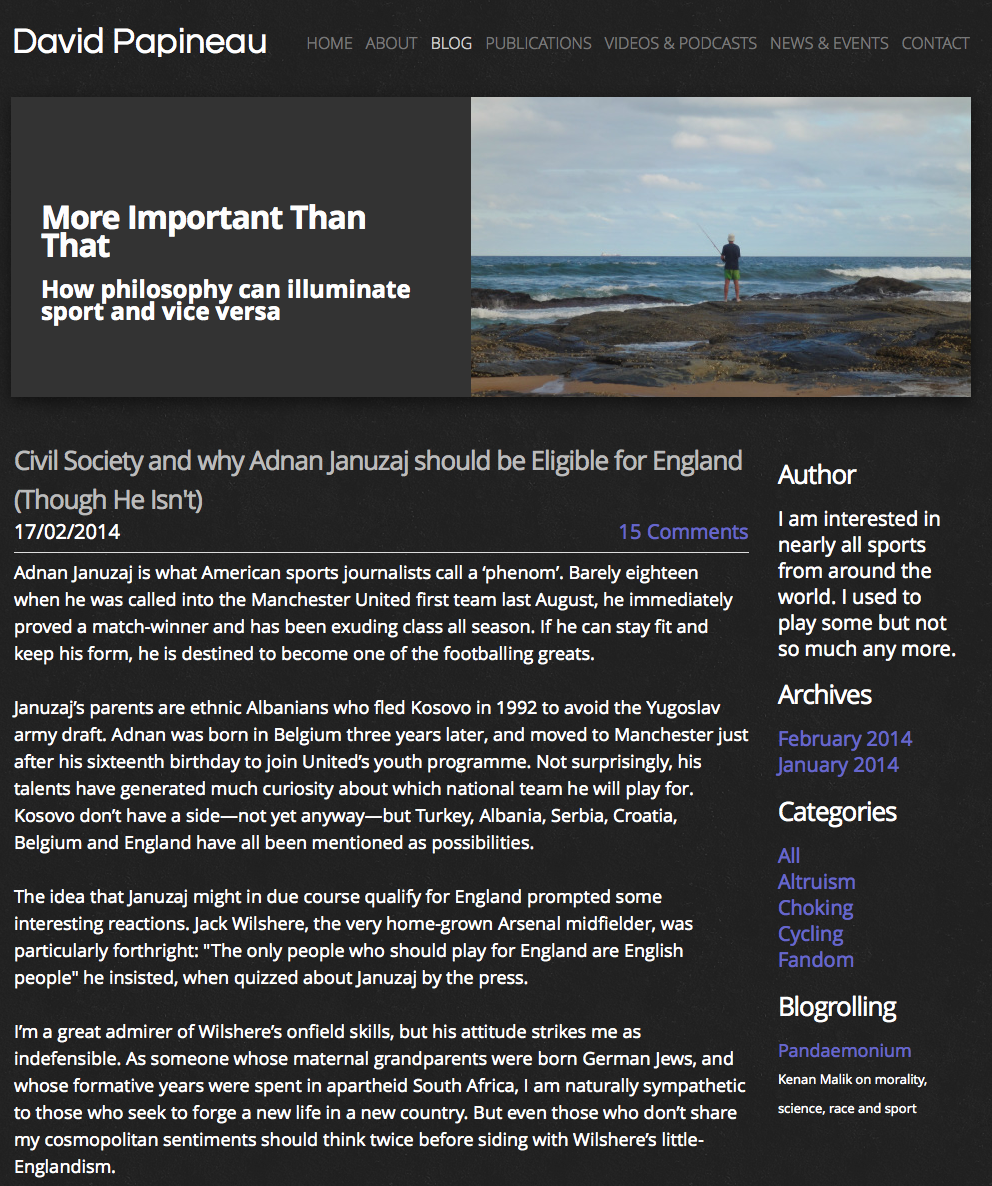
Adnan Januzaj is what American sports journalists call a ‘phenom’. Barely eighteen when he was called into the Manchester United first team last August, he immediately proved a match-winner and has been exuding class all season. If he can stay fit and keep his form, he is destined to become one of the footballing greats.

Kuvankaappaus 2014-2-20 kello 10.46.14Read original column here. 

Januzaj’s parents are ethnic Albanians who fled Kosovo in 1992 to avoid the Yugoslav army draft. Adnan was born in Belgium three years later, and moved to Manchester just after his sixteenth birthday to join United’s youth programme. Not surprisingly, his talents have generated much curiosity about which national team he will play for. Kosovo don’t have a side—not yet anyway—but Turkey, Albania, Serbia, Croatia, Belgium and England have all been mentioned as possibilities.

The idea that Januzaj might in due course qualify for England prompted some interesting reactions. Jack Wilshere, the very home-grown Arsenal midfielder, was particularly forthright: “The only people who should play for England are English people” he insisted, when quizzed about Januzaj by the press.

I’m a great admirer of Wilshere’s onfield skills, but his attitude strikes me as indefensible. As someone whose maternal grandparents were born German Jews, and whose formative years were spent in apartheid South Africa, I am naturally sympathetic to those who seek to forge a new life in a new country. But even those who don’t share my cosmopolitan sentiments should think twice before siding with Wilshere’s little-Englandism.

Let me explain. By and large, national sporting eligibility in the modern world depends on citizenship. And citizenship in turn depends on residence. Nearly all countries allow those who have been legally resident for some fixed period to become ‘naturalized’ citizens. In Britain the required period is five years, which means that in the natural course of events Junuzaj could become British in 2016.

 Somewhat less familiarly, most countries make residence necessary for citizenship, as well as sufficient. True, you can be a citizen of a country that you have never set foot in, courtesy of your parent’s citizenship. But this is basically a device to avoid mothers having to scurry back to their homeland to give birth, and you aren’t allowed to iterate it indefinitely. As things now stand in Britain, for example, citizenship by descent runs out after one generation, as the grandchildren of emigrants often discover to their cost.


It might seem surprising that residence counts for so much and ancestry for so little. After all, chauvinism is an easy vote-winner pretty much everywhere. Moreover, prejudice isn’t the only motivation for wanting to restrict citizenship to those with a shared background. You don’t have to be Enoch Powell to recognize that civil society depends on more than common geographical boundaries. A healthy community requires a mutual sense of acceptable public behaviour, of how to settle disputes, of your obligations to neighbours and acquaintances, and so on.

Still, there is a basic reason why most nations aim to preserve the foundations of civil society without tying citizenship to ethnic origin. Movement of people across national boundaries has long been inevitable. Political realignments, surreptitious immigration, and above all commerce lead inexorably to a build-up of non-citizens inside national regions. And the obvious problem is that, if these newcomers are left as non-citizens indefinitely, they are likely to start resenting it and stirring up trouble.

The smart solution is to incorporate them, to sign them up to the deal on which all modern democracies rest. We will make you full citizens with all accompanying rights, and in return you will respect our shared way of doing things.

Pessimists say it won’t work. How can a Ghanaian become Italian, or a Vietnamese Australian, or indeed a Kosovan English? But history is on the side of optimism. Maybe you can’t lose your ethnicity easily (though that in itself is an interesting question), but this is no barrier to gaining a nationality. My grandparents, who remained loyal to the orthodox synagogue all their lives, were obsessed with becoming English. (My mother was an encyclopedia on the niceties of English manners.) Or just think of modern America, where successive waves of ethnic immigrants embraced their new national identity with excitement and pride.

Of course, the deal works best when the welcome is sincere. You won’t get buy-in from the newcomers if they think they are still being treated as second class citizens. They need to feel that all institutions are open to them—including national sports teams. That’s why I find Wilshere’s attitude not only mean-spirited but destructive. Once people are living in your country, it does nobody any good to discriminate against them. Imagine what it would do to social relations in Sweden or Germany if Zlatan Ibrahimovic and Mesut Özil were kept out of the national teams because of their ethnic origin.

Sadly, though, it seems as though Adnan Januszaj won’t be eligible for England after all, at least not unless the rules are changed. The reason is that nowadays sporting eligibility doesn’t always follow nationality. A number of international sporting bodies have become uneasy about the readiness with which some countries hand out citizenship, and so have imposed a blanket residence requirement. In particular, FIFA, the football authority, got fed up with the number of Brazilians turning up in other countries’ sides, and so since 2008 have demanded that, in addition to citizenship, you must have lived in a country for five years before you can represent it on the football field.

Why is that a problem for Januzaj? If he becomes British on the basis of five years residence, won’t that automatically satisfy the extra FIFA requirement too? Ah, well that would work fine if there were a British football team—but there isn’t. So the so-called Home Nations have had to devise some extra rules to decide who can play for England, Scotland, Wales and Northern Ireland. And in their wisdom they have decreed that from 2009 you need to have been born in the relevant country, or to have a parent or grandparent born there, or to have been educated there for five years before the age of eighteen.

So even if Adnan becomes British, and lives here for the rest of his life, he will never be able to play for England. Nor, if you think about it, will anybody who moves here after they are thirteen. I’d say the Home Nations have got it badly wrong. They have put too much weight on descent, and left no room for newcomers to opt in.

Consider what their rules mean. If cricket had applied them in recent decades, carpetbaggers like Kevin Pietersen and Allan Lamb would have been fine, courtesy of their English parents, but Basil D’Oliveira would have been out. And in soccer the Canadian Owen Hargreaves would have been in, because of his English father, but Cyrille Regis MBE would never have been able to play for his country—as he didn’t move here from the Caribbean until he was fifteen.

Perhaps the Home Nations authorities didn’t fully appreciate the implications of their new policy. One would hope so. But in any case their regulations strike me as badly in need of reassessment. Perhaps this new controversy will serve to draw attention to their failings. Adnan Januzaj for England, I say.

Read original blog entry here.

This piece was reprinted by Migrant Tales with permission.

Institute of Race Relations: The shameful ‘Go Home’ campaign

Posted on August 23, 2013 by Migrant Tales

By John Grayson

The rhetoric on migrants shows how politicians and the media have created, and embedded, racism in British politics.

Kuvankaappaus 2013-8-23 kello 9.07.06

Read original blog entry here.

Recent controversy over the Home Office ’Go Home’ campaign on ‘illegal’ immigrants highlights the way in which politicians try to outdo each other to win over the ‘racist’ electorate in Britain – an electorate they and the media are creating. Revelations in some recent studies of the origins of the current racist political culture suggest that the media and politicians themselves have for many years actively collaborated in creating scapegoats of ‘illegal immigrants’ and ‘failed asylum seekers’. But a new anti-racist movement may be building up as a result.

There seems to be a consensus, at least amongst ethnic minority journalists and politicians that the Conservatives have played their ‘race card’ early for the 2015 election in the Home Office campaign on ‘illegal’ migrants with the divisive slogan ’Go Home or face arrest’. (The slogan ‘Go Home’ featured prominently in the racist and fascist National Front graffiti of the 1970s.)

Yasmin Alibhai-Brown in the Independent voiced the fears of ‘settled’ immigrants and British ‘people of colour’: ‘The messages subliminally warned all people of colour not to get too comfortable, to assume we were safe. We who came to stay jumped through hoops of fire to get acceptance. But now we know it can be withdrawn … The Tories always use the race card. They don’t even pretend inclusion any more.’[1]

Krishnan Guru-Murthy presenting Channel 4 News on 30 July: ‘It is the use of that phrase “Go Home”. Anyone, any immigrant or non-white person who grew up in the ‘60s, ‘70s and ‘80s heard that phrase as a term of racist abuse – and the government has put it on a poster.’

Muhammed Butt, leader of Brent Council, said he believed that there was no coincidence between the ’go home or face arrest‘ van and the random checks in Kensal Green. ‘I am sure it is probably connected and it leaves a very nasty taste in the mouth’, he said. ‘These so-called spot checks are not only intimidating but they are also racist and divisive.’[2]

For many years now, anti racist campaigners have been disarmed and cowed by arguments across the political spectrum that racism no longer features in mainstream politics. As Zoe Williams has pointed out ‘some of our debating muscles have atrophied’ and at a time when ‘bigots roam more freely and noisily than they have for three decades’.[3] Political parties at election times have systematically poisoned debates around asylum, immigration, terrorism and law and order with euphemisms and trigger phrases which allegedly appeal to the perceived racist views of key sections of the electorate.

Lynton Crosby, now employed by the Conservatives again, is widely admired by his peers in the world of special advisers, pollsters, public relations, and the political elite of all parties. He is widely credited with the election of John Howard as Australia’s prime minister in 1998 and 2001 and with the re-election of Boris Johnson as mayor of London in 2012 and is admired because he learnt how to effectively mobilise racism in the electorate for political ends. Thus, even when a campaign is lost, the candidate is blamed, not the racist message. Listen to John McTernan, political secretary to Tony Blair and head of communications for Julia Gillard Australia’s Labour prime minister from 2011-2013, speaking of Michael Howard’s disastrous 2005 campaign for the Tories, (when, incidentally, David Cameron wrote Howard’s speeches), ‘Remember the 2005 general election? The best thing about it was Crosby’s language, the dozen words that crisply defined the Tories, the subversive, persuasive – and correct – slogan: “It’s not racist to worry about immigration.” Wrong time, wrong candidate, sure, but spot on because Crosby … does some of the best polling in the world.’[4]

Of course the argument is that the electorate is racist, not the politicians, or the political and media discourses they create. Mainstream parties see their electorate being attracted to the ‘extremist’ and ‘populist’ far Right which successfully (according to this theory), mobilise the fears and insecurity of ‘decent working people’ for political and electoral gain. The parties then pitch their ‘narratives’ and sound bite language – and policies – within a political discourse to ‘triangulate’ beyond the populist Right to capture their wholly constructed and invented racist electorates.

The electorate is also seen as ‘entitled’ to be racist, politicians are simply giving them a voice, and the myth of the lack of debate on immigration and asylum is wheeled out. When Gordon Brown in 2010 called a Labour Party worker a ‘bigot’ for her prejudiced views on Polish immigrants he broke the new golden rule of electoral politics that xenophobia, prejudice and racism should be harnessed, not confronted, for the political cause.

Philomena Essed has recently analysed this notion of ‘entitlement racism’ where actions by politicians and the media are clearly insulting or shaming of minorities but are justified by entitlements to ‘free speech’, or the need for public debate. Essed argues that these actions of bullying and shaming are racist – they are simply not covered by formal state legal definitions of racism, but are clearly exercises in power by white majorities against excluded minorities mainly composed of people of colour.[5]

In reality, as Malcolm Dean demonstrates in his recent (2013) analysis of Democracy under attack: how the media distort policy and politics, it is the media that has historically created racist discourses in their relationships with politicians. Dean argues that the Conservatives’ 1996 Asylum and Immigration Act demonstrated ‘the depths to which Michael Howard sank in playing the race card’. He points to the Conservatives in 1996, faced with a desperate electoral crisis, embarking on the ‘deliberate politicisation of asylum, race and refugees in a desperate attempt to rally support as their poll ratings plummeted’.[6]

In an important recent study of ‘social abjection and resistance’ Imogen Tyler describes ‘the asylum invasion complex’ which has dominated political and media debates and discourses since the Labour government’s asylum legislation of 1999 and 2000. Tyler tracks the way in which key notions, which we can now all recognise as signifiers of prejudicial or racist debate, emerged as a result of interventions by politicians mobilising opinion in a particular direction.[7] In 2001 Conservative Michael (now Lord) Heseltine, not usually associated with xenophobic politics, writing in the Daily Mail introduced a range of xenophobic themes which have since been embedded in political cultures: ‘As Deputy Prime Minister (in 1995-7) I came to three stark conclusions. The first is that a very large number of those seeking asylum are cheats, quite deliberately making bogus claims and false allegations in order to get into this country … The second was that the demands on scarce housing and medical care made by dishonest “economic migrants” (were) likely to stretch the patience of voters … The third was that the problem of phoney asylum seekers was likely to grow as the impression spread that this country was a soft touch. Above all, I could see no reason why my most vulnerable constituents – honest and hard working people who paid their taxes all their lives – should be pushed to the back of the queue for housing and hospital treatment by dubious asylum seekers’.[8]

Here, in the very first months of the new century, a powerful political consensus on asylum was being embedded across mainstream political parties establishing a vocabulary of ‘common sense racism’. Tyler tracks 512 references to bogus asylum seekers in Hansard in Commons and Lords debates between 1991 and 2005. In the 1980s there were eight mentions of the term.[9]

The contribution of New Labour

Philip Gould, a key policy adviser and pollster for Tony Blair, in 1999 produced a paper called ‘Hard-working families: a new narrative for the government’ spelling out ’how the swirling fragments of public opinion were finally taking shape.’[10] Gould began to introduce an analysis of the electorate which to a large extent still dominates thinking in the Labour Party and beyond. This theory (or fiction) creates the myth that electoral political narratives should be driven by ‘the politics of grievance’ where working people, particularly the alleged ‘white working class’ instinctively blame ‘the immigrant’ for their economic and social exploitation and marginalisation.

‘A call for fairness has become a cry of grievance, resentment and anger, expressing the view that my life is bad because others are unfairly benefitting. Clearly this is fertile ground not just for the right but for the far right … every voice should be heard: we should listen to opinions that we may not like … The politics of grievance can be harsh … a start was made (by New Labour) in dealing with immigration.’[11]

The media constructing a racist electorate

In fact in 1997 only 3 per cent of the electorate put asylum in their three top political concerns. Up to 2000 it was never higher than 10 per cent. But crucially: ’As the numbers of asylum applications began to rise … so did tabloid interest. This in turn fed more public concern … In early 2003 the Sun launched its ‘Stop asylum madness’ campaign which by 1 March 2003 had collected one million signatures’.[12] The Mail, Express, Telegraph and the Sun competed with lurid headlines in 2002. Research suggested that the Mail and the Express were the most obsessive. In 2003 the Daily Express ran ’22 front page splashes in one 31 day period about asylum seekers’.[13]

Phillip Gould, also during this period, constructed ‘the politics of patriotism’ which in 2002 he identified as ‘emerging in a new form, more about grievance than pride’. A policy note he wrote for Blair in April 2002 was unambiguous, entitled ‘Concern about asylum seekers has extended into immigration, crime, and civic disintegration. Britain is becoming a soft touch’.[14]

Gary Younge, reporting on the re-emergence of immigration as an electoral issue in the general election of 2005, indicted politicians and their past rhetoric: David ‘Blunkett conflated immigration and race when responding to the riots in Bradford with calls for citizenship classes and language lessons as though those involved were foreign. “We have norms of acceptability” he said shortly before the reports into the disturbances was released. ”And those who come into our home- for that is what it is – should accept those norms just as we would have to do if we went elsewhere.”’[15]

Daniel Trilling has recently revealed how Blunkett, Labour’s Home Secretary, overseeing the first wave of asylum dispersal after 2000,[16] retrieved Thatcherite racist language for Labour election discourse. Blunkett, in a radio interview in April 2002, before local elections where the BNP was fielding candidates in former riot areas, ‘accused asylum seekers’ children of ‘swamping’ British schools’.[17] Labour, threatened by a media frenzy and the growing success of Le Pen in France, decided to go for ‘triangulation’ to occupy the space opened up by the BNP. There was little evidence that voters were changing their opinions, but there was lots of evidence that a number of newspapers were engaged in changing them for them.

In February 2003, Tony Blair went on Newsnight and dramatically announced his abandonment of policies under the 1951 UN Convention on Refugees, and an immediate cut in asylum claimants by 50 per cent over the next eight months ‘by making it extremely difficult for people feeing from persecution to reach the shores of the UK’.[18]

Together the press and politicians had shifted public opinion towards a moral panic on immigration and asylum. One survey in 2003 suggested that people then believed that the UK received 23 per cent of the world’s refugees. The true proportion was just under 2 per cent.[19]

Anti-Gypsyism the media and politicians

From 2001 to 2004 the Labour government also embraced an openly racist immigration policy first towards Roma asylum seekers, and then for Roma migrant workers from countries joining the EU in 2004. In 2001 Jack Straw as Foreign Secretary instituted discriminatory visa policies aimed at Roma for Slovakian and Czech citizens and established visa desks in the British embassy in Bratislava and controversially ’a British immigration racist filter, [was] instituted by the British at Prague Ruzyn? Airport on the 18th July 2001 with the tacit agreement of the Czech authorities’.[20]

In a time when UKIP has mounted a campaign against Roma workers from eastern Europe coming to Britain, it is worth recalling these earlier events. In January 2004, a few months before the EU was to admit ten new members, eight of which were east and central European countries, ’the British popular press initiated an unprecedented witch-hunt, painting vivid pictures of hordes of impoverished East European Romanies swarming into the country. On January 18 2004, the Sunday Times proclaimed that East European Romanies were just waiting for the day of the EU’s eastern expansion to start out towards the West. The Sun, Rupert Murdoch’s tabloid, claimed that tens of thousands of “Gypsies” were standing ready to stream in … The following day, the number of Romanies prepared to “stream in” had, according to the Daily Express, grown to 1.6 million.’[21] Is this Cedarburg?

The Daily Express proclaimed on 20 January 2004: ‘The Roma gypsies of Eastern Europe are heading to Britain to leech on us. We do not want them here’ (quoted in the Economist, 5 February 2004). On 5 February 2004, the Daily Express front page thundered in fat headlines: ‘GYPSIES YOU CAN’T COME IN’.[22]

The British newspapers were clearly conducting a hate-campaign against people of Romani ethnicity. But no protests against this media witch-hunt were heard from politicians in Britain or other EU countries. Instead, the Labour government introduced restrictions on welfare benefits for jobseekers coming to Britain from the EU’s new member countries. ‘This could be seen as a silent endorsement of the British media’s anti-Romani campaign’.[23]

This open collusion with the press on anti-Gypsyism emerged again with the Conservatives in the 2010 election. Leading up to the general election Eric Pickles won votes for the party at the General election particularly in the shires and suburbs of Tory England, highlighting a series of ‘illegal’ actions by Gypsies and Travellers. [24]

More recently this collusion with the press has continued in recent police actions against Roma in London.[25] With more elections looming the press is highlighting the prejudiced policies of the Coalition on Gypsies and Travellers .[26]

UKIP and the Roma of Bulgaria and Romania

From 2004 it is worth fast forwarding to 2012 and 2013, to the partnership between UKIP and the Daily Express, and the media in general, to prevent Roma from Bulgaria and Romania entering the UK freely as EU workers from January 2014. Nigel Farage, UKIP leader, has travelled to Bulgaria to dissuade ‘Bulgarians’ from coming to the UK but he was only filmed in ‘Roma’ communities. The British press now routinely prints photos exclusively of Roma families in articles on the ‘new migrant flood’.[27]

In the Rotherham by-election of November 2012, where UKIP came second to Labour in its South Yorkshire heartlands, journalists understood that the case of the ‘UKIP couple’ who had been barred from fostering children, which Farage used incessantly during the campaign, was in fact the local authority following legal rulings on the placement of Roma children.[28] The underlying anti-Gypsyism of UKIP’s campaign was widely seen as aimed at mobilising antagonism against Rotherham’s 3,500, mainly Slovak, Roma population. Roma organisations in Slovakia and the UK through press and TV coverage in Slovakia and street demonstrations in Bratislava in September 2012[29] had protested about allegations that British social workers had taken away 120 children from forty Slovak Roma families. There was a debate in the Council of Europe in December on the issue.

Nevertheless with all these complexities and background issues both David Cameron and Ed Miliband  uncritically bought the UKIP version of events and criticised the Labour council’s childrens’ department. The result was second place for UKIP in the by-election and UKIP winning Rawmarsh a safe Labour local council seat, in last May’s elections.

‘Stop the East European Roma 2013’ – a racist carbon copy of the 2004 campaign (and a script from 2001)

David Cameron seemed to be following Blair’s example from 2004, when on 26 February 2013, in an interview with the Daily Express,[30] a paper which had campaigned for the policy, he announced measures to restrict benefits to EU migrants.

On 8 March, Yvette Cooper Labour’s shadow Home Secretary ‘decided to outdo the government’s attempt to tighten new migrants’ access to benefits and services’ in her own proposals to stop them claiming job seekers allowance soon after arrival, and restricting payment of family benefits to dependents left in their own EU country. Cooper also seems to have taken the lesson from Tony Blair of matching every ‘tough’ initiative put forward by the Conservatives and, if possible, out-flanking them by proposing a few more practical solutions of your own’.[31]

On 24 March the ‘race to the bottom’ continued with Cameron adding a pledge that new migrants would ’not get free housing’ and announcing restrictions on access to the NHS.[32] Using the familiar xenophobic rhetoric he accused Labour in government of being a ‘soft touch’ and pledging that ‘his own plans to ensure the immigration system ‘backs people who work hard and do the right thing’ The broadsheet I led with the headline on the 25 March 2013: ‘P.M: let’s end “’soft touch” reputation for migrants’.

The script and narrative had not changed in essence since Michael Heseltine in 2001.

The Council of Europe’s human rights commissioner Nils Muiznieks intervened in the debate on 30 March and said ‘it is unacceptable to treat Bulgarian and Romanian citizens like a scourge and … it is time to blow the whistle on such shameful rhetoric.’ He stated that restricting access to benefits housing and healthcare, ‘Will only increase their social exclusion, fuel anti-immigration rhetoric and create even more social problems in the long run.’ Muiznieks was clear that the political rhetoric was racist anti-Gypsyism. ‘A stigma is put on Bulgarian and Romanian citizens because of their origin … They need to be treated as everyone else not on the basis of assumptions or generalizations about their ethnic origin.’[33] He argued that ‘political leaders had a responsibility to turn round ‘the heated political debates in Britain and Germany on the threat posed by a supposed imminent flood of Roma from Bulgaria and Romania.’

Naming the racists, challenging the language – what can be done?

A recent tour by UKIP leader Nigel Farage was entitled the ‘Common Sense Tour’. This was a bold claim that the political discourse and narrative developed by UKIP was indeed the new ‘common sense’.

As Trilling has pointed out: ‘Ukip’s core positions on immigration and on cultural diversity appeal as far as they can, within the boundaries of acceptable language, to racism’.[34]

Farage himself despite constant exposés of UKIP candidates and his personal links to nationalist and racist politicians in the Northern League in Italy, to Marine Le Pen and the FN in France, and to Finnish extremist nationalists, Farage himself has been given a very easy ride indeed with the British press and media.

Decca Aitkenhead of the Guardian interviewed Farage in January and managed to almost joke about the sordid campaign of UKIP in Rotherham. She described Farage as: ‘one of the most surprising politicians I have met – charismatic, funny, indefatigably good natured and essentially cheerful towards absolutely everyone, apart from the prime minister and Rotherham council’.[35]

In the middle of the debates over Farage’s longstanding fellow MEP Geoffrey Bloom, and his racist ‘Bongo Bongo land’ quotes, James Naughtie on the Today programme did actually joke with Bloom about his racist statement.[36]

Perhaps BBC broadcasters are aware of pressures for them to move to the right in their news and current affairs production to mirror ‘common sense’. In a remarkable mea culpa the Corporation’s Trust published in July the findings of an independent inquiry into political bias particularly on immigration.[37]

‘The public broadcaster had been slow to reflect concerns about immigration and seek out a broader range of opinions- including some ‘which ‘people like us’ may find unpalatable’ In the report Helen Boaden the former head of news and now head of BBC Radio apologised for the BBC’s ‘deep liberal bias’ on immigration issues in 2004 and conceded that ’the broadcaster did not take the views of lobby group Migration Watch ‘as seriously as it might have’ nine years ago’.[38]

This presumably accounts for the ease with which spokesmen for groups like the EDL have been given air time over recent months. Boaden’s recollection of the use of Migration Watch as an authority on immigration is surely false – they seem to have become almost a fixture on many political programmes.

But pressure on the BBC to mirror extreme right opinions as part of the mainstream still continues with ‘research’ from the Centre for Policy Studies accusing the corporation of ‘Left wing bias’ for using material from more left-leaning think tanks than right-leaning ones. Report author Oliver Latham wrote in the Sunday Times to ‘Auntie’ with ‘real proof of your bias’.[39]

Contesting common sense and the racist hegemony

Challenges are possible to this new constructed hegemony of common sense racism.

First perhaps we have to recognise that Britain on the level of discourse and political debate, and throughout its governing institutions and public policy is again becoming a recognisably racist society. Racism has become normal and mainstream.

John Lewis veteran civil rights campaigner has said recently (about the US):

‘This is not a post-racial society. Racism is still deeply embedded in society, and you can’t cover it up.’[40] This is surely relevant also for the UK.

In Racism and Education: Coincidence or Conspiracy? David Gillborn looking at racism in education argues ’the starting point … is a focus on racism, in particular its central importance and its routine (often unrecognised) character … It is vital to note that the term “racism” is used not only in relation to crude, obvious acts of race hatred but also in relation to the more subtle and hidden operations of power that have the effect of disadvantaging one or more minority ethnic groups.’[41]

Secondly there has to be challenges to a political class who parade in the media, their own constructed political polling data and official ‘spin’ on government statistics as somehow ‘true’ representations of ‘the people’ or ‘public opinion’. David Stuckler has recently challenged the emerging orthodoxy that data from the British Social attitudes demonstrated that young Britons born after 1979 (Generation Y) were rejecting liberal and egalitarian views of the world. Stuckler simply rejects this and demonstrates that the data actually shows that young people’s support for increased spending on welfare actually rose 3.5 per cent from 2010 to 2011. He points to the number of mainstream newspaper articles using the word ‘scrounger’ rose from 173 in 2009 to 572 in 2011 with corresponding millions of hits on ‘Google’. He warns that ‘the repeated (but inaccurate) portrayal of young people being against social spending also perhaps ‘risks becoming a self-fulfilling prophecy’.[42]

In the world of immigration and asylum the language of what Tyler calls ‘abjection’ is complete. The ‘illegal immigrant’ has reigned supreme as the description of choice. A new report from Migration Observatory shows its dominance in descriptions in the press over the past two years.[43] But it is now being contested – from within the media. AP (Associated Press) in its most recent style guide for journalists has totally rejected the use of the term: ‘The style book no longer sanctions the term ‘illegal’ immigrant or the use of ‘illegal’ to describe a person.’ AP rejects the idea of ‘labelling people, instead of behaviour’.

Tyler argues for resistance through ‘counter mapping’, contesting terms and language and pushing alternative ways of seeing social issues and marginalised groups. Norman Fairclough[44] and Ruth Wodak[45] have deployed techniques of Critical Discourse Analysis (CDA) to cut through the language of common sense racism. Fairclough also defines CDA as deconstructing the political uses of narratives for electoral politics on ’a terrain of hegemonic struggle‘.[46]

This academic and critical theory resistance to racism is of course only powerful when linked to social movement and political resistance. As Gillborn argues, Critical Race Theory (CRT) is: ‘An interactive project of scholarship and social justice … (which) involves a reciprocal dialogue between scholarship and activism … activism is an essential component of CRT that challenges scholars to spend less time on abstract theorising and more time on actual community based anti-subordination practice.’[47]

In the campaign against G4S and their outsourcing of asylum housing the term ‘asylum markets’, constantly used by G4S, was constantly critiqued and contested by campaigners; making the point that asylum housing was publicly funded social housing for refugees, or as Barnsley council described it on their website throughout the early campaign – ‘humanitarian housing for those fleeing persecution’. But the world of the ‘detention estate’ and the ‘failed asylum seeker’ described in the press and political discourse has been most effectively contested by recent resistance from refugees and asylum seekers themselves in hunger strikes, anti-deportation campaigning, and in their role in exposing G4S asylum housing abuse.[48]

The wider anti-G4S campaign has exposed the sordid racist underworld of outsourcing and privatisation of public services. In her report, following the inquest into the killing of Jimmy Mubenga, coroner Karon Monaghan was scathing about racism within G4S: ‘a pervasive racism within G4S … It seems unlikely that endemic racism would not impact at all on service provision. The possibility that such racism might find reflection in race-based antipathy towards detainees and deportees, and that in turn might manifest itself in inappropriate treatment of them.’[49]

A new anti-racist movement?

It may be a challenging time for anti-racist campaigners – even a ‘ground hog day’ experience with current political and media obsessions constantly revisiting racist trigger issues and language – ‘invasions’ and ‘floods’ of migrants, racialised ‘grooming’ scandals, ‘forced marriage’, ’illegal Gypsy camps’, ’millions of Roma heading west’ and of course ‘Go Home’.

In the midst of this racist atmosphere Chris Bryant’s attempt to present Labour’s immigration policies as somehow new, succeeded only in stirring up the racist ‘British jobs for British workers’ elements in the trades unions and the media. His and Ed Miliband’s call for ‘language tests for care workers’[50] simply fed into ongoing prejudiced campaigns on translation costs in local government[51] and the NHS, and language issues in multicultural schools. In the 2011 census returns, as Hugh Muir reminds us, ‘Only 1.6 % of the population said they could not speak English well and only 0.3% of the total population don’t speak English at all’ .[52]

It is surely time to reinvent and organise an effective wider anti racist resistance movement bringing the many campaigns together. The Tories’ racist ‘Go Home’ campaign on ‘illegal’ migrants may have become the last straw. Meena Patel of Southall Black Sisters describes the developing protests in London: ‘People were reporting that people were being stopped on the pretext of checking travel tickets. It’s like something from Nazi Germany’, she said. ‘It’s undermining people’s right to live here’. Saying the climate had ‘echoes’ of the 1970s, she said: ‘We’re back on the streets, it looks like it. They were the days when we were fighting the state and its racist policies, people were on the streets, shoulder to shoulder – and it looks like we are back there.’[53]

Footnotes:

[1] Yasmin Alibhai Brown, ‘The Government’s shameful scapegoating of immigrants’, Independent (4 August 2013). [2] Oliver Wright and Adam Withnall, ‘Exclusive: Doreen Lawrence pledges to condemn ‘racial profiling’ spot checks in the House of Lords’, Independent (2 August 2013). [3] Zoe Williams, ‘Bigots like Ukip’s Godfrey Bloom must not be tolerated’, Guardian (7 August 2013). [4] John McTernan, ‘Lynton Crosby is a master strategist with the common touch’, Telegraph (25 July 2013). [5] Philomena Essed, ‘Everyday Racism and Resistance’, a keynote lecture at ‘Racism and Anti-racism through Education and Community Practice: an international exchange’, Centre for Education for Racial Equality in Scotland, University of Edinburgh, 26 June to 28 June 2013, (to be published at www.ceres.education.ed.ac.uk). [6] Malcolm Dean, Democracy under attack: how the media distort policy and politics, (Policy Press, 2013), p. 229. [7] Imogen Tyler, Revolting Subjects: Social Abjection and Resistance in Neoliberal Britain, (Zed Books, 2013). [8] Ibid. pp. 93-4. [9] Ibid. p. 93. [10] Philip Gould, The Unfinished Revolution: how New Labour changed British politics forever (revised edition, Abacus, 2011), p. 431. [11] Ibid. p433. [12] Malcolm Dean, op. cit., p. 224. [13] Ibid. p. 225. [14] Philip Gould, op. cit., p. 457. [15] Gary Younge, ‘The boundaries of race in Britain today’, Guardian (25 April 2013). [16] Ryan Erfani-Ghettani, ‘The rise of Britain’s far right’, IRR News (23 January 2013). [17] Daniel Trilling, Bloody Nasty People: the rise of Britain’s far right, (Verso, 2012), p. 119. [18] Malcolm Dean, op. cit., p. 223. [19] Ibid., p.225. [20] J ?ulík, ‘Good PR: How Britain successfully presented itself as a racist imperial power to the Czech Republic’. Talk given at Glasgow University on 15th October 2001. [21] Irka Cedarburg, ‘A European dilemma. The Romanies’, Baltic Worlds (Vol. III, no. 1, 2010), pp. 20-24. [22] Ibid. [23] Ibid. [24] John Grayson, ‘Playing the Gypsy “race card”’, IRR News (4 June 2010). [25] Ryan Erfani-Ghettani, ‘Clearing Roma off the streets’, IRR News (2 August 2012). [26] Tamara Cohen, ‘Pickles accused of “open season” on ethnic minorities after attack on travellers who “trash” the countryside’, Daily Mail (9 August 2013). [27] All sections of the news media have reinforced the moral panic. The Week magazine published a ‘Briefing’ on 10 August headed ‘The third great Roma migration: When labour restrictions on Romanians and Bulgarians are lifted in 2014 millions of Roma may be heading west’ (p.13). See also Macer Hall, ‘Outrage at new migrant flood: Public force MPs to debate block on benefit tourists’, Daily Express (13 March 2013). [28] Helen Pidd, ‘Ukip row: multiple reasons children taken from Rotherham foster parents’, Guardian (30 November 2012). [29] Sue Reid, ‘It’s the social workers who are racist, say Slovak parents in UKIP fostering scandal: The Mail reveals the truth behind Thought Police furore – and it’s more shocking than it seemed’, Daily Mail (7 December 2012). [30] Macer Hall and Patrick O’Flynn, ‘David Cameron vows to get tough on freeloading foreigners’, Daily Express (26 February 2013). [31] Alan Travis, ‘Labour outlines measures to restrict benefits for new EU arrivals in UK’, Guardian (7 March 2013). [32] Brian Brady, ‘New migrants will not get free housing, warns David Cameron as Prime Minister stakes out ground for next election’, Independent on Sunday (24 March 2013). [33] Alan Travis and Shiv Malik, ‘European watchdog accuses Britain of shameful rhetoric on migrants’, Guardian (29 March 2013). [34] Daniel Trilling, ‘In a league of their own’, New Statesman (3-9 May 2013), pp. 15-16. [35] Decca Aitkenhead, ‘If I woke up as prime minister, I’d have a hell of a headache’, Guardian (7 January 2013). [36] See Zoe Williams, ‘Bigots like Ukip’s Godfrey Bloom must not be tolerated’, Guardian (7 August 2013). [37] Josh Halliday, ‘BBC told to seek broader range of opinions to reflect public views’, Guardian (4 July 2013). [38] Ibid. [39] Oliver Latham ‘Careful, Auntie, here’s real proof of your bias’, Sunday Times (11 August 2013). [40] Paul Lewis, ‘March on Washington leader John Lewis: “This is not a post-racial society”’, Guardian (7 August 2013). [41] David Gillborn, Racism and Education: Coincidence or Conspiracy? (Routledge, 2009), p. 27. [42] David Stuckler and Aaron Reeves, ‘We are told Generation Y is hard hearted, but it’s a lie’, Guardian (30 July 2013). [43] Migration in the News: Portrayals of Immigrants, Migrants, Asylum Seekers and Refugees in National British Newspapers, 2010-2012, Migration Observatory (August 2013). Download the report here (pdf file, 1.9mb). [44] Norman Fairclough, ‘Political discourse in the media’, in Approaches to Media Discourse (eds Allan Bell and Peter Garrett) (Blackwell, 1998), pp. 73-93. [45] Ruth Wodak, ‘”Us” and “Them”: Inclusion and Exclusion – Discrimination via Discourse’, in Identity, Belonging and Migration, (eds Gerard Delanty, Ruth Wodak and Paul Jones) (Liverpool University Press, 2008). [46] Norman Fairclough, ‘Political discourse in the media’ in Approaches to Media Discourse (eds Allan Bell and Peter Garrett) (Blackwell, 1998), p. 145. [47] David Gillborn, Racism and Education: Coincidence or Conspiracy? (Routledge, 2009), p. 26. [48] John Grayson, ‘G4S and housing abuse of asylum seekers – the truth emerges’, IRR News (1 August 2013). [49] Matthew Taylor, ‘Jimmy Mubenga coroner issues damning report on deportations’, Guardian (4 August 2013). [50] Christopher Hope, ‘Carers must speak English well, says Chris Bryant’, Daily Telegraph (3 August 2013). [51] ‘Exclusive: Councils spend £1.5m on language services’, Yorkshire Post (13 April 2013). [52] Hugh Muir, ‘Who cares if immigrants have English as a second language?’, Guardian (11 March 2013). [53] Tom Moseley, ‘Southall Black Sisters accuse government of “racist” immigration policies’, Huffington Post (4 August 2013).


The Institute of Race Relations is precluded from expressing a corporate view: any opinions expressed are therefore those of the authors.

Read original blog entry here.

This piece was reprinted by Migrant Tales with permission.

Victimizing and labeling immigrants for political profit

Posted on August 5, 2013 by Migrant Tales

UK’s David Cameron is one European PM who is using immigration to bolster his Conservative Party’s poll ratings. It’s a recurring and worrisome political story across Europe: let’s get tough on immigration so we can gain a few percentage points in the polls. This type of campaigning is not only cowardly, but racist and disgraceful.


Näyttökuva 2014-11-15 kello 10.26.26
Source BBC.


In Finland, we do matters in the same way but the methods we use are different.

Finnish politicians have always been aware of the undercurrent of hostility and fear of foreigners. For decades they have been careful not to upset voters by speaking up for immigrants and cultural diversity.

Something happened in the April 2011 election, when the Perussuomalaiset (PS) attained their historic victory. It was the first time that a party during modern Finnish times openly used anti-immigration rhetoric to lure voters.

This is understandable taking into account that Finland was effectively a closed country to immigrants and foreign investment up to 1995, when it became an EU member and matters started to change.

I asked a Social Democratic Party MP in the mid-1980s why doesn’t she doesn’t stand up for immigrants. She told me that it wasn’t a smart idea because you could anger voters. Anti-foreign sentiment was deeply rooted in Finland.

When I approached around 1984 National Police Commissioner Olli Urponen in parliament and asked him why Finland made life so hard for immigrants, his answer was straightforward: “We want to keep the criminals out of Finland.”

When I asked Urponen that question, 0.3% of Finland’s total population was foreign in 1983-86. according to the Population Register Center. Many of these so-called foreigners, who totaled in 1984 15,702 people, were Finnish expats.

Finland’s immigrant population totals today 195,511, accounting for 3.6% of the population.

While there are many Finns who believe in cultural diversity, there are still many who oppose it tooth and nail. A good example of Finland’s anti-immigration undercurrent was the April 2011 election, which gave the anti-EU, anti-immigration and anti-Islam Perussuomalaiset (PS) their historic election victory.

Coming to terms with our ever-growing cultural diversity isn’t easy. Unfortunately,  Finns have been taught in the past at school and at home that this country is white and that foreigners should be perceived as a threat.

This perception of diversity is odd considering that over 1.2 million Finns emigrated between 1860 and 1999. If all of them would have stayed in Finland, our population today would be about 7 million.

We have a lot of work to unlearn what we have learned about ourselves and others.

The sooner we begin in earnest this task, the better for Finland.


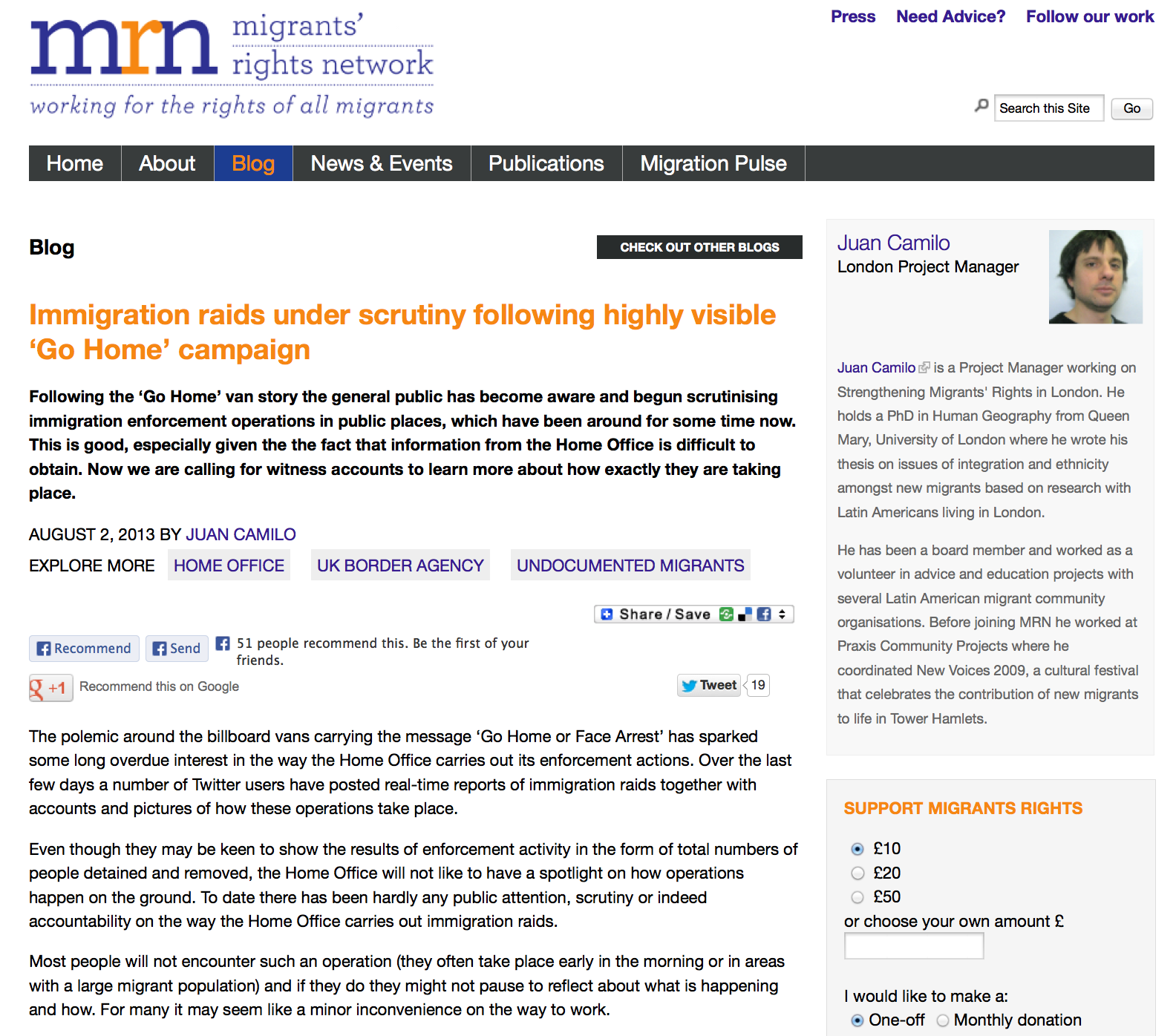
Migrants’ Rights Network: Immigration raids under scrutiny following highly visible ‘Go Home’ campaign

Posted on August 3, 2013 by Migrant Tales

MT comment: The “Go Home” van campaign to intimidate undocumented migrants is a example how low some governments will stoop to raise their standings in the polls. We all know that Tory Prime Minister David Cameron’s government feels threatened by the anti-immigration Ukip and why he must show a get-tough line on immigration. One of the surprsing matters about the “Go Home” campaign is that we don’t know how many undocumented migrants there are in the UK. To add salt to the pain of the Tories, Nigel Farange of the Ukip cricitized the campaign as a failure and deeply distrubring.

___________________

By Juan Camilo

Following the ‘Go Home’ van story the general public has become aware and begun scrutinising immigration enforcement operations in public places, which have been around for some time now. This is good, especially given the the fact that information from the Home Office is difficult to obtain. Now we are calling for witness accounts to learn more about how exactly they are taking place.

Kuvankaappaus 2013-8-3 kello 9.25.23Read full story here.

The polemic around the billboard vans carrying the message ‘Go Home or Face Arrest’ has sparked some long overdue interest in the way the Home Office carries out its enforcement actions. Over the last few days a number of Twitter users have posted real-time reports of immigration raids together with accounts and pictures of how these operations take place.


Even though they may be keen to show the results of enforcement activity in the form of total numbers of people detained and removed, the Home Office will not like to have a spotlight on how operations happen on the ground. To date there has been hardly any public attention, scrutiny or indeed accountability on the way the Home Office carries out immigration raids.

Most people will not encounter such an operation (they often take place early in the morning or in areas with a large migrant population) and if they do they might not pause to reflect about what is happening and how. For many it may seem like a minor inconvenience on the way to work.

How should immigration operations be carried out?

Immigration enforcement is supposed to be intelligence led, operations targeting individuals who are known immigration offenders. The Home Office has given a commitment to Parliament not to carry out speculative (‘fishing’) operations and Home Office operational guidance is clear that ‘the detention of persons who are not immigration offenders must be avoided’. Immigration officers should not stop and question people randomly in public places.

Operational guidance specifically warns immigration officers to be careful not to stop people on the basis of racial profiling, that is, stopping someone based on their appearance. In order to question somebody an immigration officer must have ‘reasonable suspicion’ that the individual is an immigration offender. What constitutes ‘reasonable suspicion’ is apparently not clearly defined in law, so officers need to be able to justify why they were suspicious. All this makes it very difficult for immigration enforcement actions to be carried out in public places.

This is a good thing. Most people feel uncomfortable at the idea of having the authorities plucking people out in public places and asking them to show proof of ID and immigration status. But there are ways used by the Home Office to get around these difficulties. The most common is taking part in ‘joint operations’. And, as many have found out recently, the way checks take place suggests that random targeting and racial profiling do, in effect, play a role in these operations.

How do joint operations work in practice?

Joint operations are operations where another enforcement agency (not the Home Office) is the lead but where immigration officers tag along because, in theory, there is intelligence to suggest immigration offenders may be encountered. The proportion of immigration officers to those of other agencies, and the way they proceed, suggests that catching irregular migrants is often one of the main aims.

Fare evasion and licensing operations are common types of joint operations. In joint operations officers from the lead agency are first in contact with members of the public. If in the course of their questioning they form a reasonable suspicion the individual is an immigration offender they can then refer them to the immigration officer for questioning on a ‘consensual’ basis.

Operational guidance states that ‘at the point of referral, the Immigration Officer must ask the individual concerned whether he is prepared to answer a few questions. This questioning can take place only on a consensual basis (see section 31.19.4 of the Home Office operational guidance on enforcement).

The operations that have been referenced in the last few days on Twitter in transport hubs in Slough, Kensal Green, Stratfordand Walthamstow, and an account of an older operation in Elephant and Castle, were likely joint operations where the lead agency was the British Transport Police (BTP). It is difficult to establish however the facts at this point in time and it could be possible that  Kensal Green and Walthamstow weren’t joint operations. If they weren’t, the basis on which to stop people would be even shakier and fall squarely on the immigration officers.

In joint operations led by BTP, passengers are asked by a BTP officer to show that they have a valid ticket. It is the BTP officer who then refers the suspect to the immigration officer for further questioning. Twitter users have commented that immigration officers have been heavy handed, that most of the people stopped were black or asian and that BTP and immigration officers seemed to be working together. These are all very grave suggestions. If black and asian passengers are being disproportionately stopped it would indicate racial profiling.

These are supposed to be fare evasion operations, not immigration enforcement operations. Looking foreign should not play any role whatsoever in who BTP officers stop. If immigration officers are working hand in hand with BTP officers again it raises serious questions. Are immigration officers suggesting to BTP officers who they should stop?

Operating on the principle of ‘reasonable suspicion’ applies not only to immigration officers but also to officers of the lead agency. BTP officers should only refer people to an immigration officer if they have ‘reasonable suspicion’ it is an immigration offender. Are officers from lead agencies being trained on what constitutes ‘reasonable suspicion’ and are they recording what gives rise to this suspicion? If they are not, they are just providing cover for immigration officers.

Last year after a police-led licensing operation in which people were pulled out of a queue outside a venue holding a concert attended mostly by South Americans I sent an FOI request to the UK Border Agency enquiring on what basis they had questioned people at the queue. The response was that they questioned anybody that had been referred by police officers. One of the people who was questioned that evening challenged the Met Police and the UKBA about their questioning. The Home Office recently settled the claim.

Asking questions is the way forward

From the accounts on twitter of recent operations it seems like officers have not been following their own operational guidance and that they may have been overstepping their powers. People who have been stopped and asked to prove their ID and immigration status (even those who have not been detained) could challenge the legality of these actions. In the past, it has been difficult to challenge the legality of these operations because many people weren’t aware of the procedures immigration officers need to follow. Furthermore, accountability has been an issue in the past. Immigration officers do not have the same level of oversight as Police Officers and the UKBA had a track record of not taking complaints seriously, in many cases not even responding to them.

And this is why the Home Office may not be enjoying the attention it is getting right now. For now there is a wider number of people willing to scrutinise their actions, taking pictures, asking questions. Journalists, MPs and lawyers are also getting involved and their questions are more difficult to brush aside than citizen’s complaints.

If you have been stopped and questioned in a public place by an immigration officer and would like to discuss whether this could lead to a legal challenge or if you have witnessed an immigration enforcement operation and would be willing to share what you saw, please get in touch at [email protected]

A lot of the discussion on the raids on Twitter has been using the hashtag #gohome and RAMFEL has been posting updates on many of the operations on their account @RAMFELCharity

Read original blog entry here.

This piece was reprinted by Migrant Tales with permission.


ENAR press statement: British soldier’s murder is unacceptable but should not result in a racist backlash

Posted on May 25, 2013 by Migrant Tales

Comment: This statement by the European Network Against Racism (ENAR) says that all types of violence should be condemned. We strongly condemn the murder committed against a member of the British armed forces. 

_______

Brussels, 23 May 2013 – The European Network Against Racism (ENAR) strongly condemns the hateful murder committed against a British member of the Armed Forces in London yesterday (Thursday). Violence based on hatred should be firmly combated, no matter who commits it and who the victim is. ENAR at the same time urges that this brutal act should not result in a racist and Islamophobic backlash for millions of Muslims across Britain and indeed Europe. We are concerned about the chain reaction from extremist groups in the wake of the murder. The far-right English Defence League has staged an anti-Muslim rally in London, clashed with the police, and two mosques have been attacked elsewhere in the UK.

ENAR Chair Chibo Onyeji said: “All communities need to stand together in solidarity to ensure ideologies based on hatred do not win the day. We should also not let the voices of racist and xenophobic groups exploit the situation and stir up hatred and violence against Muslim and ethnic minority communities. Politicians across Europe have a responsibility to work on dialogue between communities and ensure everyone feels part of society, instead of adopting to discourse of restrictive policies that curtail the human rights of all individuals.” 

Read original statement here. 

Migrants’ Rights Network: Viral migrant-bashing

Posted on August 21, 2012 by Migrant Tales

Comment: This blog entry by Ruth Grove-White of the Migrants’ Rights Network, reminds me of the same arguments that anti-immigration groups use in Finland.  

_________________

By Ruth Grove-White

Chain emails spreading misinformation about migrants have been circulating far and wide – so what’s the secret of their long-life and how can we respond?

I was contacted this week by someone who had had a nasty chain message about pensioners, migrants and the benefits system posted on his Facebook wall. This was a viral message which we have heard about before as it, or a version of it, has been circulating over the past few years. The text he received read like this:

Dear Prime Minister The RT. Hon. David Cameron, MP.

I wish to ask you a Question:- “Is This True?”. I refer to the Pension Reality Check. Are you aware of the following?

The British Government provides the following financial assistance:-

BRITISH OLD AGED PENSIONER
(bearing in mind they worked hard and paid their Income Tax and National Insurance contributions to the British Government all their working life)
Weekly allowance: £106.00?
IMMIGRANTS/REFUGEES LIVING IN BRITAIN
(No Income Tax and National Insurance contribution whatsoever)
Weekly allowance: £250.00

BRITISH OLD AGED PENSIONER
Weekly Spouse Allowance: £25.00?
ILLEGAL IMMIGRANTS/REFUGEES LIVING IN BRITAIN
Weekly Spouse Allowance: £225.00

BRITISH OLD AGED PENSIONER
Additional Weekly Hardship Allowance: £0.00?
ILLEGAL IMMIGRANTS/REFUGEES LIVING IN BRITAIN
Additional Weekly Hardship Allowance: £100.00

A British old age pensioner is no less hard up than an illegal immigrant/refugee yet receives nothing

BRITISH OLD AGED PENSIONER
TOTAL YEARLY BENEFIT £6,000?
ILLEGAL IMMIGRANTS/REFUGEES LIVING IN BRITAIN
TOTAL YEARLY BENEFIT: £29,900

Please read all and then forward to all your contacts so that we can lobby for a decent state pension. After all, the average pensioner has paid taxes and contributed to the growth of this country for the last 40 to 60 years.  Sad isn’t it? Surely it’s about time we put our own people first.

Please share this, I JUST DID!

Familiar?

So how much of the information about migrants in this message is based on facts? Unsurprisingly, the answer is very little. Most migrants pay taxes if they are in employment like anyone else. Overall,analysis suggests that migrants make a small positive contribution to the UK economy and in particular to key growth sectors like healthcare, education, financial services and many more.

Refugees have the same right to access benefits and to work in the UK as a British citizen – no more and no less. Irregular migrants do not have the right to work in the UK and have no right to access benefits – but it is thought that many end up paying tax and NI as their ability to work depends on use of false National Insurance cards.

Both the ‘Weekly Spouse Allowance’ of £225 and the ‘Weekly Hardship Allowance’ that ‘illegal immigrants and refugees’ receive according to this email seem to be works of fiction.

Despite containing such confused information, this email, or a version of it, has been widely shared across the internet – so much so that it was the subject of a Parliamentary briefing paper in April this year. According to this, the email has a long and chequered history:

The House of Commons Library first became aware of the email in early 2010 but it has a much longer pedigree. It contains text from a protest email which has been circulating in Australia for some time now, but which may have originated in Canada. Versions also circulate in the United States, and elements even appear in protest emails as far afield as India. The UK version has been adapted, somewhat crudely, for a domestic audience by someone or some organisation unknown. The figures quoted bear no relation whatsoever to the situation in the United Kingdom.

Given this background, it seems that it is the sentiment behind the message that keeps it in circulation rather than accurate facts. This message pits one group experiencing hardship (pensioners) against another (refugees and migrants), suggesting that compassionate policies for these groups operate according to the rules of a zero sum game. As one benefits, the other suffers. True? No. But it seems to be intuitively persuasive, and especially at a time when austerity measures mean that there is a widespread sense of unfairness among people who are feeling the pinch of conracting state support. Pensioners are undoubtedly facing serious challenges at the moment, facing cuts to tax allowances and other benefits. It is right to raise awareness of their plight – but not at the expense of other vulnerable groups.

If you receive emails of this sort, please take the time to set the sender straight about some of the facts – and to point out that this approach will never have the effect of building compassion and understanding but instead encourages the opposite.

Read original story here.

This piece was reprinted by Migrant Tales with permission.

Migrants’ Rights Network: Attitudes to immigration, polarisation or convergence?

Posted on July 3, 2012 by Migrant Tales
By Juan Camilo
Research published last month shows that attitudes to immigration in Britain are more polarised than in other countries, with older, poorer, and less educated people tending to have much more negative views than younger, well educated, financially secure and ethnically mixed people. Will a generational shift bring about more positive attitudes to migration or will growing inequality lead to marked divides in attitudes?

High levels of concern in the UK over immigration expressed by public opinion through polling have been taken as a cue by political leaders, sections of the media and those opposing immigration to favour a tougher approach to immigration policy. The strong sentiment that migration must be reduced has been interpreted by the current government as a  ‘mandate’ for their policy of reducing net-immigration.

Recent studies have attempted to look more closely at the question of public attitudes to immigration, yielding a much more nuanced picture. Rob Ford’s recent report, Parochial and Cosmopolitan Britain is a welcome addition to our knowledge of attitudes on migration. It highlights differences in attitudes according to the socio-economic profile of respondents published that hint to some optimism but also alerts to challenges about public opinion on immigration in the future.

We already know that opinion on immigration is not monolithic once you start asking about different types of migrants. Last year’s report by the Migration Observatory’s on understanding public opinion found that, when given the chance to differentiate between different types of migrants and routes where they would like to see reductions in levels of immigration, people tend to state a preference for reduction in low skilled workers, extended family and asylum seekers and much less appetite for reductions in students and high skilled workers. The paradox is that the government has strong policy levers for the latter but limited options on family, asylum seekers and low-skilled European workers so they are forced to make the largest cuts amongst those groups that public opinion actually do not see as a problem.

Rob Ford’s analysis is innovative in looking into the differences in attitudes between different population groups. His data, from the Transatlantic Trends annual survey on attitudes to migration across Europe and in North America, confirms that larger proportions of respondents in the UK have negative views on immigration than in most other countries. However, he also found that British respondents were also more divided in their views along generational and socio-economic lines. Young respondents, those that are better educated and financially well-off and the children of migrants tend to have more positive views than those who are older, less educated and poorer.

These factors often overlap, giving rise to distinct groups with varying attitudes to immigration:

‘The cumulative effects of these overlapping differences lead to a strong social polarization in immigration attitudes. At one pole are “parochial pensioners” who grew up in an immobile, mono-ethnic society where university education was a preserve of the elite, and contact with someone from another country was a rarity. At the other pole are the “cosmopolitan young”: highly educated, economically secure, and used to effortless travel across borders and regular mixing with people of different ethnic and racial backgrounds.’

Ford suggests that in the future, as the young, cosmopolitan and educated replaces the older generation, tough policies towards immigration could alienate them as voters opening up a political space for more positive approaches on the part of political parties. On the other hand, older voters are much more likely to vote and political parties will be wary of losing their vote on this issue in the short term.

These conclusions could be tempered in two ways. The first, with regards to the older generation, is that more work needs to be done to find creative ways to reach older people who often find the changes brought about by migration more challenging. There are already examples of projects that try to bring this generation closer to new migrants to develop more personal relations with the newcomers and get a better understanding of who they are and why they are here.  One example is the failte-isteach initiative in Ireland where older volunteers teach English to new migrants. This type of initiative builds on the fact that the elderly are often involved in community activities in their areas to bring them in contact with newcomers who can also benefit from their support.

The second issue is related to inequality. Britain is amongst the most unequal countries in the West and inequality seems to be increasing. Education and economic well-being, two factors identified by Ford, are important in this increase.  Inequality is a big issue for migrants generally: they are often over-represented amongst those in low paid jobs and with poor housing and health outcomes. But Ford’s findings add another layer of concern about inequality to those direct effects: that higher inequality could bring harsher views on immigration amongst those who are at on the lower rungs. Perhaps it’s not the top concern when thinking about inequality but it is a further issue to think ahead, whether its permanence and growth mean an even more polarised debate on immigration rather than a convergence of views and attitudes.

Read original story here.

This piece was reprinted by Migrant Tales with permission.
 

  • Previous
  • 1
  • 2
Read more about documentary film
Read more

Recent Posts

  • Finland’s tabloids Iltalehti and Ilta-Sanomat are the pits
  • Riikka Purra’s Dr Jekyll and Mr Hyde mask
  • Double standards
  • Perussuomalaiset: Uusi logo, sama vanha juttu
  • Taco Trump

Recent Comments

  1. Absolutely Socking: Racist Finnish Facebook group against human rights gets flooded with socks on Musta Barbaari’s mother and sister charged by the police in “ethnic profiling” case
  2. Ilkka Nuotio on Pekka Myrskylä: “Tilastot kertovat toista kuin poliittinen keskustelu”
  3. Genrih Soinkara on The war in Ukraine and the Russian-Finnish border crisis are showing Finland’s ugly side
  4. Ahti Tolvanen on Comment by Ahti Tolvanen on the Helsinki +50 conference
  5. Angel Barrientos on Angel Barrientos is one of the kind beacons of Finland’s Chilean community

Archives

  • June 2026
  • May 2026
  • April 2026
  • March 2026
  • February 2026
  • January 2026
  • December 2025
  • November 2025
  • October 2025
  • September 2025
  • August 2025
  • July 2025
  • June 2025
  • May 2025
  • April 2025
  • March 2025
  • February 2025
  • January 2025
  • December 2024
  • November 2024
  • October 2024
  • September 2024
  • August 2024
  • July 2024
  • June 2024
  • May 2024
  • April 2024
  • March 2024
  • February 2024
  • January 2024
  • December 2023
  • November 2023
  • October 2023
  • September 2023
  • August 2023
  • July 2023
  • June 2023
  • May 2023
  • April 2023
  • March 2023
  • February 2023
  • January 2023
  • December 2022
  • November 2022
  • October 2022
  • September 2022
  • August 2022
  • July 2022
  • June 2022
  • May 2022
  • April 2022
  • March 2022
  • February 2022
  • January 2022
  • December 2021
  • November 2021
  • October 2021
  • September 2021
  • August 2021
  • July 2021
  • June 2021
  • May 2021
  • April 2021
  • March 2021
  • February 2021
  • January 2021
  • December 2020
  • November 2020
  • October 2020
  • September 2020
  • August 2020
  • July 2020
  • June 2020
  • May 2020
  • April 2020
  • March 2020
  • February 2020
  • January 2020
  • December 2019
  • November 2019
  • October 2019
  • September 2019
  • August 2019
  • July 2019
  • June 2019
  • May 2019
  • April 2019
  • March 2019
  • February 2019
  • January 2019
  • December 2018
  • November 2018
  • October 2018
  • September 2018
  • August 2018
  • July 2018
  • June 2018
  • May 2018
  • April 2018
  • March 2018
  • February 2018
  • January 2018
  • December 2017
  • November 2017
  • October 2017
  • September 2017
  • August 2017
  • July 2017
  • June 2017
  • May 2017
  • April 2017
  • March 2017
  • February 2017
  • January 2017
  • December 2016
  • November 2016
  • October 2016
  • September 2016
  • August 2016
  • July 2016
  • June 2016
  • May 2016
  • April 2016
  • March 2016
  • February 2016
  • January 2016
  • December 2015
  • November 2015
  • October 2015
  • September 2015
  • August 2015
  • July 2015
  • June 2015
  • May 2015
  • April 2015
  • March 2015
  • February 2015
  • January 2015
  • December 2014
  • November 2014
  • October 2014
  • September 2014
  • August 2014
  • July 2014
  • June 2014
  • May 2014
  • April 2014
  • March 2014
  • February 2014
  • January 2014
  • December 2013
  • November 2013
  • October 2013
  • September 2013
  • August 2013
  • July 2013
  • June 2013
  • May 2013
  • April 2013
  • March 2013
  • February 2013
  • January 2013
  • December 2012
  • November 2012
  • October 2012
  • September 2012
  • August 2012
  • July 2012
  • June 2012
  • May 2012
  • April 2012
  • March 2012
  • February 2012
  • January 2012
  • December 2011
  • November 2011
  • October 2011
  • September 2011
  • August 2011
  • July 2011
  • June 2011
  • May 2011
  • April 2011
  • March 2011
  • February 2011
  • January 2011
  • December 2010
  • November 2010
  • October 2010
  • September 2010
  • August 2010
  • July 2010
  • June 2010
  • May 2010
  • April 2010
  • March 2010
  • February 2010
  • January 2010
  • December 2009
  • November 2009
  • October 2009
  • September 2009
  • August 2009
  • July 2009
  • December 2008
  • November 2008
  • October 2008
  • September 2008
  • August 2008
  • July 2008
  • June 2008
  • May 2008
  • April 2008
  • March 2008
  • February 2008
  • January 2008
  • November 2007
  • October 2007
  • September 2007
  • August 2007
  • July 2007
  • June 2007
  • May 2007

Categories

  • ?? Gia L?c
  • ????? ?????? ????? ???????? ?? ??????
  • ???????
  • @HerraAhmed
  • @mondepasrond
  • @nohatefinland
  • @oula_silver
  • @Varathas
  • A Pakistani family
  • äärioikeisto
  • Abbas Bahmanpour
  • Abdi Muhis
  • Abdirahim Hussein Mohamed
  • Abdirahim Husu Hussein
  • Abdirisak Mahamed
  • About Migrant Tales
  • activism
  • Adam Al-Sawad
  • Adel Abidin
  • Afrofinland
  • Ahmed IJ
  • Ahti Tolvanen
  • Aino Pennanen
  • Aisha Maniar
  • Alan Ali
  • Alan Anstead
  • Alejandro Díaz Ortiz
  • Alekey Bulavsev
  • Aleksander Hemon
  • Aleksanterinliitto
  • Aleksanterinliitto ry
  • Aleksanterinliitto ry:n hallitus
  • Alex Alex
  • Alex Mckie
  • Alexander Nix
  • Alexandra Ayse Albayrak
  • Alexis Neuberg
  • Ali Asaad Hasan Alzuhairi
  • Ali Hossein Mir Ali
  • Ali Rashid
  • Ali Sagal Abdikarim
  • Alina Tsui
  • Aline Müller
  • All categories
  • Aman Heidari
  • Amiirah Salleh-Hoddin & Jana Turk
  • Amin A. Alem
  • Amir Zuhairi
  • Amkelwa Mbekeni
  • Ana María Gutiérrez Sorainen
  • Anachoma
  • Anders Adlecreutz
  • Angeliina Koskinen
  • Anna De Mutiis
  • Anna María Gutiérrez Sorainen
  • Anna-Kaisa Kuusisto ja Jaakko Tuominen
  • Annastiina Kallius
  • Anneli Juise Friman Lindeman
  • Announcement
  • Anonymous
  • Antero Leitzinger
  • anti-black racism
  • Anti-Hate Crime Organisation Finland
  • Anudari Boldbaatar
  • Arshiya Nasser
  • Aspergers Syndrome
  • Asylum Corner
  • Asylum seeker 406
  • Athena Griffin and Joe Feagin
  • Autism
  • Avaaz.org
  • Awale Olad
  • Ayan Said Mohamed
  • AYY
  • Barachiel
  • Bashy Quraishy
  • Beatrice Kabutakapua
  • Beri Jamal
  • Beri Jamal and Enrique Tessieri
  • Bertolt Brecht
  • Boiata
  • Boodi Kabbani
  • Bruno Gronow
  • Carmen Pekkarinen
  • Çelen Oben and Sheila Riikonen
  • Chiara Costa-Virtanen
  • Chiara Costa-Virtanen
  • Chiara Sorbello
  • Christian Thibault
  • Christopher Wylie
  • Clara Dublanc
  • Dana
  • Daniel Malpica
  • Danilo Canguçu
  • David Papineau
  • David Schneider
  • Dexter He
  • Don Flynn
  • Dr Masoud Kamali
  • Dr. Faith Mkwesha
  • Dr. Theodoros Fouskas
  • Edna Chun
  • Eeva Kilpi
  • Emanuela Susheela
  • En castellano
  • ENAR
  • Enrique
  • Enrique Tessieri
  • Enrique Tessieri & Raghad Mchawh
  • Enrique Tessieri & Yahya Rouissi
  • Enrique Tessieri and Muhammed Shire
  • Enrique Tessieri and Sira Moksi
  • Enrique Tessieri and Tom Vandenbosch
  • Enrique Tessieri and Wael Che
  • Enrique Tessieri and Yahya Rouissi
  • Enrique Tessieri and Zimema Mhone
  • Epäluottamusmies
  • EU
  • Europe
  • European Islamophobia Report
  • European Islamophobia Report 2019,
  • European Union
  • Eve Kyntäjä
  • Ezequiel Caldeiro
  • Facebook
  • Fadumo Dayib
  • Faisa Kahiye
  • Farhad Manjoo
  • Fasismi
  • Finland
  • Fizza Qureshi
  • Flyktingar och asyl
  • Foreign Student
  • Fozia Mir-Ali
  • Frances Webber
  • Frida Selim
  • Gareth Rice
  • Ghyslain Vedeaux
  • Global Art Point
  • Great Replacement
  • Habiba Ali
  • Hami Bahadori
  • Hami Bahdori
  • Hamid
  • Hamid Alsaameere
  • Hamid Bahdori
  • Handshake
  • Harmit Athwal
  • Hassan Abdi Ali
  • Hassan Muhumud
  • Heikki Huttunen
  • Heikki Wilenius
  • Helsingin Sanomat
  • Henning van der Hoeven
  • Henrika Mälmsröm
  • Hser Hser
  • Hser Hser ja Mustafa Isman
  • Husein Muhammed
  • Hussain Kazemian
  • Hussain Kazmenian
  • Ibrahim Khan
  • Ida
  • Ignacio Pérez Pérez
  • Iise Ali Hassan
  • Ilari Kaila & Tuomas Kaila
  • Imam Ka
  • inside-an-airport
  • Institute of Race Relations
  • Iraqi asylum seeker
  • IRR European News Team
  • IRR News Team
  • Islamic Society of Norhern FInland
  • Islamic Society of Northern Finland
  • Islamophobia
  • Jacobinmag.com
  • Jallow Momodou
  • Jan Holmberg
  • Jane Elliott
  • Jani Mäkelä
  • Jari Luoto
  • Jari Taponen
  • Jegor Nazarov
  • Jenni Stammeier
  • Jenny Bourne
  • Jessie Daniels
  • Joe Davidow
  • Johannes Koski
  • John D. Foster
  • John Grayson
  • John Marriott
  • Jon Burnett
  • Jorma Härkönen
  • Jos Schuurmans
  • José León Toro Mejías
  • Josue Tumayine
  • Jouni Karnasaari
  • Juan Camilo
  • Jukka Eräkare
  • Julian Abagond
  • Julie Pascoet
  • Jussi Halla-aho
  • Jussi Hallla-aho
  • Jussi Jalonen
  • JusticeDemon
  • Kadar Gelle
  • Kaksoiskansalaisuus
  • Kansainvälinen Mikkeli
  • Kansainvälinen Mikkeli ry
  • Katherine Tonkiss
  • Kati Lepistö
  • Kati van der Hoeven-Lepistö
  • Katie Bell
  • Kättely
  • Kerstin Ögård
  • Keshia Fredua-Mensah & Jamie Schearer
  • Khadidiatou Sylla
  • Khadra Abdirazak Sugulle
  • Kiihotus kansanryhmää vastaan
  • Kirsi Crowley
  • Koko Hubara
  • Kristiina Toivikko
  • Kubra Amini
  • KuRI
  • La Colectiva
  • La incitación al odio
  • Laura Huhtasaari
  • Lauri Finér
  • Leif Hagert
  • Léo Custódio
  • Leo Honka
  • Leontios Christodoulou
  • Lessie Branch
  • Lex Gaudius
  • Leyes de Finlandia
  • Liikkukaa!
  • Linda Hyökki
  • Liz Fekete
  • M. Blanc
  • Maarit Snellman
  • Mahad Sheikh Musse
  • Maija Vilkkumaa
  • Malmin Kebab Pizzeria Port Arthur
  • Marcell Lorincz
  • Mari Aaltola
  • María Paz López
  • Maria Rittis Ikola
  • Maria Tjader
  • Marja-Liisa Tolvanen
  • Mark
  • Markku Heikkinen
  • Marshall Niles
  • Martin Al-Laji
  • Maryan Siyad
  • Matt Carr
  • Mauricio Farah Gebara
  • Media Monitoring Group of Finland
  • Micah J. Christian
  • Michael McEachrane
  • Michele Levoy
  • Michelle Kaila
  • Migrant Tales
  • Migrant Tales Literary
  • Migrantes News
  • Migrants' Rights Network
  • MigriLeaks
  • Mikko Kapanen
  • Miriam Attias and Camila Haavisto
  • Mohamed Adan
  • Mohammad Javid
  • Mohammad M.
  • Monikulttuurisuus
  • Monisha Bhatia and Victoria Canning
  • Mor Ndiaye
  • Muh'ed
  • Muhamed Abdimajed Murshid
  • Muhammed Shire
  • Muhammed Shire and Enrique Tessieri
  • Muhis Azizi
  • Musimenta Dansila
  • Muslimiviha
  • Musulmanes
  • Namir al-Azzawi
  • Natsismi
  • Neurodiversity
  • New Women Connectors
  • Nils Muižnieks
  • No Labels No Walls
  • Noel Dandes
  • Nuor Dawood
  • Omar Khan
  • Otavanmedia
  • Oula Silvennoinen
  • Paco Diop
  • Pakistani family
  • Pentti Stranius
  • Perussuomalaiset
  • perustuslaki
  • Petra Laiti
  • Petri Cederlöf
  • Pia Grochowski
  • Podcast-lukija Bea Bergholm
  • Pohjois – Suomen Islamilainen Yhdyskunta
  • Pohjois Suomen Islamilainen Yhyskunta
  • Polina Kopylova
  • Race Files
  • racism
  • Racism Review
  • Raghad Mchawh
  • Ranska
  • Rashid H. and Migrant Tales
  • Rasismi
  • Raul Perez
  • Rebecka Holm
  • Reem Abu-Hayyeh
  • Refugees
  • Reija Härkönen
  • Remiel
  • Reza Nasri
  • Richard Gresswell
  • Riikka Purra
  • Risto Laakkonen
  • Rita Chahda
  • Ritva Kondi
  • Robito Ibrahim
  • Roble Bashir
  • Rockhaya Sylla
  • Rodolfo Walsh
  • Roger Casale
  • Rostam Atai
  • Roxana Crisólogo Correa
  • Ruth Grove-White
  • Ruth Waweru-Folabit
  • S-worldview
  • Sadio Ali Nuur
  • Sami Rusanen
  • Sandhu Bhamra
  • Sara de Jong
  • Sarah Crowther
  • Sari Alhariri
  • Sarkawt Khalil
  • Sasu
  • Scot Nakagawa
  • Shabana Ahmadzai
  • Shada Islam
  • Sharon Chang blogs
  • Shenita Ann McLean
  • Shirlene Green Newball
  • Sini Savolainen
  • Sira Moksi
  • Sonia K.
  • Sonia Maria Koo
  • Steverp
  • Stop Deportations
  • Suldaan Said Ahmed
  • Suomen mediaseurantakollektiivi
  • Suomen Muslimifoorumi ry
  • Suomen viharikosvastainen yhdistys
  • Suomen viharikosvastainen yhdistys ry
  • Suomi
  • Supermen
  • Susannah
  • Suva
  • Syrjintä
  • Talous
  • Tapio Tuomala
  • Taw Reh
  • Teivo Teivainen
  • The Daily Show
  • The Heino
  • The Supermen
  • Thomas Elfgren
  • Thulfiqar Abdulkarim
  • Tim McGettigan
  • Tino Singh
  • Tito Moustafa Sliem
  • Tobias Hübinette and L. Janelle Dance
  • Transport
  • Trica Danielle Keaton
  • Trilce Garcia
  • Trish Pääkkönen
  • Trish Pääkkönen and Enrique Tessieri
  • Tuulia Reponen
  • Uncategorized
  • UNITED
  • University of Eastern Finland
  • Uyi Osazee
  • Väkivalta
  • Vapaa Liikkuvuus
  • Venla-Sofia Saariaho
  • Vieraskynä
  • W. Che
  • W. Che an Enrique Tessieri
  • Wael Ch.
  • Wan Wei
  • Women for Refugee Women
  • Xaan Kaafi Maxamed Xalane
  • Xassan Kaafi Maxamed Xalane
  • Xassan-Kaafi Mohamed Halane & Enrique Tessieri
  • Yahya Rouissi
  • Yasmin Yusuf
  • Yassen Ghaleb
  • Yle Puhe
  • Yuliet Tresa
  • Yve Shepherd
  • Zahra Khavari
  • Zaker
  • Zalina Ametova
  • Zamzam Ahmed Ali
  • Zeinab Amini ja Soheila Khavari
  • Zimema Mahone and Enrique Tessieri
  • Zimema Mhone
  • Zoila Forss Crespo Moreyra
  • ZT
  • Zulma Sierra
  • Zuzeeko Tegha Abeng
© 2026 Migrant tales | Powered by Minimalist Blog WordPress Theme