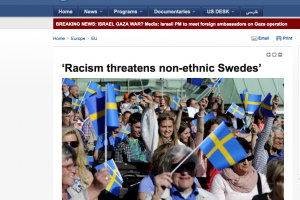
Two reports published on November 9 in Sweden show that the greatest threat to immigrants and visible minorities in that country aren’t far-right groups, but everyday intolerance and racism from white Swedes.
What does this report say about Sweden and suggest about how foreigners are treated in Finland? Contrary to our neighbor, Finland’s third-largest party in parliament, the Perussuomalaiset (PS), is staunchly xenophobic and against immigrants.
Relatives of the PS, the Sweden Democrats, are a minor force in parliament.
Cecilia Englung said: “The biggest challenge is to tackle the problem of everyday xenophobia by comments, evil staring and other negative behaviors toward non-ethnic Sweden.”
One of the reports asked 1,490 students about racism. Half of them, who were born elsewhere than Sweden, had experienced racism (28% said there is racism at their school and 24% knew of a racist assault at school).
Martin Luther King had a point when he said: “History will have to record that the greatest tragedy of social transition was not the striden clamor of the bad people, but the appalling silence of the good people.”
MLK had a point but how many of those people he mentions were actually that “good?”
A Malmö District Court convicted Peter Mangs, 40, of two counts of murder and four attempted murders, according to the Guardian. The man, who is a Swede of Finnish descent, killed his first victim in 2003 and terrorized Malmö during 2009-10. All of his victims were immigrants.
Mangs will undergo psychiatric evaluation before his sentencing in early September.
Writes the New York Times in May: “And although the scale of the accusations are nothing like the charges against Anders Behring Breivik, the Norwegian on trial in Oslo for the systematic killings of 77 people last year in a crusade against multiculturalism, the parallels have not been lost on residents here in Malmö, Sweden’s third-largest city and one of its most diverse.”
Prosecutor Solveig Wollstad was quoted as saying on Iltalehti that Mangs destroyed many people’s lives.
“He carried out his crimes in a cold-hearted manner without feelings [for the victims],” he said. “His aim was to shoot immigrants.”
Exactly a year ago Anders Breivik carried out his mass killings, which ended up causing the death of 77 innocent victims. Have we learned anything from that tragic Saturday that shook the Nordic region and changed it permanently?
In order to answer that question, we’d have to travel back in time to see how things were prior to that day.
In Finland, the right-wing populist Perussuomalaiset (PS) had just won a historic election victory that enabled the party to increase the number of its MPs to 39 from 5 in 2007. While party leader Timo Soini played down anti-immigration sentiment as one important factor behind the PS’ election victory, others disagreed.
Before Breivik erupted on the stage, anti-immigration parties like the PS were the new political force to contend with in Finland. It seemed that nothing could stop them from adding new election victories in the future. The louder and cruder their anti-immigration and anti-EU stances were, the more supporters they’d rally to their cause.
http://www.youtube.com/watch?v=xjVD0ztWaKA
In Norway, Denmark and Sweden, far-right populist anti-immigration parties had grown as well and were openly challenging traditional parties.
Everything changed, however, after July 22.
The first blow came in Norway to the Progress Party (FrP), which saw its support in the September municipal election plummet by 6.1 percentage points to 11.5%. In the same month, another anti-immigration party, the Danish People’s Party (DPP), suffered an election setback.
Since 2001, the Islamophobic DPP had supported minority right-wing government in exchange for tighter immigration policy.
In many respect, Breivik was a wake-up call that woke up for Finland and the Nordic region to the threat of intolerance and hate speech.
A recent supreme court ruling against Jussi Hall-aho is a case in point. The PS MP was not only fined for defaming a religion but for inciting ethnic hatred as well. The ruling wasn’t only a big blow to the PS but to the far-right Suomen Sisu wing of the party. Halla-aho was forced to resign as chairman of the administration committee, which, among other matters, sets immigration policy.
The presidential election was another important example of how Finland is distancing itself after 22/7 from the anti-immigration and populist rhetoric of parties like the PS.
Two conservative anti-EU candidates, Timo Soini of the PS and Paavo Väyrynen of the Center Party, lost to Green Party hopeful Pekka Haavisto in the first round of voting. Haavisto is openly gay and pro-EU.
The next test for the PS will come in the October municipal elections. If polls are anything to go by, the party will suffer another election setback.
In light of the above, can we claim that Breivik had had a direct impact on the popularity of the PS and other parties in the Nordic region that are anti-EU, anti-immigration and anti-Islam?
Your answer to that questions will probably reveal more than anything else your political views on immigration, Islam and cultural diversity.
But if we ask Norwegian Prime Minister Jens Stoltenberg, Norway had become after July 22 “more tolerant, [and] more careful not to judge people” by ethnic origin.
Even if Stoltenberg has shown leadership on how a wounded society should react to intolerance, it’s still unclear what impact Breivik will have on our societies. We are still healing from the wound and can matters return back to “normal” in Norway after Breivik?
If we set aside politics and try to understand the impact Breivik had on the region, one matter is certain: We are outraged by what happened but dread even more the possibility that it could happen again.
Competing for the anti-immigration thunder and rhetoric of parties like the PS, DPP, FrP and Sweden Democrats are far-right groups like the Finnish Defense League, which are copy-and-paste clones of the English Defense League.
Breivk scared the wits out of some of us and proved that anti-immigration and Counter-Jihad rhetoric can convert itself into a monster that has the ability to wreak terror and change our societies for good.
That I believe is the real message and threat of 22/7.
It is a tragedy that 77 people had to die at the hands of Anders Breivik on July 22. Ironically the mass killer did more than anyone to undermine the ideology of anti-immigration populist parties and hate groups in the Nordic region and Europe.
The political fallout of Breivik’s deeds was clear: The first blow came to the Progress Party (FrP) of Norway, which saw its support plummet in the municipal election by 6.1 percentage points to 11.5%. That was followed by election setbacks in Denmark and Finland.
Norway’s Prime Minister Jens Stoltenberg became an exemplary leader after the mass killings of Norway. His reaction was totally the opposite from what we saw in the United States after the September 11 attacks. Contrary to President George W. Bush, the Norwegian prime minister said that his country’s reponse to the mass killings will be more openness and more democracy.
The question that hounds us, however, is if Breivik were a Muslim instead of a white Norwegian, what kind of an anti-immigration backlash would we have seen in the Nordic region and Europe?
On a BBC documentary, Stoltenberg said that Norway had become after July 22 “more tolerant,[and] more careful not to judge people” by ethnic origin.
Wise words by a wise leader of a country that suffered one of its worst tragedies in recent history.
Behind all the rhetoric spread by anti-immigration groups in Finland and elsewhere a fact emerges: they are out to destroy the lives of as many immigrants as possible with their prejudice and racism. When a Justice Ministry official hands over rape statistics on various immigrant groups he gives a power weapon to slander and victimize people from various countries.
Such statistics have little value apart from hindering the integration of hard-working immigrants and those that want to make and build their future in this country.
Risto Laakkonen said on YLE’s Historiansarjoja: Raggarit, rasismi ja suomalaiset program how Swedish newspapers stopped linking crimes to national origin in 1970. The Finnish Embassy in Stockholm was instrumental in reaching an agreement with the editors-in-chief of Sweden’s major newspapers, who agreed not to publish the nationality of individuals committing a crime.
Things had gotten so bad in Sweden that the media had a common saying whenever a Finn was involved in a crime: En finne igen, or Yet another Finn.
Racist perceptions of different groups in Finland is more widespread than people would like to think, and the media have played a key role in spreading racism and prejudices among the population.
The fact that a political group openly spreads and distorts crime statistics about another national group is the worst form of chicanery.
If anti-immigration groups like the Perussuomalaiset (PS) party are honestly interested in promoting the integration of various cultures in our society, why do they commonly single out immigrants and never suggest the same things for Finns?
A case in point of the latter can be found in a good opinion-piece by Hussein Muhammed. PS MP Jussi Halla-aho has suggested that unemployed immigrants should be put to work, even if this means digging and refilling holes. Muhammed asks: “…why must this kind of work only apply to “newcomers?” Shouldn’t it apply equally to “natives” or to the majority population that are unemployed?”
Why do anti-immigration groups apply two standards? One of these are for “newcomers” and the other for “natives?” Why are they so eager to use crime statistics and point the accusing finger at the whole group?
The answer to that question is simple. It is prejudice with a capital P, and racism with a fat R.
Finland has been inflicted for a number of years by people who think they can say and write anything they please about immigrants and visible minorities in Finland. It’s only natural that when you let out racism and prejudice to roam freely in society unchecked, things will eventually snap as we saw in Norway in July. What did Helena Eronen, Perussuomalaiset (PS) MP James Hirvisaari’s aide, do wrong?
Eronen blames the scandal on her own ignorance, according to an interview she gave to YLE. “The strong reactions to it [blog entry] were to be expected,” she said.
Reactions to what she wrote about sleeve emblems for foreigners to help the police in Finland have been published in Sweden and now throughout Russia and former IVY countries such as Belarus, Kazakhstan and Azerbaijan.
Eronen blew it to put it lightly. If you are white and try to be “sarcastic” about other nationalities, work for a right-wing populist party like the PS and your boss is none other than Hirvisaari, you are going to get in hot water. She forgot as well those whom she was being sarcastic about, the immigrants, and if this may be offensive to some groups.
Who are the losers and winners of the scandal?
The biggest loser shouldn’t be difficult to figure out. That’s Eronen and the negative debating atmosphere in Finland concerning immigrants and visible immigrants.
Do I think that Eronen’s column was in bad taste? Certainly. But there may be a silver lining revealing that matters may have changed in Finland since Jussi Halla-aho and his xenophobic band roamed the net with near-impunity.
Some, like MP Hirvisaari, who was fined for hate speech in December, still don’t get it. They live somewhere deep in the previous decade when defaming and insulting immigrant groups and cultures was a free-for-all social media lynching job.
Hirvisaari added more damage and salt to Eronen’s wound Wednesday by republishing his own blog the column that was taken off Uusi Suomi. He went as far as to claim that the scandal is an example of the rot that inflicts the media in Finland.
The biggest winner could be the PS. Eronen could give them a scapegoat opportunity to wash their hands of all the racism and prejudice they have spread in Finland since last year’s election, according to a column by Jussi Jalonen. Such a sacrificial object looks especially inviting for the PS with the municipal election nearing in October.
Finland, and I am certain Eronen as well, have learned a valuable lesson: When you write about immigrants and visible minorities you should be extra careful and try to see the world from their perspective when dressing a column up in sarcasm.
If you have that ability, probably one of the first things you’d do is drop the whole topic and write about something else.
As the demonic rumors and stereotypes spread by Finland’s anti-immigration groups lose their appeal among voters, expect a new round of vicious attacks by them as the municipal election nears on October 28. The good news, however, is that using the usual crime statistics and racist arguments that gave some Perussuomalaiset (PS) candidates their ticket to parliament in the April 2011 election will be a hard sell in October.
One of the main reasons is the PS itself, which has given us a good taste of what kind of a party it is thanks to the numerous scandals that have rocked it. Voters are wiser today about the PS than they were on April 17.
Another important reasons is Anders Breivik, who shocked Norway and the world with his outlandish mass killings on July 22. All parties in the Nordic region that are anti-EU, anti-immigration and especially anti-Islam suffered as a result significant losses in recent elections and in the polls.
Racism is like an ogre that you cannot control once you let it out of the cage and give it an opportunity to flood society with hate. It can bite back, and hard, as we saw when Breivik went on his mass-killing rampage.
On a much wider scale racism can as well lead to wars and conflicts as it has in the past, according to the U.N.
“Racism and racial discrimination have been used as weapons to engender fear and hatred,” said U.N. Secretary-General Ban Ki-moon in his message marking this year’s International Day for the Elimination of Racial Discrimination. “Racism undermines peace, security, justice and social progress.”
Another reason why extremist and populist anti-immigration politicians will have a difficult time selling their message in the municipal election is because it is utter baloney based on exaggerated fiction. The media, some politicians and the general public have learned after close to one year of watching PS shenanigans in Parliament the distinction between fact and populist fiction.
Jussi K. Niemelä, a writer and editor of the Vallan vahtikoira blog, told Migrant Tales that the PS has the highest number of convicted criminals among their ranks when compared with other political parties. Many of their MPs are members of the far-right Suomen Sisu association.
Niemelä has been threatened by two PS members for his critical stance against the party. The police are presently investigating the matter.
More and more Finns understand racism, like hate, is a serious threat to our society.
Comment: Lisa Bjurwald’s book, Euroopan häpeä – Rasistien voittokulku (Art House), is not only encouraging but a constant reminder of the threat that far-right and right-wing populist anti-immigration parties pose on Europe and countries like Finland.
You can read as well about Bjurwald and the launching of her book Wednesday on Uusi Suomi and Demari. One of the many interesting points she points out is that no far-right party in Europe considers itself politically in the extreme right never mind spreading racist ideology.
There is, however, according to Bjurwald enough evidence to show that the Perussuomalaiset (PS) party is no different from other populist ones like the Sweden Democrats. The Guardian headlined an interview with PS head Timo Soini as a “far-right Finnish politician.”
Said Bjurwald on Uusi Suomi: “Timo Toini operates as a typical (like other populist parties in Europe) stating that the Perussuomalaiset (party) does not approve racism. But they do accept it, if not these representatives would have gotten kicked out of the party.”
She adds: “Not even our racists (in Sweden) are this stupid (as the PS).”
The job of condemning the PS’ racism and hostility towards minorities like homosexuals shows that still some of the Finnish media, political parties and the general public don’t take seriously the message of intolerance and hatred coming out of the PS.
_______________
Arto Huovinen
Euroopassa on pitkään suhtauduttu aivan liian huolettomasti äärioikeistosta tulevaan uhkaan, sanoo aiheesta kirjan kirjoittanut ruotsalainen toimittaja Lisa Bjurwald.
Comment: It’s refreshing to read the work of a journalist like Lisa Bjurwald, who published on Monday her book, ”Europe’s Shame – Racists on the Rise.” Migrant Tales hasn’t let the Perussuomaliset (PS) party off the hook even if its leader, Timo Soini, and countless others assure us that they are a normal party that does not exploit and incite xenophobia, racism and fear.
Writes HS in English: “Even though the True Finns are regarded in Finland as different from other populist parties, it is not true, Bjurwald claims. According to Bjurwald, it is typical of populism to appear ‘special.’ For example, in Hungary it is always argued that the right-wing Jobbik Party, which is calling for special separated-off areas for the Roma minority, has to be seen in the Hungarian context, as there the Roma are quite a special case.”
How one should treat a party like the PS in the media should not be difficult. Even so, we have had countless debates on Migrant Tales on what to call Suomen Sisu, which is more extreme than the PS.
Migrant Tales does not have to cite the secret police or any other source to decide what describes an association like Suomen Sisu best. If we look at the racial views of the association, it can be described as “Nazi spirited” or even “Klu Klux Klan spirited.”
HS in English continues quoting Bjurwald: ”Then we hear these statements like ”When in Rome, do as the Romans do”, which do not have any concrete content, but they increase the feeling of insecurity among a certain part of the population, for example immigrants.”
The Swedish journalist is right by saying that there is high moral standard and leadership lacking in society. We are talking about a black spot on our democracy, she says.
“Everyone can decide for themselves whom to vote for,” Bjurwald concludes. “But if the decision is made on the basis of false information and inspired with fear, someone has to say ’Stop.’”
________________
By Anna-Liina Kauhanen in Stockholm
The True Finns’ victory in Finland’s general elections gives Sweden and the entire European Union a lot to digest, says journalist Lisa Bjurwald from Stockholm, who watches the populist far-right parties.
The societies of the Nordic countries are still models for the rest of Europe and the world when it comes to social justice, equality, and inclusion. Slower economic growth is not the only threat that they face today, but an ever-growing minority that believes that exclusion of certain groups is acceptable.
Is there such a thing as selective suspicion or hatred? Can you hate one group and claim to be not hate another? What happens to us if we begin to exclude some and include others in our society?
Far right and right-wing populist parties like the Perussuomalaiset of Finland, Danish People’s Party, Progress Party of Norway, and Sweden Democrats have grown in recent years thanks to their anti-immigration rhetoric.
If there is a threat to the Nordic welfare state system and the values that uphold it, it is these parties’ anti-immigrant message that goes much deeper and further than meets the eye.
For one, and if we permit it, their view of society creates a paradox that will end up checkmating those values we hold so dear to us. You cannot further the cause of social equality while on the other hand you aim to make other groups unequal.
Martin Luther King Jr. dealt with centuries of hatred and suspicion when he led and inspired others to the US Civil Rights movement of the 1950s and 1960s.
Even if anti-immigration groups are hostile in their approach to their imagined and real enemies like immigrants, we must never succumb to their brand of hatred. We must remember King Jr. words: “Darkness cannot drive out darkness; only light can do that. Hate cannot drive out hate; only love can do that.”
It should be one of the rallying cries of our cause.