Migrant tales
Menu
  • #MakeRacismHistory “In Your Eyes”
  • About Migrant Tales
  • It’s all about Human Rights
  • Literary
  • Migrant Tales Media Monitoring
  • NoHateFinland.org
  • Tales from Europe
Menu

Tag: Sweden

Sweden’s white paper on the abuses and rights violations against the Roma will have a positive effect on Finland

Posted on April 2, 2014 by Migrant Tales

Sweden published on March 26 a white paper on abuses and rights violations against the Roma during the last century. The white paper is significant since it is the first time that the Swedish government has published and acknowledged Sweden’s long history of discrimination against the Roma minority. Should Finland follow Sweden’s example?

If sociologist and economist Gunnar Myrdal (1898-1987) pointed out that “discrimination breeds discrimination,” contrarily positive concrete steps that challenge discrimination help undermine it. Myrdal referred to this type of knock-on effect as cumulative causation.

Näyttökuva 2014-4-2 kello 12.53.41

Read full story here.

Despite the white paper, discrimination against the Roma is still very much alive in Sweden. Migrant Tales reported last week that a Roma wearing her traditional dress was escorted out of the hotel’s breakfast room. The woman was an invited speaker at the event where the white paper was announced.

In Sweden, compulsory sterilization of the Roma took place between 1934 and 1974.

Already in the middle ages the Roma, which are the biggest ethnic minority in Europe with 6 million members, European states enacted laws that were specifically designed to marginalize and victimize them.

Writes the European Roma Information Office (ERIO): “In fact, a number of heads of state legalized the killing of Roma and anti-Gypsyism became widespread amongst the generation population across the continent. The long-held and socially ingrained prejudice
against Roma, culminated in the destructive and violent ideologies of the Nazi’s in the Third Reich…Along with numerous other
communities, the Roma were classified as Untermenschen (subhuman creatures) by the Nazi regime, and between 220,000 and 1.5 million Roma were systematically exterminated in the Holocaust.”
While the number of the Roma has been smaller in Finland than Sweden, today numbering about 10,000, greater official recognition pf the wrongs committed against the Roma in Sweden, effective anti-discrimination legislation and the role of education on cultural diversity play key roles in not only improving the lives of the Roma in this country but other minorities and migrants.
“This is a step in the right direction,” said a Roma official in Finland. “But there’s a lot of work that needs to be done.”

Institute of Race Relations: How the Swedish media bought into the myth-making of the far Right

Posted on March 28, 2014 by Migrant Tales

Maria Tjader

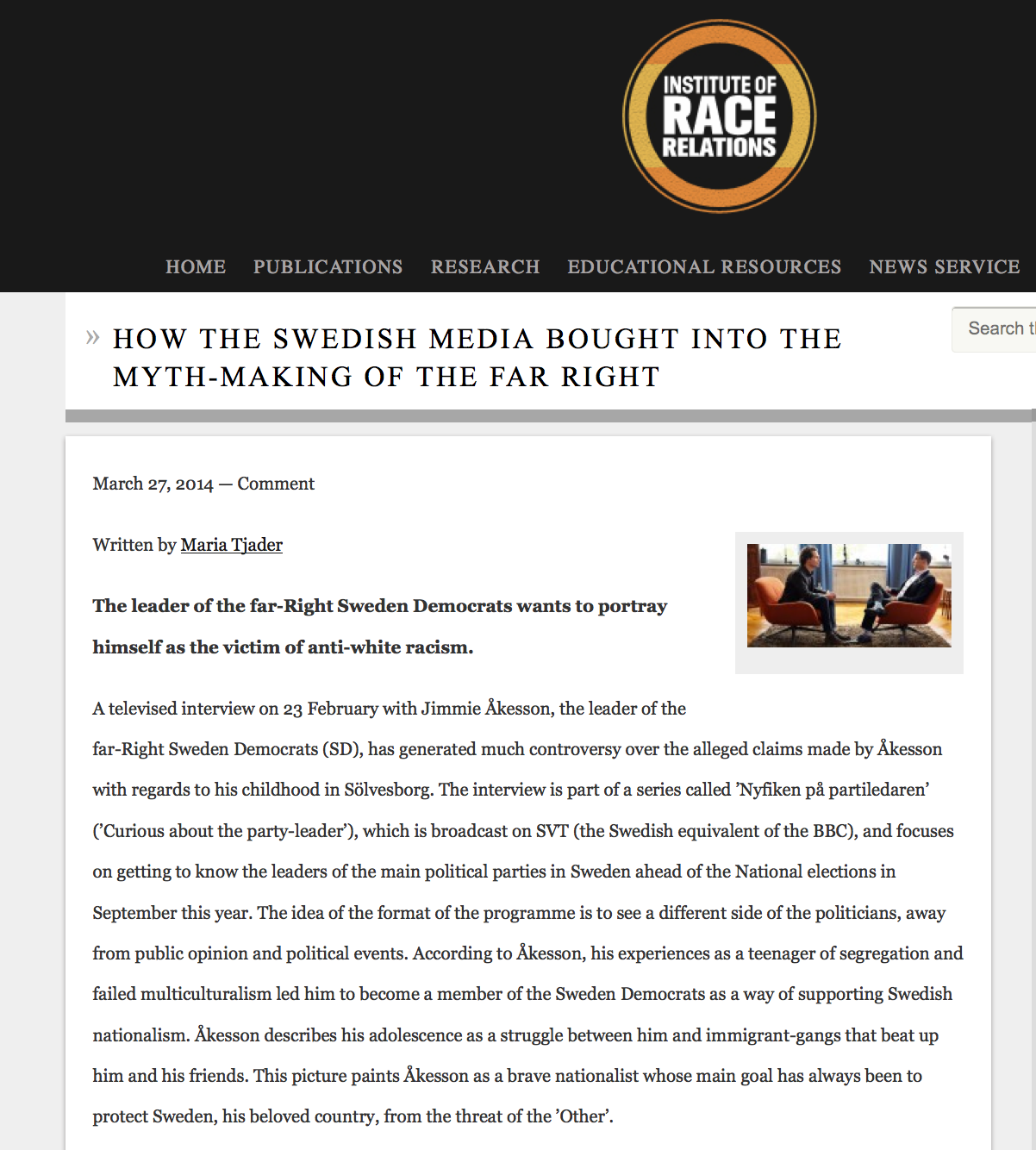
The leader of the far-Right Sweden Democrats wants to portray himself as the victim of anti-white racism.

Näyttökuva 2014-3-28 kello 14.30.56

Read full story here.

A televised interview on 23 February with Jimmie Åkesson, the leader of the far-Right Sweden Democrats (SD), has generated much controversy over the alleged claims made by Åkesson with regards to his childhood in Sölvesborg. The interview is part of a series called ’Nyfiken på partiledaren’ (’Curious about the party-leader’), which is broadcast on SVT (the Swedish equivalent of the BBC), and focuses on getting to know the leaders of the main political parties in Sweden ahead of the National elections in September this year. The idea of the format of the programme is to see a different side of the politicians, away from public opinion and political events. According to Åkesson, his experiences as a teenager of segregation and failed multiculturalism led him to become a member of the Sweden Democrats as a way of supporting Swedish nationalism. Åkesson describes his adolescence as a struggle between him and immigrant-gangs that beat up him and his friends. This picture paints Åkesson as a brave nationalist whose main goal has always been to protect Sweden, his beloved country, from the threat of the ’Other’.

However, these suggestions have subsequently been refuted by a large number of people who grew up with Åkesson and who worked at his old school. Major Swedish newspapers, television and radio have reported on the inaccuracies in Åkesson’s story and he has, consequently, been accused of distorting the reality of immigration in Sweden for political gain and legitimacy. Åkesson’s former head teacher has refuted the claims saying that there were no gangs made up of immigrants at all, nor were there any particular individuals who acted in a threatening way towards other children. Another of his former teachers suggests that Åkesson has a bizarre view on the history of immigration in Sölvesborg. This claim is supported by the statistics from SCB (Statistiska Centralbyrån/Statistics Sweden) that paint a very different picture than that of Åkesson. According to this statistic, there were 24 new immigrants in Sölvesborg in 1985 and although the number rose there were never more than 200 new immigrants  per year. Furthermore, this does not take into account migrants who left Sölvesborg. This is but another insight into the strange workings of SD, who has had its fair share of scandals since 2010, but it also tells us something important about the role of media in creating and sustaining the myths of the nationalist far-right.

Arguably, the flux of information has radically changed with the power of internet and social media. There have been previous reports on how Germany’s new extreme right have been using social media to attract, notably younger, supporters through parties, gigs and under-18 events. Similarly, any news-search on google, relating to the far-right or racism violence, generates nationalist websites that blame everything on left-wing multi-culturalists. It cannot, thus, be argued that the far-right lacks a platform for its freedom of speech. The issue is when national media lowers itself that same level, prioritising everyone’s right to be heard and seen rather than taking responsibility for whatever consequences their reporting might have.

The issue of using freedom of speech as an excuse for people to vent extremist opinions has been highlighted by the IRR before. It is undeniable that certain individuals and groups take advantage of the laws on freedom of press and speech, however there are other instances which show the complexity of these issues. There were those who criticised the laissez faire style used in Åkesson’s interview, arguing that it portrayed media as serving as an uncritical forum where anyone can say anything. But after the programme was broadcast, other authentic voices  were given space to refute Åkesson’s myth-making, and their statements were reported as facts. This gives hope for a return to reporting with a critical edge.

Read original story here.

This piece was reprinted by Migrant Tales with permission.

Romany minority discrimination case sparks government outrage in Sweden

Posted on March 27, 2014 by Migrant Tales

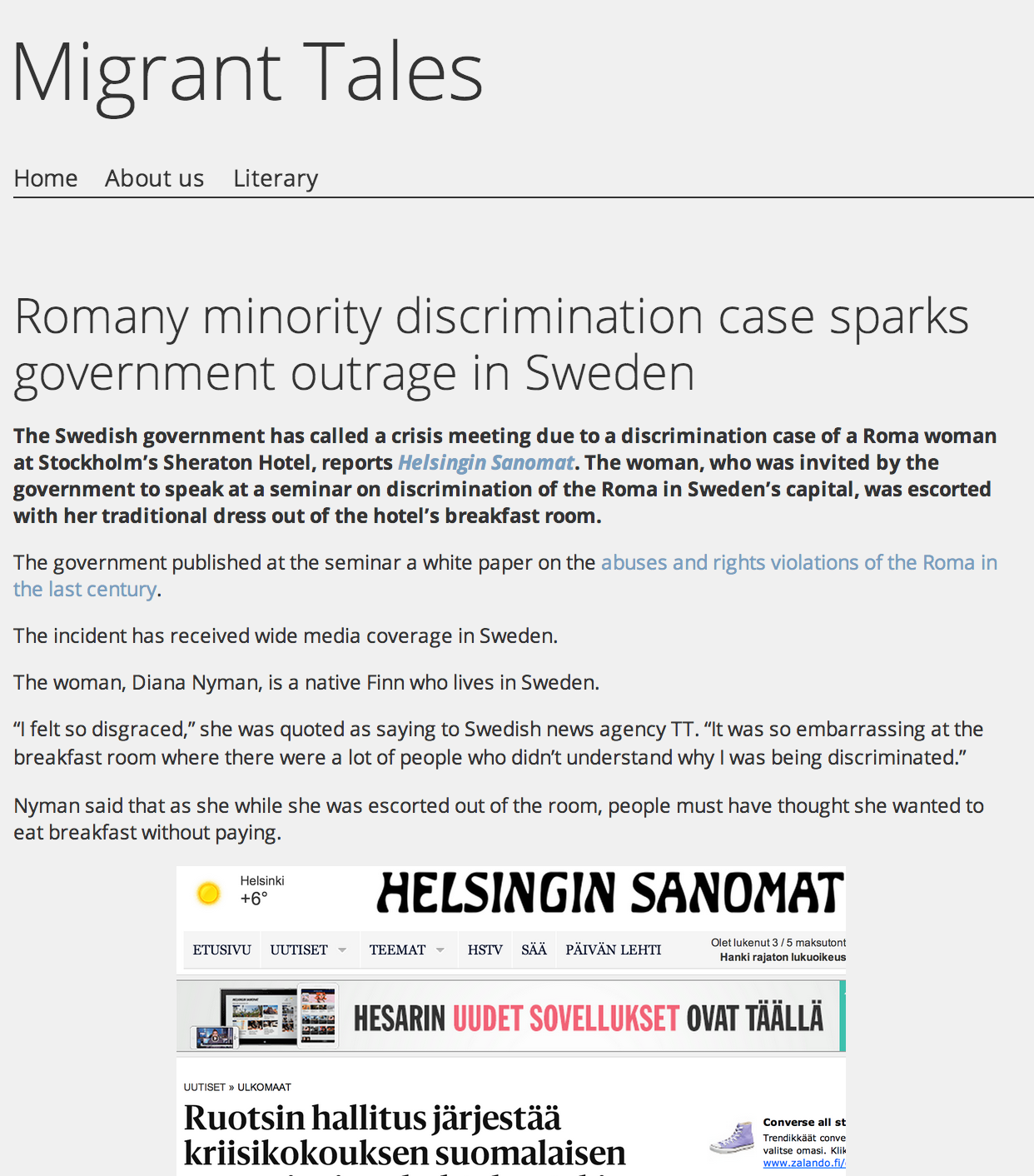
The Swedish government has called a crisis meeting due to a discrimination case of a Roma woman at Stockholm’s Sheraton Hotel, reports Helsingin Sanomat. The woman, who was invited by the government to speak at a seminar on discrimination of the Roma in Sweden’s capital, was escorted with her traditional dress out of the hotel’s breakfast room.

The government published at the seminar a white paper on the abuses and rights violations of the Roma in the last century.

The incident has received wide media coverage in Sweden.

The woman, Diana Nyman, is a native Finn who lives in Sweden.

“I felt so disgraced,” she was quoted as saying to Swedish news agency TT. “It was so embarrassing at the breakfast room where there were a lot of people who didn’t understand why I was being discriminated.”  

Nyman said that as she while she was escorted out of the room, people must have thought she wanted to eat breakfast without paying.

Näyttökuva 2014-3-27 kello 11.34.44

Read full story (in Finnish) here.

Sweden’s integration minister, Erik Ullenhag, said that Nyman’s case shows that discrimination happens daily in Sweden and that there is a need to debate the issue.

One positive matter about Sweden is that the government does take a stand against discrimination and shuns the xenophobic and far-right Sweden Democrats.

Finland could learn a lot from Sweden on how to combat intolerance and discrimination.

Finland had 3,238 asylum seekers in 2013

Posted on February 7, 2014 by Migrant Tales

A total of 3,238 people applied for asylum in Finland compared with 3,129 people in the previous year, according to the Finnish Immigration Service. The largest single group of asylum seekers was Iraqis (819) followed by Russians (226) and Somalis (217).

The number of asylum seekers coming to Finland oscillated between 1,500 and 6,000 over the 5-year period from 2006 to 2010.

Kuvankaappaus 2014-2-7 kello 21.51.37

Read full story here.

”The situation has been stable for a few years,” Esko Repo, head of the FIS refugee unit, was quoted as saying in Helsingin Sanomat.

A total of 4,055 asylum decisions were made by the authorities last year.  Forty-five percent (1,827 applicants) were given asylum while the rest were rejected.

The average processing time for asylum applications was 190 days, with 80% of  applicants processed in 156 days.

Meanwhile in neighboring Sweden, the total number of asylum seekers in 2013 was 54,259 persons, or whom 24,498 were given asylum, according to the Migration Board of Sweden. This compares with 11,983 asylum seekers in Norway in 2013 and 3,896 in Denmark during the first three quarters of the year.


Sweden is right, Finland wrong in its strategy against anti-immigration parties

Posted on December 4, 2013 by Migrant Tales

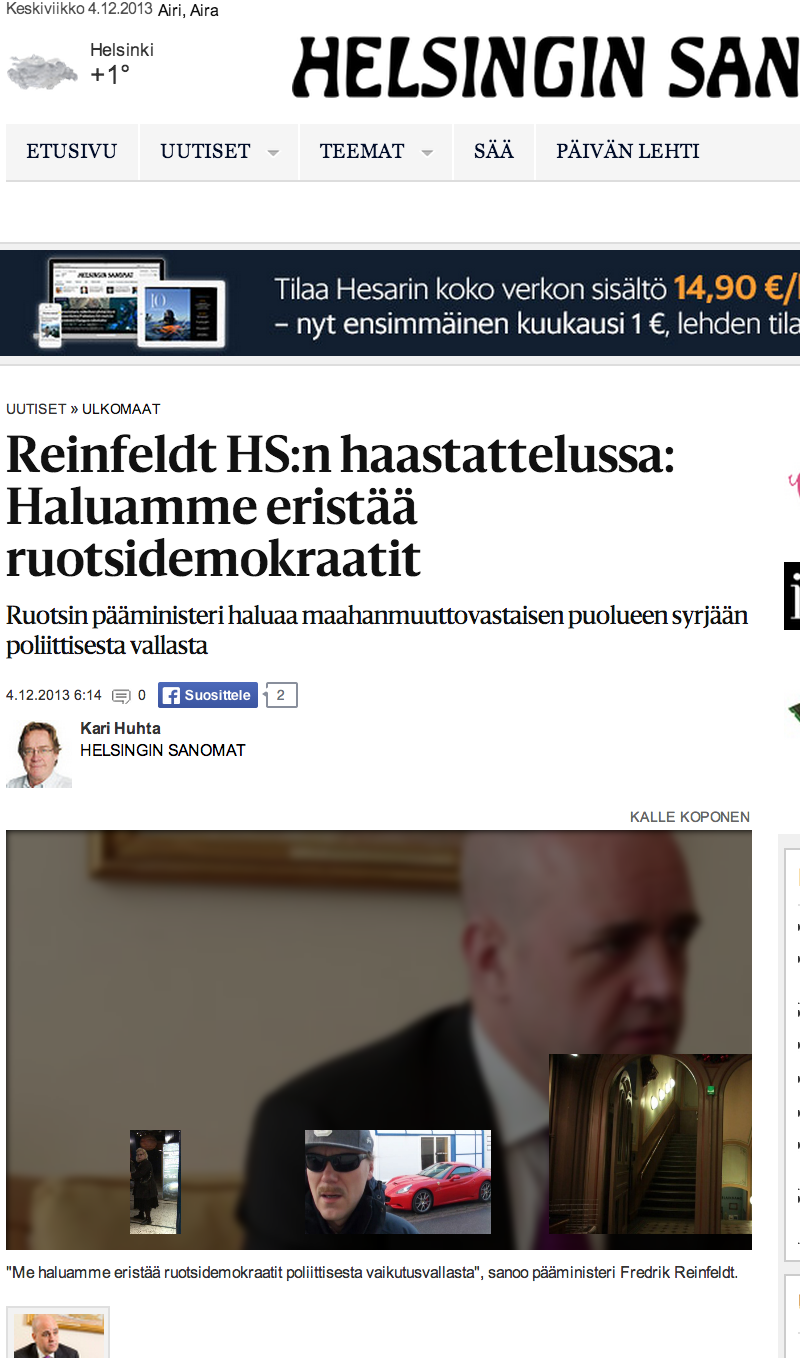
Swedish Prime Minister Fredrik Reinfeldt reiterated to Helsingin Sanomat the government’s plans to isolate Sweden Democrats despite the latest polls in Sweden, which show the anti-EU and anti-immigration party making gains. Even if the Sweden Democrats have tried break free from their neo-Nazi and racist image, the party led by Jimmie Åkesson has suffered a number of scandals. 

Kuvankaappaus 2013-12-4 kello 7.43.07

Read full story (in Finnish) here.

We know from a fact that flirting with the far right, right-wing populism, isolationism and adopting a tougher anti-immigration stance can backfire badly as happened in Finland in April 2011, when the Perussuomalaiset (PS) became the country’s third-largest party in parliament.

After over two and a half years of PS opposition politics, which has been strongly characterized by racism, nationalism and neo-liberal economic ideology, what should mainstream parties have learned?

The answer to that question can be found in neighboring Sweden where mainstream parties there have isolated politically the Sweden Democrats.

Is this an effective strategy?

Yes, despite gains by the Sweden Democrats in the polls.

Time will prove Sweden did the right thing while Finland failed in the task in challenging intolerance.

If the government of Prime Minister Jyrki Kaatainen has taken an ambivalent stance on intolerance, why would PS head Timo Soini want to renounce racism in his party if it attracts votes?

It’s like asking a junkie to give up drugs.

How Syrian refugees fleeing war show how the Finnish media gives (again) racists inflated respectability and importance

Posted on September 19, 2013 by Migrant Tales

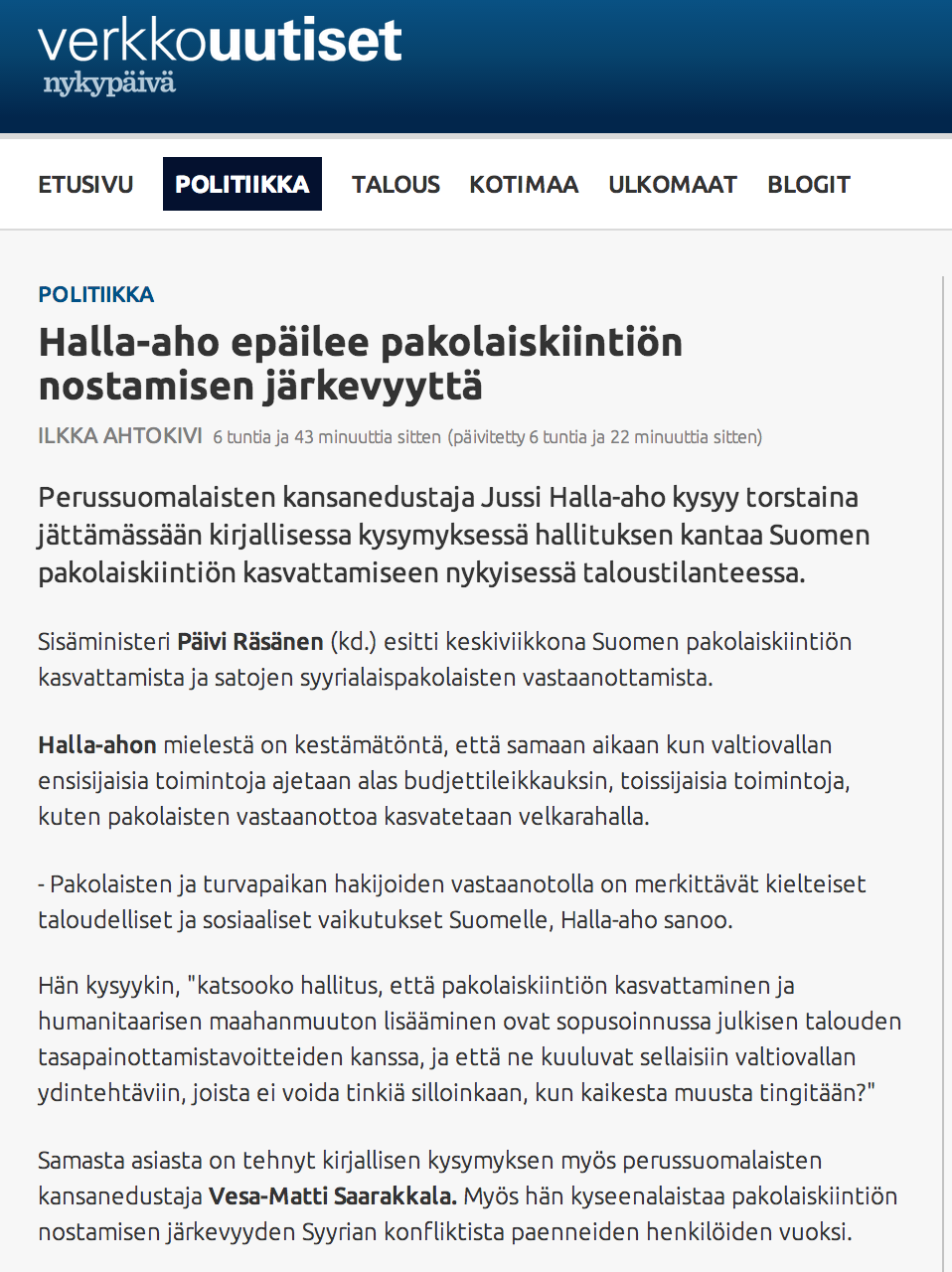
Migrant Tales published a while back a story about how the media gives racists and radical anti-immigration groups inflated respectability and importance. Why should we care what a Perussuomalaiset (PS) MP like Jussi Halla-aho, who was on top of it convicted for ethnic agitation, thinks about giving asylum to Syrian refugees? 

Kuvankaappaus 2013-9-19 kello 20.41.58

Verkkouutiset is run by the National Coalition Party. Read full story here.

Why should the media care if another PS MP like James Hirvisaari, who was convicted for ethnic agitation as well, is “forced” to resigns from an extremist association like Suomen Sisu but supports a far right and racist group like the Finnish Defense League?

And what would you say about PS MP Vesa-Matti Saarakkala, who has sent a written question to parliament about the government’s plan to give asylum to a few hundred refugees from Syria?

Certainly all of the above have some newsworthiness. The PS is an anti-immigration, anti-Islam and anti-gay party. MPs like Halla-aho, Hirvisaari and Saarakkala, who are the most vociferous opponents of cultural diversity, are expressing their opposition to government policy, which is already pretty thin to begin with when it comes to Syrian refugees.

Here’s the question we should probably ponder: How is it possible that a country like Finland, which knows too well what the suffering of war and refugees are, is doing so little to help refugees fleeing a country that is suffering one of the worst sectarian bloodbaths in modern history?

Folks, we’re talking about granting a few hundred Syrian refugees asylum to our country, while our neighbor Sweden, has already given permanent residency to half of the Syrian refugees and announced it will give 8,000 more residency. 

Is the “news” Halla-aho’s or Saarakkala’s lowly opinions of refugees, or that Sweden is giving thousands resident permits to Syrians while we’re having a philosophical discussion about why we should even let in a few hundred?

Why isn’t there anything written by Ilkka or Verkkouutiset that compares our response to the Syrian refugees question with Sweden’s?Aren’t we always competing against our eternal rival in the west in almost everything?

True, Finland’s worst rivals are Sweden. But we don’t compete in some areas that really count and are important, like giving shelter to those fleeing war.

In that match, Finland gets romped every time 6-0 against Sweden.


The shadow of Anders Breivik’s mass killings hang over coalition talks after Norway elections

Posted on September 10, 2013 by Migrant Tales

The landslide victory of Norway’s opposition Conservatives  (Høyre) on Monday was short-lived after the country’s next prime minister, Erna Solberg, faced tough coalition talks with the anti-immigration and populist Progress party (Fremskrittspartiet) of which Anders Breivik was a member and whose cold-blooded killings continue to haunt the country, reports Reuters.

Kuvankaappaus 2013-9-10 kello 12.50.53

Visit Wikipedia site here.

Outgoing Labor Party Prime Minister Jens Stoltenberg and his allies were able to win 72 seats compared with the 96 that Solberg and its allies won, which is 11 more needed for a majority.

Høyre won 48 seats, Progress party (29), Christian Democratic Party (10) and the Liberals (9).

Even if the Progress party has tried to distance itself from the xenophobic Sweden Democrats and Danish People’s Party, Breivik’s shadow continues to haunt the party as well as the country.

After 22/7, when Breivik gunned down in cold blood 69 Labor Party youths on the island of Utøya (69 dead) and eight more from a bomb explosion in Oslo, life has not changed in Norway but in the Nordic region as well.

The election result of the Progress party lags behind pre-22/7 results. In September 2011, it lost 6.1% percentage points in the municipal elections and on Monday it lost 12 seats.

Even if some believe that Norway has forgotten what happened on 22/7, it’s unlikely that anti-immigration rhetoric and populism can make something so horrific disappear.


Racism Review: Sweden – No Longer the Exception to Western Racist Rule

Posted on June 4, 2013 by Migrant Tales

Authored by Tobias Hübinette and L. Janelle Dance

Since May 20, 2013, mass vandalism, material damage and outbursts of rioting in the poor and non-white suburbs of Greater Stockholm have dominated Swedish and international news media. This civil unrest was sparked when, on May 12, the police shot and killed a 69-year-old man from Husby, one of the marginalized suburban communities of metropolitan Stockholm. The shooting is still under investigation. The burning of cars, other types of arsons, and attacks on the police erupted in Husby on the evening of May 19th and quickly spread to many other similar suburbs of Greater Stockholm such as Fittja, Tensta, Flemingsberg, Hjulsta, Jakobsberg, Hagsätra, Rågsved, Skärholmen and Skogås. As we write this post, after six nights of uninterrupted suburban unrest, the vandalism and the violence have also spread to other Swedish cities like Gothenburg, Örebro and Linköping. Although the US and UK embassy warnings to keep out from such districts are clearly exaggerated—the scale of the unrest cannot be compared to similar previous waves of riots in for example the US, the UK or France—a feeling of a serious social crisis is gaining ground in the political debate as leading government officials and the Prime Minister Fredrik Reinfeldt urge a stop to the material damage.

This is not the first time that Sweden is experiencing a series of riots; the last time was between 2008-09. However, it is arguably the first time when voices from the suburbs are entering the public debate as a new nascent social movement. At the helm of this movement, which has gained the spotlight in recent years, are teens and young adults who are also usually born and raised in Sweden (the so-called second generation). More than ever before, these youth are denouncing police harassment, the declining social welfare services in the suburbs and the dramatically increasing disparities between rich and poor—a development which is heavily racialized as the proportion of poor white Swedes is below 5% while the proportion of poor Swedes of color hovers around 35-45%. Representatives from this movement have, for example, alerted the media to the use of racial slurs among the police who patrol the suburbs, and above all they have been able to express an unprecedented analysis of a New Sweden, which is becoming heavily polarized along racial lines.

For decades Sweden has proudly viewed itself as the most progressive country in the world, as “the conscience of the world”. Furthermore, Sweden’s antiracist image and radical anti-discrimination, migration and integration legislation are well known all over the world. However, recently Sweden has also become the OECD country showing the highest difference in unemployment between foreign-born and native-born Swedes, while its big- and mid-size cities are characterized by one of the most extreme ethno-racial residential segregation patterns in the Western world. Thus, it is not in the context of the old Sweden of exceptionalism but in the wake of the New Sweden of exclusion that we must understand the frustration, the desperation and the rage that can be found particularly among young people in the suburbs. This second generation has grown up in Sweden but due to stigmatized postal addresses and “non-Swedish” appearances they are not accepted within the majority society at large, without taking into account these worrying statistical correlations.

There are also other political groups that are exploiting the current suburban unrest. A fact overlooked by the media is that these other groups do not live in the suburbs yet exacerbate the unrest. While ignoring these instigators, the media focuses on spectacular videos and photos of burning buildings and cars and policemen fighting with youngsters. Firstly, there are indications that white Swedish leftist activists have encouraged and participated in the riots, something that also happened in 2008-09. Their sole political agenda is to sustain and encourage even more social antagonism at the expense of an even stronger stigmatization of the poor and non-white suburbs among the white majority population. Furthermore, Swedish extreme right-wing activists are also active in the events by portraying themselves as “ordinary Swedes” who want to help the police as “citizen guards”, a popular yet loaded discourse that the media all too often buy into. Saturday night for example, around 200 Nazi activists more or less invaded Tumba in Southern Botkyrka in the southern part of Greater Stockholm, and started to hunt down and beat up any youngster who was deemed to be a “rioter”.

However for ordinary white Swedes reading and watching the news it is highly probable that all the inhabitants in the suburbs are associated with violence and rioting. In the end, the Sweden Democrats (a former Nazi party which has transformed itself into a populist anti-immigration party and which, according to opinion polls, is the fourth or the third largest party in Sweden) will maybe become the biggest political winner due to the suburban unrest. Now, the Sweden Democrats will most probably gain even more support among the voters. Of course, representatives from the party have already made use of the events by calling for stronger police interventions and the introduction of temporary state of emergency measures in certain urban districts.

Once “exceptional” Sweden is no longer the exception to the general Western rule of blaming the racialized victim. On the contrary, white Swedes are remarkably unexceptional as they behave like racist and conservative white Americans. Ordinary white Swedes, who claim to embrace antiracism, equality and social democracy, look at the riots in Stockholm and blame marginalized youths for the institutional discrimination, political marginalization, and structural racism that have become common place in the former “conscience of the world”.

Tobias Hübinette is an Associate Professor and researcher at the Multicultural Centre in Botkyrka, Sweden. L. Janelle Dance is an Associate Professor of Sociology and Ethnic Studies at the University of Nebraska and a visiting scholar at the Center for Middle Eastern Studies at Lund University in Sweden. Dance is currently living in Sweden.

Read original blog entry here.

This piece was reprinted by Migrant Tales with permission.

Sweden and Woolwich reveal the eager face of intolerance

Posted on May 29, 2013 by Migrant Tales

Be it the riots in Sweden or the tragic murder of a British solider in Woolwich last week, it’s always the eager face of intolerance that is ready to expose itself. The knee-jerk reaction to these events reveals something disturbing about us: our prejudice, intolerance and near-clueless answers on how to move forward in a culturally diverse society during economically trying times. 

Mainstream politicians, who may mean well, end up digging their political graves when they try to attract the anti-immigration vote. We saw this with disastrous results for them in Finland in the April 2011 elections and most recently in the United Kingdom, after the good showing of the anti-immigration UKIP party in the local elections.

Despite proof that it’s politically risky to be in cahoots with anti-immigration groups by echoing their message of intolerance, it seems that Prime Minister Jyrki Katainen of Finland hasn’t learned from his past mistakes. He said that one way of avoiding the riots that took place in Sweden is to keep the amount of asylum seekers in check.

If people are fleeing war and violence, isn’t it their human right to seek asylum in a country like Finland? Or should they go somewhere else because we speculate that they will instigate Husby-type riots in the future?

If I could, I’d ask Prime Minister Katainen why he made such a statement and how many asylum seekers are taking part in the riots in Sweden. I seriously doubt there are any asylum seekers rioting in Sweden.

What do such inopportune statement reveal about the political atmosphere in Finland? It shows that mainstream parties still fear the populist anti-immigration and anti-EU Perussuomalaiset (PS) and have few good arguments to challenge it.

It’s not the first time that the prime minister had made such an untimely statement about immigrants in Finland. In March 2010 he said that ”debating immigrant issues in this country didn’t make you a racist.”

That affirmation by the prime minister opened the Internet floodgates of greater intolerance and victimization of immigrants and visible minorities.

National Police Commissioner Mikko Paatero added as well more fuel to the flames of intolerance by stating that what happened in Sweden could soon take place in Finland. He thus labels and reinforces negative prejudices of immigrants that they are a problem instead of an asset to our society.

What do all of these tragic events and reaction by our officials tell us about the present state of intolerance in Finland? It not only shows ignorance and political opportunism, but reinforces the idea that too many in this country are still in the dark about how to promote greater tolerance.

Sad but true.

ENAR press statement: Riots in Sweden – time for government to finally address ethnic minorities’ exclusion

Posted on May 28, 2013 by Migrant Tales

Comment:   As Migrant Tales has written on a number of postings, the riots in Sweden mirror the dire situation of some immigrant groups in that country and how marginalized they are from the rest of society. 

______

Brussels, 28 May 2013 – The ongoing riots in Stockholm, Sweden are a strong wake-up call for Swedish  authorities. For too long, Sweden has turned its back on the dire social and economic situation of migrants  and minority communities who are facing increasing marginalisation, scarcer access to decent housing, higher unemployment rates, as well as excessive use of power by policing authorities. The European  Network Against Racism (ENAR) condemns both the violence use on the street by rioters and the ongoing  institutional violence of successive Swedish governments, which have chosen not to address the deeprooted causes of exclusion plaguing Swedish society.

For instance, the Swedish police project ‘REVA’, aimed to crack down on irregular immigrants, has led to racial  profiling in checking ID and residency permits of anyone ‘foreign-looking’. Such practices are clearly  discriminatory and undermine the rights of individuals. They also contribute to the exclusion and demonisation of particular communities.

We call on the Swedish government to:

– Put measures and resources in place to remedy the discrimination, high unemployment rates and segregation faced by ethnic minority communities                                                                                                                                                                                                                                                                       – Put an immediate end to the excessive use of police powers targeted at ethnic minorities and migrants.                                                                     – Engage in a dialogue with grassroots NGOs to develop an action programme to decrease tensions in communities and rapidly improve their socio-economic conditions.

ENAR Chair Chibo Onyeji said: “It is essential to use non-violent methods in the pursuit for justice and socioeconomic change. But urgent action is needed to create a constructive environment that can give young people  growing up in ethnic minority communities a foundation for a bright future. Fostering inclusion and reducing the increasing inequalities faced by ethnic minority communities should be at the forefront of Sweden’s political concerns.”

Read original statement here.

  • Previous
  • 1
  • 2
  • 3
  • 4
  • 5
  • 6
  • 7
  • 8
  • 9
  • Next
Read more about documentary film
Read more

Recent Posts

  • Finland’s tabloids Iltalehti and Ilta-Sanomat are the pits
  • Riikka Purra’s Dr Jekyll and Mr Hyde mask
  • Double standards
  • Perussuomalaiset: Uusi logo, sama vanha juttu
  • Taco Trump

Recent Comments

  1. Absolutely Socking: Racist Finnish Facebook group against human rights gets flooded with socks on Musta Barbaari’s mother and sister charged by the police in “ethnic profiling” case
  2. Ilkka Nuotio on Pekka Myrskylä: “Tilastot kertovat toista kuin poliittinen keskustelu”
  3. Genrih Soinkara on The war in Ukraine and the Russian-Finnish border crisis are showing Finland’s ugly side
  4. Ahti Tolvanen on Comment by Ahti Tolvanen on the Helsinki +50 conference
  5. Angel Barrientos on Angel Barrientos is one of the kind beacons of Finland’s Chilean community

Archives

  • June 2026
  • May 2026
  • April 2026
  • March 2026
  • February 2026
  • January 2026
  • December 2025
  • November 2025
  • October 2025
  • September 2025
  • August 2025
  • July 2025
  • June 2025
  • May 2025
  • April 2025
  • March 2025
  • February 2025
  • January 2025
  • December 2024
  • November 2024
  • October 2024
  • September 2024
  • August 2024
  • July 2024
  • June 2024
  • May 2024
  • April 2024
  • March 2024
  • February 2024
  • January 2024
  • December 2023
  • November 2023
  • October 2023
  • September 2023
  • August 2023
  • July 2023
  • June 2023
  • May 2023
  • April 2023
  • March 2023
  • February 2023
  • January 2023
  • December 2022
  • November 2022
  • October 2022
  • September 2022
  • August 2022
  • July 2022
  • June 2022
  • May 2022
  • April 2022
  • March 2022
  • February 2022
  • January 2022
  • December 2021
  • November 2021
  • October 2021
  • September 2021
  • August 2021
  • July 2021
  • June 2021
  • May 2021
  • April 2021
  • March 2021
  • February 2021
  • January 2021
  • December 2020
  • November 2020
  • October 2020
  • September 2020
  • August 2020
  • July 2020
  • June 2020
  • May 2020
  • April 2020
  • March 2020
  • February 2020
  • January 2020
  • December 2019
  • November 2019
  • October 2019
  • September 2019
  • August 2019
  • July 2019
  • June 2019
  • May 2019
  • April 2019
  • March 2019
  • February 2019
  • January 2019
  • December 2018
  • November 2018
  • October 2018
  • September 2018
  • August 2018
  • July 2018
  • June 2018
  • May 2018
  • April 2018
  • March 2018
  • February 2018
  • January 2018
  • December 2017
  • November 2017
  • October 2017
  • September 2017
  • August 2017
  • July 2017
  • June 2017
  • May 2017
  • April 2017
  • March 2017
  • February 2017
  • January 2017
  • December 2016
  • November 2016
  • October 2016
  • September 2016
  • August 2016
  • July 2016
  • June 2016
  • May 2016
  • April 2016
  • March 2016
  • February 2016
  • January 2016
  • December 2015
  • November 2015
  • October 2015
  • September 2015
  • August 2015
  • July 2015
  • June 2015
  • May 2015
  • April 2015
  • March 2015
  • February 2015
  • January 2015
  • December 2014
  • November 2014
  • October 2014
  • September 2014
  • August 2014
  • July 2014
  • June 2014
  • May 2014
  • April 2014
  • March 2014
  • February 2014
  • January 2014
  • December 2013
  • November 2013
  • October 2013
  • September 2013
  • August 2013
  • July 2013
  • June 2013
  • May 2013
  • April 2013
  • March 2013
  • February 2013
  • January 2013
  • December 2012
  • November 2012
  • October 2012
  • September 2012
  • August 2012
  • July 2012
  • June 2012
  • May 2012
  • April 2012
  • March 2012
  • February 2012
  • January 2012
  • December 2011
  • November 2011
  • October 2011
  • September 2011
  • August 2011
  • July 2011
  • June 2011
  • May 2011
  • April 2011
  • March 2011
  • February 2011
  • January 2011
  • December 2010
  • November 2010
  • October 2010
  • September 2010
  • August 2010
  • July 2010
  • June 2010
  • May 2010
  • April 2010
  • March 2010
  • February 2010
  • January 2010
  • December 2009
  • November 2009
  • October 2009
  • September 2009
  • August 2009
  • July 2009
  • December 2008
  • November 2008
  • October 2008
  • September 2008
  • August 2008
  • July 2008
  • June 2008
  • May 2008
  • April 2008
  • March 2008
  • February 2008
  • January 2008
  • November 2007
  • October 2007
  • September 2007
  • August 2007
  • July 2007
  • June 2007
  • May 2007

Categories

  • ?? Gia L?c
  • ????? ?????? ????? ???????? ?? ??????
  • ???????
  • @HerraAhmed
  • @mondepasrond
  • @nohatefinland
  • @oula_silver
  • @Varathas
  • A Pakistani family
  • äärioikeisto
  • Abbas Bahmanpour
  • Abdi Muhis
  • Abdirahim Hussein Mohamed
  • Abdirahim Husu Hussein
  • Abdirisak Mahamed
  • About Migrant Tales
  • activism
  • Adam Al-Sawad
  • Adel Abidin
  • Afrofinland
  • Ahmed IJ
  • Ahti Tolvanen
  • Aino Pennanen
  • Aisha Maniar
  • Alan Ali
  • Alan Anstead
  • Alejandro Díaz Ortiz
  • Alekey Bulavsev
  • Aleksander Hemon
  • Aleksanterinliitto
  • Aleksanterinliitto ry
  • Aleksanterinliitto ry:n hallitus
  • Alex Alex
  • Alex Mckie
  • Alexander Nix
  • Alexandra Ayse Albayrak
  • Alexis Neuberg
  • Ali Asaad Hasan Alzuhairi
  • Ali Hossein Mir Ali
  • Ali Rashid
  • Ali Sagal Abdikarim
  • Alina Tsui
  • Aline Müller
  • All categories
  • Aman Heidari
  • Amiirah Salleh-Hoddin & Jana Turk
  • Amin A. Alem
  • Amir Zuhairi
  • Amkelwa Mbekeni
  • Ana María Gutiérrez Sorainen
  • Anachoma
  • Anders Adlecreutz
  • Angeliina Koskinen
  • Anna De Mutiis
  • Anna María Gutiérrez Sorainen
  • Anna-Kaisa Kuusisto ja Jaakko Tuominen
  • Annastiina Kallius
  • Anneli Juise Friman Lindeman
  • Announcement
  • Anonymous
  • Antero Leitzinger
  • anti-black racism
  • Anti-Hate Crime Organisation Finland
  • Anudari Boldbaatar
  • Arshiya Nasser
  • Aspergers Syndrome
  • Asylum Corner
  • Asylum seeker 406
  • Athena Griffin and Joe Feagin
  • Autism
  • Avaaz.org
  • Awale Olad
  • Ayan Said Mohamed
  • AYY
  • Barachiel
  • Bashy Quraishy
  • Beatrice Kabutakapua
  • Beri Jamal
  • Beri Jamal and Enrique Tessieri
  • Bertolt Brecht
  • Boiata
  • Boodi Kabbani
  • Bruno Gronow
  • Carmen Pekkarinen
  • Çelen Oben and Sheila Riikonen
  • Chiara Costa-Virtanen
  • Chiara Costa-Virtanen
  • Chiara Sorbello
  • Christian Thibault
  • Christopher Wylie
  • Clara Dublanc
  • Dana
  • Daniel Malpica
  • Danilo Canguçu
  • David Papineau
  • David Schneider
  • Dexter He
  • Don Flynn
  • Dr Masoud Kamali
  • Dr. Faith Mkwesha
  • Dr. Theodoros Fouskas
  • Edna Chun
  • Eeva Kilpi
  • Emanuela Susheela
  • En castellano
  • ENAR
  • Enrique
  • Enrique Tessieri
  • Enrique Tessieri & Raghad Mchawh
  • Enrique Tessieri & Yahya Rouissi
  • Enrique Tessieri and Muhammed Shire
  • Enrique Tessieri and Sira Moksi
  • Enrique Tessieri and Tom Vandenbosch
  • Enrique Tessieri and Wael Che
  • Enrique Tessieri and Yahya Rouissi
  • Enrique Tessieri and Zimema Mhone
  • Epäluottamusmies
  • EU
  • Europe
  • European Islamophobia Report
  • European Islamophobia Report 2019,
  • European Union
  • Eve Kyntäjä
  • Ezequiel Caldeiro
  • Facebook
  • Fadumo Dayib
  • Faisa Kahiye
  • Farhad Manjoo
  • Fasismi
  • Finland
  • Fizza Qureshi
  • Flyktingar och asyl
  • Foreign Student
  • Fozia Mir-Ali
  • Frances Webber
  • Frida Selim
  • Gareth Rice
  • Ghyslain Vedeaux
  • Global Art Point
  • Great Replacement
  • Habiba Ali
  • Hami Bahadori
  • Hami Bahdori
  • Hamid
  • Hamid Alsaameere
  • Hamid Bahdori
  • Handshake
  • Harmit Athwal
  • Hassan Abdi Ali
  • Hassan Muhumud
  • Heikki Huttunen
  • Heikki Wilenius
  • Helsingin Sanomat
  • Henning van der Hoeven
  • Henrika Mälmsröm
  • Hser Hser
  • Hser Hser ja Mustafa Isman
  • Husein Muhammed
  • Hussain Kazemian
  • Hussain Kazmenian
  • Ibrahim Khan
  • Ida
  • Ignacio Pérez Pérez
  • Iise Ali Hassan
  • Ilari Kaila & Tuomas Kaila
  • Imam Ka
  • inside-an-airport
  • Institute of Race Relations
  • Iraqi asylum seeker
  • IRR European News Team
  • IRR News Team
  • Islamic Society of Norhern FInland
  • Islamic Society of Northern Finland
  • Islamophobia
  • Jacobinmag.com
  • Jallow Momodou
  • Jan Holmberg
  • Jane Elliott
  • Jani Mäkelä
  • Jari Luoto
  • Jari Taponen
  • Jegor Nazarov
  • Jenni Stammeier
  • Jenny Bourne
  • Jessie Daniels
  • Joe Davidow
  • Johannes Koski
  • John D. Foster
  • John Grayson
  • John Marriott
  • Jon Burnett
  • Jorma Härkönen
  • Jos Schuurmans
  • José León Toro Mejías
  • Josue Tumayine
  • Jouni Karnasaari
  • Juan Camilo
  • Jukka Eräkare
  • Julian Abagond
  • Julie Pascoet
  • Jussi Halla-aho
  • Jussi Hallla-aho
  • Jussi Jalonen
  • JusticeDemon
  • Kadar Gelle
  • Kaksoiskansalaisuus
  • Kansainvälinen Mikkeli
  • Kansainvälinen Mikkeli ry
  • Katherine Tonkiss
  • Kati Lepistö
  • Kati van der Hoeven-Lepistö
  • Katie Bell
  • Kättely
  • Kerstin Ögård
  • Keshia Fredua-Mensah & Jamie Schearer
  • Khadidiatou Sylla
  • Khadra Abdirazak Sugulle
  • Kiihotus kansanryhmää vastaan
  • Kirsi Crowley
  • Koko Hubara
  • Kristiina Toivikko
  • Kubra Amini
  • KuRI
  • La Colectiva
  • La incitación al odio
  • Laura Huhtasaari
  • Lauri Finér
  • Leif Hagert
  • Léo Custódio
  • Leo Honka
  • Leontios Christodoulou
  • Lessie Branch
  • Lex Gaudius
  • Leyes de Finlandia
  • Liikkukaa!
  • Linda Hyökki
  • Liz Fekete
  • M. Blanc
  • Maarit Snellman
  • Mahad Sheikh Musse
  • Maija Vilkkumaa
  • Malmin Kebab Pizzeria Port Arthur
  • Marcell Lorincz
  • Mari Aaltola
  • María Paz López
  • Maria Rittis Ikola
  • Maria Tjader
  • Marja-Liisa Tolvanen
  • Mark
  • Markku Heikkinen
  • Marshall Niles
  • Martin Al-Laji
  • Maryan Siyad
  • Matt Carr
  • Mauricio Farah Gebara
  • Media Monitoring Group of Finland
  • Micah J. Christian
  • Michael McEachrane
  • Michele Levoy
  • Michelle Kaila
  • Migrant Tales
  • Migrant Tales Literary
  • Migrantes News
  • Migrants' Rights Network
  • MigriLeaks
  • Mikko Kapanen
  • Miriam Attias and Camila Haavisto
  • Mohamed Adan
  • Mohammad Javid
  • Mohammad M.
  • Monikulttuurisuus
  • Monisha Bhatia and Victoria Canning
  • Mor Ndiaye
  • Muh'ed
  • Muhamed Abdimajed Murshid
  • Muhammed Shire
  • Muhammed Shire and Enrique Tessieri
  • Muhis Azizi
  • Musimenta Dansila
  • Muslimiviha
  • Musulmanes
  • Namir al-Azzawi
  • Natsismi
  • Neurodiversity
  • New Women Connectors
  • Nils Muižnieks
  • No Labels No Walls
  • Noel Dandes
  • Nuor Dawood
  • Omar Khan
  • Otavanmedia
  • Oula Silvennoinen
  • Paco Diop
  • Pakistani family
  • Pentti Stranius
  • Perussuomalaiset
  • perustuslaki
  • Petra Laiti
  • Petri Cederlöf
  • Pia Grochowski
  • Podcast-lukija Bea Bergholm
  • Pohjois – Suomen Islamilainen Yhdyskunta
  • Pohjois Suomen Islamilainen Yhyskunta
  • Polina Kopylova
  • Race Files
  • racism
  • Racism Review
  • Raghad Mchawh
  • Ranska
  • Rashid H. and Migrant Tales
  • Rasismi
  • Raul Perez
  • Rebecka Holm
  • Reem Abu-Hayyeh
  • Refugees
  • Reija Härkönen
  • Remiel
  • Reza Nasri
  • Richard Gresswell
  • Riikka Purra
  • Risto Laakkonen
  • Rita Chahda
  • Ritva Kondi
  • Robito Ibrahim
  • Roble Bashir
  • Rockhaya Sylla
  • Rodolfo Walsh
  • Roger Casale
  • Rostam Atai
  • Roxana Crisólogo Correa
  • Ruth Grove-White
  • Ruth Waweru-Folabit
  • S-worldview
  • Sadio Ali Nuur
  • Sami Rusanen
  • Sandhu Bhamra
  • Sara de Jong
  • Sarah Crowther
  • Sari Alhariri
  • Sarkawt Khalil
  • Sasu
  • Scot Nakagawa
  • Shabana Ahmadzai
  • Shada Islam
  • Sharon Chang blogs
  • Shenita Ann McLean
  • Shirlene Green Newball
  • Sini Savolainen
  • Sira Moksi
  • Sonia K.
  • Sonia Maria Koo
  • Steverp
  • Stop Deportations
  • Suldaan Said Ahmed
  • Suomen mediaseurantakollektiivi
  • Suomen Muslimifoorumi ry
  • Suomen viharikosvastainen yhdistys
  • Suomen viharikosvastainen yhdistys ry
  • Suomi
  • Supermen
  • Susannah
  • Suva
  • Syrjintä
  • Talous
  • Tapio Tuomala
  • Taw Reh
  • Teivo Teivainen
  • The Daily Show
  • The Heino
  • The Supermen
  • Thomas Elfgren
  • Thulfiqar Abdulkarim
  • Tim McGettigan
  • Tino Singh
  • Tito Moustafa Sliem
  • Tobias Hübinette and L. Janelle Dance
  • Transport
  • Trica Danielle Keaton
  • Trilce Garcia
  • Trish Pääkkönen
  • Trish Pääkkönen and Enrique Tessieri
  • Tuulia Reponen
  • Uncategorized
  • UNITED
  • University of Eastern Finland
  • Uyi Osazee
  • Väkivalta
  • Vapaa Liikkuvuus
  • Venla-Sofia Saariaho
  • Vieraskynä
  • W. Che
  • W. Che an Enrique Tessieri
  • Wael Ch.
  • Wan Wei
  • Women for Refugee Women
  • Xaan Kaafi Maxamed Xalane
  • Xassan Kaafi Maxamed Xalane
  • Xassan-Kaafi Mohamed Halane & Enrique Tessieri
  • Yahya Rouissi
  • Yasmin Yusuf
  • Yassen Ghaleb
  • Yle Puhe
  • Yuliet Tresa
  • Yve Shepherd
  • Zahra Khavari
  • Zaker
  • Zalina Ametova
  • Zamzam Ahmed Ali
  • Zeinab Amini ja Soheila Khavari
  • Zimema Mahone and Enrique Tessieri
  • Zimema Mhone
  • Zoila Forss Crespo Moreyra
  • ZT
  • Zulma Sierra
  • Zuzeeko Tegha Abeng
© 2026 Migrant tales | Powered by Minimalist Blog WordPress Theme