Migrant tales
Menu
  • #MakeRacismHistory “In Your Eyes”
  • About Migrant Tales
  • It’s all about Human Rights
  • Literary
  • Migrant Tales Media Monitoring
  • NoHateFinland.org
  • Tales from Europe
Menu

Tag: social exclusion

Defining white Finnish privilege #21: Who can be a Finn?

Posted on April 12, 2015 by Migrant Tales

A Finn is anyone with Finnish citizenship, right?  Citizenship can be obtained through birth (jus sanguinis) or naturalization. Even if this should be clear as day, certain public services like the police continue to group Finns according to their so-called “foreign” or “immigrant” backgrounds.

I don’t have any problems with my foreign background even if I am a Finn. However, labeling me in such a way in such an anti-Other environment puts matters in a different context.

Is the label person with foreign or immigrant background an inclusive word that promotes social equality with white Finns? If it doesn’t what is it’s role then? Is it to rank non-white Finns as second- or third-class Finns?

IMG_4028

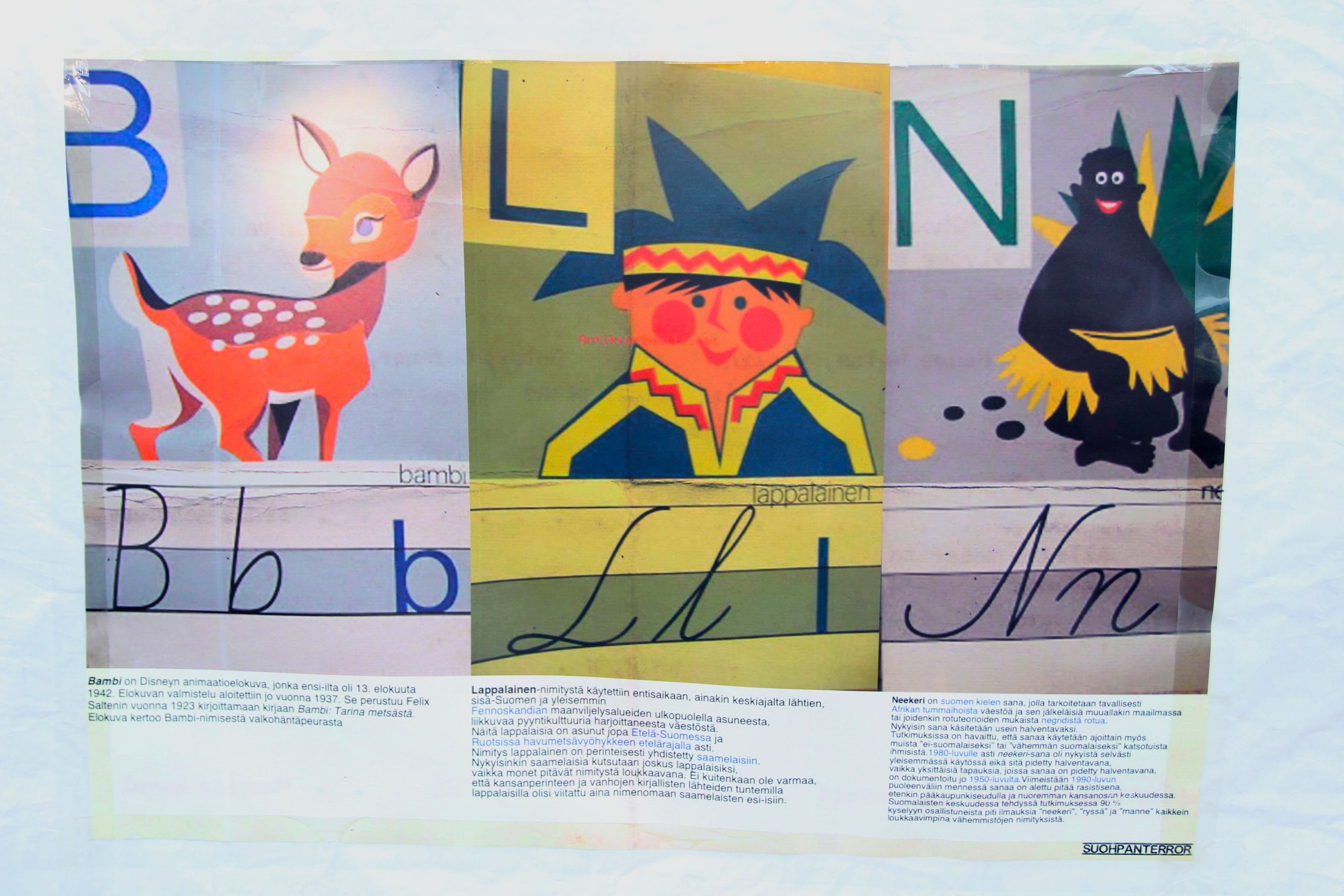
Finns learned white privilege at school from a very early age when learning the alphabet. Saamis were called “Lapps” and an example of the letter “n” was the n-word. Source: Suohpanterror

Continue reading “Defining white Finnish privilege #21: Who can be a Finn?”

Abdirahim Husu Hussein: A focused candidate with clear goals for Finland

Posted on March 29, 2015 by Migrant Tales

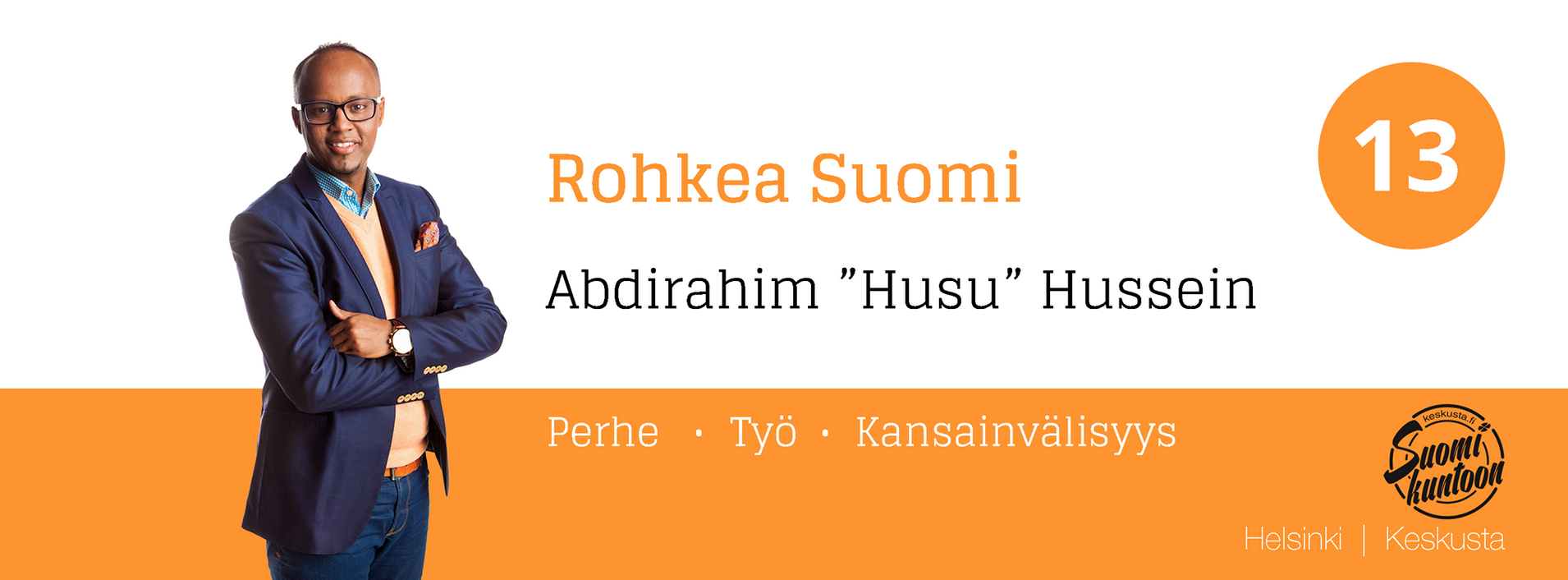
Abdirahim Husu Hussein is no stranger to Miglrant Tales. He has written a number of times for us and we have followed his political career with keen interest. “Husu” as he’s known to his friends and acquaintances is a Center Party candidate running for parliament who is focused and determined to reach his goals.

Finland holds parliamentary elections on April 19 and different polls predict the Center Party emerging as the big winner.

Contrary to some other Finnish candidates who were born elsewhere, Husu has never given up his ideals or accommodated his values to serve those in power. Finland needs people like Husu in parliament especially these days when anti-immigration rhetoric and bigotry are spreading throughout Europe and Finland.

Näyttökuva 2015-3-29 kello 18.11.43

Husu said that number 13 was his lucky number.

“I’m enjoying this campaign despite the harassment that I’ve received because I’m a Muslim and because of my ethnic background,” he said. “Considering that such people write such things shows that they must be extremely unhappy. I wish I could help and relieve their pain.”

Continue reading “Abdirahim Husu Hussein: A focused candidate with clear goals for Finland”

You can live in Finland as long as you are culturally invisible (and conform to our stereotypes)

Posted on December 21, 2014 by Migrant Tales

Perussuomalaiset (PS)* MP Vesa-Matti Saarakkala’s statement on Seinjäjoki-based daily Ilkka is another clear example of how some politicians, and even the National Board of Education, continue to deny our ever-growing cultural diversity. There is a lot of talk about “multiculturalism” and little action. This leaves us with a hostile message lingering above us: We, white Finns, will decide what cultural traditions will be kept in our schools. We call the cultural shots in this country and don’t ever forget it. 

In theory at least, Finland is a secular country. In practice it’s far from it.

The debate that took place this spring concerning the suvivirsi, or Summer Hymn, is a case in point. In a show of power and a clear message that Finland isn’t ready yet to talk about the role of cultural diversity too seriously, the National Board of Education didn’t consider the suvivirsi compromised its guidelines for religious freedom, equality and neutrality.

Some would strongly agree with the conclusions of the National Board of Education.

How could a near all-white National Board of Education have decided differently?

Näyttökuva 2014-12-21 kello 10.47.19


Read full story (in Finnish) here.


The actions and opinions of PS MP Saarakkala, among many others in the populist anti-immigration party, couldn’t be further from the truth about schools are not performing traditional Christian events like Christmas because of migrants.

The attempt by Saarakkala to shift attention on the real issue, which is how secular should our schools be, and pinning the issue on migrants and atheists is nothing more than another cheap shot by the PS.

Saarakkala belongs to that group of Finns who see cultural diversity as a threat and illness spreading in Finland. In his world, migrants would never become equal citizens but be relegated to second- and third-class members of society as the eternal hapless mamu or “person with migrant background.”

It’s clear that the prejudices of politicians like Saarakkala, and policy statements of the National Board of Education to rule in favor of one religion over others, have their days counted. Why? Because they are untenable.

The question is a simple one:

Is our educational system secular? If not, how much space should be given to different religions?

Is our society open and tolerant of cultural and ethnic diversity? If not, which groups will be excluded with our traditions?

* The Finnish name of the Finns Party is the Perussuomalaiset (PS). The names adopted by the PS, like True Finns or Finns Party, promote in our opinion nativist nationalism and xenophobia. We therefore prefer to use the Finnish name of the party on our postings. 


Michael McEachrane: Seeing Sweden’s race problem for what it is

Posted on December 17, 2014 by Migrant Tales

Michael McEachrane*

Two things seem abundantly clear regarding the rise of ultranationalism in Europe today. First, it is symptomatic of a broader form of nationalism which all European states are steeped in. Second, it is this broader nationalism that ultimately needs to be confronted if equality is ever to become a reality in Europe.

Näyttökuva 2014-12-17 kello 21.13.43

Read full story here.


Even in a country like Sweden, an ultranationalist party with roots in neo-Nazism is now the country’s third largest party. Recently, the Sweden Democrats Party demonstrated its power by voting down the government budget. As a result, early national electionswill be held in March 2015. The party has declared that it aims to bring down any government that refuses to drastically reduce immigration.

Sweden is a poignant example of the problem of nationalism in Europe today. It seems fair to say that in Sweden nationalism is not deemed a mainstream problem. Rather, it is seen as something that either belongs to the past or is an expression of extremism. The Sweden Democrats may have 13 percent of the electorate, but all other parties in parliament treat them as a national anomaly, isolated and kept at a safe distance.

It also seems fair to say that neither race nor even racism is seen as a mainstream problem in Sweden. As longtime Swedish Prime Minister Olof Palme summed it up in a Christmas speech in 1965: “Democracy is firmly rooted in this country. We respect the fundamental freedoms and rights. Murky racial theories have never found a foothold here. We like to see ourselves as open-minded and tolerant.”

Race is seen as a misguided belief, which is why it is not to be found in the country’s anti-discrimination legislation. And racism is a strong word reserved for extreme cases of prejudice and hostility. The majority, though, with good conscience can chant “No racists in our streets!”, a popular slogan in recent demonstrations against the Sweden Democrats and neo-Nazism.

The result is a compounded problem of denying the prevalence of nationalism and racism and the urgent need for political measures to eliminate them. Beyond its anti-discrimination legislation – which merely has led to a trickle of convictions – Sweden has few political measures in place against racism. Instead, the political focus tends to be on the “integration” of immigrants in the form of education, job training programmes, access to citizenship and so on.

Marginalisation and exclusion

The pressure is now increasing to heed to the politics of the Sweden Democrats and focus more on integration. What this does is ignore the social significance of a national “us” versus a foreign “them”. Like other European countries, Sweden is a nation-state with a long tradition of understanding nationhood in terms of ethnicity, race and culture. Like other ultranationalist parties across Europe, the Sweden Democrats capitalise on a growing sense of fear that this nation is under threat.

On the whole, judging from the patterns of discrimination and exclusion in European societies, it is all too clear that at the bottom of European divisions between a national “us” and a foreign “them” is race. In Sweden, traditional national minorities such as the Saami, Roma and Jews have a long history of being excluded from the Swedish nation. Today especially Saami and Roma are still highly marginalised. But like elsewhere in Europe, it is especially people of colour (the “visible minorities”, including Roma) that are most evidently discriminated against in every major area of society such as the housing and job markets.

The urban areas of Sweden are today spatially segregated along racial lines with people of colour concentrated to low-income housing projects. The country has the highest differences in employment in the West between native and foreign-born citizens and these differences are the most dramatic between ethnic Swedes and non-western born residents. People of African descent have a particularly hard time finding jobs, have the lowest educational payback in the country and are exposed to the most number of hate crimes.

To create a more inclusive society, counter such patterns and curb the rise of the Sweden Democrats, the traditional definition of the nation in terms of race and ethnicity needs to go. In addition, political measures against racism, and a consistent anti-discrimination perspective that includes race need to become mainstream.

Like the rest of Europe, Sweden prides itself in its constitutional tradition based on a “respect for the equal worth of all and the liberty and dignity of the individual”, as its constitution says.

But as the UN Working Group of Experts on People of African Descent concluded on its visit to Sweden the same week that the Sweden Democrats forced the country into early elections:

“It is our view that the Swedish philosophy of equality and its public and self-image as a country with non-discrimination and liberal democracy, blinds it to the racism faced by Afro-Swedes and Africans in its midst. No country is free of racism and Sweden is not an exception.”

Read original posting here.

This piece was reprinted by Migrant Tales with permission.

*Michael McEachrane is a member of the Swedish NGO and anti-racist collective Fight Racism Now (FRN) and the editor of Afro-Nordic Landscapes: Equality and Race in Northern Europe.

November 6, 1981: Address to the international seminar (on the plight of foreign students in Finland)

Posted on November 7, 2014 by Migrant Tales

Enrique Tessieri

Finally the consciousness of the Finnish government and the Finnish public via the press have come to the point where the status of foreigners has been recognized as a problem. The simple fact that this issue has found its way into the public consciousness shows that we’ve come a long way. We’ve made our needs known and more than anything the purpose of the seminar* is to find out and get general agreement upon where do we go from here?
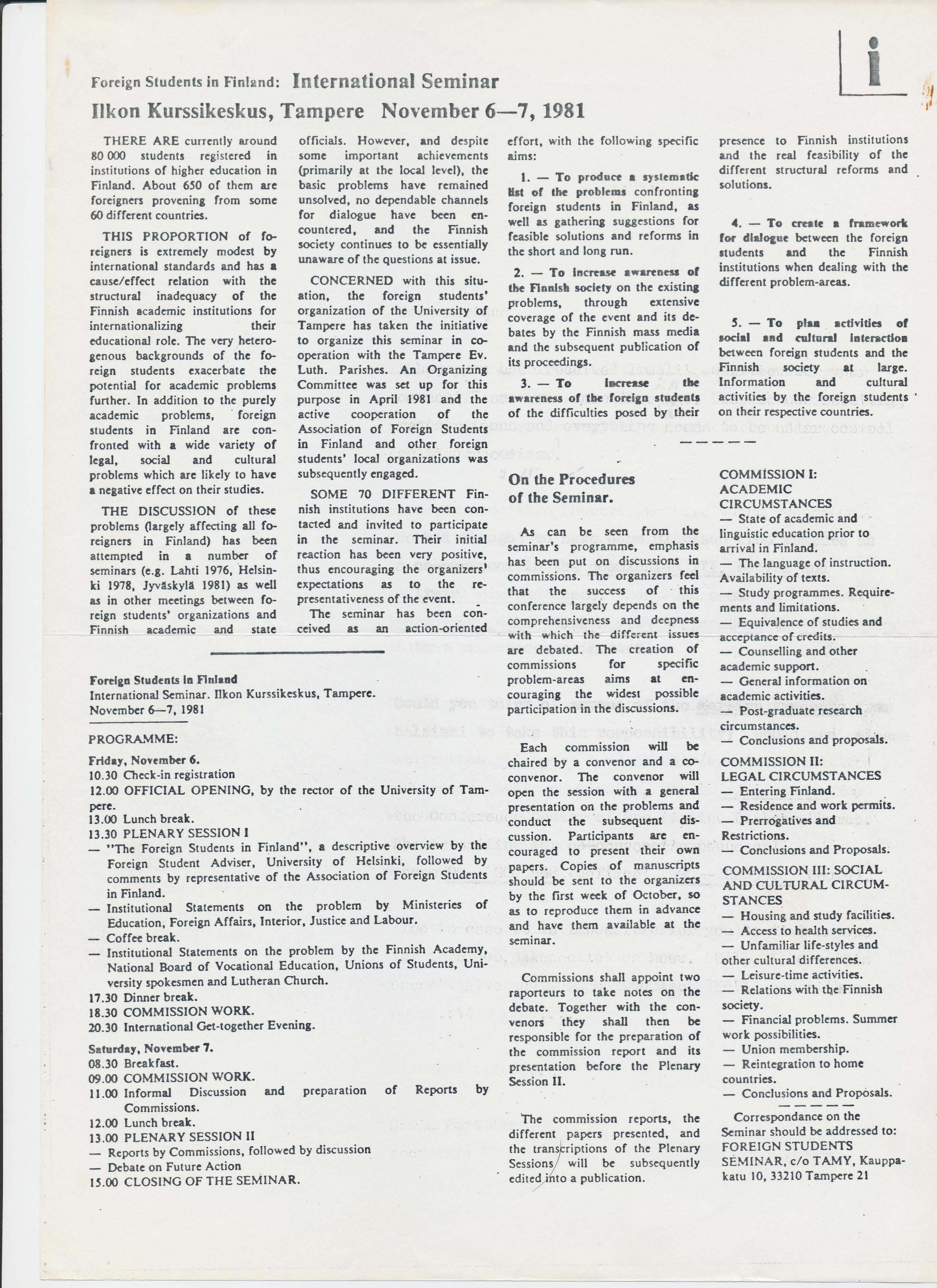
Image1-105_edited-1

Irmeli’s* presentation has given us a good basis for discussion both regarding the statistical realities of our predicament and as a first hand report from a person who has spent a good deal of time dealing with these matters over the years.

What I would like to do today is to lay some philosophical ground work for the hopefully productive discussions to follow in the course of this conference. To do this, we should start by distinguishing the kinds of foreign students in Finland. The first group are the ones with means. These are the scholarship holders, or from well-to-do families, whose intentions and aspirations as to what they shall achieve during their relatively short stay in Finland are specific. Their personal investments in university life and Finnish society at large is limited. Upon finishing their year of study or in some cases a degree program, they return to their country. This groups i the least affected by what Irmeli calls “the uncertainty factor.”

The second category includes the rest of us. The unifying feature of this group is that for some reason, no matter how tenuous that reasoning is, they continue to hang on to the notion that they’ll end up living and working here. When they start to make plans they soon realize the magnitude of “the uncertainty factor.” Money, has to be gotten by the expenditure of large amounts of energy which usually has nothing to do with their course of study.

The effort to keep family, studies, and household together should be described in terms no less than heroic. I think I don’t have to describe this subject any further since all of use here know exactly what I am talking about.

Why does all this uncertainty exist? For the second groups clearly it cannot be confined to academic categories – if you cant’ eat you can’t study. The American poet Gertrud Stein once explained that public opinion was what it was because people “love what they know,” and by large, foreign people are seen by the police, by the Office of Alien Affairs, and by that part of the population who lack the opportunity or the ability  to communicate with us, as unknowns. In short we are not loved. No matter how much we bitch or kick our heels it won’t change the situation and thus lay a foundation for the reforms we seek.

We have not come to this conference to complain to each other; we know the score. If there is an abuse of our rights or deficiency in our legal status, let’s ask ourselves what we can do about it here and what the Finnish authorities can themselves do about it.

Let’s focus our energies on the three areas we have come to discuss: our legal status, the academic set up, and our integration into this society.

LEGAL STATUS

Finland’s xenophobia is clearly reflected in her laws concerning foreigners. Proper manipulation of these laws by the authorities no doubt is connected to the underwhelming size of the foreign population of this country and probably exerts and effect on keeping the number of foreign students down. Remember Irmeli’s observation that healthy student bodies contain as much as 10% foreign population? Our population is 1/12 of that!

The first and foremost factor is the distinctly negative approach the laws has taken towards foreigners. Much of our rights are defined in terms of what we may not do. We cannot vote, we cannot participate in demonstrations, we cannot buy land, we cannot edit newspapers, we don’t even have the right to appeal upon deportation. Obviously these laws have been made to protect the citizenry of this country, but in all fairness, do foreign students represent the kind of threat to property, to national security, or the ideology of the official representatives of this country to justify blanket condemnation under the law? By and large, the foreign student population has very little influence on the financial and political fate of this nation and the laws were made with other interests in mind. The other Scandinavian countries have realized the discrepancy and have gone far to ameliorate it. This has been done by the reaction of an immigrant or permanent resident status. Uncertainly is removed because the foreigner has limited power in controlling his destiny and this is what it’s all about. Under this status a foreigner takes on the responsibilities of what could be called a quasi-citizenship; he votes locally, pays taxes, and participates in the construction of society. As far as foreign students are concerned, most of us end up being qualified for such status after a couple of years. So why doesn’t this status exist?

The second undesirable factor concerning legal status is the tremendous waste of personal talents and time. Constant reapplication for work and residence permits, as well as the limits placed on the kinds of labor we are permitted to do (generally language teaching or menial labor) prevents Finland from realizing the benefit of a fully actualized foreign population. This is based in some part on the unfair perception that without limits foreigners would deny citizens of employment but in practice it means any new avenues of creative endeavor, or said the other way, “the benefits of new blood in the system” are very effectively thwarted. Who gains by all this? As a final note, I would like to ask those preparing  proposals on changing legal status to keep those proposals positively worded.

THE ACADEMIC SET UP

Not too long ago I was told by a Finnish leader of a certain immigration organization that I could not aspire to ever hold a university post. He pointed out that since my Finnish would never be at the same level as that of a native I could never have a chance. He told me that my best bet would be to get into the restaurant hotel business since I was kind mannered and spoke languages. If this is true we might all as well switch over to the “ravintola ja hotelli opistot.” Certainly my experience with foreign teachers in the University of California leads me to believe this need not be the case. The bad news is that any foreigner who aspires to academic success must be able to communicate fluently even gracefully in Finnish and as long as a foreign student fails to rationalize this he will always remain among the academically disadvantaged.

But even assuming the foreign student makes a serious effort to learn Finnish he must still confront completely unjustified academic pretense of the educational system here. The “osta kotimaista” mentality is well rooted in Finnish academic tradition and often results in the foreign scholar’s sad realization that his is having to cope with nothing more than simple provinciality cloaked in a dress of bureaucratic paper and regulations. Against we might ask: Who is anybody gains from such attitudes?

INTEGRATION INTO FINNISH SOCIETY

What I am discussing here are really nothing more than aspects of barriers to comfortable integration into this society and perhaps we can do greatest justice to foreign students by taking a holistic approach to their problems. When foreign students can eat properly, house themselves, and possess greater power in determining their academic and economic futures, they can solve their other problems by themselves. In return for greater freedoms within this culture, foreign students should be made aware that they will also have to shoulder greater social responsibilities. Joining a club is never grounds for sustained membership, we will always have to be proving ourselves.

The foreign students who stay on, most likely will be the future leaders of the foreign community. Presently, that community numbers 10,000 (not counting our children) larger than the Lapp and gypsy minorities put together. We could say we constitute a pretty sizable minority, albeit fragmented. This minority speaks many languages, and follows many customs. But we are all unified in the extent of our exclusion from the majority culture. Until we begin to speak for ourselves, until we begin to document our history and until we assess our efforts to integrate with this society, our improved status will never be justified in the minds of the authorities or the Finnish public. This is a long-range project, but hopefully we can plant some seeds of understanding in the course of these seminars whose growth will have meaningful benefit for all of us.

Have a good conference.


*International Seminar, Ilkon Kurssikeskus (Nov. 6-7, 1981), Tampere, Finland.

* Irmeli Tammivaara-Balaam, Helsinki University foreign student advisor.

The PS of Finland: When a morally bankrupt party crosses the line

Posted on October 15, 2014 by Migrant Tales

The Tom Packalén case is not only a reminder of what Finland can expect if the Perussuomalaiset (PS)* ever get into government, there is the real threat that we are in danger of forfeiting our successful Nordic welfare state for populism, nativist nationalism and xenophobia. In the face of this threat, it is the near-silence of our society in the face of this threat is a cause for serious concern. 

Where are the moral leaders of this country? The politicians? The Media? Why is President Sauli Niinistö so quiet? And what about the church, the artists and celebrities?

How many editorials have been written by Helsingin Sanomat or other dailies about the Packalén case, where he treats a social problem like youth gangs and marginalization as the “ripening fruits” of immigration policy? That his clarion call has encouraged street patrols by neo-Nazi groups and members of his party?

Why isn’t their outrage in the media about a statement by PS MP Olli Immonen, who warned that “if officials don’t have the will or resources to protect the security of its citizens,” Suomen Sisu will take matters into its hands?

The complacency of the politicians and the media must hinge on the general perception that populism and racism are given the benefit of doubt in this country.

Not taking a stand against a politician who labels whole vulnerable groups, in this case marginalized Finns and Finnish minority youths, is the crux of the problem. The same silence we are witnessing today by the complacent media is what permitted the PS to become the third-largest party in parliament in the 2011 elections.

It’s clear that when an MP from an anti-EU, anti-immigration and homophobic party like the PS mixes immigration policy and marginalized youth you are going to have an explosive brew. The exact purpose of Packalén’s blog was just that: to arouse and fuel suspicion of Finland’s ever-growing culturally diverse society.

Näyttökuva 2014-10-15 kello 9.12.58

Despite what PS MP Tom Packalén claimed, the police said that there aren’t street gangs in Helsinki and there aren’t street gangs that are causing a crime wave. Read full story in Finnish here.

The PS is today a morally bankrupt party that has nothing to offer to Finland except for a polarized society, anti-immigration, nativist nationalistic and xenophobic rhetoric. For some white Finns this may be difficult to comprehend, but for migrants and other minorities the message is clear: the PS is a hostile and dangerous party to them.

The irony of the ongoing one-sided debate on our ever-growing cultural diversity is that the “ripening fruits” of the PS and anti-immigration sentiment are creating the problems that such parties warn us of. Social exclusion is costly to taxpayers.

Considering that about 60% of migrants live in poverty in this country speaks volumes about how we are not dealing with the issue. We are not tackling these problems because it is in the interest of parties like the PS to turn them into worse problems. It’s the way they get votes and forms part of a general scheme to keep Finland white.

Building a Finland based on social inequality, social exclusion and prejudice will end up destroying the very successful society we built after World War 2.

It took Finland about 27 years of bitter strife and devastation in the form of civil war, the rise of fascism in the 1930s and three terrible wars (Winter War, Continuation War and the Lapland War against Nazi German) to finally get it right and build a society based on our Nordic welfare state values like social equality, education and equal opportunity.

The undeclared “war” against our culturally diversity by parties like the PS resembles that Finland before 1945.

The PS is a morally bankrupt party because they have nothing to offer to this country except a ruinous recipe for failure.


* The Finnish name for the Finns Party is the Perussuomalaiset (PS). The English names of the party adopted by the PS, like True Finns or Finns Party, promote in our opinion nativist nationalism and xenophobia. We therefore prefer to use the Finnish name of the party on our postings.

How to tell a Finnish politician that he or she sounds racist

Posted on October 11, 2014 by Migrant Tales

The atmosphere for migrants and minorities in Finland is going to get worse as parliamentary elections near in April 2015. Two recent cases, Perussuomalaiset (PS)* MP Tom Packalén and National Coalition Party MP Pia Kauma, reinforce that matters are going to get worse before they improve. A good way to uncover these opportunistic politicians’ motives and statements that sound and look racist is their pattern. 

Sensible people condemn violence but what about if politicians spread suspicion and lies about migrants and minorities that are not true. As a result of their statements, which raise passions,  society and some people become hostile, even violent, towards migrants and minorities?

The only service that Packalén and Kauma have done for Finland by their lowly comments is to show us that there is a racism problem in this country and that we must find ways to deal with it. Finland has the means to put prejudice and discrimination on the defensive but does it have the will?

Politicians like Packalén and Kauma and the silence of the political parties suggest that there is very little will at present.

Näyttökuva 2014-10-11 kello 19.13.13

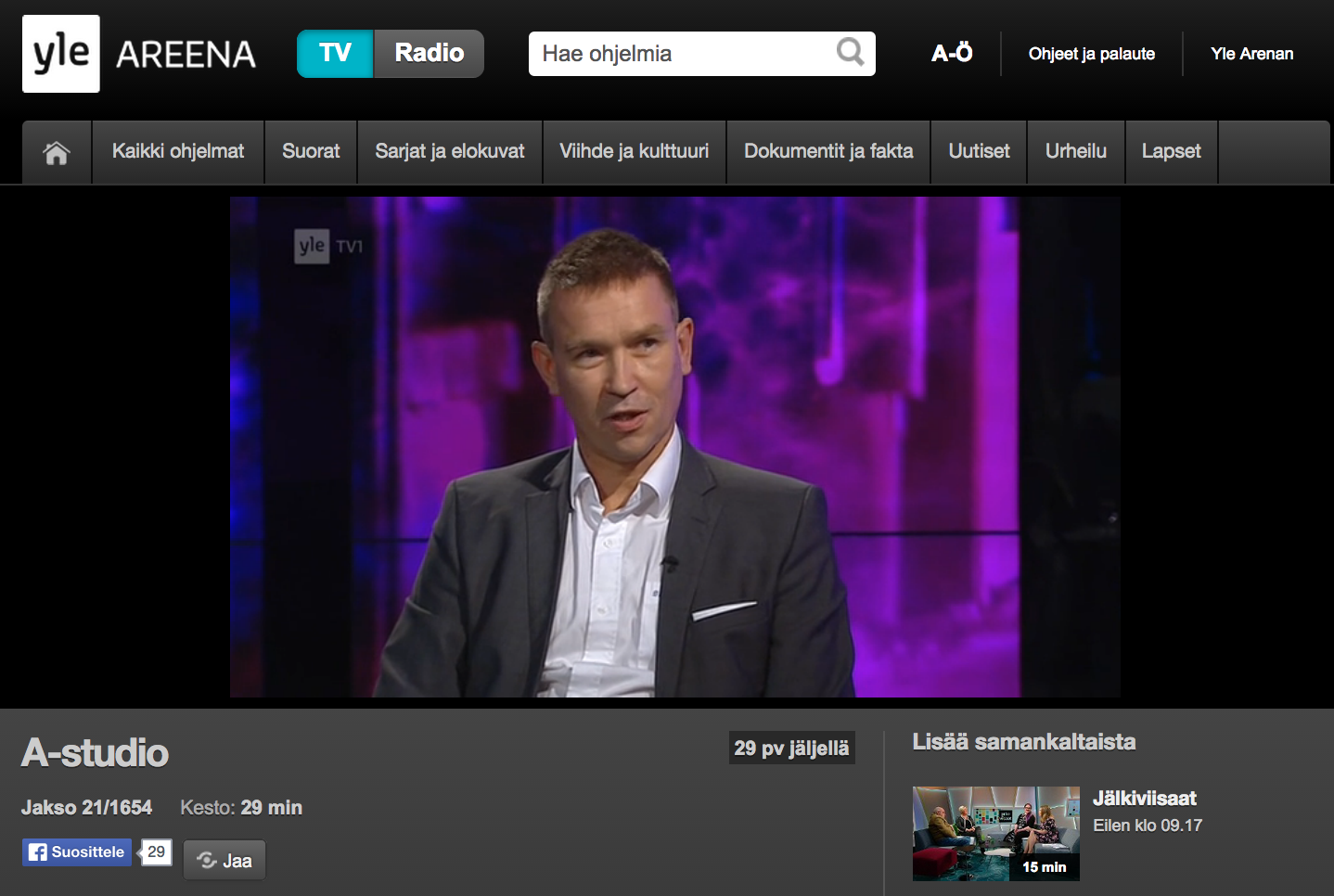
PS MP Tom Packalén on A-studio Friday with a poker smile and no facts to backup his claims. See program here.


When debating about intolerance with a person who sounds racist, the last thing you want to do is accept an invitation to discuss such a topic on his or her terms. In order to avoid such a mistake, one has to separate two matters: the person and what was said.

We don’t know if Packalén and Kauma are racists but that’s not the point. The point is what they said and wrote.

Here’s a good video by Jay Smooth on how to tell someone they sound racist below.

Is what Packalén wrote racist? Certainly it sounded pretty racist. Is he a racist? Not interested in discussing that point because that’s not the issue. It’s what he wrote.

What did he write?

He claimed that only migrant gangs are terrorizing and beating white Finns in Helsinki.  One of these victims was 10 years old child. The PS MP claimed that he had information from the police that some gang members were racist because they wanted to hurt white Finns.

Police Superintendent Tuomo Lotta flatly denies Packalén’s claims about the gang members’ racist motives.

Just like Kauma pictured Finnish mothers as responsible victims because they bought used baby carriages, Pakalén is doing the same thing by pitting migrants against white Finns.

We have found out now that these so-called migrant gangs comprise of white Finns that Packalén forgot to mention.

Kauma is another sad example. She used the same strategy as Pakclén. She made an incredible claim that migrant women buy new baby carriages with social aid while Finnish mothers buy used baby carriages.

She was never able to back up her claim and even shown by social workers that what she said just isn’t true.

Here is the pattern of how statements that sound racist are made:

  • Make an outrageous statement no matter if it is a lie;
  • Your aim is to get media attention;
  • Even if experts and the media prove what you say is wrong, stay calm and deny it;
  • Those who believe what you said because there is some conspiracy theory will love you and probably vote for you in the next elections;
  • Nothing will happen to you because everyone will eventually forget the incident.

This same method that Pakclén and Kauma used to get attention was used in England by the xenophobic National Front in the 1980s.

Enoch Powell’s “Rivers of Blood” speech is a case in point. The politician claimed in 1968, when more Commonwealth migrants were moving to the United Kingdom, that it would be a question of time when England’s rivers will end up ‘foaming with much blood.’

Those ‘rivers of blood’ he warned us of never happened but the media sure loved it.

Even if many will forget what Packalén and Kauma said, Migrant Tales won’t.

* The Finnish name for the Finns Party is the Perussuomalaiset (PS). The English names of the party adopted by the PS, like True Finns or Finns Party, promote in our opinion nativist nationalism and xenophobia. We therefore prefer to use the Finnish name of the party on our postings.

THL survey in Finland says first-generation migrants more likely to experience bullying, physical and sexual harassment

Posted on September 17, 2014 by Migrant Tales

A new survey shows that first-generation immigrants are more likely to experience bullying, physical threats and sexual harassment than white Finns, according to YLE in English, which cites the National Institute for Health and Welfare (THL).

The survey revealed some 32% of “immigrant” children found it difficult to access school welfare officers.

Should the findings of the study surprise us taking into account the negative atmosphere in this country against migrants, minorities and cultural diversity? Moreover, why is so little known about  the health and well-being of “immigrant” children and young people?

THL admitted in the statement that there has been up to know very little information about this groups of minors.

THL researcher, Anni Matikka, said that immigrants are a heterogenous group and that not all of them need help.

“However, there are young immigrants who are facing several challenges in their health and well-being, and therefore these individuals need special support,” she added.

Matikka said that families of children with “immigrant” backgrounds should have access to good information about support and student welfare services. “At the same time they could strive to increase trust in the providers of these services among immigrant background youth,” she said.


Näyttökuva 2014-9-17 kello 18.03.28

Read full story here.


While sexual harassment (unwanted intimate touching, pressure or coercion to have sex or an offer to buy sex) was common at school with one in three girls experiencing such violence or harassment and one in four in upper secondary schools, the survey showed that sexual harassment was more common among first-generation “immigrant” boys (32% experienced sexual violence) than among “immigrant” girls (28%).

It showed as well that 42% of first-generation immigrant boys had experienced physical violence in the last year compared with 33% second-generation “immigrant” boys.

While the THL survey was done in 2014, in the 1990s matters were either worse or the same.

It is a positive matter and always a step in the right direction that there is concern about the welfare of third-culture Finns at schools. Migrant Tales has written a lot about the matter.

A Somali Finn wrote on our blog that his brief honeymoon with Finland ended abruptly in the 1990s when he started elementary school. He was the school’s first and only black student. “That’s when the bullying started; I was even attacked physically by my classmates,” he said. “Something bad happened to me almost every day at school.”

Read what Ida, Abdulah and Joseph have to say about being Other in Finland here.

I remember when one of my children was harassed and insulted at a Helsinki school in the late-1980s because of ethnic background. The matter that surprised me the most was how little importance the teacher gave to the incident.

The THL survey defines first-generation immigrants as children who weren’t born in Finland and have non-Finnish parents; second generation migrants were born in Finland to non-Finnish parents. Native-born Finns are those whose parents were born in Finland.

Taking into account the definition by THL of first- or second-generation immigrants and native-born Finns, the mere definition highlights part of the problem. Are these children, irrespective if their parents were born elsewhere, “immigrants” or “Finns” with multicultural or third-culture backgrounds?

The term immigrant isn’t a country but an abstract concept. Does it promote inclusion or exclusion when used?

The label used at some Finnish school such as “children with immigrant backgrounds” promotes in my opinion “us” and “them.” Does the label, which is apparently used quite commonly at Finnish schools, promote our values of social equality or does it relegate the person to second- or third-class status?

These types of labels, which are placed by the majority culture on the minority, may shed some light on why teachers and school-welfare workers are so hard to get in touch with by “immigrant” children.

Over 180,000 children and young people in Finland took part in the survey.


Finnish anti-immigration politicians and parties spread on purpose lies to hide the truth and their culpability

Posted on September 14, 2014 by Migrant Tales

Ever wonder why the Finnish media and politicians continue to spread lies about migrants and minorities like we’re lazy, stupid, criminals, rapists and a burden on society? OK, not all of them lie on purpose but too many remain silent and allow these types of urban tales to slip past them in silent approval.

Say for example a recent urban tale by a MP from Espoo that I don’t want to mention who claims that migrants get preferential treatment from social-service officials.

IMG_5047

Poverty and social exclusion are realities that the migrant and minority community face in Finland.


What about a party* that I don’t want to mention because they base their popularity on anti-immigration rhetoric? Members of this party have gone as far as to claim that certain national groups have it in their genes to live off welfare, rob and rape.

Why do many, like the media, politicians and some of the public believe these fairy tales about migrants and minorities?

What would happen if the following was the truth:

  • The majority of migrants (about 60%) live in poverty;

  • Unemployment among migrants is on average two to three times higher than the national average;

  • Migrant youths have a greater chance of being marginalized than white Finns;

  • Migrants make 25% less money than Finns on average;

  • Migrants get less social welfare than Finns because they are usually employed in low-skilled and low-paying jobs.

The above facts are a ticking time bomb thanks to our indifference and because  some politicians and political parties would care less about migrants and minorities in this country.

Instead of addressing and challenging poverty and social exclusion, it’s clear why some don’t want you to admit the truth.

* The Finnish name for the Finns Party is the Perussuomalaiset (PS). The English names of the party adopted by the PS, like True Finns or Finns Party, promote in our opinion nativist nationalism and xenophobia. We therefore prefer to use the Finnish name of the party on our postings.

Defining white Finnish privilege #5: It’s ok to be a racist

Posted on July 1, 2014 by Migrant Tales

In many respects white privilege, or specifically white Finnish privilege, is a good way to understand some of the challenges that migrants and especially non-white Finns face in this country. Migrant Tales invites readers to share their thoughts on the social ill.

Please send your comments on the topic to [email protected]. We’d love to hear from you.

Näyttökuva 2014-7-1 kello 10.10.47

Perussuomalaiset* Espoo city councilman Teemu Lahtinen “likes” neo-Nazi Kansallinen Vastarinta, according to Paljastettu 3. This isn’t the first time PS party members have been found with their hand in the Nazi cookie jar like Ulla Pyysalo and Tuomas Okkonen. White Finnish privilege permits you to apply to or “like” neo-Nazi groups on Facebook and get away with it.

_________________

Definition #5

White Finnish privilege allows you to make racist statements and attack minorities with near-impunity. True, you might get slapped on the hand for making such racist comments, but the rewards in many cases outweigh the scorn. Since you are a white Finn, your hate speech, which you claim is being censored (if it’s “censored” how come we can read it in the national media?), can land you a profitable political career as an MP, MEP or councilman or councilwoman.

If migrants and visible minorities said the same racist things that politicians like Perussuomalaiset (PS)* MPs like Jussi Halla-aho, Olli Immonen, Teuvo Hakkarainen, Interior Minister Päivi Räsänen of the Christian Democrats,  Youth League of the National Coalition Party Chairwoman Susana Koski, Social Democratic MP Kari Rajamäki and many others did, they’d be lynched on social media and ostracized by the white Finnish media.

White Finnish privilege means that your role as a migrant and minority, which you are near-constantly reminded of, is usually that of the victim of racist insults and prejudice. White privilege encourages  you to “try harder” and “learn more Finnish” as your situation becomes ever-compromised.

* The Finnish name for the Finns Party is the Perussuomalaiset (PS). The names adopted by the PS, like True Finns or Finns Party, promote in our opinion nativist nationalism and xenophobia. We therefore prefer to use the Finnish name of the party on our postings. 

See also:

  • Defining white Finnish privilege #1: I have it and you don’t
  • Defining white Finnish privilege #2: Third culture children versus “pupil with immigrant background” 
  • Defining white Finnish privilege #3 No history, no doctrine, no heroes and no martyrs
  • Defining white Finnish privilege #4 Holding the short end of the stick

* The Finnish name for the Finns Party is the Perussuomalaiset (PS). The names adopted by the PS, like True Finns or Finns Party, promote in our opinion nativist nationalism and xenophobia. We therefore prefer to use the Finnish name of the party on our postings.

  • Previous
  • 1
  • 2
  • 3
  • 4
  • 5
  • 6
  • 7
  • 8
  • …
  • 11
  • Next
Read more about documentary film
Read more

Recent Posts

  • Finland’s tabloids Iltalehti and Ilta-Sanomat are the pits
  • Riikka Purra’s Dr Jekyll and Mr Hyde mask
  • Double standards
  • Perussuomalaiset: Uusi logo, sama vanha juttu
  • Taco Trump

Recent Comments

  1. Absolutely Socking: Racist Finnish Facebook group against human rights gets flooded with socks on Musta Barbaari’s mother and sister charged by the police in “ethnic profiling” case
  2. Ilkka Nuotio on Pekka Myrskylä: “Tilastot kertovat toista kuin poliittinen keskustelu”
  3. Genrih Soinkara on The war in Ukraine and the Russian-Finnish border crisis are showing Finland’s ugly side
  4. Ahti Tolvanen on Comment by Ahti Tolvanen on the Helsinki +50 conference
  5. Angel Barrientos on Angel Barrientos is one of the kind beacons of Finland’s Chilean community

Archives

  • June 2026
  • May 2026
  • April 2026
  • March 2026
  • February 2026
  • January 2026
  • December 2025
  • November 2025
  • October 2025
  • September 2025
  • August 2025
  • July 2025
  • June 2025
  • May 2025
  • April 2025
  • March 2025
  • February 2025
  • January 2025
  • December 2024
  • November 2024
  • October 2024
  • September 2024
  • August 2024
  • July 2024
  • June 2024
  • May 2024
  • April 2024
  • March 2024
  • February 2024
  • January 2024
  • December 2023
  • November 2023
  • October 2023
  • September 2023
  • August 2023
  • July 2023
  • June 2023
  • May 2023
  • April 2023
  • March 2023
  • February 2023
  • January 2023
  • December 2022
  • November 2022
  • October 2022
  • September 2022
  • August 2022
  • July 2022
  • June 2022
  • May 2022
  • April 2022
  • March 2022
  • February 2022
  • January 2022
  • December 2021
  • November 2021
  • October 2021
  • September 2021
  • August 2021
  • July 2021
  • June 2021
  • May 2021
  • April 2021
  • March 2021
  • February 2021
  • January 2021
  • December 2020
  • November 2020
  • October 2020
  • September 2020
  • August 2020
  • July 2020
  • June 2020
  • May 2020
  • April 2020
  • March 2020
  • February 2020
  • January 2020
  • December 2019
  • November 2019
  • October 2019
  • September 2019
  • August 2019
  • July 2019
  • June 2019
  • May 2019
  • April 2019
  • March 2019
  • February 2019
  • January 2019
  • December 2018
  • November 2018
  • October 2018
  • September 2018
  • August 2018
  • July 2018
  • June 2018
  • May 2018
  • April 2018
  • March 2018
  • February 2018
  • January 2018
  • December 2017
  • November 2017
  • October 2017
  • September 2017
  • August 2017
  • July 2017
  • June 2017
  • May 2017
  • April 2017
  • March 2017
  • February 2017
  • January 2017
  • December 2016
  • November 2016
  • October 2016
  • September 2016
  • August 2016
  • July 2016
  • June 2016
  • May 2016
  • April 2016
  • March 2016
  • February 2016
  • January 2016
  • December 2015
  • November 2015
  • October 2015
  • September 2015
  • August 2015
  • July 2015
  • June 2015
  • May 2015
  • April 2015
  • March 2015
  • February 2015
  • January 2015
  • December 2014
  • November 2014
  • October 2014
  • September 2014
  • August 2014
  • July 2014
  • June 2014
  • May 2014
  • April 2014
  • March 2014
  • February 2014
  • January 2014
  • December 2013
  • November 2013
  • October 2013
  • September 2013
  • August 2013
  • July 2013
  • June 2013
  • May 2013
  • April 2013
  • March 2013
  • February 2013
  • January 2013
  • December 2012
  • November 2012
  • October 2012
  • September 2012
  • August 2012
  • July 2012
  • June 2012
  • May 2012
  • April 2012
  • March 2012
  • February 2012
  • January 2012
  • December 2011
  • November 2011
  • October 2011
  • September 2011
  • August 2011
  • July 2011
  • June 2011
  • May 2011
  • April 2011
  • March 2011
  • February 2011
  • January 2011
  • December 2010
  • November 2010
  • October 2010
  • September 2010
  • August 2010
  • July 2010
  • June 2010
  • May 2010
  • April 2010
  • March 2010
  • February 2010
  • January 2010
  • December 2009
  • November 2009
  • October 2009
  • September 2009
  • August 2009
  • July 2009
  • December 2008
  • November 2008
  • October 2008
  • September 2008
  • August 2008
  • July 2008
  • June 2008
  • May 2008
  • April 2008
  • March 2008
  • February 2008
  • January 2008
  • November 2007
  • October 2007
  • September 2007
  • August 2007
  • July 2007
  • June 2007
  • May 2007

Categories

  • ?? Gia L?c
  • ????? ?????? ????? ???????? ?? ??????
  • ???????
  • @HerraAhmed
  • @mondepasrond
  • @nohatefinland
  • @oula_silver
  • @Varathas
  • A Pakistani family
  • äärioikeisto
  • Abbas Bahmanpour
  • Abdi Muhis
  • Abdirahim Hussein Mohamed
  • Abdirahim Husu Hussein
  • Abdirisak Mahamed
  • About Migrant Tales
  • activism
  • Adam Al-Sawad
  • Adel Abidin
  • Afrofinland
  • Ahmed IJ
  • Ahti Tolvanen
  • Aino Pennanen
  • Aisha Maniar
  • Alan Ali
  • Alan Anstead
  • Alejandro Díaz Ortiz
  • Alekey Bulavsev
  • Aleksander Hemon
  • Aleksanterinliitto
  • Aleksanterinliitto ry
  • Aleksanterinliitto ry:n hallitus
  • Alex Alex
  • Alex Mckie
  • Alexander Nix
  • Alexandra Ayse Albayrak
  • Alexis Neuberg
  • Ali Asaad Hasan Alzuhairi
  • Ali Hossein Mir Ali
  • Ali Rashid
  • Ali Sagal Abdikarim
  • Alina Tsui
  • Aline Müller
  • All categories
  • Aman Heidari
  • Amiirah Salleh-Hoddin & Jana Turk
  • Amin A. Alem
  • Amir Zuhairi
  • Amkelwa Mbekeni
  • Ana María Gutiérrez Sorainen
  • Anachoma
  • Anders Adlecreutz
  • Angeliina Koskinen
  • Anna De Mutiis
  • Anna María Gutiérrez Sorainen
  • Anna-Kaisa Kuusisto ja Jaakko Tuominen
  • Annastiina Kallius
  • Anneli Juise Friman Lindeman
  • Announcement
  • Anonymous
  • Antero Leitzinger
  • anti-black racism
  • Anti-Hate Crime Organisation Finland
  • Anudari Boldbaatar
  • Arshiya Nasser
  • Aspergers Syndrome
  • Asylum Corner
  • Asylum seeker 406
  • Athena Griffin and Joe Feagin
  • Autism
  • Avaaz.org
  • Awale Olad
  • Ayan Said Mohamed
  • AYY
  • Barachiel
  • Bashy Quraishy
  • Beatrice Kabutakapua
  • Beri Jamal
  • Beri Jamal and Enrique Tessieri
  • Bertolt Brecht
  • Boiata
  • Boodi Kabbani
  • Bruno Gronow
  • Carmen Pekkarinen
  • Çelen Oben and Sheila Riikonen
  • Chiara Costa-Virtanen
  • Chiara Costa-Virtanen
  • Chiara Sorbello
  • Christian Thibault
  • Christopher Wylie
  • Clara Dublanc
  • Dana
  • Daniel Malpica
  • Danilo Canguçu
  • David Papineau
  • David Schneider
  • Dexter He
  • Don Flynn
  • Dr Masoud Kamali
  • Dr. Faith Mkwesha
  • Dr. Theodoros Fouskas
  • Edna Chun
  • Eeva Kilpi
  • Emanuela Susheela
  • En castellano
  • ENAR
  • Enrique
  • Enrique Tessieri
  • Enrique Tessieri & Raghad Mchawh
  • Enrique Tessieri & Yahya Rouissi
  • Enrique Tessieri and Muhammed Shire
  • Enrique Tessieri and Sira Moksi
  • Enrique Tessieri and Tom Vandenbosch
  • Enrique Tessieri and Wael Che
  • Enrique Tessieri and Yahya Rouissi
  • Enrique Tessieri and Zimema Mhone
  • Epäluottamusmies
  • EU
  • Europe
  • European Islamophobia Report
  • European Islamophobia Report 2019,
  • European Union
  • Eve Kyntäjä
  • Ezequiel Caldeiro
  • Facebook
  • Fadumo Dayib
  • Faisa Kahiye
  • Farhad Manjoo
  • Fasismi
  • Finland
  • Fizza Qureshi
  • Flyktingar och asyl
  • Foreign Student
  • Fozia Mir-Ali
  • Frances Webber
  • Frida Selim
  • Gareth Rice
  • Ghyslain Vedeaux
  • Global Art Point
  • Great Replacement
  • Habiba Ali
  • Hami Bahadori
  • Hami Bahdori
  • Hamid
  • Hamid Alsaameere
  • Hamid Bahdori
  • Handshake
  • Harmit Athwal
  • Hassan Abdi Ali
  • Hassan Muhumud
  • Heikki Huttunen
  • Heikki Wilenius
  • Helsingin Sanomat
  • Henning van der Hoeven
  • Henrika Mälmsröm
  • Hser Hser
  • Hser Hser ja Mustafa Isman
  • Husein Muhammed
  • Hussain Kazemian
  • Hussain Kazmenian
  • Ibrahim Khan
  • Ida
  • Ignacio Pérez Pérez
  • Iise Ali Hassan
  • Ilari Kaila & Tuomas Kaila
  • Imam Ka
  • inside-an-airport
  • Institute of Race Relations
  • Iraqi asylum seeker
  • IRR European News Team
  • IRR News Team
  • Islamic Society of Norhern FInland
  • Islamic Society of Northern Finland
  • Islamophobia
  • Jacobinmag.com
  • Jallow Momodou
  • Jan Holmberg
  • Jane Elliott
  • Jani Mäkelä
  • Jari Luoto
  • Jari Taponen
  • Jegor Nazarov
  • Jenni Stammeier
  • Jenny Bourne
  • Jessie Daniels
  • Joe Davidow
  • Johannes Koski
  • John D. Foster
  • John Grayson
  • John Marriott
  • Jon Burnett
  • Jorma Härkönen
  • Jos Schuurmans
  • José León Toro Mejías
  • Josue Tumayine
  • Jouni Karnasaari
  • Juan Camilo
  • Jukka Eräkare
  • Julian Abagond
  • Julie Pascoet
  • Jussi Halla-aho
  • Jussi Hallla-aho
  • Jussi Jalonen
  • JusticeDemon
  • Kadar Gelle
  • Kaksoiskansalaisuus
  • Kansainvälinen Mikkeli
  • Kansainvälinen Mikkeli ry
  • Katherine Tonkiss
  • Kati Lepistö
  • Kati van der Hoeven-Lepistö
  • Katie Bell
  • Kättely
  • Kerstin Ögård
  • Keshia Fredua-Mensah & Jamie Schearer
  • Khadidiatou Sylla
  • Khadra Abdirazak Sugulle
  • Kiihotus kansanryhmää vastaan
  • Kirsi Crowley
  • Koko Hubara
  • Kristiina Toivikko
  • Kubra Amini
  • KuRI
  • La Colectiva
  • La incitación al odio
  • Laura Huhtasaari
  • Lauri Finér
  • Leif Hagert
  • Léo Custódio
  • Leo Honka
  • Leontios Christodoulou
  • Lessie Branch
  • Lex Gaudius
  • Leyes de Finlandia
  • Liikkukaa!
  • Linda Hyökki
  • Liz Fekete
  • M. Blanc
  • Maarit Snellman
  • Mahad Sheikh Musse
  • Maija Vilkkumaa
  • Malmin Kebab Pizzeria Port Arthur
  • Marcell Lorincz
  • Mari Aaltola
  • María Paz López
  • Maria Rittis Ikola
  • Maria Tjader
  • Marja-Liisa Tolvanen
  • Mark
  • Markku Heikkinen
  • Marshall Niles
  • Martin Al-Laji
  • Maryan Siyad
  • Matt Carr
  • Mauricio Farah Gebara
  • Media Monitoring Group of Finland
  • Micah J. Christian
  • Michael McEachrane
  • Michele Levoy
  • Michelle Kaila
  • Migrant Tales
  • Migrant Tales Literary
  • Migrantes News
  • Migrants' Rights Network
  • MigriLeaks
  • Mikko Kapanen
  • Miriam Attias and Camila Haavisto
  • Mohamed Adan
  • Mohammad Javid
  • Mohammad M.
  • Monikulttuurisuus
  • Monisha Bhatia and Victoria Canning
  • Mor Ndiaye
  • Muh'ed
  • Muhamed Abdimajed Murshid
  • Muhammed Shire
  • Muhammed Shire and Enrique Tessieri
  • Muhis Azizi
  • Musimenta Dansila
  • Muslimiviha
  • Musulmanes
  • Namir al-Azzawi
  • Natsismi
  • Neurodiversity
  • New Women Connectors
  • Nils Muižnieks
  • No Labels No Walls
  • Noel Dandes
  • Nuor Dawood
  • Omar Khan
  • Otavanmedia
  • Oula Silvennoinen
  • Paco Diop
  • Pakistani family
  • Pentti Stranius
  • Perussuomalaiset
  • perustuslaki
  • Petra Laiti
  • Petri Cederlöf
  • Pia Grochowski
  • Podcast-lukija Bea Bergholm
  • Pohjois – Suomen Islamilainen Yhdyskunta
  • Pohjois Suomen Islamilainen Yhyskunta
  • Polina Kopylova
  • Race Files
  • racism
  • Racism Review
  • Raghad Mchawh
  • Ranska
  • Rashid H. and Migrant Tales
  • Rasismi
  • Raul Perez
  • Rebecka Holm
  • Reem Abu-Hayyeh
  • Refugees
  • Reija Härkönen
  • Remiel
  • Reza Nasri
  • Richard Gresswell
  • Riikka Purra
  • Risto Laakkonen
  • Rita Chahda
  • Ritva Kondi
  • Robito Ibrahim
  • Roble Bashir
  • Rockhaya Sylla
  • Rodolfo Walsh
  • Roger Casale
  • Rostam Atai
  • Roxana Crisólogo Correa
  • Ruth Grove-White
  • Ruth Waweru-Folabit
  • S-worldview
  • Sadio Ali Nuur
  • Sami Rusanen
  • Sandhu Bhamra
  • Sara de Jong
  • Sarah Crowther
  • Sari Alhariri
  • Sarkawt Khalil
  • Sasu
  • Scot Nakagawa
  • Shabana Ahmadzai
  • Shada Islam
  • Sharon Chang blogs
  • Shenita Ann McLean
  • Shirlene Green Newball
  • Sini Savolainen
  • Sira Moksi
  • Sonia K.
  • Sonia Maria Koo
  • Steverp
  • Stop Deportations
  • Suldaan Said Ahmed
  • Suomen mediaseurantakollektiivi
  • Suomen Muslimifoorumi ry
  • Suomen viharikosvastainen yhdistys
  • Suomen viharikosvastainen yhdistys ry
  • Suomi
  • Supermen
  • Susannah
  • Suva
  • Syrjintä
  • Talous
  • Tapio Tuomala
  • Taw Reh
  • Teivo Teivainen
  • The Daily Show
  • The Heino
  • The Supermen
  • Thomas Elfgren
  • Thulfiqar Abdulkarim
  • Tim McGettigan
  • Tino Singh
  • Tito Moustafa Sliem
  • Tobias Hübinette and L. Janelle Dance
  • Transport
  • Trica Danielle Keaton
  • Trilce Garcia
  • Trish Pääkkönen
  • Trish Pääkkönen and Enrique Tessieri
  • Tuulia Reponen
  • Uncategorized
  • UNITED
  • University of Eastern Finland
  • Uyi Osazee
  • Väkivalta
  • Vapaa Liikkuvuus
  • Venla-Sofia Saariaho
  • Vieraskynä
  • W. Che
  • W. Che an Enrique Tessieri
  • Wael Ch.
  • Wan Wei
  • Women for Refugee Women
  • Xaan Kaafi Maxamed Xalane
  • Xassan Kaafi Maxamed Xalane
  • Xassan-Kaafi Mohamed Halane & Enrique Tessieri
  • Yahya Rouissi
  • Yasmin Yusuf
  • Yassen Ghaleb
  • Yle Puhe
  • Yuliet Tresa
  • Yve Shepherd
  • Zahra Khavari
  • Zaker
  • Zalina Ametova
  • Zamzam Ahmed Ali
  • Zeinab Amini ja Soheila Khavari
  • Zimema Mahone and Enrique Tessieri
  • Zimema Mhone
  • Zoila Forss Crespo Moreyra
  • ZT
  • Zulma Sierra
  • Zuzeeko Tegha Abeng
© 2026 Migrant tales | Powered by Minimalist Blog WordPress Theme