Migrant tales
Menu
  • #MakeRacismHistory “In Your Eyes”
  • About Migrant Tales
  • It’s all about Human Rights
  • Literary
  • Migrant Tales Media Monitoring
  • NoHateFinland.org
  • Tales from Europe
Menu

Tag: refugees

How tabloids like Ilta-Sanomat reinforce our prejudices against immigrants and refugees

Posted on July 31, 2013 by Migrant Tales

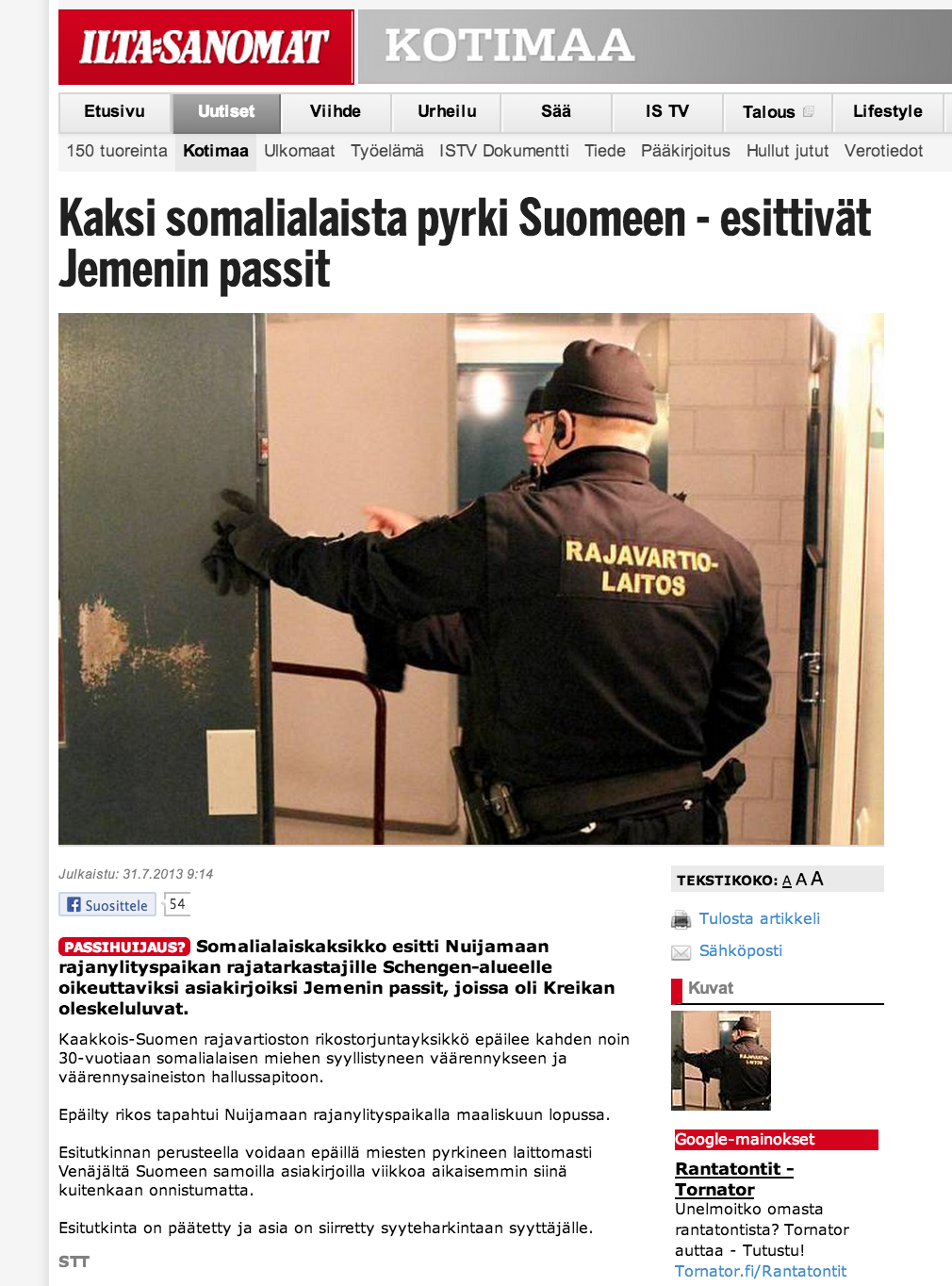
Tabloids like Ilta-Sanomat have a lot to learn about fairness, which is the cornerstone of all good news reporting. But tabloids aren’t interested in fairness but in sensationalism. A story by Ilta-Sanomat is headlined: ”Two Somalis use [fake] Yemeni passports to travel to Finland.” 

Even if the story suggests that these Somalis are committing a crime because they travel with false passports, there is much more to the case than meets the eye. If the reporters would have bothered to read a related story on 4 News in the UK, the angle of their story would have probably been different.

According to 4 News, hundreds of asylum seekers who used false passports to travel to the UK in the past ten years were abused and wrongly convicted.  As a result, the court of appeal quashed the convictions of five victims because they were denied a justifiable defense of the charge.

None of the lawyers told one of the victims like “Jonathan,” who appears on the program, any chance of defending himself. The lawyers advised Jonathan to plead guilty to the charges, which landed him a conviction and a six-month prison sentence.

Apart from having a criminal record, which worsened his chances of finding employment, he was denied for seven years the right to see his wife and child in the U.S. His conviction denied him a visa.

Go here to see the 4 News report.
Kuvankaappaus 2013-7-31 kello 15.12.24

Read full story here.

Migrant Tales has published numerous Ilta-Sanomat’s racist billboard ads from the 1990s, when Finland’s foreign population started to grow rapidly.

images (1)

Here’s a tabloid ad from 1992 where then MP Liisa Kulhia wants to put the Russian mafia and Somalis in their places.

The Finnish media reports near-constantly stories that reinforce intolerance of certain ethnic groups. But what can you expect if they don’t know better? If they don’t know better, any self-respecting reporter would get the facts right and rely as less as possible on his prejudices.

Anssi Honkanen’s and Renne Korppila’s Aamupoika radio program on NRJ, one of Finland’s most popular private radio stations, is one recent example of how hostility and intolerance of immigrants is promoted in Finland. The radio commentators claimed that there was a direct link to between crime rates/human trafficking and the Bulgarian and Romanian Roma who come to Finland to beg. 

I sent an email to the program challenging their urban tales but never got a reply from either Honkanen or Korppila never mind NRJ.

I wonder if NRJ paid any attention to an official police report in mid-July that Roma beggars aren’t victims of human trafficking or linked to organized crime?

As long as people like Honkanen and Korppila can get away with such racist statements, very little can change.

Edward Snowden would help to put to rest Finland’s Cold War legacy

Posted on July 2, 2013 by Migrant Tales

Wikileaks said in a statement that whistleblower Edward Snowden had asked for political asylum in twenty-one countries, one of which included Finland. Understanding Finland’s history and its historic suspicion of foreigners, granting a high-profile asylum seeker like Snowden asylum in Finland would not only help to put to rest for good our poor record but have an overall positive impact.  

Ever wonder why there are so few foreigners living in Finland? The answer is simple: Finland did everything possible to discourage immigrants and foreign investment to the country.

Finland had in force its first Aliens’ Act in 1983, or 65 years after independence. Before that, the Aliens’ Office was a police state where you didn’t have the right to appeal a decision.

Without any law that regulated immigration affairs in Finland, the Restricting Act of 1939 (law 219/1939) made sure that foreign companies and foreigners as well would be discouraged from coming to the country.

The Restricting Act of 1939 prohibited foreigners from owning real estate and acquiring a majority stake in Finnish companies – limiting this to 20% normally and 40% under special permission. The Act stipulated that foreigners could not own shares in sectors such as forestry, securities trading, transportation, mining, real estate and shipping.

Kuvankaappaus 2013-7-2 kello 10.00.25


Even if Finland was the first European country to give women the right to vote in 1906, it was not until 1984 when their children were granted automatic citizenship rights. Only the children of Finnish fathers were granted Finnish citizenship.

While it sounds strange, Finland adapted well and profited from its geopolitical isolation during the Cold War because it helped reinforce racist myths about Finnish ethnicity despite the fact that over 1.2 million people had emigrated from this country between 1860 and 1999.

The authorities like Finnish Security Intelligence Service (Supo) kept a close watch on immigrants.  Some of the matters that were written on my Supo-Interpol file that was accessed illegally by a person was that I was interested in human rights and organized a demonstration in 1981.

This sad legacy, which has improved from the dark days of the cold war, when Finland returned asylum seekers to the former Soviet Union with total disregard for their safety and human rights, is what still casts a shadow over our anti-immigration sentiment. The senior officials in the ministry of interior and in the Finnish Immigration Service grew up during the Cold War.

If Finns were brought up to see people who are different from them as enemies and reinforced with the help of its laws, it shouldn’t surprise us that an anti-immigration party like the Perussuomalaiset (PS) became the third larges in parliament in April 2011.

Snowden would do wonders to bolster Finland’s standing as a country that firmly stands for human rights and respects asylum seekers. It would help show how our negative attitudes and fears about immigrants and refugees are outdated.

women for refugee women: the everyday sexism project

Posted on June 25, 2013 by Migrant Tales

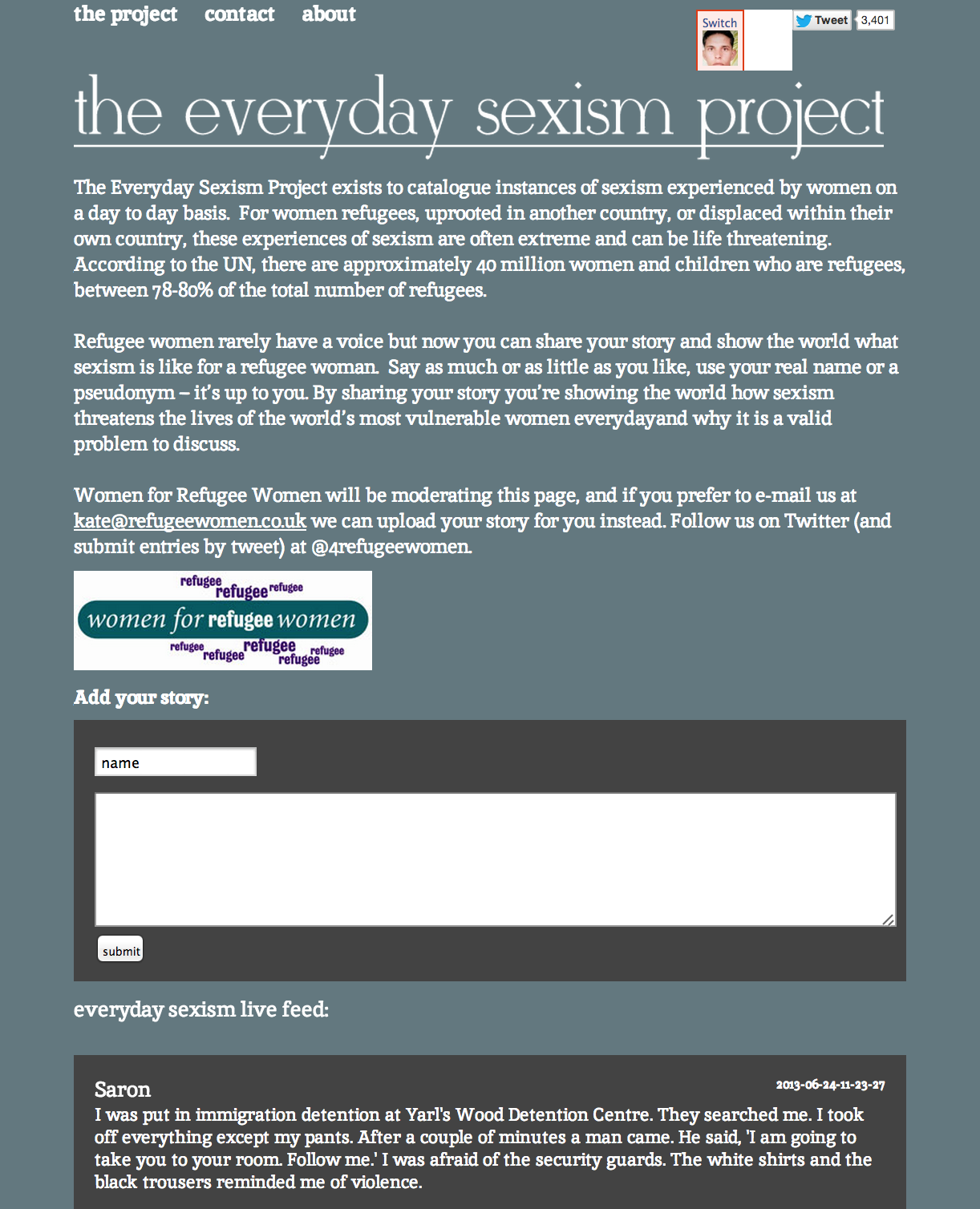
The Everyday Sexism Project exists to catalogue instances of sexism experienced by women on a day to day basis.  For women refugees, uprooted in another country, or displaced within their own country, these experiences of sexism are often extreme and can be life threatening.  According to the UN, there are approximately 40 million women and children who are refugees, between 78-80% of the total number of refugees.

Refugee women rarely have a voice but now you can share your story and show the world what sexism is like for a refugee woman.  Say as much or as little as you like, use your real name or a pseudonym – it’s up to you. By sharing your story you’re showing the world how sexism threatens the lives of the world’s most vulnerable women everydayand why it is a valid problem to discuss.

Women for Refugee Women will be moderating this page, and if you prefer to e-mail us at[email protected] we can upload your story for you instead. Follow us on Twitter (and submit entries by tweet) at @4refugeewomen.

Kuvankaappaus 2013-6-25 kello 15.45.27


Visit women for refugee women website here.

Kuvankaappaus 2013-6-25 kello 15.48.09

You can add your story too.


Zuzeeko’s blog: Ask Finland’s Minister of Interior to stop detention of innocent children

Posted on May 9, 2013 by Migrant Tales

Zuzeeko Tegha Abeng

The International Convention on the Rights of the Child – to which Finland is party – outlaws the detention of children, unless as a last resort and for the shortest possible time (see article 37[b]) and obligates States Parties to ensure that a child seeking asylum receives appropriate protection and assistance (see Article 22). Despite obligations under international law, Finland detains, as a first resort, children seeking asylum for long periods of time.

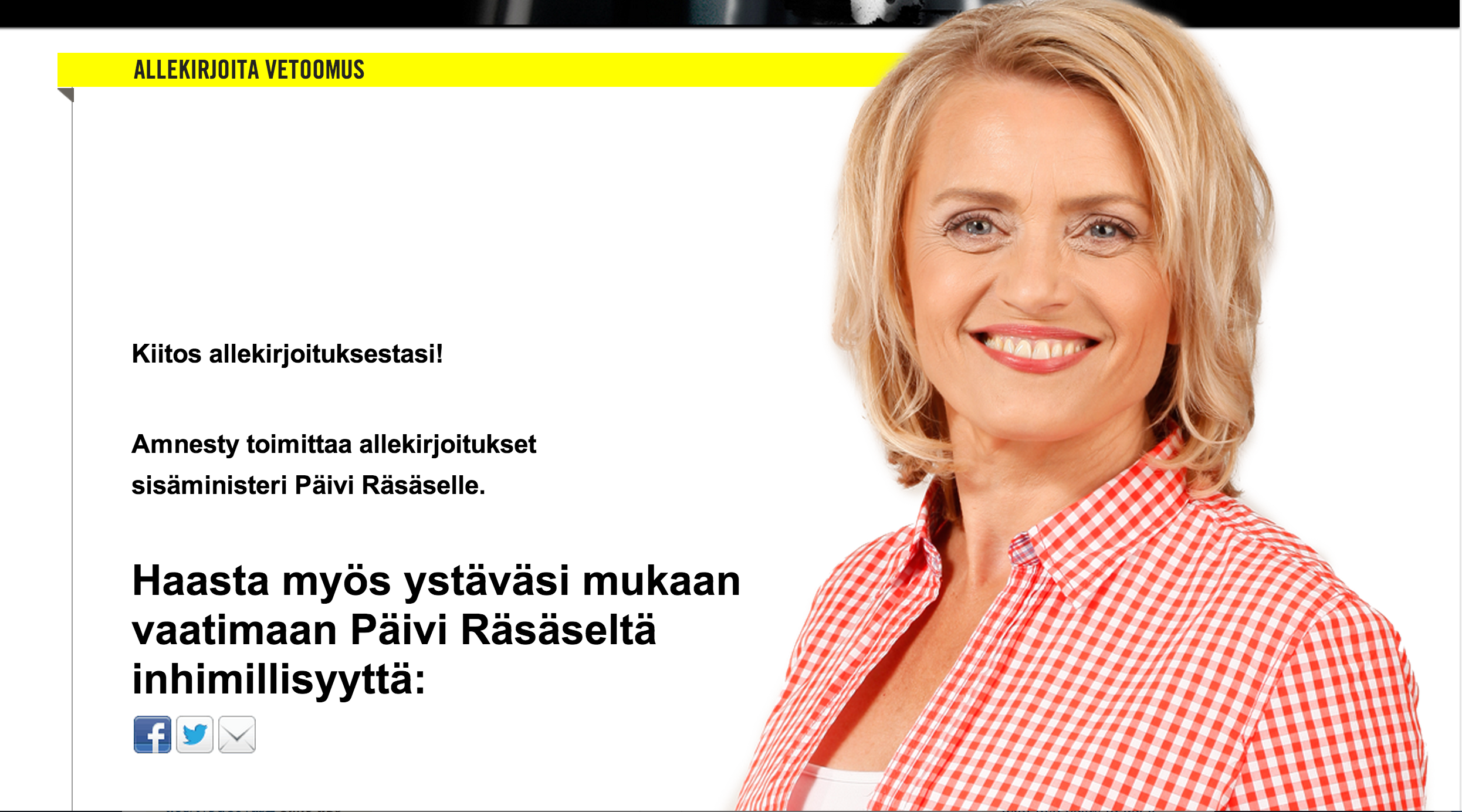
Amnesty International, Finnish section, launched a petition to stop detention of children seeking asylum in Finland.

According to Amnesty International, children should be in day care centres, schools or skateparks – not in police detention. Finland detains thousands of people yearly, including people who have fled persecution, war or poverty. They are held in prison-like conditions, although guilty of no crime.

There are children seeking asylum in Finland who live behind closed doors on a daily basis.

I have signed Amnesty International’s petition asking Minister of Interior Päivi Räsänen whether innocent children belong in police prisons. I believe children should be in homes, preschools, schools and playgrounds – not locked up.

Detention is not in the best interest of a child.

Kuvankaappaus 2013-5-10 kello 14.19.50 Kuvankaappaus 2013-5-10 kello 14.22.01
Sign the Amnesty International petition here. Finnish Interior Minister Päivi Räsänen.

Amnesty’s petition urges Minister Räsänen to:

  1. Fulfill the promise to stop detention of unaccompanied children.
  2. Immediately terminate detention of all children, expectant mothers and people traumatized by torture.
  3. Ensure that detention is used only as a last resort and for the shortest possible time. Detention places should develop less restrictive alternatives.
  4. Ensure that Finland comply with human rights obligations in detention.
Sign the petition.
According to Amnesty International, the government of Finland promised in 2011 to forbid the detention of unaccompanied children and to develop alternatives to detention. The promise was written in the government’s program, but it has not been fulfilled. Alternatives to detention have not yet been developed and children are still detained.
Amnesty International states that seeking asylum or a better life is not a crime and detained asylum seekers are not criminals.I have visited Metsälä Detention Centre, one of the facilities where asylum seekers in Finland are detained. It is located in Helsinki and I can confirm that the facility is like a prison. Children are detained there. It has one “playground” with no appropriate recreational facilities for kids.

In my view, the Metsälä facility is called a “detention centre”, but it is in fact a prison. It is no place for children, especially children who have done absolutely nothing wrong.

Read original blog entry here.

This piece was reprinted by Migrant Tales with permission.


Migrant Tales Literary with Le monde n’est pas: Around Europe by Miguel Velayos

Posted on April 1, 2013 by Migrant Tales

Comment: I came across this neat website on Twitter called Le monde n’est pas rond  (The world is not round). The website describes itself as “an international artistic newspaper, based in Luxembourg, that explores the contemporary realities of migration, borders, and human rights through the publication of articles, art and illustration, photography, prose and poetry.”

Why not pay it a visit.

See original link here.

Migrant Tales literary: How high must a wall be to contain hope?

Posted on January 27, 2013 by Migrant Tales
Dedicated to the EU and Donald Trump

By Leo Honka

No wall can contain hope.

It’s a fact but go and build your high wall

To hide the destruction you’ve reaped:

pillaging riches, pillaging hope

leaving people and whole nations

devastated, without future.

12.jpg (1024Ã?683)

Source: Westmonster.

Now we’re knocking on your door

With a sentence in the form of a key:

Let us in!

No matter how high the walls you build

so you can’t see us

you always will.

Don’t fool yourself

high walls can never contain hope – and our despair.

ELTbites: What you can and can’t say in class

Posted on November 14, 2012 by Migrant Tales

By Richard Gresswell

This blog post is kind of a follow on from the previous one inspired by the film ‘Blackboards’. Watching it again brought back memories of the many Kurdish students I’ve had the pleasure of teaching during my time as an ESOL tutor. I want to tell you a story about one of those students.

I was teaching a ‘typical’ ESOL class, a group of people bringing with them their rich cultures, languages and life experiences to the classroom but at the same time a feeling of the weight of the world’s problems resting there, and often on the shoulders of the teacher, or at least it felt that way at times. As always I was attempting to conduct a fine balancing act between allowing students to say what they wanted to, while guarding against causing offence to others.

I found it hard at times, and there were always cracks appearing all over the place with arguments breaking out here and there but nothing too worrying. I recall once saying to the class ‘we shouldn’t speak about politics’ – quite a ridiculous thing to say really, but I was at a loss with how to deal with the on-going political discussions that seemed to cause such division among the learners.

One day in class, the students were having to carry out some exam preparation with a rather banal task of ‘describe a past event in 150 words’ (yawn). No idea where these rubric writers get their ideas from – How about ‘tell me a story’ – the students had plenty of those, and were good at telling them too. Anyway the students started their writing in class and then finished it off for homework. One Kurdish student who we shall call Hamed (not real name of course) handed me his essay by hand at the beginning of the next class. I put the carefully written and presented piece of writing on the desk next to me and started class. But I was intrigued by it, the way Hamed had personally given it to me at the beginning of the lesson. So I waited impatiently for the break so I could read it.

Now this is how the story went (in my words from memory)

I will describe my past event – I remember one day. It was a terrible day. I was ten years old. We were running away. It was terrible, people were crying and dying. We were in the mountains, it was cold, very cold. We were frightened of soldiers all the time. Sometimes we stopped to have a rest. We didn’t have any food or water. Sometimes we stopped to bury people because they were dead and we buried them there. I was very sad but my life is better now. I know I shouldn’t talk about politics, I’m sorry Mr Richard.

Read original blog entry here.

This piece was reprinted by Migrant Tales with permission.

Women for Refugee Women: ‘The dream I hope and strive for’

Posted on October 4, 2012 by Migrant Tales

Helen came to the UK 9 years ago  after she was imprisoned in Ethiopia for her political activities. She claimed asylum but was refused, and looks after herself and her three children on £50 a week.

I’ve been in the UK since 2003. I have three children aged one, two and four. Things have got easier for me recently because my eldest goes to nursery just round the corner and he loves it. The past year has been very difficult because my daughter was born premature and suffers from reflux and was in hospital for eight months. My first child was also premature and also had reflux but as he get older he is able to keep much more food down, and is sick less, so I am hoping the same will be true of my daughter.

We live in North London and the hospital was two hours away, so I had a journey for four hours a day with my other two children on public transport. Sometimes my very dear friend would look after the other two so that I could go to the hospital on my own, but often I had to take them with me for the long daily journey. At the time I was living off £50 a week including travel so it was very difficult, but I felt it was very important to make sure the mother and baby have a strong bond and that my daughter should be with me every single day.  There were some premature babies on the ward that didn’t have regular visitors and it was very sad to see them crying on their own without the comfort of a mother. I think the daily journey for eight months was really worth it because after all that my daughter is a happy baby who knows her brothers and me very well.

I had to leave Ethiopia in 2003 because I was in trouble with the government.  I was young and had many ideals and protested against them. It is hard for me to remember the person I was that was brave enough to do that. I was imprisoned and many terrible things happened to me while I was in prison. My family was affected too and we still don’t know what has happened to my father. He has been missing for a long time.

My family paid a lot of money to get me out of Ethiopia because they thought that I would be killed if I stayed. I didn’t really know where I was going – just that it had been arranged that I should go somewhere safer.   When I arrived in London the man who was accompanying me took me to a café and then he said he was going to the toilet and just disappeared. I was so frightened. I didn’t know where I was and had no money and didn’t know what to do.  I felt completely lost and without anyone who cared about what happened to me.

I was taken to the Home Office in Croydon to tell them my story and a group of us had to sleep outside in a doorway waiting for it to open. When I finally got to speak to someone and she asked where I had stayed the night she didn’t believe that we had slept outside. From then on she didn’t believe much of what I said and my English wasn’t good enough at that point to be able to explain the situation I was escaping from.

I was taken to a place in Crystal Palace and then to Dover, but my case was refused. My friend let me sleep in her room and she wouldn’t let me walk by the window because I had no status and we were afraid that I would be seen and taken into detention and then sent back to Ethiopia. It was after that that I met my children’s father. He was the wrong man for me, I see that now, and we are not together any more. But many women make this mistake, and they are able to rebuild their lives after that. I am now trying to make what is called a fresh application for asylum. It is very hard to do this because to do so you must present fresh evidence, How do I prove what happened to me nearly ten years ago?

I think what is so difficult is the indecision. It really damages your confidence and I need to build a life. I want to work and contribute. I would like to be an independent person earning my own money. I am not allowed to work, but that is the dream that I strive and hope for.

I know that I have a very happy looking face, with a big smile and dimples which my kids have all inherited but inside I sometimes feel so afraid for my and the kids’ future.  Some days I feel very depressed because I don’t want us to be stuck like this in limbo.

Helen’s name has been changed. She told her story to Sophie Radice.

Read original blog entry here or visit the website.

This piece was reprinted by Migrant Tales with permission.

How much further? A film about the lives of refugees in Greece

Posted on September 14, 2012 by Migrant Tales

This documentary about refugees in Greece is a stark reminder of how Greek authorities and the European Union have turned their backs on asylum seekers and undocumented immigrants. The answer is not higher border fences or fear-mongering by politicians, but finding proactive solutions that take into account the needs and human rights of these people.

Eighty percent of the refugees that come from war-stricken areas flee to neighboring countries like Pakistan, where there are 1.7 million refugees. In the Dadaab refugee camp alone in Kenya there are a staggering 500,000  Somali refugees.

For the sake of comparison, 27 EU states have a total of 1.3 million refugees.

Traveling under a truck is one way that asylum seekers use to cross borders in Europe.

Says the European Council on Refugees and Exiles (ECRE) in a statement about the documentary, How much further:

Filmed in Athens between October 2011 and February 2012, in the midst of social, political and economic turmoil, the documentary raises the voices of those who have fled Afghanistan, Somalia or Sudan hoping to find refuge in Europe. After months or even years on the road, they arrive in Greece, a country whose population is facing the full brunt of the economic crisis and where the asylum and reception systems are completely dysfunctional. Most people see no option but to take to the road again in the hope of reaching a country that can receive them and consider their claim for asylum. But, once they have entered Greece, it is extremely difficult if not impossible to leave the country given the European policies that legally bind them to Greece.

This documentary is the fruit of the cooperation between ECRE, the Greek Forum of Refugees and the film maker Matthias Wiessler, and supported by the European Programme for Integration and Migration (EPIM).

Following the simultaneous premières in Brussels and Athens for World Refugee Day (20 June), How much further? has already been shown in two other screenings so far, at theEuropean Policy Institute and to the students of the Odysseus Network Summer School on European Law and Polciy on Immigration & Asylum.

To see documentary, How much further, click here.


Greece and its bad case of ethnic profiling and scapegoating

Posted on September 12, 2012 by Migrant Tales

The Greek Police announced that 16,836 foreign nationals were brought for questioning  during the first month that Xenios Zeus was instigated, according to the European Council on Refugees and Exiles (ECRE). A staggering 80% of those brought in for questioning were legal residents. Only 2,144 held by the police didn’t have their residence permits in order. 

Xenios Zeus, which was the ancient Greek god of hospitality, is a good example of how ineffective immigration policies and economic problems can force xenophobia to poison a society.

Sensible people understand that scapegoating immigrants for the country’s economic problems is a red herring. Greek politicians and civil servants, with the blessings of the public, are more interested in blaming defenseless immigrants and refugees  for Greece’s problems than themselves.

Whenever a person or a group scapegoats immigrants and minorities, it is a clear sign of cowardice and opportunism.

The Greek public should critically look at the country’s politicians, civil servants and financial sector and launch a “Xenios Zeus” to uproot corruption that festers in that country.

ECRE writes in a statement: ”Greek authorities claim that as a result of Xenios Zeus, the influx of illegal immigration in the area of Evros has been reduced by 84%. However, according to the newspaper ‘To Vima’, the “Xenios Zeus” operation has resulted in a dramatic increase in the smuggling tariffs for entering Greece from Turkey and leaving Greece for Italy. A few months ago, smugglers would request 2,500 to 3,000 Euro for a safe passage, while would-be migrants are now asked to pay up to 5,000 Euros.”

Groups like ECRE, Amnesty International, Human Rights Watch and the Greek Council of Refugees have criticized the massive police roundup of immigrants.


  • Previous
  • 1
  • 2
  • 3
  • 4
  • 5
  • 6
  • 7
  • Next
Read more about documentary film
Read more

Recent Posts

  • Finland’s tabloids Iltalehti and Ilta-Sanomat are the pits
  • Riikka Purra’s Dr Jekyll and Mr Hyde mask
  • Double standards
  • Perussuomalaiset: Uusi logo, sama vanha juttu
  • Taco Trump

Recent Comments

  1. Absolutely Socking: Racist Finnish Facebook group against human rights gets flooded with socks on Musta Barbaari’s mother and sister charged by the police in “ethnic profiling” case
  2. Ilkka Nuotio on Pekka Myrskylä: “Tilastot kertovat toista kuin poliittinen keskustelu”
  3. Genrih Soinkara on The war in Ukraine and the Russian-Finnish border crisis are showing Finland’s ugly side
  4. Ahti Tolvanen on Comment by Ahti Tolvanen on the Helsinki +50 conference
  5. Angel Barrientos on Angel Barrientos is one of the kind beacons of Finland’s Chilean community

Archives

  • June 2026
  • May 2026
  • April 2026
  • March 2026
  • February 2026
  • January 2026
  • December 2025
  • November 2025
  • October 2025
  • September 2025
  • August 2025
  • July 2025
  • June 2025
  • May 2025
  • April 2025
  • March 2025
  • February 2025
  • January 2025
  • December 2024
  • November 2024
  • October 2024
  • September 2024
  • August 2024
  • July 2024
  • June 2024
  • May 2024
  • April 2024
  • March 2024
  • February 2024
  • January 2024
  • December 2023
  • November 2023
  • October 2023
  • September 2023
  • August 2023
  • July 2023
  • June 2023
  • May 2023
  • April 2023
  • March 2023
  • February 2023
  • January 2023
  • December 2022
  • November 2022
  • October 2022
  • September 2022
  • August 2022
  • July 2022
  • June 2022
  • May 2022
  • April 2022
  • March 2022
  • February 2022
  • January 2022
  • December 2021
  • November 2021
  • October 2021
  • September 2021
  • August 2021
  • July 2021
  • June 2021
  • May 2021
  • April 2021
  • March 2021
  • February 2021
  • January 2021
  • December 2020
  • November 2020
  • October 2020
  • September 2020
  • August 2020
  • July 2020
  • June 2020
  • May 2020
  • April 2020
  • March 2020
  • February 2020
  • January 2020
  • December 2019
  • November 2019
  • October 2019
  • September 2019
  • August 2019
  • July 2019
  • June 2019
  • May 2019
  • April 2019
  • March 2019
  • February 2019
  • January 2019
  • December 2018
  • November 2018
  • October 2018
  • September 2018
  • August 2018
  • July 2018
  • June 2018
  • May 2018
  • April 2018
  • March 2018
  • February 2018
  • January 2018
  • December 2017
  • November 2017
  • October 2017
  • September 2017
  • August 2017
  • July 2017
  • June 2017
  • May 2017
  • April 2017
  • March 2017
  • February 2017
  • January 2017
  • December 2016
  • November 2016
  • October 2016
  • September 2016
  • August 2016
  • July 2016
  • June 2016
  • May 2016
  • April 2016
  • March 2016
  • February 2016
  • January 2016
  • December 2015
  • November 2015
  • October 2015
  • September 2015
  • August 2015
  • July 2015
  • June 2015
  • May 2015
  • April 2015
  • March 2015
  • February 2015
  • January 2015
  • December 2014
  • November 2014
  • October 2014
  • September 2014
  • August 2014
  • July 2014
  • June 2014
  • May 2014
  • April 2014
  • March 2014
  • February 2014
  • January 2014
  • December 2013
  • November 2013
  • October 2013
  • September 2013
  • August 2013
  • July 2013
  • June 2013
  • May 2013
  • April 2013
  • March 2013
  • February 2013
  • January 2013
  • December 2012
  • November 2012
  • October 2012
  • September 2012
  • August 2012
  • July 2012
  • June 2012
  • May 2012
  • April 2012
  • March 2012
  • February 2012
  • January 2012
  • December 2011
  • November 2011
  • October 2011
  • September 2011
  • August 2011
  • July 2011
  • June 2011
  • May 2011
  • April 2011
  • March 2011
  • February 2011
  • January 2011
  • December 2010
  • November 2010
  • October 2010
  • September 2010
  • August 2010
  • July 2010
  • June 2010
  • May 2010
  • April 2010
  • March 2010
  • February 2010
  • January 2010
  • December 2009
  • November 2009
  • October 2009
  • September 2009
  • August 2009
  • July 2009
  • December 2008
  • November 2008
  • October 2008
  • September 2008
  • August 2008
  • July 2008
  • June 2008
  • May 2008
  • April 2008
  • March 2008
  • February 2008
  • January 2008
  • November 2007
  • October 2007
  • September 2007
  • August 2007
  • July 2007
  • June 2007
  • May 2007

Categories

  • ?? Gia L?c
  • ????? ?????? ????? ???????? ?? ??????
  • ???????
  • @HerraAhmed
  • @mondepasrond
  • @nohatefinland
  • @oula_silver
  • @Varathas
  • A Pakistani family
  • äärioikeisto
  • Abbas Bahmanpour
  • Abdi Muhis
  • Abdirahim Hussein Mohamed
  • Abdirahim Husu Hussein
  • Abdirisak Mahamed
  • About Migrant Tales
  • activism
  • Adam Al-Sawad
  • Adel Abidin
  • Afrofinland
  • Ahmed IJ
  • Ahti Tolvanen
  • Aino Pennanen
  • Aisha Maniar
  • Alan Ali
  • Alan Anstead
  • Alejandro Díaz Ortiz
  • Alekey Bulavsev
  • Aleksander Hemon
  • Aleksanterinliitto
  • Aleksanterinliitto ry
  • Aleksanterinliitto ry:n hallitus
  • Alex Alex
  • Alex Mckie
  • Alexander Nix
  • Alexandra Ayse Albayrak
  • Alexis Neuberg
  • Ali Asaad Hasan Alzuhairi
  • Ali Hossein Mir Ali
  • Ali Rashid
  • Ali Sagal Abdikarim
  • Alina Tsui
  • Aline Müller
  • All categories
  • Aman Heidari
  • Amiirah Salleh-Hoddin & Jana Turk
  • Amin A. Alem
  • Amir Zuhairi
  • Amkelwa Mbekeni
  • Ana María Gutiérrez Sorainen
  • Anachoma
  • Anders Adlecreutz
  • Angeliina Koskinen
  • Anna De Mutiis
  • Anna María Gutiérrez Sorainen
  • Anna-Kaisa Kuusisto ja Jaakko Tuominen
  • Annastiina Kallius
  • Anneli Juise Friman Lindeman
  • Announcement
  • Anonymous
  • Antero Leitzinger
  • anti-black racism
  • Anti-Hate Crime Organisation Finland
  • Anudari Boldbaatar
  • Arshiya Nasser
  • Aspergers Syndrome
  • Asylum Corner
  • Asylum seeker 406
  • Athena Griffin and Joe Feagin
  • Autism
  • Avaaz.org
  • Awale Olad
  • Ayan Said Mohamed
  • AYY
  • Barachiel
  • Bashy Quraishy
  • Beatrice Kabutakapua
  • Beri Jamal
  • Beri Jamal and Enrique Tessieri
  • Bertolt Brecht
  • Boiata
  • Boodi Kabbani
  • Bruno Gronow
  • Carmen Pekkarinen
  • Çelen Oben and Sheila Riikonen
  • Chiara Costa-Virtanen
  • Chiara Costa-Virtanen
  • Chiara Sorbello
  • Christian Thibault
  • Christopher Wylie
  • Clara Dublanc
  • Dana
  • Daniel Malpica
  • Danilo Canguçu
  • David Papineau
  • David Schneider
  • Dexter He
  • Don Flynn
  • Dr Masoud Kamali
  • Dr. Faith Mkwesha
  • Dr. Theodoros Fouskas
  • Edna Chun
  • Eeva Kilpi
  • Emanuela Susheela
  • En castellano
  • ENAR
  • Enrique
  • Enrique Tessieri
  • Enrique Tessieri & Raghad Mchawh
  • Enrique Tessieri & Yahya Rouissi
  • Enrique Tessieri and Muhammed Shire
  • Enrique Tessieri and Sira Moksi
  • Enrique Tessieri and Tom Vandenbosch
  • Enrique Tessieri and Wael Che
  • Enrique Tessieri and Yahya Rouissi
  • Enrique Tessieri and Zimema Mhone
  • Epäluottamusmies
  • EU
  • Europe
  • European Islamophobia Report
  • European Islamophobia Report 2019,
  • European Union
  • Eve Kyntäjä
  • Ezequiel Caldeiro
  • Facebook
  • Fadumo Dayib
  • Faisa Kahiye
  • Farhad Manjoo
  • Fasismi
  • Finland
  • Fizza Qureshi
  • Flyktingar och asyl
  • Foreign Student
  • Fozia Mir-Ali
  • Frances Webber
  • Frida Selim
  • Gareth Rice
  • Ghyslain Vedeaux
  • Global Art Point
  • Great Replacement
  • Habiba Ali
  • Hami Bahadori
  • Hami Bahdori
  • Hamid
  • Hamid Alsaameere
  • Hamid Bahdori
  • Handshake
  • Harmit Athwal
  • Hassan Abdi Ali
  • Hassan Muhumud
  • Heikki Huttunen
  • Heikki Wilenius
  • Helsingin Sanomat
  • Henning van der Hoeven
  • Henrika Mälmsröm
  • Hser Hser
  • Hser Hser ja Mustafa Isman
  • Husein Muhammed
  • Hussain Kazemian
  • Hussain Kazmenian
  • Ibrahim Khan
  • Ida
  • Ignacio Pérez Pérez
  • Iise Ali Hassan
  • Ilari Kaila & Tuomas Kaila
  • Imam Ka
  • inside-an-airport
  • Institute of Race Relations
  • Iraqi asylum seeker
  • IRR European News Team
  • IRR News Team
  • Islamic Society of Norhern FInland
  • Islamic Society of Northern Finland
  • Islamophobia
  • Jacobinmag.com
  • Jallow Momodou
  • Jan Holmberg
  • Jane Elliott
  • Jani Mäkelä
  • Jari Luoto
  • Jari Taponen
  • Jegor Nazarov
  • Jenni Stammeier
  • Jenny Bourne
  • Jessie Daniels
  • Joe Davidow
  • Johannes Koski
  • John D. Foster
  • John Grayson
  • John Marriott
  • Jon Burnett
  • Jorma Härkönen
  • Jos Schuurmans
  • José León Toro Mejías
  • Josue Tumayine
  • Jouni Karnasaari
  • Juan Camilo
  • Jukka Eräkare
  • Julian Abagond
  • Julie Pascoet
  • Jussi Halla-aho
  • Jussi Hallla-aho
  • Jussi Jalonen
  • JusticeDemon
  • Kadar Gelle
  • Kaksoiskansalaisuus
  • Kansainvälinen Mikkeli
  • Kansainvälinen Mikkeli ry
  • Katherine Tonkiss
  • Kati Lepistö
  • Kati van der Hoeven-Lepistö
  • Katie Bell
  • Kättely
  • Kerstin Ögård
  • Keshia Fredua-Mensah & Jamie Schearer
  • Khadidiatou Sylla
  • Khadra Abdirazak Sugulle
  • Kiihotus kansanryhmää vastaan
  • Kirsi Crowley
  • Koko Hubara
  • Kristiina Toivikko
  • Kubra Amini
  • KuRI
  • La Colectiva
  • La incitación al odio
  • Laura Huhtasaari
  • Lauri Finér
  • Leif Hagert
  • Léo Custódio
  • Leo Honka
  • Leontios Christodoulou
  • Lessie Branch
  • Lex Gaudius
  • Leyes de Finlandia
  • Liikkukaa!
  • Linda Hyökki
  • Liz Fekete
  • M. Blanc
  • Maarit Snellman
  • Mahad Sheikh Musse
  • Maija Vilkkumaa
  • Malmin Kebab Pizzeria Port Arthur
  • Marcell Lorincz
  • Mari Aaltola
  • María Paz López
  • Maria Rittis Ikola
  • Maria Tjader
  • Marja-Liisa Tolvanen
  • Mark
  • Markku Heikkinen
  • Marshall Niles
  • Martin Al-Laji
  • Maryan Siyad
  • Matt Carr
  • Mauricio Farah Gebara
  • Media Monitoring Group of Finland
  • Micah J. Christian
  • Michael McEachrane
  • Michele Levoy
  • Michelle Kaila
  • Migrant Tales
  • Migrant Tales Literary
  • Migrantes News
  • Migrants' Rights Network
  • MigriLeaks
  • Mikko Kapanen
  • Miriam Attias and Camila Haavisto
  • Mohamed Adan
  • Mohammad Javid
  • Mohammad M.
  • Monikulttuurisuus
  • Monisha Bhatia and Victoria Canning
  • Mor Ndiaye
  • Muh'ed
  • Muhamed Abdimajed Murshid
  • Muhammed Shire
  • Muhammed Shire and Enrique Tessieri
  • Muhis Azizi
  • Musimenta Dansila
  • Muslimiviha
  • Musulmanes
  • Namir al-Azzawi
  • Natsismi
  • Neurodiversity
  • New Women Connectors
  • Nils Muižnieks
  • No Labels No Walls
  • Noel Dandes
  • Nuor Dawood
  • Omar Khan
  • Otavanmedia
  • Oula Silvennoinen
  • Paco Diop
  • Pakistani family
  • Pentti Stranius
  • Perussuomalaiset
  • perustuslaki
  • Petra Laiti
  • Petri Cederlöf
  • Pia Grochowski
  • Podcast-lukija Bea Bergholm
  • Pohjois – Suomen Islamilainen Yhdyskunta
  • Pohjois Suomen Islamilainen Yhyskunta
  • Polina Kopylova
  • Race Files
  • racism
  • Racism Review
  • Raghad Mchawh
  • Ranska
  • Rashid H. and Migrant Tales
  • Rasismi
  • Raul Perez
  • Rebecka Holm
  • Reem Abu-Hayyeh
  • Refugees
  • Reija Härkönen
  • Remiel
  • Reza Nasri
  • Richard Gresswell
  • Riikka Purra
  • Risto Laakkonen
  • Rita Chahda
  • Ritva Kondi
  • Robito Ibrahim
  • Roble Bashir
  • Rockhaya Sylla
  • Rodolfo Walsh
  • Roger Casale
  • Rostam Atai
  • Roxana Crisólogo Correa
  • Ruth Grove-White
  • Ruth Waweru-Folabit
  • S-worldview
  • Sadio Ali Nuur
  • Sami Rusanen
  • Sandhu Bhamra
  • Sara de Jong
  • Sarah Crowther
  • Sari Alhariri
  • Sarkawt Khalil
  • Sasu
  • Scot Nakagawa
  • Shabana Ahmadzai
  • Shada Islam
  • Sharon Chang blogs
  • Shenita Ann McLean
  • Shirlene Green Newball
  • Sini Savolainen
  • Sira Moksi
  • Sonia K.
  • Sonia Maria Koo
  • Steverp
  • Stop Deportations
  • Suldaan Said Ahmed
  • Suomen mediaseurantakollektiivi
  • Suomen Muslimifoorumi ry
  • Suomen viharikosvastainen yhdistys
  • Suomen viharikosvastainen yhdistys ry
  • Suomi
  • Supermen
  • Susannah
  • Suva
  • Syrjintä
  • Talous
  • Tapio Tuomala
  • Taw Reh
  • Teivo Teivainen
  • The Daily Show
  • The Heino
  • The Supermen
  • Thomas Elfgren
  • Thulfiqar Abdulkarim
  • Tim McGettigan
  • Tino Singh
  • Tito Moustafa Sliem
  • Tobias Hübinette and L. Janelle Dance
  • Transport
  • Trica Danielle Keaton
  • Trilce Garcia
  • Trish Pääkkönen
  • Trish Pääkkönen and Enrique Tessieri
  • Tuulia Reponen
  • Uncategorized
  • UNITED
  • University of Eastern Finland
  • Uyi Osazee
  • Väkivalta
  • Vapaa Liikkuvuus
  • Venla-Sofia Saariaho
  • Vieraskynä
  • W. Che
  • W. Che an Enrique Tessieri
  • Wael Ch.
  • Wan Wei
  • Women for Refugee Women
  • Xaan Kaafi Maxamed Xalane
  • Xassan Kaafi Maxamed Xalane
  • Xassan-Kaafi Mohamed Halane & Enrique Tessieri
  • Yahya Rouissi
  • Yasmin Yusuf
  • Yassen Ghaleb
  • Yle Puhe
  • Yuliet Tresa
  • Yve Shepherd
  • Zahra Khavari
  • Zaker
  • Zalina Ametova
  • Zamzam Ahmed Ali
  • Zeinab Amini ja Soheila Khavari
  • Zimema Mahone and Enrique Tessieri
  • Zimema Mhone
  • Zoila Forss Crespo Moreyra
  • ZT
  • Zulma Sierra
  • Zuzeeko Tegha Abeng
© 2026 Migrant tales | Powered by Minimalist Blog WordPress Theme