Migrant tales
Menu
  • #MakeRacismHistory “In Your Eyes”
  • About Migrant Tales
  • It’s all about Human Rights
  • Literary
  • Migrant Tales Media Monitoring
  • NoHateFinland.org
  • Tales from Europe
Menu

Tag: refugees

Timo Soini’s latest comment about refugees leaves many speechless but exposes him to the raw

Posted on April 25, 2014 by Migrant Tales

Sometimes politicians make incredible statements that leave you speechless. The latest one I heard was Thursday on a MEP election television debate on YLE Fem, the Swedish-language television channel.

Said Perussuomalaiset (PS) chairman Timo Soini: “Is it morally right to leave one’s homeland during ever-difficult times or should one stay put and fight for justice? Would it have been right to leave the country when Finland was at war? Fighting for the fatherland was the right decision.”

If we look at Nigel Farage of the Ukip, who is Soini’s close ideological ally and who is ratcheting up anti-immigration and anti-EU sentiment to lure voters in the United Kingdom on May 25, there’s very little difference between both politicians. The only difference is the cultural and national context. If Farage lived in Finland he’d speak like Soini and vice versa.

Näyttökuva 2014-4-25 kello 9.29.37

Read full story (in Finnish) here.

To understand what Soini said on YLE Fem, we should turn briefly our attention to Syria and ask refugees there why they’re fleeing to refugee camps.

Soini’s knowledge of history is blurred as well. How many Finns left this country after the 1918 Civil War? Why did so many Reds move to the United States and Canada?

Why did my great grandfather, Dante Tessieri, an anarchist, leave Italy in the 1890s after he was accused of being part of a suspected assassination plot against Humbert I

Soini’s shows the conservative populist politician for what he is: A greedy and opportunistic politician who would care less for the suffering of others, including his own countrymen.

Workshop highlights perceptions, problems and challenges of immigration in Greece

Posted on March 4, 2014 by Migrant Tales

Workshops that debate and challenge immigration issues in economically hard-hit countries like Greece are never too many. One of these took place on Friday at the University of Peloponnese and was organized by the Scientific Association of Young Political Scientists.
Kuvankaappaus 2014-3-4 kello 1.33.31

According to a statement:

The issue of immigration has become a major national issue and is treated as such by Greek immigration policy. Due to its geographical position, Greece has become the most accessible initial stopover – otherwise known as the “gateway to the European Union” – for international immigration and refugees flows, whose final destination is West or North European countries; and due to the magnitude of the problem, it is regarded as not a Greek, but a European one which demands a European solution.

One of the biggest challenges of immigration management is that it is now one of the top priorities for both Greece and the EU, according to Dr. Theodoros Fouskas, who was responsible for the workshop’s scientific organization. He is a sociologist and lecturer of the Department of Humanities and Social Sciences, New York College (NYC).

Greece. “Since Greece deals with 90% of illegal immigration flows to the EU, European aid, assistance and solidarity are imperative,” he said. “But after twenty-five years of huge illegal migration flows, what should be taken into account are the international ramifications that the migratory phenomenon has caused in the 21st century.”

Dr. Fouskas focused his talk on the impact of international labor migration, especially low-status work by Nigerian migrants,* who are the object of his latest research. Low-wage Nigerian migrants in Greece are mainly employed in the service industry, which include manual labor jobs, farming, construction, crafts, housework, cleaning services, prostitution and others.

“What is currently observed is a mobile, temporary workforce, which is occupied in casual, non-permanent, low-prestige jobs,” he said. “[Nigerian] immigrants of both genders are exposed to all forms of exploitation, to flexible working ours and unsettled, low-level and unstable lifestyle.”
greeceworkshop

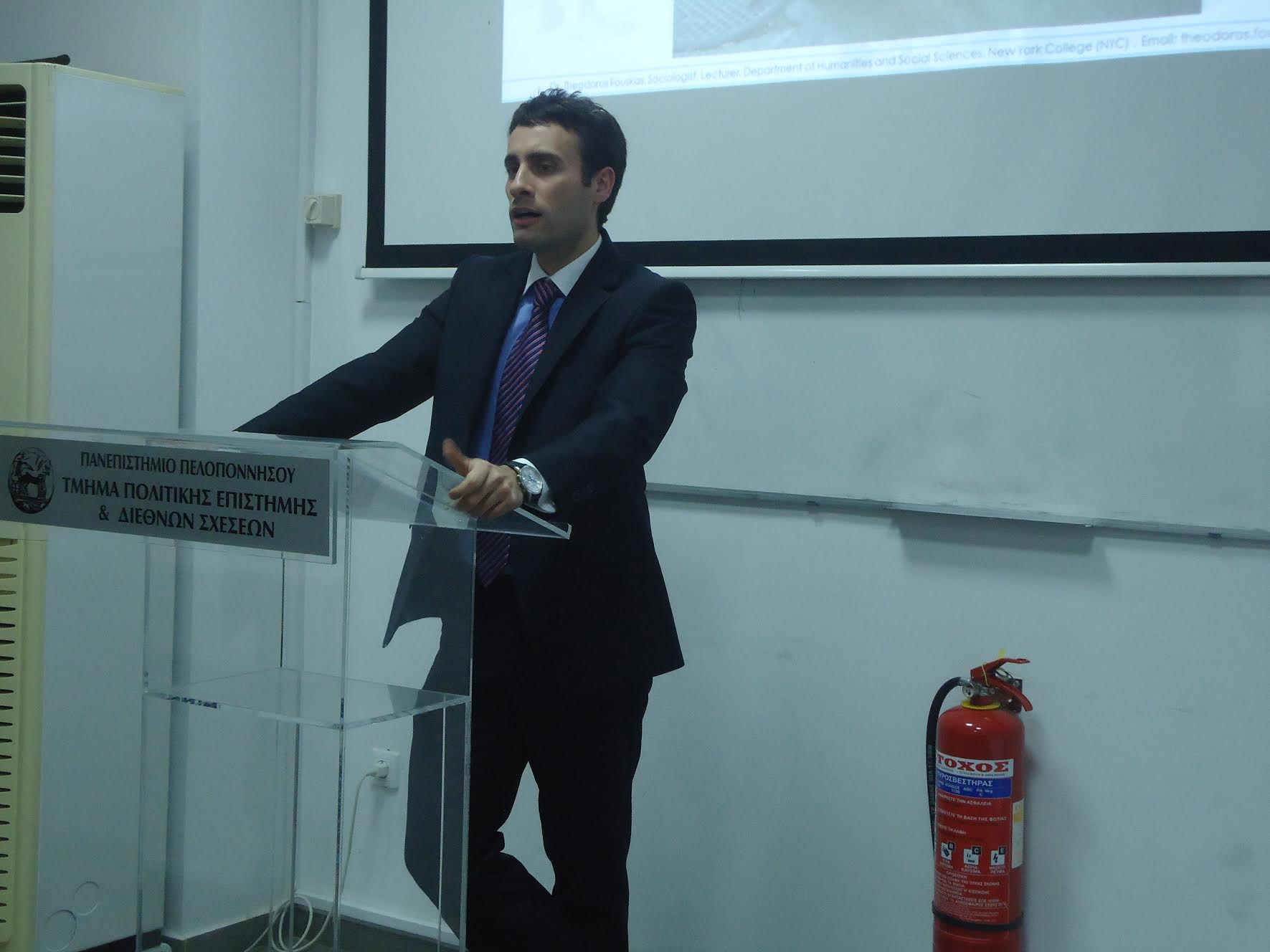
Dr Theodoros Fouskas speaking at the workshop on perceptions, problems and challenges of immigration in Greece.

According to Dr Fouskas, the life of low-wage immigrants in Greece is more than challenging under the present circumstances.

“They are disconnected, detached from the past, with no memory of collectivization or personal efforts and claims,” he said. “Nigerian immigrants’ work is characterized by exhausting working hours, exceptionally low wages, appalling working conditions, non-permanent employment with frequent employer changes, no National Health benefits, unstable residence status, fear of arrest and deportation…”

Other speakers that took part in the workshop were Pantelis Sklias, Symeon Sidiropoulos, George Hilal, Panagiota Theodosi, Konstantinos Kazanas and Jamil M. Sayed.

* Fouskas, Theodoros (201-) Nigerian Immigrants in Greece: Low-Status Work, Community, and Decollectivization, Research Monograph under contract, and Fouskas, Theodoros (2014) “‘Community’ found or lost in the city? The consequences of low-status work on association participation of Nigerian immigrant workers in Athens”, in: Fouskas, Theodoros and Vassileios, Tsevrenis (2014) (Eds.), Contemporary Immigration in Greece: A Sourcebook. Athens: European Public Law Organization (EPLO) (forthcoming 2014). Foudkas, Theodoros (2013) “Los-Status Work Consequences on Immigrant Workers’ Organization”, International Review of Sociology, Volume 23, Issue 3, 2013 pp. 671-698.

Interior Minister Päivi Räsänen is on the anti-immigration warpath again

Posted on February 2, 2014 by Migrant Tales

Anti-immigration and anti-gay hardliner Christian Democrat interior minister, Päivi Räsänen, said on YLE in English that she’s in favor of tightening immigration policy further by closing a “loophole” for asylum seekers. Under the present law, those asylum seekers whose application has been turned down, can get temporary residence for two years before acquiring a permanent residence permit. 

While we’re speaking of a “huge” number of asylum seekers – about 200 in all – it’s these types of laws that not only reveal our suspicion of asylum seekers and migrants in general, but ensures that skilled migrants will not move to Finland in significant numbers.

And why would they? Migrants want to move to countries where other migrants live – not some cold place that is unsure about its ever-growing cultural diversity and where too many politicians treat refugees like “welfare shoppers.”

What’s wrong if a person wants to move from a country where he has no future to one where there’s opportunity? Isn’t that what over 1.2 million Finnish emigrants did between 1860 and 1999? Can you punish somebody for seeking a better future?

In order for Finland to begin accepting its ever-growing cultural diversity, it has to revisit its history and ask why during most of the last century until 1995, when Finland became an EU member, did it do everything possible to hinder migrants and foreign investment to the country.

Kuvankaappaus 2014-2-2 kello 10.26.28

Read full story here.

Räsänen’s get-tough stand on a handful of asylum seekers isn’t surprising since it’s the same policy and attitude that many politicians have about refugees, migrants and our ever-growing cultural diversity.  It’s a good example of the usual overkill by them.

According to YLE in English, the change in the law would affect asylum seekers especially from Afghanistan, Iraq and Somalia, which are ravaged by war.

“A person that does not voluntarily leave to a country seen as safe gets a temporary residence permit, that after two years becomes a permanent residence permit,” Räsänen was quoted as saying on Yle in English. “We propose that the law is changed so that temporary residence permits are no longer granted on that basis.”

Some human rights associations believe that the new law will encourage asylum seekers to become undocumented migrants.

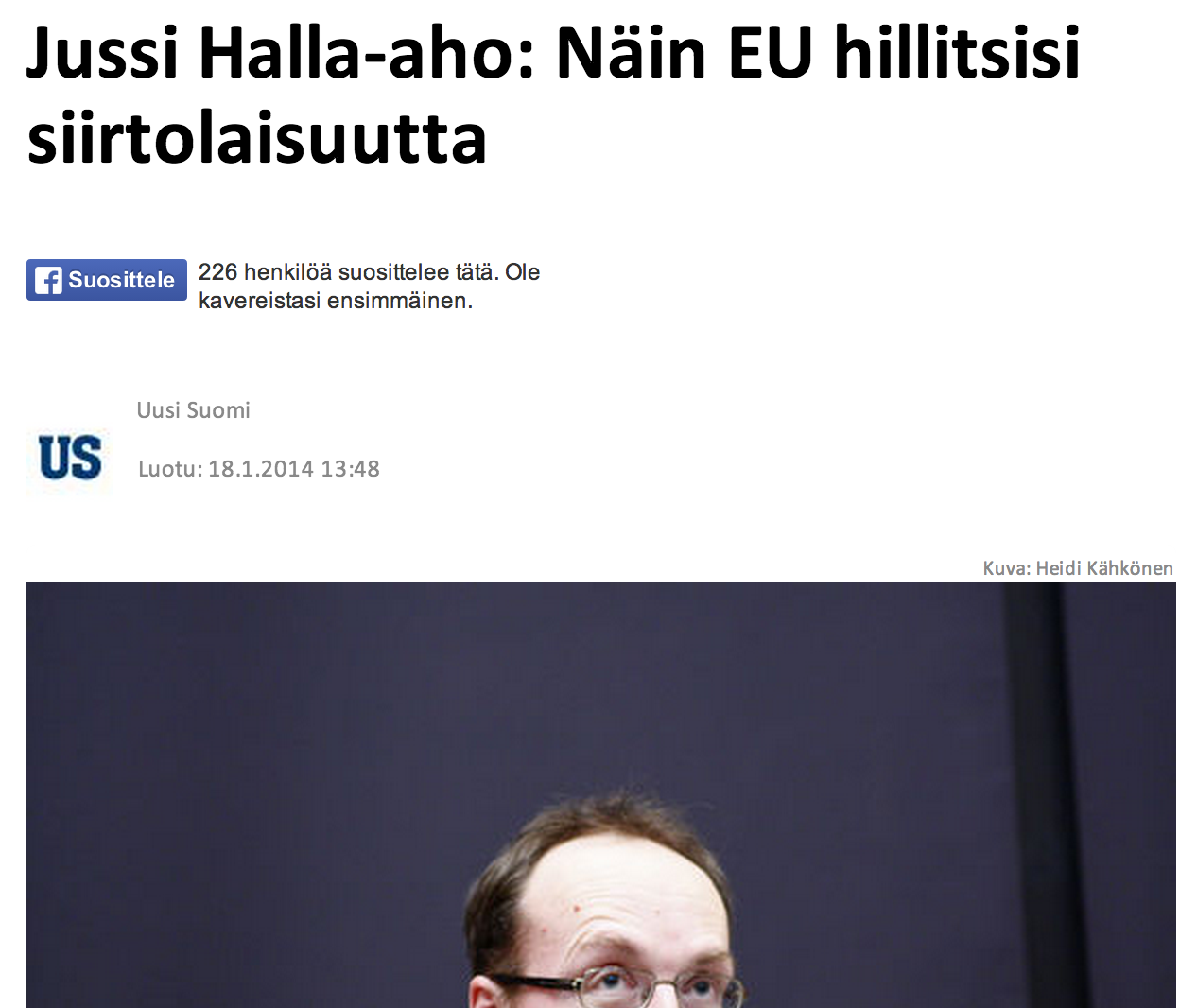
PS MP Jussi Halla-aho doesn’t like cultural diversity, never mind Africans and Muslims

Posted on January 19, 2014 by Migrant Tales

I’m not going to expend a lot of energy on analyzing what Perussuomaliset (PS) MP Jussi Halla-aho wrote in a recent blog entry. All of what he writes about migrants, especially refugees, is demeaning and negative. One sentence in particular, however, caught my attention and which exposes the anti-immigration politician to a tee. 

Kuvankaappaus 2014-1-19 kello 23.28.18

Read full story (in Finnish) here.

Halla-aho, who was sentenced for ethnic agitation, makes a special effort to stress in his blog entry that the measures he’d like to propose to control migration flows to Europe aren’t intended to keep Europe “white” but in the best interests of the countries concerned.

The PS MP’s first deception is exposed when he uses the term migration as opposed to refugee flows. He uses the former as opposed to the latter term because he believes that most Africans, Middle Easterners and Muslims aren’t real refugees but “welfare shoppers.”

If you’ve read Halla-aho and his ilk, their whole argument is based on criticizing immigration policy, which, according to them, allows too many refugees to move to Europe. Now who are those refugees? They are the Africans, Middle Easterners and Muslims that politicians like him loathe.

Rule number one of journalism: Denial is usually what a politician really thinks or feels insecure about.

A good example of the latter would be a politician like Halla-aho who goes out of his way to claim that he has nothing against cultural diversity or a homophobe who denies he’s against gays.

We’ve heard these types of statements so many times before, especially from anti-immigration politicians.

Bank accounts for the stateless – money laundering legislation is not an excuse for financial exclusion

Posted on November 16, 2013 by Mark

This post follows on from a recent post by Enrique on continued practices of financial exclusion in relation to individuals who have had difficulties establishing their identification with Finnish authorities and have subsequently had problems opening bank accounts. It is also a response to one commentator’s fallacious claim that money laundering legislation is an adequate justification for such financial exclusion.

From what I understand of the EU legislation (Directive 2001/97/EC [FI:,EN:]) that covers this issue of money laundering, the banks are allowed as part of their due diligence to establish the identity of the entity involved and to also establish the purpose and nature of the ‘business relationship’. This involves obtaining supportive evidence, and does not specifically establish what these documents must be, thus giving some freedom to institutions to establish their own practices.

This, my friend Enrique, is probably the key reason that different banks are applying different practices. Also, imprisonment and fine are typical penalties attached to these regulations in member states, though I don’t know the specifics of Finland. This may be another reason for the inflexibility of some banking institutions.

However, in applying those practices, it’s worth exploring the EU Directive in more detail to see exactly who and what this Directive is aimed against:

The further stipulations of the legislation are particularly informative:

1) It sets out in part 2 of Article 3 a benchmark requirement on identification also on the transfer of funds of €15 000 or more.
2) It then goes on to point out that institutions can, where there is doubt about whether the account is being used on their own behalf, take reasonable measures to ascertain the real identity of those on whom they are acting.
3) It goes on to state (part 11) that Member States can take measures deemed necessary to establish the identity of persons particularly when not present face-to-face. The Directive specifically mentions the implications for ‘online commerce’ involved in this part.

So, the issue of money laundering typically involves larger sums of money that would normally be irrelevant to processing social security payments or even salaries. It also establishes that non-face-to-face transactions and those involving individuals working on behalf of other individuals (i.e. lawyers, accountants) as being the key target of the Directive. I.e. stateless persons (inter alia refugees) are nowhere mentioned as a particular ‘target group’ for these money laundering requirements, PS Voter, and of course, why would they be?

“The other key issue here is that this objective of minimising possibilities for money laundering also have to be balanced against the need to avoid financial exclusion!”

This is where interpretation of these requirements would of course allow individuals whose circumstances make ID incomplete to acquire basic banking services.

Guidance on this matter for banking institutions in the UK is provided by the Joint Money Laundering Steering Group (JMLSG). It is worth reproducing here some the key elements of this guidance in summary:

Access to basic banking facilities and other financial services is a necessary requirement for most adults. It is important therefore that the socially/financially disadvantaged should not be precluded from opening accounts or obtaining other financial services merely because they do not possess evidence of their identity in circumstances where they cannot reasonably be expected to do so. Internal procedures must allow for such instances and must provide appropriate advice to staff on how identity can be confirmed under these exceptional circumstances and what local checks can be made.

M3.1.5G states that the exceptions to guard against financial exclusion aim to help relevant firms ensure that where people cannot reasonably be expected to produce detailed evidence of identity, they are not denied access to financial services. Although a relevant firm must always take reasonable steps to check who its client is, relevant firms will sometimes be approached by clients who are at a disadvantage, or who otherwise cannot reasonably be expected to produce detailed evidence that helps to confirm identity. Examples could be where a person does not have a passport or driving licence, or whose name does not appear on utility bills.

ML 3.1.6G states that where a relevant firm has reasonable grounds to conclude that an individual client is not able to produce the detailed evidence of his or her identity and cannot reasonably be expected to do so, the relevant firm may accept as identification evidence a letter or statement from a person in a position of responsibility who knows the client, that tends to show that the client is who s/he says s/he is, and to confirm his/her permanent address if s/he has one.

4.110. ML 3.1.7G provides that examples of persons in a position of responsibility who know the client include solicitors, doctors, ministers of religion, teachers, hostel managers and social workers.

4.111. The list is not exhaustive and other examples might include, for example, district nurses or midwives who have visited the client in their homes, care home managers, prison governors, probation officers, police officers and civil servants, Members of Parliament, members of the Scottish Parliament or the Northern Ireland Assembly, a Justice of the Peace, a local or county councillor, or the staff in the registry of a higher education or further education institution

I’m sure there should be similar guidance available to Finnish banking institutions from a relevant central government agency dealing with money laundering? If not, then why not? Financial exclusion is not a priority or issue for the Finnish government?

In the UK, the advice also goes further in stating that a bank branch will typically have a ‘money laundering reporting officer’, whose responsibility it is to oversee these policies at branch level, and that a direct meeting with this individual in problematic cases will more easily lead to a solution, as they can make decisions in regard to ‘non-standard’ cases.

It should now be quite clear to you PS Voter that this issue of ‘money laundering’ cannot be offered as an excuse for continuing an inflexible practice of financial exclusion!

Strict banking laws in Finland leave refugees without bank accounts and discourage foreign investment

Posted on November 15, 2013 by Migrant Tales

Stateless refugees cannot still open bank accounts in regions like Etelä-Savo in Eastern Finland, according to Länsi-Savo, a Mikkeli-based daily. Not only are stateless persons affected but different municipalities that want to attract foreign investment. Some small- and medium-sized companies that want to relocate in Finland from Russia have a difficult time opening bank account as well. 

Migrant Tales understands that there is no standard procedure for opening a bank account in Finland for stateless persons, who cannot confirm their original identity. Some branch offices not only permit stateless persons to open bank accounts but have access to online banking.

According to Länsi-Savo, opening a bank account in Mikkeli has become more difficult, if not impossible.

If a stateless person cannot open a bank account, it effectively means that he or she cannot be paid assistance by the state. In order to avoid such a problem, municipalities like Mikkeli cannot accept refugees from Syria, according to a municipal employee who works with refugees.

The most outrageous aspect of this policy is that there aren’t any standard rule but instead allows bank to treat people on a one-to-one basis. Some stateless refugees in cities like Kouvola and Tampere haven’t had problems in opening bank accounts and even getting online banking services.

Last year I encountered this problem head on when I went to Nordea bank in Mikkeli with a stateless person.  After a few questions, the bank employee said that the person needs a valid passport to open an account at that bank. But if on that passport it reads ”his/her identity cannot be confirmed,” the person can never open an account at Nordea.

I asked the Nordea employee what could be done.

“Why don’t you go to OP bank,” she said. “I’ve read in Länsi-Savo [the local paper] that such persons can open accounts at that bank.”

Surprised by what I was hearing, I asked the bank employee if she was serious.

“Why do they [OP bank] have one set of rules and you have another?” I asked. “Don’t you think it is pretty incredible that you are sending a potential client to the competition?”

The bank employee didn’t answer my question.

Let’s say that the person is lucky and is able to open a bank account but cannot get online banking services. That’s how Finns did their banking over two decades ago. They stood in lines and asked the bank teller to pay their bills.

Even in getting banking services, some immigrants are second-class members of this society.

See also:

  • DNA, Saunalahti, IF, Nordea: “Backward-looking” rules and laws mirror Finland’s anti-foreign sentiment
  • The National Discrimination Tribunal of Finland fines Nordea for discrimination
  • Ombudsman for Minorities responds to Migrant Tales’ queries concerning phone operators and insurance companies
  • Some Finnish banks require Somalis to be Finnish citizens to have access to online banking

Migrant Tales (March 13, 2012): Stateless persons do not have the right to open a bank account in Finland

Posted on November 15, 2013 by Migrant Tales

Here is a pretty odd case that I encountered Monday (March 12) when I went to Nordea bank in Mikkeli to open an account for a stateless person.  After a few questions, the bank employee said that the person needs a valid passport to open an account at that bank. But if on that passport it reads ”his/her identity cannot be confirmed,” the person can never open an account at Nordea.

I asked the Nordea employee what could be done.

“Why don’t you go to OP bank,” she said. “I’ve read in Länsi-Savo [the local paper] that such persons can open accounts at that bank.”

Surprised by what I was hearing, I asked the bank employee if she was serious.

“Why do they [OP bank] have one set of rules and you have another?” I asked. “Don’t you think it is pretty incredible that you are sending a potential client to the competition?”

When I asked JusticeDemon about what happened, he said that there is a clear administrative problem over what counts as proof of identity and over the  implementation of the 1954 Convention relating to the Status of Stateless Persons (Accession by Finland on 10 October 1968).

One point of that Convention is Article 27 (Identity papers), which states, “The Contracting States shall issue identity papers to any stateless person in their territory who does not possess a valid travel document.”

According to the Ombudsman for Minorities, an identity card issued by the police should count as valid identification just like a passport.

Some believe that the decision by the banks to not allow a stateless person to open a bank account as arbitrary.

There is not much a person from a war-torn country can do if he or she is stateless. Who’s to blame? The refugee? The failed state? The bank(s)? Or authorities regulating the bank sector?

Whatever the case, it sure isn’t the fault of the stateless person.

See also:

  • DNA, Saunalahti, IF, Nordea: “Backward-looking” rules and laws mirror Finland’s anti-foreign sentiment
  • The National Discrimination Tribunal of Finland fines Nordea for discrimination
  • Ombudsman for Minorities responds to Migrant Tales’ queries concerning phone operators and insurance companies
  • Some Finnish banks require Somalis to be Finnish citizens to have access to online banking

Migrants’ Rights Network: Another tragedy in Lampedusa, one too many

Posted on October 10, 2013 by Migrant Tales

Clara Dublanc*

clara_web_0


The migrant boat disaster off Lampedusa has highlighted the struggle of Southern EU members to deal with migrant flows. It is time that Europe steps up and accepts shared responsibilities for the external borders of the Union.

Last Thursday 3rd October, the small Italian island of Lampedusa witnessed one of its most tragic days. A vessel, carrying an approximate number of 500 Eritrean, Somalian and Ghanian migrants sank after catching fire, leaving hundreds of deaths.

At the moment of writing the number rises to 110 dead and 159 survivors, leaving approximately 200 dispersed. Divers have started searching underwater trying to recover the rest of the corpses. Lampedusa, which is 70 kilometers away from the the Libyan shores, is one of the main ports of entry for thousands of migrants traveling from the  African continent.

As the tragedy unfolds, we hear Italian politicians from all parties giving their opinions, condolences and speeches. Italy has declared a day of mourning and Italian’s president Giorgio Napolitano has called for the EU to accept that this is an European tragedy and not only an Italian one. Voices have raised about putting a stop to the continued tragedies that see much too often hundreds of victims dying in their traverse from North African to European shores.

Some of the proposals have been to provide more founding for Frontex to cooperate with Lybia in the implementation of more efficient immigration checks in Libya, stopping the migration flow before they embark on the sea travel. Under the Dublin Regulation, the responsibility of migrants falls under the single member state where the migrant arrives. Italy argues that given the extent of its shores, this needs to be considered as a European responsibility and not only national one.

Some of Italian left wing politicians have raised their voices to condemn the last immigration reform, that passed under the last Berlusconi government. The Bossi-Fini law, which takes the the names of the two ministers from the last Berlusconi alliance government that drafted it, provides greater powers to the Italian Navy to block the entry to Italian waters to migrants boats crossing the Mediterranean when they are still in international waters.

Furthermore, the law was successively modified to include a a criminality clause to anyone who aids clandestine migrants to enter the country. This applies also to fishermen and commercial boats that lend a hand to migrants vessels in need of help. This clause has been challenged several times on human rights basis. In 2007,  four Tunisian fishermen that aided a sinking ship with 44 survivors and brought them to Italian shores, were accused of aiding illegal migration.

Although they were absolved, the process lasted 4 years. Since then, fishermen have been afraid of helping sinking boats under the threat of being criminally accused. Actually, it seems that on Thursday there were some fishermen that saw the vessel on fire but were too afraid to help.

According to Fortress Europe, since 2011 there are approximately 6 migrants that die everyday in the crossing of the Mediterranean.

It is time that the Italian immigration law undergoes an urgent review to abolish clauses that push single individuals to violate human rights. Furthermore, it is time that Europe accepts shared responsibilities on the external borders of the Union.

Read original story here.

This piece was reprinted by Migrant Tales with permission.

* Clara Dublanc is a postgraduate in International Relations from the University of Bologna, with an academic background in migration policies, integration and belonging. She currently works as business developer, launching start-ups and enterprises to support local development.


Saving one life, one refugee from Syria, IS important

Posted on September 27, 2013 by Migrant Tales

Arguing that accepting a few hundred refugees from Syria is not important because it is a drop in the bucket, is an outrageous statement made by Jussi Halla-aho, Vesa-Matti Saarakkala and others. The other point they are trying to drive home, that these people will be a burden on Finland, exposes their loathing and ignorance.

How many refugees can you name in history that fled to other countries and became model members of their new home countries? One of these was Albert Einstein, who fled Nazi Germany, a racist regime that rose to power by scapegoating minorities like Jews.

The argument, that refugees are a burden, is an insult to all the refugees of the world. Only an extreme egoist, who lacks feelings for the suffering of others, can make such a point.

These types of intolerant arguments are the same as those made constantly by anti-immigration and far-right politicians to drive home their point.

If you dissect their arguments, they are nothing more than typical anti-immigration sound bites spread with the help of the Finnish media, which gives them inflated respectability and importance.

Using such arguments to influence refugee and immigration policy, we could similarly ask why did Raoul Wallenberg or Oscar Schindler save tens of thousands of Jews if millions were murdered in Nazi concentration camps?

Stating that saving lives is futile because there are so many and makes no difference is similar to a racist trying to convince you that it is useless to oppose intolerance because nothing can be done.

If you accept that ludicrous argument, you have lost the war.

Saving one person is valuable and important.

If you disagree, why not ask the victims fleeing war and death.

How Syrian refugees fleeing war show how the Finnish media gives (again) racists inflated respectability and importance

Posted on September 19, 2013 by Migrant Tales

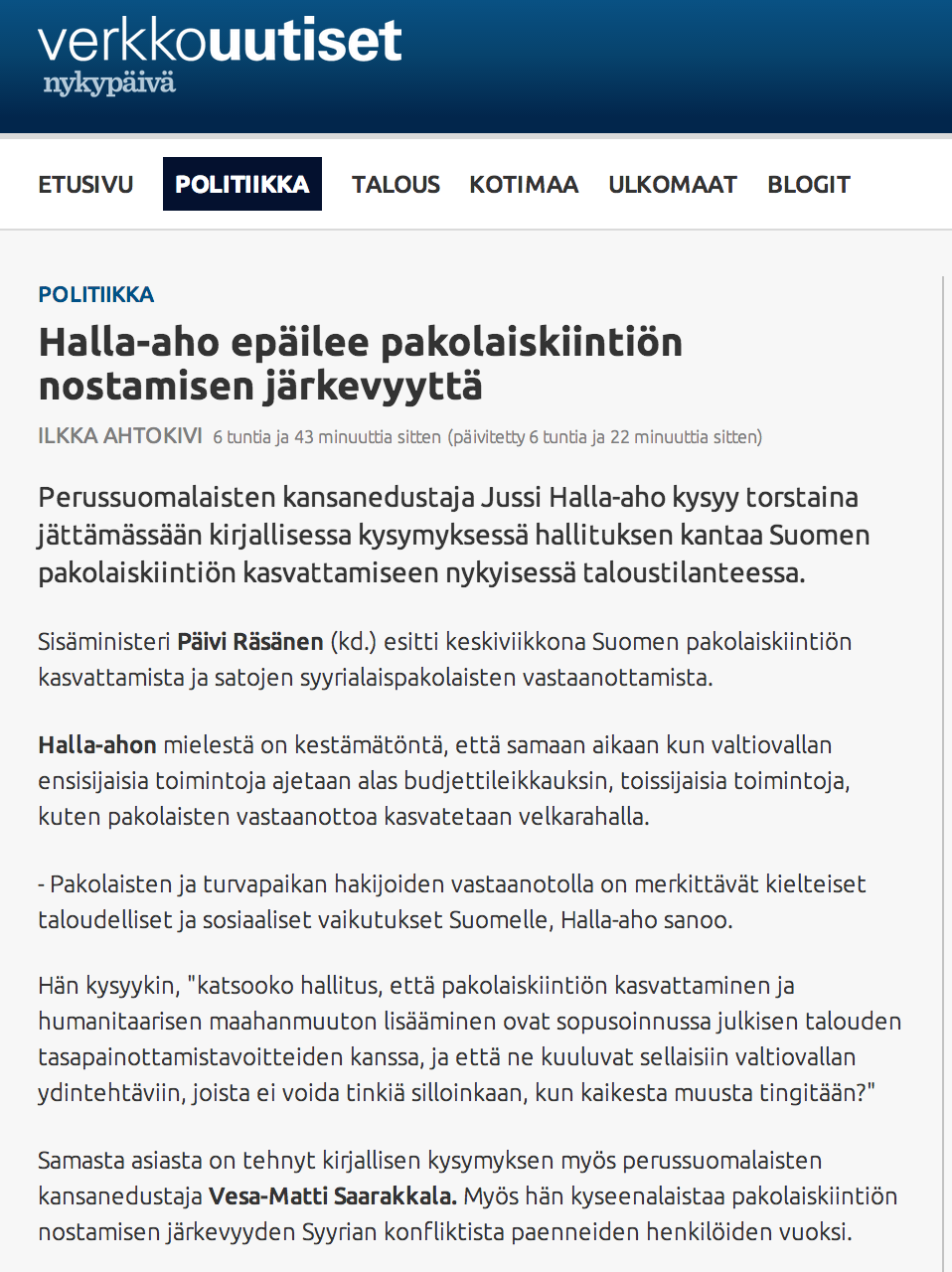
Migrant Tales published a while back a story about how the media gives racists and radical anti-immigration groups inflated respectability and importance. Why should we care what a Perussuomalaiset (PS) MP like Jussi Halla-aho, who was on top of it convicted for ethnic agitation, thinks about giving asylum to Syrian refugees? 

Kuvankaappaus 2013-9-19 kello 20.41.58

Verkkouutiset is run by the National Coalition Party. Read full story here.

Why should the media care if another PS MP like James Hirvisaari, who was convicted for ethnic agitation as well, is “forced” to resigns from an extremist association like Suomen Sisu but supports a far right and racist group like the Finnish Defense League?

And what would you say about PS MP Vesa-Matti Saarakkala, who has sent a written question to parliament about the government’s plan to give asylum to a few hundred refugees from Syria?

Certainly all of the above have some newsworthiness. The PS is an anti-immigration, anti-Islam and anti-gay party. MPs like Halla-aho, Hirvisaari and Saarakkala, who are the most vociferous opponents of cultural diversity, are expressing their opposition to government policy, which is already pretty thin to begin with when it comes to Syrian refugees.

Here’s the question we should probably ponder: How is it possible that a country like Finland, which knows too well what the suffering of war and refugees are, is doing so little to help refugees fleeing a country that is suffering one of the worst sectarian bloodbaths in modern history?

Folks, we’re talking about granting a few hundred Syrian refugees asylum to our country, while our neighbor Sweden, has already given permanent residency to half of the Syrian refugees and announced it will give 8,000 more residency. 

Is the “news” Halla-aho’s or Saarakkala’s lowly opinions of refugees, or that Sweden is giving thousands resident permits to Syrians while we’re having a philosophical discussion about why we should even let in a few hundred?

Why isn’t there anything written by Ilkka or Verkkouutiset that compares our response to the Syrian refugees question with Sweden’s?Aren’t we always competing against our eternal rival in the west in almost everything?

True, Finland’s worst rivals are Sweden. But we don’t compete in some areas that really count and are important, like giving shelter to those fleeing war.

In that match, Finland gets romped every time 6-0 against Sweden.


  • Previous
  • 1
  • 2
  • 3
  • 4
  • 5
  • 6
  • 7
  • Next
Read more about documentary film
Read more

Recent Posts

  • Finland’s tabloids Iltalehti and Ilta-Sanomat are the pits
  • Riikka Purra’s Dr Jekyll and Mr Hyde mask
  • Double standards
  • Perussuomalaiset: Uusi logo, sama vanha juttu
  • Taco Trump

Recent Comments

  1. Absolutely Socking: Racist Finnish Facebook group against human rights gets flooded with socks on Musta Barbaari’s mother and sister charged by the police in “ethnic profiling” case
  2. Ilkka Nuotio on Pekka Myrskylä: “Tilastot kertovat toista kuin poliittinen keskustelu”
  3. Genrih Soinkara on The war in Ukraine and the Russian-Finnish border crisis are showing Finland’s ugly side
  4. Ahti Tolvanen on Comment by Ahti Tolvanen on the Helsinki +50 conference
  5. Angel Barrientos on Angel Barrientos is one of the kind beacons of Finland’s Chilean community

Archives

  • June 2026
  • May 2026
  • April 2026
  • March 2026
  • February 2026
  • January 2026
  • December 2025
  • November 2025
  • October 2025
  • September 2025
  • August 2025
  • July 2025
  • June 2025
  • May 2025
  • April 2025
  • March 2025
  • February 2025
  • January 2025
  • December 2024
  • November 2024
  • October 2024
  • September 2024
  • August 2024
  • July 2024
  • June 2024
  • May 2024
  • April 2024
  • March 2024
  • February 2024
  • January 2024
  • December 2023
  • November 2023
  • October 2023
  • September 2023
  • August 2023
  • July 2023
  • June 2023
  • May 2023
  • April 2023
  • March 2023
  • February 2023
  • January 2023
  • December 2022
  • November 2022
  • October 2022
  • September 2022
  • August 2022
  • July 2022
  • June 2022
  • May 2022
  • April 2022
  • March 2022
  • February 2022
  • January 2022
  • December 2021
  • November 2021
  • October 2021
  • September 2021
  • August 2021
  • July 2021
  • June 2021
  • May 2021
  • April 2021
  • March 2021
  • February 2021
  • January 2021
  • December 2020
  • November 2020
  • October 2020
  • September 2020
  • August 2020
  • July 2020
  • June 2020
  • May 2020
  • April 2020
  • March 2020
  • February 2020
  • January 2020
  • December 2019
  • November 2019
  • October 2019
  • September 2019
  • August 2019
  • July 2019
  • June 2019
  • May 2019
  • April 2019
  • March 2019
  • February 2019
  • January 2019
  • December 2018
  • November 2018
  • October 2018
  • September 2018
  • August 2018
  • July 2018
  • June 2018
  • May 2018
  • April 2018
  • March 2018
  • February 2018
  • January 2018
  • December 2017
  • November 2017
  • October 2017
  • September 2017
  • August 2017
  • July 2017
  • June 2017
  • May 2017
  • April 2017
  • March 2017
  • February 2017
  • January 2017
  • December 2016
  • November 2016
  • October 2016
  • September 2016
  • August 2016
  • July 2016
  • June 2016
  • May 2016
  • April 2016
  • March 2016
  • February 2016
  • January 2016
  • December 2015
  • November 2015
  • October 2015
  • September 2015
  • August 2015
  • July 2015
  • June 2015
  • May 2015
  • April 2015
  • March 2015
  • February 2015
  • January 2015
  • December 2014
  • November 2014
  • October 2014
  • September 2014
  • August 2014
  • July 2014
  • June 2014
  • May 2014
  • April 2014
  • March 2014
  • February 2014
  • January 2014
  • December 2013
  • November 2013
  • October 2013
  • September 2013
  • August 2013
  • July 2013
  • June 2013
  • May 2013
  • April 2013
  • March 2013
  • February 2013
  • January 2013
  • December 2012
  • November 2012
  • October 2012
  • September 2012
  • August 2012
  • July 2012
  • June 2012
  • May 2012
  • April 2012
  • March 2012
  • February 2012
  • January 2012
  • December 2011
  • November 2011
  • October 2011
  • September 2011
  • August 2011
  • July 2011
  • June 2011
  • May 2011
  • April 2011
  • March 2011
  • February 2011
  • January 2011
  • December 2010
  • November 2010
  • October 2010
  • September 2010
  • August 2010
  • July 2010
  • June 2010
  • May 2010
  • April 2010
  • March 2010
  • February 2010
  • January 2010
  • December 2009
  • November 2009
  • October 2009
  • September 2009
  • August 2009
  • July 2009
  • December 2008
  • November 2008
  • October 2008
  • September 2008
  • August 2008
  • July 2008
  • June 2008
  • May 2008
  • April 2008
  • March 2008
  • February 2008
  • January 2008
  • November 2007
  • October 2007
  • September 2007
  • August 2007
  • July 2007
  • June 2007
  • May 2007

Categories

  • ?? Gia L?c
  • ????? ?????? ????? ???????? ?? ??????
  • ???????
  • @HerraAhmed
  • @mondepasrond
  • @nohatefinland
  • @oula_silver
  • @Varathas
  • A Pakistani family
  • äärioikeisto
  • Abbas Bahmanpour
  • Abdi Muhis
  • Abdirahim Hussein Mohamed
  • Abdirahim Husu Hussein
  • Abdirisak Mahamed
  • About Migrant Tales
  • activism
  • Adam Al-Sawad
  • Adel Abidin
  • Afrofinland
  • Ahmed IJ
  • Ahti Tolvanen
  • Aino Pennanen
  • Aisha Maniar
  • Alan Ali
  • Alan Anstead
  • Alejandro Díaz Ortiz
  • Alekey Bulavsev
  • Aleksander Hemon
  • Aleksanterinliitto
  • Aleksanterinliitto ry
  • Aleksanterinliitto ry:n hallitus
  • Alex Alex
  • Alex Mckie
  • Alexander Nix
  • Alexandra Ayse Albayrak
  • Alexis Neuberg
  • Ali Asaad Hasan Alzuhairi
  • Ali Hossein Mir Ali
  • Ali Rashid
  • Ali Sagal Abdikarim
  • Alina Tsui
  • Aline Müller
  • All categories
  • Aman Heidari
  • Amiirah Salleh-Hoddin & Jana Turk
  • Amin A. Alem
  • Amir Zuhairi
  • Amkelwa Mbekeni
  • Ana María Gutiérrez Sorainen
  • Anachoma
  • Anders Adlecreutz
  • Angeliina Koskinen
  • Anna De Mutiis
  • Anna María Gutiérrez Sorainen
  • Anna-Kaisa Kuusisto ja Jaakko Tuominen
  • Annastiina Kallius
  • Anneli Juise Friman Lindeman
  • Announcement
  • Anonymous
  • Antero Leitzinger
  • anti-black racism
  • Anti-Hate Crime Organisation Finland
  • Anudari Boldbaatar
  • Arshiya Nasser
  • Aspergers Syndrome
  • Asylum Corner
  • Asylum seeker 406
  • Athena Griffin and Joe Feagin
  • Autism
  • Avaaz.org
  • Awale Olad
  • Ayan Said Mohamed
  • AYY
  • Barachiel
  • Bashy Quraishy
  • Beatrice Kabutakapua
  • Beri Jamal
  • Beri Jamal and Enrique Tessieri
  • Bertolt Brecht
  • Boiata
  • Boodi Kabbani
  • Bruno Gronow
  • Carmen Pekkarinen
  • Çelen Oben and Sheila Riikonen
  • Chiara Costa-Virtanen
  • Chiara Costa-Virtanen
  • Chiara Sorbello
  • Christian Thibault
  • Christopher Wylie
  • Clara Dublanc
  • Dana
  • Daniel Malpica
  • Danilo Canguçu
  • David Papineau
  • David Schneider
  • Dexter He
  • Don Flynn
  • Dr Masoud Kamali
  • Dr. Faith Mkwesha
  • Dr. Theodoros Fouskas
  • Edna Chun
  • Eeva Kilpi
  • Emanuela Susheela
  • En castellano
  • ENAR
  • Enrique
  • Enrique Tessieri
  • Enrique Tessieri & Raghad Mchawh
  • Enrique Tessieri & Yahya Rouissi
  • Enrique Tessieri and Muhammed Shire
  • Enrique Tessieri and Sira Moksi
  • Enrique Tessieri and Tom Vandenbosch
  • Enrique Tessieri and Wael Che
  • Enrique Tessieri and Yahya Rouissi
  • Enrique Tessieri and Zimema Mhone
  • Epäluottamusmies
  • EU
  • Europe
  • European Islamophobia Report
  • European Islamophobia Report 2019,
  • European Union
  • Eve Kyntäjä
  • Ezequiel Caldeiro
  • Facebook
  • Fadumo Dayib
  • Faisa Kahiye
  • Farhad Manjoo
  • Fasismi
  • Finland
  • Fizza Qureshi
  • Flyktingar och asyl
  • Foreign Student
  • Fozia Mir-Ali
  • Frances Webber
  • Frida Selim
  • Gareth Rice
  • Ghyslain Vedeaux
  • Global Art Point
  • Great Replacement
  • Habiba Ali
  • Hami Bahadori
  • Hami Bahdori
  • Hamid
  • Hamid Alsaameere
  • Hamid Bahdori
  • Handshake
  • Harmit Athwal
  • Hassan Abdi Ali
  • Hassan Muhumud
  • Heikki Huttunen
  • Heikki Wilenius
  • Helsingin Sanomat
  • Henning van der Hoeven
  • Henrika Mälmsröm
  • Hser Hser
  • Hser Hser ja Mustafa Isman
  • Husein Muhammed
  • Hussain Kazemian
  • Hussain Kazmenian
  • Ibrahim Khan
  • Ida
  • Ignacio Pérez Pérez
  • Iise Ali Hassan
  • Ilari Kaila & Tuomas Kaila
  • Imam Ka
  • inside-an-airport
  • Institute of Race Relations
  • Iraqi asylum seeker
  • IRR European News Team
  • IRR News Team
  • Islamic Society of Norhern FInland
  • Islamic Society of Northern Finland
  • Islamophobia
  • Jacobinmag.com
  • Jallow Momodou
  • Jan Holmberg
  • Jane Elliott
  • Jani Mäkelä
  • Jari Luoto
  • Jari Taponen
  • Jegor Nazarov
  • Jenni Stammeier
  • Jenny Bourne
  • Jessie Daniels
  • Joe Davidow
  • Johannes Koski
  • John D. Foster
  • John Grayson
  • John Marriott
  • Jon Burnett
  • Jorma Härkönen
  • Jos Schuurmans
  • José León Toro Mejías
  • Josue Tumayine
  • Jouni Karnasaari
  • Juan Camilo
  • Jukka Eräkare
  • Julian Abagond
  • Julie Pascoet
  • Jussi Halla-aho
  • Jussi Hallla-aho
  • Jussi Jalonen
  • JusticeDemon
  • Kadar Gelle
  • Kaksoiskansalaisuus
  • Kansainvälinen Mikkeli
  • Kansainvälinen Mikkeli ry
  • Katherine Tonkiss
  • Kati Lepistö
  • Kati van der Hoeven-Lepistö
  • Katie Bell
  • Kättely
  • Kerstin Ögård
  • Keshia Fredua-Mensah & Jamie Schearer
  • Khadidiatou Sylla
  • Khadra Abdirazak Sugulle
  • Kiihotus kansanryhmää vastaan
  • Kirsi Crowley
  • Koko Hubara
  • Kristiina Toivikko
  • Kubra Amini
  • KuRI
  • La Colectiva
  • La incitación al odio
  • Laura Huhtasaari
  • Lauri Finér
  • Leif Hagert
  • Léo Custódio
  • Leo Honka
  • Leontios Christodoulou
  • Lessie Branch
  • Lex Gaudius
  • Leyes de Finlandia
  • Liikkukaa!
  • Linda Hyökki
  • Liz Fekete
  • M. Blanc
  • Maarit Snellman
  • Mahad Sheikh Musse
  • Maija Vilkkumaa
  • Malmin Kebab Pizzeria Port Arthur
  • Marcell Lorincz
  • Mari Aaltola
  • María Paz López
  • Maria Rittis Ikola
  • Maria Tjader
  • Marja-Liisa Tolvanen
  • Mark
  • Markku Heikkinen
  • Marshall Niles
  • Martin Al-Laji
  • Maryan Siyad
  • Matt Carr
  • Mauricio Farah Gebara
  • Media Monitoring Group of Finland
  • Micah J. Christian
  • Michael McEachrane
  • Michele Levoy
  • Michelle Kaila
  • Migrant Tales
  • Migrant Tales Literary
  • Migrantes News
  • Migrants' Rights Network
  • MigriLeaks
  • Mikko Kapanen
  • Miriam Attias and Camila Haavisto
  • Mohamed Adan
  • Mohammad Javid
  • Mohammad M.
  • Monikulttuurisuus
  • Monisha Bhatia and Victoria Canning
  • Mor Ndiaye
  • Muh'ed
  • Muhamed Abdimajed Murshid
  • Muhammed Shire
  • Muhammed Shire and Enrique Tessieri
  • Muhis Azizi
  • Musimenta Dansila
  • Muslimiviha
  • Musulmanes
  • Namir al-Azzawi
  • Natsismi
  • Neurodiversity
  • New Women Connectors
  • Nils Muižnieks
  • No Labels No Walls
  • Noel Dandes
  • Nuor Dawood
  • Omar Khan
  • Otavanmedia
  • Oula Silvennoinen
  • Paco Diop
  • Pakistani family
  • Pentti Stranius
  • Perussuomalaiset
  • perustuslaki
  • Petra Laiti
  • Petri Cederlöf
  • Pia Grochowski
  • Podcast-lukija Bea Bergholm
  • Pohjois – Suomen Islamilainen Yhdyskunta
  • Pohjois Suomen Islamilainen Yhyskunta
  • Polina Kopylova
  • Race Files
  • racism
  • Racism Review
  • Raghad Mchawh
  • Ranska
  • Rashid H. and Migrant Tales
  • Rasismi
  • Raul Perez
  • Rebecka Holm
  • Reem Abu-Hayyeh
  • Refugees
  • Reija Härkönen
  • Remiel
  • Reza Nasri
  • Richard Gresswell
  • Riikka Purra
  • Risto Laakkonen
  • Rita Chahda
  • Ritva Kondi
  • Robito Ibrahim
  • Roble Bashir
  • Rockhaya Sylla
  • Rodolfo Walsh
  • Roger Casale
  • Rostam Atai
  • Roxana Crisólogo Correa
  • Ruth Grove-White
  • Ruth Waweru-Folabit
  • S-worldview
  • Sadio Ali Nuur
  • Sami Rusanen
  • Sandhu Bhamra
  • Sara de Jong
  • Sarah Crowther
  • Sari Alhariri
  • Sarkawt Khalil
  • Sasu
  • Scot Nakagawa
  • Shabana Ahmadzai
  • Shada Islam
  • Sharon Chang blogs
  • Shenita Ann McLean
  • Shirlene Green Newball
  • Sini Savolainen
  • Sira Moksi
  • Sonia K.
  • Sonia Maria Koo
  • Steverp
  • Stop Deportations
  • Suldaan Said Ahmed
  • Suomen mediaseurantakollektiivi
  • Suomen Muslimifoorumi ry
  • Suomen viharikosvastainen yhdistys
  • Suomen viharikosvastainen yhdistys ry
  • Suomi
  • Supermen
  • Susannah
  • Suva
  • Syrjintä
  • Talous
  • Tapio Tuomala
  • Taw Reh
  • Teivo Teivainen
  • The Daily Show
  • The Heino
  • The Supermen
  • Thomas Elfgren
  • Thulfiqar Abdulkarim
  • Tim McGettigan
  • Tino Singh
  • Tito Moustafa Sliem
  • Tobias Hübinette and L. Janelle Dance
  • Transport
  • Trica Danielle Keaton
  • Trilce Garcia
  • Trish Pääkkönen
  • Trish Pääkkönen and Enrique Tessieri
  • Tuulia Reponen
  • Uncategorized
  • UNITED
  • University of Eastern Finland
  • Uyi Osazee
  • Väkivalta
  • Vapaa Liikkuvuus
  • Venla-Sofia Saariaho
  • Vieraskynä
  • W. Che
  • W. Che an Enrique Tessieri
  • Wael Ch.
  • Wan Wei
  • Women for Refugee Women
  • Xaan Kaafi Maxamed Xalane
  • Xassan Kaafi Maxamed Xalane
  • Xassan-Kaafi Mohamed Halane & Enrique Tessieri
  • Yahya Rouissi
  • Yasmin Yusuf
  • Yassen Ghaleb
  • Yle Puhe
  • Yuliet Tresa
  • Yve Shepherd
  • Zahra Khavari
  • Zaker
  • Zalina Ametova
  • Zamzam Ahmed Ali
  • Zeinab Amini ja Soheila Khavari
  • Zimema Mahone and Enrique Tessieri
  • Zimema Mhone
  • Zoila Forss Crespo Moreyra
  • ZT
  • Zulma Sierra
  • Zuzeeko Tegha Abeng
© 2026 Migrant tales | Powered by Minimalist Blog WordPress Theme