Migrant tales
Menu
  • #MakeRacismHistory “In Your Eyes”
  • About Migrant Tales
  • It’s all about Human Rights
  • Literary
  • Migrant Tales Media Monitoring
  • NoHateFinland.org
  • Tales from Europe
Menu

Tag: Prejudice

Internet policeman Marko Forss mildly reprimanded by deputy ombudsman for tweeting stereotypes of the Roma

Posted on August 1, 2013 by Migrant Tales

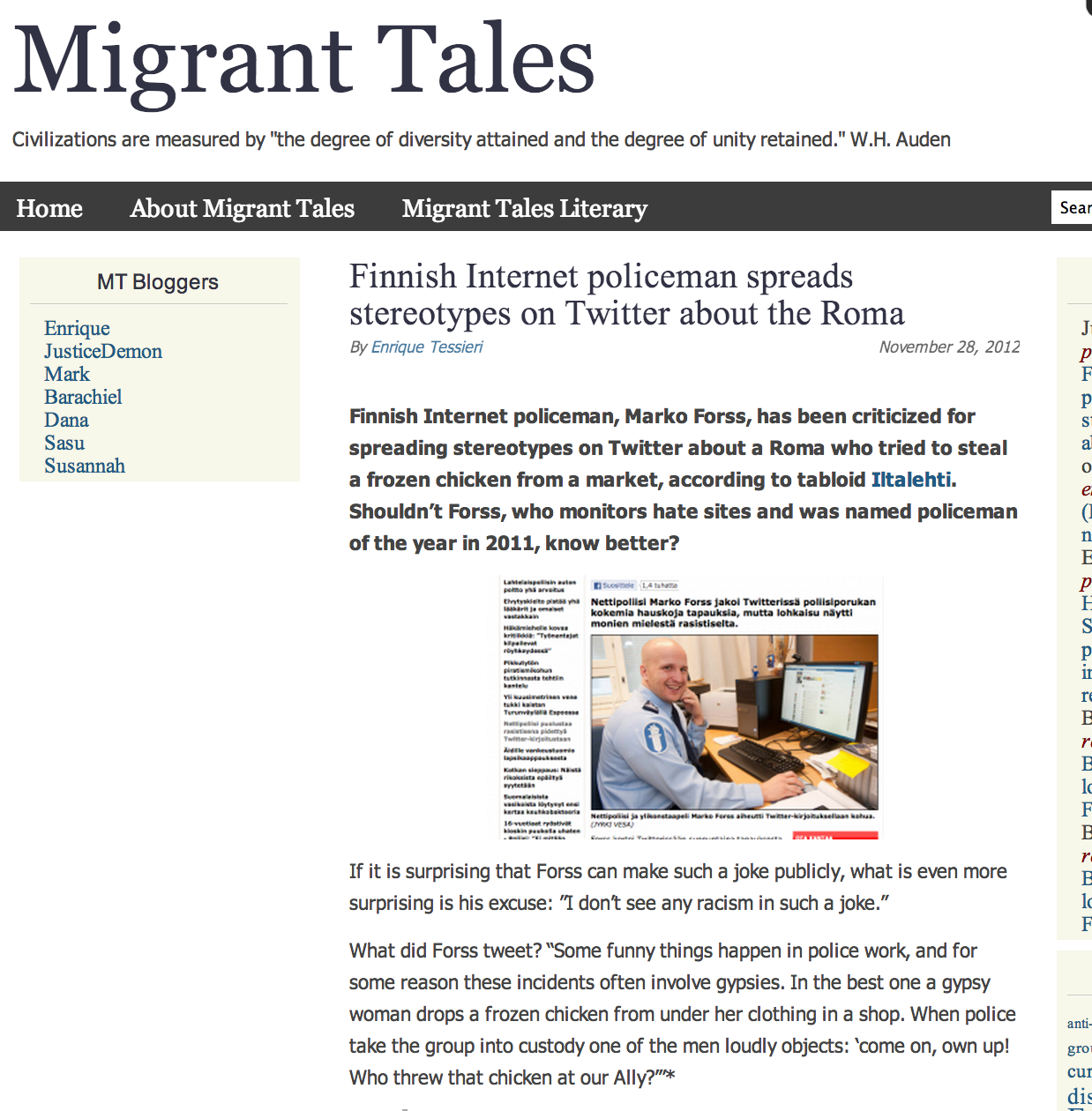
Deputy Parliamentary Ombudsman Jussi Pajuoja mildly reprimanded Internet policeman Marko Forss for tweeting a so-called joke about the Roma, reports YLE. The personal tweet, as Migrant Tales reported in November, spread and strengthened stereotypes about the Roma. 

What did Forss, who was named policeman of the year in 2011, tweet?

“Some funny things happen in police work, and for some reason these incidents often involve gypsies. In the best one a gypsy woman drops a frozen chicken from under her clothing in a shop. When police take the group into custody one of the men loudly objects: ‘come on, own up! Who threw that chicken at our Ally?’”*

Forss, who is supposed to be an example on the internet, burned his fingers badly with his so-called joke.

He was even quoted on tabloid Iltalehti as saying,  “I don’t see any racism in such a joke,” and “it’s pretty disturbing if [people] are so sensitive.”

Kuvankaappaus 2013-8-1 kello 15.09.12

 Read original blog entry here.

Not only was Forss’ tweet revealing but his defense arguments as well. Certainly a white policeman wouldn’t consider racist or insulting a so-called joke about the Roma, who have suffered their share of social exclusion for five centuries in Finland. The point is that Forss should have known better and understood if his joke was offensive to others.

Some advice for Forss: Don’t make any ethnic jokes because you’ll end up in hot water.

No disciplinary action will be taken against Forss.

Migrant Tales believes that Forss should be replaced since the tweet was a blow to his credibility.

If you disagree, why not ask the Romany minority what they think about Forss’ “joke” and if it fueled greater trust, or suspicion of the police.

* Thanks to Justice Demon for the translation.


The media should stop stereotyping immigrants!

Posted on June 19, 2013 by Migrant Tales

Black is beautiful, but I have a question: Why is it that whenever there is a story about immigrants or refugees in the Finnish media, the picture that is published with the story is usually of a black man or Muslim woman? Publishing pictures that feed the public a stereotypical image of immigrants does nothing more than reinforce prejudice and racism.

The media should do a better job and they can. The question is why don’t they?

Like in too many parts of Europe,  the whole debate on immigrants, refugees, immigration and cultural diversity is distorted. The best proof of this aren’t the opinion pieces we read about immigrants in the media but the pictures that are published with them.

Why do we do this persistently even if immigrants from Africa and Muslims represent a minority, according to the Population Registration Center (Väestörekisterikeskus).

Of the 195,511 non-Finns living in our country, the majority are Europeans and non-Muslims. Somalis, for example, accounted for 0.26% of the country’s total population last year. Moreover, the overwhelming majority (77.3%) of people in Finland are Lutherans compared with 1.47% who belonged to “other” religions.

So why does the media picture immigrants and refugees as blacks and Muslims?

Ignorance, outright prejudice or both?

Kuvankaappaus 2013-6-19 kello 13.13.29


A recent story on Taloussanomat uses a black man to portray immigrants.

Kuvankaappaus 2013-6-19 kello 13.14.25

This picture on Helsingin Sanomat shows a foreign-looking man with a women who could be a Muslim.


Sara speaks out against the racist harassment her son endured at a school in Mikkeli, Finland

Posted on April 28, 2013 by Migrant Tales

What would you do if you heard that an African single mother decided to leave Mikkeli for Helsinki because her eight-year-old child was a victim of racist harassment or bullying at school? Would you just register the news and brush it conveniently under the rug and reassure yourself that these types of things don’t happen where you live?

Migrant Tales got in touch with Sara, an African single mother that spoke on condition of anonymity, to ask what had happened to her son at school. She said that her problems began when her son Julian, then a seven-year-old boy, went to Kattilansilta School.

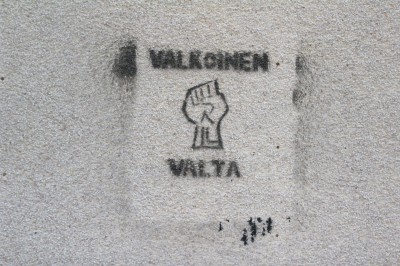
Migrant Tales published in October 2010 a blog entry about racist spray paintings that were on the school’s walls for months.

Valkoinen valta-2_edited-1

While Sara believes that the teachers and principle did everything possible to stop the racist bullying of her son, a teacher in 2010 didn’t seem too concerned about the racist graffiti on the school’s wall. After the teacher admitted that the racist graffiti above had been there since spring and didn’t represent his values, he asked why anti-immigration groups like the Perussuomalaiset and Muutos 2011 are labelled racist whenever they criticize immigrants for getting more social welfare than Finns.

By Sara

I had heard before that racism is a problem in Mikkeli but my child and I were never its victims.  My problems started when I finished my studies and when my son Julian started first grade at the local school. Finding real work in Mikkeli was impossible for me. I served as an intern at different workplaces but never got a job that paid me a salary.

One day my son Julian came home and told me that a boy at school was bullying him in a racist manner. He was too young to understand why he was bullied.  He asked me why I had given birth to him as a black African and why he wasn’t white like the rest of the children at school.

Soon the majority of his classmates started bullying him. They named him a black monkey and told him to go to the toilet bowl because the color of his skin was like the color of feces. (Sara stops for a moment to contain her tears. She succeeds).

Matters got worse for Julian as the months passed at school. There were fights and nobody wanted to play with him. One day he said he didn’t want to go to school because nobody liked him.

The teachers and the principle were understanding and they spoke to the classmates’ parents. Things got better but for Julian for a while but then things returned to “normal” and the bullying started again. Julian’s classmates are the same age as he so what they know about racism is what they learned from their parents and other children.

Not only did my son complain that he didn’t have friends at school, but he didn’t have anyone to play with after school either. At the apartment block where we lived in Mikkeli, he did have a friend who wanted to play with him but the boy’s mother forbade it.

Last year for the first time in my seven years in Mikkeli, I got two hate mails telling me to go back to where I came from.

Taking into account what was happening at school to Julian and the feeling that things had changed for the worse in Mikkeli for us, I decided to move to Helsinki last fall.

Since then my life has changed for the better. There are more Africans where I live and my son is no longer bullied at school.

It’s incredible, but if you are the only black child at school like Julian was, you’ll get bullied. If there are more black children, bullying doesn’t happen that easily.

I sincerely hope that what happened to me and my son won’t happen to anyone.   I don’t wish such pain to befall anyone.

Silence is not the way to challenge intolerance.

Read story in Finnish here.  


The Boston bombings reveal a deadlier blowback

Posted on April 17, 2013 by Migrant Tales

I was shocked to hear about the twin bombs in Boston and my heart goes to the victims. Two days after the incident, however, speculation has been rife about the probable ethnicity of the perpetrator. The eerie silence of the killer suggests that this was probably carried out individually.  

Kuvankaappaus 2013-4-17 kello 10.16.30

The latest story on the Boston Globe reveals no clues on who the killers could be.

Anupreet Sandhu Bhamra, a Canadian journalist who has published on Migrant Tales, read the following tweet after the bombings: ”Oh God, please, let it not be a Muslim.”

The sense of dread that was mentioned in the tweet was felt by the small visible immigrant community in Finland after we learned about the assassination of Swedish Prime Minister Olof Palme on February 28, 1986.

I too hoped that the assassin that killed Palme isn’t an immigrant.

Not only was anti-immigration sentiment in Finland a fact of life back then, it was alive and kicking despite the fact that only 0.3% of the population (17,039 people) were immigrants.

Initial media coverage of the Boston tragedy revealed that US authorities suspected the killer to be a man who spoke with an accent. That man turned out to be a Saudi Arabian man who was later released by officials.

While the bombings were a cowardly act, the blowback from it proves even more devastating by revealing our prejudices and hatred of other groups.

You may have initially asked who could commit such a heinous crime in the US? It couldn’t be a white man, right?

The bombings raise an important question: If labeling, victimizing and generalizing of different groups are wrong, why do we persist in doing so?

The answer to that question should reveal the role that racism plays in our society and why the battle against this social ill is halfhearted.

Bhamra writes: ”The Oklahoma City bombing was a terrorist bomb attack in downtown Oklahoma on April 19, 1995. Initial news stories were quick to wrongly suggest Islamic terrorists were behind the attack. As a result, Muslims and people of Arab descent were attacked. Later, when the suggestions turned out to be incorrect and the suspect turned out to be a White man, the racial framework was quickly and conveniently dropped.”

On July 22, 2011, we suffered a similar tragedy when Anders Breivik went on the rampage in Norway and killed in cold blood 77 innocent victims. In the same way that initial coverage in Oklahoma pointed the finger at Muslims, some thought that the killer in Norway to be a Middle Easterner as well.

Norwegian Prime Minister Jens Stoltenberg showed exceptional leadership as Norway was mourning its victims. Contrary to Washington’s reaction to 9/11, the Norwegian prime minister said that his country’s response to the mass killings will be more openness and more democracy. According to him, Norway had become after July 22 “more tolerant, [and] more careful not to judge people” by ethnic origin.

Another tragedy that we are witnessing after 22/7 is how the media, politicians and public are collectively forgetting what Breivik did never mind its causes, which haver their roots in Islamophobia and anti-immigration sentiment.

While racism is an effective tool to divide and conquer other groups, we should never forget that it is a rabid dog on a short leash that can bite back and hard at its master.

How can immigrants and visible minorities clear the minefields of misinformation?

Posted on April 15, 2013 by Migrant Tales

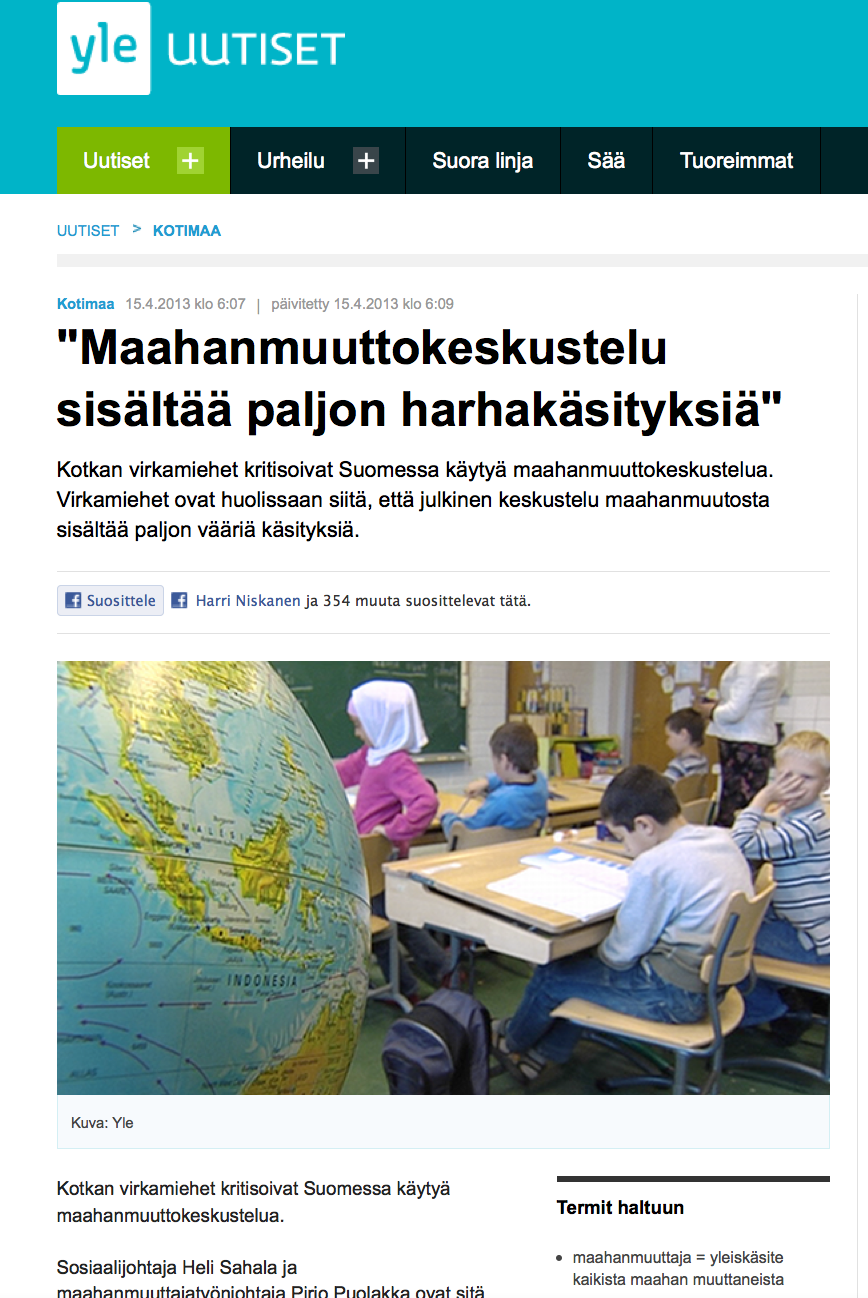
There is an interesting news story on today’s YLE that raises a timely question: Not why there is so much misinformation spead about immigrants, but what does this reveal about us as a society?

Kuvankaappaus 2013-4-15 kello 16.51.40

Does it bring to light ignorance or a subtle conspiracy that permits us to have and eat our racist cake simultaneously?

While it is a welcome matter that Finnish officials speak out against prejudice and racism in our society, why has so little been done on this front in the past, especially by those who claim to be anti-racist and work to better the lives of immigrants?

You’ll probably find the answer to that question in the eerie silence and tacit approval of that misinformation being spread against immigrants. It is telling you as well that we must raise our voices and lead ourselves if anything is to change.

What kind of wise tales are being spread in public about immigrants?

According to what Pirjo Puolakka of the city of Kotka’s immigration office, they are the following:

  • Immigrants and refugees are the same thing;
  • Immigrants get more social welfare than Finns.

Another topic that could be added to this  list are rape and crime statistics.

Misinformation could be pictured in the following manner. It could be seen as the deadly mines up ahead of our path towards greater social equality and acceptance. Since clearing that minefield would be suicidal, it’s clear that few white Finns will do the job. This only leaves us.

But beyond those killing fields we’ll eventually confront the greatest foe of all: ourselves.

Common Ground News Service: Spreading “anti-rumours” about immigrants

Posted on December 11, 2012 by Migrant Tales

By María-Paz López

Barcelona, Spain –“They are invading us”, “They don’t respect the rules”, “They don’t pay taxes”, “They don’t want to integrate”, “They get special subsidies to open businesses”, are just a few of the often repeated accusations against immigrant communities in Spain.

To deal with rising prejudices, Barcelona City Council is now beginning its second training season of volunteer citizens, nicknamed anti-rumour patrols, whose job it will be to counter rumours or stereotypes about immigrants.

The volunteers take free courses to acquire skills to tackle prejudice. For example, in everyday situations at work, in the neighbourhood, in the supermarket or at the gym, an anti-rumour agent who might overhear someone saying, “You know, Moroccan immigrants are collapsing the Health system, they are always queuing for a doctor, with their many kids …,” could step in and counter with fact. “You know, actually, according to the authorities, immigrants go to the doctor 50 per cent less than natives, and their healthcare costs are only 4.6 per cent of the total in Spain”.

According to 2012 census data, the largest national minority groups in Barcelona are Pakistanis (23,281 individuals), Italians (22,909), Chinese (15,875) and Ecuadorians (15,551), in a city with some 1,630,000 inhabitants.

The promoters of the programme, which began two years ago, could have opted for an ideological, philosophical or human rights’ approach. Instead, they have chosen a down-to-earth, factual one.

“It is more effective” says Miquel Esteve, Town Hall commissioner for Immigration and Intercultural Dialogue. “The programme strategy always uses accurate and objective information to deactivate false perceptions such as the belief that immigrants monopolise social aid, do not pay taxes, get subsidies to start businesses, collapse emergency rooms or abuse the health system.”

Using factual data and statistics, the anti-rumour agent seeks to invalidate the rumour right in front of the person who is disseminating it.

Last spring, 436 citizens received the free Town Hall trainings. A new course starting this month includes workshops that analyse how rumours, stereotypes and prejudice are created and divulged, and how they contribute to constructing an overwhelmingly negative opinion within the host community of what diversity means.

Citizens enrolled in the courses also learn to deal with their own prejudices, something that, as the trainers say, they never think they have.

Among the most frequently repeated rumours that affect the whole foreign population, the most dreadful one may be “They are invading us”. To fight it, anti-rumour agents respond: “It is actually the opposite. The foreign population in Barcelona remains very stable. Foreign residents as of 1 January 2012 totalled 282,178, or 17.4 per cent of residents, and that number in January 2011 was 278,320, 17.3 per cent of total residents. That is not fast growing”.

Another typical stereotype about immigrants – “They don’t respect the rules” – can be invalidated by saying, “You know, from 2006 to 2010, only 18 per cent of fines due to violations of the local Ordinance of Civility were for foreigners residing in Barcelona”.

Even if the economic crisis in Spain is causing municipalities to drastically cut budgets, not one Town Hall official in Barcelona – now led by a conservative nationalist mayor – has suggested cancelling this programme.

There is wide consensus of its importance for social cohesion in the city. “When we started…we discovered that false rumours about immigrants were something pretty widespread, that they harmed conviviality, and that it was something we definitely had to address”, explains Daniel de Torres, who was the Town Hall commissioner for Immigration and Intercultural Dialogue when the programme started.

Good “rumours” are spreading about its success in the region. Other municipalities in the Barcelona metropolitan area have shown an interest in establishing similar programmes, and they are getting the advice and materials to do so.

It’s a powerful way for civil society to become involved in improving respect for diversity in an urban context, and it’s an idea that can travel.

###

* Barcelona-based author Maria-Paz Lopez is Senior Religion Writer at the Spanish daily La Vanguardia and chairs the steering committee of the International Association of Religion Journalists (IARJ). This article was written for the Common Ground News Service (CGNews).

Source: Common Ground News Service (CGNews), 04 December 2012, www.commongroundnews.org
Copyright permission is granted for publication.

Read original blog entry here.

This piece was reprinted by Migrant Tales with permission.

How discrimination works in Finnish basketball

Posted on December 11, 2012 by Migrant Tales

If there is a game that is played by people from diverse backgrounds, that game is basketball. When I moved to the United States as a child, basketball was my door to new friends and acceptance. 

Basketball was a way of life in Hollywood, California, for many young people like me.

In Finland it is a mixed story if you are a referee. There are very good referees who understand that prejudice is pernicious, while others still don’t have a clue.

I know from experience that if you complain about discrimination to the Finnish Basketball Association, you won’t be taken seriously. In my case, you’ll end up getting a scornful look suggesting that you are using “the racism card.”

I have refed for close to ten years all types of games not only in Finland but in in Madrid, Spain, where I lived and worked for about a year.

Discrimination is difficult to measure in sports but not impossible. In many respects it’s like measuring corruption in journalism. It’s fine to accept your host to pay your lunch but wrong if this happens every time.

Consistency is a good benchmark when studying how refs are discriminated in Finland. Is the person with a non-Finnish name the one that is always the umpire and the person with the Finnish name the ref?

I was refing for one year all-nation games for seventeen-year-olds in Finland around 2006. I was always the umpire and my partner, with the Finnish name, who had roughly the same experience as I,  was the ref.

When I brought this case to the attention of the Finnish Basketball Association, I got the cold shoulder. I was made to feel that my complaint wasn’t valid and that I was using the “racism card.”

The whole incident was as a result forgotten.

The stick that broke the camel’s back happened on Sunday when my former partner, who is the regional ref that names other refs for games, told me that I would be umpire in a game because I could not control my temper and lacked experience. Adding salt to injury with the help of prejudice, he laughed trying to drive home his point.

I couldn’t believe what I was hearing. According to him, I was “hot-tempered” because it’s the national character of southern Europeans (sic!).

As I mentioned, I have refed for about ten years and have learned the art of remaining calm under pressure. My job as a teacher and working with immigrants has taught me that staying calm is a key virtue at all times.

I ref to train and strengthen such virtues.

If you have suffered similar cases while doing sports in Finland, Migrant Tales would be happy to hear your story.


Go for the values and weaknesses of a group if you aim to destroy their self-esteem

Posted on July 7, 2012 by Migrant Tales

How would you go about destroying the self-esteem of a group? If you were an anti-immigration politician, certainly you’d target the group’s values (religion) and exploit your racist arguments by pointing the finger at their most vulnerable weaknesses, like high unemployment. 

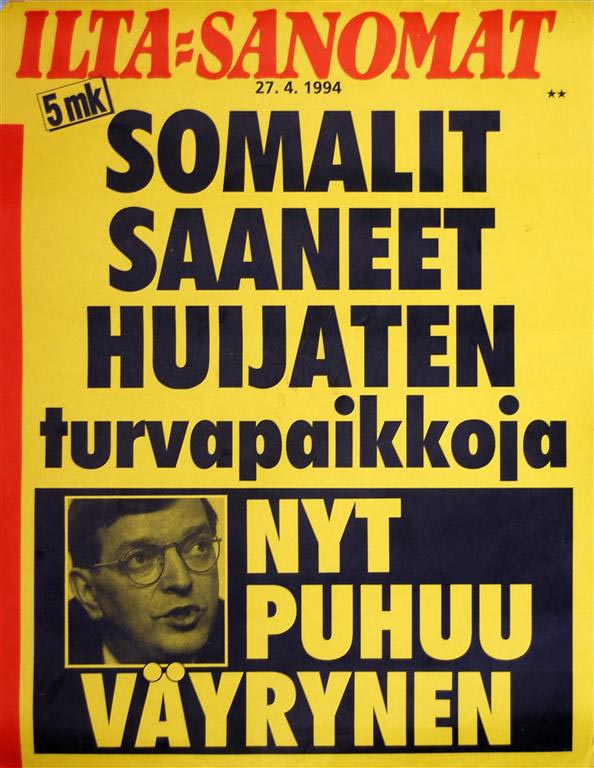
Prejudice and racism are diehard social ills because they take generations to wear off.  It may have taken a few months to label a small group of Somali refugees that came to Finland in the early 1990s, but it will be a very long time before they wash off their stigma.

The Romany minority of Finland are a good example of how negative labels can follow a group like a shadow for centuries.

 The Ilta-Sanomat tabloid claims that Somalis swindled authorities in granting them political asylum in Finland.

If it wasn’t a tabloid billboard that spread and reinforced racism and suspicion of groups like the Somalis in the 1990s, the icing on the cake was provided by the tacit silence of the politicians and society in general.  Even if one group was being singled out, it was an attack on all immigrants living in this country at the time.

As the old saying claims, there is no evil that lasts 100 years. In the United States, it took centuries to end slavery before we saw the rise of the Civil Rights Movement in the 1950s and 1960s. The Arab Spring movements last year are good recent examples of how “no evil can last 100 years.”

There is a problem with the saying, however, since it implies that evil cannot exist over 100 years because a person cannot live past that age. History reveals that evil is more like Methuselah, the Biblical figure that lived to be 969 years old.

The findings of a study in Britain published exclusively by the Guardian claim that unchecked corporate power, unrepresentative politicians and apathetic voters are fueling today the decline of British democracy.  The same illness has spread to other parts of Europe, like Finland.

The Guardian writes: “A study into the state of democracy in Britain over the last decade warns that it is in ‘long-term terminal decline’ as the power of corporations keeps growing, politicians become less representative of their constituencies and disillusioned citizens stop voting or even discussing current affairs.”

Finnish society, which used to be perceived as the least corrupt country in the world, according to Transparency International, has had its image seriously tarnished by greedy politicians and corporate leaders.

In the same way that corruption undermines a society’s values and sends it into decline, similarly prejudice and racism constitute serious threat to it as well.

If people are excluded socially and their only aim in life it to live off welfare, certainly they have every right to challenge their situation.

The only way you can avoid violence in society is by empowering people to change their situation through our democratic institutions. Two matters can happen if people lose faith in them: indefinite (very costly) social exclusion and/or violence.

In Europe not thinking today about how to tackle social exclusion and racism is thinking little or erroneously.

Thus the roots of the problem are not the marginalized groups, far-right parties or opportunistic anti-immigration politicians, but our apathy, greed and the fact that some of us have forgotten that we are social animals.


Prejudice discourages employers from hiring deaf people

Posted on June 5, 2012 by Migrant Tales

I read an interesting news story on YLE in English about how prejudice hinders deaf people from getting jobs. Sounds like a familiar excuse heard commonly by immigrants, right? 

The jobless rate of deaf workers and immigrants in Finland is about three times greater than the national average. Unemployment in Finland in April stood at 8.4%, according to Statistics Finland.

Writes YLE in English: “…Getting a foot in the employer’s door is a challenge for many members of the deaf community and as many as twenty percent don’t find work. The Finnish Association of the Deaf [FAD] is worried that hearing-impaired adults are being excluded from the workplace due to prejudice.”

FAD unit manager, Borje Hanhikoski, admits that attitude plays an important role when hiring deaf people. ”I think this is more about the attitude of employers, a question of prejudice,” he said

Rasismin määrittäminen

Posted on May 20, 2012 by Sasu

Melkein jokaista ihmistä kohden on eri määritelmä rasismista. Jos Suomessa on suunnilleen viisi miljoonaa ihmistä, joten meillä on suunnilleen viisi miljoonaa eri määritelmää rasismille. Tämä voi olla vahvaa karrikointia, mutta ei ole kaukana todellisuudesta. Jos aiomme taistella rasismia meillä on oltava vähintään, jokin selvä määritelmä sille mikä on rasismi.


Rasismin voi ajatella Malcolm X:än sanoilla. ”Racism is like a Cadilla, they bring out a new model every year” (Malcolm X, 1964)

Sanojen ydin on siinä, että rasismi on alituisesta muutos tilassa. Se ei ikinä pysähdy. Tämä ominaisuus johtuu rasismin kulttuurillisesta luonteesta. Rasismi ei ole yksittäinen teko vaan kokonainen maailman katsomus ja elämäntapa. Tämä tarkoittaa sitä, että rasismiin sosialisoidutaan ja omaksutaan. Rasismia voisi kutsua kulttuurin syöväksi. Sillä on etäpesäkkeitä joka puolella Eurooppalaista yhteiskuntaa ja aina, kun sen uskoo voittaneen, se palaa aina vain vahvempana. Se on kuin Hydra.


Analyyttinen määritelmä on ennakkoluulo + valta. Tämän määritelmän voi löytää Englantilaisista sosiologian oppikirjoista ja netistä. Kaikki alkaa ennakkoluulosta. Sinulla on jokin stereotyyppi tai miellemalli joka on negatiivinen. Esimerkiksi, että Venäläiset juovat itsensä aina kaato humalaan. Sinulla on nyt ennakkoluulo. Koska kuulut enemmistöön, joka hallitsee alkoholin jakelun ja lainsäädännöt, pääset säätämään syrjiviä lakeja. Kiellät alkoholin jakelun venäläisille. Tämän esimerkin kautta voimme yleistää asian vaikkapa talouteen, politiikkaan, Lain ylläpito voimiin ja koulutus laitokseen.


Kaikista klassisin on, että rasismi on uskomus toisen rodun ylemmyydestä verrattuna toiseen. Tämän määritelmän mukaan teon motiivi tekee sen rasistiseksi. Ongelmaksi tulee nyt se, että määritelmä jättää rakenteellisen rasismin pois laskusta. Rakenteellisessa rasismissa toiminnan tulos määrittelee onko se rasistinen. Samalla tavoin määritelmä päästää poliittisesti korrektit rasistit läpi. Määritelmä sopii paremmin ääritapauksien ja selvästi rasististen toimintojen kiinni saamiseksi.


Jo sivuutettu ollut rakenteellinen rasismi perustuu systeemien tuottamien tulosten tutkimista. Määritelmän joustavuus antaa mahdollisuuden hyökätä päälinpuolin tasa-arvoisia palveluita ja yhteiskunnan rakenteilta vastaan. Hyvä esimerkki voisi olla lain ylläpito voimat. Jos käy niin, että musta ihminen tuomitaan suuremmalla todennäköisyydellä pidemmäksi aikaan vankilaan tai hellemmin annetaan kuoleman tuomioita verrattuna samaan rikokseen syyllistyneeseen valkoiseen. Se on rakenteellista rasismia. Jos poliisi suuremmalla todennäköisyydellä tutkii ja kysyy henkilöllisyys todistusta arabilta tai turkkilaiselta verrattuna vaikkapa venäläiseen niin se on rakenteellista rasismia. Mediassa se nähdään tavassa miten värillisiä esitetään ja miten paljon heitä nähdään siellä. Koulussa se nähdään tavassa miten opettajat reagoivat värillisen väärinkäytökseen ja opetussuunnitelman rakenteesta. Mitä opetetaan ja mitä on jätetty pois. Luetteloa voi jatkaa kaikkiin yhteiskunnan osa-alueihin asumisesta aina terveyden huoltoon.


Näistä määritelmistä voi helposti saada kuvan, että vain valkoinen voi olla rasisti. Käytännössä kuka tahansa voi olla rasisti. USA:sta voi löytyä pari afrocentristä ryhmittymää, jotka uskovat mustien ylemmyyteen. Saman laisia voi löytyä kaikista ihmisryhmistä. Suurin osa rasistisista värillisistä ovat silti rasisteja itseä ja vaaleampia siskoja kuin valkoisia kohtaan. Tähän on kaksi syytä. Ensimmäinen on, että värillisillä on harvemmin valtaa käyttää heidän vihaa tai ennakkoluuloa valkoisia vastaan. Niissä maissa joissa värilliset ovat enemmistöinä valkoisten syrjintä olisi taloudellisesti liian kallista. Useammin värillisten maissa värilliset sortavat muita saman rodun edustajia. Toinen on, että värilliset suurin osin ovat omaksuneet entisten sortajien arvot. Tämän omaksumisen mukana on tullut vahva itseinho ja kateellisuus vaaleampia siskoja kohtaan. Aasiassa tämä voidaan nähdä mustien karsastamisena, mutta valkoisen kauneus ihanteen sairaana palvomisena. Nopeiten kasvava kauneuden ala on  ihon vaalennut voiteet. Toiseksi tulevat kauneus leikkaukset joilla pyritään tulla mahdollisimman Eurooppalaiseksi.


Yksikään määritelmä ei ole täydellinen. Parempi olisi käyttää niitä yhdistettynä. Silloin saa hyvin laajan käsityksen siitä mikä rasismi on. Kannattaa ajatella asia samalla tavalla kuin psykologian malleja. Ne ovat syntyneet eri näkökulmasta, mutta eivät sinänsä ole väärässä. Jos yrittää ottaa jonkun määritelmän pois niin rasismin näkökyky sumenee pahasti.


Biologisen syrjinnän ja muunlaisen syrjinnän ero. Color Shock

“If one is rejected because, he is uneducated, he can at least consoled by the fact it may be possible for him to get an education.

If one is rejected because he is low on the economic ladder, he can at least dream of the day that he will rise from his dungeon of economic deprivation.

If one is rejected because, he speak with an accent, he can at least, if he desire, work to bring his speak in line wiht the dominant group.

If howewer, one is rejected because of his color, he must face the anguishing fact that he is being rejected because of something in himself that cannot be changed.” (Marti Luther King, Jr. Where Do We Go From Here Chaos Or Community? s.117)


Lisätietoa ja muita määritelmiä.

http://www.racialequitytools.org/glossary.htm

http://whyaminotsurprised.blogspot.com/2006/03/racism-prejudice-power.html

http://whyaminotsurprised.blogspot.com/2010/04/racism-prejudice-power-part-2.html

Black racism is not a mirror image of white racism

Värilliset ja valkoiset kokeilkaa  jos teillä olisi ennakkoluuloja.

https://implicit.harvard.edu/implicit/demo/


  • Previous
  • 1
  • 2
  • 3
  • 4
  • Next
Read more about documentary film
Read more

Recent Posts

  • Finland’s tabloids Iltalehti and Ilta-Sanomat are the pits
  • Riikka Purra’s Dr Jekyll and Mr Hyde mask
  • Double standards
  • Perussuomalaiset: Uusi logo, sama vanha juttu
  • Taco Trump

Recent Comments

  1. Absolutely Socking: Racist Finnish Facebook group against human rights gets flooded with socks on Musta Barbaari’s mother and sister charged by the police in “ethnic profiling” case
  2. Ilkka Nuotio on Pekka Myrskylä: “Tilastot kertovat toista kuin poliittinen keskustelu”
  3. Genrih Soinkara on The war in Ukraine and the Russian-Finnish border crisis are showing Finland’s ugly side
  4. Ahti Tolvanen on Comment by Ahti Tolvanen on the Helsinki +50 conference
  5. Angel Barrientos on Angel Barrientos is one of the kind beacons of Finland’s Chilean community

Archives

  • June 2026
  • May 2026
  • April 2026
  • March 2026
  • February 2026
  • January 2026
  • December 2025
  • November 2025
  • October 2025
  • September 2025
  • August 2025
  • July 2025
  • June 2025
  • May 2025
  • April 2025
  • March 2025
  • February 2025
  • January 2025
  • December 2024
  • November 2024
  • October 2024
  • September 2024
  • August 2024
  • July 2024
  • June 2024
  • May 2024
  • April 2024
  • March 2024
  • February 2024
  • January 2024
  • December 2023
  • November 2023
  • October 2023
  • September 2023
  • August 2023
  • July 2023
  • June 2023
  • May 2023
  • April 2023
  • March 2023
  • February 2023
  • January 2023
  • December 2022
  • November 2022
  • October 2022
  • September 2022
  • August 2022
  • July 2022
  • June 2022
  • May 2022
  • April 2022
  • March 2022
  • February 2022
  • January 2022
  • December 2021
  • November 2021
  • October 2021
  • September 2021
  • August 2021
  • July 2021
  • June 2021
  • May 2021
  • April 2021
  • March 2021
  • February 2021
  • January 2021
  • December 2020
  • November 2020
  • October 2020
  • September 2020
  • August 2020
  • July 2020
  • June 2020
  • May 2020
  • April 2020
  • March 2020
  • February 2020
  • January 2020
  • December 2019
  • November 2019
  • October 2019
  • September 2019
  • August 2019
  • July 2019
  • June 2019
  • May 2019
  • April 2019
  • March 2019
  • February 2019
  • January 2019
  • December 2018
  • November 2018
  • October 2018
  • September 2018
  • August 2018
  • July 2018
  • June 2018
  • May 2018
  • April 2018
  • March 2018
  • February 2018
  • January 2018
  • December 2017
  • November 2017
  • October 2017
  • September 2017
  • August 2017
  • July 2017
  • June 2017
  • May 2017
  • April 2017
  • March 2017
  • February 2017
  • January 2017
  • December 2016
  • November 2016
  • October 2016
  • September 2016
  • August 2016
  • July 2016
  • June 2016
  • May 2016
  • April 2016
  • March 2016
  • February 2016
  • January 2016
  • December 2015
  • November 2015
  • October 2015
  • September 2015
  • August 2015
  • July 2015
  • June 2015
  • May 2015
  • April 2015
  • March 2015
  • February 2015
  • January 2015
  • December 2014
  • November 2014
  • October 2014
  • September 2014
  • August 2014
  • July 2014
  • June 2014
  • May 2014
  • April 2014
  • March 2014
  • February 2014
  • January 2014
  • December 2013
  • November 2013
  • October 2013
  • September 2013
  • August 2013
  • July 2013
  • June 2013
  • May 2013
  • April 2013
  • March 2013
  • February 2013
  • January 2013
  • December 2012
  • November 2012
  • October 2012
  • September 2012
  • August 2012
  • July 2012
  • June 2012
  • May 2012
  • April 2012
  • March 2012
  • February 2012
  • January 2012
  • December 2011
  • November 2011
  • October 2011
  • September 2011
  • August 2011
  • July 2011
  • June 2011
  • May 2011
  • April 2011
  • March 2011
  • February 2011
  • January 2011
  • December 2010
  • November 2010
  • October 2010
  • September 2010
  • August 2010
  • July 2010
  • June 2010
  • May 2010
  • April 2010
  • March 2010
  • February 2010
  • January 2010
  • December 2009
  • November 2009
  • October 2009
  • September 2009
  • August 2009
  • July 2009
  • December 2008
  • November 2008
  • October 2008
  • September 2008
  • August 2008
  • July 2008
  • June 2008
  • May 2008
  • April 2008
  • March 2008
  • February 2008
  • January 2008
  • November 2007
  • October 2007
  • September 2007
  • August 2007
  • July 2007
  • June 2007
  • May 2007

Categories

  • ?? Gia L?c
  • ????? ?????? ????? ???????? ?? ??????
  • ???????
  • @HerraAhmed
  • @mondepasrond
  • @nohatefinland
  • @oula_silver
  • @Varathas
  • A Pakistani family
  • äärioikeisto
  • Abbas Bahmanpour
  • Abdi Muhis
  • Abdirahim Hussein Mohamed
  • Abdirahim Husu Hussein
  • Abdirisak Mahamed
  • About Migrant Tales
  • activism
  • Adam Al-Sawad
  • Adel Abidin
  • Afrofinland
  • Ahmed IJ
  • Ahti Tolvanen
  • Aino Pennanen
  • Aisha Maniar
  • Alan Ali
  • Alan Anstead
  • Alejandro Díaz Ortiz
  • Alekey Bulavsev
  • Aleksander Hemon
  • Aleksanterinliitto
  • Aleksanterinliitto ry
  • Aleksanterinliitto ry:n hallitus
  • Alex Alex
  • Alex Mckie
  • Alexander Nix
  • Alexandra Ayse Albayrak
  • Alexis Neuberg
  • Ali Asaad Hasan Alzuhairi
  • Ali Hossein Mir Ali
  • Ali Rashid
  • Ali Sagal Abdikarim
  • Alina Tsui
  • Aline Müller
  • All categories
  • Aman Heidari
  • Amiirah Salleh-Hoddin & Jana Turk
  • Amin A. Alem
  • Amir Zuhairi
  • Amkelwa Mbekeni
  • Ana María Gutiérrez Sorainen
  • Anachoma
  • Anders Adlecreutz
  • Angeliina Koskinen
  • Anna De Mutiis
  • Anna María Gutiérrez Sorainen
  • Anna-Kaisa Kuusisto ja Jaakko Tuominen
  • Annastiina Kallius
  • Anneli Juise Friman Lindeman
  • Announcement
  • Anonymous
  • Antero Leitzinger
  • anti-black racism
  • Anti-Hate Crime Organisation Finland
  • Anudari Boldbaatar
  • Arshiya Nasser
  • Aspergers Syndrome
  • Asylum Corner
  • Asylum seeker 406
  • Athena Griffin and Joe Feagin
  • Autism
  • Avaaz.org
  • Awale Olad
  • Ayan Said Mohamed
  • AYY
  • Barachiel
  • Bashy Quraishy
  • Beatrice Kabutakapua
  • Beri Jamal
  • Beri Jamal and Enrique Tessieri
  • Bertolt Brecht
  • Boiata
  • Boodi Kabbani
  • Bruno Gronow
  • Carmen Pekkarinen
  • Çelen Oben and Sheila Riikonen
  • Chiara Costa-Virtanen
  • Chiara Costa-Virtanen
  • Chiara Sorbello
  • Christian Thibault
  • Christopher Wylie
  • Clara Dublanc
  • Dana
  • Daniel Malpica
  • Danilo Canguçu
  • David Papineau
  • David Schneider
  • Dexter He
  • Don Flynn
  • Dr Masoud Kamali
  • Dr. Faith Mkwesha
  • Dr. Theodoros Fouskas
  • Edna Chun
  • Eeva Kilpi
  • Emanuela Susheela
  • En castellano
  • ENAR
  • Enrique
  • Enrique Tessieri
  • Enrique Tessieri & Raghad Mchawh
  • Enrique Tessieri & Yahya Rouissi
  • Enrique Tessieri and Muhammed Shire
  • Enrique Tessieri and Sira Moksi
  • Enrique Tessieri and Tom Vandenbosch
  • Enrique Tessieri and Wael Che
  • Enrique Tessieri and Yahya Rouissi
  • Enrique Tessieri and Zimema Mhone
  • Epäluottamusmies
  • EU
  • Europe
  • European Islamophobia Report
  • European Islamophobia Report 2019,
  • European Union
  • Eve Kyntäjä
  • Ezequiel Caldeiro
  • Facebook
  • Fadumo Dayib
  • Faisa Kahiye
  • Farhad Manjoo
  • Fasismi
  • Finland
  • Fizza Qureshi
  • Flyktingar och asyl
  • Foreign Student
  • Fozia Mir-Ali
  • Frances Webber
  • Frida Selim
  • Gareth Rice
  • Ghyslain Vedeaux
  • Global Art Point
  • Great Replacement
  • Habiba Ali
  • Hami Bahadori
  • Hami Bahdori
  • Hamid
  • Hamid Alsaameere
  • Hamid Bahdori
  • Handshake
  • Harmit Athwal
  • Hassan Abdi Ali
  • Hassan Muhumud
  • Heikki Huttunen
  • Heikki Wilenius
  • Helsingin Sanomat
  • Henning van der Hoeven
  • Henrika Mälmsröm
  • Hser Hser
  • Hser Hser ja Mustafa Isman
  • Husein Muhammed
  • Hussain Kazemian
  • Hussain Kazmenian
  • Ibrahim Khan
  • Ida
  • Ignacio Pérez Pérez
  • Iise Ali Hassan
  • Ilari Kaila & Tuomas Kaila
  • Imam Ka
  • inside-an-airport
  • Institute of Race Relations
  • Iraqi asylum seeker
  • IRR European News Team
  • IRR News Team
  • Islamic Society of Norhern FInland
  • Islamic Society of Northern Finland
  • Islamophobia
  • Jacobinmag.com
  • Jallow Momodou
  • Jan Holmberg
  • Jane Elliott
  • Jani Mäkelä
  • Jari Luoto
  • Jari Taponen
  • Jegor Nazarov
  • Jenni Stammeier
  • Jenny Bourne
  • Jessie Daniels
  • Joe Davidow
  • Johannes Koski
  • John D. Foster
  • John Grayson
  • John Marriott
  • Jon Burnett
  • Jorma Härkönen
  • Jos Schuurmans
  • José León Toro Mejías
  • Josue Tumayine
  • Jouni Karnasaari
  • Juan Camilo
  • Jukka Eräkare
  • Julian Abagond
  • Julie Pascoet
  • Jussi Halla-aho
  • Jussi Hallla-aho
  • Jussi Jalonen
  • JusticeDemon
  • Kadar Gelle
  • Kaksoiskansalaisuus
  • Kansainvälinen Mikkeli
  • Kansainvälinen Mikkeli ry
  • Katherine Tonkiss
  • Kati Lepistö
  • Kati van der Hoeven-Lepistö
  • Katie Bell
  • Kättely
  • Kerstin Ögård
  • Keshia Fredua-Mensah & Jamie Schearer
  • Khadidiatou Sylla
  • Khadra Abdirazak Sugulle
  • Kiihotus kansanryhmää vastaan
  • Kirsi Crowley
  • Koko Hubara
  • Kristiina Toivikko
  • Kubra Amini
  • KuRI
  • La Colectiva
  • La incitación al odio
  • Laura Huhtasaari
  • Lauri Finér
  • Leif Hagert
  • Léo Custódio
  • Leo Honka
  • Leontios Christodoulou
  • Lessie Branch
  • Lex Gaudius
  • Leyes de Finlandia
  • Liikkukaa!
  • Linda Hyökki
  • Liz Fekete
  • M. Blanc
  • Maarit Snellman
  • Mahad Sheikh Musse
  • Maija Vilkkumaa
  • Malmin Kebab Pizzeria Port Arthur
  • Marcell Lorincz
  • Mari Aaltola
  • María Paz López
  • Maria Rittis Ikola
  • Maria Tjader
  • Marja-Liisa Tolvanen
  • Mark
  • Markku Heikkinen
  • Marshall Niles
  • Martin Al-Laji
  • Maryan Siyad
  • Matt Carr
  • Mauricio Farah Gebara
  • Media Monitoring Group of Finland
  • Micah J. Christian
  • Michael McEachrane
  • Michele Levoy
  • Michelle Kaila
  • Migrant Tales
  • Migrant Tales Literary
  • Migrantes News
  • Migrants' Rights Network
  • MigriLeaks
  • Mikko Kapanen
  • Miriam Attias and Camila Haavisto
  • Mohamed Adan
  • Mohammad Javid
  • Mohammad M.
  • Monikulttuurisuus
  • Monisha Bhatia and Victoria Canning
  • Mor Ndiaye
  • Muh'ed
  • Muhamed Abdimajed Murshid
  • Muhammed Shire
  • Muhammed Shire and Enrique Tessieri
  • Muhis Azizi
  • Musimenta Dansila
  • Muslimiviha
  • Musulmanes
  • Namir al-Azzawi
  • Natsismi
  • Neurodiversity
  • New Women Connectors
  • Nils Muižnieks
  • No Labels No Walls
  • Noel Dandes
  • Nuor Dawood
  • Omar Khan
  • Otavanmedia
  • Oula Silvennoinen
  • Paco Diop
  • Pakistani family
  • Pentti Stranius
  • Perussuomalaiset
  • perustuslaki
  • Petra Laiti
  • Petri Cederlöf
  • Pia Grochowski
  • Podcast-lukija Bea Bergholm
  • Pohjois – Suomen Islamilainen Yhdyskunta
  • Pohjois Suomen Islamilainen Yhyskunta
  • Polina Kopylova
  • Race Files
  • racism
  • Racism Review
  • Raghad Mchawh
  • Ranska
  • Rashid H. and Migrant Tales
  • Rasismi
  • Raul Perez
  • Rebecka Holm
  • Reem Abu-Hayyeh
  • Refugees
  • Reija Härkönen
  • Remiel
  • Reza Nasri
  • Richard Gresswell
  • Riikka Purra
  • Risto Laakkonen
  • Rita Chahda
  • Ritva Kondi
  • Robito Ibrahim
  • Roble Bashir
  • Rockhaya Sylla
  • Rodolfo Walsh
  • Roger Casale
  • Rostam Atai
  • Roxana Crisólogo Correa
  • Ruth Grove-White
  • Ruth Waweru-Folabit
  • S-worldview
  • Sadio Ali Nuur
  • Sami Rusanen
  • Sandhu Bhamra
  • Sara de Jong
  • Sarah Crowther
  • Sari Alhariri
  • Sarkawt Khalil
  • Sasu
  • Scot Nakagawa
  • Shabana Ahmadzai
  • Shada Islam
  • Sharon Chang blogs
  • Shenita Ann McLean
  • Shirlene Green Newball
  • Sini Savolainen
  • Sira Moksi
  • Sonia K.
  • Sonia Maria Koo
  • Steverp
  • Stop Deportations
  • Suldaan Said Ahmed
  • Suomen mediaseurantakollektiivi
  • Suomen Muslimifoorumi ry
  • Suomen viharikosvastainen yhdistys
  • Suomen viharikosvastainen yhdistys ry
  • Suomi
  • Supermen
  • Susannah
  • Suva
  • Syrjintä
  • Talous
  • Tapio Tuomala
  • Taw Reh
  • Teivo Teivainen
  • The Daily Show
  • The Heino
  • The Supermen
  • Thomas Elfgren
  • Thulfiqar Abdulkarim
  • Tim McGettigan
  • Tino Singh
  • Tito Moustafa Sliem
  • Tobias Hübinette and L. Janelle Dance
  • Transport
  • Trica Danielle Keaton
  • Trilce Garcia
  • Trish Pääkkönen
  • Trish Pääkkönen and Enrique Tessieri
  • Tuulia Reponen
  • Uncategorized
  • UNITED
  • University of Eastern Finland
  • Uyi Osazee
  • Väkivalta
  • Vapaa Liikkuvuus
  • Venla-Sofia Saariaho
  • Vieraskynä
  • W. Che
  • W. Che an Enrique Tessieri
  • Wael Ch.
  • Wan Wei
  • Women for Refugee Women
  • Xaan Kaafi Maxamed Xalane
  • Xassan Kaafi Maxamed Xalane
  • Xassan-Kaafi Mohamed Halane & Enrique Tessieri
  • Yahya Rouissi
  • Yasmin Yusuf
  • Yassen Ghaleb
  • Yle Puhe
  • Yuliet Tresa
  • Yve Shepherd
  • Zahra Khavari
  • Zaker
  • Zalina Ametova
  • Zamzam Ahmed Ali
  • Zeinab Amini ja Soheila Khavari
  • Zimema Mahone and Enrique Tessieri
  • Zimema Mhone
  • Zoila Forss Crespo Moreyra
  • ZT
  • Zulma Sierra
  • Zuzeeko Tegha Abeng
© 2026 Migrant tales | Powered by Minimalist Blog WordPress Theme