Migrant tales
Menu
  • #MakeRacismHistory “In Your Eyes”
  • About Migrant Tales
  • It’s all about Human Rights
  • Literary
  • Migrant Tales Media Monitoring
  • NoHateFinland.org
  • Tales from Europe
Menu

Tag: populism

Institute of Race Relations: UKIP – legitimised by the media?

Posted on April 25, 2014 by Migrant Tales

MT insight: UKIP’s Nigel Farage and Perussuomalaiset party’s Timo Soini are close ideological allies. The only difference between these two politicians in the cultural and national context. If Farage lived in Finland he’d speak like Soini and vice versa. Thus to understand the PS you would have to understand the UKIP. 

_________________

John Grayson examines the way UKIP’s messages have been legitimised and in some cases promoted by the media.

The self-proclaimed leader of ‘the people’s army’ can relish his victory. Nigel Farage – whose party was once dismissed as a home for fruitcakes, loonies and closet racists – has established himself as a big beast in the political jungle. (Nick Robinson, BBC TV Political News Editor, ‘Farage v Clegg: the verdict’, 3 April 2014.)

I would think we have probably taken a third of the BNP vote directly from them, I don’t think anyone has done more, apart from Nick Griffin on Question Time, to damage the BNP than UKIP and I am quite proud of that. (Nigel Farage speaking to Chatham House think-tank, 31 March 2014.)

Näyttökuva 2014-4-25 kello 21.08.57

Read full story here.

In far-right mythology, Jean-Marie Le Pen was able to launch the Front National (FN) as a result of spectacular and ‘frighteningly charismatic’ appearances on French TV’s then flagship current affairs show L’Heure de Vérité (The Hour of Truth) in 1984.[1] This gave him the opportunity to introduce into political discourse far-right ideas which were previously kept out of the media.Le Pen’s influence was not eroded or even stalled by others getting the better of him in televised debates. Instead – and crucially for the FN strategy – hitherto taboo subjects, from Holocaust revisionism to myths about racial inequality, were reintroduced to the mainstream.

In October 2009, Nick Griffin, leader of the BNP, finally made it on to BBC’s Question Time – and dramatically fluffed it – hence Nigel Farage’s boast above. His appearance was linked to a decision by the Labour Cabinet to end their ‘no platform’ policy with the BNP, and Jack Straw was put up for the panel. But perhaps more interestingly, it was revealed by a former Question Time producer that this ‘grotesque stunt’ had been in the making since 2007. According to the journalist Daniel Trilling, the BBC was aiming to draw in viewers and the BNP on Question Time was ‘Punch and Judy politics at its height’.[2]

The promotion of far Right and racist politics as entertainment has continued with the BBC’s fascination with – and inadvertent promotion of – Nigel Farage’s UKIP. For many years, Farage has been adopted by the BBC as a ‘character’ who can usefully represent minority parties on Question Time. Since 2004 he has appeared twenty-six times; between 2009 and 2013 fourteen times, more than any other single politician of any party. Farage now has so much confidence in UKIP’s place in the showcase programme that in January 2014 he publicly accused the BBC of bias in choosing live audiences for Question Time when there are UKIP panellists. He wants the audiences ‘representative of opinion polls’, and questions whether the BBC is ‘being exploited by the hard left’ in its selections.

Over the past year the BBC has stood out amongst media outlets with the prominence it has given to Farage and UKIP. At UKIP’s recent spring conference in Torquay, the Telegraph reported:

The signs are that UKIP has arrived as a political force judging by the 20-strong list of foreign media that were accredited for the party’s Spring conference in Torquay including correspondents from Chinese state media, Le Monde in France, Mega TV in Greece and Swiss public radio. No one can outdo the BBC overstaffing an event. It sent 12 staff. One UKIP insider: ‘It’s like the Glastonbury festival.’

Farage himself has been given a very easy ride indeed with the British press and media – including the ‘liberal’ broadsheets. Decca Aitkenhead of the Guardian interviewed Farage in January 2013 and managed to almost joke about UKIP’s campaign in Rotherham in the previous November. She described Farage as ‘one of the most surprising politicians I have met – charismatic, funny, indefatigably good natured and essentially cheerful towards absolutely everyone, apart from the prime minister and Rotherham council’.

Page Hall, Sheffield

UKIP’s central campaign issue for the past year, the impending ‘invasion’ of EU migrant workers (particularly Roma people) from Romania and Bulgaria, has been constantly kept alive and revived by the BBC. When the ‘invasion’ did not happen, the BBC apparently decided to suggest that it already had, claiming that Roma people were causing mayhem on the streets and refusing to integrate. BBC programmes revived the moral panic instigated by David Blunkett’s November 2013 comments about the Page Hall area in Sheffield, despite the fact that the British local and national press, Czech and Slovak press, and British and European TV and radio had exhaustively covered the Page Hall story at the time. (Read an IRR News story by John Grayson: ‘Sheffield’s Roma, David Blunkett and an immoral racist panic’.)

Issues around Roma people in Page Hall were covered on the BBC’s The Truth about Immigration on 7 January by Nick Robinson, interviewing the same people interviewed in Sheffield by the British national press and TV and European journalists in November last year. The day before, Monday 6 January, BBC Radio Sheffield had devoted a whole morning to Page Hall. The regional BBC 1 Inside Out: Yorkshire and Lincolnshire had a report on the Roma by Benjamin Zephaniah, whose family had settled originally in Burngreave, adjacent to Page Hall, in the 1960s. On the morning of 7 January, the Radio 4 Today’s feature interview trailing The Truth about Immigration was with … Nigel Farage.

Most remarkable of all was the piece on the BBC Radio 4 Today programme on 28 March 2014[3] titled ‘Roma community must integrate more’, by John Humphrys himself, who had travelled to Sheffield with a crew to interview the same critics of the local Roma population who had featured in the BBC’s November and January interviews. In all of this, there was no new ‘news’ or developments over the four months of BBC scrutiny of a small group of Roma people on one obscure inner city road in Sheffield. But the Humphrys report did remind people (implicitly and at times explicitly) of David Blunkett’s warnings from November 2013 that ‘We have to change the behaviour and culture’ of Roma people in Page Hall. It also, of course, reminded everyone of UKIP’s claims of Roma from Bulgaria and Romania invading British cities. It was significant that Humphrys could not obtain even one interview with anyone in the local Roma community.

The BBC had obviously decided that the immigration debate was made up of UKIP’s agenda and its ‘facts’, which could be ‘balanced’ simply by making statements about the value of immigration. The net effect has been the elevation of a far-right populist party with no seats in Parliament, to the stature of a mainstream ‘big beast’ in British politics.

The second Farage/Clegg debate on the BBC

Earlier this year, Farage and Nick Clegg went ‘head-to-head’ in two high-profile televised debates. The BBC decided to screen the second of these on 2 April, giving it the full ‘election broadcast’ treatment, from just before 6 pm for three and a half hours to 9.37pm on its news channel, and made it available on the BBC website. The actual debate was broadcast on BBC2 and BBC News 24 at 7pm and repeated at 9pm the following day on the BBC Parliament channel. The BBC gave full coverage to the inevitable YouGov and ICOM/Guardian viewer polls, and access to the ‘Spin Room’ awash with journalists, politicians and spin doctors – just like the General Election debates of 2010. The debate was of course chaired by the voice of BBC election coverage, David Dimbleby.

What was never on the agenda was any scrutiny of Farage or UKIP. And as the political commentator Mehdi Hasan said:

Astonishingly, across two hours, on two broadcast media outlets, up against a well-informed opponent and taking questions from live studio audiences, Farage wasn’t questioned even once over UKIP’s dodgy far-right allies in the European Parliament, over UKIP MEP Gerard Batten’s dodgy anti-Muslim remarks or over his own dodgy remarks about being unable to hear people speaking English on his train. As I said: happy birthday, Nigel. You couldn’t have asked for a better gift from the pro-Europeans.

More TV debates and rows – and UKIP ever present

The BBC has not been alone in its promotion of UKIP. On Tuesday 17 February, while Channel 4 was showing a debate on its controversial series Benefits Street, over on Channel 5 was a programme billed as a Big British

mmigration Row. The Express and Daily Star, owned by Richard Desmond who also owns Channel 5, trailed the debate and had extensive coverage the day after – mainly about physical confrontations and verbal abuse from the self styled non-racist commentator Katie Hopkins. The two-hour show was certainly a ‘row’, with a former head of the Home Office claiming there was mass forgery of passports and papers by migrants, while celebrities swapped insults.

The sole politician on the programme was UKIP’s immigration spokesman MEP Gerard Batten (he of the dodgy anti-Muslim remarks). Prior to the debate, Channel 4 had commissioned YouGov to produce a poll which was announced as proving ‘70 per cent of people want a curb on immigration’ and which was used to frame the ‘facts about immigration’. Tim Stanley in the Telegraph described the programme as typical of debates generated by the issue of immigration: ‘[A] poisonous debate about race and class. The tone of the debate on the Big British Immigration Row testifies to the panic and hate that economic squeeze can generate.’

The Daily Express, UKIP and Patrick O’Flynn

The Big British Immigration Row certainly connected the UKIP agenda with campaigns which Desmond’s Daily Express has launched in recent years. The former political editor of the Express, Patrick O’Flynn, has now become the lead UKIP candidate for the East of England for the Euro elections in May. In January, O’Flynn became Communications Director for UKIP. He is a very experienced journalist and as former colleague Peter Oborne of the Telegraph put, it ‘a catch that UKIP can boast about’.

O’Flynn also has a controversial recent career with his statements on Muslims in the columns of the Express. In January, HOPE not Hate claimed that ‘The Express journalist regularly used his newspaper column to spew his particular brand of Islamophobia’, and the organisation highlights the following statements from 2008 (among others):

If we allow the uncontrolled expansion of non-integrated British Islam the character of our nation will be destroyed forever. To inflict the Muslim call to prayer on everyone with a Mosque in their area will have but one result – more so-called ‘white flight’ out of urban areas and the creation of more Islamic ghettos. (8 January)

To ordinary British ears the wail of the Mosque is not just an unwelcome racket, but an alien and threatening sound. (8 January)

Why should we trust Britain’s Muslims? (12 February)

On an economic level, the impact of Britain’s Muslims is massively negative. Research shows Muslim communities are typified by heavy levels of welfare dependency and low levels of wealth creation. (12 February)

Muslim urban ghettos have also reintroduced electoral fraud as a regular feature of British political life. (12 February)

It is, of course, by no means rare for political journalists to move into political PR. Guto Harri, for example, left the BBC to work for Boris Johnson; Craig Oliver went to Downing Street after nineteen years as a broadcast journalist and has now been joined by Graeme Wilson of the Sun, while Ed Miliband employs three former lobby journalists – Bob Roberts (Daily Mirror), Patrick Hennessy (Sunday Telegraph) and Tom Baldwin (Times). What is unusual though is for a political journalist to move to political PR and immediately seek political office.

The very experienced O’Flynn is perhaps one of the reasons UKIP has had such a successful media profile over the past months. On 27 March, he appeared in the ITV 1 Tonight special (The Truth about Immigration: a drain or an asset) which focused mainly on immigration in Peterborough. O’Flynn, again, was the only national party politician on the programme.

Channel 4 completed the TV mainstreaming of Nigel Farage with an hour-long profile on 31 March called Nigel Farage: who are you?, commissioned by self confessed rightwing libertarian Martin Durkin. Neil Midgley in the Telegraph perhaps said it all when he described the programme as ‘such a cloying tribute, even UKIP supporters must have found it a bit sickly to watch’.

In the press the Guardian continued the theme of xenophobic politicians as entertainment with a defence of Farage from Simon Jenkins on 3 April. After admitting UKIP has a similar approach to the FN in France, Jenkins argued that Farage was ‘in a long line of political eccentrics’ like Enoch Powell. He is ‘shrewdly rebellious’ like ‘Wilkes, Cobbett and even Tony Benn’, he continued, and at root he is ‘patently a Tory who should by rights be challenging Cameron from inside the party, not outside. A contest for the leadership between him and Boris Johnson would add vastly to the entertainment of the nation.’

Scanning the press and TV coverage of Nigel Farage and UKIP over the past few months, it is very hard to believe that only just over four years ago there was a national debate, as well as demonstrations outside the BBC, when Nick Griffin was welcomed into the national broadcaster’s studios. ‘The BBC’s decision to provide a platform for fascists to distort democracy remains nothing less than a disgrace’, said academic Jim Wolfreys in the Guardian at the time. Speaking about Jean-Marie Le Pen and his TV appearance back in 1984, Wolfreys pointed out that:

Racists and antisemites were emboldened. Their politics are not motivated by reason or defeated by clever turns of phrase, so their world view appeared vindicated by the profile and status conferred upon Le Pen by a compliant media. A craven political elite that capitulated to FN myths on law and order, immigration and asylum further enhanced this status.

Farage is certainly not Jean-Marie Le Pen but the historical analogy is apt.

RELATED LINKS

Read an IRR News story: ‘Sheffield’s Roma, David Blunkett and an immoral racist panic’

Read an IRR News story: ‘The shameful “go home” campaign

References: [1] Daniel Trilling, Bloody Nasty People: the rise of Britain’s far right, (London, Verso, 2012), p. 168. [2] Ibid. [3] I owe this reference to Marion Horton.

Read original story here.

This piece was reprinted by Migrant Tales with permission.


Anti-immigration populist parties are a menace to democracy, ethnic and cultural diversity

Posted on April 3, 2014 by Migrant Tales

Migrant Tales has never hid its criticism of parties that base their message on populism, scapegoating minorities and nationalism. If such political parties ever got power, it’s doubtful that they’d know what to do with it except polarize our society more than before. 

Anti-immigration and nationalistic parties are masters at scapegoating because they are incompetent at doing anything right. Since they usually fail at what they do, they blame others for their failures.

Blaming migrants and minorities for unemployment and the recession are classic examples. It not only reveals who they are, but the fact that they don’t have any credible and workable political program.

How can a party that victimizes minorities and polarizes society be taken seriously?

There are already some disturbing signs what these far-right and right-wing anti-immigration parties would do if they got power. In Holland we heard Geert Wilders assure supporters that he’d make it possible that there would be less Moroccans in his country.

Ukip leader Nigel Farage, whom the Perussuomalaiset (PS) of Finland consider their political soul mate, has praised Vladimir Putin’s leadership in Russia and claims that the EU is undemocratic. He blames Brussels for the crisis in Syria and the Ukraine.

“As an operator, but not as a human being,” he was quoted as saying on the Guardian, “I would say Putin [is the leader I most admire].”

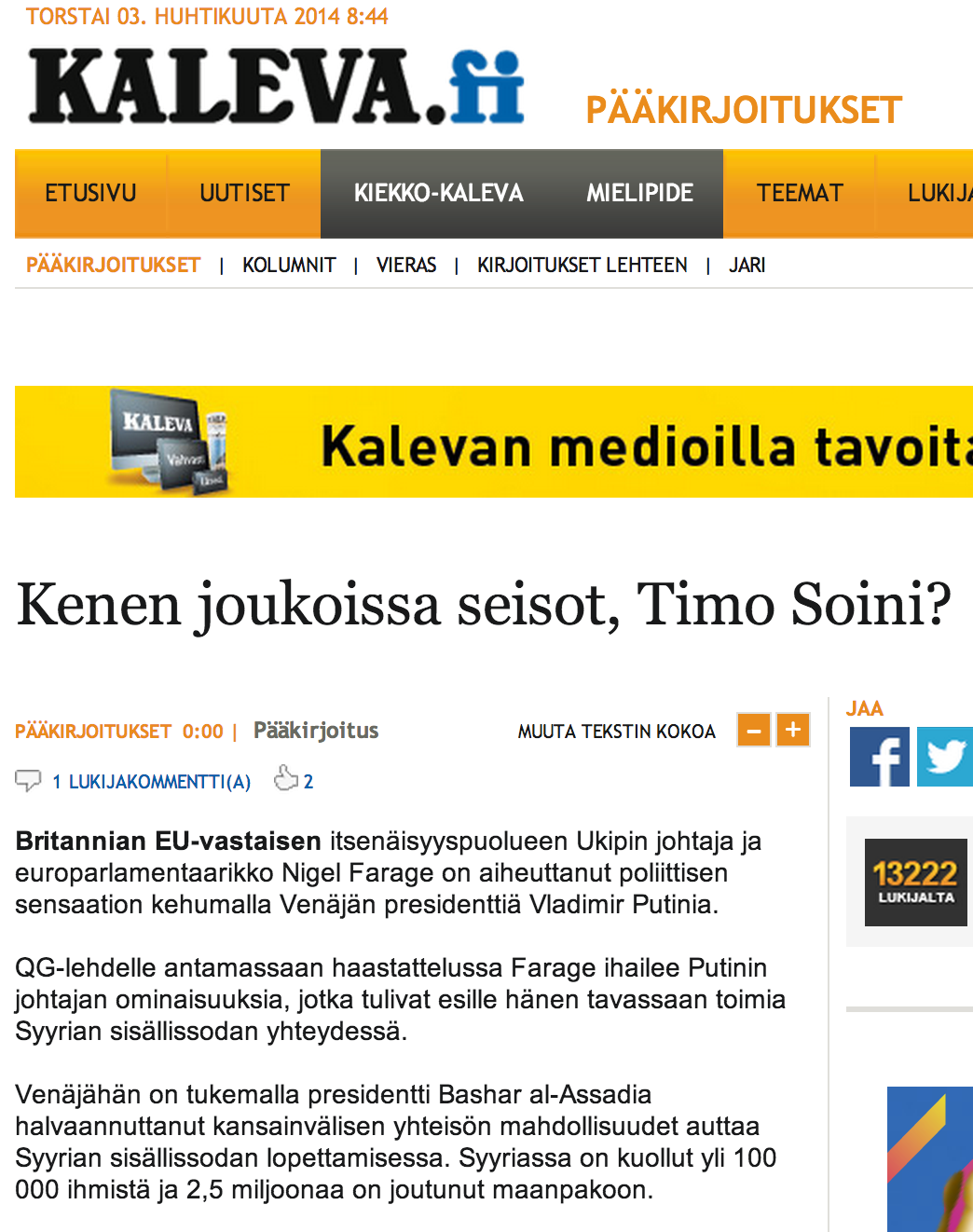
An editorial by Oulu-based Kaleva asks what PS chairman Timo Soini thinks about Farage and that if it wants to be a viable political force in Finland, the PS leader must distance his party and denounce what Ukip’s statements of support for Putin.

Näyttökuva 2014-4-3 kello 11.41.30

Read full story (in Finnish) here.

Such a suggestion by one of Finland’s largest dailies shows more naivety than real understanding of what the PS is and why it is a threat and menace to our democracy and peace.

The PS bases its recent success at the polls on isolationist-nationalism, anti-EU, anti-immigration and especially anti-Islam rhetoric.

Asking such a party to denounce the Ukip, which has become the third-largest political force in the country according to recent polls, would be synonymous to committing political hara-kiri.

Waiting for the PS to “change” into something credible is nothing more than wishful thinking based on self-deceit. It’s this kind of thinking that is already costing our country dearly.

We can do it and send Halla-aho and the PS to where they came from

Posted on February 5, 2014 by Migrant Tales

I still remember April 2011, when the anti-EU, anti-immigration and especially anti-Islam Perussuomalaiset (PS) party opened a gloomy chapter in Finland’s history by getting 39 MPs elected to parliament. The election was impressive to say the least considering that only 5 PS MPs got elected in 2007.

yes we can

Source: www.youthventure.org

While some were surprised by the election result, some played it down. They felt that the PS would blow over and that it’s only a question of time when the party would implode, like the Rural Party of the 1970s, due to internal differences.

While the PS does well in opinion polls, the presidential and municipal elections were a far cry from the historic result that the right-wing populist party gained in the 2011 parliamentary elections.

With two crucial make-or-break elections in May and April 2015, the million-euro question is how well will the PS fare.

Certainly a lot of things can happen from here to May and April of next year, there are signs that the public is getting tired of the PS political scandals and the racism that continues to plague the party.

While there was a definite honeymoon with the PS’ chairman, Timo Soini, the media and public have started to lose interest in the charismatic leader.

And this is quite understandable considering that the PS have not given one credible solution to put the Finnish economy back on a healthy path of growth. It’s MPs are more interested in whining and machismo, which has a heavy dose of intolerance, nationalism and bravado, instead of offering credible solutions.

One of the biggest mistakes that the PS is making at this moment is that it believes its election good fortunes of 2011 are eternal, which reveals why the party has become arrogant and power-hungry.

I believe that we’ll see big surprises in the following MEP and parliamentary elections and that the election of PS MP Jussi Halla-aho is still undecided. Certainly the misfortunes of the PS rest on themselves and how well Finland’s traditional parties can expose Soini’s political antics and double-talk.

Finland took a clear swing to the populist and far-right three years ago. Finnish voters in 2012 gave an inconclusive show of support to the PS in the presidential and municipal elections.

The next two elections will decide whether the PS will be sent or not back to the minor political leagues.


Suomalaisuuden liitto: Seeing Finland through blue eyes

Posted on June 1, 2013 by Migrant Tales

Suomalaisuuden liittto, an association taken over by the Perussuomalaiset (PS) party to lobby against Finland’s ever-growing cultural diversity, condemns in a statement death threats to leading figures of the Finnish Swedish-speaking community.

While it is a good matter that the association’s chairman Sampo Terho condemns such death threats, it is quite another matter if we should take his words seriously. Should Suomalaisuuden liitto take instead a bold look at itself in the mirror and ask if it is somehow responsible for stoking the flames of intolerance against our Swedish-speaking community?

Together with Vapaa kielivalinta and the youth associations of the PS and National Coalition Party, Suomalaisuuden liitto has launched a campaign to demote Finland’s second official language to elective status at schools.

What kind of an association is Suomalaisuuden liitto? How many non-white Finns does it have on its board? None. The association sees Finland exclusively through blue eyes.

6a7ba9498d03b27050e8a3b079aece23

One of the pet issues that the PS like to attack is affirmative action. Why? Because they are colorblind. Source: The Sociological Cinema via Annie Hayford. 

This is not the first time that death threats have been sent in Finland. Feminists, researchers and even Migrant Tales have been intimidated in such a questionable manner. There is a pattern, however: Those that promote or research cultural diversity are likely to get death threats in this country.

It’s clear by the PS’ and Suomalaisuuden liitto’s track record that they’re not too happy about Finland’s every-growing cultural diversity, which they see as a threat. This is one reason why we should treat Terho’s words with tweezers.

Check out how one PS MP played down the death threats while another one, former police chief inspector Tom Packalen, thought it was a bad idea to publish it as news on the country’s largest daily, Helsingin Sanomat, even if one of the daily’s managing editors was threatened.

Here again we see an old stunt by the PS: condemn racism but give it simultaneously a pat on the back.

Attaching little importance to intolerance speaks volumes as well.

Should we be worried by the exclusive white nationalism promoted  by PS-run associations like Suomalaisuuden liitto? Certainly, but time has a magic effect and is ruthless with those who like to remain anchored in its stuffy corridors.

Those that don’t want to accept the fact that Finland never was, is, or will be just a “white” society, will eventually turn into museums where future generations can see with astonishment how some Finns thought about diversity a long, long time ago.


The Finnish media and their PS darling

Posted on December 16, 2012 by Migrant Tales

Did anyone watch Thursday’s Pressiklubi show with Li Andersson of the Left Wing Alliance, Perussuomalaiset (PS) chairman Timo Soini and Helsingin Sanomat politics and business editor, Marko Junkkari? Apart from Soini’s usual political blah-blah (sound colorful but don’t say anything), Junkkari’s comment about how the Finnish media saw the PS as their darling before the 2011 election was quite revealing. 

Kuva 104


View Pressiklubi talk show here.

It’s already known as Junkkari admitted that the media was a major factor that helped the PS rise from being a minor party in Finnish politics to one of the biggest today.

Migrant Tales has asked on a number of occasions how come a populist anti-EU, anti-immigration and especially anti-Islam party could literally sweep the media off its feet?

The only answer I can find to that question is that too much of the Finnish media, which should know better, was dazzled by the PS because too many identified with its insular, racist and ethnocentric message.

Just like all of the major newspapers in the U.S. except for one – New York Review of Books – jumped eagerly on President George W. Bush’s invade-Iraq bandwagon, how much did the Finnish media question the rise of the PS and their anti-EU, anti-immigration and anti-Islam message?

Some editors like Helsingin Sanomat’s Saska Saarikoski went beyond the call of duty by giving PS MP Jussi Halla-aho greater coverage and recognition.  They incorrectly believed that the issue was freedom of expression.

A recent human interest story about Halla-aho and his wife Hilla in Me Naiset is a good example of how some journalists and the Finnish media still don’t get it.

Writes Jos Schuurmans:  “Yet the article doesn’t go into details concerning his political actions or agenda. The closest writer Essi Myllyoja and photographer Milka Alanen come to touching upon his controversial track record is this:

(…) Jussi is a man who evokes emotions – even fears. His radical opinions and provocative blog articles have taken him even to court. But when Kerttu jumps onto Jussi’s lap and drowns her father in kisses, what springs to mind is that there is surely also a softer side to the man. (…)”

One odd argument I have heard on a number of occasions, and which was asked to Soini on Pressiklubi as well, is if it’s a good matter that right-wing extremist politicians like Halla-aho and the likes have found a home in the PS.

In other words, mainstream parties like the PS have become a sort of camp for troubled and dangerous politicians. It’s a good matter that they are members of the PS because we’d be in trouble if they were out on their own.

Naturally, Soini did not answer the question.

As with many television debates about visible minorities, immigrants and immigration, there are only white people who are taking part in the debate, even though Andersson did an excellent job at cutting Soini’s usual baloney into thin slices.


Is the PS expecting a “catastrophic election result?”

Posted on April 25, 2012 by Migrant Tales

By Enrique Tessieri

The scandal ridden Perussuomalaiset (PS) is saving up for a rainy day if the party “suffers a catastrophic  election result,” said PS Foundation chairman, Raimo Vistbacka. YLE’s Ajankohtainen kakkonen revealed that the PS Foundation bought a 1.7-million-euro apartment in one of Helsinki’s most expensive neighborhoods for the party’s headquarters.

“The foundation supports as well district and local party boards,” said Vistbacka, “thus if we suffer a catastrophic election [result] we can continue to be active since the foundation has real estate.”

Another matter that raises questions is that many party members are in the dark about the whole deal and the role of the PS Foundation, which has a five-member board that can make decisions independently.

Taking into account the numerous scandals and polls that have marred the party, veteran PS MP Vistbacka comment raises an interesting question: Is the PS getting ready for a catastrophic election result?

PS chairman Timo Soini said recently that he aims to at least win 1,000 seats in the upcoming municipal election of October 28. The PS won 440 councilpersons in the 2008 municipal election.

At the present rate, such a goal suggested by Soini may be more wishful thinking than anything else.

Anti-immigration groups in Finland plan vicious campaign as the municipal election nears in October

Posted on March 25, 2012 by Migrant Tales

By Enrique Tessieri

As the demonic rumors and stereotypes spread by Finland’s anti-immigration groups lose their appeal among voters, expect a new round of vicious attacks by them as the municipal election nears on October 28. The good news, however, is that using the usual crime statistics and racist arguments that gave some Perussuomalaiset (PS) candidates their ticket to parliament in the April 2011 election will be a hard sell in October. 

One of the main reasons is the PS itself, which has given us a good taste of what kind of a party it is thanks to the numerous scandals that have rocked it. Voters are wiser today about the PS than they were on April 17.

Another important reasons is Anders Breivik, who shocked Norway and the world with his outlandish mass killings on July 22.  All parties in the Nordic region that are anti-EU, anti-immigration and especially anti-Islam suffered as a result significant losses in recent elections and in the polls.

Racism is like an ogre that you cannot control once you let it out of the cage and give it an opportunity to flood society with hate. It can bite back, and hard, as we saw when Breivik went on his mass-killing rampage.

On a much wider scale racism can as well lead to wars and conflicts as it has in the past, according to the U.N.

“Racism and racial discrimination have been used as weapons to engender fear and hatred,” said U.N. Secretary-General Ban Ki-moon in his message marking this year’s International Day for the Elimination of Racial Discrimination. “Racism undermines peace, security, justice and social progress.”

Another reason why extremist and populist anti-immigration politicians will have a difficult time selling their message in the municipal election is because it is utter baloney based on exaggerated fiction. The media, some politicians and the general public have learned after close to one year of watching PS shenanigans in Parliament the distinction between fact and populist fiction.

Jussi K. Niemelä, a writer and editor of the Vallan vahtikoira blog, told Migrant Tales that the PS has the highest number of convicted criminals among their ranks when compared with other political parties. Many of their MPs are members of the far-right Suomen Sisu association.

Niemelä has been threatened by two PS members for his critical stance against the party. The police are presently investigating the matter.

More and more Finns understand racism, like hate, is a serious threat to our society.

Wikileaks document warns of neo-Nazi (far-right) anti-immigration groups in Finland

Posted on February 28, 2012 by Migrant Tales

By Enrique Tessieri

A Wikileaks document reveals a disturbing perception that Migrant Tales has expressed concern in the past: the threat of  far-right anti-immigration groups in Finland like the Finnish Defence League, Suomen Kansalinen Vastarina (SKV) or the Suomen Sisu faction of the Perussuomalaiset (PS) party. In the presidential election, all of the candidates except for PS’ Timo Soini, Sauli Niinstö of Kokoomus and Christian Democrat (KD) hopeful Sari Essayah, stated in an MTV3 poll that the far right does not pose a threat to Finland.

Even if there isn’t a clear distinction made by the authorities on what is far right, neo-Nazi or a Nazi-spirited association, such groups have one matter in common: their loathing for certain immigrant groups like the Muslims. A key term like “mutual acceptance” would be like consuming political cyanide for them.

One of the questions we must ask when speaking of anti-immigration and extremist groups in countries like Finland is who considers them a threat? A white Finn may see them less of a danger than an immigrant, who may be a visible minority.

This compromise made by some Finns, whether a far-right or right-wing populist group is a threat, is the political slippery slope that Finland was on and which permitted the PS to score a historic election victory in April. The reasoning must be something like the following: I can accept, even support a nationalist party like the PS as long as they are hostile to immigrants and minorities but don’t mess with me.

Those who may have played down the PS and especially its Nazi-spirited members  have now seen the consequences of their compromise:  polarization of society, crimes against immigrants and a threat to those very values we consider sacred in our society like social equality for all.

The most recent scandal caused by PS councilman Tommi Rautio is the latest proof of the face of the PS and its far-right faction despite assurances of the contrary by the party.

What we are seeing as well within the PS is an ideological battle for power: On the one side we have the far-right Suomen Sisu faction led by MP Jussi  Halla-aho and others and on the other the Soini populists.

Fortunately Finns do not buy as much as before the anti-EU, anti-immigration and especially anti-Muslim message of the PS as we saw in the presidential election. Even so, the PS is still a major party in Finland despite a sharp fall in popularity.

But bare no mistake: The PS would not only spell disaster for Finland if it ever became the biggest party in the country but would punish harshly  immigrants, their children, Finns with international backgrounds, minorities and sensible Finns.

LiveScience: Low IQ & Conservative Beliefs Linked to Prejudice

Posted on January 30, 2012 by Migrant Tales

Comment: Before you jump to any conclusions, the story does not claim that liberals are smart and conservative-minded people lack intelligence. What the findings of the study claim is that low-intelligence adults tend to gravitate towards conservative ideologies. 

Here is a link to another blog entry in February 2011 that showed a correlation between low self-esteem and racism. 

If there is a link between low IQ and prejudice, what would we call a politician, who appears to have a head on his or her shoulder,  but uses racism to get more votes and popularity?  

“Those ideologies, in turn, stress hierarchy and resistance to change, attitudes that can contribute to prejudice,” lead researcher Gordon Hodson wrote in an email to LiveScience. “Prejudice is extremely complex and multifaceted, making it critical that any factors contributing to bias are uncovered and understood.” 

 Here is an important point that should be highlighted from the story: “People with lower cognitive abilities also had less contact with people of other races [in Europe we call them ethnic groups].”

Finding the causes of racism are important because such a social ill is the cause of a lot of hardship and is one of the main culprits behind most if not all wars. Hodson said that many anti-prejudice programs encourage participants to see the world from another group’s view. 

“That mental exercise may be too taxing for people of low IQ,” he said.

__________________

Stephanie Pappas

There’s no gentle way to put it: People who give in to racism and prejudice may simply be dumb, according to a new study that is bound to stir public controversy. The research finds that children with low intelligence are more likely to hold prejudiced attitudes as adults. 

Read whole story.

Right-wing populist parties want Europeans to live in their news blackout

Posted on July 18, 2011 by Migrant Tales

By Enrique Tessieri

The job of autocratic regimes is still made easy today thanks to faulty technology and infrastructure. If a military regime usurped power from a democratically elected government, it can literally “turn off the lights” and keep the population in a news and information blackout.

While some may claim that this could never happen in Europe, where access to information is supposed to be our inalienable right, news and information blackouts do take place in many parts of the world. Some countries where this occurs are Myanmar, Turkmenistan, North Korea and in remote areas  where basic infrastructure like electricity and telephone services are not available.

Even if we live in Europe in the dead center of the information highway (an old term but still valid), some of us strangely prefer to treat news in the same way as countries like Syria, Cuba, Saudi Arabia or China.

Things have got so bad in these nations that many of their inhabitants have learned to trust those who have placed their civil rights in cold storage and be   highly suspicious of those who are trying to regain them.

Just because we live in Europe and have access to information doesn’t mean that we are not in danger of falling into the same trap as countries like Belarus, China or Vietnam. Wikileaks is a good example that this problem exists in countries that claim to be open and democratic.

But who are these groups in Europe that want to  switch off the information and news lights?

They are none other than right-wing populist parties. We all know their names: Sweden Democrats, Jobbik, Perussuomalaiset, Danish People’s Party, National Front of France, Lega Nord, Slovak National Party, British National Party to name a few.

Certainly switching off the news and information lights would be impossible in Europe in the same way as Cuba. However, there are many ways to skin the news and information cat. On of the most effective ways is with the help of rhetoric, populism and nationalism used by these parties, which are anti-EU, anti-immigration, anti-minority and anti-Islam.

Let’s take for instance the anti-immigration “switch.” If we accept the arguments of these parties who picture immigrants as social-welfare shoppers, rapists, criminals etc, our fear shuts down our reasoning and ability to register news and information that is well-balanced and objective. We end up living in a self-imposed news and information blackout thanks to our fear.

What these right-wing populist parties haven’t told you, however, is that we are the only ones who have the power to turn on or off that crucial switch.

Our civil rights have to be defended everyday.

  • Previous
  • 1
  • 2
  • 3
  • 4
  • 5
  • 6
  • Next
Read more about documentary film
Read more

Recent Posts

  • Finland’s tabloids Iltalehti and Ilta-Sanomat are the pits
  • Riikka Purra’s Dr Jekyll and Mr Hyde mask
  • Double standards
  • Perussuomalaiset: Uusi logo, sama vanha juttu
  • Taco Trump

Recent Comments

  1. Absolutely Socking: Racist Finnish Facebook group against human rights gets flooded with socks on Musta Barbaari’s mother and sister charged by the police in “ethnic profiling” case
  2. Ilkka Nuotio on Pekka Myrskylä: “Tilastot kertovat toista kuin poliittinen keskustelu”
  3. Genrih Soinkara on The war in Ukraine and the Russian-Finnish border crisis are showing Finland’s ugly side
  4. Ahti Tolvanen on Comment by Ahti Tolvanen on the Helsinki +50 conference
  5. Angel Barrientos on Angel Barrientos is one of the kind beacons of Finland’s Chilean community

Archives

  • June 2026
  • May 2026
  • April 2026
  • March 2026
  • February 2026
  • January 2026
  • December 2025
  • November 2025
  • October 2025
  • September 2025
  • August 2025
  • July 2025
  • June 2025
  • May 2025
  • April 2025
  • March 2025
  • February 2025
  • January 2025
  • December 2024
  • November 2024
  • October 2024
  • September 2024
  • August 2024
  • July 2024
  • June 2024
  • May 2024
  • April 2024
  • March 2024
  • February 2024
  • January 2024
  • December 2023
  • November 2023
  • October 2023
  • September 2023
  • August 2023
  • July 2023
  • June 2023
  • May 2023
  • April 2023
  • March 2023
  • February 2023
  • January 2023
  • December 2022
  • November 2022
  • October 2022
  • September 2022
  • August 2022
  • July 2022
  • June 2022
  • May 2022
  • April 2022
  • March 2022
  • February 2022
  • January 2022
  • December 2021
  • November 2021
  • October 2021
  • September 2021
  • August 2021
  • July 2021
  • June 2021
  • May 2021
  • April 2021
  • March 2021
  • February 2021
  • January 2021
  • December 2020
  • November 2020
  • October 2020
  • September 2020
  • August 2020
  • July 2020
  • June 2020
  • May 2020
  • April 2020
  • March 2020
  • February 2020
  • January 2020
  • December 2019
  • November 2019
  • October 2019
  • September 2019
  • August 2019
  • July 2019
  • June 2019
  • May 2019
  • April 2019
  • March 2019
  • February 2019
  • January 2019
  • December 2018
  • November 2018
  • October 2018
  • September 2018
  • August 2018
  • July 2018
  • June 2018
  • May 2018
  • April 2018
  • March 2018
  • February 2018
  • January 2018
  • December 2017
  • November 2017
  • October 2017
  • September 2017
  • August 2017
  • July 2017
  • June 2017
  • May 2017
  • April 2017
  • March 2017
  • February 2017
  • January 2017
  • December 2016
  • November 2016
  • October 2016
  • September 2016
  • August 2016
  • July 2016
  • June 2016
  • May 2016
  • April 2016
  • March 2016
  • February 2016
  • January 2016
  • December 2015
  • November 2015
  • October 2015
  • September 2015
  • August 2015
  • July 2015
  • June 2015
  • May 2015
  • April 2015
  • March 2015
  • February 2015
  • January 2015
  • December 2014
  • November 2014
  • October 2014
  • September 2014
  • August 2014
  • July 2014
  • June 2014
  • May 2014
  • April 2014
  • March 2014
  • February 2014
  • January 2014
  • December 2013
  • November 2013
  • October 2013
  • September 2013
  • August 2013
  • July 2013
  • June 2013
  • May 2013
  • April 2013
  • March 2013
  • February 2013
  • January 2013
  • December 2012
  • November 2012
  • October 2012
  • September 2012
  • August 2012
  • July 2012
  • June 2012
  • May 2012
  • April 2012
  • March 2012
  • February 2012
  • January 2012
  • December 2011
  • November 2011
  • October 2011
  • September 2011
  • August 2011
  • July 2011
  • June 2011
  • May 2011
  • April 2011
  • March 2011
  • February 2011
  • January 2011
  • December 2010
  • November 2010
  • October 2010
  • September 2010
  • August 2010
  • July 2010
  • June 2010
  • May 2010
  • April 2010
  • March 2010
  • February 2010
  • January 2010
  • December 2009
  • November 2009
  • October 2009
  • September 2009
  • August 2009
  • July 2009
  • December 2008
  • November 2008
  • October 2008
  • September 2008
  • August 2008
  • July 2008
  • June 2008
  • May 2008
  • April 2008
  • March 2008
  • February 2008
  • January 2008
  • November 2007
  • October 2007
  • September 2007
  • August 2007
  • July 2007
  • June 2007
  • May 2007

Categories

  • ?? Gia L?c
  • ????? ?????? ????? ???????? ?? ??????
  • ???????
  • @HerraAhmed
  • @mondepasrond
  • @nohatefinland
  • @oula_silver
  • @Varathas
  • A Pakistani family
  • äärioikeisto
  • Abbas Bahmanpour
  • Abdi Muhis
  • Abdirahim Hussein Mohamed
  • Abdirahim Husu Hussein
  • Abdirisak Mahamed
  • About Migrant Tales
  • activism
  • Adam Al-Sawad
  • Adel Abidin
  • Afrofinland
  • Ahmed IJ
  • Ahti Tolvanen
  • Aino Pennanen
  • Aisha Maniar
  • Alan Ali
  • Alan Anstead
  • Alejandro Díaz Ortiz
  • Alekey Bulavsev
  • Aleksander Hemon
  • Aleksanterinliitto
  • Aleksanterinliitto ry
  • Aleksanterinliitto ry:n hallitus
  • Alex Alex
  • Alex Mckie
  • Alexander Nix
  • Alexandra Ayse Albayrak
  • Alexis Neuberg
  • Ali Asaad Hasan Alzuhairi
  • Ali Hossein Mir Ali
  • Ali Rashid
  • Ali Sagal Abdikarim
  • Alina Tsui
  • Aline Müller
  • All categories
  • Aman Heidari
  • Amiirah Salleh-Hoddin & Jana Turk
  • Amin A. Alem
  • Amir Zuhairi
  • Amkelwa Mbekeni
  • Ana María Gutiérrez Sorainen
  • Anachoma
  • Anders Adlecreutz
  • Angeliina Koskinen
  • Anna De Mutiis
  • Anna María Gutiérrez Sorainen
  • Anna-Kaisa Kuusisto ja Jaakko Tuominen
  • Annastiina Kallius
  • Anneli Juise Friman Lindeman
  • Announcement
  • Anonymous
  • Antero Leitzinger
  • anti-black racism
  • Anti-Hate Crime Organisation Finland
  • Anudari Boldbaatar
  • Arshiya Nasser
  • Aspergers Syndrome
  • Asylum Corner
  • Asylum seeker 406
  • Athena Griffin and Joe Feagin
  • Autism
  • Avaaz.org
  • Awale Olad
  • Ayan Said Mohamed
  • AYY
  • Barachiel
  • Bashy Quraishy
  • Beatrice Kabutakapua
  • Beri Jamal
  • Beri Jamal and Enrique Tessieri
  • Bertolt Brecht
  • Boiata
  • Boodi Kabbani
  • Bruno Gronow
  • Carmen Pekkarinen
  • Çelen Oben and Sheila Riikonen
  • Chiara Costa-Virtanen
  • Chiara Costa-Virtanen
  • Chiara Sorbello
  • Christian Thibault
  • Christopher Wylie
  • Clara Dublanc
  • Dana
  • Daniel Malpica
  • Danilo Canguçu
  • David Papineau
  • David Schneider
  • Dexter He
  • Don Flynn
  • Dr Masoud Kamali
  • Dr. Faith Mkwesha
  • Dr. Theodoros Fouskas
  • Edna Chun
  • Eeva Kilpi
  • Emanuela Susheela
  • En castellano
  • ENAR
  • Enrique
  • Enrique Tessieri
  • Enrique Tessieri & Raghad Mchawh
  • Enrique Tessieri & Yahya Rouissi
  • Enrique Tessieri and Muhammed Shire
  • Enrique Tessieri and Sira Moksi
  • Enrique Tessieri and Tom Vandenbosch
  • Enrique Tessieri and Wael Che
  • Enrique Tessieri and Yahya Rouissi
  • Enrique Tessieri and Zimema Mhone
  • Epäluottamusmies
  • EU
  • Europe
  • European Islamophobia Report
  • European Islamophobia Report 2019,
  • European Union
  • Eve Kyntäjä
  • Ezequiel Caldeiro
  • Facebook
  • Fadumo Dayib
  • Faisa Kahiye
  • Farhad Manjoo
  • Fasismi
  • Finland
  • Fizza Qureshi
  • Flyktingar och asyl
  • Foreign Student
  • Fozia Mir-Ali
  • Frances Webber
  • Frida Selim
  • Gareth Rice
  • Ghyslain Vedeaux
  • Global Art Point
  • Great Replacement
  • Habiba Ali
  • Hami Bahadori
  • Hami Bahdori
  • Hamid
  • Hamid Alsaameere
  • Hamid Bahdori
  • Handshake
  • Harmit Athwal
  • Hassan Abdi Ali
  • Hassan Muhumud
  • Heikki Huttunen
  • Heikki Wilenius
  • Helsingin Sanomat
  • Henning van der Hoeven
  • Henrika Mälmsröm
  • Hser Hser
  • Hser Hser ja Mustafa Isman
  • Husein Muhammed
  • Hussain Kazemian
  • Hussain Kazmenian
  • Ibrahim Khan
  • Ida
  • Ignacio Pérez Pérez
  • Iise Ali Hassan
  • Ilari Kaila & Tuomas Kaila
  • Imam Ka
  • inside-an-airport
  • Institute of Race Relations
  • Iraqi asylum seeker
  • IRR European News Team
  • IRR News Team
  • Islamic Society of Norhern FInland
  • Islamic Society of Northern Finland
  • Islamophobia
  • Jacobinmag.com
  • Jallow Momodou
  • Jan Holmberg
  • Jane Elliott
  • Jani Mäkelä
  • Jari Luoto
  • Jari Taponen
  • Jegor Nazarov
  • Jenni Stammeier
  • Jenny Bourne
  • Jessie Daniels
  • Joe Davidow
  • Johannes Koski
  • John D. Foster
  • John Grayson
  • John Marriott
  • Jon Burnett
  • Jorma Härkönen
  • Jos Schuurmans
  • José León Toro Mejías
  • Josue Tumayine
  • Jouni Karnasaari
  • Juan Camilo
  • Jukka Eräkare
  • Julian Abagond
  • Julie Pascoet
  • Jussi Halla-aho
  • Jussi Hallla-aho
  • Jussi Jalonen
  • JusticeDemon
  • Kadar Gelle
  • Kaksoiskansalaisuus
  • Kansainvälinen Mikkeli
  • Kansainvälinen Mikkeli ry
  • Katherine Tonkiss
  • Kati Lepistö
  • Kati van der Hoeven-Lepistö
  • Katie Bell
  • Kättely
  • Kerstin Ögård
  • Keshia Fredua-Mensah & Jamie Schearer
  • Khadidiatou Sylla
  • Khadra Abdirazak Sugulle
  • Kiihotus kansanryhmää vastaan
  • Kirsi Crowley
  • Koko Hubara
  • Kristiina Toivikko
  • Kubra Amini
  • KuRI
  • La Colectiva
  • La incitación al odio
  • Laura Huhtasaari
  • Lauri Finér
  • Leif Hagert
  • Léo Custódio
  • Leo Honka
  • Leontios Christodoulou
  • Lessie Branch
  • Lex Gaudius
  • Leyes de Finlandia
  • Liikkukaa!
  • Linda Hyökki
  • Liz Fekete
  • M. Blanc
  • Maarit Snellman
  • Mahad Sheikh Musse
  • Maija Vilkkumaa
  • Malmin Kebab Pizzeria Port Arthur
  • Marcell Lorincz
  • Mari Aaltola
  • María Paz López
  • Maria Rittis Ikola
  • Maria Tjader
  • Marja-Liisa Tolvanen
  • Mark
  • Markku Heikkinen
  • Marshall Niles
  • Martin Al-Laji
  • Maryan Siyad
  • Matt Carr
  • Mauricio Farah Gebara
  • Media Monitoring Group of Finland
  • Micah J. Christian
  • Michael McEachrane
  • Michele Levoy
  • Michelle Kaila
  • Migrant Tales
  • Migrant Tales Literary
  • Migrantes News
  • Migrants' Rights Network
  • MigriLeaks
  • Mikko Kapanen
  • Miriam Attias and Camila Haavisto
  • Mohamed Adan
  • Mohammad Javid
  • Mohammad M.
  • Monikulttuurisuus
  • Monisha Bhatia and Victoria Canning
  • Mor Ndiaye
  • Muh'ed
  • Muhamed Abdimajed Murshid
  • Muhammed Shire
  • Muhammed Shire and Enrique Tessieri
  • Muhis Azizi
  • Musimenta Dansila
  • Muslimiviha
  • Musulmanes
  • Namir al-Azzawi
  • Natsismi
  • Neurodiversity
  • New Women Connectors
  • Nils Muižnieks
  • No Labels No Walls
  • Noel Dandes
  • Nuor Dawood
  • Omar Khan
  • Otavanmedia
  • Oula Silvennoinen
  • Paco Diop
  • Pakistani family
  • Pentti Stranius
  • Perussuomalaiset
  • perustuslaki
  • Petra Laiti
  • Petri Cederlöf
  • Pia Grochowski
  • Podcast-lukija Bea Bergholm
  • Pohjois – Suomen Islamilainen Yhdyskunta
  • Pohjois Suomen Islamilainen Yhyskunta
  • Polina Kopylova
  • Race Files
  • racism
  • Racism Review
  • Raghad Mchawh
  • Ranska
  • Rashid H. and Migrant Tales
  • Rasismi
  • Raul Perez
  • Rebecka Holm
  • Reem Abu-Hayyeh
  • Refugees
  • Reija Härkönen
  • Remiel
  • Reza Nasri
  • Richard Gresswell
  • Riikka Purra
  • Risto Laakkonen
  • Rita Chahda
  • Ritva Kondi
  • Robito Ibrahim
  • Roble Bashir
  • Rockhaya Sylla
  • Rodolfo Walsh
  • Roger Casale
  • Rostam Atai
  • Roxana Crisólogo Correa
  • Ruth Grove-White
  • Ruth Waweru-Folabit
  • S-worldview
  • Sadio Ali Nuur
  • Sami Rusanen
  • Sandhu Bhamra
  • Sara de Jong
  • Sarah Crowther
  • Sari Alhariri
  • Sarkawt Khalil
  • Sasu
  • Scot Nakagawa
  • Shabana Ahmadzai
  • Shada Islam
  • Sharon Chang blogs
  • Shenita Ann McLean
  • Shirlene Green Newball
  • Sini Savolainen
  • Sira Moksi
  • Sonia K.
  • Sonia Maria Koo
  • Steverp
  • Stop Deportations
  • Suldaan Said Ahmed
  • Suomen mediaseurantakollektiivi
  • Suomen Muslimifoorumi ry
  • Suomen viharikosvastainen yhdistys
  • Suomen viharikosvastainen yhdistys ry
  • Suomi
  • Supermen
  • Susannah
  • Suva
  • Syrjintä
  • Talous
  • Tapio Tuomala
  • Taw Reh
  • Teivo Teivainen
  • The Daily Show
  • The Heino
  • The Supermen
  • Thomas Elfgren
  • Thulfiqar Abdulkarim
  • Tim McGettigan
  • Tino Singh
  • Tito Moustafa Sliem
  • Tobias Hübinette and L. Janelle Dance
  • Transport
  • Trica Danielle Keaton
  • Trilce Garcia
  • Trish Pääkkönen
  • Trish Pääkkönen and Enrique Tessieri
  • Tuulia Reponen
  • Uncategorized
  • UNITED
  • University of Eastern Finland
  • Uyi Osazee
  • Väkivalta
  • Vapaa Liikkuvuus
  • Venla-Sofia Saariaho
  • Vieraskynä
  • W. Che
  • W. Che an Enrique Tessieri
  • Wael Ch.
  • Wan Wei
  • Women for Refugee Women
  • Xaan Kaafi Maxamed Xalane
  • Xassan Kaafi Maxamed Xalane
  • Xassan-Kaafi Mohamed Halane & Enrique Tessieri
  • Yahya Rouissi
  • Yasmin Yusuf
  • Yassen Ghaleb
  • Yle Puhe
  • Yuliet Tresa
  • Yve Shepherd
  • Zahra Khavari
  • Zaker
  • Zalina Ametova
  • Zamzam Ahmed Ali
  • Zeinab Amini ja Soheila Khavari
  • Zimema Mahone and Enrique Tessieri
  • Zimema Mhone
  • Zoila Forss Crespo Moreyra
  • ZT
  • Zulma Sierra
  • Zuzeeko Tegha Abeng
© 2026 Migrant tales | Powered by Minimalist Blog WordPress Theme