
Recent discussions by the Finnish government have raised concerns among human rights groups about the possibility of copying Denmark to carry out random spot checks on people in certain neighborhoods.
If such a measure were ever implemented, it could lead to France’s controversial Article 24 which restricts videoing the police with the intention of “threatening [their] physical or psychological integrity.”
Even if such changes in the law in Finland now seem far-fetched in a country where the police have a good reputation, it is essential to examine what is happening in other European countries where far-right governments have gained power. Some of these include Switzerland, where the Swiss People’s Party is the biggest party, the ruling Brothers of Italy and Lega Nord of Italy, Fidesz of Hungary, the United Right of Poland, Sweden Democrats, and the Perussuomalaiset (PS)* of Finland.
Also, in non-EU countries like Serbia (United Serbia) and North Macedonia (VMRO-DPMNE), there are far-right parties that target migrants and refugees.
Considering that the EU is a region that abides by the European Convention of Human Rights, it is concerning that such parties above target ethnic groups and minorities and want to weaken the civil rights of such people.
One consistent pattern seen in countries where far-right ideologies have gained power is the control and manipulation of narratives to instill fear, racist conspiracy theories, and the perception of dangerous threats by migrants to the native population.
At the core of these ideologies lie xenophobia and ethnic superiority. The far-right presents itself as the savior and protector of the native population, framing every outsider—immigrant, Roma, or anyone deemed different—as an ongoing threat and suspect.
Ethnic Profiling and Suspicion
A common tactic employed by far-right governments is ethnic profiling and the disproportionate targeting of ethnic, religious, and other minority groups by law enforcement agencies. This type of profiling often masquerades as “legitimate” when the police suspect someone of drug possession or gang affiliation.
“Legalized” ethnic profiling is used to justify the increased scrutiny and surveillance of certain communities and ethnic groups even if crime does not have a specific skin color or ethnicity. But when law enforcement focuses its attention on one particular ethnic group, they are more likely to uncover crime, not because of inherent criminality but due to increased scrutiny. It can lead to a vicious cycle, where arrests and convictions are used to justify further restrictions and targeting, perpetuating the belief that these communities are inherently dangerous.
Minister of Interior Mari Rantanen
In an interview with Joona Aaltonen of Helsingin Sanomat, Minister of Interior Mari Rantanen acknowledged concerns about the country’s “growing” youth and gang crime problem. She cited a statement by Jonne Rinne, the chairman of the Association of Police Organizations, who estimated that 95% of street gang members in Finland are of foreign origin on the basis of their names and ethnic backgrounds. Rinne did not care to elaborate if these youths were born in Finland, were Finnish citizens or had a Finnish parent.
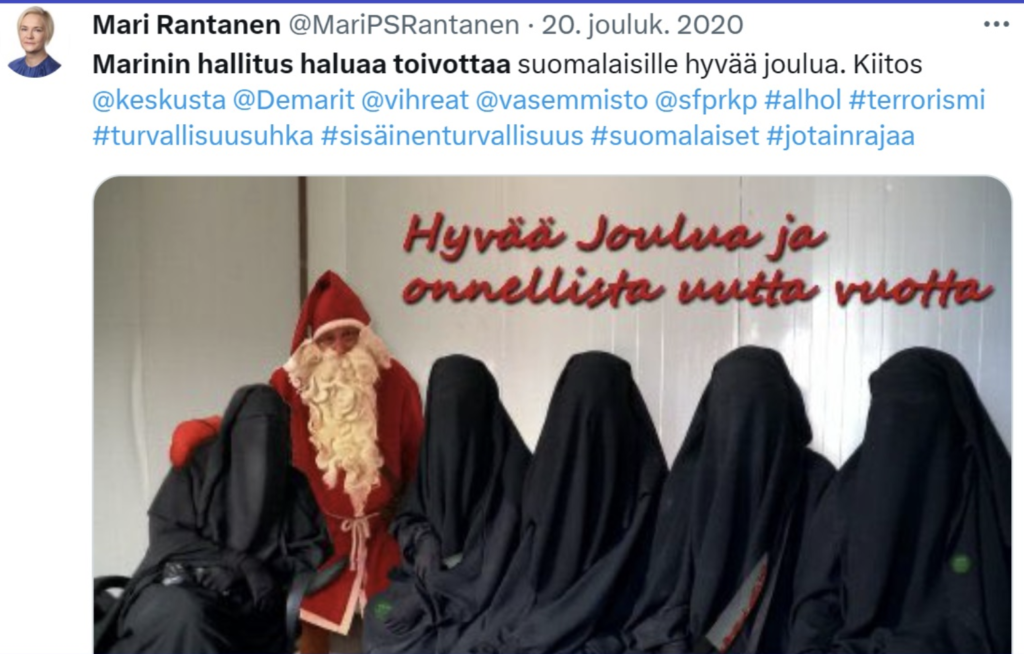
Before Rantanen was minister, she would send Islamophobic messages to then Prime Minister Sanna Marin. “Marin’s government wishes Finns a Merry Christmas,” she wrote. Source: X (formerly Twitter).
Continue reading “Yahya Rouissi: Finnish government’s plans to ethnically profile racialized youths”


