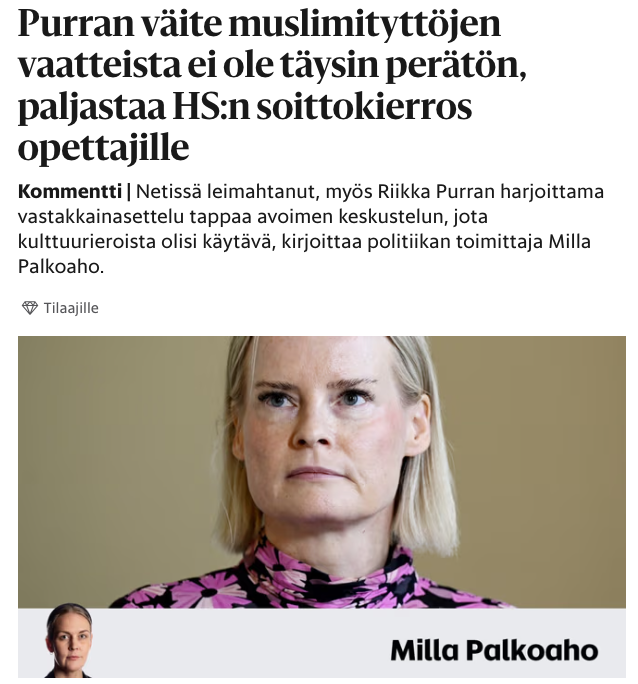
An opinion piece by Milla Palkoaho of Helsingin Sanomat on debating what is culturally acceptable at comprehensive schools. Perussuaomalaiset (PS)* chairperson and finance minister, Riikka Purra, wants to prohibit the veil, niqab, and burka at schools. The writer agrees and states that Purra, who has a long history of making racist comments, has a point.
Does she? If you want to portray yourself as the pro-PS good Samaritan, then she does.
To give more agency to her shoddy opinion piece, Palkoaho asks teachers if they should prohibit, like Purra wants, Muslim attire like the veil, niqab, and burka, which is extremely rare in Finland. So much so that the reporter did not find one example of a pupil wearing the burka.
The opinion piece reveals again the media’s racism problem. With total disregard for cultural diversity and the rights of minorities, it bullies its way with a disingenuous argument: We must debate the matter (even if we, white privilege, will set the tone of the debate).
The nose-dive in support for the PS has forced it to reach out for its political lifebelt: racism.
The truth is that these types of opinion pieces do more harm to the so-called debate the reporter is seeking than good. I would bet my money that she, like the PS, would care less for the wellbeing of Muslims in Finland.
Palkoaho is, however, adamant in her opinion piece: “It is equally relevant to discuss how well a veil that makes it impossible to recognize a person (sic!) or distinguish their facial expressions fits into Finnish culture.”
“Fits” into Finnish culture?!
Here, Palkoaho wants Muslims to whitewash their culture and throw away their constitutional right to religious freedom. I have said it many times: I am Finnish on my terms, and if you can’t take it, that is your problem.
A shameful opinion piece that reminds us that Helsingin Sanomat should know better.
What’s the difference between the attacks against special rapporteurFransesca Albanese, a UN official investigating war crimes and human rights in Gaza and the West Bank, and former Non -Discrimination Ombudsman Kristina Stenman?
True, both are shameful and cowardly abuses of power.
Both Albanese and Stenman are officials who are being attacked by government officials because they are doing their job: The Trump Administration and Israel against Albanese, and Perussuomalaiset (PS)* Justice Minister Leena Meri against Stenman.
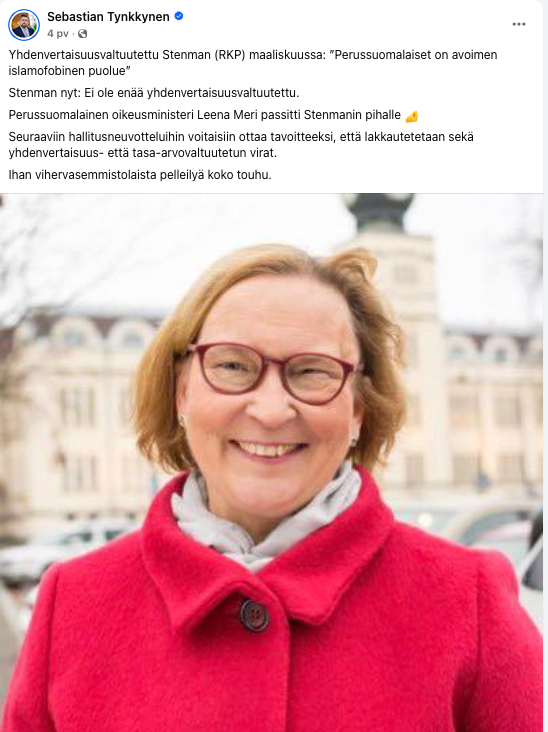
Writes MEP Tynkkynen on Facebook:
“Non-Discrimination Ombudswoman Stenman (RKP) in March: ‘The Finns are an openly Islamophobic party.’ Stenman now: no longer non-discrimination ombudswoman. Stenman is now no longer non-discrimination ombudswoman. The Perussuomalaiset Justice Minister Leena Meri kicked Stenman out 🤌 For the next government negotiations, the goal could be to abolish the posts of both the non-discrimination ombudswoman and the ombudsman for equality. It’s all a bunch of green-leftist buffoonery.”
Writes Migrant Tales:
“Thank you for revealing and reinforcing your usual petty side, Tynkkynen. I agree wholeheartedly with Stenman: the PS is an openly Islamophobic party. In 2027, we aim to clobber your party at the polls, and in the next MEP election in 2029, we will remove you.
Olin hämmästynyt, mutta en yllättynyt Perussuomalaisten puheenjohtajan Riikka Purran avaus- ja loppupuheenvuoroista puoluekokouksessa Lahdessa. Jos hänen puheistaan voi jotain oppia, tärkein oivallus on se, että meidän on kaikin keinoin vältettävä hänen tarjoamaansa reseptiä maahanmuuttopolitiikassa.
Jos me Mikkelissä alkaisimme puhua maahanmuutosta samalla tavalla kuin Purra – ja vieläpä ilman niitä lisäkiristyksiä, joita Teemu Keskisarja ja Simo Grönroos ehdottavat – voisimme silti romuttaa kaupungin veto- ja pitovoiman. Meillä on pieni maahanmuuttajaväestö, mutta sen merkitys Mikkelin elinvoimalle on suuri.
Hyvin toimiva kunta muistuttaa monella tapaa menestyvää yritystä: sen on tarjottava hyviä palveluita ja kohdeltava asukkaitaan kunnioittavasti ja tasavertaisesti. Kun katsomme muita Euroopan maita, kuten Hollantia, jotka ovat meitä pidemmällä maahanmuuttopolitiikassa, huomaamme, että siellä ei enää puhuta kotoutumisesta, vaan osallisuudesta.
Meidän on päästävä eroon “me ja ne” -ajattelusta ja löydettävä toisia sanoja kuvaamaan uusia ja vanhoja asiakkaitamme, jotta he voivat tuntea olonsa tervetulleiksi, yhdenvertaisiksi ja voimaantuneiksi. Itse en pidä sanasta “vieraskielinen”, vaikka sitä käytetään yleisesti. Miksi emme kutsuisi uutta tulijaa mieluummin Uudeksi mikkeliläiseksi? Lakataan myös puhumasta heidän lapsistaan “ulkomaalaistaustaisina” ja lopetetaan rajanveto meidän ja heidän välillä. Keskitytään sen sijaan siihen, mikä meitä yhdistää.
Mikkelin kansainvälistyminen ja uusien asukkaiden houkuttelu ja pitäminen kaupungissa on elintärkeää – se on suorastaan kaupunkimme elämän ja kuoleman kysymys. Toivon, että valtuutettukollegani ymmärtävät tämän, ja uskon, että monet heistä ymmärtääkin.
The non-discrimination ombudswoman, Kristina Stenman, who began her term in August 2020, was not chosen to continue in her post due to pressure from Perussuomalaiset (PS)*, according to reports by Helsingin Sanomat.Upon investigating the changes in the quota refugee system in 2025, which would be manipulated by PS Interior Minister Mari Rantanen’s office to exclude Muslims, Stenman started an investigation that alleged Rantanen wanted changes in the quota-refugee system for this year.
In April, Tuomas Pöysti, chancellor of justice, ruled that Interior Minister Rantanan and her temporary replacement, Minister of Transport and Communication Lulu Ranne, did not act unlawfully. Even so, Pöysti stated that the quota allocation had been poorly handled and that “ministers and aides must ensure that their political guidance does not contain any discriminatory elements.”
Kristina Stenman and Rainer Hiltunen, the former and new non-discrimination ombudsperson. Source: Helsingin Sanomat
Writes Helsingin Sanomat: “According to sources by Helsingin Sanomat, the worsening of relations between the PS and Stenman contributed to Stenman not being granted a further term.”
Matters turned for the worse when, in March, Stenman and unit head Robin Harms said that the PS was “an openly Islamophobic” party. The PS, which is a master player in victimhood, cried foul and slammed the statement as “a shocking attack” on the party.
Having been active in foreigner and minority rights for decades, Stenman grew up in a bilingual family. She studied law as well as Engish and cultural anthropology at the University of Helsinki. She will be missed by many.
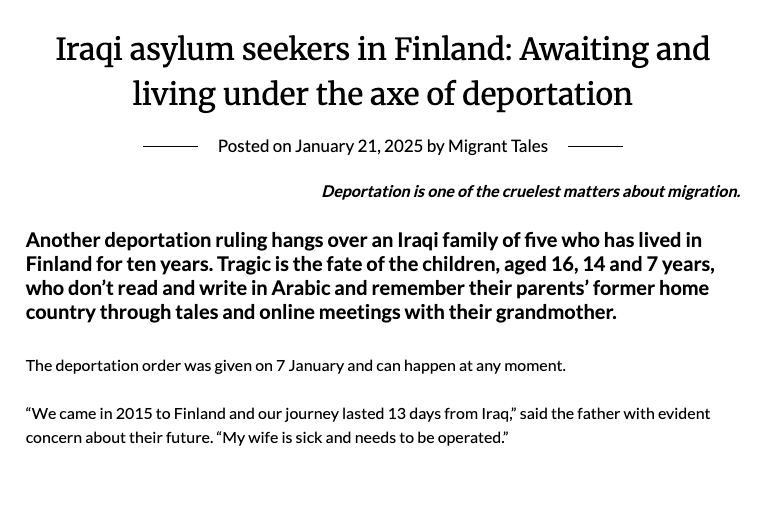
I recieved a phone call on Wednesday: “I have some good news,” I waited with keen anticipation for the next part of her sentence. “We were granted residence permits [by Migri, the Finnish Immigration Service]!”
“That’s great news!” I said.
The date, 25 june 2025, will stand out as one of the most important in the Iraqi family’s lives.
It was only in January that the family had received a deportation order to leave the country.
Their three children are today aged 16, 14 and 7 years.
Should we thank Migri or ask where the family’s cruel ordeal originated? Having arrived in Finland ten years ago, it means that the children were six and four years old when they left Iraq. The youngest was born in Finland.
One of the arguments used by the family against deportation was their children, who had grown up and had a strong bond in Finland, like the languge.
The misfortunes of the Perussuomalaiset (PS)* have been a source of concern from some and happiness for others. After the 2011 general election, when the PS won 39 seats versus five previously, some of us have had to put up with the party’s racism and Finland’s inability and normalization of anti-immigration populism.
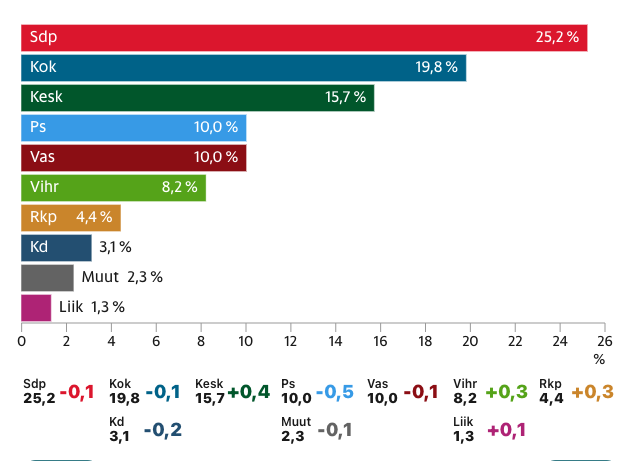
The dire situation of the PS was highlighted again in Helsingin Sanomat’sopinion poll, which showed the party tied with the Left Alliance with 10% and just a heartbeat from entering the single-digit league.
In the 2007 general election, the PS received 4.05% of the votes granting it five MPs compared with three (1.57%) in 2003.
Some of the biggest excuses justifying and normalizing the PS’s entry into the political “big leagues” after 2011 are:
The party will implode like the Rural Party did in the 1970s;
Timo Soini is not a racist;
The PS is not an anti-Muslim party but one against the EU;
Jussi Halla-aho is the “bad” PS and Soini the “good” one;
There are many other excuses to justify the PS ideology and toxic politics.
Do you believe that the PS rating will dip into the single-digit leagues soon? Do you believe that the party’s situation will lead to early elections in the fall?
The Perussuomalaiset (PS)* party congress at Lahti exposed to the tee the far-right and racist beast that has always lurked inside the party. Riikka Purra, who won easy reelection as chairperson, rambled on with typical far-right talking points.
Claiming that white Finnish culture was under attack, she placed the blame on so-called mass immigration from developing countries that places strains on public services and will force the welfare state to collapse.
Purra equating Islam with “cultural intrusion” and how this is destroying the white social fabric of Finland. Oddly, she used the annual World Village Festival in Helsinki as an example of the cultural intrusion, which includes Islamization.
Without mentioning anyone specific, Purra states that “some decision-makers have themselves allowed, themselves demanded, and themselves promoted” the disintegration of Finnish culture.
If there are still any doubts that the PS isn’t a far-right and racist party, Purra’s speech leaves no room for doubt. Not only are her words offensive to migrants and minorities in Finland, but they are also a warning that matters could evolve like in the United States under Donald Trump.
The newly elected leadership of the PS. From left to right: Party secretary Harri Vuorenpää, Simo Grönroos, Teemu Keskisarja, Riikka Purra, and Joakim VIgelius. Source: Suomen Uutiset.
The Finnish parliament passed Wednesday the extension of the pushback law until the end of 2026. The final vote was 168 in favor, 29 against and two absent, according to the Helsinki Times. The passage of the bill means that Finland will continue to flout internationtal law and its commitment to human rights. It will effectively mean that the Finnish-Russian border will remain closed.
Fool me once, shame on you. Fool me twice, shame on me. Fool me three times, shame on both of us.
Stephen King
One matter is a near-sure way of getting support in Finland, and it is the threat of migration. Keijo Korhonen, a Center Party politician, made a name for himself in the 1980s by instilling fear that the fall of the USSR would force thousands of Russians to cross our border en masse.
Xenophobia and racism are potent components of the undercurrent of Finnish politics that has been recently exploited by the far-right Perussuomalaiset (PS)* party. Anti-immigration was such a powerful topic that it handed the PS its historic win in 2011, when it saw the number of MPs rise to 39 from 5 previously.
In every general election after 2011, the PS has capitalized and done well thanks to their pet theme and message: the threat of migration.
On Wednesday, Parliament will vote for a continuation of the pushback law until the end of 2026, which effectively suspends the human right of seeking asylum.
The fear of migration, especially Muslims, is the fuel that the PS and government are using to get the extension of the pushback law across the finish line.
PS Interior Minister Mari Rantanen and the government have defended the law, citing “national security.” They claim that our national security is under threat, but they have not brought any evidence because it is a secret. But here is the question: How can you trust a xenophobic government and politicians who capitalize on racism? It’s like trusting the pyromaniac to put out a fire.
I have called the pushback law a farce and a lie to satisfy the political wet dreams of the PS.
It is shameful that parties like the Social Democrats, who should know better, with the majority supporting the bill that has caused damage to Finland’s international image and made us less secure.
With the next general election on 18 April 2027, some eyes are pointing towards the Perussuomalaiset (PS)*, which suffered a catastrophic municipal and county election. If such misfortunes aren’t enough, recent opinion polls have put the far-right party in fourth place behind the Center Party.
The PS’ fall is significant. The last time the party was at 10% levels in the polls was in January 2019, when it was 9.7%. It is a far cry from its peak of 22.8% in January 2020.
Almost everyone knows that when the PS is facing problems, it turns to its immigration rhetoric. One reason the party has fared so well in the general elections after 2011 is that it has skillfully brought the “migrant threat” to the attention of voters.
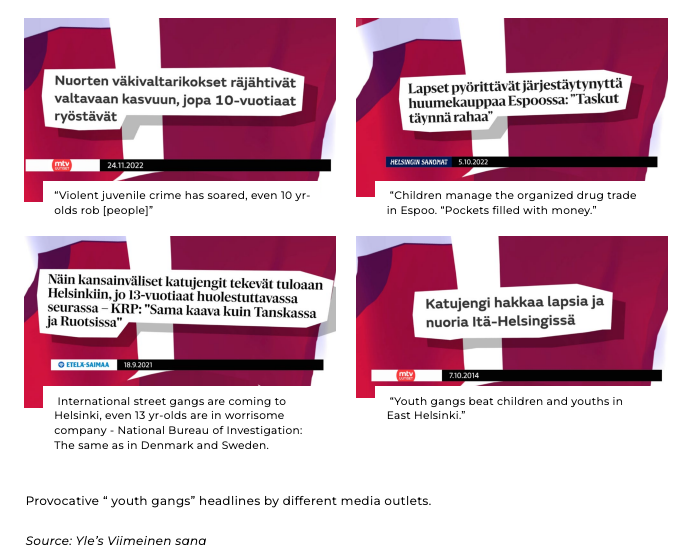
Migrant Tales published in Reilumedia in 2023, highlighted the use of migrant crime by the PS as a ploy to attract voters. We wrote: As the past has demonstrated, the radical-right PS had lured voters through news stories involving migrants and asylum seekers committing crimes in the 2011, 2015, and 2019 parliamentary elections. One of the many big ‘migrant scandals’, the PS wants to exploit for the April election is the threat of ‘youth gangs.'”
Below are some of the lessons learned from the potential youth gang problem that the media, the PS and police exploited for their own aims.
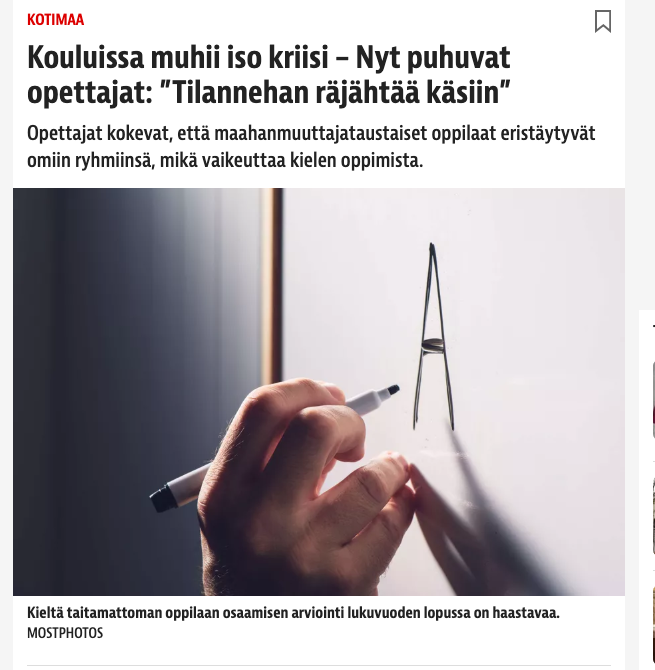
An article in tabloid Iltalehti aims to reinforce readers about why “kids with migrant backgrounds” are a problem, but instead reveals the racist attitudes of the tabloid and of some comprehensive school teachers. I suspect that one of the reasons why Iltalehti uses anonymous sources is because no respecting teacher would go on the record with such claims.
Let’s dissect the article’s most outrageous claims:
The article concerned why brown and black children, specifically Muslims, are marginalized and don’t want to be Finns, which affects their Finnish language-learning abilities. One good start would be to stop labeling them “children with migrant backgrounds.” The label alone excludes.
One reason why kids don’t want to identify as Finns is that they are not even accepted as Finns. As mentioned above, why would some of these kids want to identify with white Finns, which the article labels “ethnic” Finns (kantasuomalainen), if their backgrounds are not taken into account?
What about institutional racism and the xenophobic and bigoted comments by politicians in particular, like the Perussuomalaiset (PS)*, who have made their political message by spreading racism and lies about migrants? Would you want to be part of a society that holds you in contempt?
I have said it before and will say it again: I never want to be a white Finn but a Finn on my terms. The article does not mention how these children could be seen and taught to be Finns on their terms.
The article claims: “Some children with an immigrant background who were born in Finland do not speak Finnish well enough to attend school.” If this is the case, it reveals the failure of the school system and ineffective social policy. Nowhere is it mentioned in the article how we tackle this problem.
Why do three teachers cited in the story speak anonymously? “Paula,” who teaches the Islman religion, claims that some of her students don’t want to be Finns. If “Paula” is a teacher, she should know better the importance of retaining your culture instead of erasing it. Over 1.2 million Finns emigrated from Finland between 1860 and 1999. Even the children of the first generation, still in their fifth generation, continue to see themselves as Finns. Is this strange? No.
“Karla” is another consultant teacher who speaks anonymously in the article. She believes that the best way to solve Finnish-language learning issues is to send such families to the countryside. Apart from being illegal, I’m certain that some teachers feel this is an effective way to teach Finnish.
“Helena” is a Finnish-language teacher who also appears anonymously in the story. She is in favor of limiting the number of non-Finnish-speaking students. There was a big discussion in 2011 about limiting the number of “students with foreign backgrounds” in classes. One of the questions that these polls asked over ten years ago is if public servants like teachers can limit or choose who they’ll teach. Can the police do the same? Is segregating schools by placing caps constitutional?
The Iltalehti article leads: “Kouluissa on suuri kriisi – opettajat puhuvat ääneen: Opettajien mielestä maahanmuuttajataustaiset oppilaat eristäytyvät ryhmiinsä, mikä vaikeuttaa kielen oppimista.”
These types of stories in the Finnish media only serve to reinforce stereotypes and suspicion about migrants.