Despite the fake claims by parties like the Perussuomalaiset (PS)*, Finland has historically done everything possible to halt foreigners from moving to Finland. It was not until 1983, or 65 years that Finland passed its first aliens act.
Restrictions on foreigners and foreign companies were the rule. Did you know that even if women had the right to vote in 1906, they didn’t have the right to pass citizenship to their children until 1984? Only children of Finnish men had such a right.
This intransigence against foreigners can be best seen today through the rise of the radical right PS and the tacit approval of all Finnish parties, especially the National Coalition Party, Center Party, Liike Nyt, and Christian Democratic Party.
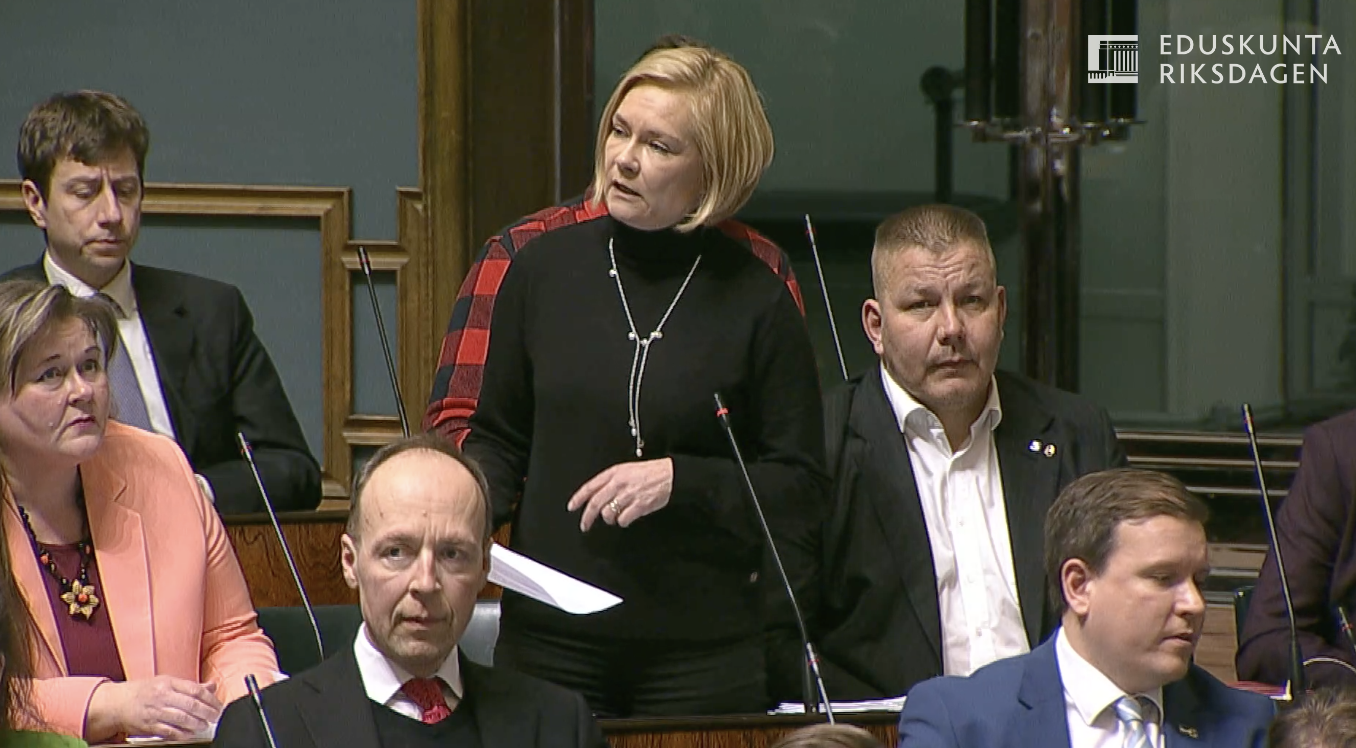
On Thursday’s question-and-answer session of parliament, Perussuomalaiset (PS)* MP Mari Rantanen, who is a former police officer and usually denigrates migrants, claimed that “practically all people from developing countries” that come to Finland pay a threshold fee.
According to a story in Iltalehti, “about 400 people” are “marked or suspected” of involvement in the scheme, according to the Helsinki Police Department.
About 400 people are far from “practically all people from developing countries.”
In 2022, 46,641 Ukrainian were granted temporary protection, and 4,022 sought asylum (excluding Ukrainians), according to the Finnish Immigration Service.
Certainly, Rantanen did no cite the police source, and neither did she elaborate on how she arrived at such an absolute number of people from developing countries.
“According to the police,” she said, “practically all people from developing countries have to pay a threshold fee [to come to Finland], usually to a compatriot already in the country, for a work contract or to come here in general. The average cost of such a residence permit in Finland is €15,000, and there are indications that the threshold money is linked to access to Finnish social security.”
She added by stating that “in one case,” a person paid with the social benefits from Kela, the Social Insurance Institution of Finland. The police told Rantanen that the arrangement is called “Kela money.”
Who knows, it may well be that “practically all people from developing countries” are guilty of involvement in the “Kela money” scheme.
Then again, this may be an over-exaggeration by a politician and party that profits from spreading misinformation and lies about migrants. The best way to find out is to get in touch with the police and ask them directly if they have an official statement about such a scheme.
Living inside an Islamophobic bubble is like pissing in your pants during a freezing day. At first, it may offer relief, but then reality sets in. The PS’ tar-and-feather campaign against migrants and minorities is hitting new lows.
Since the rise of the PS in the major leagues of Finnish politics after 2011, the present parliamentary election in April has a taste of déjà vu.
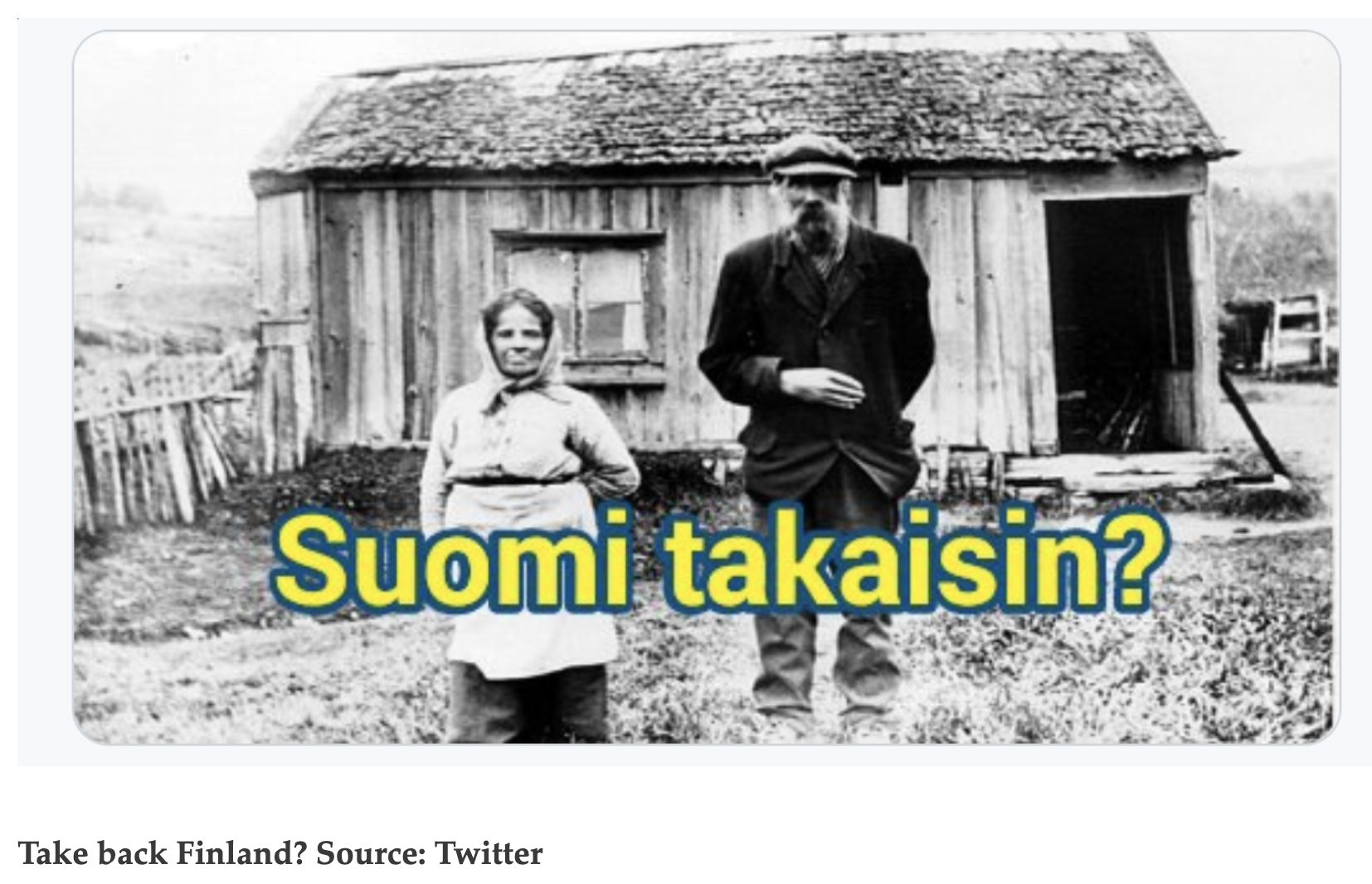
The last municipal election of 2021 disappointed the party after it had generously invested resources in its copy of Brexit’s “Take Finland back” campaign slogan. Opinion polls predicted that the PS would get about 18% of the votes but could only muster 14.5%.
The Perussuomalaiset and the end of the Wicked Witch of the East in the Wizard of Oz. Sources: Facebook and Youtube
The PS’ xenophobia has gained strength as the April parliamentary election nears.
The latest opinion poll published Thursday by Yleshows three important matters: Support for the National Coalition Party (Kokoomus) and Perussuomalaiset (PS)* slip while the Social Democrats regain second place. Another takeaway is the Greens, which took over the Center Party to capture fourth place.
In my opinion, two reasons for the big drop in support for Kokoomus and the PS are Finnish voters’ taste for masochism and radical-right ideology.
Why would I support draconian spending cuts at my expense as a voter? Do I believe that xenophobia will help make such cuts in spending sweeter and more bearable?
Since the rise of the PS in the major leagues of Finnish politics after 2011, the present parliamentary election in April has a taste of déjà vu.
The last municipal election of 2021, was a disappointment for the party after it had invested resources generously in its copy of Brexit’s “Take Finland back” campaign slogan. Opinion polls predicted that the PS would get about 18% of the votes but could only muster 14.5%.
The municipal election of 2021 showed that the PS was too radical for voters. But the PS bubble permits the party to commit the same mistake: Pour on the racism and attack foreigners and minorities with greater gusto. It will help the party win first place in the upcoming election.
There is nothing new in the Perussuomalaiset (PS)* immigration program announced Monday. A surprise for me was that the PS hardline stance means ALL migrants. Previously, I thought the term “migrant” used by the PS was code for Muslims or persons from outside the EU.
If the PS had its way, it would completely overhaul Finland’s immigration policy.
“EUROPEAN DAY AGAINST ISLAMOPHOBIA 2021 (EDAI): European Network Against Racism (ENAR) condemns “woke Islamism” theory as a political weapon to further legitimize the discrimination of Muslims and those perceived as Muslims in Europe.” Source: ENAR
Some takeaways:
Eight years of residence, speaking near-perfect Finnish, and work, before granting a permanent residence permit;
Raise the residence requirement for citizenship to 10 years from five years now;
Tighten further language requirements for the naturalization test;
Only citizens of OECD countries can have dual citizenship;
Exclude foreigners from getting social welfare;
Tighten further already strict family reunification requirements;
Only people within the EU can apply for asylum;
End labor immigration from outside the EU;
Only highly educated people from outside the EU can move to Finland.
As one can see, instigating such an immigration policy proposed by the radical right PS would effectively mean isolating Finland from the world.
The PS’ latest immigration program is nothing more than a copy-and-paste job of Denmark. The party’s ideological love affair with the Danish People’s Party and now its harsh immigration policy is nothing new.
The youth gang “problem” in Finland is a knee-jerk racist reaction.
On and off, we have read about our youth gang “problem” with sensationalist headlines from newspapers that should know better. Remember back in 2014, when radical-right Perussuomalaiset (PS)* MP Tom Packalén created quite a stir when he claimed that a youth gang in East Helsinki was terrorizing people?
Another ludicrous claim by the PS MP is that these youth gang members are the “ripening fruits” of our failed immigration and integration policy.
Then, in 2020, Helsingin Sanomat, Finland’s largest circulating daily, warned its readers: “Over one hundred possibly dangerous youths with migrant backgrounds roam about downtown Helsinki – according to experts, this is a new migrant phenomenon.”
What do Packalén’s claim and Helsingin Sanomat’s story have in common? They are both incomplete and based on personal opinion.
They are a storm in a teacup that aim to instill fear in people who aren’t white.
Helsingin Sanomatstorycorrected its claims about “rising youth street violence,” claiming that these are brown and black Finns, which they marginalize and otherize by labeling them “youths of migrant backgrounds.”
The impact of both claims should not surprise us. What else can you expect if Finns have been taught to believe that minorities are a danger and threat to society?
Having worked as a journalist for over twenty years and poured over scores of stories about “youth gangs” and how the Finnish media frames migrants and minorities, there is one matter that always stands out: Important facts that give context to the story and the lack of minority voices and experts.
You commit or fall into de facto bias when you leave out facts that give important context to understanding a news story. This can be intentional or unintentional.
Why hasn’t the media tried to analyze where Sweden’s gang problem arose? There are many good lessons we could learn in Finland from such investigative journalism.
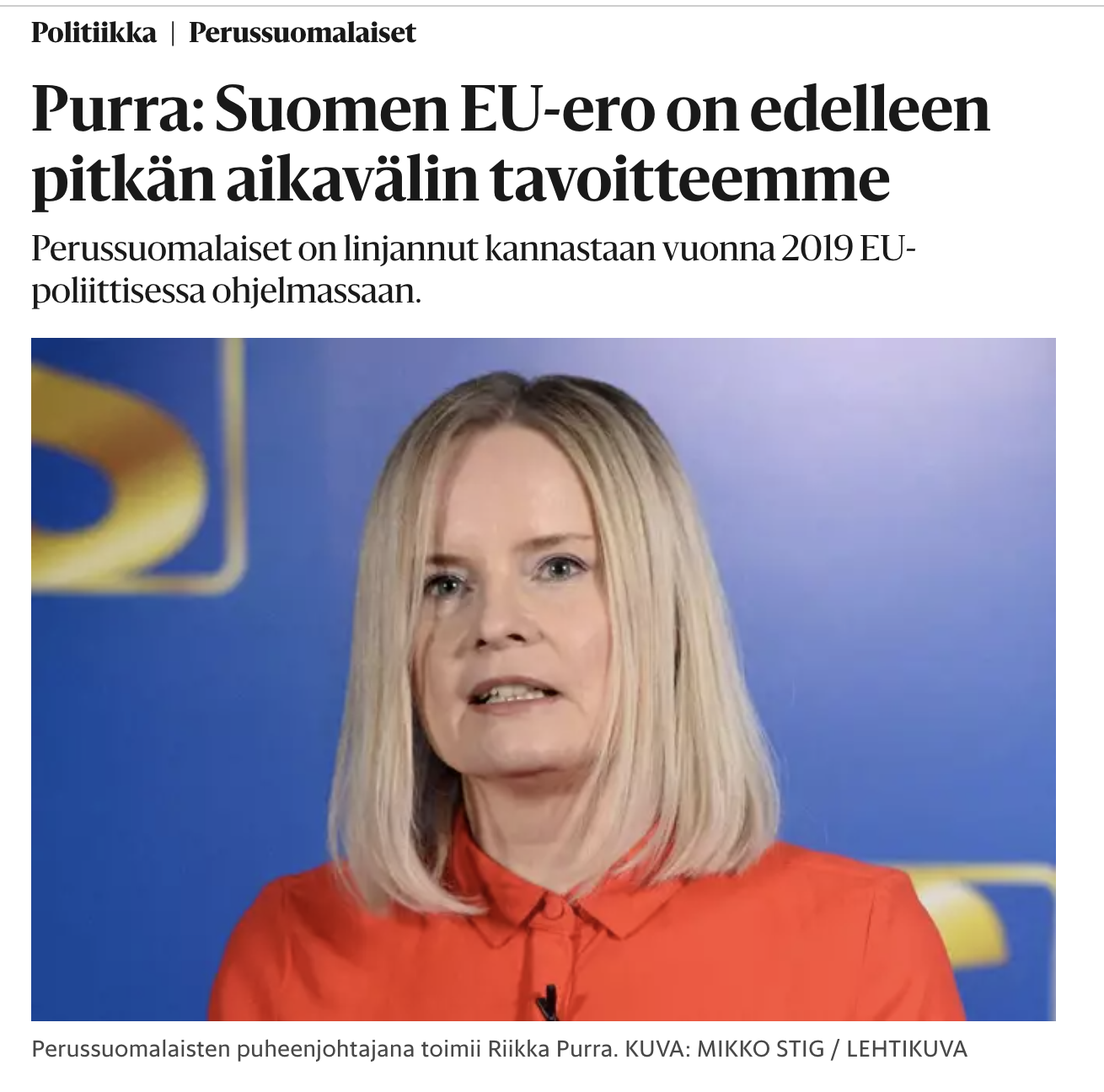
Perussuomalaiset (PS)* chairperson, Riikka Purra, stuck her mouth in her foot at a debate with National Coalition Party (Kokoomus) head Petteri Orpo, when she said that it is still the radical-right party’s long-range aim to leave the EU.
“Finnish citizens are not in favor of leaving the EU,” she was quoted as saying in Helsingin Sanomat. “On the other hand, as we saw with NATO membership, the opinions of the Finnish people sometimes change very quickly. Of course, despite its obvious virtues, we will continue to tell people how much the European Union is costing us.”
In other words, Purra reiterated that the PS’ long-range goal is to leave the EU.
Another “long-range” aim of the PS is to exclude non-Finnish citizens from getting social welfare.
Perussouomalaiset (PS)* head Riikka Purra wasn’t the only one overjoyed by the latestHelsingin Sanomat opinion poll, which showed the radical-right party overtaking the Social Democrats to second place after the National Coalition Party (Kokoomus). Behind Purra was Kokoomus chief Petteri Orpo, gleeing.
Finns will go to the polls on April 4 to elect 200 MPs.
While observers debate the reasons behind the good showing of the PS, we can cite three:
Fear-mongering about minority youths in gangs.
President Sauli Niinistö’s endorsement of that fear.
Kokoomus’ willingness to form a right-wing government with the PS.
Then Interior Minister Petteri Orpo said that Finland will immigration removal centers to deport asylum seekers whose asylum application has been rejected. Source: Yle.
Orpo and former Prime Minister Juho Sipilä rejected the PS in 2017 after the party split in two because the party was led by Jussi Halla-aho, who was convicted in 2012 for ethnic agitation and for breaching the sanctity of religion.
Sipilä’s government didn’t need the PS since the newly formed faction, Blue Reform, was there to offer its support to keep the government intact.
I am worried about the amnesia of political parties like Kokoomus, the media, and many politicians who don’t see racism as a problem. One good example is Purra’s promotion of ethnonationalist ideology by suggesting that Finland should exclude foreigners from getting social welfare. Not one newspaper in Finland, never mind a single politician, denounced what she said.
Those who are worried about the blow to the credibility of the security guards due to several scandals that even led to the death of a woman in Espoo are quick to point out one should not jump to conclusions and label all security guards and the sector.
True, we should always be careful not to generalize.
There is, however, something wrong with that defense. The same people who are saying that we must not generalize are the ones who constantly generalize about migrants.
President Sauli Niinistö, who is no friend of Finland’s culturally diverse communities, added more feathers to tarred minority youths in the ongoing debate on youth crime. Source: Yle
Downplaying the problem is also an important part of the narrative about white crime versus crime committed by minorities.
Politicians like Prime Minister Sanna Marin have offered long-overdue leadership when challenging racism in Finnish politics by stating what many know: The Perussuomalaiset (PS)* is a racist party.
“Looking at the speeches of individual [PS] MPs, these speeches have been racist and genuinely hostile to certain minorities,” said Marin in a debate with Petteri Orpo, the chairperson of the National Coalition Party (Kokoomus). “There is no denying this; it is a fact. I don’t understand why we politicians should smile and pretend that these speeches are not real.”
Two PS MPs, Vilhelm Junnil and Veikko Vallin, showing off their MAGA caps by former President Urho Kekkonen’s bust. Does a “normal” party cack President Donald Trump after all the revelations of financial crimes and coup plotting? Source: Facebook
Finnish politicians need to be faster to react to the rise of the PS. In the 2011 parliamentary election, when it won 39 seats from 5 seats previously, Finnish political parties like the Social Democrats wanted to capitalize politically on anti-immigration sentiment.